

If you are an adult Gen Z or Millennial Californian in your twenties, thirties, or early-to-mid forties and you are trying to decide whether 2027 is your year to move, this article is for you. The bottom line is simple: for adult Gen Z and Millennials who are trying to buy a home, build financial breathing room, or create more space for the next stage of life, Texas presents an unusually strong case. No state personal income tax, housing you can actually afford, land at prices that stopped existing in California decades ago, state programs that put cash toward your down payment, and a San Antonio/Hill Country economy and school landscape that are worth evaluating on current, address-specific data rather than reputation alone. None of them depends on catching a lucky market moment [1][9][41].
Why does 2027 matter specifically? Three facts line up. First, the $140,000 school-district residence homestead exemption that Texas voters approved in November 2025 is now permanent law: it took effect with the 2025 tax year and applies every year after to anyone who owns and occupies a Texas home as a homestead, so the property tax math you run today already includes it [6][7]. Second, Texas keeps adding more residents than any other state, about 391,000 between July 2024 and July 2025, while California was one of only five states to lose population. That continuing population growth is evidence of sustained demand for Texas communities, although employment conditions and housing-market liquidity still need to be evaluated locally [41]. Third, the price gap is not closing: California's statewide median for an existing single-family home was about $901,000 in August 2026, while the San Antonio metro median sits at roughly a third of that [9][13]. None of these depends on waiting for a better year.
The numbers below use two composite characters so the math is concrete, not abstract. Maya, 31, is a product manager in Sacramento earning $120,000. Josh, 27, is a graphic designer in San Diego earning $80,000. Neither is a real person; they are bundles of patterns from real moves, and they exist only to put faces on the arithmetic. All ten reasons are discussed in full, with the tables where the data earns one, and every sourced claim carries a bracketed number matching the source list at the end of the article. Sources were verified on September 27, 2026.
No state income tax
What the savings actually are at common California salaries, in a table you can verify.
Housing you can afford
California prices and per-square-foot costs versus the San Antonio metro and the Hill Country, with the honest Texas property tax offset.
Land and acreage
Suburban lots up to ranch-scale parcels in Kendall, Comal, and Bandera counties, and what an acre actually costs.
Buying programs and down payment help
TSAHC Homes for Texas Heroes, the mortgage credit certificate, and Veterans Land Board loans: who qualifies, current limits, and where to apply.
Jobs, remote work, and your tax position
How a California remote employee who establishes Texas residency ends up with no state income tax, and what residency actually requires.
Cost of living beyond housing
Utilities, fuel, groceries, insurance, and the straight talk about Texas heat and the electric grid.
Schools for the family you are planning
Boerne ISD, Comal ISD, and Northside ISD ratings and what they mean at your exact address.
Quality of life and space
The outdoors, the change of pace in Boerne and Comfort, and what the space does for how you live.
Wealth building
How no income tax and the homestead exemption compound for owners in the current Texas market.
Logistics that make the move work
Airports, Central Time, the Texas Triangle, and a realistic move-year mindset.
1. No State Personal Income Tax: the Savings at Your Salary
Texas does not tax wages, salaries, or other personal income at the state level [1]. That is a constitutional and statutory fact, not a promotion, and it has been true for decades. California taxes individual income on a nine-bracket schedule that reaches 9.3% at roughly $72,700 of taxable income for a single filer, keeps climbing to 12.3% above about $743,000, and adds a 1% surcharge above $1 million, for a top combined rate of 13.3% [2]. Almost no working Californian ever reaches the top rate, but most salaried professionals land squarely in the middle of the schedule: many California professionals with six-figure incomes reach the 9.3% marginal bracket.
Here is the honest version of the comparison. California's median household income was about $100,100 in 2024, versus about $79,700 in Texas [5]. California households earn more on paper, and California taxes more of what they earn. The tax saving is a real annual number, and the difference reduces annual state income-tax liability, subject to each taxpayer's deductions, credits, filing status, and other income. What you give up is the public services California income tax pays for, which is why the serious version of this decision is a lifetime budget, not a rate table.
The practical test for Maya: at $120,000 in Sacramento, her 2025 California state income tax, estimated on the official bracket schedule with the $5,706 single standard deduction and the $153 personal exemption credit, comes to roughly $6,915 [2]. In Texas that line is $0 [1]. She keeps nearly $7,000 a year that California would have taken, before she has changed a single other thing about her spending. Josh at $80,000 keeps roughly $3,195 a year [2].
Estimated California state income tax, single filer, 2025 brackets with standard deduction
| Salary | Estimated California state income tax | Texas state income tax | Kept by moving |
|---|---|---|---|
| $80,000 | ~$3,195 | $0 | ~$3,195 a year |
| $100,000 | ~$5,055 | $0 | ~$5,055 a year |
| $120,000 | ~$6,915 | $0 | ~$6,915 a year |
| $150,000 | ~$9,705 | $0 | ~$9,705 a year |
| $200,000 | ~$14,355 | $0 | ~$14,355 a year |
Estimates computed from the official 2025 single-filer bracket schedule, the 2025 single standard deduction of $5,706, and the $153 personal exemption credit [2]. Your number depends on credits, adjustments, and filing status; married filers pay less at the same household income because the low brackets roughly double. This is educational math, not tax advice.
Two practical notes. First, the saving grows with income, because every dollar Maya earns above $72,724 of taxable income is taxed at 9.3% in California and 0% in Texas [2]. Second, moving from California does not make you tax-free: federal income tax still applies to work done in Texas, Texas sales tax runs 6.25% statewide plus local additions, and local property taxes fund the schools and services [1][6]. For the full framework, the site's income tax arbitrage analysis walks the annual budget line by line.
One more California line disappears with the move: State Disability Insurance. California withholds SDI at 1.3% of all wages in 2026, with no wage cap, so Maya pays about $1,560 on top of her income tax, and Josh about $1,040; Texas has no state disability payroll tax [48]. For Maya, the modeled difference consists of approximately $6,915 in California personal income tax plus approximately $1,560 in California SDI withholding at the 2026 rate. Those are different programs and should be shown separately. That comparison is not entirely one-sided: California SDI finances Disability Insurance and Paid Family Leave benefits, so moving removes the payroll deduction but also removes access to those California programs once eligibility ends.
2. Housing Affordability: the Price Gap, With the Texas Property Tax Truth Told
This is the reason most Gen Z and Millennial moves actually start. The California Association of Realtors put the August 2026 median price of an existing single-family home at about $1,875,000 in San Francisco County, about $947,000 in Los Angeles County, and about $549,000 in Sacramento County, with the statewide median at about $901,000 [13]. On the Texas side, the city of San Antonio sat around $255,000 to $265,000 at the median in 2026, and the full San Antonio-New Braunfels metro, which adds the suburbs and New Braunfels, ran around $300,000 to $320,000 [9][10]. San Antonio-New Braunfels metro listings were running around $170 per square foot, while C.A.R. reported roughly $428 per square foot for California existing single-family-home sales statewide [13][43]. Because one is a listing measure and the other a sales measure, treat the comparison as directional rather than perfectly apples-to-apples. Sacramento County, the most affordable of the three California examples, still runs about $327 per square foot, nearly double the San Antonio figure [42].
The Hill Country is more expensive than San Antonio proper. Redfin reported Kendall County, which contains Boerne, at a median sale price of about $618,000 and about $233 per square foot for the three months ending August 2026, while Boerne itself was about $505,000 and $215 per square foot over the same three-month period [11][12]. That is the honest range: Texas is not uniformly cheap, the Hill Country is the premium tier, and the premium still buys a newer, larger home on land than the same money buys almost anywhere in urban California [11][12][13].
Now the part nobody on the relocation side wants to lead with, and every honest guide has to: Texas property taxes are not low. There is no state property tax; local taxing units, meaning the school district, county, city, and special districts, set their own rates [8]. By late September 2026, several local taxing units had adopted their 2026 rates. For a property inside the City of Boerne that is also in Boerne ISD and Kendall County, the three principal 2026 adopted rates total approximately $1.8585 per $100 of taxable value before any property-specific special-district taxes and before exemptions [14]. San Antonio, Comal County, and other Hill Country properties require the same address-by-address calculation because their taxing-unit combinations differ: the City of San Antonio adopted its 2026 tax-year/FY2027 rate of $0.56288 per $100 on September 17, 2026, Bexar County's combined 2026 rate is $0.299999 per $100 (adopted September 15, 2026), and Comal County adopted its 2026 county rate of $0.305015 per $100 on September 17, 2026 [15][16]. A complete figure for a specific property depends on the school-district and special-district rates attached to that parcel, so verify every taxing unit before combining rates into a total.
The counterweight is the exemption stack. Texas homeowners who occupy their home as a residence homestead take the $140,000 school-district residence homestead exemption off the home's appraised value for school taxes, up from $100,000, after Texas voters approved the increase in November 2025; it applies starting with the 2025 tax year [6][7]. Counties and cities commonly add their own exemptions. For a homeowner who qualifies for the residence-homestead limitation in both the preceding and current year, Texas generally limits the annual increase in the home's appraised value to the lesser of market value or the prior year's appraised value plus 10%, plus the market value of qualifying new improvements. This limits appraised-value growth; it does not guarantee that the total property-tax bill itself cannot rise by more than 10% [6][8]. A $400,000 home in Boerne carries a very different tax bill after the exemptions than the raw rate suggests, and the property tax shock or relief guide shows the exact math for Kendall, Bexar, and Comal counties.
Do not stop at the county, city and school-district rates. Depending on the address, a buyer may also encounter emergency-services districts, utility or water districts, public-improvement-district assessments, municipal utility districts, HOA dues, or other property-specific charges. Pull the actual tax entities and assessments for the parcel before comparing monthly ownership costs. In the communities this guide covers, municipal utility districts and public-improvement-district assessments are present in some developments but are far from universal, so whether any of them applies to a particular address is decided by the parcel's actual taxing entities and recorded charges, not by the town's name [8].
Median prices and price per square foot, compared
| Market | Median price (recent) | Price per square foot |
|---|---|---|
| California statewide | ~$901,000 (Aug 2026) [13] | ~$428 [13] |
| San Francisco County, CA | ~$1,875,000 (Aug 2026) [13] | — |
| Los Angeles County, CA | ~$947,000 (Aug 2026) [13] | — |
| Sacramento County, CA | ~$549,000 (Aug 2026) [13] | ~$327 [42] |
| San Antonio city, TX | ~$255,000 to $265,000 [10] | ~$150 to $160 [10] |
| San Antonio-New Braunfels metro, TX | ~$300,000 to $320,000 [9] | ~$170 (listings) [43] |
| Boerne, TX (Kendall County) | ~$505,000 [12] | ~$215 [12] |
| Kendall County, TX overall | ~$618,000 (3 months ending Aug. 2026) [11] | ~$233 [11] |
Sources differ by measurement window and by whether they count city, county, or metro; read the range cells as ranges [9][10][11][12][13][42][43]. California medians are C.A.R.'s August 2026 figures for existing single-family homes, taken directly from C.A.R.'s release [13]. C.A.R. publishes price per square foot statewide only, so the San Francisco and Los Angeles cells are left blank rather than filled from a different source.
Compare payment, not just price
The price gap is real, but the honest comparison is the monthly payment at the same loan assumptions. When you compare a California listing and a Texas property, run both through the same columns:
- Principal and interest at the same loan assumptions
- School, city, county and special-district property taxes after applicable exemptions
- Homeowners insurance
- Flood insurance if applicable
- HOA, PID or MUD and other assessments where applicable
- Expected maintenance
- Utilities
- Commuting costs
A home price is only one line of that list, and comparing purchase prices alone makes the gap look larger than the budget difference it creates.
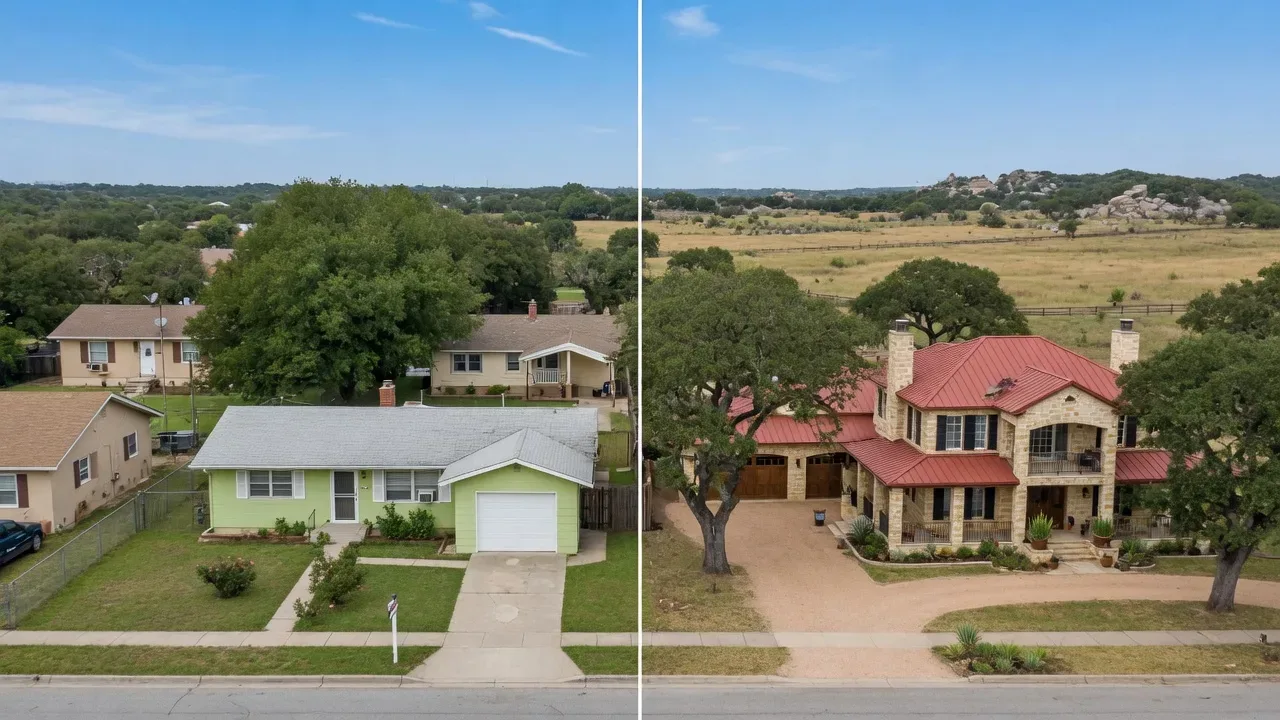
The same budget buys a different house in California and Texas. The budget comparison guide shows what $600K, $800K, and $1.2M actually buy in each market.
A fair one-sentence verdict: a median-priced home in the San Antonio metro costs a fraction of a median-priced home in California, the Hill Country carries a measurable premium over San Antonio proper, and whether that premium is justified depends on the buyer's priorities for lot size, community, commute, schools, and housing stock, and Texas property taxes mean the ongoing cost is not free. Model both columns with your actual tax rate and your actual purchase price rather than a percentage rule of thumb [9][14][15][16].
Should you rent first?
For a buyer who does not yet know Boerne, Fair Oaks Ranch, northwest San Antonio, New Braunfels or the surrounding rural areas, a six- or twelve-month rental can be rational even when buying is the long-term goal. It provides time to learn commute patterns, summer utility costs, school geography, traffic, flood exposure and neighborhood differences before committing to a purchase. The downside is an additional move and the possibility that rates or prices change while you wait.
3. Land and Acreage for the Same Money
The thing that shocks California buyers more than any price tag is the land under the house. In many expensive California markets, buyers at ordinary professional-income budgets are choosing among condos, townhomes, smaller urban lots, or substantial price premiums for additional land. The Hill Country broadens the range of lot sizes available at comparable purchase budgets. Across Fair Oaks Ranch, Boerne, and the surrounding unincorporated Hill Country, buyers can find everything from conventional subdivision lots to half-acre, one-acre, and larger acreage properties; price varies sharply with location, improvements, utilities, views, and restrictions. This is not a lifestyle upgrade; it is a change in what property means [17][18][19].
Available county land datasets are not directly apples-to-apples. Acres currently reports a median of about $32,870 per acre across 45 recorded sold-land observations in Kendall County. Land.com, by contrast, reports a current median asking price of about $56,200 per acre for its Comal County listing inventory [17][18]. The difference should not be interpreted as proof that otherwise comparable Comal land sells for roughly 70% more than Kendall land, because one measure is based on recorded sales and the other on asking prices. Selected large-ranch listings in Bandera County can show asking prices in the roughly $6,000-to-$21,000-per-acre range, while Land.com's broader current inventory reports a substantially higher countywide median asking price per acre, about $27,379, with a median lot size of 24.9 acres and a median list price of about $864,500 [19]. Parcel size, improvements, water, access, and location make simple county averages especially unreliable for land.
What the land does for a 30-something's life is concrete. You can size the lot for the life you want now: a shop, a garden, a dog run, room for a pool and a guest casita, none of which requires a second purchase. On acreage, the honest costs follow the land: a private well and a septic system, which the water and infrastructure guide and the well water guide cover in the detail a first-time rural buyer needs, plus propane and driveway maintenance in the farther tracts.
For a buyer like Josh, the practical advantage is that the Hill Country offers substantially more acreage options within a professional-income household's budget than the California markets used in this comparison. A $200,000 land budget, which will not buy a buildable lot in most of coastal California, buys roughly six acres at the Kendall County median and considerably more in Bandera County, depending on water, access, and improvements [17][19]. Keep the septic, well, and utility connection costs inside the same budget line, and the total can still be workable, but only after well, septic, road, utility-extension, site-work, and financing costs are included. Before valuing acreage solely by price per acre, verify deed restrictions, easements, legal access, well availability and production, septic feasibility, utility-extension costs, floodplain, topography, agricultural valuation status where applicable, and whether the tract can actually support the buyer's intended improvements.
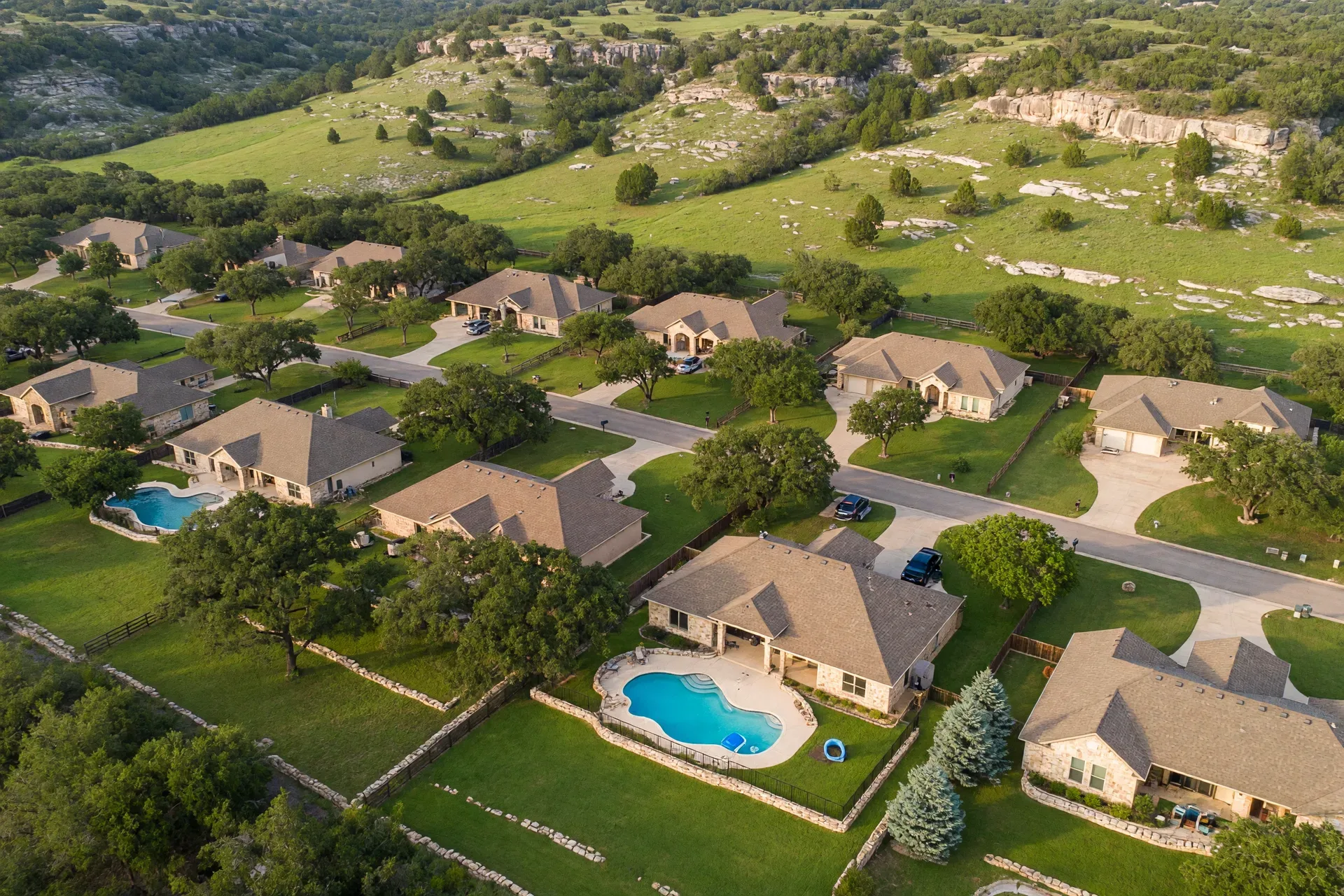
One distinction of the Hill Country is the availability of larger-lot and acreage communities alongside conventional subdivisions. Buyers who specifically want half-acre, one-acre, or larger properties have considerably more options than they may be accustomed to in high-cost California markets. The Fair Oaks Ranch community guide shows the acreage-living side of this market.
4. Buying Programs and Down Payment Assistance: TSAHC, the MCC, and VLB
Program status checked September 27, 2026. Rates, income limits, purchase price limits, and funding availability change. TSAHC's income and purchase price limit table in effect as of September 27, 2026 is the edition effective June 13, 2026 [22]; program mortgage rates are set on TSAHC's daily rate sheet [23].
Texas runs state programs that put real cash into a first home purchase, and most California buyers have never heard of them. The most useful is Homes for Texas Heroes, run by the Texas State Affordable Housing Corporation (TSAHC), a nonprofit created by the Texas Legislature. It targets public-service buyers: full-time public school teachers, teacher aides, librarians, counselors, and school nurses; peace officers, county jailers, correctional and juvenile correctional officers, and public security officers; firefighters and EMS personnel; full-time nursing and allied health faculty; and veterans and active-duty military who meet the program's definitions [20]. Maya, as a product manager, does not qualify by profession, but a public school teacher, police officer, firefighter, or paramedic in their twenties may qualify by profession, subject to TSAHC's current income, credit, loan, occupancy, purchase-price, and other program requirements. A hospital nurse generally does not, because the nursing category covers nursing faculty, not bedside nurses [20]. Veterans relocating from California should read the fine print: the program's veteran definition requires Texas residency at the time of application and either Texas residency at enlistment or at least one year of Texas residency before applying [20]. Buyers outside the hero professions should ask a TSAHC lender about the Home Sweet Texas program, which is based on income rather than profession [20].
The headline numbers, current as of this writing: income limits run up to 170% of area median family income, with dollar amounts set by county and household size in TSAHC's table effective June 13, 2026 [21][22]. The down payment assistance runs up to 5% of the loan amount, available either as a grant that never has to be repaid or as a forgivable second lien that is fully forgiven after three years, as long as you do not sell, refinance, or move out during that time [20]. TSAHC also sets minimum credit scores of 620 for government loans and 640 for conventional loans [20]. Repeat buyers are allowed for the down payment assistance, which matters to a 35-year-old who owned a condo in California [20]. Purchase price limits are set per county in the same June 13, 2026 table [22].
The mortgage credit certificate, or MCC, is the second component, and for a first-time buyer it can matter more than the down payment help. The MCC is a federal income tax credit equal to 15% of the mortgage interest you pay each year, a dollar-for-dollar reduction in federal tax owed, and TSAHC offers it alongside its down payment assistance [20][24]. The MCC generally carries a first-time-home-buyer requirement, meaning the buyer ordinarily cannot have owned an interest in a principal residence during the preceding three years. TSAHC waives that requirement for qualified veterans and for qualifying homes purchased in designated targeted areas [20][24]. A Texas Hero who combines TSAHC down payment assistance with an MCC has the MCC fee waived, about a $400 saving [20][24]. The income ceiling for the MCC is tighter: 100% of area median family income for households of two or fewer and 115% for households of three or more, under TSAHC's September 15, 2026 notice for the 2026 MCC program [25]. The full step-by-step application sequence is on the site's TSAHC grant guidance page, and the same TSAHC programs, plus USDA, FHA, and conventional options, are compared in the first-time buyer programs guide.
A worked example makes the credit concrete. On a $332,500 mortgage at 7% for 30 years, first-year mortgage interest of approximately $23,200 would generate an MCC credit of approximately $3,480 at TSAHC's current 15% credit rate, subject to the borrower's federal tax liability and program rules. Compared with the selected down payment assistance, which is capped at about $16,625 on this loan (5% of $332,500) and given once at closing, the MCC credit of roughly $3,480 in year one and approximately $32,700 cumulatively over the first ten years is the larger long-term line for a borrower who owes federal tax each year to offset. The two benefits serve different purposes, closing cash versus annual federal tax relief, so a first-time buyer who qualifies for both should model both rather than assume one benefit is automatically the better one [13][20][24][25]. This example assumes a $350,000 purchase with 5% down and a 30-year fixed rate of 7%, consistent with the rate environment this article cites for the second week of September 2026; it is an illustration, not a quote, and your loan amount, your rate, and your tax position change the numbers [13][24][25].
One important piece of fine print: an MCC recipient who sells the home within nine years of purchase may be subject to federal mortgage-subsidy recapture tax, depending on the gain, household income, and timing of the sale. TSAHC identifies several circumstances in which no recapture tax is due. Buyers should review the current TSAHC recapture rules with their lender or tax adviser before closing. An MCC must also be reissued after an eligible refinance if the borrower wants to continue claiming the credit.
Veterans and active-duty military get a third layer. The Texas Veterans Land Board finances land purchases in Texas of at least one net acre with 5% down and fixed-rate terms, with land loan caps raised in 2026 to $200,000 and $275,000 for qualifying couples [26][27]. Its veterans home loan program is a first-lien mortgage offered through participating lenders, with a loan cap near $832,750 as published in early 2026 [28]. Both VLB programs require Texas residency at application, so they are programs you use after you commit to the move, and the full picture is in the military home buying reference guide [26][27][28].
What the TSAHC stack looks like, at a glance
| Program | Who it fits | Current terms (as of September 27, 2026) | Where you apply |
|---|---|---|---|
| Homes for Texas Heroes down payment assistance | Public school educators and school nurses, police, fire and EMS, corrections, nursing and allied health faculty, and veterans and active military who meet Texas residency rules [20] | Up to 5% of the loan as a grant or a second lien forgiven after three years; income limits up to 170% of AMFI; limits per county effective June 13, 2026; minimum credit score 620 government, 640 conventional [20][21][22] | A participating TSAHC lender; start at tsahc.org [20][23] |
| Mortgage credit certificate (MCC) | First-time buyers under the MCC income ceilings: the buyer ordinarily cannot have owned an interest in a principal residence during the preceding three years, with waivers for qualified veterans and qualifying homes in designated targeted areas; typically used with TSAHC down payment assistance [20][24][25] | 15% of annual mortgage interest as a federal tax credit; income ceilings of 100% of AMFI for households of two or fewer, 115% for households of three or more, under the September 15, 2026 notice [24][25] | A participating TSAHC lender [24] |
| VLB land loan | Eligible Texas veterans, active-duty, Guard, and Reserve who are Texas residents at application [26] | One net acre minimum, 5% down, caps of $200,000 and $275,000 for qualifying couples as raised in 2026 [26][27] | Texas Veterans Land Board / Texas General Land Office; begin with the VLB land-loan application and prequalification process at glo.texas.gov/land-loans [26] |
| VLB home loan (VHAP) | Eligible Texas veterans buying a primary Texas residence [28] | First-lien mortgage through participating lenders; cap near $832,750 as published in early 2026 [28] | glo.texas.gov/veterans/loans-veterans [28] |
Every line in this table is a program detail that can change: income limits and price limits get new editions, rates are set daily, and funding windows open and close [21][22][23][24][25]. Ask your lender for same-day numbers, not this article's snapshot.
5. Jobs, Remote Work, and the Tax Position of a California Remote Employee
The job market question used to be the blocker. It is not anymore. Texas employment grew through the 2020s on the strength of the Texas Triangle, the corridor of Dallas-Fort Worth, Houston, San Antonio, and Austin that holds more than half of the state's residents, and San Antonio has its own growth engine in healthcare, cybersecurity, defense, and financial services [38]. The jobs and economy page maps the regional employers and sectors for relocating Californians.
Current San Antonio-New Braunfels labor-market data keeps the picture honest. According to the Bureau of Labor Statistics, nonfarm payroll employment in the San Antonio-New Braunfels metro was approximately 1.192 million in August 2026, with preliminary payroll employment up approximately 0.5 percent year over year, and the July 2026 unemployment rate was approximately 4.7 percent [51]. Those are the current conditions, not a promotional claim; the point of the numbers is that you can see where the market actually stands. By payroll counts, the metro's largest employment sectors are trade, transportation and utilities; government; education and health services; and professional and business services, followed by smaller supersectors including leisure and hospitality, manufacturing, and financial activities [52].
For remote workers, the tax question is the one that decides the move, and the answer is genuinely good news. California taxes its residents on their worldwide income, so while you are a California resident your wages are California taxable no matter where you sit [3]. Once you are no longer a California resident, California sources wages to the state where the work is physically performed, not to where the employer is headquartered [4][29]. For a former California resident who genuinely establishes Texas residency and physically performs employment services from Texas, ordinary wage income is generally sourced outside California even when the employer is headquartered there. Employer authorization, payroll compliance, and compensation earned for prior California services can complicate the result [3][4][29]. Texas has no state income tax [1][4][29]. That is the entire mechanism: it is ordinary residency law, not a loophole.
The catch is the word "resident." California taxes you as a resident as long as California is still your domicile, meaning your permanent home, even while you are physically somewhere else, and it presumes you are a resident if you spend more than nine months of a tax year in the state [3]. Spending less time than that does not prove you left; the Franchise Tax Board weighs where your home, family, driver's license, voter registration, bank accounts, doctors, and professional and social ties actually are [3]. Leave the state for a few months and keep California as your home base, and California will still tax you. There is a 546-day safe harbor for California domiciliaries working outside the state under an employment-related contract, but it is built for fixed-term assignments, it is lost in any year intangible income exceeds $200,000 or if the principal purpose is avoiding California tax, and it is not how a permanent move is judged [3]. A permanent move is judged by whether you truly changed your domicile.
Before moving, confirm in writing that your employer permits you to work permanently from Texas. A move across state lines can create payroll, unemployment-insurance, workers' compensation, benefits, licensing, and other compliance obligations for the employer, so tax residency is only one part of the remote-work decision.
The practical playbook for Maya: make the break clean, do not keep a California home available for her own use, convert her driver's license, vehicle registration, and voter registration to Texas, keep any return trips to California short and clearly temporary, and log her days in each state. She should tell her employer's payroll team before she moves so withholding matches the new state, and expect to file a California part-year resident return (Form 540NR) for the year she leaves [3][4][29]. One trap catches tech workers in particular: stock options, RSUs, and bonuses earned partly while she lived in California can remain partly California-source income after she moves, so equity compensation is the point to bring in a CPA [4].
6. The Cost of Living Beyond Housing: Utilities, Fuel, Groceries, Insurance, and the Grid
Housing is the headline, but the month-to-month columns decide whether the move actually saves money. On electricity, the difference is close to free money: residential electricity averaged about 33.6 cents per kilowatt-hour in California against about 15.9 cents in Texas [32]. With Texas air conditioning running seven months a year, the rate advantage is worth less than the sticker suggests, and the honest framing is that both states have high summer electric bills, but Texas starts from roughly half the unit price [32].
Fuel is a straight win. In the week of September 21, 2026, retail regular gasoline averaged about $6.00 a gallon in California and about $3.93 in Texas [30]. At 12,000 miles a year in a 25-mpg car, that difference is roughly $1,000 a year in the tank. Natural gas is a smaller line than the per-unit numbers suggest. Texas residential gas prices ran about $13.68 to $14.22 per thousand cubic feet in early 2025 and rose to roughly $30 to $33 in mid-2025. Residential natural-gas prices can look volatile on a per-Mcf basis during low-usage months, so a household comparing California and Texas should model annual gas spending rather than draw conclusions from a single summer month's unit price [31]. Judge gas on the annual bill, not the summer per-unit rate.
Insurance is one of the variables that can materially narrow the housing-cost advantage. Hill Country buyers need address-specific homeowners quotes that account for wind, hail, roof age, wildfire exposure and deductibles; California buyers should compare those figures with the actual premium and coverage on the property they are leaving. The site's insurance comparison guide does the real side-by-side.
Two Hill Country risks deserve their own line in the insurance budget. Flood is the first: a standard homeowners policy does not cover it, the Hill Country's creeks and rivers can rise with little warning, and a property outside a mapped flood zone can still flood, so check the FEMA flood map for the exact parcel and price a separate flood policy before you close [49]. Wildfire is the second: First Street's modeling, as reported by Redfin, puts some level of 30-year wildfire risk on nearly every property in Kendall County [11]. Neither risk is a reason to avoid the area; both are reasons to get insurance quotes during the option period, not after closing.
Now the honesty section, because a good neighbor does not sugarcoat this. Texas summers are genuinely hot: June through September regularly clear 95 to 100 degrees, humidity climbs along the Gulf side, and the Hill Country is a real heat zone, not a coastal breeze. And Texas runs its own electric grid, ERCOT, which means extreme weather has caused price spikes and, in the February 2021 winter storm, forced outages that left millions of Texans without power for days [45]. The answer is not denial; it is preparation: buy a home with a modern high-efficiency AC system, keep an emergency kit, and consider a standby generator on acreage. Before you shop for an electricity plan, find out who serves the address. Much of the area this article covers has no plan shopping at all: CPS Energy in San Antonio and the City of Boerne are municipal utilities, and Bandera Electric Cooperative and Pedernales Electric Cooperative serve much of the surrounding Hill Country; none of them participates in Texas retail electric choice [44]. Where an address does have choice, compare plans by total annual cost rather than by the advertised teaser rate [44]. The ERCOT guide and the Texas heat reality guide cover exactly what to expect and what to budget.
The monthly columns, compared
| Item | California | Texas |
|---|---|---|
| Residential electricity, per kWh | ~33.6 cents [32] | ~15.9 cents [32] |
| Retail gasoline, per gallon (week of Sept 21, 2026) | ~$6.00 [30] | ~$3.93 [30] |
| Residential natural gas, per Mcf (2025) | ~$20.88 to $23.78 [31] | ~$13.68 to $19.31 typical, spiking to ~$33 in summer 2025 [31] |
Natural-gas figures use the complete 2025 monthly series rather than the incomplete 2026 series available at publication, so seasonal highs and lows can be compared on the same basis in both states [31].
Electricity and gasoline figures are EIA-based state averages, and municipal and cooperative utilities in the Hill Country set their own electric rates, so check the serving utility's tariff for the address; natural gas is the EIA monthly series for each state [30][31][32].
7. Schools: the Districts That Decide Where Families Land
If you are planning a family in the next five years, the school district is the highest-stakes decision on this list, and Texas publishes the answer. The Texas Education Agency uses an A-F accountability system for eligible public school districts and campuses, although some entities receive a 'Not Rated' designation. In the 2026 ratings released August 14, 2026, Boerne ISD earned an A, Comal ISD earned a B with a score of 88, and Northside ISD earned a C [33][34][35]. Boerne ISD serves Boerne and much of Fair Oaks Ranch; Comal ISD serves Bulverde, Spring Branch, Canyon Lake, Garden Ridge, parts of New Braunfels, and the Comal County portion of Fair Oaks Ranch, while most of the city of New Braunfels is in New Braunfels ISD; and Northside ISD covers a large northwest San Antonio footprint [33][34][35].
Read the ratings at your exact address, not simply the district name. Local school districts establish attendance zones, feeder patterns, campus assignments, and transfer policies; TEA does not maintain official campus-attendance-zone maps. Verify the assigned elementary, middle, and high school directly with the district before relying on a property address in a purchase decision.
Two structural notes for California parents. First, Texas funds schools primarily through local property taxes plus a state share, which is the main reason the property tax bill exists at all, and the $140,000 school-district residence homestead exemption lowers the local school tax contribution on your own home [6][8]. Second, enrollment follows your address, not the calendar: Texas Education Code §25.001 establishes the circumstances under which a student is entitled to admission to a public school district. Campus placement is a separate, locally administered matter: districts use attendance zones, assignment policies, transfer rules, grade placement, residency documentation, and other enrollment procedures. A family arriving mid-year should therefore confirm both district eligibility and the assigned campus directly with the district before the move [46]. What does run on a calendar is choice: transfer requests to a campus outside your zone, magnet and specialty programs, and some pre-K slots have application windows that open months before school starts, and missing them is the real timing trap. The Boerne ISD guide and the enrollment calendar guide cover the timing trap a late-summer move can spring.
2026 Texas Education Agency district ratings (2025-26 school year)
| District | Rating | Detail | Where it serves |
|---|---|---|---|
| Boerne ISD | A | A in student achievement and closing the gaps, B in school progress [33] | Boerne and much of Fair Oaks Ranch [33] |
| Comal ISD | B | Score of 88 [34] | Bulverde, Spring Branch, Canyon Lake, Garden Ridge, and parts of New Braunfels [34] |
| Northside ISD | C | C in all three domains; fourth consecutive C [35] | Northwest San Antonio [35] |
Ratings are from the Texas Education Agency's 2026 A-F accountability ratings, covering the 2025-26 school year and released August 14, 2026 [33][34][35]. Rating methodology changes over time; verify the current year on txschools.gov for the exact campus.
8. Quality of Life and Space: the Change of Pace in Boerne, Fair Oaks Ranch, and the Hill Country
California is clearly part of the housing search interest in Boerne. In Redfin's April-through-June 2026 search data, Los Angeles ranked second only to Austin among outside metros whose Redfin users searched for homes in Boerne, with Seattle third [12]. Redfin cautions that these data measure home-search behavior among its users and do not represent completed moves.
The outdoors are the everyday currency here. The Guadalupe River and its state parks run 30 to 45 minutes north, Government Canyon lies 25 minutes from Boerne, and the Hill Country's network of trails, springs, and scenic highways is woven through the area rather than reserved for vacation weekends. As a qualitative local observation, the pace is the opposite of the California default: people walk their dogs at the same time every evening, the farmers market and the monthly Market Days on the Main Plaza set the rhythm, and the town square in Boerne is a working downtown rather than a museum. The what to expect guide and the making friends guide cover the social integration that actually helps a newcomer, which the brochures never do.
Climate deserves its own line because it is the most common regret and the most preventable one. Winters are mild and genuinely pleasant, with many sunny 60-degree days, and the fall and spring are long. The summer is the trade: months of 95-degree-plus afternoons that make the indoor-outdoor California lifestyle a seasonally different thing. Space is the compensation: your own yard, pool, and acreage replace the shared amenity deck, and whether the additional space compensates for the summer heat is personal, which is why a summer visit is more useful than a brochure. The heat reality guide tells the unvarnished version of exactly that first year.
Safety and community read differently here too. The Hill Country towns are small enough that, as a qualitative local observation, your neighbors know your name and the school drop-off line is a social event; inside Boerne and Fair Oaks Ranch, small city police departments rather than a big-city force handle local calls, with the county sheriff's office covering unincorporated areas. None of that is a substitute for checking the current crime data for your exact neighborhood, which the city comparison helps you scope before you commit [39][40].
One tradeoff should be stated plainly: Boerne, Fair Oaks Ranch and most surrounding Hill Country communities are predominantly car-dependent. Buyers accustomed to walkable California neighborhoods or extensive transit should evaluate everyday trips, work, groceries, schools, medical care and entertainment, from the actual address before buying. The data back that up. American Community Survey estimates put the share of San Antonio workers who drive alone to work at almost 80 percent, and Boerne's ACS profile shows the same car-centered pattern, with an average commute of about 25 minutes, so the mode of everyday life here is the car [54].
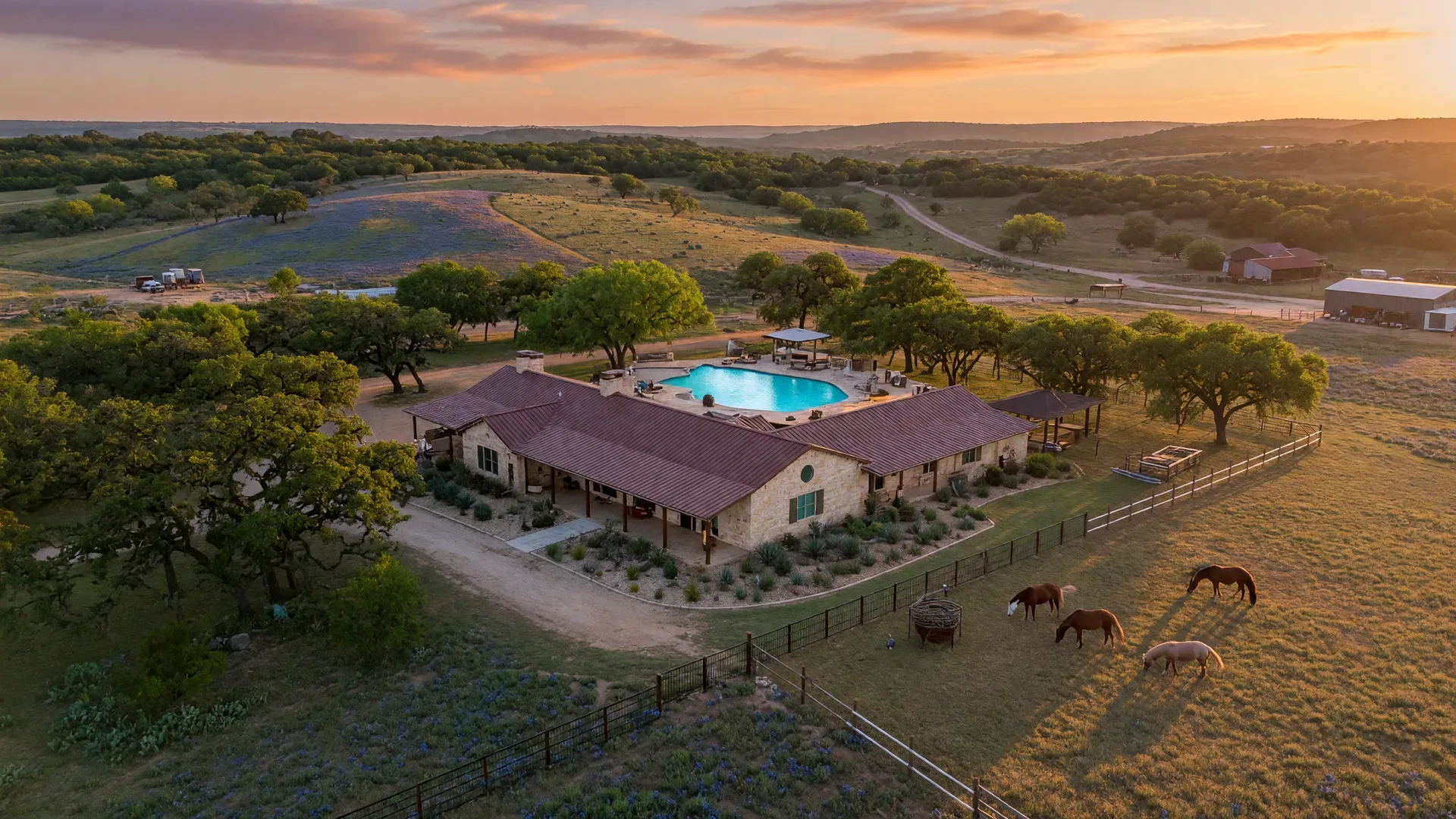
The outdoor life is the everyday product in Boerne, Fair Oaks Ranch, and the surrounding ranch country. The parks and recreation guide lists the closest trailheads by drive time.
9. Wealth Building: How the Texas System Compounds for Owners
This is where the individual columns add up to a balance sheet. Take Maya's numbers again: no California state income tax on her $120,000 salary means roughly $6,915 a year in California state income tax no longer comes out of her budget, based on the assumptions used in Reason 1 [1][2]. She buys a $420,000 Hill Country home instead of the $500,000 Sacramento condo she could have stretched for. On the Texas side, her property tax bill starts from the $140,000 school-district residence homestead exemption on the appraised value for school taxes, and the 10% appraisal cap limits how fast the taxable value grows after her first qualifying year [6][8]. Homeownership creates a mechanism for equity accumulation because the principal portion of each mortgage payment reduces the loan balance. That does not make the full housing payment an investment: interest, property taxes, insurance, maintenance, transaction costs, and any decline in market value remain real expenses.
The market context matters. The Texas Real Estate Research Center tracks the San Antonio market at the metro level, and the site's own $1.2 million equity example walks the five-year wealth path for a family that sells high in California and buys low in the Hill Country [9]. The point is not that Texas prices always go up. The financial argument is narrower and stronger: eliminating California state income tax can improve after-tax cash flow, while purchasing a lower-priced Texas home can reduce the capital required to own comparable or greater space. Whether the move improves long-term net worth still depends on financing costs, property taxes, insurance, maintenance, investment returns, and future home appreciation [1][2][9].
Two more Texas advantages quietly matter. The homestead exemption is not just a tax break; the Texas Constitution protects a homestead from most forced sale by general creditors, a real if rarely discussed asset-protection feature for a professional with business-formation risk, with exceptions for the purchase mortgage, property taxes, home equity and improvement loans, and certain federal claims [47]. And for anyone whose money picture includes an estate, a trust, or inherited property, the state lines matter twice over: Texas probate is a different process from California's, and the Texas probate guide at texasprobatehomes.net explains how it works if inheritance becomes part of your plan, while the site's estate plan review guide covers the documents a move makes stale.
Maya and Josh, before and after: the modeled budget lines
| Budget line | California | Texas (Hill Country) |
|---|---|---|
| Salary, Maya | $120,000 | $120,000 (unchanged compensation) |
| Salary, Josh | $80,000 | $80,000 (unchanged compensation) |
| Estimated California state income tax, Maya | ~$6,915 [2] | $0 [1] |
| Estimated California state income tax, Josh | ~$3,195 [2] | $0 [1] |
| California SDI withholding, Maya | ~$1,560 [48] | None |
| California SDI withholding, Josh | ~$1,040 [48] | None |
| Illustrative housing payment (principal and interest only), Maya | ~$2,660 per month (illustrative) | ~$2,235 per month (illustrative) |
| Illustrative housing payment, Josh | Not modeled | Not modeled |
| Property tax and HOA | Not modeled | Address-specific; model per Reason 2 rates after exemptions [6][8] |
| Utilities and homeowners insurance | Not reliably sourced for a side-by-side comparison; obtain address-specific quotes (Reasons 2 and 6) | |
The estimated annual difference for Maya is approximately $13,600: the $6,915 income tax line, the $1,560 SDI line, and roughly $5,100 in illustrative housing-payment difference, before property taxes, insurance, utilities, maintenance, and commuting, which narrow the gap and depend on the address. For Josh the estimated annual difference is approximately $4,235, the sum of his income tax and SDI lines; no housing comparison is modeled for Josh in this article. The income tax, SDI, and salary lines come from Reasons 1 and 9; the housing payments are illustrations computed from the $500,000 California condo and $420,000 Texas home prices used above, assuming 20% down and a 30-year fixed rate of 7%, consistent with the rate environment of the second week of September 2026, and they are principal-and-interest only [1][2][13][48]. Every modeled figure is an illustration based on the stated assumptions, not a quote, and only documented numbers or clearly labeled estimates are shown.
10. Practical Logistics: Airports, Central Time, the Texas Triangle, and the Move-Year Mindset
A move only works if the logistics are boring, and in Texas they are. San Antonio International Airport carried about 10.7 million passengers in 2025, its second-best year on record, per the airport's own year-end statistics, and 2025 press reporting put its nonstop network at 46 destinations as of March, growing to as many as 49 by year end; Austin-Bergstrom added about 21.7 million passengers the same year [36][37][53]. From Boerne, downtown San Antonio is approximately 30 minutes, the San Antonio airport is approximately 40 minutes, and the Austin airport is approximately an hour and a half, depending heavily on traffic and starting point. Several major California markets can be reached nonstop or with one connection from SAT or AUS, but schedules and nonstop availability vary by destination and season. The San Antonio airport guide maps the routes that matter most for California transplants.
Central Time is a quiet gift for remote workers. Texas runs two hours ahead of California, so 9 a.m. in Boerne is 7 a.m. in the Bay Area. Work 8 to 5 Central and you overlap a 9-to-5 Pacific team from 9 a.m. to 3 p.m. Pacific—six full hours—with three hours at the beginning of the Texas workday before a 9 a.m. Pacific team logs on. For anyone whose team was already remote, the time zone works.
The Texas Triangle is the macro reason the logistics stay boring. The corridor of Dallas-Fort Worth, Houston, San Antonio, and Austin holds more than half of Texas's population and connects by I-35, I-45, and I-10, with commercial airports in every corner [38]. You are never more than a day's drive from a major job market, a specialist hospital, or a third airport. The moving logistics page and the 12-month relocation timeline cover movers, utilities, the driver's license and vehicle registration sequence, and the homestead filing timing. The legal clocks are short: Texas gives new residents 30 days to register a vehicle, while a new resident may drive on a valid, unexpired out-of-state driver's license for up to 90 days. Since January 1, 2025, noncommercial vehicles no longer require a Texas safety inspection. An emissions inspection is still required before registration in designated emissions counties, but Bexar, Kendall, Comal, and Bandera counties are not currently among them [50]. Inspection rules differ for commercial vehicles.
The move-year mindset, stated plainly: Texas gains are structural, and 2027 is not a finish line. Plan the move around your lease, your job's remote policy, and the school calendar rather than around a market forecast. List the California property, coordinate the Texas closing, and treat the first twelve months as a settling year, not a performance review. The 90-day checklist gives the week-by-week version for the final quarter before the truck arrives.
The Recap: Ten Reasons in One Checklist
Save this section. It is the whole article distilled into actions you can take this quarter.
- Income: Confirm Texas has no state income tax on your wage type, then model your personal saving against the 2025 California brackets [1][2].
- Housing: Compare price per square foot in your California county against San Antonio, Boerne, and your target Hill Country community before you set a budget [9][10][11][12][13].
- Property tax: Read the latest adopted rates for every taxing unit attached to the exact property, apply the $140,000 residence homestead exemption to the school-district taxable value, apply any separate city, county, or special-district exemptions for which the property qualifies, and model the resulting tax bill using the applicable adopted rates [6][7][8][14][15][16].
- Land: If acreage matters, price per acre in Kendall, Comal, and Bandera counties and add well, septic, and utility connection to the same budget [17][18][19].
- Programs: Check TSAHC Homes for Texas Heroes (170% of AMFI income limit, up to 5% down payment assistance, limits effective June 13, 2026) and the MCC for first-time buyers (15% credit; the buyer ordinarily cannot have owned an interest in a principal residence during the preceding three years, with TSAHC waivers for qualified veterans and qualifying homes in designated targeted areas; 100%/115% AMFI ceilings under the September 15, 2026 notice) [20][21][22][24][25].
- Veterans: If you or a spouse served, run the Veterans Land Board land and home loan numbers before you compare conventional financing [26][27][28].
- Remote work: Make a clean domicile change: move your license, registration, and voter registration, keep California return trips short and temporary, log your days, change your payroll work address before the move, and have a CPA review any stock options or RSUs [3][4][29].
- Monthly costs: Confirm which utility serves the address, budget electricity at that utility's rates, gas at Texas pump prices, and homeowners insurance with wind and hail in the quote [30][32][44].
- Insurance: During the option period, obtain a property-specific homeowners quote using the actual roof age and construction, verify wind/hail deductibles, check FEMA flood information, ask whether separate flood coverage is warranted, and investigate wildfire exposure. Do not assume the seller's current premium is transferable or representative of the buyer's premium.
- Schools: Pull your exact feeder pattern's 2026 TEA ratings (Boerne ISD A, Comal ISD B, Northside ISD C) and mark any transfer or program application deadlines [33][34][35].
- Logistics: Confirm the most practical SAT or AUS itinerary for your trip, register your vehicle within 30 days of establishing Texas residency, obtain your Texas driver's license within the applicable 90-day window, and file for the residence homestead exemption with the county appraisal district once the home qualifies as your principal residence [6][36][37][50].
Frequently Asked Questions
The questions that come up every time an adult Gen Z or Millennial Californian starts this research for real, answered straight.
Is it really true that Texas has no state income tax?
Yes. Texas does not tax wages, salaries, or most personal income at the state level; no Texas income tax return is filed for employment income [1]. You still pay federal income tax, Texas sales tax (6.25% statewide plus local additions), and local property taxes, so the benefit is real but it is one column in a bigger budget.
I am a remote worker for a California employer. Do I keep paying California tax after I move to Texas?
Once you are a true Texas resident and perform your work from Texas, California generally stops taxing your wages, because California sources wages to the state where the services are performed [4][29]. The hard part is ending California residency: California keeps taxing you as a resident as long as California is still your domicile, it presumes residency if you spend more than nine months of a year in the state, and it weighs your home, driver's license, voter registration, and other connections to decide where you really live [3]. Cut the California ties cleanly, keep return visits clearly temporary, talk to your employer about payroll before you leave, and have a CPA review any stock options or RSUs, which can stay partly California-taxable after the move [3][4].
How much more house does my money buy in Texas?
At comparable budgets, a lot. San Antonio metro listings run about $170 per square foot, against about $428 for the typical existing California single-family home statewide and about $327 in Sacramento County; on median price, San Francisco County sits near $1.9 million and Los Angeles County near $947,000, against roughly $300,000 to $320,000 for the San Antonio metro [9][13][42][43]. A $600,000 budget reaches a materially different segment of the market around Boerne and Fair Oaks Ranch than it does in Los Angeles or the Bay Area. In the Hill Country it can reach detached new or newer homes and, depending on location and property type, larger lots; the exact comparison should be made against current listings or closed sales in the California neighborhood the buyer is actually leaving [11][12]. Texas property tax is the honest offset; see Reason 2 for the math.
Do I qualify for TSAHC down payment assistance, and what are the income limits?
Homes for Texas Heroes covers full-time public school educators (including teacher aides, librarians, counselors, and school nurses), peace officers, county jailers, correctional officers, public security officers, firefighters and EMS personnel, nursing and allied health faculty, and veterans and active military who meet the program's definitions, including its Texas residency rules for veterans [20]. Hospital nurses generally do not qualify. Income limits run up to 170% of area median family income, with county-by-county dollar limits in TSAHC's table effective June 13, 2026, and the down payment assistance is open to repeat buyers [20][21][22]. The mortgage credit certificate is separate and generally carries a first-time-home-buyer requirement, meaning the buyer ordinarily cannot have owned an interest in a principal residence during the preceding three years; TSAHC waives that requirement for qualified veterans and for qualifying homes purchased in designated targeted areas. Its income ceilings are 100% of area median family income for households of two or fewer and 115% for households of three or more under TSAHC's September 15, 2026 notice [20][24][25].
Are Texas schools actually better than California schools?
District by district, not as a blanket statement. In Texas's 2026 A-F accountability ratings, covering the 2025-26 school year, Boerne ISD earned an A, Comal ISD earned a B (88), and Northside ISD earned a C, its fourth consecutive C [33][34][35]. So the answer depends entirely on where you land: Boerne ISD earned an A, Comal ISD earned a B (88), and Northside ISD earned a C in the 2026 ratings. Because Fair Oaks Ranch and the broader Hill Country cross school-district boundaries, buyers should verify the district and individual feeder campuses for the exact address rather than infer school assignments from the city name. Read the ratings for the exact feeder pattern at your address, and mind the application windows for transfers and specialty programs [33].
What is the honest deal with Texas heat and the power grid?
Summers are genuinely hot: June through September regularly push past 95 to 100 degrees, and air conditioning runs many months of the year. The electricity rate is usually far cheaper than California's, about 15.9 cents per kilowatt-hour versus roughly 33.6 cents [32], but Texas has its own grid, and extreme weather has caused price spikes and, in the February 2021 winter storm, multi-day outages for millions of customers [45]. Budget for a serious AC system, find out whether your address has retail electric choice or is served by a municipal utility or co-op, and expect higher summer bills [44].
Is 2027 actually a better year to move than 2026?
The structural advantages in this article do not depend on the calendar year: no state income tax, far lower home prices, and land you can actually afford are permanent features of Texas [1][9][13]. The $140,000 school-district residence homestead exemption that voters approved in November 2025 took effect with the 2025 tax year and continues every year after [7]. What changes year to year is mortgage rates, inventory, and your own lease or job timeline; according to the C.A.R. release, the average 30-year fixed rate surpassed 7% in the second week of September 2026, illustrating how quickly financing conditions can change [13]. There is no reliable basis for assuming that waiting until 2027 will improve the comparison. Mortgage rates, inventory, prices, taxes, program rules and personal circumstances can all move in either direction, so the decision should be based on today's verified numbers and the buyer's actual timeline rather than a forecast.
Boerne, Fair Oaks Ranch, San Antonio, or Comfort: which fits adult Gen Z and Millennials?
San Antonio gives you the urban life at a California price that would be impossible in LA or the Bay Area [10]. Boerne and Fair Oaks Ranch give you the Hill Country pace, A-rated Boerne ISD, acreage options, and a 30- to 45-minute drive to the city airport and jobs [33]. Comfort gives you rural character, lower land prices, and a longer commute, so it suits buyers who value land over commuting [17]. Match the town to your commute and your tolerance for rural infrastructure, not to a brochure.
The Bottom Line
The ten reasons are one argument: Texas gives adult Gen Z and Millennials the two things those generations are missing, an income that keeps more of itself and housing that does not eat the whole paycheck, and then backs them with usable state programs, a strong school system in the Hill Country, and a quality of life built on space rather than scarcity [1][2][9][13][20][33]. Several of the largest differences, most notably Texas's lack of a personal state income tax and the large housing-price gap, are structural, while mortgage rates, inventory, insurance premiums, program rules, utility costs, and individual market conditions are time-sensitive. Every number in this article carries its source, and the tradeoffs, property taxes, heat, and grid risk, are stated instead of hidden [6][14][44][45].
Texas will not be the better answer for everyone. A Californian whose compensation falls materially after relocation, who strongly values walkability or mild coastal weather, who would face substantially higher insurance or commuting costs, whose career depends on a California-based industry cluster, or whose family and support network are difficult to leave may reasonably reach a different conclusion. The purpose of the comparison is not to make Texas win every column; it is to show which columns actually change when you move.
What to do next, in plain terms. Run the income tax table against your own salary, pull TSAHC and county tax numbers for the town you are considering, and drive the two ZIP codes you are actually choosing between. If you want help turning this checklist into a move plan, Bill Ross at Hill Country Homesteads Group, brokered by Keller Williams Boerne, coordinates California-to-Texas purchases through a direct network of more than 1,100 California real-estate agents. Reach him through the contact page at movetotexas.net/contact, by email at Bill@HillCountryHomesteads.com, or by phone at (210) 294-9190 during business hours, 8 AM to 6 PM Central, Monday through Friday. The brokerage is at 116 Herff Rd, Suite 203, Boerne, TX 78006. A no-pressure conversation about your specific situation is the only thing on offer.
For deeper local detail, the Hill Country Homesteads insights hub covers Boerne property taxes and community comparisons in more depth, and the Texas probate guide at texasprobatehomes.net covers the estate side of a cross-state move.
Sources
Numbered sources, as cited in the body above. Primary authorities come first wherever one exists; secondary market-data sources are labeled as such.
- Taxes FAQ: Does Texas have a state income tax?: Texas Comptroller of Public Accounts. comptroller.texas.gov/faq/
- 2025 California Tax Rate Schedules (Form 540): California Franchise Tax Board. www.ftb.ca.gov/forms/2025/2025-540-tax-rate-schedules.pdf Also: 2025 Form 540 2EZ Single Tax Table (standard deduction $5,706; personal exemption credit $153), California Franchise Tax Board. www.ftb.ca.gov/forms/2025/2025-540-2ez-taxtable-single.pdf
- Publication 1031: Guidelines for Determining Resident Status (residency tests, domicile factors, 546-day safe harbor): California Franchise Tax Board. www.ftb.ca.gov/forms/2024/2024-1031-publication.pdf
- Part-Year Resident and Nonresident: how wages and other income are sourced: California Franchise Tax Board. www.ftb.ca.gov/file/personal/residency-status/part-year-and-nonresident.html
- Household Income in States and Metropolitan Areas: 2024 ACS 1-Year Estimates of median household income by state, in 2024 inflation-adjusted dollars (California $100,149, Texas $79,721): U.S. Census Bureau, American Community Survey 2024, tables S1901/B19013. www.census.gov/library/publications/2025/acs/acsbr-025.html
- Property Tax Exemptions: the residence homestead exemption and the 10% appraisal cap (Tax Code 11.13, 23.23): Texas Comptroller of Public Accounts. comptroller.texas.gov/taxes/property-tax/exemptions/
- Property Tax Today (January 2026): documenting voter approval of the increase in the school homestead exemption to $140,000: Texas Comptroller of Public Accounts. comptroller.texas.gov/taxes/property-tax/newsletter/vol35-jan26.php Also: S.J.R. 2, 89th Legislature: constitutional text raising the residence homestead exemption to $140,000 with a January 1, 2025 effective date. capitol.texas.gov/tlodocs/89R/billtext/html/SJ00002F.htm
- Property Tax Basics: how local taxing units set rates and how the homestead appraisal cap works: Texas Comptroller of Public Accounts. comptroller.texas.gov/taxes/property-tax/basics.php
- San Antonio Housing Activity: median closed sale price and median price per square foot by county for the San Antonio LMA, monthly: Texas Real Estate Research Center, Texas A&M University. trerc.tamu.edu/housing-activity-data/lma/san-antonio/
- San Antonio, TX Housing Market: median closed sale price and median price per square foot of closed sales, single calendar month (secondary): Redfin (secondary). www.redfin.com/city/16657/TX/San-Antonio/housing-market
- Kendall County, TX Housing Market: median sale price $617,733 (about $618,000) and median sale price per square foot $233, three months ending August 2026: Redfin (secondary). www.redfin.com/county/2769/TX/Kendall-County/housing-market
- Boerne, TX Housing Market: median closed sale price about $505,000 and median price per square foot of closed sales about $215, rolling three months ending August 2026; homebuyer search data, April-June 2026, measuring Redfin users' home-search behavior, not completed moves: Redfin (secondary). www.redfin.com/city/2371/TX/Boerne/housing-market
- August 2026 Home Sales and Price Report, with county sales and price tables: median closed sale price of existing single-family homes, single month (August 2026), statewide about $901,420 and median price per square foot of closed sales statewide about $428; San Francisco County about $1,875,000; Los Angeles County about $946,950; Sacramento County about $549,000; 30-year fixed rate above 7% in the second week of September 2026: California Association of Realtors news release, September 16, 2026. www.car.org/aboutus/mediacenter/newsreleases/2026releases/august2026sales
- Current Tax Rates: City of Boerne 2026 adopted rate of $0.4790 per $100 (Ordinance No. 2026-06, second reading approved September 8, 2026), Boerne ISD 2026-27 adopted rate of $1.0065 per $100, and Kendall County 2026 adopted rate of $0.3730 per $100: City of Boerne. www.ci.boerne.tx.us/646/Current-Tax-Rates
- 2026 Tax Rates: Bexar County combined 2026 rate of $0.299999 per $100 (adopted September 15, 2026) and City of San Antonio 2026 tax-year/FY2027 adopted rate of $0.56288 per $100 (adopted September 17, 2026): Bexar County; City of San Antonio. www.bexar.org/DocumentCenter/View/50481/2025-Tax-Rates-PDF
- Tax Rates: Comal County 2026 adopted county rate of $0.305015 per $100 (adopted September 17, 2026): Comal County. www.comalcounty.gov/372/Tax-Rates
- Kendall County, TX Land for Sale: median recorded sold price per acre of about $32,870, based on 45 recorded sold-land observations: Acres.com (secondary). www.acres.com/plat-map/land-for-sale/tx/kendall-county-tx
- Comal County, TX Land Market Insights: median asking price per acre of about $56,200, based on current land listings (an asking-price measure): Land.com (secondary). www.land.com/Comal-County-TX/
- Land for Sale in Bandera County, Texas: Land.com county summary, median listing price per acre about $27,379, median lot size 24.9 acres, and median list price about $864,500; selected large listed ranch tracts can show asking prices in the roughly $6,000-to-$21,000-per-acre range (both listing-price measures): Land.com (secondary). www.land.com/Bandera-County-TX/all-land/
- Homes for Texas Heroes Program: eligible professions, veteran residency definition, down payment assistance up to 5%, credit score minimums, MCC for first-time buyers, and the Home Sweet Texas program: Texas State Affordable Housing Corporation (TSAHC). www.tsahc.org/program/homes-for-texas-heroes/
- What Higher Income Limits Mean for Texas Home Buyers: Homes for Texas Heroes income limit raised to 170% of area median family income: Texas State Affordable Housing Corporation (TSAHC). www.tsahc.org/blog/post/what-higher-income-limits-mean-for-texas-home-buyers
- TSAHC Combined Income and Purchase Price Limits, effective June 13, 2026: Texas State Affordable Housing Corporation (TSAHC). www.tsahc.org/public/upload/files/general/TSAHC_Combined_Income_Purchase_Price_Limits.pdf
- Home Buyer Programs: Today's Interest Rates, set daily for TSAHC programs: Texas State Affordable Housing Corporation (TSAHC). www.tsahc.org/homebuyer-programs
- Mortgage Credit Certificates: the 15% credit rate and how the credit works: Texas State Affordable Housing Corporation (TSAHC). www.tsahc.org/homebuyers-renters/mortgage-credit-certificates
- 2026 MCC Program Notice, September 15, 2026: income ceilings of 100% of AMFI for households of two or fewer and 115% for households of three or more: Texas State Affordable Housing Corporation (TSAHC). www.tsahc.org/news/article/notice-of-the-implementation-of-a-2026-qualified-mortgage-credit-certificate-program
- Veterans Land Loans: minimum one net acre in Texas, 5% down, fixed-rate terms: Texas General Land Office, Veterans Land Board. www.glo.texas.gov/land-loans
- Land Commissioner Buckingham announces combined $100,000 increase in VLB's land loan caps (2026): $200,000 standard and $275,000 for qualifying couples: Texas General Land Office press release. www.glo.texas.gov/about-glo/press-releases/land-commissioner-buckingham-announces-combined-100000-increase-vlbs-land
- Veterans Home Loans (VHAP): first-lien home loan program through participating lenders, cap about $832,750 as published in early 2026: Texas General Land Office, Veterans Land Board. www.glo.texas.gov/veterans/loans-veterans
- Publication 1100: Taxation of Nonresidents and Individuals Who Change Residency (2025): California Franchise Tax Board. www.ftb.ca.gov/forms/2025/2025-1100-publication.pdf
- Gasoline and Diesel Fuel Update: state weekly retail average, California about $6.00 per gallon versus Texas about $3.93, week of September 21, 2026: U.S. Energy Information Administration. www.eia.gov/petroleum/gasdiesel/
- Texas Price of Natural Gas Delivered to Residential Consumers (2025 monthly series): U.S. Energy Information Administration. www.eia.gov/dnav/ng/hist/n3010tx3m.htm California series: www.eia.gov/dnav/ng/hist/n3010ca3m.htm
- Electric Power Monthly, Table 5.6.A: July 2026 average residential electricity prices, California 33.61 cents per kWh versus Texas 15.88 cents per kWh, released September 24, 2026: U.S. Energy Information Administration, Electric Power Monthly, Table 5.6.A. www.eia.gov/electricity/monthly/epm_table_grapher.php?t=epmt_5_6_a
- Texas School Report Cards: Boerne ISD, overall rating A (2026 ratings, 2025-26 school year): Texas Education Agency. txschools.gov/?view=district&id=130901&lng=en
- Texas School Report Cards: Comal ISD, overall rating B with a score of 88 (2026 ratings, 2025-26 school year): Texas Education Agency. txschools.gov/?id=046902&lng=en&tab=overview&view=district
- Texas School Report Cards: Northside ISD, overall rating C (2026 ratings, 2025-26 school year; fourth consecutive C): Texas Education Agency. txschools.gov/?id=015915&lng=en&tab=performance%7Caccountability&view=district
- December 2025 and full-year 2025 statistics: San Antonio International Airport, about 10.74 million total passengers (10,740,694) in 2025, its second-best year on record: City of San Antonio, flysanantonio.com, San Antonio International Airport. flysanantonio.com/wp-content/uploads/2026/01/December-2025.pdf
- AUS December 2025 Passenger Traffic and Year-End Numbers: about 21.7 million passengers in 2025: City of Austin, flyaustin.com. www.flyaustin.com/news/aus-december-2025-passenger-traffic-and-year-end-numbers
- The Texas Triangle: A rising megaregion unlike all others (Dallas-Fort Worth, Houston, San Antonio, Austin, home to more than half of Texas residents): Kinder Institute for Urban Research, Rice University. kinder.rice.edu/urbanedge/texas-triangle-rising-megaregion-unlike-all-others
- QuickFacts: Boerne city, Texas (population about 24,047 in the 2025 estimates, up from 17,850 in the 2020 census): U.S. Census Bureau. www.census.gov/quickfacts/fact/table/boernecitytexas/PST045225
- QuickFacts: Fair Oaks Ranch city, Texas (population about 12,025 in the 2025 estimates, up from 9,833 in the 2020 census): U.S. Census Bureau. www.census.gov/quickfacts/fairoaksranchcitytexas
- Vintage 2025 state population estimates: Texas reached about 31.7 million on July 1, 2025, adding about 391,000 residents, the largest numeric gain of any state; California was one of five states to lose population: U.S. Census Bureau. www.census.gov/data/tables/time-series/demo/popest/2020s-state-total.html Backup citation: Texas Department of Transportation, "Texas Population: Trends and Characteristics," April 30, 2026, citing Census Vintage 2025. www.txdot.gov/content/dam/docs/commission/2026/0430/5b.pdf
- Sacramento County, CA Housing Market: median closed sale price about $533,000 and median price per square foot of closed sales about $327, rolling three months ending August 2026: Redfin (secondary). www.redfin.com/county/336/CA/Sacramento-County/housing-market
- Housing Inventory: median listing price per square foot in San Antonio-New Braunfels, TX, single month (August 2026), a listing-price measure of about $170: Realtor.com data via Federal Reserve Bank of St. Louis (FRED). fred.stlouisfed.org/series/MEDLISPRIPERSQUFEE41700
- Power to Choose: which Texas addresses have retail electric choice (municipal utilities and electric cooperatives such as CPS Energy, the City of Boerne, Bandera EC, and Pedernales EC do not participate): Public Utility Commission of Texas. www.powertochoose.org/
- February 2021 Cold Weather Outages in Texas and the South Central United States: Federal Energy Regulatory Commission and North American Electric Reliability Corporation. www.ferc.gov/news-events/news/final-report-february-2021-freeze-underscores-winterization-recommendations
- Texas Education Code Chapter 25, Section 25.001: admission of resident students: Texas Legislature. statutes.capitol.texas.gov/Docs/ED/htm/ED.25.htm
- Texas Constitution Article XVI, Section 50: homestead protection from forced sale and its exceptions: Texas Legislature. statutes.capitol.texas.gov/Docs/CN/htm/CN.16.htm
- Contribution Rates, Withholding Schedules, and Meals and Lodging Values (State Disability Insurance rate): California Employment Development Department. edd.ca.gov/en/payroll_taxes/rates_and_withholding/
- FEMA Flood Map Service Center: official flood hazard maps by address: Federal Emergency Management Agency. msc.fema.gov/portal/home
- New to Texas: vehicle registration and driver license timelines for new residents, and which vehicles require Texas inspections: Texas Department of Motor Vehicles. www.txdmv.gov/motorists/new-to-texas
- San Antonio-New Braunfels, TX Economy at a Glance: total nonfarm payroll employment about 1.192 million in August 2026; preliminary payroll employment up about 0.5 percent year over year; unemployment rate about 4.7 percent in July 2026: U.S. Bureau of Labor Statistics. www.bls.gov/eag/eag.tx_sanantonio_msa.htm
- San Antonio-New Braunfels, TX Metropolitan Area: employees on nonfarm payrolls by industry supersector, showing trade, transportation and utilities; government; education and health services; and professional and business services as the largest sectors: U.S. Bureau of Labor Statistics, Southwest Information Office. www.bls.gov/regions/southwest/data/employmentandunemploymentandwages_sanantonio_table.htm
- San Antonio International Airport: 2025 press reporting on nonstop destinations, 46 as of March 2025 and up to 49 by December 2025 (secondary media reporting): Air Service One (secondary); KSAT coverage of the airport's March 2025 announcement. airserviceone.com/san-antonio-welcomes-2-new-airlines-now-has-record-international-capacity/ Also: KSAT, "First nonstop flight to nation's capital expands SAT's nonstop destinations to 46," March 2025. www.ksat.com/news/local/2025/03/03/its-a-big-win-san-antonio-international-airport-to-debut-first-nonstop-flight-to-nations-capital-on-monday/
- Commute and mode-share context: American Community Survey estimates showing almost 80 percent of San Antonio workers drive alone to work, as reported by the San Antonio Report: U.S. Census Bureau, American Community Survey, as reported by San Antonio Report and DataUSA. sanantonioreport.org/census-data-almost-80-of-san-antonians-drive-to-work-alone/ Also: Boerne, TX ACS 5-year profile, in which most workers drive alone and the average commute is 25.3 minutes. datausa.io/profile/geo/boerne-tx
Last verified: September 27, 2026. Program statuses and limits carry their own effective dates: the TSAHC income and purchase price limit table in effect as of this article was published is the edition effective June 13, 2026 [22]; the TSAHC mortgage credit certificate income ceilings come from the September 15, 2026 program notice [25]; the $140,000 school-district residence homestead exemption took effect with the 2025 tax year and continues every year after [7]; the school ratings are the TEA's 2026 ratings released August 14, 2026 [33][34][35]; the property tax rates cited are the adopted 2026 rates from the principal taxing units in each county [14][15][16]; the Veterans Land Board caps are the 2026 published figures [27][28]; and TSAHC mortgage rates are set daily [23]. Rates, limits, and deadlines move; confirm anything time-sensitive with the Texas Comptroller, TSAHC, the Texas General Land Office, your county appraisal district, and a tax professional before relying on it. This is general educational information about programs and taxes, not legal, tax, or financial advice for your specific situation.