
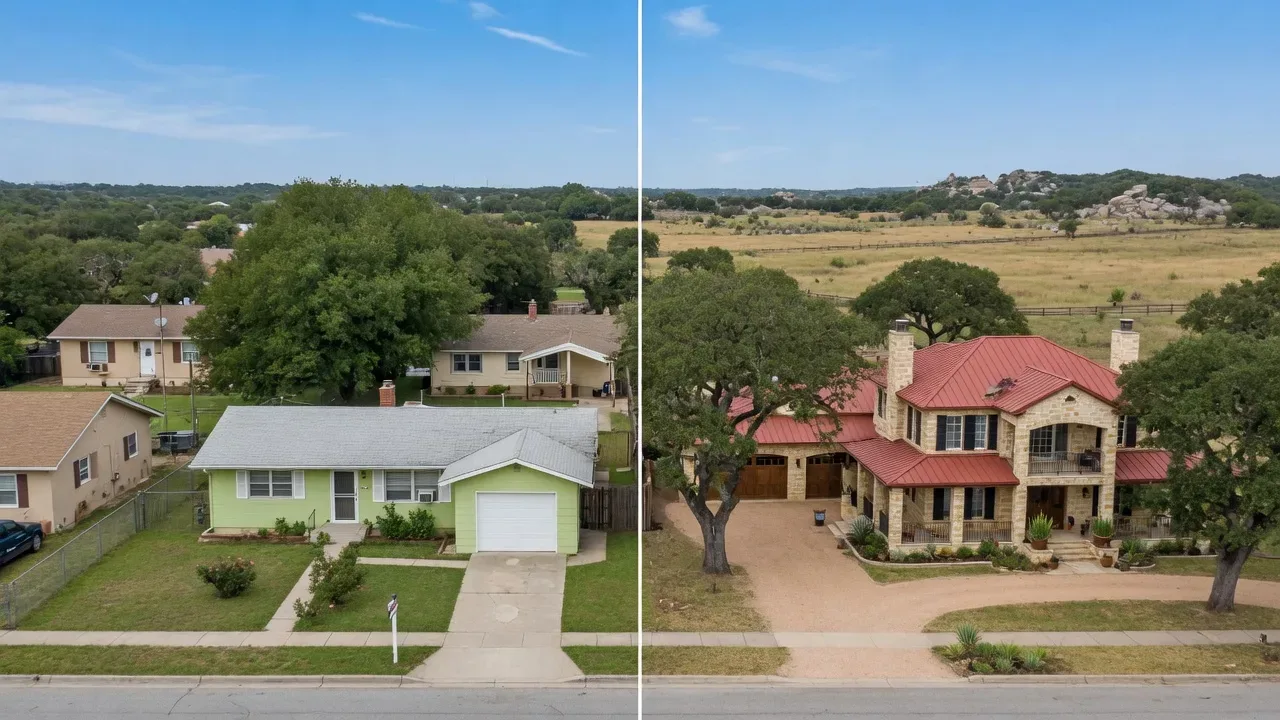
Is property tax in Texas a shock or a relief for California buyers? The honest answer is both, and it depends on which number you look at. Texas levies a genuinely higher rate, there is no Proposition 13 cap on a new purchase, and the county appraisal district reassesses toward market value. But the bill you actually write, after the $140,000 homestead exemption, the 10% appraisal cap, and a routine protest, is usually lower than the headline frightens you with, and the monthly budget almost always comes out ahead because there is no state income tax [6][7][9].
This article walks through the comparison the way a careful buyer should: the real rates for Kendall, Bexar, and Comal Counties, a worked example of the same family's California bill versus their Texas bill, the exemption and cap math in dollars, and a year-by-year view of what happens after closing. The numbers come from the sources listed at the bottom, and where a figure is an estimate, the estimate is labeled [1][2].
First, the Shock: The Rate Really Is Higher
In California, Proposition 13 caps the base rate at 1% of the assessed value, and a recent buyer's total with voter-approved additions, bonds, and Mello-Roos districts typically lands between 1.1% and 1.2% [8]. In the Texas Hill Country, the combined tax-year 2025 rates run meaningfully higher [1][3][4]:
Combined Property Tax Rates, Tax Year 2025
| Location | Combined rate per $100 | What it includes |
|---|---|---|
| Boerne / Kendall County | $1.8645 (about 1.86%) | Boerne ISD $1.0109, City of Boerne $0.4716, Kendall County $0.3770, Cow Creek GCD $0.005 |
| San Antonio / Bexar County | about $2.27 (range 2.10 - 2.60) | City, county, ISD, Alamo Colleges, University Health, special districts |
| New Braunfels / Comal County | about $1.79 | Comal ISD about $1.07, City of New Braunfels $0.4089, Comal County $0.3050 |
Rates reflect published tax year 2025 combined levies. Sources: City of Boerne; Ballard Property Tax Protest county rollups; City of New Braunfels [1][2][3][4][5]. Actual bills vary by ISD, city limits, and special district boundaries within each county.
Notice what that means for a buyer. In California your taxable base is locked at the price you paid and grows at most 2% a year. In Texas your appraisal district values the property near market and starts a new buyer's base at the purchase price, with no lock [1][8]. Two people who bought the same house in the same week can have different bills forever after, because each state starts their base differently. That one structural fact drives everything else in this article [2][8].
Then the Relief: The Exemptions, the Cap, and the Protest
Texas does not ask you to pay that full rate on your full value. Three mechanisms cut the bill, and each one is worth real dollars:
- The $140,000 homestead exemption. Since the 2025 tax year, a homeowner with a filed exemption removes $140,000 of appraised value from the school district maintenance and operations tax, the largest single slice of the bill [6][7]. On the Boerne ISD combined rate of $1.0109, that exemption is worth roughly $1,415 a year by itself [1]. Counties and cities may add their own exemptions on top.
- The 10% appraisal cap. With a homestead exemption in place, the appraised value used for taxes cannot jump more than 10% in a single year, even if the market soars [7]. California's 2% Prop 13 cap is tighter, but the Texas cap still protects you from a reassessment spike after a hot year.
- The protest. Texas is one of the few states where contesting your value is normal annual maintenance rather than an act of war. The deadline to protest is May 15 or 30 days after the notice, whichever is later, and a simple comparable-sales case regularly saves 3% to 8% [7]. Because the cap compounds on the protested value, this year's win keeps paying.
The order matters. File the exemption first, because the appraisal cap only applies once the exemption is active, then protest the value that remains, then watch the track run flat [7].
The Worked Example: Same Family, Two Different Bills
Let us run one realistic family through both systems. They sell a $1.2 million California home and buy a $650,000 home in Boerne, near the current 78006 median. The Texas column runs the bill two ways: without a filed exemption, and with the $140,000 homestead exemption applied to the school lines [1][6][8].
Annual Property Tax Bill, Worked Example
| Scenario | Taxable base | Rate | Annual bill | Monthly |
|---|---|---|---|---|
| CA recent buyer, $1.2M home | $1,200,000 assessed at purchase | about 1.15% | about $13,800 | about $1,150 |
| CA owner since 2016, $1.2M home today | about $731,000 locked base | about 1.15% | about $8,400 | about $700 |
| TX new buyer, $650K Boerne home, no exemption filed | $650,000 | 1.8645% | about $12,120 | about $1,010 |
| TX new buyer, $650K Boerne home, homestead filed | $650,000 minus $140,000 on school lines | 1.8645% nominal | about $10,650 | about $890 |
Illustrative estimates built on the rates and exemption math cited in the sources: Boerne combined rate [1], county rollups [2][3][4][5], the $140,000 exemption [6], and Prop 13 base rules [8]. The locked California base assumes the 2016 purchase appreciated at the 2% maximum annually, an assumption that understates many Bay Area bases. Actual bills vary by district and exact property.
Reading the Table Honestly
The middle row is the shock Californians rarely see coming. If you have owned for ten years, your locked base can make your California bill smaller than your Texas bill on a house that is worth half as much. That is not a myth, and it is not a reason to stay. It is the predictable consequence of two different tax structures, and it is exactly why the full-budget picture matters more than the tax line alone [2][8].
The bottom row is the honest Texas number: about $890 a month with the exemption filed, before protest and before any county option. The delta between the no-exemption row and the filed row, roughly $120 a month on this house, is the price of paperwork. The one-page exemption application is worth every minute of the twenty minutes it takes [6][7].
Monthly Property Tax Line, Compared
Bar widths proportional to the monthly figures in the worked example (1 unit = $11.50). Illustrative only, derived from the cited rates and exemptions.
County by County: Where the Rates Actually Land
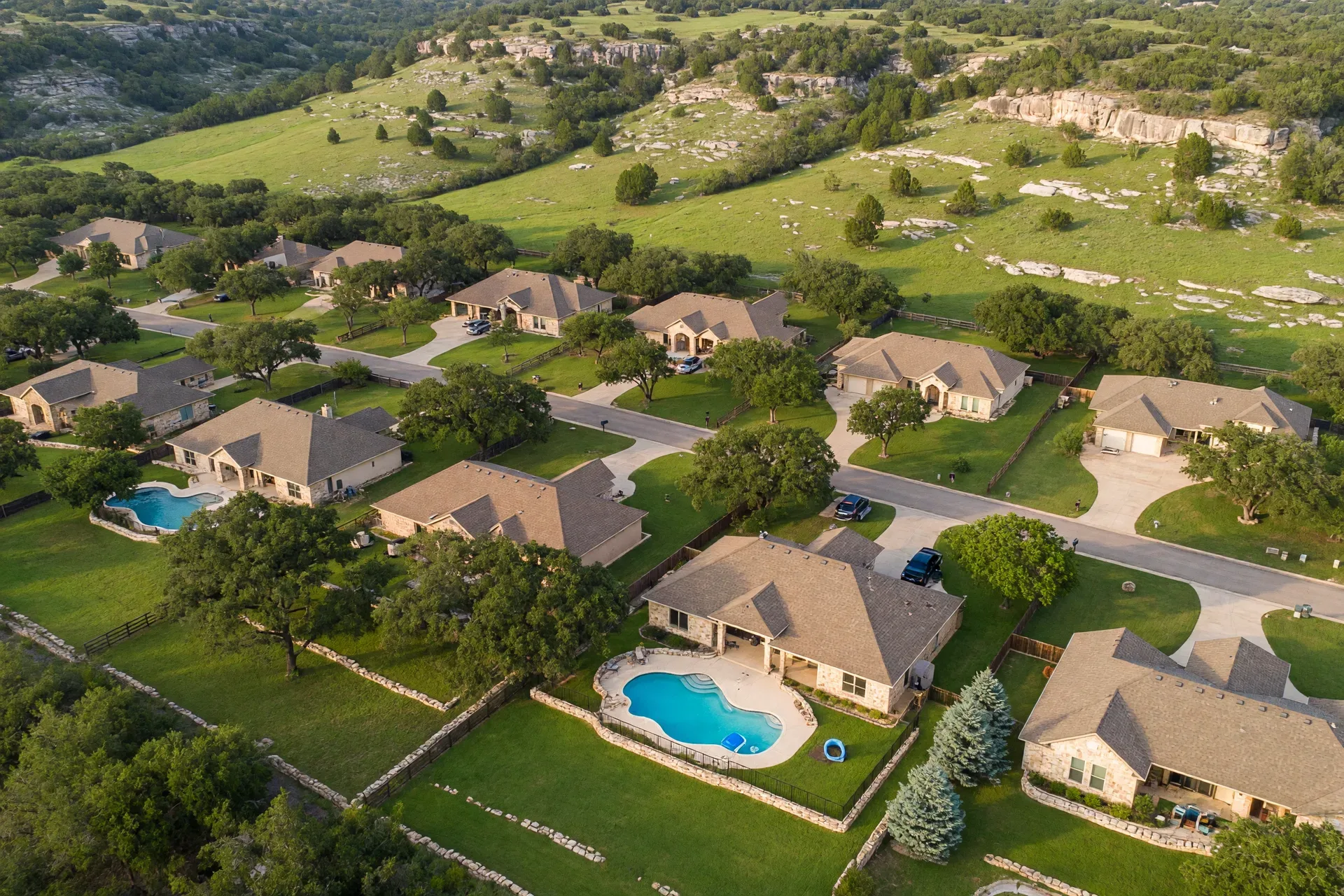
The three counties that serve most Hill Country buyers produce meaningfully different bills on the same house, so the county you buy in is a line item, not a footnote [2][3][4]:
Where a $650,000 Home Carries, Before Exemptions
| County / city | Combined rate (2025) | Annual bill, $650K home | Notes |
|---|---|---|---|
| San Antonio / Bexar | about 2.27% | about $14,760 | Highest combined rate of the three; big-city services, medical center, airport |
| Boerne / Kendall | about 1.86% | about $12,120 | Boerne ISD carries about 54% of the bill; strong schools, smaller city footprint |
| New Braunfels / Comal | about 1.79% | about $11,630 | Lowest of the three; Comal ISD is the largest slice |
Illustrative, computed from the published 2025 combined rates before exemptions [1][3][4][5]. The homestead exemption and an optional county exemption reduce each number, and the reduction on the San Antonio lines is proportionally larger because the rate is higher.
There is no free lunch here. Bexar County gives you urban amenities and the shortest airport commute, and it prices that into the tax bill. Comal County and Kendall County give you the Hill Country character and A-rated schools at a lower combined rate, and they ask you to trade some services and commute time in return [2][5]. The right county is a lifestyle decision first and a tax decision second, but it is worth deciding with the rate sheet in front of you rather than in the rearview mirror after closing.
Year One to Year Five: The 10% Cap in Action
The first-year bill matters, and the fifth-year bill matters more. With the homestead exemption filed, the appraisal cap holds annual growth to at most 10%, and protest usually holds real growth to far less. Two paths diverge after closing [7]:
Illustrative Annual Bill on a $650,000 Boerne Home, Homestead Filed
| Year | Worst case, capped at 10% growth | With a typical protest outcome |
|---|---|---|
| Year 1 | about $10,650 | about $10,650 |
| Year 2 | about $11,720 | about $11,080 |
| Year 3 | about $12,890 | about $11,520 |
| Year 4 | about $14,180 | about $11,980 |
| Year 5 | about $15,600 | about $12,460 |
Illustrative model, not a forecast. The worst case assumes the appraised value rises the full 10% cap every year, which happens in few markets. The protest column assumes a typical 3% to 5% annual reduction off the appraised value, compounding. Property values can also fall; the cap only sets a ceiling on growth, not a floor [7].
The gap between the two columns is roughly $3,140 a year by year five, about $15,700 across the five years. That is the measurable value of 20 minutes of paperwork every spring. Californians who are used to ignoring their property tax bill entirely can take the opposite habit in Texas without any real cost, because the state built the protest process to be walked [7].
The Verdict: Shock on the Line, Relief on the Budget
If you compare only the property tax line, the surprise is fair to call a shock, especially for long-time California owners whose Prop 13 base sits far below market. If you compare the lines that actually repeat every month, the picture flips. The same $250,000 household that loses to Texas on the property-tax line saves roughly $10,000 to $12,000 a year in California state income tax that simply does not exist in Texas [9]. The savings outweigh the tax-line delta before you even add the smaller mortgage, lower utility seasonality, and the exemption, cap, and protest on the Texas bill.
The practical playbook is short. Run the rate sheet for the exact property, not the county average, because ISD and special district boundaries move the number. File the homestead exemption the first year you are eligible, no exceptions. Protest every year after the notice arrives. And keep the total monthly budget, not the tax line, as the number you actually manage [1][6][7].
Run the Real Rate Before You Make an Offer
The county and ISD that serve a specific home change its tax line by thousands. That is why I pull the actual rate sheet for the property, not the ZIP-level rumor, for every California buyer I work with in Boerne, Fair Oaks Ranch, and San Antonio. The best time to understand the bill is before the offer, when the address is still a choice.

Written by
Bill Ross
Hill Country Homesteads Group, brokered by KW Boerne
Bill Ross is a Texas real estate agent (TX License 778434) whose practice is built on guiding out-of-state relocations, with a direct network of 1,100+ California real estate agents for coordinated cross-state sales. Recognized in USA Today and The Washington Post for relocation expertise. His family made the same Silicon Valley to the Hill Country transition.
Related Guides
Property Tax Shock or Relief: The Full Line-by-Line Bills
The complete anatomy of a Santa Clara County bill versus a Kendall County bill, line item by line item.
The Texas Homestead Exemption Guide
How the exemption works, who qualifies, what it saves, and where to file in Kendall, Bexar, and Comal Counties.
The Texas Property Tax Protest
How to challenge your appraisal, build a comparable-sales case, and what informal and ARB hearings are really like.
California Equity to Texas Wealth
The full worked example of a $1.2 million sale and a $650,000 Boerne purchase, including the tax lines in the monthly carry.
Frequently Asked Questions
These are the questions California buyers ask after the headline wears off, the ones that show whether the surprise is a dealbreaker or just a line item with paperwork attached.
Is the Texas property tax rate really double California's?
The headline rate usually is. California's Proposition 13 base rate is 1% of the assessed value, with voter-approved additions that typically take a recent buyer's total to roughly 1.1% to 1.2% [8]. In the Hill Country, the combined 2025 rates run about 1.79% in New Braunfels and Comal County, 1.86% in Boerne and Kendall County, and around 2.27% inside San Antonio in Bexar County [1][3][4]. But the rate is only half the story. The bill is the rate times the taxable value, and Texas applies a $140,000 homestead exemption to the school district portion, an appraisal cap that limits growth, and a protest process that usually trims the number further [6][7].
How much does the $140,000 homestead exemption save on a $650,000 Boerne home?
On a $650,000 home in Boerne ISD, the $140,000 exemption removes that amount from the school district taxable value. Boerne ISD's combined 2025 rate is $1.0109 per $100, so the exemption reduces the annual bill by roughly $1,415 on the school lines alone [1][2][6]. County and city exemptions, where offered, add a little more. That is the difference between a nominal bill near $12,000 a year and a filed homestead bill in the $10,500 to $10,700 range, before protest and before the county's optional exemption. On a home in a district at 2.2% or higher, the same exemption is worth proportionally more.
I have owned my California home for 10+ years and my Prop 13 bill is tiny. Will I pay more in Texas?
Often yes, and this is the honest shock of the whole comparison. A California owner who bought in 2016 for $600,000 has a 2026 Prop 13 assessed value near $731,000, and at roughly 1.1% the annual bill is about $8,000 [8]. A $650,000 Boerne home with the homestead filed carries a bill closer to $10,600 [1][6]. The Texas bill is larger even though the house is worth less, because Texas reassesses toward market value and starts a new buyer's taxable base at the purchase price. The relief is on the total budget: no state income tax, which is worth roughly $10,000 to $12,000 a year to a $250,000 household, more than covers the delta [9].
When do I need to file for the homestead exemption after buying in Texas?
Act the first year you are eligible. For the year you purchase and occupy the home, the application window runs to the first anniversary of closing. In later years, the general deadline is April 30 of the tax year you are claiming [7]. The exemption is retroactive to the date of purchase when you file on time, so a family that closes in June and files in November can still get the full first-year benefit on the school lines. The appraisal district that handles Boerne, Fair Oaks Ranch, and much of Kendall County is the Kendall County Appraisal District, and its form is a short one-page application.
Can I really lower my bill by protesting the appraisal?
Yes, and in Texas it is routine. The appraisal district sends a notice of value, usually in April, and you have until May 15 or 30 days after the notice to file a protest, whichever is later [7]. You can gather three to five comparable sales, attend an informal meeting with the appraiser, and if needed appear before the Appraisal Review Board. Homeowners who build a simple comparable-sales case regularly shave 3% to 8% off the appraised value, and some property tax consultants charge a percentage of the savings. With the 10% appraisal cap compounding, a protest that saves money in year two keeps saving money every year after.
Sources
- City of Boerne current tax rates, combined county, city, and ISD (Tax Year 2025): City of Boerne, Texas. www.ci.boerne.tx.us/646/Current-Tax-Rates
- Texas property tax rates by county, 2025 comparison: Ballard Property Tax Protest, 2025 rate rollup. www.ballardpropertytaxprotest.com/post/texas-property-tax-rates-by-county
- Bexar County property tax rates by taxing entity, 2025: Ballard Property Tax Protest, Bexar County (2025). www.ballardpropertytaxprotest.com/post/bexar-county-property-tax-rate
- Comal County property tax rates by taxing entity, 2025: Ballard Property Tax Protest, Comal County (2025). www.ballardpropertytaxprotest.com/post/comal-county-property-tax-rate
- City of New Braunfels tax information, 2025 total tax rate: City of New Braunfels, Texas. www.newbraunfels.gov/2470/Tax-Information
- Texas Proposition 13: increase homestead exemption to $140,000 (approved November 2025): Ballotpedia, 2025 Texas Proposition 13. ballotpedia.org/Texas_Proposition_13,_Increase_Homestead_Property_Tax_Exemption_Amendment_(2025)
- Texas Comptroller: property tax assistance, homestead exemption and appraisal cap guidance: Texas Comptroller of Public Accounts. comptroller.texas.gov/taxes/property-tax/
- California property tax basics, Proposition 13 assessed value rules: California State Board of Equalization. www.boe.ca.gov/proptaxes/
- Texas has no state income tax: Texas Comptroller of Public Accounts. comptroller.texas.gov/faq/
Last reviewed: October 9, 2026. Tax rates reflect published tax-year 2025 levies (carried into the 2026 tax year — Kendall $0.377, Bexar $0.299999, Comal $0.305015 per $100) and the $140,000 homestead exemption increase; both can change by year and district. The worked examples are illustrative models built on the stated assumptions and cited sources, not a quote or an appraisal for a specific property. This is general information, not legal, tax, or financial advice. Verify every line with your appraisal district, a lender, and a CPA before you rely on it.