
Last updated: September 2026. Reflects current Texas protest deadlines and procedures.
Almost every California buyer I work with in the Hill Country is surprised by something in their first Texas property tax experience. It is not the rate, and it is not even the bill. It is that the number on the bill is an opinion, and in Texas you get to push back on that opinion every single year. The property tax protest is a normal, routine part of homeownership here, not an aggressive act.
This guide walks through exactly how it works: when your appraisal notice arrives, whether you have grounds to file, the deadlines that actually matter, how to build a comparable-sales case, what happens at the informal and formal hearings, and whether you should hire a tax consultant [1][2][6]. It is the same advice I give new Hill Country homeowners, written down so you can act on it with confidence.
Why Texas Reappraises Your Home Every Year
The single biggest mental shift for a Californian moving to Texas is understanding that your assessed value is not a fixed number. Under California's Proposition 13, your assessed value is largely locked to your purchase price, growing at no more than 2 percent a year. That stability is exactly why most California homeowners never think about their assessment and rarely have any reason to protest.
Texas is the opposite. County appraisal districts reappraise property at or near current market value on a regular cycle, and for homestead properties they often revisit value every year [1][10]. When home prices in Kendall, Bexar, or Comal County run hot, your appraised value can climb quickly, and because your tax bill is a percentage of that value, a higher appraisal is the direct cause of a higher bill.
Here is the important nuance: if you file a homestead exemption, Texas caps the growth in your school district taxable value at 10 percent per year (plus new improvements) [10]. That cap protects you somewhat, but it does not protect you from being appraised at a value that simply does not match what your house would actually sell for. The protest exists precisely to correct that gap.
The mental model that helps: think of the appraised value as a starting number the district proposes, not a final verdict. The protest is your annual opportunity to argue that the starting number is wrong. Around half the homeowners in major Texas counties exercise this right each year, and most issues resolve without ever sitting in front of a hearing board [1][4][7].
Do You Actually Have Grounds to Protest?
Texas law gives property owners the right to protest their appraised value, and there are two main arguments that work. The first is market value: you believe your home is worth less than the district says. The second is unequal appraisal: you believe similar homes nearby are assessed at a lower value per square foot than yours [2][9].
Not every property is a good candidate. If the district appraised your home right at what it sold for and the market has been stable, you may not have much of a case. The strongest situations are when a value was pushed up by a recent sale that does not reflect your property's condition, when your home has issues a buyer would discount, or when the district used an appraised method that overshoots what similar homes actually sold for [2][9].
If you just closed on the house, be realistic: arguing the value is higher than market right after you paid market price is a hard sell. In that first year, your more credible grounds is usually unequal appraisal, which requires showing that comparable properties are assessed at a lower rate than yours. After a few years of ownership, the market-value argument becomes stronger as neighborhood sales move around you [9].
The Notice, and the Deadline That Really Matters
If your appraised value changes, the appraisal district is required to send you a written notice of appraised value in the spring, with details on how to protest [1][6]. In most Hill Country counties the notices go out in April. If you do not receive a notice, you can still file a protest if the value went up, but the clock behaves differently, so do not count on that.
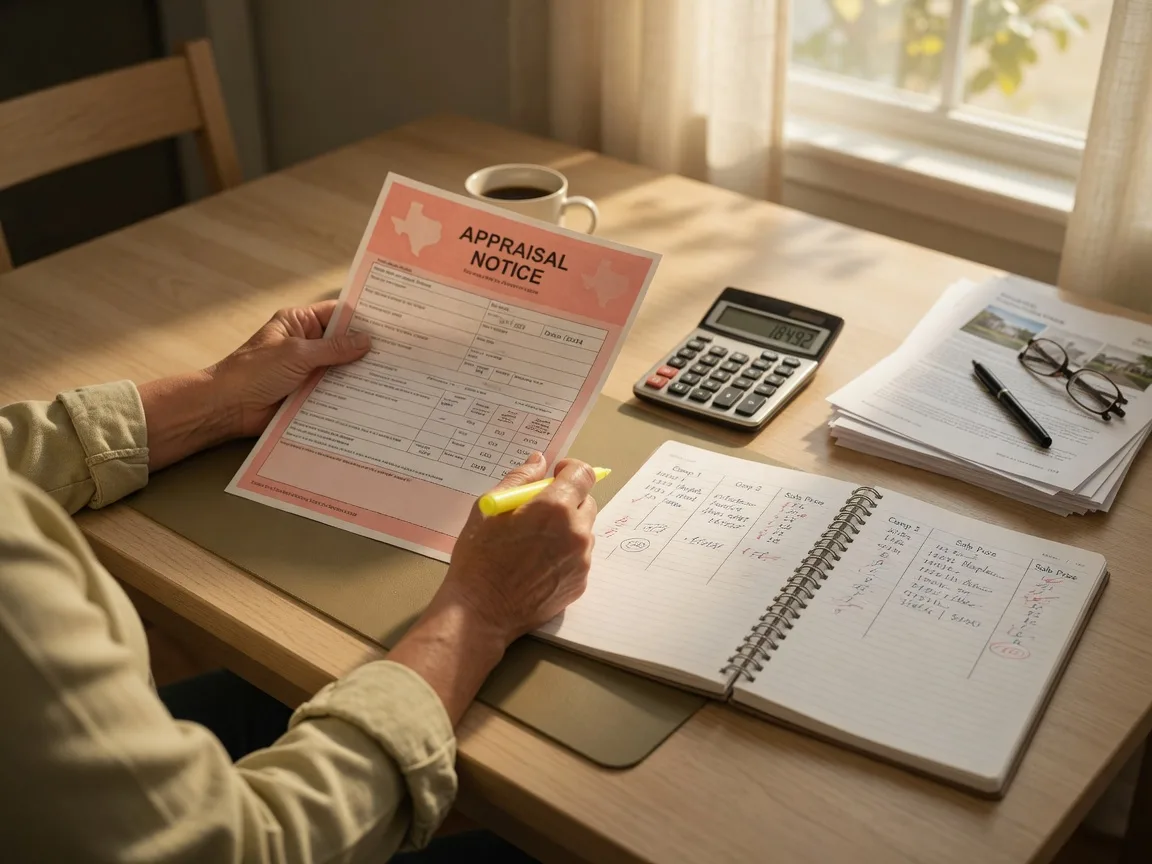
This is the number to commit to memory: file by May 15, or within 30 days of the mailing date on your notice, whichever is later [1][2]. If the deadline lands on a weekend or holiday, it moves to the next business day. That gives most homeowners from mid-April to mid-May, which feels short, so start gathering evidence the day the notice arrives rather than the week before the deadline [4][5].
Missing the deadline is costly. Without a good-cause exception, such as illness, a disaster, or military service accepted by the board before the tax rolls are certified in late July, you lose your right to protest that year's value entirely [1][2]. File early.
Hill Country Appraisal District Snapshot
| District | Where | Deadline | How to file |
|---|---|---|---|
| Kendall | Boerne | May 15 or 30 days after notice | Mail, in person, or district form |
| Bexar | San Antonio | May 15 or 30 days after notice | BCAD eFile portal, mail, or in person |
| Comal | New Braunfels | May 15 or 30 days after notice | Online, mail, or in person |
All three follow the same state-law deadline: May 15 or 30 days after the mailing date of your notice, whichever is later. Deadlines move to the next business day if they fall on a weekend or holiday [1][2][3][4][5].
How to File Your Protest
Filing is straightforward and most counties now make it easy to do online. Many districts accept a signed written statement, and the common state form is the Notice of Protest, Form 50-132, available through the Texas Comptroller [1]. In Bexar County you can file through the BCAD eFile portal; Kendall and Comal accept filings online, by mail, or in person [3][4][5].
One checkbox on the form matters more than people realize: request the appraisal district's evidence package. The district is required to provide you with the evidence, data, and information it will rely on at your hearing, so you can see exactly what comparables or cost figures support your value. Getting that package is how you know what you are arguing against [2][9].
The Evidence: What Actually Wins
A protest rises or falls on evidence, and the strongest evidence is comparable sales: recent, closed sales of similar homes. Your case is convincing when you can show several properties that sold for meaningfully less than your appraised value, ideally in the same neighborhood or ZIP and close to your home's size and age [2][9].
Here is what a solid comparison looks like in practice:
- Sold within roughly the last 6 to 12 months, the more recent the better.
- In the same neighborhood or ZIP, or as close as the local market allows.
- Within about 10 to 15 percent of your square footage.
- Within about 5 to 10 years of your home's age.
- Similar condition, lot size, and features, with obvious differences adjusted.
Appraisal districts do not always automatically have current sale prices, so you may need to bring them. Your real estate agent can pull closed sales and help you frame the comparison fairly. Photographs of any condition issues, such as an aging roof, settling cracks, or dated interiors, can reinforce a value argument, but the sales data is what carries the most weight [2][9].
Keep your case simple. You do not need a dozen charts. You need a small set of comparable sales, a short written explanation of why your value is too high or unequal, and photos if they help. A clear, well-organized case is far more persuasive than a long, unfocused one.
The Informal Hearing, Then the Appraisal Review Board
Most districts start with an informal conference between you and an appraisal staff member. This is not a courtroom. It is a working meeting, often held by phone or video, where you present your comparables and the staff can agree to adjust the value on the spot. In Bexar County the overwhelming majority of residential protests resolve at this informal stage, which is exactly why the process feels so approachable to new homeowners [4][7].
If you and the district cannot agree, you can take the case to a formal hearing before the Appraisal Review Board (ARB), a panel of local citizens who are trained and appointed to make binding decisions [1][2][6]. The district must send you at least 15 days' notice of the hearing date, time, and place, and must mail you the Texas Property Taxpayer Bill of Rights at least 14 days beforehand [1][6]. You can appear in person, by phone or video, or submit your evidence in writing.
The ARB can lower your value, uphold it, or in theory raise it, though the last is rare and almost never happens in a routine residential protest. Most cases settle before this stage; of those that go to a hearing, many homeowners appear with their comparables and let the evidence speak [1][9].

Appeals, and What a Win Is Actually Worth
If you disagree with the ARB's order, Texas gives you two further paths: you can appeal to district court within 60 days of receiving the order, or you can request binding arbitration, which is usually faster and cheaper than litigation [1][9]. These steps are worth knowing but are rare for a typical homeowner, most of whom resolve their protest at the informal or ARB stage.
To make the financial picture concrete, here is a realistic illustration for a Hill Country home, not guaranteed, but representative of how the arithmetic works. Take a home appraised at a value the owner successfully argues is 8 percent too high:
Illustrative Protest Savings: 700,000 Home
| Appraised value as set by the district | 700,000 |
| Value reduction from a successful protest (illustrative 8%) | − 56,000 |
| Tax savings at an effective rate near 2.5% | ≈ 1,400 / year |
| Consultant share at a typical 30% contingency | − 420 |
| Your net annual savings (with consultant) | ≈ 980 / year |
Illustrative only. Actual savings depend on your appraised value, exemptions, taxing entities, and the effective rate in your specific district. The homestead exemption already reduces the school portion of your bill, so gross savings here are a top-line estimate [1][8][10].
A tax cut is not a one-year event. If your value is corrected and neighborhood values stay in line, that lower value applies every subsequent year until the district reappraises you again, so a 56,000 reduction can repeat year after year. This is why the protest is best treated as an annual habit rather than a one-time fix [1].
Should You Hire a Property Tax Consultant?
Property tax protest consultants are common and perfectly legitimate in Texas. They take your case, build the comparable-sales file, and handle the hearings for you, and they typically charge a contingency fee of roughly 25 to 50 percent of your first-year savings, meaning no fee at all if they do not win [8]. For a homeowner who would rather not spend the time, that trade is often worth it.
The tradeoff is transparent: you give up a cut of the savings, but you hand off the work and the know-how. If you are comfortable pulling a few comparable sales and sitting on a phone call, you can absolutely do it yourself and keep all of the savings. There is no right answer for everyone. Compare the fee percentage before signing, because it directly changes your net result [8].
One practical note for California relocators specifically: this is an unfamiliar muscle. In California you may never have protested in your life, because Prop 13 rarely gives you a reason. In Texas, expect to consider it most years. Building a relationship with a real estate agent who can pull your comparables, or with a tax consultant, is simply part of becoming a Texas homeowner, and it is a habit worth forming early [1][8].
What I tell new California buyers: file your homestead exemption on day one, because the 10% annual cap and the exempt portion of the school bill are your baseline protection. Treat the protest as the annual fine-tuning on top of it. Get both habits right and you will handle Texas property taxes with none of the sticker shock I see in almost every first-year conversation [10].
Frequently Asked Questions
These are the protest questions I hear most from California buyers evaluating the Hill Country. Every property is different, but the process is consistent.
Is the tax protest really worth the effort for a typical homeowner?
For most Hill Country homeowners, yes. The appraisal district sets your value, and the tax bill is a direct percentage of it. A modest reduction compounds every year the value stays adjusted. Industry experience and appraisal-district data point to most successful protests resolving in the informal phase, and many homeowners drop the value by single digits to over 10 percent. Even a smaller reduction can justify an hour of your time, because a consultation is free at no upfront cost.
What if I miss the May 15 deadline?
The deadline is May 15, or 30 days after the appraisal district mails your notice, whichever is later. If you miss it, you generally lose your right to protest that year's value unless you can show good cause, such as illness, a disaster, or military service, and the Appraisal Review Board accepts it before the tax rolls are certified, typically in late July. File as soon as the notice arrives rather than waiting for the calendar deadline.
Do I have to hire a property tax consultant?
No. You can file and present a protest yourself, and many people do. A consultant is essentially paying someone to do the comparable-sales research and handle the hearing for you, usually on a contingency of roughly 25 to 50 percent of your first-year savings, so there is no fee unless you win. The tradeoff is simple: a consultant costs you a cut of the savings but saves you the time. Either path is normal and legitimate in Texas.
How is this different from protesting in California?
In California, Proposition 13 locks your assessed value to your purchase price with a 2 percent annual cap, so most homeowners rarely see a large reassessment and have little reason to protest. Texas reappraises at or near market value on a regular schedule, and a jump in your appraised value is common. That is why the protest is a routine annual habit here, and it is worth understanding before you buy, not after you open the first big tax bill.
Can I protest a property I just bought for market value?
Yes, but the bar is higher right after a sale. If you closed at a price that matches the appraisal district value, it is harder to argue the value is too high. Your strongest grounds that first year are unequal appraisal, meaning similar homes nearby are assessed lower per square foot. After the property has been in your name for a few years, a market-value argument built on recent nearby sales carries more weight.
Know Your Starting Number Before You Buy
The best time to understand a property's tax picture is before you make an offer, not after your first bill arrives. Every California-to-Texas move I coordinate starts with running the real numbers for the exact properties we are considering: the appraised value, the exemptions that apply, the effective rate, and what a future protest could realistically win.
If you are evaluating the Hill Country, I am happy to walk through the property tax math for a specific home or neighborhood, with real figures for your price point and timeline. A direct conversation beats any general article.

Written by
Bill Ross
Hill Country Homesteads Group, brokered by KW Boerne
Bill Ross is a Texas real estate agent with nearly four decades in high-tech sales and a network of 1,000+ California real estate agents for coordinated cross-state transactions. He founded Hill Country Homesteads Group to give coast-to-coast clients a direct, data-driven path to the Texas Hill Country.
Related Guides
Texas Homestead Exemption Guide
How to file, how much you save, and the deadlines that matter for every new Texas homeowner.
Property Tax Shock or Relief
A line-by-line comparison of what you pay in California versus Texas.
The Tax Bill Beneath the Tax Bill
MUDs, PIDs, ESDs, and the special districts that layer onto your base rate.
Why California Buyers Underestimate Texas Property Taxes
Why the no-income-tax headline does not tell the full story.
Sources
- Texas Comptroller of Public Accounts, "Appraisal Protests and Appeals" — Filing deadline, Form 50-132, informal and ARB hearing process, and appeals. comptroller.texas.gov/taxes/property-tax/protests/
- Texas Tax Code §41.44 and §41.47–41.67 — Protest deadline (May 15 or 30 days after notice) and Appraisal Review Board procedure. statutes.capitol.texas.gov/Docs/TX/htm/TX.41.htm
- Kendall Appraisal District — Appraisal notice timing and protest filing for Boerne and Kendall County. kendallad.org/
- Bexar Appraisal District, "Property Tax Protest and Appeal Procedures" — BCAD eFile, informal hearing schedule, and dispute steps for San Antonio. help.bcad.org/hc/en-us/articles/39781924621587-Property-Tax-Protest-and-Appeal-Procedures
- Comal Appraisal District, "Protest Information" — Notice of Protest form and filing for New Braunfels and Comal County. comalad.org/protest-information/
- Texas Comptroller of Public Accounts, "Texas Property Taxpayer Bill of Rights" — Rights to notice, protest, and a hearing before the ARB. comptroller.texas.gov/taxes/property-tax/bill-of-rights.php
- Bexar County property tax protest guide — Informal hearing settlement experience and evidence tips for the Bexar appraisal district. lrgrealty.com/lrg-blog/how-to-protest-property-taxes-bexar-county/
- AppealDesk, "Best Texas Property Tax Protest Services: Pricing Compared" — Typical contingency fees for Texas tax protest consultants. www.appealdesk.com/compare/best-texas-property-tax-protest-services
- Texas Legal Guide, "Property Tax Protest: ARB & Arbitration Guide" — Appeal options after the ARB, including district court and binding arbitration. texaslegal.guide/guides/texas-real-estate-law/property-tax-protest/
- Texas Tax Code §23.23 — 10% cap on annual appraisal increases for homestead properties. statutes.capitol.texas.gov/Docs/TX/htm/TX.23.htm
Last reviewed: September 2026. Deadlines and procedures follow Texas state law and published district guidance; verify with your county appraisal district for your specific property and tax year.