

Important Disclaimer
This article provides general educational information for comparative purposes only. Home prices, property taxes, insurance premiums, lot sizes and finish levels vary by specific property, community, market conditions and date of purchase. Figures cited are approximations based on publicly available data and should not be relied upon as guarantees or specific predictions. Consult a licensed real estate agent, mortgage professional, tax advisor and insurance agent for advice specific to your situation.
Scope and Methodology
This comparison covers Boerne, Fair Oaks Ranch and Spring Branch in Texas; San Jose, Fremont and Walnut Creek in the Bay Area; and Santa Monica, Manhattan Beach and Hermosa Beach in coastal Los Angeles County. These are selected-city examples, not regional medians.
Spring Branch-area data is drawn from Realtor.com listings and local market observations. Spring Branch is an unincorporated community; boundary definitions vary by source.
Property profiles were developed from citywide market context, local market observations and representative property types for each selected city. Because no separate price-band dataset is disclosed in this article, the square-footage, age, lot-size and HOA ranges below should be treated as illustrative profiles rather than statistical medians or guaranteed outcomes.
Here is the short version: in the selected markets examined here, the same purchase price buys substantially more interior space and private land in the Texas Hill Country. California buyers are paying a significant premium for location, employment access, climate and proximity to the coast — and at the lower price tiers, that premium buys attached housing rather than a detached home. The monthly payments are comparable, but what you get for those payments is dramatically different.
The $600,000 Tier
At $600,000, the contrast is stark.
Hill Country
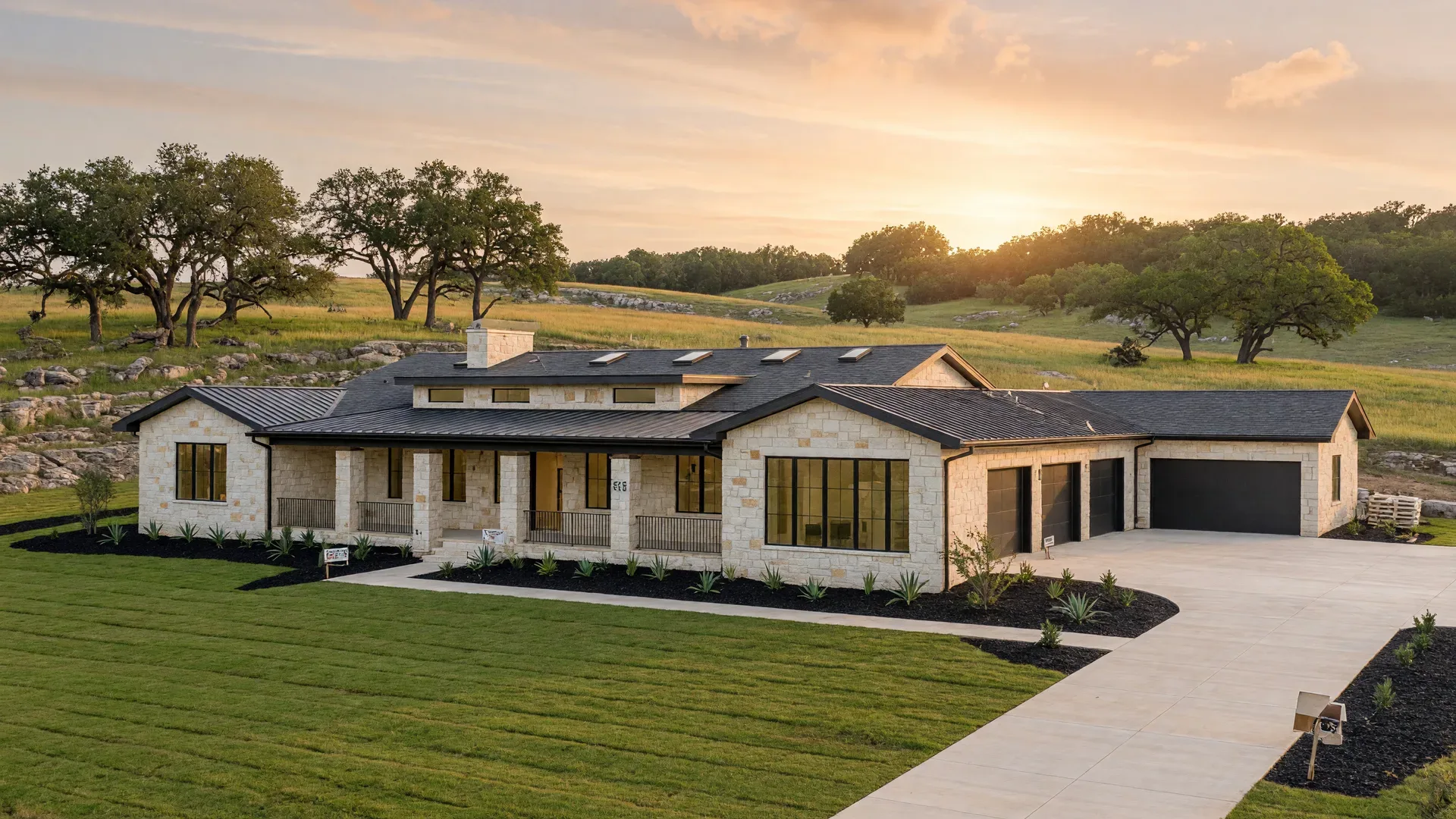
At approximately $600,000, the illustrative profiles for Boerne and Spring Branch assume a new or recently built detached home with roughly 2,200 to 2,800 square feet, three or four bedrooms, a modern kitchen, a two-car garage and a suburban-size yard. Actual availability, specifications and builder upgrades vary by community and date.
Fair Oaks Ranch is different: buyers at this price are more likely to encounter an existing home than brand-new construction. Across all three markets, acreage should not be assumed at this tier. A buyer seeking more land will usually trade off some combination of age, condition, square footage or proximity to town.
Bay Area
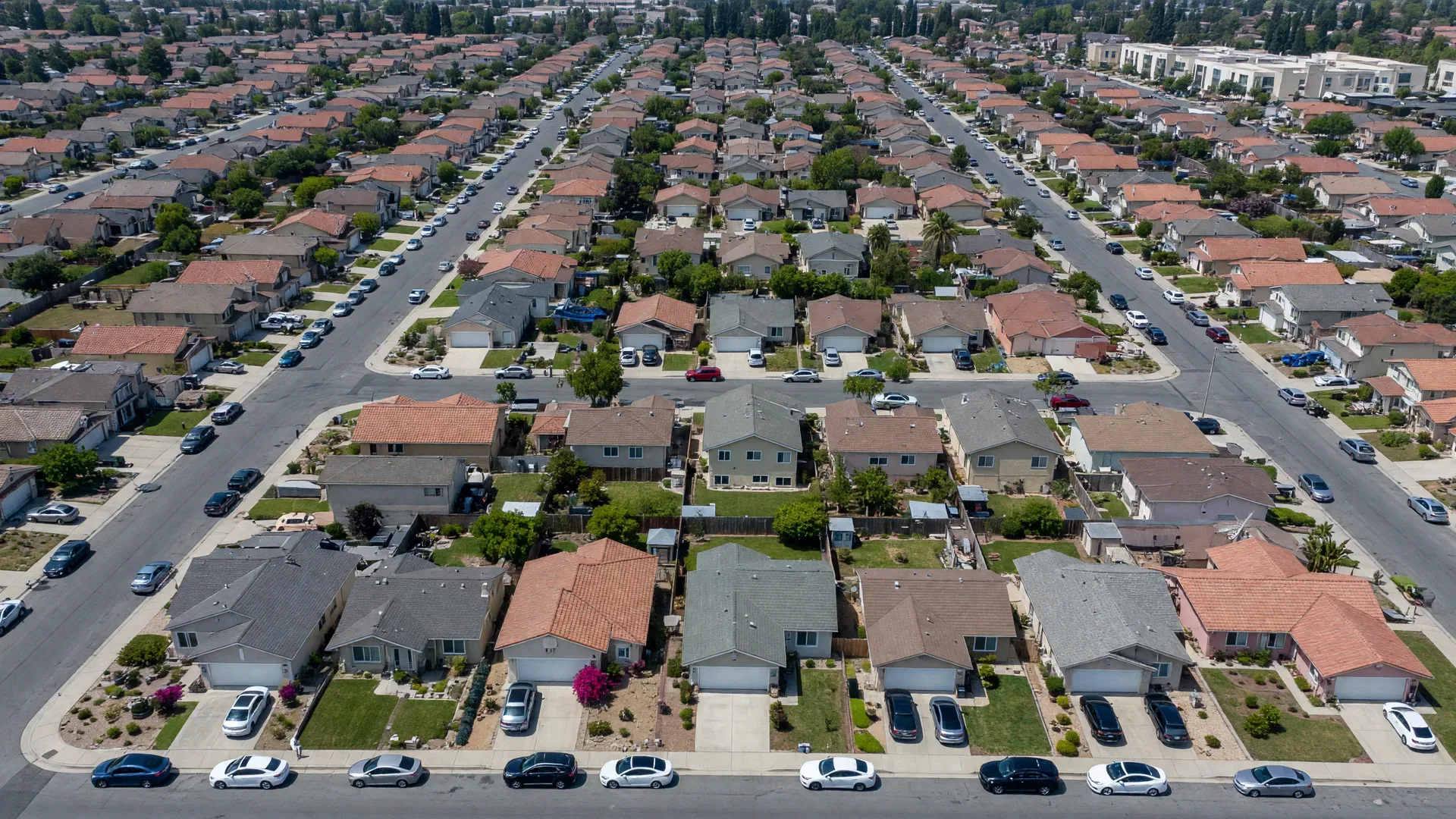
At $600,000 in San Jose, Fremont or Walnut Creek, a detached single-family home in the three selected cities is effectively unavailable. The only realistic options are condos or townhomes — older units, typically built decades ago, with shared walls, limited parking and property-specific HOA dues that can run $300 to $600 per month. You are paying $600,000 for a 900-to-1,300-square-foot unit that may need renovation, with no private yard and no real autonomy over your living space.
Coastal LA
At $600,000 in Santa Monica, Manhattan Beach or Hermosa Beach, inventory is extremely limited. The realistic options are condos — 600 to 1,000 square feet, with no private yard, no real privacy and HOA dues that can run $400 to $800 per month. A detached single-family home in these cities is not a realistic possibility at this price. You are paying over half a million dollars for a small attached unit in markets where the median sale price starts at $1.74 million and goes up from there.
$600K Comparison
| Feature | Hill Country | Bay Area | Coastal LA |
|---|---|---|---|
| What you get | New or newer 3-4 bed home, 2,200-2,800 sq ft, yard | Condo/townhome, 900-1,300 sq ft, shared walls | Condo, 600-1,000 sq ft, extremely limited inventory |
| Lot size | Fraction of an acre (yard) | Little or no private outdoor space; varies by property | Little or no private outdoor space; varies by property |
| Condition | New, newer or existing; varies by property | Older, may need renovation | Varies by property; inventory is limited |
| Garage | Two-car garage in the illustrative profile; verify the property | Parking varies by property and association | Parking varies by property and association |
| HOA | Property-specific; $0-$50/month used in payment illustration | $300–$600/month | $400–$800/month |
Mortgage rate assumption: 6.5% (rounded illustrative rate; Freddie Mac reported a national average of 6.58% for a 30-year fixed conforming mortgage on July 23, 2026).
$600K Monthly Payment
| Component | Hill Country | Bay Area | Coastal LA |
|---|---|---|---|
| Down payment (20%) | $120,000 | $120,000 | $120,000 |
| Monthly P&I (6.5%, 30-year) | $3,034 | $3,034 | $3,034 |
| Illustrative property taxes (monthly; Texas shown before homestead exemption) | $950 (1.9%) | $560 (1.12%) | $585 (1.17%) |
| Illustrative insurance assumption (monthly; not a matched quote) | $350 | $175 | $185 |
| HOA (monthly) | $0–$50 | $450 | $600 |
| Total monthly | $4,334–$4,384 | $4,219 | $4,404 |
| Income at 28% ratio | $185,700–$187,900 | $180,800 | $188,700 |
Note on HOA: HOA dues are illustrative assumptions tied to the property type described in each tier's text. Detached properties without an association typically have $0 HOA; attached properties have HOA dues that vary by building. Verify the actual HOA for any specific property.
Note on insurance assumptions: Insurance figures are planning assumptions, not matched quotes. The Texas examples assume detached-home coverage, while California attached-home examples may require unit-owner coverage in addition to master-policy costs included in HOA dues. Because policy type, replacement-cost coverage, deductibles and catastrophe coverage have not been standardized, these figures should not be used to conclude that one market's insurance is inherently cheaper.
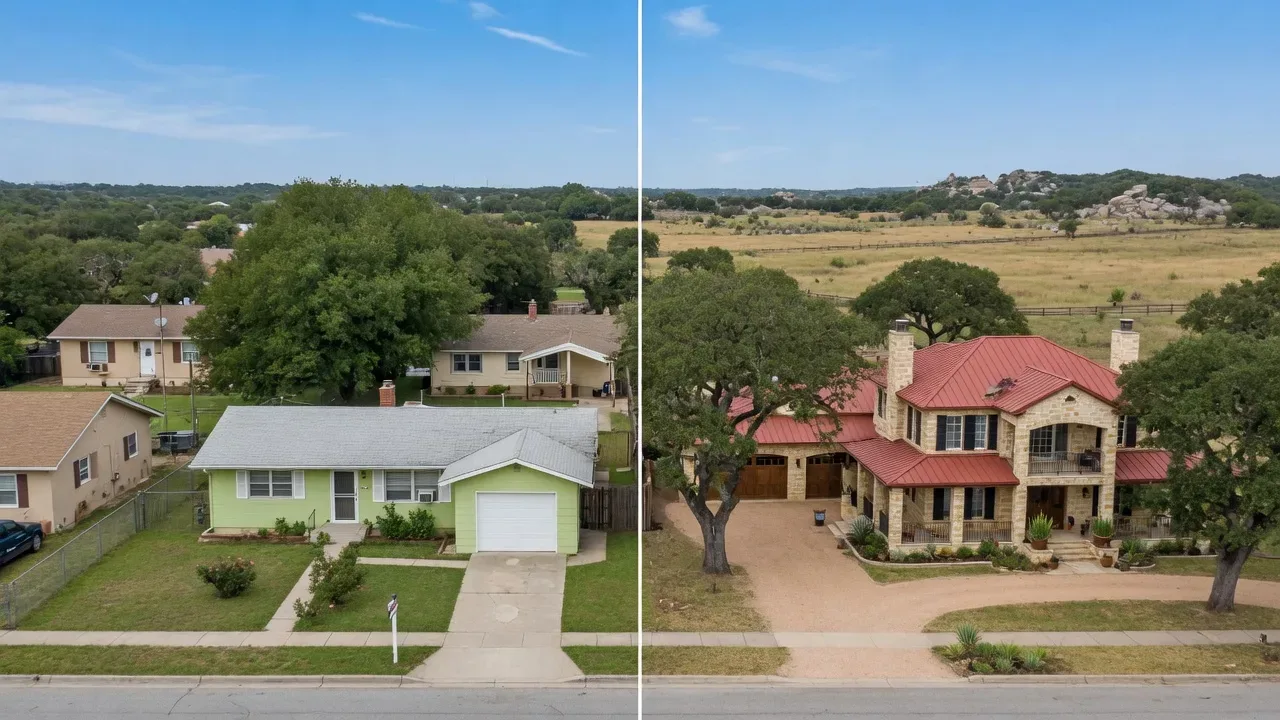
These monthly payments are remarkably similar — and that is the point. For roughly the same monthly outlay, the Hill Country gets you a newer, detached three-to-four-bedroom home with a yard and real autonomy over your property. The Bay Area and coastal LA get you a small condo with shared walls, HOA obligations and no private outdoor space. The value gap is enormous.
Note on Texas property taxes: Texas property taxes depend on the property's actual taxing-unit stack and appraised value. The 1.9% figure is a simplified pre-exemption assumption, not a universal Hill Country rate. A qualifying residence homestead receives a $140,000 exemption from school-district taxation, but that exemption does not reduce the taxable value used by every county, city, utility district or other taxing unit.
The $800,000 Tier
At $800,000, the gap widens.
Hill Country
At approximately $800,000, buyers can generally choose between a larger, extensively upgraded home on a community-size lot and an older or smaller home with more land. Some properties offer 3,000 or more square feet, additional garage space, outdoor living areas or a pool. Acreage is also possible in parts of the broader Hill Country, but acreage, premium finishes, views, mature trees and auxiliary buildings should be treated as tradeoffs rather than a standard package.
The practical advantage at this tier is choice: buyers can emphasize interior space, newer construction, neighborhood amenities or land. They should not assume that one property will provide all four.
Bay Area
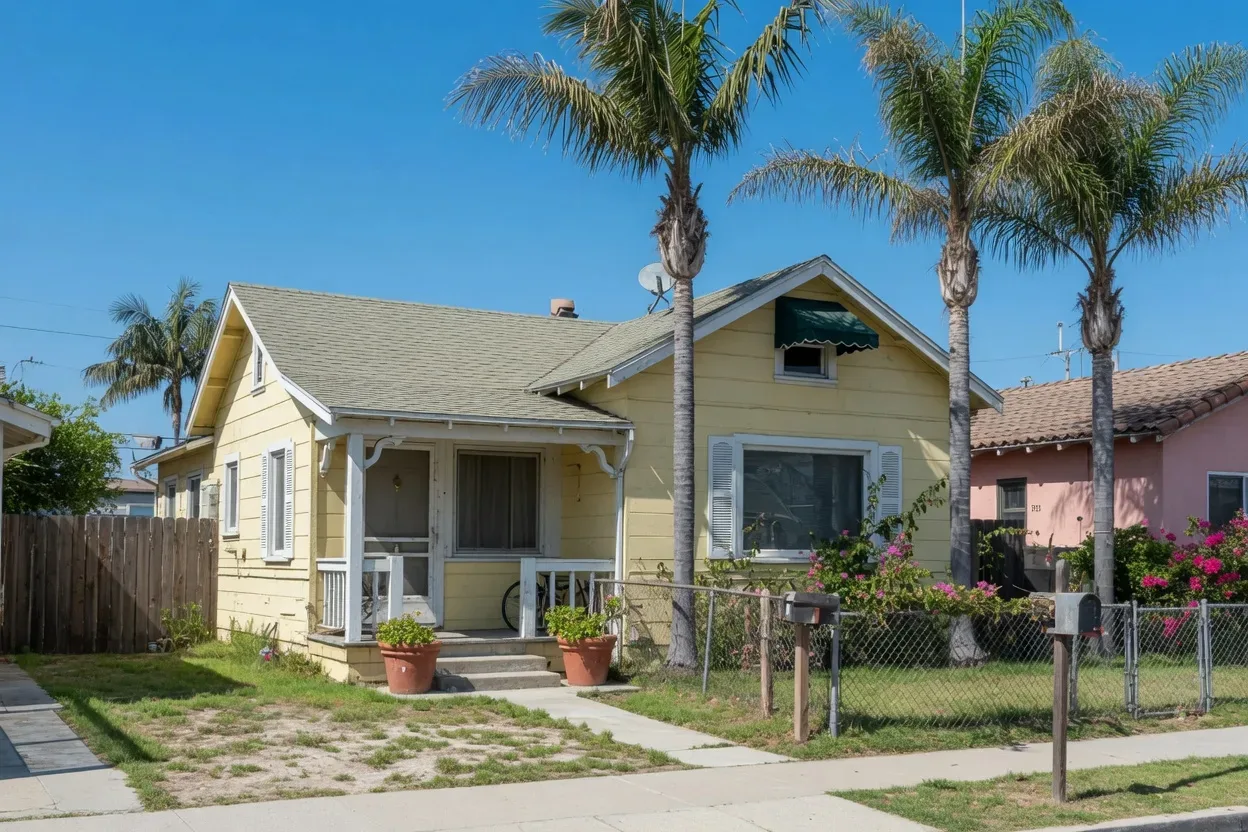
At $800,000, the picture in San Jose and Fremont does not improve dramatically. You are still generally looking at attached housing — a condo or townhome in a 1970s-to-1990s development that may or may not have been updated. Walnut Creek offers more detached options near this price, but much of its inventory remains attached. Even at $800,000, a detached home in the Bay Area is not a sure thing.
Coastal LA
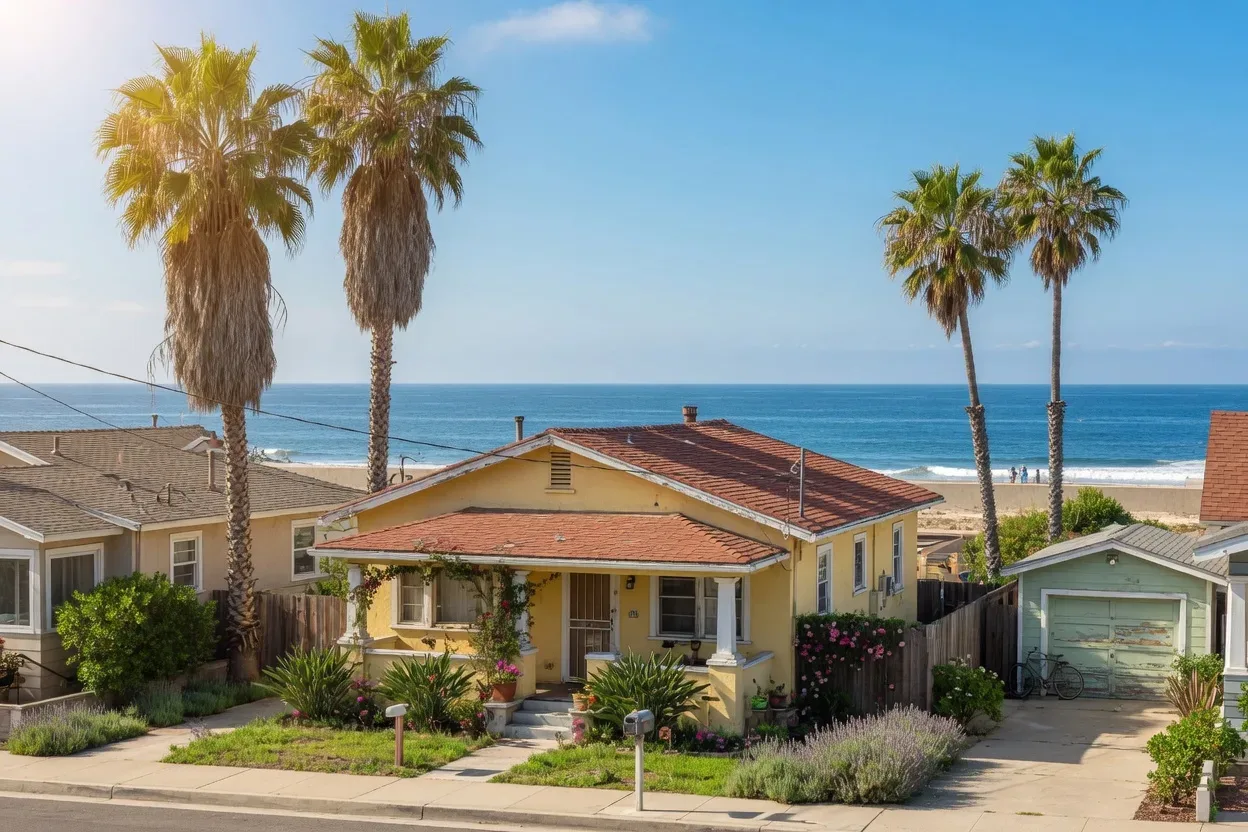
At $800,000 in Santa Monica, Manhattan Beach or Hermosa Beach, you are still evaluating condos or townhomes with shared walls. A detached home near the beach at this price remains extremely difficult to find. The HOA dues alone can run $300 to $600 per month, on top of a purchase price that buys you far less square footage than the same money delivers in Texas.
$800K Comparison
| Feature | Hill Country | Bay Area | Coastal LA |
|---|---|---|---|
| What you get | Larger upgraded home on a community lot, or an older/smaller home with acreage | Condo/townhome, 1,400-1,800 sq ft, attached | Condo/townhome, 1,000-1,400 sq ft, attached |
| Lot size | Suburban lot common; acreage available with location, age or size tradeoffs | Small lot or no private lot | No private lot (condo) |
| Condition | Newer, upgraded or older acreage property; varies by location | Older; may or may not be updated | Varies by property; may need updates |
| Garage | Two-to-three-car garage in the illustrative profile; varies by property | Varies by property and association | Varies by property and association |
| HOA | Varies by community; $0-$75/month used in payment illustration | $350/mo assumed | $500/mo assumed |
| Pool | Possible, but not assumed | Property- or community-specific | Property- or community-specific |
$800K Monthly Payment
| Component | Hill Country | Bay Area | Coastal LA |
|---|---|---|---|
| Down payment (20%) | $160,000 | $160,000 | $160,000 |
| Monthly P&I (6.5%, 30-year) | $4,045 | $4,045 | $4,045 |
| Illustrative property taxes (monthly; Texas shown before homestead exemption) | $1,267 (1.9%) | $747 (1.12%) | $780 (1.17%) |
| Illustrative insurance assumption (monthly; not a matched quote) | $400 | $210 | $220 |
| HOA (monthly) | $0–$75 | $350 | $500 |
| Total monthly | $5,712–$5,787 | $5,352 | $5,545 |
| Income at 28% ratio | $244,800–$248,000 | $229,400 | $237,600 |
Rounding note: Texas property-tax line rounded from exact $1,266.67 ($800,000 × 1.9% ÷ 12).
Note on HOA: HOA dues are illustrative assumptions tied to the property type described in each tier's text. Detached properties without an association typically have $0 HOA; attached properties have HOA dues that vary by building. Verify the actual HOA for any specific property.
Under these assumptions, the Hill Country runs approximately $360 to $435 more per month than the Bay Area example and approximately $170 to $240 more than the coastal LA example. The illustrative Hill Country profile generally offers a larger detached home and, in some cases, more land, but buyers should not assume that maximum interior space, acreage and premium features will be available together.
Note on Texas property taxes: Texas property taxes depend on the property's actual taxing-unit stack and appraised value. The 1.9% figure is a simplified pre-exemption assumption, not a universal Hill Country rate. A qualifying residence homestead receives a $140,000 exemption from school-district taxation, but that exemption does not reduce the taxable value used by every county, city, utility district or other taxing unit.
The $1,200,000 Tier
At $1.2 million, the gap between markets is substantial.
Hill Country
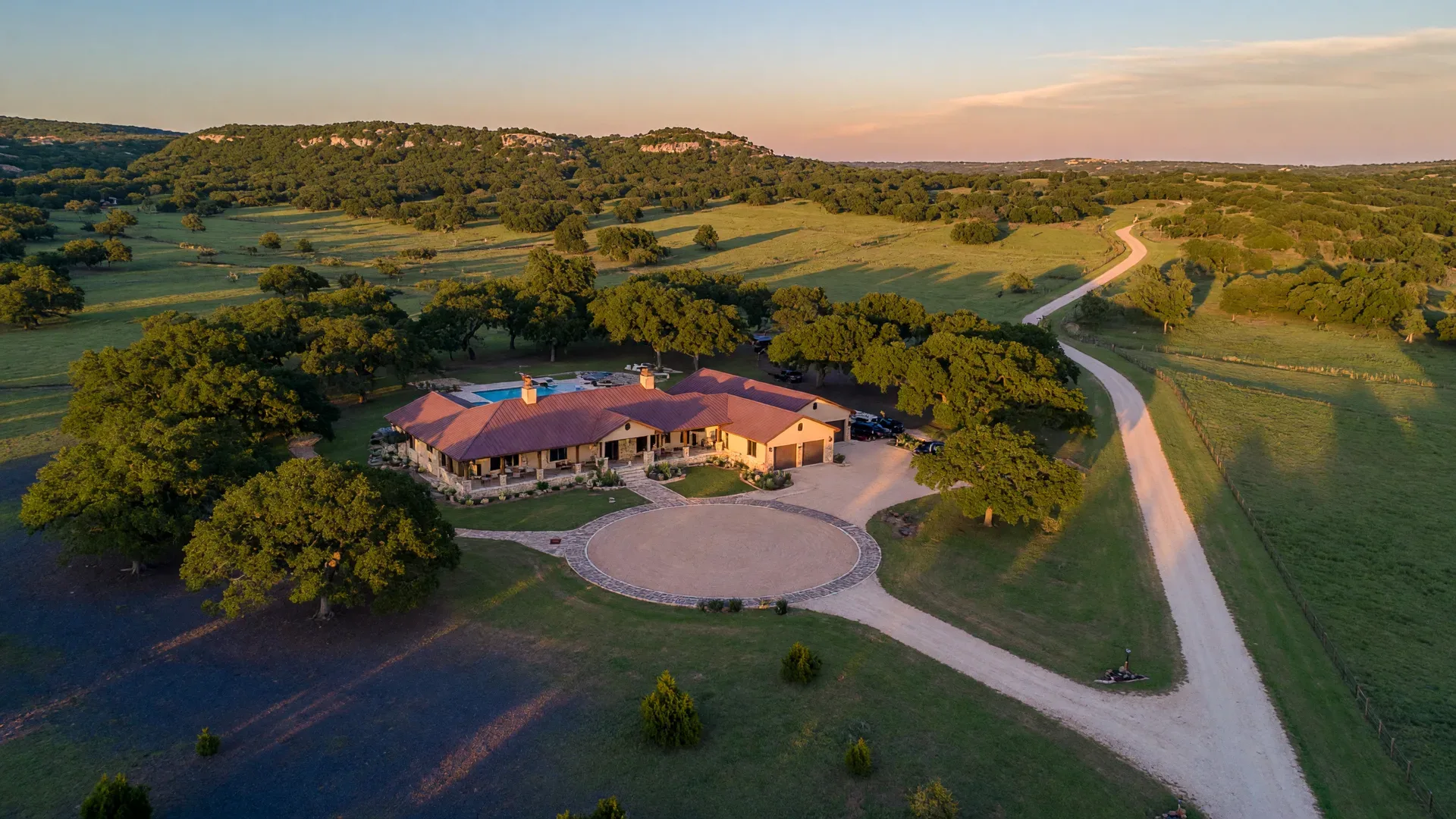
At $1.2 million, you enter the upper end of the Hill Country market and can find genuinely impressive properties — custom construction, 4,000 to 6,000+ square feet, pools, acreage, guest houses and equestrian facilities in parts of the inventory. Not every feature comes standard, and buyers should expect tradeoffs between size, land, finishes and location. But the possibilities at this price are extraordinary compared to what the same money buys in California.
Bay Area
At $1.2 million, the three selected Bay Area cities diverge substantially. In San Jose or Fremont, you may find a smaller detached home that needs work, or an attached property. Walnut Creek offers more detached options, but the result is still a suburban home on a small lot — not an estate. A single 1,800-to-2,400-square-foot profile should not be applied to all three cities. In every case, lot size, school assignment, condition and commute access depend heavily on the exact address.
Coastal LA
At approximately $1.2 million in Santa Monica, Manhattan Beach or Hermosa Beach, buyers are still primarily evaluating condos and townhomes. Detached homes are scarce at this price, particularly near the beach, and an ocean view should not be presented as typical. The buyer is paying a substantial location premium, but the exact result varies sharply by city, distance from the water, property type, HOA obligations and condition.

$1.2M Comparison
| Feature | Hill Country | Bay Area | Coastal LA |
|---|---|---|---|
| What you get | Luxury custom or semi-custom home; size, acreage, pool and auxiliary improvements vary and involve tradeoffs | Varies by city: a smaller or older detached home, a fixer or an attached home; Walnut Creek generally offers more detached-home choices | Primarily a condo or townhome; detached opportunities are scarce in the three selected cities |
| Lot size | Community lot to several acres; location, condition and property features involve tradeoffs | No private lot if attached; detached-lot size varies | Usually no private lot if attached; detached-lot size varies |
| Condition | Newer custom or semi-custom home, resale home or acreage property | Varies from updated to needing work | Varies by building and unit |
| Garage | Two-to-three-plus spaces in the illustrative profile; varies by property | Varies by property | Varies by property |
| Pool | Possible, but not assumed | Not assumed; property- or community-specific | Not assumed; property- or community-specific |
| Guest house | Possible, but not assumed | Not assumed | Not assumed |
| HOA | Varies by community | $0 if detached; property-specific if attached | Property-specific; $450 is used only in the payment illustration |
Financing Warning: A $1.2 million purchase with 20% down produces a $960,000 loan. That exceeds the 2026 baseline conforming limit of $832,750 applicable in most Texas counties, so the Texas loan would ordinarily be a jumbo loan. Santa Clara, Alameda, Contra Costa and Los Angeles counties qualify for higher high-cost limits. Jumbo and high-balance conforming loans may carry different rates, reserve requirements and underwriting standards. The figures below are arithmetic illustrations, not evidence that the same loan terms would be available in every market.
$1.2M Monthly Payment
| Component | Hill Country | Bay Area | Coastal LA |
|---|---|---|---|
| Down payment (20%) | $240,000 | $240,000 | $240,000 |
| Monthly P&I (6.5%, 30-year) | $6,068 | $6,068 | $6,068 |
| Illustrative property taxes (monthly; Texas shown before homestead exemption) | $1,900 (1.9%) | $1,120 (1.12%) | $1,170 (1.17%) |
| Illustrative insurance assumption (monthly; not a matched quote) | $475 | $260 | $275 |
| HOA (monthly) | $0–$100 | $300 (illustrative attached-home scenario) | $450 |
| Total monthly | $8,443–$8,543 | $7,748 | $7,963 |
| Income at 28% ratio | $361,800–$366,100 | $332,100 | $341,300 |
The monthly payments are within about $800 of each other. For a buyer in the Hill Country, the profile includes larger square footage, more land and the potential for auxiliary features depending on the specific property. The selected Bay Area cities do not share one $1.2 million profile. Walnut Creek may offer a detached home, while San Jose and Fremont may produce a smaller or older detached home, a fixer or an attached property. Coastal LA generally provides an attached home at this budget in the three selected cities.
Note on Bay Area HOA: The Bay Area total-payment and income figures in this table illustrate an attached property with a $300 monthly HOA fee. A detached home without an HOA would produce a lower total, while another condo or townhome could have materially higher dues.
Note on HOA: HOA dues are illustrative assumptions tied to the property type described in each tier's text. Detached properties without an association typically have $0 HOA; attached properties have HOA dues that vary by building. Verify the actual HOA for any specific property.
Note on Texas property taxes: Texas property taxes depend on the property's actual taxing-unit stack and appraised value. The 1.9% figure is a simplified pre-exemption assumption, not a universal Hill Country rate. A qualifying residence homestead receives a $140,000 exemption from school-district taxation, but that exemption does not reduce the taxable value used by every county, city, utility district or other taxing unit.
The Santa Clara County Reality Check
To put this in perspective, consider Santa Clara County, the heart of Silicon Valley. In June 2026, the median sale price of an existing single-family home in Santa Clara County was $1.95 million. That figure describes the midpoint of sale prices, not one standard home configuration. The county includes markets ranging from Gilroy and Morgan Hill to Palo Alto, Los Altos and Cupertino, so the size, age, lot and condition associated with the median vary considerably.
Source: California Association of REALTORS®, “June Home Sales and Price Report.” https://www.car.org/aboutus/mediacenter/newsreleases/2026releases/june2026sales
For $1.2 million in the Texas Hill Country, the illustrative profile used in this analysis is a larger, newer home with more square footage and private land, although exact comparisons depend on specific properties, locations and market conditions.
These are market-data observations, not editorial claims about which region offers objectively better value.
Who Can Actually Afford These Homes?
The numbers above assume you have the income to qualify. But what do households in these markets actually earn?
According to the U.S. Census Bureau's 2024 American Community Survey 1-year estimates:
- San Jose-Sunnyvale-Santa Clara MSA: median household income approximately $164,800
- San Francisco-Oakland-Fremont MSA (includes Fremont and Walnut Creek): approximately $135,600
- Los Angeles-Long Beach-Anaheim MSA: approximately $96,400
- San Antonio-New Braunfels MSA: approximately $78,100
These metro-level figures provide broad economic context but do not represent the household incomes of the individual cities or neighborhoods sampled in this article.
Under the article's 20%-down and 28%-housing-ratio assumptions, the indicated income exceeds the median household income in every metro examined. That does not mean every household below the threshold is unable to buy. Larger down payments, accumulated equity, cash purchases, co-borrowers, other debts and lender underwriting materially change affordability.
See the Census table at: data.census.gov/table/ACSDT1Y2024.B19013
The mortgage payment comparison is only part of the financial picture. Texas has no individual state income tax, while California imposes one of the highest state income taxes in the nation. For a household earning $250,000, the California income tax can exceed $20,000 per year. That is real money that does not show up in the monthly mortgage payment but directly affects your take-home pay and your ability to save, invest or afford a larger down payment.
The Texas state income tax advantage does not fully offset Texas's higher property taxes. The net effect depends on income level, deductions, filing status and the specific property. But for many relocators, particularly those selling California homes with substantial equity, the combination of no state income tax and lower California property-tax-equivalent costs can make the total financial footprint meaningfully different.
Illustrative Income at a 28% Housing-Expense Ratio
The 28% figure is a front-end budgeting guideline, not a lender-approval rule. Mortgage underwriting also considers recurring debts, credit, reserves, loan type, occupancy, insurance, taxes and other factors. The figures below show the gross income needed to keep this article's estimated housing expense at 28% of gross income; they do not predict loan approval.
| Budget | Hill Country | Bay Area | Coastal LA |
|---|---|---|---|
| $600K | $185,700–$187,900 | $180,800 | $188,700 |
| $800K | $244,800–$248,000 | $229,400 | $237,600 |
| $1.2M | $361,800–$366,100 | $332,100 | $341,300 |
These are illustrative gross household incomes at a 28% housing-expense ratio. Under these assumptions, the Hill Country requires more income than the Bay Area example at all three tiers. Compared with coastal LA, the Hill Country requirement is slightly lower at $600,000 because the coastal HOA assumption is higher, but it is higher at $800,000 and $1.2 million. But what that income buys you is measurably different.
What the Numbers Do Not Show
The tables above illustrate monthly housing costs. They do not capture the broader lifestyle and financial differences between these markets.
The Hill Country offers detached housing, more interior space and private land at every price tier. For households that value space, privacy and a connection to the outdoors, the difference is significant. It is not just in square footage, but in the quality of daily life.
The Bay Area offers proximity to the technology industry, world-class dining and cultural institutions, and a dense network of professional connections. For households whose careers are anchored in Silicon Valley, the location premium may be worth the tradeoff in housing.
Coastal LA offers a temperate climate, beach access and the lifestyle amenities of Southern California. For households that prioritize climate and coastal proximity, the attached-housing tradeoff may be acceptable.
None of these is objectively better. They are different. The question is which one matches your priorities, your career, your household needs and your tolerance for the tradeoffs.
How California Equity Changes the Calculation
The 20%-down examples provide a consistent comparison, but many California homeowners relocate with considerably more equity. A larger down payment reduces principal and interest and may keep a Texas loan below the jumbo threshold. It does not proportionally reduce Texas property taxes, homeowners insurance, utilities or maintenance. Buyers should run the comparison using their expected net California sale proceeds rather than assuming that 20% down is their likely outcome.
The Tax and Insurance Math
The monthly payments above include property taxes and insurance. Here is why those numbers matter.
Texas property taxes are higher than California's. The illustrative rate in the Hill Country is 1.9%, versus 1.12% in the Bay Area and 1.17% in coastal LA. The illustrative Texas property-tax rate used here is higher than the California rates used in the examples, although actual rates and assessments vary by address. Before any Texas homestead exemption, the Hill Country estimate exceeds the Bay Area and coastal LA estimates by approximately $390 and $365 per month, respectively, at $600,000; $520 and $487 at $800,000; and $780 and $730 at $1.2 million. A qualifying residence homestead receives a $140,000 exemption from school-district taxation. The savings equal the applicable school-district tax rate multiplied by $140,000; the exemption should not be applied to the entire combined tax rate. Other local exemptions may also apply. See our guide on Texas homestead exemptions for details.
Texas homeowners insurance: The insurance entries are not directly comparable unless the coverage assumptions are disclosed. A Texas detached-home policy generally covers the dwelling, while a California condo owner's policy works in conjunction with the association's master policy. Part of the California building-insurance expense is therefore embedded in HOA dues. Compare deductibles, replacement-cost coverage, wind and hail terms, water-damage limitations, loss assessments and the association's master policy before comparing premiums.
California earthquake insurance: Standard California homeowners and condo policies generally exclude earthquake damage. Earthquake coverage is optional, and the premium and deductible depend on location, construction, replacement value, coverage selections and deductible. Obtain a property-specific quote rather than applying a statewide premium range.
The bottom line on costs: California's lower property-tax rate is real, but it exists alongside a state income tax that Texas does not have. Whether the total financial picture favors one state or the other depends on your income, deductions, filing status and the specific property. What the monthly-payment comparison makes clear is that the Hill Country delivers more space and land per dollar of housing cost. Whether the broader financial picture, including income taxes, insurance, commute costs and maintenance, favors Texas or California depends on your individual situation.
Costs the Payment Tables Do Not Include
The tables estimate principal, interest, property taxes, homeowners insurance and assumed HOA dues. They do not include closing costs, lender fees, discount points, utilities, routine maintenance, major repairs, landscaping, pool service, well or septic maintenance, private-road costs, flood insurance, earthquake insurance, HOA special assessments or the cost of maintaining fences, barns and acreage.
These exclusions matter in both directions. A larger Hill Country property with a pool, acreage or outbuildings can cost substantially more to operate and maintain than a California condo. But California buyers face their own additional costs: earthquake insurance, condo special assessments, parking fees, higher utility rates and the state income tax that does not appear in the mortgage payment. A complete annual ownership budget should account for all of these factors.
Interest-Rate Sensitivity
Every 0.5% change in the interest rate affects the monthly payment. Here is what that looks like for an $800K Hill Country home:
| Rate | Monthly P&I | Total Monthly | Income at 28% |
|---|---|---|---|
| 6.0% | $3,837 | $5,504–$5,579 | $235,900–$239,100 |
| 6.5% | $4,045 | $5,712–$5,787 | $244,800–$248,000 |
| 7.0% | $4,258 | $5,925–$6,000 | $253,900–$257,100 |
| 7.5% | $4,475 | $6,142–$6,217 | $263,200–$266,400 |
The total-payment and income columns retain the $800,000 Hill Country assumptions used above, including the pre-homestead property-tax estimate and the illustrative insurance and HOA amounts. Only the interest rate changes.
The Bottom Line
The selected Hill Country markets offer substantially more home per dollar. At every price tier, the Hill Country provides detached housing, more interior space and private land, while the selected California markets at the same price points predominantly deliver attached housing. The monthly payments are comparable, but the value delivered is not. California buyers are paying a premium for location — and at the lower price tiers, that premium does not even buy a house.
- At $600,000, the illustrative Hill Country profile is a newer three-to-four-bedroom home with a yard; the illustrative Bay Area profile is a 900-to-1,300-square-foot condo or townhome.
- At $800,000, the illustrative Hill Country profile is a larger detached home, with some acreage options requiring tradeoffs; the illustrative Bay Area profile is a 1,400-to-1,800-square-foot condo or townhome.
- At $1.2 million, the Hill Country profile is a luxury home with more space and possible land or amenities. The selected Bay Area outcome varies from an attached home or fixer to a detached home, depending heavily on the city, condition and current inventory.
- In June 2026, the median sale price of an existing single-family home in Santa Clara County was $1.95 million. That countywide median does not identify one standard home size, age, lot size or architectural type.
The decision is not purely financial. It is about what kind of life you want to live. Buyers who prioritize square footage and private land will find the Hill Country data points favorable in this comparison.
FAQ
What does $600K buy in the Hill Country?
At approximately $600,000, the illustrative profiles for Boerne and Spring Branch assume new or recently built detached homes with roughly 2,200 to 2,800 square feet. In Fair Oaks Ranch, buyers are more likely to encounter an existing home. Acreage should not be assumed at this tier; seeking more land usually requires a tradeoff in age, condition, size or proximity to town.
Can I find a detached home for $600K in the Bay Area?
A detached single-family home in higher-priced submarkets at $600K is essentially nonexistent. At this price, buyers are evaluating condos or townhomes in San Jose, Fremont or Walnut Creek.
What about property taxes?
The illustrative Texas property-tax rate is higher than the California rates used here, although actual rates and assessments vary by address. Before any Texas homestead exemption, the Hill Country estimate exceeds the Bay Area and coastal LA estimates by approximately $390 and $365 per month, respectively, at $600,000; $520 and $487 at $800,000; and $780 and $730 at $1.2 million. A qualifying residence homestead receives a $140,000 exemption from school-district taxation, but the actual savings depend on the address-specific school-district rate and any additional local exemptions.
How much income do I need?
Using the article's 28% housing-expense assumption, the Hill Country examples indicate approximately $185,700 to $187,900 at $600,000, $244,800 to $248,000 at $800,000, and $361,800 to $366,100 at $1.2 million. The corresponding Bay Area figures are $180,800, $229,400 and $332,100. The coastal LA figures are $188,700, $237,600 and $341,300. These are budgeting illustrations, not lender-approval thresholds.
What about commute times?
Drive time depends on the exact address, destination, construction and time of day. A trip from central Boerne to downtown San Antonio may take roughly 35 to 60 minutes or longer during congestion, while Fair Oaks Ranch to the Rim may take approximately 15 to 30 minutes. Buyers should test the exact route during their expected commuting hours rather than relying on a regional estimate.
Is Santa Clara County really that expensive?
Yes. In June 2026, the median sale price of an existing single-family home in Santa Clara County was $1.95 million. That figure describes the midpoint of sale prices, not one standard home configuration. The county includes markets ranging from Gilroy and Morgan Hill to Palo Alto, Los Altos and Cupertino, so the size, age, lot and condition associated with the median vary considerably. (Source: California Association of REALTORS®, “June Home Sales and Price Report.”)
Community Guides
Pair this comparison with our community guides for location-specific detail:
Related Articles
Los Gatos vs. Boerne Housing Comparison
Side-by-side comparison of single-family home markets in Los Gatos, CA and Boerne, TX.
California Buyers Underestimate Texas Property Taxes
How Texas taxes compare to Prop 13, what homestead exemptions save, and how to budget accurately.
The Tax Bill Beneath the Tax Bill
Special districts, MUDs, and your monthly payment.
The Texas Insurance Stack
Home, flood, wind, hail, auto and umbrella coverage explained.
Property Tax Shock or Relief
A line-by-line comparison of California vs. Texas.
Five Mistakes California Sellers Make Buying Texas
Predictable mistakes and how to avoid them.
New Construction vs. Resale in the Hill Country
Builder incentives, pricing dynamics, and community breakdowns.
Boerne vs. Fair Oaks Ranch for Families
Which community fits your family?

Written by
Bill Ross
Hill Country Homesteads Group, brokered by KW Boerne
Bill Ross is a Texas real estate agent with nearly four decades in high-tech sales and a professional network of more than 1,000 California real estate agents. Featured in national coverage discussing his family's relocation from Silicon Valley to the Texas Hill Country.
Sources
All Redfin market-data pages accessed July 24, 2026; displayed market data through May 2026.
Market Data
- Redfin, "Boerne Housing Market." redfin.com/city/2371/TX/Boerne/housing-market
- Redfin, "Fair Oaks Ranch Housing Market." redfin.com/city/6483/TX/Fair-Oaks-Ranch/housing-market
- Realtor.com, "Spring Branch, TX Homes for Sale." Accessed July 24, 2026. https://www.realtor.com/realestateandhomes-search/Spring-Branch_TX
- Redfin, "San Jose Housing Market." redfin.com/city/17420/CA/San-Jose/housing-market
- Redfin, "Fremont Housing Market." redfin.com/city/6671/CA/Fremont/housing-market
- Redfin, "Walnut Creek Housing Market." redfin.com/city/20635/CA/Walnut-Creek/housing-market
- Redfin, "Santa Monica Housing Market." redfin.com/city/17882/CA/Santa-Monica/housing-market
- Redfin, "Manhattan Beach Housing Market." redfin.com/city/11576/CA/Manhattan-Beach/housing-market
- Redfin, "Hermosa Beach Housing Market." redfin.com/city/8536/CA/Hermosa-Beach/housing-market
- Redfin, "Santa Clara County Housing Market." https://www.redfin.com/county/345/CA/Santa-Clara-County/housing-market
- California Association of REALTORS®, "June Home Sales and Price Report." car.org/aboutus/mediacenter/newsreleases/2026releases/june2026sales
Mortgage Data
- Freddie Mac, "Primary Mortgage Market Survey." freddiemac.com/pmms
- Federal Housing Finance Agency, "2026 Conforming Loan Limit Values." fhfa.gov/news/news-release/fhfa-announces-conforming-loan-limit-values-for-2026
Texas Property Tax
- Texas Comptroller, "Tax Rates and Levies." comptroller.texas.gov/taxes/property-tax/rates
- Texas Comptroller, "Property Tax Exemptions." comptroller.texas.gov/taxes/property-tax/exemptions
California Property Tax
- California State Board of Equalization, "California Property Tax: An Overview." boe.ca.gov/proptaxes/pdf/pub29.pdf
Income Data
- U.S. Census Bureau, "American Community Survey, 2024 1-Year Estimates: Median Household Income." data.census.gov/table/ACSDT1Y2024.B19013?g=310XX00US31080,41700,41860,41940