

Last updated: July 27, 2026 — reflects current California and Texas tax law.
The phrase "zero state income tax" gets thrown around a lot in California-to-Texas relocation conversations. It is often treated as a slogan — one more bullet point in a list of reasons to move. But the numbers behind it are not marketing. They are arithmetic, and the arithmetic works the same way for every income level: you earn money, California takes a percentage, Texas takes nothing [3].
The question most people ask is not "is it true?" (it is), but "what does that actually mean for my monthly budget?" This article answers that question with real numbers across six income scenarios that reflect the range of California households considering a Hill Country move — from a public school teacher at $85,000 to a tech manager at $220,000. For each scenario, we calculate exactly how much stays in your pocket each month, what that money can buy in terms of quality-of-life differences, and the one important asterisk that every California-to-Texas relocator needs to understand about California's continued reach.
What You Actually Pay in California State Income Tax
California's state income tax is progressive, with rates ranging from 1% on the first $10,000 of taxable income to 12.3% on income above $698,271 (single filers, 2026). There is also an additional 1% mental health services tax on income above $1 million, bringing the top marginal rate to 13.3% [1][2]. Most upper-middle-class households fall into the 8% to 9.3% marginal brackets, but the effective rate — what you actually pay as a percentage of total income — is lower because the lower brackets apply first.
For a married couple filing jointly earning $175,000 in the Bay Area, the California state income tax bill is approximately $11,700 to $13,300 depending on deductions — right around 7% effective rate. A single earner at $220,000 in Los Angeles pays roughly $18,000 to $18,500, or about 8.3% effective [2]. These are not trivial amounts. They are annual payments that rival a car payment, a year of private school tuition, or a significant chunk of a down payment fund [12].
In Texas, the state income tax on the same income is exactly zero dollars. Not lower. Zero [3].
State Income Tax: California vs. Texas — Six Scenarios
| Profile | Income | CA Tax/yr | TX Tax/yr | Monthly Savings |
|---|---|---|---|---|
| Software Engineer / Tech Manager | $220,000 | ~$18,260 | $0 | $1,522/mo |
| Mid-level Engineer / Sr. Analyst | $175,000 | ~$13,300 | $0 | $1,108/mo |
| Sales Executive / Marketing Director | $145,000 | ~$10,005 | $0 | $834/mo |
| Small Business Owner / Consultant | $120,000 | ~$7,440 | $0 | $620/mo |
| Nurse / Teacher / Police Officer | $85,000 | ~$3,740 | $0 | $312/mo |
| Retiree (drawing $60K from IRA) | $60,000 | ~$1,560 | $0 | $130/mo |
California tax estimates based on 2026 brackets and rates for single and married filers. Includes standard deduction. Effective rates shown. FTB Publication 2026 [1][2].
The $1,500 Monthly Difference
A Bay Area tech manager earning $220,000 saves $1,522 per month in state income tax alone by moving to Texas. That is $18,260 per year — enough to fund a Roth IRA for two people, make an additional mortgage payment, or cover a year of private school tuition. And that is before accounting for any housing cost savings.
Beyond Income Tax: What the Rest of Your Monthly Budget Looks Like
The income tax savings are the headline, but they are not the whole story. Everyday expenses shift when you move from California to the Texas Hill Country. Some go up, some go down, and the net effect for most households is positive [12].
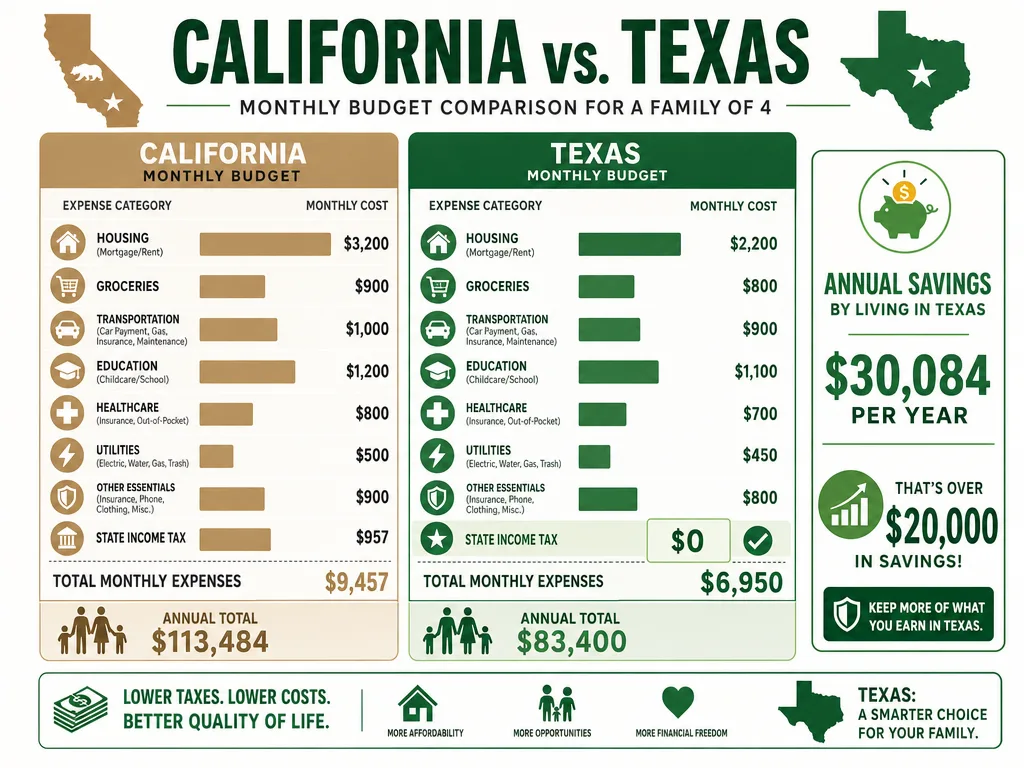
Here is a side-by-side comparison of typical monthly costs for a family of four in the Bay Area or Los Angeles versus the same family in Boerne or San Antonio. These are averages — your specific situation will vary — but they reflect the patterns I see across dozens of client transactions each year.
Monthly Cost Comparison: California vs. Texas Hill Country
| Expense | California | Texas | Difference |
|---|---|---|---|
| Electricity (avg summer bill) | $210 | $285 | +$75 (TX higher) |
| Natural gas (winter peak) | $115 | $85 | -$30 |
| Water / sewer | $110 | $95 | -$15 |
| Auto insurance (2 cars) | $195 | $175 | -$20 |
| Homeowners insurance | $240 | $280 | +$40 (TX higher) |
| Groceries (family of 4) | $1,250 | $1,030 | -$220 |
| Fuel (2 cars, 12K mi/yr) | $420 | $340 | -$80 |
| Dining out (4x/month) | $480 | $350 | -$130 |
| Total (non-housing, non-tax) | $3,020 | $2,640 | -$380/mo |
The everyday cost difference adds up to roughly $380 per month in favor of Texas, even before considering housing. Electricity is higher (summer air conditioning in the Hill Country is not optional), and homeowners insurance runs slightly more due to hail and wind exposure. But groceries, fuel, dining, and auto insurance are all meaningfully cheaper in Texas [8][9].
The Combined Monthly Advantage: Income Tax + Cost of Living
When you combine the income tax savings with the everyday cost-of-living difference, the monthly advantage becomes substantial. Here is what it looks like for a typical Bay Area professional household earning $175,000 and buying a comparable home in the Hill Country:
Income Tax Savings
$1,108
per month
Cost of Living Savings
$380
per month
Total Monthly Advantage
$1,488
per month = $17,856/yr
That $1,488 per month is not a theoretical number. It is cash that stays in your bank account every single month. Invested at a 7% annual return over 20 years, that surplus grows to approximately $740,000. Used to pay down a mortgage, it shaves 8-10 years off a 30-year loan. Spent on lifestyle — travel, hobbies, private schools, home improvements — it meaningfully changes your quality of life.
And this is before the largest savings category of all: housing. The median home price in Boerne ($485,000) versus the Bay Area ($1.4 million) means that even after higher Texas property taxes, the monthly housing payment on a comparable home is typically $2,000 to $4,000 lower in Texas [5][7].
The Asterisks: What California Can Still Reach From Texas
The income tax savings are real and significant. But the notion that moving to Texas completely severs your tax relationship with California is not entirely accurate. California has a long reach, and the FTB (Franchise Tax Board) is aggressive about asserting it [5][6].
Here is what remains on the table after you move:
California-source income
If you keep a rental property in California, the rental income remains taxable by California. If you sell a California property, the capital gain is taxable by California. If you retain ownership in a California business or partnership, your share of the income is California-source. You will file a California nonresident return (Form 540NR) each year for as long as you have California-source income [6].
The residency audit risk
California audits residency claims aggressively. The FTB uses a nine-factor domicile test to determine whether you actually moved or just established a nominal presence in Texas while maintaining significant ties to California. The factors include: where you spend your time, where your family lives, where your children go to school, where you maintain professional licenses and memberships, where you bank, where you vote, where your driver's license is issued, where you own a home, and where your physician and dentist are located. If the FTB determines you did not truly change domicile, it can assess back taxes, interest, and penalties [5].
The remote worker's gray area
If you work for a California-based company but perform all your work from Texas, your wages are generally Texas-sourced and not taxable by California. However, if you travel back to California for meetings, training, or conferences, the days you work in California may be taxable by California. Some employers also require employees to maintain a California office presence, which can complicate the sourcing analysis. Get the arrangement in writing and track your work locations [2][6].
Property taxes in Texas
The tradeoff for zero state income tax is higher property taxes. Texas has no constitutional cap on how fast assessed values can rise (like California's Prop 13), though the homestead exemption caps annual appraisal increases at 10% for homes that qualify. On a $500,000 Hill Country home, total property taxes typically run $8,500 to $12,500 per year, depending on county, school district, and special districts. This is higher than on a California home of equivalent value, but when that California home was worth $1.2 million, the absolute tax bill was likely higher in California even with Prop 13's protections [7].
Practical Steps to Secure the Tax Savings
The difference between "I moved to Texas" and "I am officially a Texas resident for tax purposes" comes down to documentation. Here is what you need to do, in order of priority:
Get a Texas driver's license within 30 days of moving
Texas law requires new residents to obtain a Texas driver's license within 90 days. Doing it within 30 creates a clear paper trail of your move date.
Register your vehicles in Texas
Transfer vehicle registration and title to Texas. California requires vehicles to be registered in California if you are a resident. Keeping California plates creates an audit flag.
Register to vote in Texas
Voter registration is a primary indicator of domicile. Register in your Texas county and cancel your California registration.
File a Texas homestead exemption on your home
Filing the homestead exemption with the county appraisal district does two things: it reduces your property tax bill, and it creates a public record that you claim Texas as your residence. Do this within the first year.
Update your banking and investment account addresses
Move all financial accounts to your Texas address. Banks, brokerages, credit cards, and retirement accounts should all reflect your Texas residence. Do not maintain a "mail forwarding" arrangement with a California address.
Keep a physical location calendar for the first 2 years
California's residency test includes the number of days you spend in California. Keep a calendar or travel log documenting where you are each day. If the FTB audits you, this is the first document they will ask for.
The 183-Day Rule Is Not Enough
Many people believe that spending fewer than 183 days in California automatically makes them a nonresident. This is not correct. The FTB considers domicile, not just days. You can spend 100 days in California and still be considered a resident if your primary domicile remains there. Conversely, spending 200 days in California while maintaining Texas as your domicile can trigger a full audit. Domicile is the standard, and it is determined by the totality of your circumstances [5].

The numbers are meaningful, but the real question is how your family will use the financial breathing room.
Frequently Asked Questions
These are the questions I hear most from California buyers evaluating the income tax impact of a Texas move. Every situation has nuances, but the patterns are consistent.
Do I really save the full California state income tax amount when I move to Texas?
In most cases, yes — if you establish Texas domicile and do not retain significant California-source income. The savings equal what you would have paid California on your wages, self-employment income, and most passive income. However, certain income types (California rental properties, business income from California operations, and some pension income) may remain taxable by California even after you move. A CPA who understands cross-state tax issues should review your specific income sources.
How do I prove to California that I have actually moved?
California audits residency claims aggressively. To establish Texas residency, you need: a Texas driver's license issued within 30 days of moving, vehicle registration in Texas, voter registration in Texas, a homestead exemption filing on your Texas home, updated banking and investment addresses, and a documented trail of fewer than 183 days per year in California. The FTB uses a nine-factor domicile test. Keep a calendar of your physical location for the first two years after moving.
If I keep a California home as a rental property, do I still owe California income tax?
Yes. California taxes nonresidents on California-source income, including rental income from California real estate and gains from its sale. You will need to file a California nonresident return (Form 540NR) each year for that income. However, the bulk of your ordinary wage income — if your employer and job location are outside California — should be Texas-sourced and not taxable by California.
Does Texas have any other taxes that offset the income tax savings?
Texas has no state personal income tax, but it collects higher property taxes (typically 1.8–2.8% of assessed value vs. 1.0–1.3% effective in California under Prop 13). Texas also imposes a gross receipts tax on certain businesses (franchise tax) and has higher sales tax in some localities. For most households, the income tax savings of $5,000–$20,000+ per year far exceed the higher property tax, especially when the Texas home costs 40–60% less than the California home you sold.
I am a remote employee. My employer is based in California but I live in Texas. Do I still pay California income tax?
Generally, no. If you perform all of your work from Texas and your employer has no requirement that you work in California, your wages are sourced to Texas and are not taxable by California. However, if you travel to California for work (meetings, conferences, training) and exceed certain thresholds, those specific days of work may be taxable by California. This is a common area of audit focus for the FTB. Maintain a travel log and discuss your arrangement with a tax professional.
Run the Numbers for Your Situation
The income tax arbitrage is one of the most compelling financial arguments for a California-to-Texas move. But the numbers are personal. Your income, your California ties, your housing budget, and your timeline all affect the calculation. A general article can point you in the right direction. A direct conversation with someone who has done this work with dozens of California families can tell you what your specific situation looks like.
If you would like to talk through your numbers, I am happy to have that conversation. No pressure, no sales pitch — just the data, the tradeoffs, and a practical plan for how to think about the timing and the tax implications.

Written by
Bill Ross
Hill Country Homesteads Group, brokered by KW Boerne
Bill Ross is a Texas real estate agent with nearly four decades in high-tech sales and a network of 1,000+ California real estate agents for coordinated cross-state transactions. Featured in national coverage discussing his family's relocation from Silicon Valley to the Texas Hill Country, Bill helps California families navigate every aspect of the move to the Texas Hill Country.
Related Guides
Property Tax Shock or Relief
A line-by-line comparison of what you pay in California property tax versus Texas property tax for comparable homes.
California Home Equity to Texas Wealth
The real math behind selling in California and buying in Texas, with transaction costs and capital gains effects.
Texas Homestead Exemption Guide
How to file, how much you save, and the deadlines that matter for every new Texas homeowner.
First 90 Days: Establishing Texas Residency
A step-by-step guide to driver's license, vehicle registration, voter registration, and residency documentation.
Sources
- California Franchise Tax Board — State Income Tax Rates and Brackets — FTB Publication, 2026. ftb.ca.gov/file/personal/tax-rates.html
- California Revenue and Taxation Code Sections 17041 and 17054 — California Legislative Information. leginfo.legislature.ca.gov/faces/codes_displaySection.xhtml?lawCode=RTC§ionNum=17041
- Texas Comptroller of Public Accounts — No Personal Income Tax — Texas Comptroller. comptroller.texas.gov/taxes/personal-income/
- California FTB Form 540NR instructions — Nonresident and Part-Year Resident — FTB, 2026. ftb.ca.gov/forms/2025/2025-540nr-booklet.pdf
- California FTB Publication 1031 — Guidelines for Determining Resident Status — FTB, 2026. ftb.ca.gov/forms/2025/2025-1031.pdf
- California Revenue and Taxation Code Section 17951 — California-source income for nonresidents — California Legislative Information. leginfo.legislature.ca.gov/faces/codes_displaySection.xhtml?lawCode=RTC§ionNum=17951
- Texas Property Tax Code Section 11.13 — Residence Homestead Exemption — Texas Constitution and Statutes. statutes.capitol.texas.gov/Docs/TX/htm/TX.11.htm
- Texas Sales and Use Tax Rates — Texas Comptroller. comptroller.texas.gov/taxes/sales/
- California Sales and Use Tax Rates (by county/city) — CDTFA. www.cdffa.gov/taxes-and-fees/sales-tax-rates.htm
- IRS Publication 501 — Domicile and Residency Standards — IRS. www.irs.gov/publications/p501
- California FTB FTB 1031 — Domicile vs. Residence: The Nine-Factor Test — FTB. ftb.ca.gov/forms/2025/2025-1031.pdf
- US Census Bureau — Median Home Prices and Cost of Living Data — US Census Bureau. www.census.gov/programs-surveys/ahs.html
Last reviewed: July 27, 2026. Tax rates, brackets, and rules reflect current California and Texas law as of the date of publication. Laws change. Consult a qualified tax professional for advice on your specific situation.