
Last reviewed: July 27, 2026 — statutory references were checked as of that date.
Quick answer
Moving to Texas does not automatically invalidate a California will, trust, power of attorney, or health-care directive. The plan should nevertheless be reviewed because Texas law controls important questions involving Texas real estate, homestead rights, probate procedure, fiduciary qualification, powers of attorney, and medical documents. For Texas probate specifics, see our probate guide. The highest-priority checks are the deed to the Texas home, trust funding, beneficiary designations, fiduciary appointments, marital-property records, and property-tax homestead application. Our Boerne property tax guide covers local tax obligations.
In This Guide
When you move from California to Texas, you think about the big things: selling the house, finding a new home, moving your belongings, registering your car, updating your driver's license. The estate plan sitting in a three-ring binder at the bottom of a box does not cross your mind. It was drafted by a good attorney in San Jose or Los Angeles or Sacramento. It has served you well for years. Why would moving change anything?
The answer, as many California transplants discover too late, is that estate planning is deeply state-specific. A will that works perfectly under California law may create complications in Texas. A trust that avoided probate for your California home may not own or otherwise control the Texas home purchased with the proceeds. The deed, trust instrument, and any separate assignment or transfer documents must be reviewed together to determine whether the trustee holds the property for the trust and whether the intended probate-avoidance plan was actually implemented. A durable power of attorney that your California bank accepted without question may be refused by a Texas title company.
These are common cross-state planning issues, but they do not affect every household in the same way. The consequences depend on marital status, domicile, title, beneficiary designations, trust funding, the location of assets, and the language of the existing documents. This article walks through each document in a typical estate plan, explains what changes after the move, and gives you a practical checklist to work through with a Texas estate-planning attorney.
Tom and Linda's Story: A Hypothetical Example
Tom and Linda are a hypothetical composite created to illustrate several issues that can arise after a California-to-Texas move. They are not clients, and the facts should not be treated as a case result.
Tom and Linda retired from the Bay Area in 2024. They sold their home in Cupertino for $2.1 million, paid off the mortgage, and moved to a four-bedroom home on two acres outside Boerne. Texas does not impose an individual state income tax. While they were California residents, California generally would have taxed their taxable pension income but not their Social Security benefits. The actual state-tax savings from the move would therefore depend on the amount and type of their taxable income [32]. They were thrilled with the decision.
Their California estate plan, drafted in 2018, included a joint revocable living trust, pour-over wills, durable powers of attorney, advance health care directives, and beneficiary designations on their retirement accounts. Their documents had been professionally prepared and coordinated as a single estate-planning package.
The problem was that the trust had held their California home, but the sale proceeds went into a joint checking account and the deed to the Texas home named Tom and Linda individually as husband and wife — not in their capacities as trustees. That created a likely trust-funding gap requiring review of the deed, trust instrument, closing documents, and any separate assignment or declaration. Merely listing real estate on a trust schedule does not necessarily accomplish the deed, execution, and recording steps needed to place Texas real property under the trustee's control.
Tom also kept a small rental condo in San Francisco that he had owned before the marriage. California generally treats rents from separate property as separate property [3], while Texas generally treats income from separate property as community property [1][2][16]. After the move, however, the condo remained California real property. The characterization of its rent therefore presents a choice-of-law question involving domicile, the property's situs, the period to which the income is attributable, tracing, and any marital-property agreement. Tom and Linda should not assume that either state's general income rule conclusively answers the question without coordinated Texas and California advice [37].
They did not discover these gaps until a routine review with a Texas attorney six months after the move. Fortunately, no emergency had occurred. But if Tom had become incapacitated, his California durable power of attorney might have been slow to be honored by Texas banks. If one of them had died, the decedent's interest in the Texas home might have required probate or another title-clearing procedure before it could pass under the estate plan. A pour-over will could direct probate property to the trust, but only after the necessary probate process; the trust would not itself avoid probate for property it did not own or otherwise receive through a valid nonprobate arrangement.
This hypothetical illustrates a recurring planning pattern: a well-drafted California plan may remain valid but no longer match the family's property, domicile, fiduciaries, or implementation needs. Correcting the gaps may involve anything from a deed or beneficiary update to a coordinated trust restatement. The appropriate solution depends on the documents and assets involved.
Why State Lines Change Everything
Both California and Texas are community property states. This shared foundation leads many people to assume the rules are the same. They are not. California treats income from separate property as separate property (California Family Code Section 770(a)(3)) [3]. Texas generally treats income from separate property during marriage as community property unless a valid marital-property agreement provides otherwise [1][2][16]. That contrast is useful for income governed by Texas law, but it does not by itself resolve rent from real property located in another state. Foreign real estate can raise a separate situs and choice-of-law analysis [37]. Once Texas becomes the spouses' marital domicile, income attributable to the period after that change generally is characterized under Texas law. Both the date of the domicile change and the period to which particular income is attributable can be fact-specific; domicile does not necessarily change on the physical date the couple crosses the state line.
The burden of proof is also different. Texas presumes that property possessed by either spouse during or on dissolution of marriage is community property and requires clear and convincing evidence to rebut that presumption [1]. California Evidence Code Section 115 supplies a general preponderance-of-the-evidence default when another burden is not prescribed, but California also has asset-specific title, tracing, reimbursement, and transmutation rules [4]. These are litigation standards, not alternative recordkeeping standards. Couples should preserve acquisition records, account statements, closing documents, inheritance records, marital agreements, and evidence tracing separate funds.
Trust administration, probate procedures, homestead protections, powers of attorney, and advance directives all have separate statutory frameworks in each state. A document that is fully enforceable in one state may be honored with skepticism or delay in the other. Texas statutes recognize certain out-of-state wills, durable powers of attorney, and advance directives when the applicable statutory requirements are met [5][11][12]. Trust validity, administration, real-property ownership, beneficiary designations, and other documents require separate analysis. Even when a document is legally effective, practical implementation can be harder, slower, and more expensive than expected.
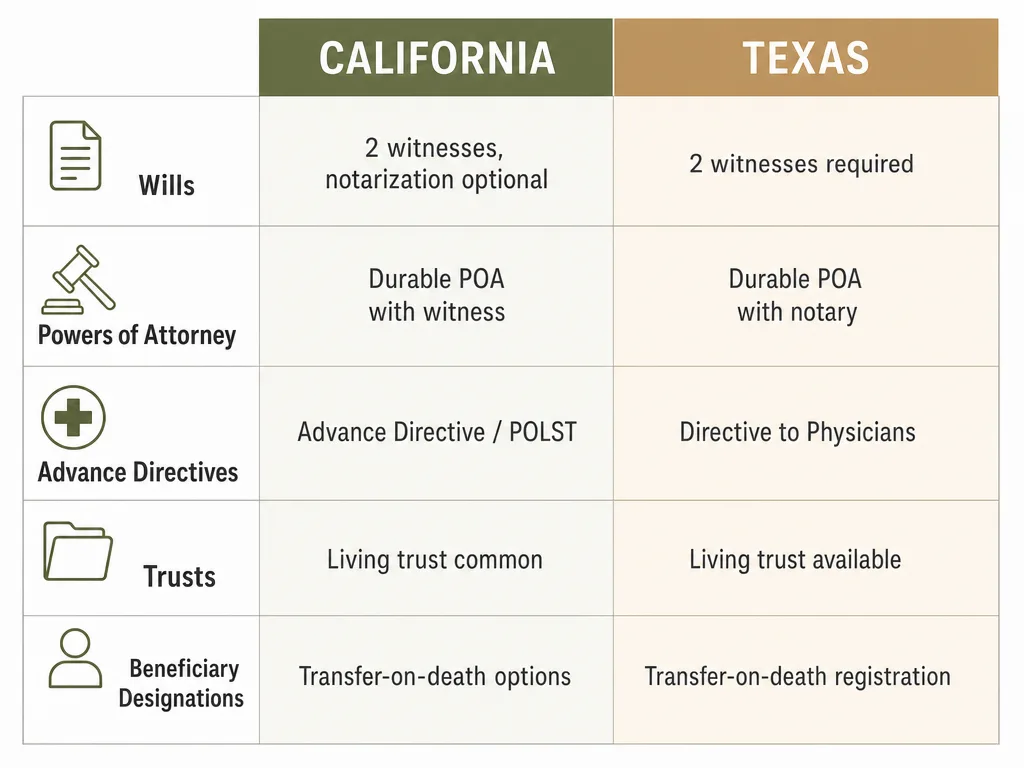
| TOPIC | CALIFORNIA | TEXAS |
|---|---|---|
| Attested will | Generally two witnesses; separate rules apply to a qualifying holographic will. Notarization is not a substitute for valid execution. | Generally two witnesses; separate rules apply to a qualifying holographic will. A self-proving affidavit is a separate procedural feature. |
| Financial power of attorney | Generally acknowledged before a notary OR signed by two qualifying adult witnesses, subject to statutory restrictions. | A durable power of attorney generally must be signed and acknowledged before a notary. |
| Health-care documents | Advance health care directive; POLST is a separate medical order used for qualifying seriously ill or frail patients. | Medical Power of Attorney and Directive to Physicians serve different functions; an out-of-hospital DNR is a separate medical order. |
| Trust and real estate | Trust validity does not prove that real estate was funded; review the deed and all signed transfer documents. | Same core funding issue; also review Texas recording and qualifying-trust homestead rules. |
| Homestead | Creditor exemption and property-tax rules require separate California analysis. | Forced-sale homestead, property-tax homestead, and probate homestead are distinct protections. |
Summary only. Exceptions and execution details apply; obtain advice about the actual documents.
Wills and Trusts
A written will executed outside Texas may be valid in Texas if its execution complied with Texas law, the law of the place where it was executed, or the law of the testator's domicile or residence at execution or death. The applicable provision is Texas Estates Code Section 251.053, not Section 251.051 [5]. A will that was self-proved under another jurisdiction's law may also qualify for admission without additional execution testimony under Section 256.152, but Texas counsel should verify the affidavit and probate requirements [22].
Texas independent administration may be authorized by the will under Section 401.001. When the will does not provide for it, agreed independent administration may still be possible if the statutory requirements are met, including the necessary distributee consents and court findings under Section 401.002 [6]. California wills lacking Texas-language independent-administration provisions do not necessarily require dependent administration. Have Texas counsel review executor qualification, bond language, self-proof, independent-administration language, tax clauses, and dispositive provisions.
Revocable living trusts present a different set of issues. A California revocable trust generally remains valid after the settlors move to Texas. A trust generally controls property transferred to the trustee or otherwise made payable to the trust. An account not retitled to the trustee may nevertheless pass under a beneficiary, payable-on-death, or transfer-on-death designation. Conversely, merely listing an asset on a trust schedule may not complete a legally required deed, assignment, registration, or beneficiary change. If the Texas home is titled only in the owners' individual names, that is a significant trust-funding warning, but the deed should not be analyzed in isolation. Counsel should review the deed, trust instrument, any signed declaration or assignment, and the applicable transfer and recording rules. A recorded deed to the trustee is ordinarily the clearest way to place record title in the trustee's name and avoid later title problems. An individually titled financial account may instead pass under its beneficiary, POD, or TOD designation. The trust will receive or control the account only if a valid ownership, assignment, beneficiary, or probate-transfer mechanism directs the account to the trust.
For Texas real estate held in a trust, the trust must satisfy the requirements of Texas Property Code Section 41.0021 to qualify for homestead creditor protection, and Texas Tax Code Section 11.13 for the residence homestead property tax exemption [8][9]. California and Texas apply different homestead rules to trust-owned residences. A trust drafted for a California home may require review or amendment before it holds a Texas homestead, but amendment or restatement is not automatically required.
Texas Property Code Section 115.001(a)(2) gives a Texas court jurisdiction in a trust proceeding to determine the law applicable to a trust instrument; it does not supply a universal choice-of-law rule. The effect of a California governing-law clause depends on the instrument, the issues involved, and applicable conflict-of-laws principles. Regardless of the trust's governing-law clause, Texas law controls the conveyance and recording of Texas real property and Texas-specific homestead and property-tax requirements. Texas Property Code Section 112.001 identifies methods of creating a trust, Section 112.004 establishes written-evidence requirements, and Section 112.005 requires the existence of trust property [7]. Whether a particular Texas asset was effectively transferred to an existing trust depends on the type of asset, the signed instruments, title or registration records, and other applicable transfer requirements. A move also does not necessarily end California trust tax and filing exposure. California-source income, a California-resident trustee, or a California-resident noncontingent beneficiary may cause some or all trust income to remain taxable or reportable in California. A California tax adviser should review the trust's post-move filing position [23].
If you are also managing a family member's estate in Texas, our probate guide covers the full process for executors and heirs.
Community Property with Right of Survivorship
Texas spouses may enter a written community-property survivorship agreement under Texas Estates Code Chapter 112. The agreement — not joint ownership language alone — creates the survivorship right. It must be in writing and signed by both spouses. For real property, proper recording is important because Texas Estates Code Section 112.202 treats recording in the county where the property is located as notice of the agreement to third parties [24].
This arrangement can transfer covered community property to the surviving spouse without probate at the first death, but it is not automatically simpler or better than a trust, transfer-on-death deed, or coordinated will plan. It provides no comprehensive incapacity plan and may conflict with blended-family, creditor, tax, or second-death objectives. Texas counsel should first confirm that the property is community property and then compare all available transfer methods.
Different rules apply to noncommunity property, including property owned by unmarried co-owners and property treated as one spouse's separate property. Texas Estates Code Chapter 111 permits joint owners to enter into a written survivorship agreement, but a survivorship right is not created merely because property is jointly owned. The agreement must satisfy Chapter 111's written and signature requirements, and an agreement affecting real property should be coordinated with the deed and recording records [34].
Reviewing Executors, Trustees, Agents, and Guardians After the Move
Your California estate plan names someone to handle your affairs if you die or become incapacitated: an executor (for the will), a successor trustee (for the trust), and an agent (for the power of attorney). These roles carry significant responsibility and must be exercised by someone who is both willing and practically able to act.
If you named a California resident as your executor or successor trustee, that person may need to travel to Texas, hire Texas counsel, and navigate a legal system they do not know. Texas Estates Code Section 304.003 does not disqualify an out-of-state executor outright, but it does impose a specific procedural burden: a nonresident individual or corporation is disqualified from serving unless they appoint a Texas resident agent to accept service of process on the estate's behalf, and that appointment is filed with the court [10]. This is a separate requirement from bonding. Bond requirements depend on the will, the fiduciary, the form of administration, and applicable statutory and court requirements. A will may waive bond for an independent executor, but the will's language is not the only potentially relevant consideration. This requirement is separate from the Texas resident-agent requirement imposed on a nonresident executor. A California successor trustee managing a Texas trust may also face practical difficulties coordinating with Texas financial institutions, tax authorities, and real estate professionals.
The question is not whether the person you named is capable: it is whether the person you named can efficiently discharge the duties across state lines. Residency is one practical factor, not a reason by itself to add a co-fiduciary. Co-executors or co-trustees can create additional signatures, expense, delay, or deadlock. Texas counsel should evaluate the current primary and successor appointments, the nonresident-agent requirement, geographic availability, institutional acceptance, and whether a Texas resident should serve as a primary, alternate, or carefully defined co-fiduciary.
Couples should also review successor designations. Many married couples name each other as the primary agent or trustee, then name a California child as the successor. If both parents die simultaneously in an accident, the California successor will need to act in Texas. Discussing this scenario with the named successor before it happens can avoid surprises.
Durable Powers of Attorney
Texas generally recognizes a durable power of attorney executed in another jurisdiction when it is valid under the law selected by Texas Estates Code Section 751.0023. Section 751.0024 separately addresses which jurisdiction's law governs the instrument's meaning and effect [11]. Nevertheless, a Texas bank, title company, brokerage, or other recipient may be more familiar with a Texas form and may request a certification, translation, or attorney opinion within the limits of Texas law.
Financial powers of attorney and medical powers of attorney are different documents. Do not combine them or assume a single form covers both.
Some powers — including certain gifts, beneficiary changes, survivorship changes, delegations, and trust-related transactions — must be expressly granted. Counsel should review the exact authority needed rather than assume a general grant is sufficient. Texas also has statutory acceptance and rejection procedures, including Section 751.201 [11].
Signing a new Texas document does not automatically leave the California document usefully in place. A later instrument may revoke, supersede, duplicate, or conflict with an earlier one. Texas counsel should coordinate the documents, specify the intended governing effect, and advise which agents and institutions should receive updated or revoked copies.
Medical Powers of Attorney and Advance Directives
Texas Health and Safety Code Section 166.005 provides that advance directives executed in another jurisdiction that comply with that jurisdiction's law are enforceable in Texas [12]. A California advance health care directive validly executed under California law generally receives the same effect as a Texas advance directive. However, Texas Health and Safety Code Section 166.005 does not authorize health care that otherwise is prohibited by Texas law [12].
Again, validity is not the same as seamless implementation. Texas uses a specific statutory form for its Directive to Physicians and Family or Surrogates (Texas Health and Safety Code Section 166.033) [13]. Texas health care providers may be more familiar with this form than with a California directive. In a crisis, the difference between "we recognize this document" and "we are comfortable acting on this document" can matter.
Texas also recognizes a Medical Power of Attorney (Texas Health and Safety Code Chapter 166, Subchapter D) that is distinct from the California form [14]. The Texas Medical Power of Attorney appoints an agent to make health-care decisions when the attending physician certifies in writing that the principal lacks competence and files that certification in the medical record. A Directive to Physicians is a separate document expressing treatment wishes for terminal or irreversible conditions. These two documents serve different purposes and should not be treated as interchangeable [13][14].
Ask Texas counsel whether to replace or supplement the California documents with a Texas Medical Power of Attorney, Directive to Physicians, out-of-hospital DNR order, declaration concerning mental-health treatment, or other document appropriate to the client's wishes.
HIPAA is federal law. Review whether the authorization is HIPAA-compliant, identifies the intended recipients and information, contains appropriate expiration or event language, and uses current contact information. Coordinate it with the medical documents without implying that it grants decision-making authority.
Beneficiary Designations
Beneficiary designations commonly control retirement accounts, life insurance, and POD or TOD accounts, but the governing contract, plan terms, federal law, and any applicable spousal-consent requirements must be reviewed. A will ordinarily does not override a valid beneficiary designation.
A trust named as retirement-account beneficiary can create significant required-minimum-distribution and SECURE Act consequences. Employer plans may also require a spouse's consent before a nonspouse beneficiary can be named. Review primary and contingent beneficiaries, simultaneous-death contingencies, minors or beneficiaries with disabilities, trusts named as beneficiaries, and former spouses.
Do not rely on a divorce decree or a state revocation-on-divorce statute as a substitute for changing the beneficiary designation. Texas Estates Code Chapter 123 affects certain former-spouse designations, but plan terms and federal law can control, particularly for ERISA-governed benefits. In Kennedy v. Plan Administrator for DuPont Savings and Investment Plan, the U.S. Supreme Court enforced payment under the plan documents even though the former spouse had waived the benefits in the divorce decree. After divorce, update the designation directly with the plan administrator or carrier and coordinate any qualified domestic relations order and surviving-spouse rules with counsel [40].
Retirement accounts do not receive the same basis adjustment as ordinary community property. Internal Revenue Code Section 1014(b)(6) can provide a basis adjustment for qualifying community property, but Section 1014(c) excludes income in respect of a decedent. The taxable portion of an inherited traditional IRA or similar retirement account therefore generally does not receive a Section 1014 basis step-up [15].
Under current federal law, the basic exclusion amount is $15 million per individual for 2026 and is indexed for inflation. A future Congress can change this provision. A married couple does not automatically receive a combined $30 million exclusion through portability. Portability generally requires the deceased spouse's executor to make an election on Form 706. The ordinary deadline is nine months after death, subject to an available six-month extension. For an estate that was not otherwise required to file Form 706, IRS Revenue Procedure 2022-32 may permit a simplified late portability election on or before the fifth anniversary of death [30]. Portability does not transfer the deceased spouse's generation-skipping transfer tax exemption.
State Estate and Inheritance Taxes
Neither Texas nor California currently imposes a separate inheritance tax on current transfers. Texas repealed Tax Code Chapter 211 effective September 1, 2015. California generally has not required a state estate-tax return for decedents dying on or after January 1, 2005, after elimination of the federal credit on which its estate tax depended [36].
That does not eliminate federal estate, gift, or generation-skipping transfer taxes. It also does not eliminate estate or trust income tax, California-source income tax, California property-tax reassessment, or possible estate or inheritance tax imposed by another state in which the person owns property or maintains another legally significant connection. High-net-worth and multistate families should have the entire state and federal transfer-tax picture reviewed.
Community-Property Characterization and Separate-Property Records
This is the area that catches most California transplants by surprise. Under Texas law, income generated during marriage by separate property — including rent, interest, and dividends — is generally community property under Texas Family Code Section 3.002 and Texas case law. Spouses may agree in writing that income from specified separate property will remain separate under Section 4.103 [1][2][16]. California takes the opposite position: rents, issues, and profits from separate property are generally separate property (California Family Code Section 770(a)(3)) [3]. For a deeper look at how community property works across state lines, see our guide on Community Property vs. Separate Property.
Do not apply that general Texas income rule mechanically to rent from real property in another state. The property's situs and conflict-of-laws principles may affect the characterization, so out-of-state rental income requires separate analysis [37].
For example, a San Francisco condo owned before marriage generally remains the owner's separate real property after a move to Texas. The character of post-move rent is less suitable for a categorical statement: Texas's general income rule points toward community property, California's separate-property rule points toward separate property, and situs and choice-of-law principles may affect which rule applies. Interest and dividends from separately owned personal-property investments may be governed differently. Counsel should analyze each income stream based on asset type, domicile, situs, timing, tracing, and any marital agreement [1][2][3][16][37].
Any premarital, partition, exchange, income, or postmarital agreement should be reviewed for its governing law, scope, execution, disclosure, voluntariness, enforceability, and treatment of post-move income. Texas premarital agreements are addressed in Family Code Sections 4.001-4.010; partition, exchange, and income agreements are addressed in Sections 4.102-4.105 [16]. An agreement valid in one state is not necessarily invalid in the other. Have Texas and, when appropriate, California counsel evaluate the actual instrument.
Couples who have commingled separate and community funds should consult an attorney about tracing documentation. Texas requires clear and convincing evidence to overcome the community property presumption. The party claiming separate property bears the burden, and inadequate records can result in the entire asset being treated as community property [1].
Homestead Protections
California and Texas both protect qualifying homesteads, but in different ways. California's exemption is generally the greater of an inflation-adjusted statutory floor or the prior calendar year's countywide median sale price for a single-family home, subject to an inflation-adjusted statutory ceiling under Code of Civil Procedure Section 704.730 [17].
Texas provides broad forced-sale protection for a qualifying urban or rural homestead, subject to constitutional, statutory, and federal exceptions. Texas Constitution Article XVI, Section 50 establishes forced-sale protection and the permitted lien categories. Article XVI, Section 51 and Texas Property Code Section 41.002 establish the urban and rural acreage limits [25]. Texas forced-sale homestead rights generally arise from qualifying use or occupancy combined with intent; a voluntary recorded designation exists but is not a universal prerequisite. When a trust owns the home, Section 41.0021's qualifying-trust rules must be analyzed [8][25].
For forced-sale protection, Texas Property Code Section 41.002 generally limits an urban homestead to 10 acres. A rural homestead may include up to 200 acres for a family or 100 acres for a single adult. Whether Hill Country acreage is urban or rural is determined by statutory location-and-services criteria — not simply by the property's mailing address, marketing description, or location outside a city center [25].
The residence homestead property-tax exemption is separate from forced-sale protection and requires an application with the county appraisal district. The current statewide school-district exemption is $140,000, with other exemptions potentially available [9][26]. The 10% appraised-value limitation is governed by Tax Code Section 23.23, generally begins January 1 after the property qualifies, and does not protect the value of new improvements [26]. Filing a property-tax application does not create the constitutional creditor exemption.
Probate Homestead and Family Protections After Death
Texas's probate-homestead rules are separate from both forced-sale creditor protection and the property-tax homestead exemption. When a homeowner dies leaving a surviving spouse or minor child, Texas Constitution Article XVI, Section 52 and Texas Estates Code Chapter 102 can affect descent, possession, occupancy, and partition of the homestead. A devise in a will or trust therefore does not always mean that a remainder beneficiary can immediately occupy or force a sale of the home.
Texas Estates Code Chapter 353 also provides rules for setting aside exempt property and determining a family allowance for eligible survivors. These rights can affect liquidity, administration, and the practical result of an otherwise valid estate plan. Texas counsel should review them when the plan includes a surviving spouse, minor child, adult incapacitated child, blended family, or a gift of the home to someone other than the surviving spouse.

Transfer-on-Death Deeds
Texas Estates Code Chapter 114 authorizes transfer-on-death deeds for Texas real property [18]. The deed must satisfy Texas requirements, be signed and acknowledged, and be recorded in the county's real-property records before the transferor dies. Unless the deed or another applicable rule provides otherwise, a designated beneficiary generally must survive the transferor by 120 hours. The beneficiary takes the property subject to applicable liens, encumbrances, and interests, and the property may remain subject to the creditor-claim and statutory-allowance provisions of Chapter 114 [18][19].
Do not assume that a California form satisfies Texas Chapter 114. An instrument affecting Texas land should be prepared or reviewed for Texas execution, content, and recording requirements.
A TOD deed is not automatically the right fix for a home omitted from a trust. It supplies no incapacity management and can frustrate trust provisions, blended-family planning, creditor planning, or instructions for a beneficiary's inheritance. Compare it with a trust deed, community-property survivorship agreement, life estate, and will-based plan before recording.
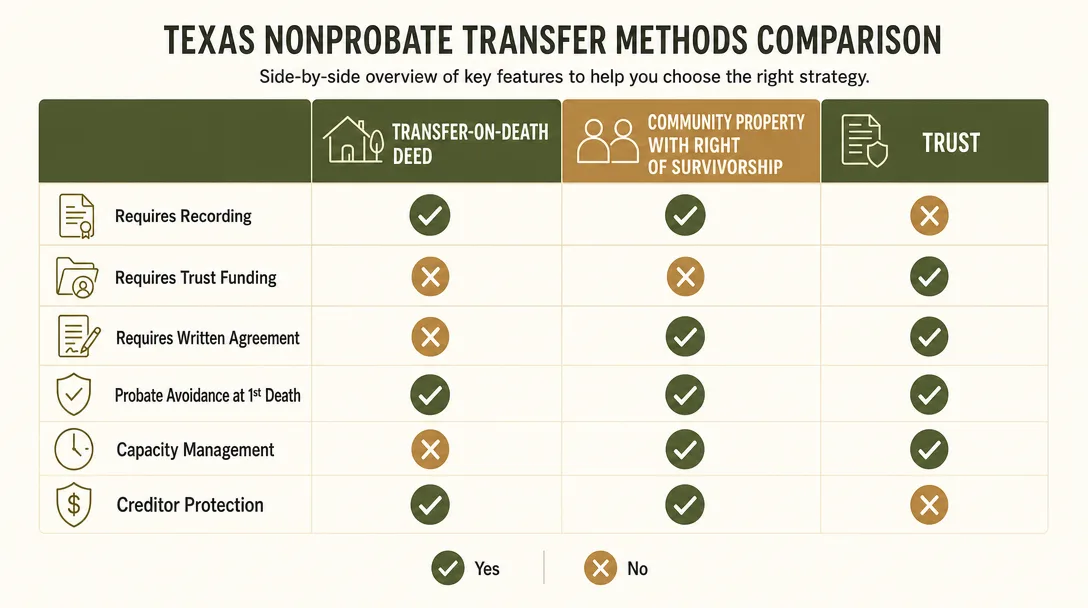
| METHOD | REQUIRED IMPLEMENTATION | INCAPACITY MANAGEMENT | PROBATE AVOIDANCE | CREDITOR EFFECT |
|---|---|---|---|---|
| Transfer-on-death deed | Texas-compliant deed signed, acknowledged, and recorded before death | No | Only for the covered property if the deed remains effective and the beneficiary survives as required | No inherent creditor protection; beneficiary takes subject to applicable liens, encumbrances, claims, and statutory allowances |
| Community-property survivorship agreement | Written agreement signed by both spouses; coordinate the agreement with the deed and record it for real-property notice | No comprehensive incapacity plan | Only for covered property that is confirmed to be community property | No inherent creditor protection |
| Revocable trust | Valid trust plus an effective transfer/funding step; for real property, ordinarily use and record an appropriate deed to the trustee | Can provide management if the terms and successor-trustee arrangements are effective | Only for property properly transferred or made payable to the trust | Depends on the trust, settlor/beneficiary status, asset, and applicable homestead or spendthrift rules |
Each method can fail if execution, funding, survival, title, or beneficiary requirements are not satisfied.
Funding a Texas Home Into a Trust: Implementation Risks
A California revocable trust may remain valid in Texas, but it will not control a Texas home unless title or another valid transfer arrangement connects the property to the trust. A pour-over will sends probate property to the trust only after probate; it does not itself avoid probate.
An instrument executed in California can affect Texas land if it satisfies Texas law. The correct point is that a California deed form should not be assumed to meet Texas substantive and recording requirements. Have a licensed Texas attorney prepare or review the deed and coordinate recording with the title insurer.
If the property is the spouses' Texas homestead, Texas Family Code Section 5.001 generally requires both spouses to join in a sale, conveyance, or encumbrance, even when record title or separate-property ownership rests in only one spouse. A deed intended to place a homestead into a trust therefore requires Texas legal and title review for spousal joinder as well as trust, homestead, lender, and recording requirements [33].
For a loan secured by residential real property containing fewer than five dwelling units, 12 U.S.C. Section 1701j-3(d)(8) generally restricts enforcement of a due-on-sale clause when the property is transferred into an inter vivos trust in which the borrower is and remains a beneficiary and the transfer does not relate to a transfer of occupancy rights [27]. That exception does not eliminate other issues. Before recording, coordinate with the mortgage servicer, title insurer, homeowner's insurer, HOA, appraisal district, and tax adviser. Confirm legal description, homestead status, insurance, lender requirements, title coverage, and the trust's qualifying-trust provisions.
Out-of-State Rental Properties
Many California transplants keep rental property in California after relocating to Texas. California-source rent remains subject to California income tax, and gain from a later sale generally remains California-source income even when the owner is a Texas resident. A California nonresident return may therefore be required [28]. If the property is held in a trust, California-source income or California connections involving trustees or beneficiaries may create separate fiduciary filing and tax consequences [23].
The characterization of California rental income for marital-property purposes is distinct from its California income-tax treatment. Texas's general rule for income from separate property does not necessarily resolve rent produced by California land. Because the property's situs, domicile, timing, tracing, and any marital agreement may matter, obtain coordinated Texas and California advice rather than assuming the rent automatically changed from separate to community property after the move [1][3][16][37].
California property-tax reassessment is another planning issue. Under Proposition 19, the parent-child and grandparent-grandchild exclusions generally apply only to a qualifying family home or family farm. For a family home, the transferee must use the property as a principal residence and satisfy the applicable filing requirements. A California rental property that is inherited by children will therefore generally be reassessed to current market value unless another exclusion applies. Families expecting children to retain a California rental should model the resulting property-tax cost before deciding whether the property should be retained, sold, or distributed [35].
Individually titled California real estate may require a California probate or ancillary proceeding after the owner's death. A will does not avoid that proceeding. California counsel should confirm title, trust funding, beneficiary or TOD arrangements, lender and insurance consequences, and the relationship between the California property plan and the Texas plan.
Business Interests
If you own a California business — whether operated through an LLC, corporation, partnership, or sole proprietorship — the estate-planning issues multiply. For an entity, its articles, bylaws, operating agreement, partnership agreement, shareholder agreement, or buy-sell agreement may govern ownership transfers, voting rights, management succession, and purchase rights. Federal and state law independently control many tax, fiduciary, registration, and creditor issues. A sole proprietorship is not a separate legal entity and ordinarily has no entity formation or governance document.
Moving to Texas does not change the entity's jurisdiction of organization. A California corporation, LLC, or partnership remains organized under California law unless it completes a legally authorized conversion, domestication, merger, dissolution, or other restructuring.
Texas registration and Texas franchise-tax filing are separate questions. Secretary of State registration generally depends on whether a foreign filing entity is transacting business in Texas, while franchise-tax responsibility depends on whether the entity is taxable and has the required Texas nexus. An owner's move to Texas does not, by itself, answer either question [31]. Review transfer restrictions, buy-sell provisions, management succession, valuation and funding, key-person insurance, and whether a transfer to a trust could affect an S corporation election or another tax status.
Digital Assets
Texas adopted fiduciary-access rules in Texas Estates Code Chapter 2001 [20]. The law addresses access by personal representatives, trustees, guardians, and agents under powers of attorney. A service provider's online legacy-contact or other online tool may receive priority over contrary language in a will, trust, or power of attorney, depending on the statute and the user's directions.
Review online-tool selections and ensure that the will, trust, and power of attorney expressly grant the intended digital-asset and electronic-communication authority. Also maintain a secure inventory describing accounts and access instructions without placing passwords or private cryptocurrency keys in a public will.
Funeral and Disposition Instructions
Texas has a statutory Appointment for Disposition of Remains form and a statutory priority system under Health and Safety Code Section 711.002 [29]. A Texas attorney can advise whether to execute the statutory appointment and how to coordinate it with cremation, burial, organ-donation, military-honors, prepaid-contract, and religious instructions. Give accessible copies to the appointed agent and appropriate family members. An ethical will or informal statement can communicate values and preferences, but it is generally nonbinding and not a substitute for the statutory appointment or an enforceable contract.
Guardianship Nominations
A surviving parent may designate an eligible person to serve as guardian of a minor child in a will or written declaration under Texas Estates Code Section 1104.053 [21]. The designation remains subject to statutory eligibility rules and court appointment; it does not guarantee appointment regardless of the child's best interest or the nominee's qualifications.
Review nominees and alternates for willingness, age, health, residence, immigration or travel constraints, family circumstances, and ability to serve. Separately decide who should manage property for a child; that role may be handled through a trust rather than by placing inherited property directly under a guardianship. Texas generally requires a guardian to furnish a bond, subject to specific statutory exceptions. Under Section 1105.101, a qualifying will or declaration may eliminate the bond for a guardian of the person, but the court may not waive the bond for a guardian of the estate merely because the parent's will or declaration requests a waiver [21].
Texas also permits a competent adult to execute a Declaration of Guardian in the Event of Later Incapacity or Need of Guardian. The declarant may nominate a preferred guardian of the person or estate and may expressly disqualify named individuals. A power of attorney and funded trust may reduce the likelihood that a guardianship will be needed, but the declaration provides a backup if a court proceeding nevertheless becomes necessary. Texas counsel should review any California guardian nomination and determine whether a Texas declaration should be executed.
The Estate-Plan Review Checklist
The following checklist covers the major documents and issues that should be reviewed after moving from California to Texas. This is not exhaustive, but it provides a starting point for a conversation with a Texas estate-planning attorney.
Before the attorney meeting, gather the complete signed estate-plan binder, all amendments, deeds, recent account statements, beneficiary-confirmation pages, business agreements, marital agreements, California property records, and the Texas closing package. A document inventory prepared in advance can make the legal review faster and reduce the risk that an omitted asset remains outside the coordinated plan.
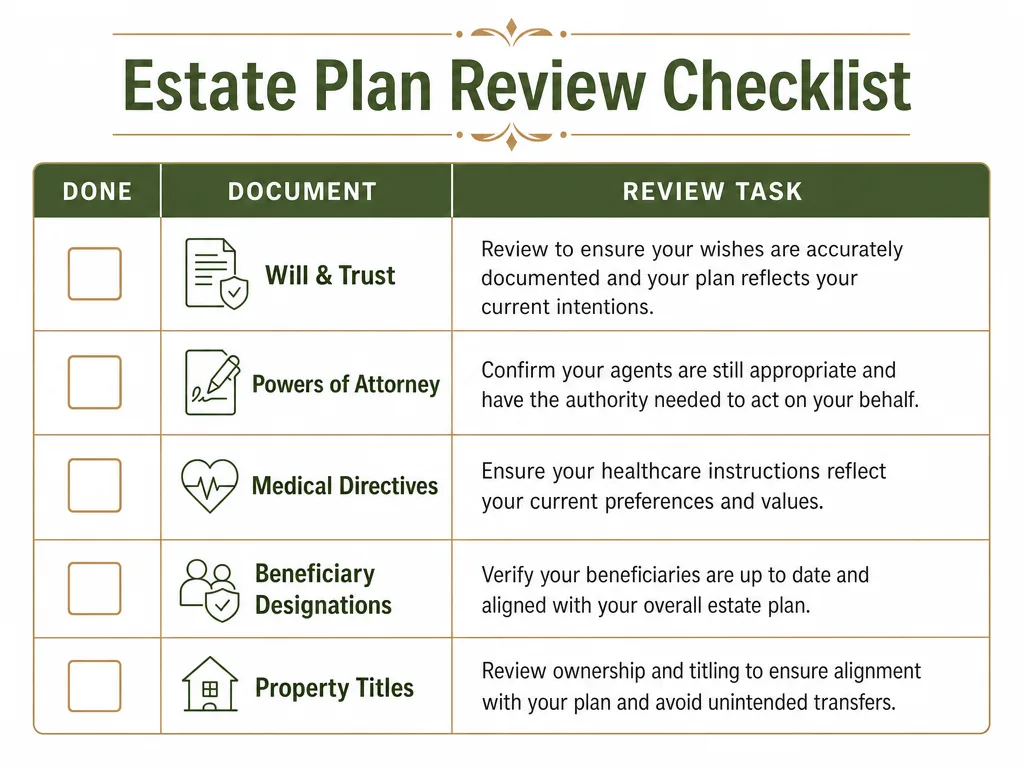
| Item | Review | Possible action |
|---|---|---|
| Revocable trust | Governing law; trustees; California tax connections; Texas home funding; qualifying-trust language | Amend, restate, or retain after coordinated legal and tax review |
| Will | Texas validity; foreign self-proof; independent administration; bond waiver; executor eligibility; pour-over provisions | Execute a Texas will or codicil if counsel recommends |
| Executor and trustee | Availability; nonresident executor's Texas resident-agent-for-service requirement; alternates; co-fiduciary burden | Keep or revise appointments based on practicality — not residency alone |
| Financial power of attorney | Foreign-document validity; express special powers; digital assets; acceptance; conflicts with prior instruments | Coordinate a Texas document and any revocation or replacement |
| Medical Power of Attorney | Agent availability; activation standard; limitations; current contacts | Consider a Texas Medical Power of Attorney |
| Directive to Physicians | Terminal or irreversible-condition instructions; consistency with other documents | Consider a Texas directive appropriate to the client's wishes |
| HIPAA authorization | Authorized people; information covered; expiration; current contacts | Update a federally compliant authorization |
| Beneficiary designations | Primary and contingent beneficiaries; minors; trusts; spousal consent; plan terms | Review each retirement account, insurance policy, annuity, and POD/TOD account |
| Divorce and former-spouse designations | Plan documents; actual beneficiary forms; decree; QDRO; Texas revocation rules; federal preemption | Change designations directly and obtain plan-specific legal review |
| Retirement accounts | SECURE Act/RMD consequences; trust beneficiaries; income-in-respect-of-decedent treatment | Review with estate counsel and a qualified tax adviser |
| Marital agreement | Governing law; validity; income from separate property; tracing; disclosure | Obtain Texas and, if needed, California review |
| Texas home deed | Current title; trust funding; spousal joinder for a homestead; survivorship; TOD alternatives; mortgage; title coverage; insurance | Have Texas counsel evaluate before recording any deed |
| TOD deed | Chapter 114 execution and recording; 120-hour survival; liens; trust coordination | Record only if it fits the overall plan |
| California real estate | Title; trust funding; California-source income; situs and marital-property characterization of rent; Proposition 19; ancillary probate exposure | Coordinate Texas counsel, California counsel, and a California-qualified tax adviser |
| Business interests | Transfer restrictions; succession; buy-sell terms; trust eligibility; state nexus | Coordinate business, estate, and tax advisers |
| Forced-sale homestead | Occupancy and intent; acreage; permitted liens; qualifying trust | Review separately from the property-tax exemption |
| Property-tax homestead | Ownership and occupancy; application; trust qualification; appraisal-cap start | Apply with the county appraisal district and verify approval |
| Probate homestead and family protections | Surviving-spouse/minor-child occupancy and partition rights; exempt property; family allowance; liquidity | Have Texas counsel compare the dispositive plan with Chapters 102 and 353 |
| Digital assets | Online legacy tools; fiduciary authority; secure inventory | Update settings and documents under Chapter 2001 |
| Disposition of remains | Statutory agent; alternates; funeral and prepaid arrangements | Consider the Texas Section 711.002 form |
| Minor children | Guardian nominees; alternates; property management; trust terms | Update nominations and child-focused trust provisions |
Frequently Asked Questions
Do I need an entirely new estate plan, or can I amend my California documents?
There is no universal answer. A valid California trust may be retained, amended, or restated. Supporting documents may be replaced separately. The decision depends on the trust's governing-law and amendment provisions, tax connections, assets, family plan, fiduciaries, and the cost and clarity of amendments compared with a restatement. A Texas attorney should review the actual documents before recommending a method.
Does moving to Texas invalidate my California living trust?
No. Moving ordinarily does not invalidate a trust validly created in California. Its practical effectiveness depends on its terms and on whether relevant assets were transferred or made payable to it. Texas counsel should review Texas real estate, homestead qualification, trustees, governing law, and administration. California tax or legal review may remain necessary if the trust has California-source income, a California trustee or beneficiary, or California property.
What happens if I die without updating my estate plan after moving?
If your Texas real estate is not controlled by the trust and no valid nonprobate transfer mechanism applies, the decedent's interest may require Texas probate or another title-clearing procedure. A pour-over will can direct probate property to the trust, but it does not itself avoid probate. Depending on the facts, other procedures — such as an affidavit of heirship — may sometimes be available, although they do not provide a universal substitute for probate. The trust can still control assets properly transferred or made payable to it, while financial accounts governed by valid beneficiary or POD/TOD designations ordinarily pass under those designations.
Is a California power of attorney honored in Texas?
Generally yes, if the instrument is valid under the law selected by Texas Estates Code Section 751.0023. Section 751.0024 separately governs its meaning and effect. Texas institutions may still request a certification, translation, or attorney opinion as permitted by Texas law [11]. Texas counsel may recommend a Texas statutory durable power of attorney to reduce unfamiliarity or address missing powers, but no particular form guarantees immediate acceptance.
How should retirement accounts be reviewed after the move?
Federal plan and tax rules govern much of the analysis, while state marital-property law can affect ownership interests. Preserve records showing premarital balances, contributions, rollovers, conversions, and distributions. Review beneficiary designations, spousal-consent rules, trust beneficiaries, required minimum distributions, and income-in-respect-of-decedent treatment with qualified counsel and a tax adviser.
Can a Texas attorney help with my California rental property?
A Texas attorney can advise on how the rental property fits into your overall Texas estate plan and can coordinate with California counsel. California-specific legal questions involving title, trust funding, and probate should be reviewed by a California-licensed attorney. California income-tax questions should be reviewed by a qualified tax professional familiar with California nonresident and fiduciary taxation. Cross-state estate planning typically requires a team with attorneys in both states.
What is the deadline for filing a Texas homestead exemption after I move?
The general application deadline is before May 1, but Texas law permits certain late homestead applications. A person acquiring and occupying a qualifying home after January 1 may receive a prorated exemption for the remaining portion of the year if the prior owner did not receive the same exemption for that year. The 10% appraised-value limitation generally begins January 1 after qualification. File promptly with the county appraisal district and verify approval. Texas Tax Code Section 11.431 permits certain late residence-homestead applications filed no later than two years after the applicable taxes become delinquent, but owners should not rely on late-filing relief when timely filing is possible [26].
Should I update my estate plan immediately after closing on a Texas home, or can I wait?
Review the plan promptly after domicile and property ownership change; 90 days is a practical target, not a legal safe harbor. Do not record a deed conveying the property to a trustee, a TOD deed, or a survivorship agreement merely to avoid probate before counsel reviews title, mortgage, insurance, homestead, beneficiary, and family-plan consequences. Until the review is complete, keep existing originals accessible and avoid creating inconsistent documents.
If I keep a California rental property, do I still need a California will?
Not automatically. A will does not avoid probate. Individually titled California real estate may require a California probate or ancillary proceeding even when a Texas will states who should receive it. Proper trust funding or another valid nonprobate transfer may avoid probate, but each method has legal, tax, mortgage, title, and beneficiary consequences. California and Texas counsel should determine whether one coordinated will, a trust, or another arrangement is appropriate.
Your Estate Plan Should Cross State Lines. Make Sure It Does.
A California estate plan does not stop working merely because its owner moves to Texas. The more common problem is mismatch: the documents remain valid, but title, beneficiaries, fiduciaries, tax connections, and Texas-specific procedures no longer align. A coordinated review can identify which documents should remain, which should be revised, and which assets require separate implementation.
If you have moved from California to the Texas Hill Country and want a referral to a Texas estate-planning attorney who understands cross-state issues, or if you have questions about how your specific situation fits into the broader picture of your Texas relocation, I am happy to help point you in the right direction.

Written by
Bill Ross
Hill Country Homesteads Group, brokered by KW Boerne
Bill Ross is a Texas real estate agent with nearly four decades in high-tech sales and a network of more than 1,100 California real estate agents for coordinated cross-state transactions. Featured in national coverage discussing his family's relocation from Silicon Valley to the Texas Hill Country, Bill helps California families navigate every aspect of the move to the Texas Hill Country.
Related Guides
Community Property vs. Separate Property
How Texas law affects your California trust and community property character after moving.
Healthcare and Estate Planning for Seniors
California vs. Texas healthcare systems, nursing home costs, and estate planning laws for retirees.
Texas Homestead Exemption Guide
How to file, how much you save, and the deadlines that matter for every new Texas homeowner.
How to File for Probate in Texas
A step-by-step guide to the Texas probate process for families navigating estate administration.
Sources
- Texas Family Code Sections 3.001-3.003 — separate property, community-property definition, and burden of proof. Texas Constitution and Statutes
- Arnold v. Leonard, 273 S.W. 799 (Tex. 1925) — Texas Supreme Court decision concerning rents and revenues from separate property. Case text
- California Family Code Section 770(a)(3) — separate property includes rents, issues, and profits. California Legislative Information
- California Family Code Section 760 and California Evidence Code Section 115 — general community-property definition and default burden of proof. California Family Code 760 · California Evidence Code 115
- Texas Estates Code Section 251.053 — validity of a written will executed outside Texas. Texas Constitution and Statutes
- Texas Estates Code Sections 401.001-401.003 — independent administration authorized by a will or established through statutory agreement. Texas Constitution and Statutes
- Texas Property Code Sections 112.001, 112.004, 112.005, and 115.001(a)(2) — methods of creating a trust, written evidence of the trust's terms, the requirement of trust property, and a Texas court's jurisdiction to determine the law applicable to a trust instrument. Texas Constitution and Statutes · Texas Property Code 115
- Texas Property Code Section 41.0021 — homestead treatment of property held through a qualifying trust. Texas Constitution and Statutes
- Texas Tax Code Section 11.13 — residence homestead property-tax exemption and qualifying-trust provisions. Texas Constitution and Statutes
- Texas Estates Code Section 304.003 — qualification and resident-agent requirement for nonresident executors. Texas Constitution and Statutes
- Texas Estates Code Sections 751.0023, 751.0024, 751.031, and 751.201 — express grants of authority, validity of out-of-state durable powers of attorney, and acceptance procedures. Texas Constitution and Statutes
- Texas Health and Safety Code Section 166.005 — advance directives executed in another jurisdiction. Texas Constitution and Statutes
- Texas Health and Safety Code Section 166.033 — Directive to Physicians statutory form. Texas Constitution and Statutes
- Texas Health and Safety Code Chapter 166, Subchapter D — Medical Power of Attorney. Texas Constitution and Statutes
- Internal Revenue Code Sections 1014(b)(6) and 1014(c), and IRS Publication 559 — community-property basis adjustment and exclusion of income in respect of a decedent. 26 U.S.C. 1014 · IRS Publication 559
- Texas Family Code Sections 4.001-4.010 and 4.102-4.105 — premarital agreements and marital partition, exchange, and income agreements. Texas Constitution and Statutes
- California Code of Civil Procedure Section 704.730 — California homestead-exemption formula. California Legislative Information
- Texas Estates Code Chapter 114 — creation, execution, recording, revocation, and operation of transfer-on-death deeds. Texas Constitution and Statutes
- Texas Estates Code Sections 114.103-114.106 — survival, liens and encumbrances, creditor claims, and statutory allowances affecting transfer-on-death property. Texas Constitution and Statutes
- Texas Estates Code Chapter 2001 — fiduciary access to digital assets. Texas Constitution and Statutes
- Texas Estates Code Sections 1104.053, 1104.202-1104.205, and 1105.101 — parental guardian designations, adult Declaration of Guardian, and the different bond rules for a guardian of the person and a guardian of the estate. Texas Estates Code 1104.053 · Texas Estates Code 1105.101
- Texas Estates Code Section 256.152 — wills self-proved under the laws of other jurisdictions. Texas Constitution and Statutes
- California Franchise Tax Board, Estates and Trusts — California-source income and California trustee and beneficiary connections. FTB.ca.gov
- Texas Estates Code Chapter 112 — community-property survivorship agreements. Texas Constitution and Statutes
- Texas Constitution Article XVI, Sections 50-51, and Texas Property Code Sections 41.001-41.002 — homestead forced-sale protection, permitted liens, and acreage limits. Texas Constitution · Texas Property Code 41
- Texas Tax Code Sections 11.13, 11.42, 11.43, 11.431, and 23.23, and Texas Comptroller guidance — residence homestead exemptions, prorated eligibility, application and late-filing rules, and the appraised-value limitation. Texas Tax Code 11 · Texas Tax Code 23 · Comptroller Exemptions · Comptroller Valuing Property
- 12 U.S.C. Section 1701j-3(d)(8) — restriction on enforcing due-on-sale clauses after certain transfers into an inter vivos trust. U.S. Code
- California Franchise Tax Board, Rental Income and Expenses, and Part-Year Resident and Nonresident — California taxation of rent from California real property and gain from the sale or transfer of California real property. FTB.ca.gov — Rental Income · FTB.ca.gov — Part-Year and Nonresident
- Texas Health and Safety Code Section 711.002 — priority and statutory appointment for disposition of remains. Texas Constitution and Statutes
- IRS estate-and-gift-tax guidance and Instructions for Form 706 — 2026 federal basic exclusion amount and the requirement to file Form 706 to elect portability of a deceased spouse's unused exclusion. IRS Estate and Gift Tax · Instructions for Form 706
- Texas Secretary of State foreign-entity guidance and Texas Comptroller franchise-tax guidance — foreign registration, transacting business, taxable entities, and Texas nexus. Texas SOS · Comptroller Franchise Tax · Comptroller Taxable Entities FAQ
- California Franchise Tax Board, Residents and Social Security — California residents generally are taxed on income regardless of source, while Social Security benefits are excluded from California taxable income. FTB.ca.gov — Residency Status · FTB.ca.gov — Social Security
- Texas Family Code Section 5.001 — neither spouse generally may sell, convey, or encumber the homestead without the other spouse's joinder, whether the homestead is separate or community property. Texas Constitution and Statutes
- Texas Estates Code Chapter 111, including Section 111.001 — written right-of-survivorship agreements for jointly owned noncommunity property. Texas Constitution and Statutes
- California State Board of Equalization, Proposition 19 Fact Sheet — intergenerational transfer exclusions for qualifying family homes and family farms. BOE.ca.gov
- Texas Comptroller and California State Controller — repeal or current nonapplication of state inheritance and estate taxes. Texas Comptroller · California State Controller
- Thomas M. Featherston Jr., "Marital Property Character of Property After a Change of Domicile or Shift in Situs" — discussion of community-property differences, changes of domicile, and the rule that the law of the situs generally governs interests in land. Baylor Law School. Baylor Law School
- Texas Constitution Article XVI, Section 52, and Texas Estates Code Chapter 102 — descent and probate-homestead protections involving a surviving spouse or minor children. Texas Constitution · Texas Estates Code Chapter 102
- Texas Estates Code Chapter 353 — exempt property and family-allowance provisions in estate administration. Texas Constitution and Statutes
- Texas Estates Code Chapter 123 and Kennedy v. Plan Administrator for DuPont Savings and Investment Plan, 555 U.S. 285 (2009) — former-spouse designations, plan-document rules, and federal-law limits. Texas Estates Code Chapter 123 · Kennedy v. DuPont, 555 U.S. 285 (2009)
Last reviewed: July 27, 2026. Statutory references reflect current Texas and California law as of the date of publication. Laws change. Consult a qualified attorney for advice on your specific situation.