
Published:
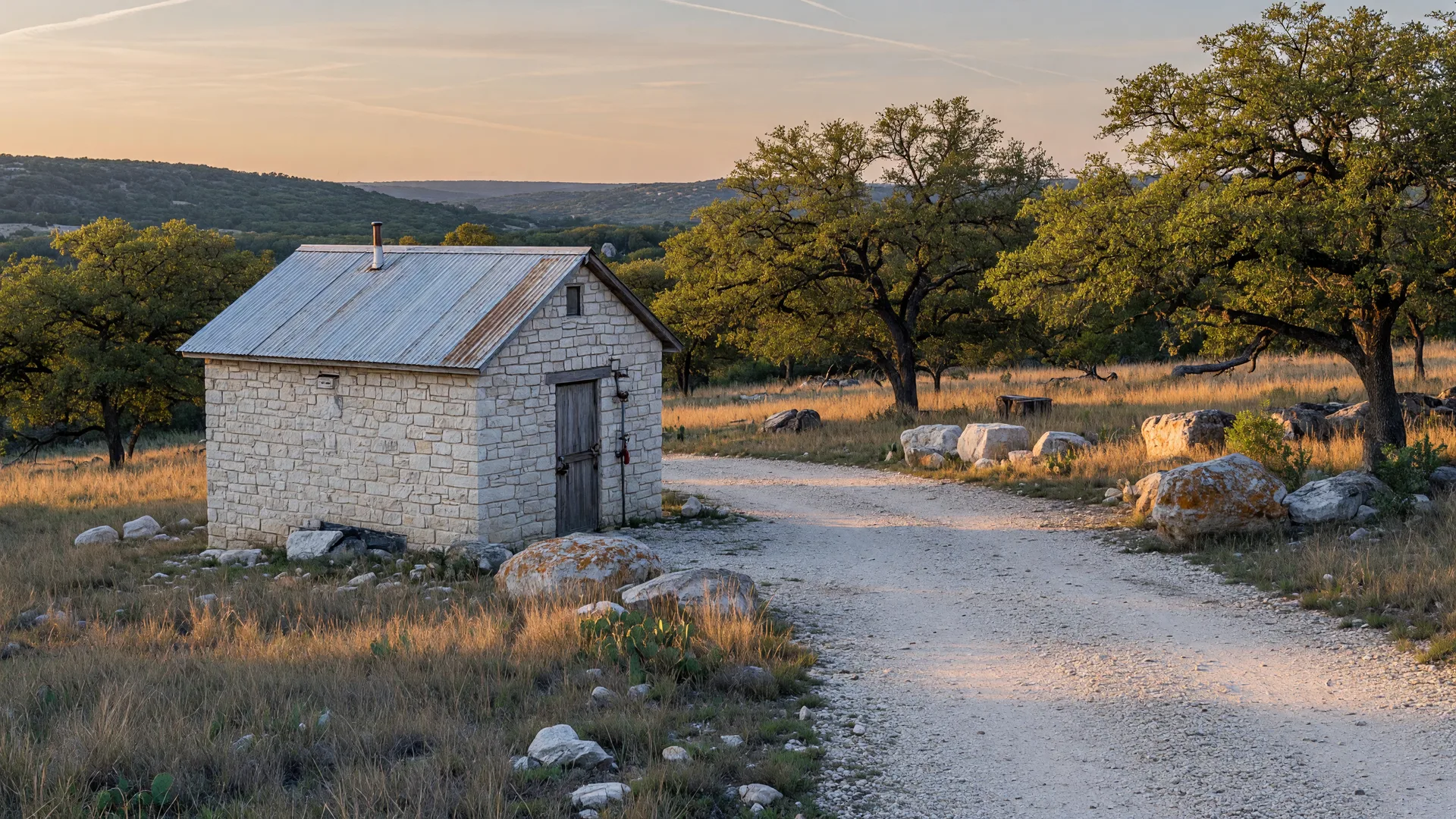
In California, water arrives with a bill. A district or a utility treats it, tests it, delivers it, and shows up with a truck when something breaks. You never touch the system and you rarely think about it. In the Texas Hill Country, the rules change the day you buy a home outside the main towns. If the listing says the property has a well, you are the utility now: the pump, the pressure tank, the softener, the annual test, and the midnight call when the pressure drops. This article is the owner's manual for that change, written the way I would explain it to a neighbor who is moving from a city water district to a well for the first time.
I am Bill Ross, a Texas real estate agent serving Boerne, Fair Oaks Ranch, San Antonio, and the surrounding Hill Country. Roughly four out of ten properties I show in the greater Boerne and Kendall County area rely on a private well, and the share climbs the farther you get from the municipal systems. I have watched California transplants adapt to this faster than they expect, because the transition is mostly about knowing what to ask, what to test, and what to budget. This guide covers the water chemistry you will meet, the treatment systems and their real costs, the annual testing that keeps your family safe, what drought means for a well, and the checklist I use when a client is buying a well property. Every number here is sourced and verifiable, and I have linked the sources at the end. If you want the wider infrastructure picture, my full guide to wells, septic, and the Edwards Aquifer is here.
Your First Water Bill Is a Chore List, Not a Bill
The first adjustment is mental. In Boerne and Fair Oaks Ranch, city water is available on a large share of lots inside the city limits, and many newer subdivisions are on municipal systems. The city of Boerne operates its own water system, and Fair Oaks Ranch has municipal water. But the acreage market, the 1-to-5+ acre places most California relocators are drawn to, sits largely outside those lines. There, a private well is the standard, not the exception.
Here is the practical comparison that matters before you decide whether a well property is right for you:
| Factor | Californian on city water | Hill Country well owner |
|---|---|---|
| Monthly cost | A predictable utility bill | No water bill, but you pay for electricity, salt, filters, and repairs |
| Water quality testing | The district tests and publishes results | Your responsibility, done at a certified lab on your schedule [7][8] |
| Who fixes a failure | The utility, with a service truck | A licensed well driller or pump service, dispatched by you [1][14] |
| Drought behavior | District manages supply and restrictions | Depends on your well's depth and aquifer; shallow wells can drop [4][5] |
| Power dependency | Tower pressure keeps water flowing during most outages | No electricity, no pump, no water. A generator is a real consideration |
None of this is a reason to avoid a well property. It is a reason to buy one with your eyes open. A well on good groundwater is a real asset, and for many families the freedom of a rural lot is worth becoming their own utility. The families who struggle are the ones who discover the responsibilities after closing, usually during the first power outage or the first hard-water surprise. [9][12]
What Comes Out of the Tap: The Chemistry Californians Meet Here
Here is the thing almost no one tells a California buyer before the first shower: Hill Country groundwater is hard, and often it is very hard. Rainwater falls on the Edwards Plateau and slowly dissolves the limestone it travels through, picking up calcium and magnesium along the way. Water above roughly 120 milligrams per liter, about 7 grains per gallon, is considered hard, and a good share of Hill Country wells run well beyond that. [7][8][12]
The practical effects are familiar to anyone who has lived on hard water: scale builds up in pipes and water heaters, soap lathers poorly, and hair and skin feel different. The fix, a whole-house water softener, is routine and affordable, but it is part of the system you are buying along with the well. The table below shows the parameters that matter most on a Hill Country test report, what the standards are, and what each one means in plain English.
| Parameter | Standard | What it means to you |
|---|---|---|
| Total coliform bacteria / E. coli | Must be absent | Presence signals possible septic or surface contamination, a health concern, and a reason to disinfect and retest [7][8] |
| Nitrate | 10 mg/L (as N) | Comes from septic systems and fertilizer; high levels are dangerous for infants [7][8] |
| Arsenic | 0.010 mg/L (10 µg/L) | Naturally occurring in Edwards Plateau rock, so Hill Country wells should test for it specifically [7][8] |
| Total dissolved solids (TDS) | 500 mg/L (secondary) | An aesthetic measure; high TDS affects taste and can cause staining and scale [7][8] |
| Hardness | 120 mg/L (7 gpg) and up is hard | Scale in pipes and water heaters; the reason a softener is the default upgrade [8][11] |
| Iron | 0.3 mg/L (secondary) | Common in Texas wells; causes orange staining and a metallic taste, and iron bacteria can clog plumbing [7][8] |
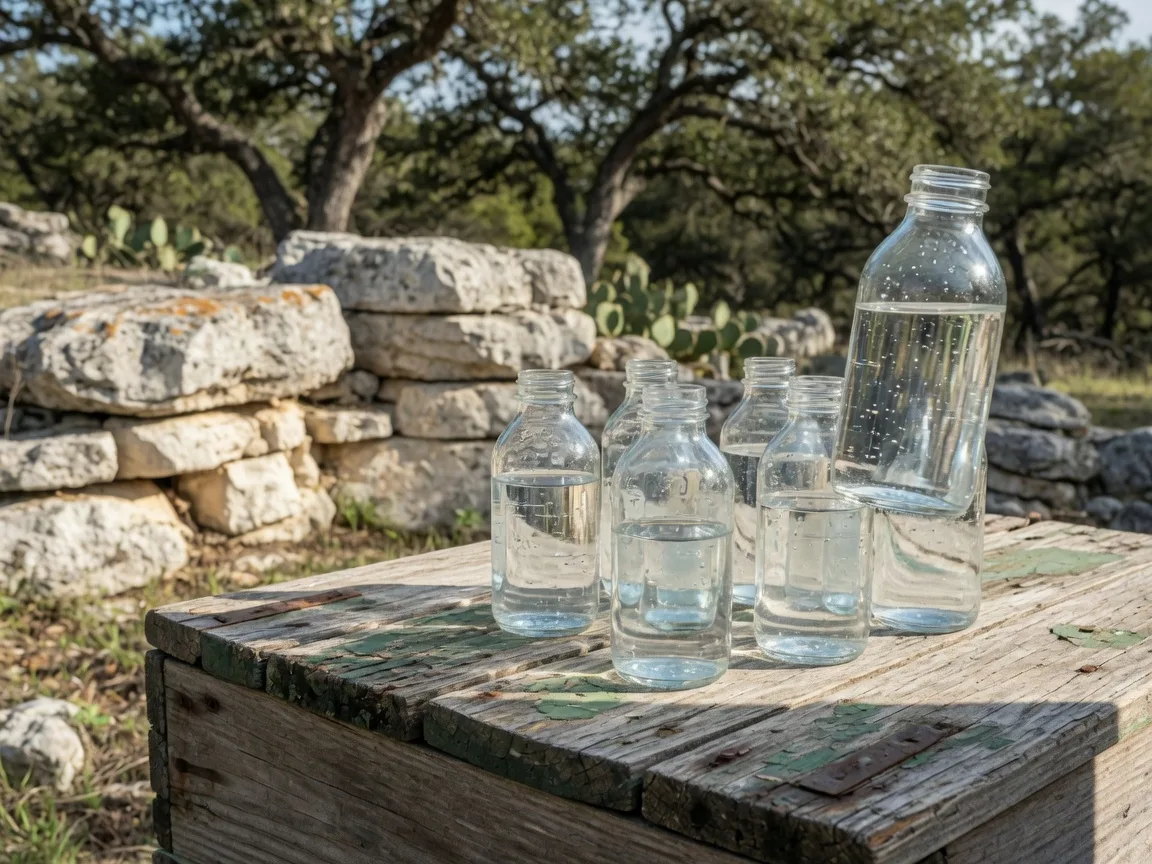
The good news is that none of these conditions are unusual or unmanageable. A water test turns a mystery into a short shopping list, and the treatment industry in the Boerne and San Antonio area deals with exactly these chemistry profiles every day. The bigger risk is skipping the test and guessing. [8][10]
The Treatment Stack: What Goes in the Garage or Pump House
Once you know your water chemistry, the equipment list writes itself. Most Hill Country well homes end up with a version of this stack: a sediment filter to catch grit, a softener for hardness, an iron filter if iron shows up, a UV light if there is any bacterial history, and an under-sink reverse osmosis unit for the drinking water of picky kids and guests. That sounds like a lot of machinery. In practice it is one tidy row of tanks in a utility room or pump house, and each piece has a clear job and a clear price.
| System | Typical installed cost | Ongoing cost |
|---|---|---|
| Whole-house water softener | $1,200 to $4,500 | $100 to $250 a year in salt; resin replacement roughly every 10 to 15 years [10][11] |
| Iron / oxidation filter | $1,000 to $3,500 | Backwashing plus periodic media replacement, a few hundred dollars at intervals [10] |
| UV disinfection | $500 to $2,200 | Replace the bulb every year, $80 to $160, even if it still glows [10] |
| Reverse osmosis (under-sink) | $300 to $800 | $80 to $200 a year in replacement filters; membranes last 2 to 5 years [10] |
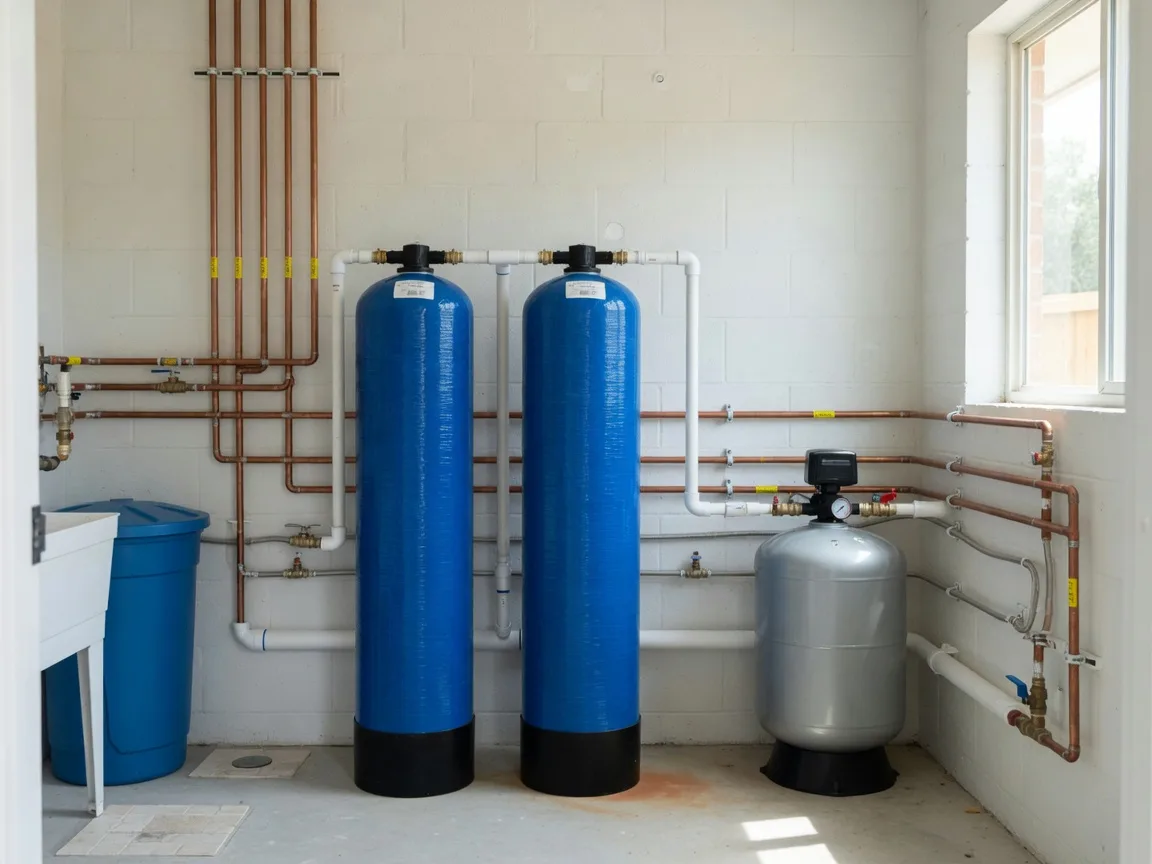
For most Hill Country wells, a complete treatment train, sediment plus softener plus iron filter plus UV, runs roughly $3,000 to $7,000 installed. [10][11] That is a one-time capital cost, not a monthly bill, and it is often negotiable into a purchase or comfortably within the maintenance budget of a home that cost far less than its California equivalent. When you tour a well property, ask what equipment is installed, how old it is, and whether the seller has water test results. Those three answers tell you whether you are inheriting a system or buying a project. [10][14]
The Annual Test: Small Money, Big Peace of Mind
Texas does not force a private well owner to test on a schedule, which surprises people coming from a system where a water district tests on their behalf. The Texas Commission on Environmental Quality and the Texas Well Owner Network at Texas A&M AgriLife both recommend testing at least once a year, with total coliform bacteria and nitrate as the annual minimum for every well. [7][8] Add arsenic to the panel for Hill Country properties, because it occurs naturally in the Edwards Plateau rock, and test more often after flooding, after well repairs, or any time the water changes in taste, color, or smell. A new well should be tested before anyone drinks from it. [7][8]
A basic annual panel, covering bacteria, nitrate, pH, TDS, hardness, and iron, typically costs about $150 to $300 at a state-certified laboratory. [7] Arsenic adds to the cost; it is a more involved analysis, and it is worth every dollar on an Edwards Plateau property. This is the cheapest insurance you will ever buy for your family's drinking water, and it is the single most important habit to carry out of a California mindset, where testing was someone else's job.
When the results come back, read them against the standards in the chemistry table above. Coliform should be absent, nitrate should stay below 10 mg/L, and arsenic below 0.010 mg/L. TDS at or under 500 is fine and mostly about taste. Hardness is not a health issue at all. [7][8] If something comes back out of range, your options are clear: treat it, adjust the treatment equipment you already have, or in rare cases dig deeper or pursue a different water source. None of these are emergencies if you catch them on an annual test instead of on a doctor's visit. [8][13]
Drought and the Edwards Aquifer: What a Dry Year Does to a Well
The Edwards Aquifer is one of the most productive limestone aquifer systems in the United States, and it supplies water to more than two million people across South Central Texas. [12] Much of the Hill Country sits over the aquifer's contributing and recharge zones, which means surface water, creek flow, and groundwater are one connected system. When the aquifer drops, springs slacken and shallow wells feel it first.
The drought of 2025 drove that point home in a way Californians can appreciate, because the numbers made statewide news. The Edwards Aquifer Authority tracks conditions at the J-17 index well near San Antonio. By mid-2025 the level had fallen so far that the authority declared Stage 5 restrictions for the first time in its history, with the 10-day average at about 624 feet on May 23, 2025, roughly 12 feet above the all-time low of 612 feet set in 1956. [5][6] Heavy rain through 2026 reversed the trend: the 10-day average climbed to about 641.5 feet by June 2, 2026, and drought restrictions were later lifted in parts of the system. [5]
| Milestone | J-17 level / event |
|---|---|
| January 1, 2025 | Opened at the second-lowest January 1 reading on record, roughly 40 feet below normal [5] |
| April 15, 2025 | 625.4 feet, the lowest level since 1990 [5] |
| May 23, 2025 | About 624 feet (10-day average 624.7), triggering the first-ever Stage 5; the 1956 all-time low was 612 feet [5][6] |
| June 2, 2026 | 10-day average 641.5 feet, back at Stage 2 and more than 13 feet above mid-April [5] |
| August 2026 | Critical period management lifted in the Uvalde pool of the aquifer [5] |
Here is the part that reassures most well owners. The Edwards Aquifer Authority's drought restrictions apply to permit holders authorized to pump more than three acre-feet a year, meaning industrial, irrigation, and municipal users. A private exempt domestic well, one that is registered, used only for household and livestock purposes, and physically incapable of producing more than 25,000 gallons a day, is not subject to mandatory pumping cutbacks. The authority strongly encourages well owners to conserve, but no one meters your kitchen tap. [4]
Your real drought risk is simpler and more personal: the depth of your specific well. A well drilled 400 to 600 feet into the Trinity or the Edwards has years of buffer that a 150-foot well on a shallow formation does not. When homes in the Hill Country ran short during the severe drought years of the early 2010s, the pattern was almost always shallow wells. The remedy, drilling deeper or re-drilling into a more reliable formation, is a five-figure project in this region, which is why well depth and drought history belong at the top of your due diligence list, right next to the water test. [1][4][5]
Drilling a New Well: Depths, Dollars, and Paperwork
If you buy acreage without a well, you will probably drill one, and the price will be one of the first surprises of rural Texas living for a Californian accustomed to tapping into existing infrastructure. The Hill Country is among the more expensive parts of Texas to drill in, because the wells are deep and the ground is hard limestone. Typical residential wells in Kendall and Bandera run 200 to 400 feet, and many across the region reach 300 to 600 feet before they find reliable water. [1][2]
Drilling itself runs about $25 to $58 per foot depending on geology, and a fully installed well, including casing, pump, pressure tank, wiring, and the rest, typically lands between $10,000 and $25,000. Full turnkey systems often start near $25,000, and genuinely deep and difficult wells, 700 to 1,000 feet, can climb past $80,000. [1][2] That is the number to budget mentally before you fall in love with an undeveloped lot, because it changes the true cost of the land.
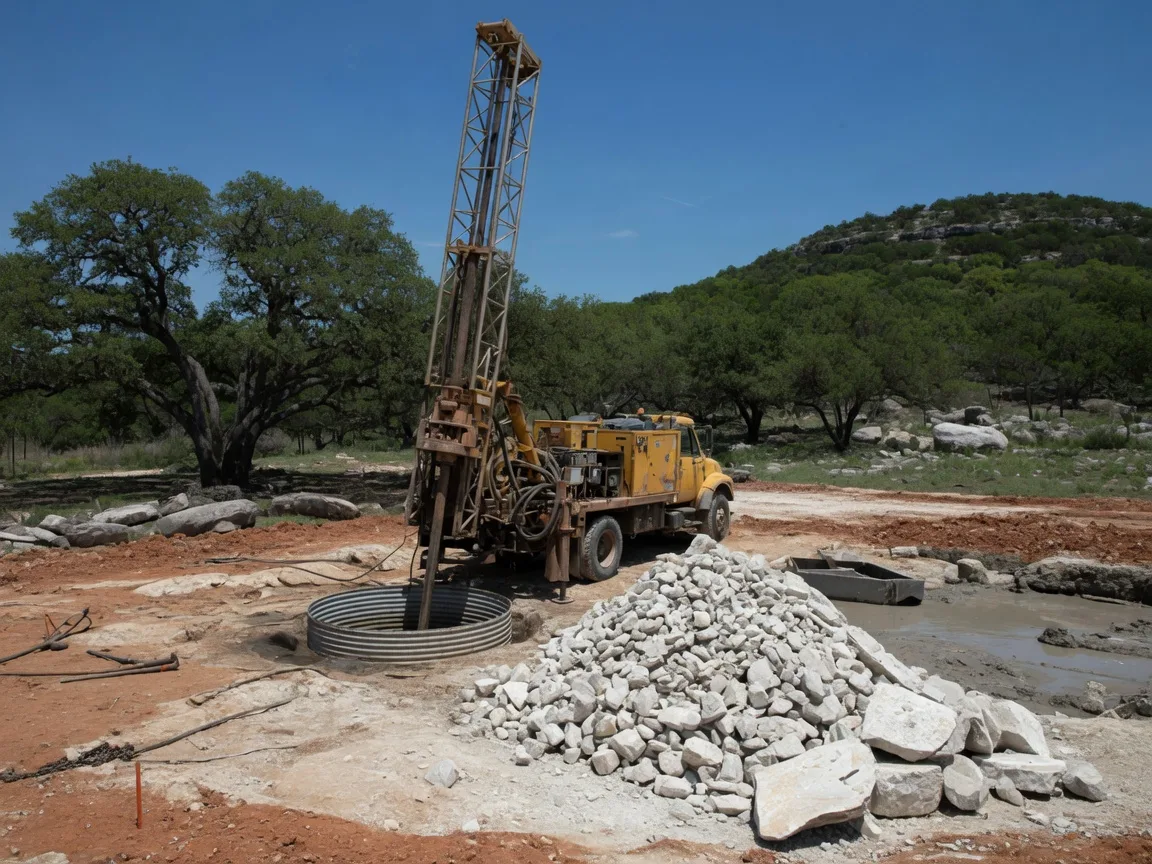
There is also paperwork. Texas regulates new wells through local groundwater conservation districts, and the district that covers your property depends on the county. In Kendall County it is the Headwaters Groundwater Conservation District, in Comal County it is the Comal Trinity Groundwater Conservation District, which charges on the order of $20 per acre-foot for non-agricultural use, and in Bandera County it is the Bandera County River Authority and Groundwater District. [1][3] Each requires a permit for a new well, and wells in Edwards Aquifer Authority jurisdiction must also be registered with the authority. [3][4] A licensed Texas water-well driller handles the permitting as part of the job, but you should know the district exists and what it charges before you budget. [1][14]
| County | Groundwater district | What to expect |
|---|---|---|
| Kendall (Boerne area) | Headwaters GCD | Permit required for a new well; deep drilling through Edwards Plateau limestone is typical [1][3] |
| Comal (New Braunfels area) | Comal Trinity GCD | Permit required; about $20 per acre-foot for non-agricultural use [3] |
| Bandera | Bandera County River Authority & Groundwater District | Permit required; verify fees and well rules with the district before contracting a driller [1][3] |
One more thing worth writing down: a drilled well is a built asset with a lifespan, not a mystery hole. The driller's log records depth, casing, static water level, and date, and that document should be kept with the property's records and reviewed by any buyer. Texas issues well identification numbers and maintains driller records precisely so that this history is available, and a good agent will pull it before you make an offer. [9][14]
The Buyer's Checklist for Any Well Property
When a California client asks me what to do about a well property, I give them a list, not a lecture. You do not need to become a hydrologist. You need six answers before you commit, and each one is cheap compared to the surprise it prevents:
- Pull the driller's log and well report. Depth, casing, static water level, and age tell you how much buffer the well has in a drought. Ask the seller for it, and if it does not exist, treat that as a question mark. [1][9]
- Run a well performance (flow) test. A licensed well service can confirm that the well produces its rated gallons per minute through a full day of use, not just the first surprising minute. [1][14]
- Order a full water quality test at a state-certified lab. Bacteria, nitrate, pH, TDS, hardness, iron, and arsenic. $150 to $300 for the basic panel plus the arsenic add-on, and it is the single highest-value line on your entire due diligence budget. [7][8]
- Inspect the treatment equipment and get ages. A softener on its last legs is a $4,000 replacement that belongs in your offer math, not a discovery six months after closing. [10][14]
- Verify the septic separation distances. Texas rules require a well to sit at least 50 feet from a septic drain field, 100 feet from a septic tank, and 150 feet from any livestock or manure area. Confirm the distances on the actual property, not the plat. [15]
- Ask about drought history. The neighbors and the listing agent know whether the well has ever run short in a dry year. That question has saved more clients than any inspection report. [4][5]
Take that list seriously and a well property stops being a risk and becomes what it should be: a self-contained home on land that is genuinely yours. My earlier deep dive on the Edwards Aquifer and groundwater fundamentals covers the geology in more depth, and the septic systems guide walks through the other half of the rural infrastructure picture.
Living with a Well Is Living Connected to Your Land
There is a moment in almost every well-property closing where the new owner looks at the tank, the softener, and the little building by the drive and realizes they know more about their utility than they ever did in California. Most of my clients end up describing that moment as a shift, not a burden. You trade a monthly bill and a customer-service number for a system you understand, maintain, and control. [9][13]
That trade is right for some families and wrong for others, and both answers are fine. Homes in Boerne, Fair Oaks Ranch, and the newer subdivisions near San Antonio offer city water, while the acreage market offers independence. My job is to help you match the property to the life you actually want, and that includes the well, the water test, and the septic setback just as much as the kitchen and the lot size. If you are weighing a Hill Country move and wondering whether a well property fits your family, reach out for a no-pressure conversation. I have the drillers' contact lists, the lab referrals, and the local knowledge to help you decide with numbers instead of anxiety. [1][8]
Frequently Asked Questions
How much does it really cost to live on a private well in the Hill Country?
There is no monthly water bill, but there is a real annual cost: roughly $100 to $250 a year in softener salt, $80 to $160 a year for a UV lamp replacement, replacement filters for any reverse osmosis unit, plus an annual lab test of $150 to $300. Set aside against the cost of a deep well itself, a $10,000 to $25,000 investment on many Hill Country properties is modest. The ongoing operating cost is typically a few hundred dollars a year plus the occasional service call. [1][7][10]
Is Hill Country well water safe to drink?
Most of the time, yes, but the answer depends on your specific well and your test results, not on the neighborhood. The annual minimum panel is total coliform bacteria and nitrate, and Hill Country wells should also test for arsenic, which occurs naturally in the region. Bacteria should be absent, nitrate should stay below 10 mg/L, and arsenic below 0.010 mg/L. If results come back clear and you maintain your treatment equipment, the water is safe. If anything is out of range, treat it before drinking, and remember the lab results are the authority, not assumptions. [7][8]
What happens to my well during a drought?
Private exempt domestic wells, those registered for household and livestock use and limited to 25,000 gallons a day, are not subject to the Edwards Aquifer Authority's mandatory drought pumping restrictions; the authority encourages their owners to conserve. [4] The real risk is depth. Shallow wells on thin formations feel drought first, and wells drawing from deeper Trinity or Edwards formations have far more buffer. During the severe 2025 drought the aquifer's J-17 index well fell to its first-ever Stage 5 level at about 624 feet, roughly 12 feet above its 1956 record low, before heavy 2026 rains brought recovery. [5][6]
Do I need a permit to drill a well in Kendall, Comal, or Bandera County?
Yes. A new well in Kendall County falls under the Headwaters Groundwater Conservation District, in Comal County under the Comal Trinity Groundwater Conservation District, which charges roughly $20 per acre-foot for non-agricultural use, and in Bandera County under the Bandera County River Authority and Groundwater District. Each requires a permit, and wells in Edwards Aquifer Authority jurisdiction must also be registered. A licensed driller handles the paperwork, but the fees and rules are worth asking about before you budget the project. [1][3][4]
Should I avoid well properties and hold out for city water?
Not automatically. City water is simpler and it is the right choice for many families, especially in Boerne, Fair Oaks Ranch, and the newer subdivisions near San Antonio. But the acreage market that draws so many California relocators, the 1-to-5+ acre lots with views and space, is mostly outside municipal lines. A well property becomes a non-issue once you have a clean water test, a performance test, a driller's log, and a treatment plan. If your dream property has a well, inspect it the way you would inspect the roof, and let the data decide. [1][8][15]
Sources
- [1] WellDrillingCosts.com, "Texas Hill Country Well Drilling Cost 2026." welldrillingcosts.com/guides/well-drilling-cost-hill-country-texas
- [2] SC Well Service, "Texas Water Well Statistics 2026." scwellservice.com/blog/texas-water-well-statistics
- [3] Comal Trinity Groundwater Conservation District, FAQ on permits and fees. comaltrinitygcd.com/faqs
- [4] Edwards Aquifer Authority, Critical Period / Drought Management. edwardsaquifer.org/groundwater-users/critical-period-drought-management
- [5] San Antonio Express-News, "For first time ever, Edwards Aquifer in Stage 5 drought restrictions" and 2026 recovery coverage. expressnews.com/news/article/edwards-aquifer-water-levels-drought-20342993
- [6] Texas Public Radio, "San Antonio's Edwards Aquifer nears lowest level ever, Stage 5 declared." tpr.org/environment/2025-05-23/san-antonios-edwards-aquifer-nears-lowest-level-ever-stage-5-declared
- [7] Texas Water Resources Institute / Texas Well Owner Network, "Ask CM: How can I get my water tested for harmful contaminants?" twri.tamu.edu/news/2016/july/ask-cm-how-can-i-get-my-water-tested-for-harmful-contaminates
- [8] Texas Commission on Environmental Quality, private well owner water testing guidance. tceq.texas.gov/assistance/water/well-owners
- [9] Texas Water Development Board, groundwater data and well reports. twdb.texas.gov/groundwater
- [10] HomeGuide, "Well Water Filtration System Cost (2026)." homeguide.com/costs/well-water-filtration-system-cost
- [11] AquaTech Texas, "The Real Cost of Water Softening in Texas." aquatechtexas.net/blog-learning-center/3075965
- [12] U.S. Geological Survey, Texas Water Science Center, Edwards-Trinity Aquifer system overview. usgs.gov/centers/texas-water-science-center/science/edwards-trinity-aquifer
- [13] Centers for Disease Control and Prevention, private well water safety guidelines. cdc.gov/healthywater/drinking/private/wells
- [14] Texas Department of Licensing and Regulation, water well drillers and construction standards. tdlr.texas.gov/wells
- [15] Kendall County Development Services, well and septic setback requirements. kendallcounty.org/departments/development-services