

If you live in most parts of California, you turn on the tap and water comes out. You pay a bill from your municipal water district or a private utility. You never think about where the water came from, how deep it had to travel, whether it contains dissolved limestone that will clog your pipes, or what happens when the pump stops working on a Saturday afternoon in August.
In the Texas Hill Country, that experience changes the moment you buy a home outside city limits. About 40 percent of the homes I show in the greater Boerne and Kendall County area rely on private wells for their water supply. That number climbs higher the farther you get from downtown Boerne. For California buyers, who are almost universally accustomed to municipal water, this shift in water infrastructure is one of the bigger lifestyle adjustments that does not get mentioned in the glossy relocation brochures.
This article covers what you need to know about groundwater in the Hill Country, how wells actually work, what the Edwards Aquifer is and why it matters, the real costs of owning a well, and the practical steps to take when buying a property with a private water system. It is not meant to scare you away from rural properties. It is meant to ensure you go in informed rather than surprised.
The Foundation: What Is the Edwards Aquifer?
To understand wells in the Hill Country, you need to understand the aquifer system that sits beneath it. The Edwards Aquifer is one of the most productive limestone aquifers in the United States, supplying water to more than two million people across South Central Texas, including San Antonio and much of the Hill Country [1][6]. It is not a single underground lake. It is a system of water-bearing limestone formations, honeycombed with cracks, channels, and caverns that hold and transmit groundwater.
The aquifer is divided into three distinct zones that matter for property owners: the contributing zone (where water enters the ground), the recharge zone (where surface water moves directly into the aquifer through cracks and sinkholes in the limestone), and the artesian zone (where the water is confined under pressure between layers of less permeable rock). The Hill Country sits predominantly over the contributing and recharge zones, which means the quality and availability of groundwater varies significantly depending on exactly where your property is located [2][6].
For property owners, the practical implications are straightforward:
- Well depth varies by location. A property in northern Kendall County may need a 400-foot well to reach adequate water, while a property in southern Comal County may find water at 150 feet. The geology under your specific lot determines what it costs to access water.
- Water quality varies by formation. Wells drawing from the Edwards formation typically produce harder water (higher calcium and magnesium) but lower total dissolved solids than wells drawing from the underlying Trinity formation. Each has its own treatment requirements.
- Pumping regulations vary by county. Wells in the Edwards Aquifer zone are regulated by the Edwards Aquifer Authority, which imposes pumping limits and requires permits for certain uses. Wells outside the EAA jurisdiction fall under different groundwater conservation districts [2][10].

How Hill Country Wells Actually Work
A private well system sounds simple in concept (drill a hole, pump the water) but the reality includes several components that California buyers should understand before they own one.
The Components
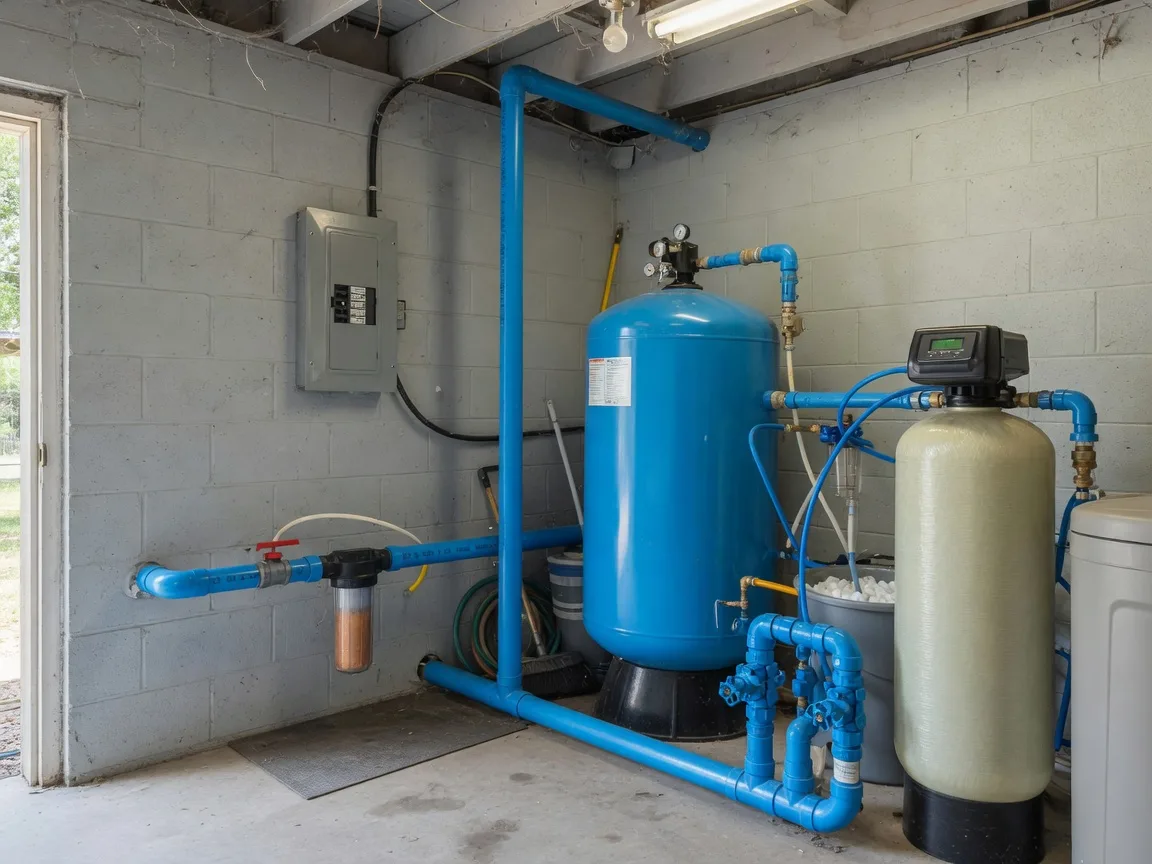
A standard Hill Country well system includes: the borehole itself, lined with a steel or PVC casing to prevent collapse and surface water infiltration; a submersible pump, typically set 50 to 100 feet below the static water level (the depth at which water stands in the well when it is not being pumped); a pitless adapter that allows the water line to pass through the casing below the frost line; a pressure tank that stores water and maintains consistent pressure in the home's plumbing; and a control box that manages the pump operation based on pressure demand [4][7].
The pressure tank is the component that homeowners interact with most. When you turn on a tap in your house, water flows from the pressure tank. As the pressure drops, the control box activates the pump to refill the tank. In a properly sized system, this cycle happens seamlessly and silently. You do not hear the pump run every time you use water, only during the refill cycle. If your pump is running every time you flush a toilet or run the dishwasher, something is wrong with your pressure tank or your well's recovery rate.
Well Yield and Recovery Rate
Every well has a yield, measured in gallons per minute. A well that produces 5 gallons per minute is considered adequate for a single-family home. A well that produces 10 to 15 gallons per minute is excellent. A well that produces 1 gallon per minute will need a larger pressure tank and careful water management because the well cannot replenish the tank as fast as the household uses it [1][4].
When you have a well tested before purchase, the yield test is the most important number. A four-hour yield test at 10 gallons per minute tells you the well can sustain household demand. A 30-minute test at the same rate may not reveal a well that would fail during extended use. Reputable well inspectors run longer tests. If the seller's disclosure mentions a yield test measured in minutes rather than hours, that is a flag worth investigating.
What Is Actually in the Water?
Hill Country well water is not the same as the Sierra Nevada snowmelt that fills California reservoirs. It is groundwater that has been in contact with limestone, clay, and organic material for months to centuries, and it carries the mineral signature of every rock it has touched.
Common Hill Country Well Water Characteristics
Typical Hill Country Well Water Profile
| Parameter | Typical Range | What It Means |
|---|---|---|
| Hardness | 10-30 grains/gallon | Very hard to extremely hard. Causes scale buildup in pipes, water heaters, and fixtures. Requires a water softener for comfortable bathing and appliance longevity. |
| Total Dissolved Solids | 300-800 mg/L | Moderate to high. Affects taste, leaves spots on glassware, and can reduce the lifespan of plumbing fixtures. Reverse osmosis systems are common for drinking water. |
| Iron | 0.3-3.0 mg/L | Stains laundry, sinks, and toilets orange or rust-colored. Gives water a metallic taste. Iron filtration systems are standard additions for many Hill Country wells. |
| Sulfates | 10-100 mg/L | Can cause a rotten-egg smell, especially if bacteria are present in the well. Treatable with aeration systems or chlorination. |
| pH | 7.0-8.5 | Slightly alkaline, typical for limestone aquifers. Acceptable for drinking but can accelerate scale formation. |
| Nitrates | 0.5-5.0 mg/L | Below EPA drinking water standard (10 mg/L) in most wells. Elevated levels can indicate surface contamination from fertilizer, livestock, or septic systems. Annual testing is recommended [3][11]. |
Sources: Texas Water Development Board groundwater quality data; Texas A&M AgriLife Extension water testing program [1][11]. Individual well results vary significantly. A complete laboratory analysis is the only way to know what is in your specific well.
The key point is this: Every well is different. Two wells on the same street, 200 feet apart, can produce water with completely different mineral profiles, because the fractures and channels in the limestone that carry the water do not follow property lines. A neighbor's excellent water does not guarantee your water will be the same. The only reliable approach is to have the specific well tested by a state-certified laboratory before closing [3][11].
The Texas Commission on Environmental Quality recommends annual testing for bacteria, nitrates, and total dissolved solids, plus periodic testing for heavy metals, volatile organic compounds, and radionuclides depending on local conditions [3]. Most Hill Country homeowners test more frequently after heavy rain events, which can introduce surface contaminants into shallow wells.
The Real Cost of Well Ownership
One of the appeals of well water is that there is no monthly water bill from a utility. But well ownership carries its own costs that California buyers should factor into their budget.
Upfront Costs
If you are buying raw land and need to drill a well, the costs are significant. Drilling typically runs $25 to $50 per foot, depending on rock hardness and the contractor's equipment. A 300-foot well at $35 per foot costs $10,500 just for the drilling. Then you add the casing, pump, pressure tank, wiring, and control box, which typically adds $5,000 to $10,000 depending on pump capacity and tank size [1][7]. A complete new well installation in the Hill Country usually falls between $12,000 and $25,000.
If you are buying an existing home with a well, the well is already there, but you should budget for an inspection and water quality test. A comprehensive well inspection, including a yield test, pump performance check, and pressure tank evaluation, runs $300 to $600. A full water quality panel from a state-certified laboratory runs $150 to $400 depending on the number of contaminants tested [3][11].
Ongoing Costs
Well ownership has no monthly utility bill, but it has predictable maintenance expenses:
- Electricity for the pump: $20 to $50 per month, depending on well depth, pump horsepower, and household water usage.
- Water treatment consumables: $30 to $80 per month for softener salt, filter cartridges, and chemical treatments.
- Annual water testing: $100 to $300 depending on the panel.
- Pump replacement: Every 8 to 15 years, at a cost of $2,000 to $5,000 for the pump and labor.
- Pressure tank replacement: Every 10 to 15 years, at a cost of $500 to $1,500.
- Well rehabilitation or deepening: Unpredictable, but a well that loses yield may need professional cleaning ($1,000 to $3,000) or deepening ($5,000 to $15,000) [4][7].
The total annual cost of owning a well, spread across predictable expenses and averaging out the capital replacement costs, typically runs $800 to $1,800 per year. That compares favorably to municipal water bills in the Hill Country, which typically range from $600 to $1,200 per year for a family of four. The tradeoff is that the well cost is lumpy and unpredictable, while the municipal bill is smooth and predictable. For many California buyers, the lumpy cost profile of well ownership is the bigger adjustment than the total amount.
The Septic Connection: Why Your Wastewater System Matters to Your Drinking Water
If your property has a well, it almost certainly has a septic system. The two are linked by something called setback distance, the minimum separation required between your wastewater disposal area and your drinking water source [8][9].
Texas regulations require that a well be located at least:
- 50 feet from a septic tank
- 100 feet from a septic drain field or absorption area
- 150 feet from any livestock enclosure or manure storage area
These are minimums. On a typical 1- to 5-acre Hill Country property, meeting the minimums is usually straightforward. On smaller lots, especially in older rural subdivisions that were platted before modern setback requirements, the distances can be tight. A well and septic system that were compliant when installed in 1985 may not meet current standards, and if either system needs replacement, the county may require both to be brought into compliance [8][9].
What this means for buyers: When you make an offer on a property with a well and septic, your option period should include a well inspection and a septic inspection. A septic system that has failed, or a well that sits too close to the septic field, can be a $10,000 to $30,000 problem that has no easy fix. I discuss this in every transaction involving rural property because it is the single most expensive surprise a California buyer can encounter in the Hill Country.
Drought, Regulation, and What Happens When the Water Stops
The Texas Hill Country is drought-prone. The historic drought of 2011-2014 was the most severe on record for much of the region, and it affected well owners across Kendall, Comal, and Bandera counties. During that period, the Edwards Aquifer Authority imposed Stage 3 and Stage 4 pumping restrictions, and shallow wells across the Hill Country went dry [2][10].
California buyers are familiar with drought, but the regulatory framework is different. In California, urban water districts impose usage restrictions. In the Texas Hill Country, the Edwards Aquifer Authority has the power to restrict how much water you can pump from your well if it draws from the Edwards Aquifer and you are using it for irrigation. Domestic use of well water for drinking, bathing, and household purposes is generally not restricted, even during severe drought. But outdoor watering, filling a swimming pool, or irrigating more than one acre can be subject to pumping limits during drought stages [2][10].
Wells drawing from the Trinity Aquifer are not subject to EAA regulations, but they face their own challenges. The Trinity formation is slower to recharge than the Edwards, and during extended droughts, Trinity wells can experience reduced yield as the water table drops. Property owners with Trinity wells are more likely to need to deepen their wells during severe drought conditions [1][5].
The practical takeaway: Before buying a rural property, ask the seller for the well's depth, the static water level, the yield in gallons per minute, and the well's performance history during drought years. A well that produced 10 gallons per minute in a wet year but only 2 gallons per minute in 2011 has a problem that will recur. If the seller cannot provide that information, a well inspection that includes a pump test under sustained drawdown conditions is money well spent.
Edwards Aquifer Drought Stages and Well Owner Impact
| Stage | J-17 Index Well Level | Restrictions for Well Owners | Historical Frequency |
|---|---|---|---|
| Stage 1 | Below 660 ft | Voluntary conservation; mandatory for large-volume users | Annually or near-annually |
| Stage 2 | Below 650 ft | Outdoor watering limited to one day per week for irrigation wells | Every 2-4 years |
| Stage 3 | Below 640 ft | Irrigation pumping restricted or suspended; domestic use unaffected | Every 5-10 years |
| Stage 4 | Below 630 ft | Critical period; mandatory reductions for all non-exempt users | Last triggered in 2014 |
| Stage 5 | Below 620 ft | Emergency stage; never triggered to date | Not yet triggered |
Source: Edwards Aquifer Authority, Drought Operations and J-17 Index Well data [2]. All values as of August 2026. Domestic well use is generally exempt from pumping restrictions. Outdoor irrigation is the primary regulated use.
Municipal Water vs. Well Water: Who Gets Which?
Not every Hill Country property has a well. Areas within city limits or in master-planned subdivisions are typically served by municipal water systems. Understanding which areas have public water and which rely on wells will shape your property search.
Municipal Water Service Areas
The city of Boerne operates its own water system, serving most homes within the city limits and some areas in the extra-territorial jurisdiction. Fair Oaks Ranch has municipal water service throughout the developed portions of the community. San Antonio Water System serves properties in Bexar County, including the far north side near the Kendall County line. Some newer subdivisions in unincorporated Kendall County have formed water supply corporations that provide treated well water to the development [1].
Private Well Areas
Once you leave the city limits and established subdivisions, private wells are the norm. Properties on acreage in Kendall County rural areas, the communities of Comfort, portions of Spring Branch, much of Bandera County, and the rural stretches of Comal County all rely on private wells. If you are looking for space, privacy, and acreage, you should expect a well.
The chart below gives a rough comparison of which communities typically offer municipal water and which do not. Always verify with the local water utility and the listing agent before making assumptions.
Water Source by Community in the Hill Country
| Community | Typical Water Source | Notes |
|---|---|---|
| Boerne (city limits) | Municipal | City of Boerne water system, drawn from wells and Guadalupe River |
| Boerne (ETJ / outskirts) | Well or water supply corp | Many newer subdivisions have water supply corporations; older rural properties have wells |
| Fair Oaks Ranch | Municipal | Municipal water throughout developed areas |
| Comfort | Well | Small municipal system serves limited downtown area; most properties on wells |
| Spring Branch | Well | No municipal system; well or water supply corporation |
| San Antonio (far north) | Municipal | SAWS provides water to most developed areas in Bexar County |
| Bandera County (rural) | Well | Almost entirely private wells |
Sources: City of Boerne Public Works; Fair Oaks Ranch Municipal Utility; Kendall County Development Services [1][9]. This is a general guide. Verify water source for each specific property with the listing agent and local utility.
What to Do When You Find the Right Property
If you are looking at a property with a well, here is the due diligence process I recommend to every California buyer:
- Get the well records. Ask the seller for the well driller's log, which records the date drilled, total depth, casing depth, static water level, and yield in gallons per minute. This document is filed with the Texas Water Development Board for permitted wells and is the single most important piece of paper about your water supply [1].
- Order a well inspection. A licensed well inspector will check the pump performance, pressure tank condition, control box, wiring, and casing integrity. They will also run a yield test to verify the well produces water at the rate stated in the driller's log.
- Test the water quality. A state-certified laboratory should test for total coliform bacteria, E. coli, nitrates, total dissolved solids, hardness, iron, manganese, sulfates, pH, and arsenic. Additional testing for heavy metals and volatile organic compounds may be warranted depending on the property's history and proximity to agricultural or industrial uses [3][11].
- Verify the septic system. The septic system should be inspected and pumped, and the setback distances between the septic components and the well should be measured and confirmed to meet current county standards [8][9].
- Check drought history. Ask the seller about the well's performance during the 2011-2014 drought. Did the well go dry? Was it deepened? Did the yield drop significantly? This information is more predictive of future performance than a single pump test in a wet year.
The Texas option period, typically 7 to 10 days in a standard contract, gives you time to complete all of these inspections before you are committed to the purchase. I make sure my California buyers understand the option period and use it for exactly this kind of due diligence. The well and septic inspections are not optional. They are as important as the structural inspection of the home itself.
Making Sense of Rural Property in the Hill Country
The water question is one of the most common topics I walk California buyers through when they start looking at properties outside of town. It is not complicated once you understand the basics, but the basics are not intuitive if you have spent your whole life on a municipal water system.
I have guided dozens of families through the well and septic evaluation process and I am happy to talk through what it means for properties you are considering. There is no obligation and no sales pitch. Just a clear explanation of what you are looking at and what questions to ask.
For a deeper look at the practical side of well and septic systems, read our companion guides on well water buying questions and septic system buying guide. And for a broader view of what rural life in the Hill Country really looks like, The Texas Driveway Moment covers the first-week experience most California transplants share.

Written by
Bill Ross
Hill Country Homesteads Group, brokered by KW Boerne
Bill Ross is a Texas real estate agent with nearly four decades in high-tech sales and a network of 1,100+ California real estate agents for coordinated cross-state transactions. Featured in national coverage discussing his family's relocation from Silicon Valley to the Texas Hill Country.
Related Guides
Well Water Buying Guide
What questions to ask, how to evaluate well flow rates and water quality, and what a new well costs in the Hill Country.
Septic Systems Buyer Guide
Aerobic vs. conventional systems, TCEQ requirements, and what a failed system costs in the Hill Country.
The Texas Driveway Moment
What Californians notice the first week in the Hill Country, from lot sizes and grocery runs to the neighbor with a casserole.
Hill Country Home Maintenance
Foundation watering, septic systems, well water, cedar removal, and HVAC care for new transplants.
Frequently Asked Questions
These are the water and well questions I hear most from California buyers evaluating rural properties in the Texas Hill Country. The answers come from working with dozens of relocating families and from consulting with licensed well drillers and water treatment professionals across Kendall, Comal, and Bexar counties.
How much does it cost to drill a well in the Texas Hill Country?
The cost of drilling a new well in the Hill Country varies significantly based on depth, geology, and location. Typical costs range from $10,000 to $25,000 for a complete installation, including the well casing, pump, pressure tank, and basic controls. Drilling alone runs $25 to $50 per foot, and Hill Country wells commonly need to reach 200 to 600 feet to access the Trinity or Edwards Aquifers. The deeper your property sits above the aquifer, the higher the cost. Before you buy undeveloped land without an existing well, you should obtain a drilling estimate from a licensed water-well driller in the specific county. Kendall County, Comal County, and Bexar County each have different well depths and water quality profiles, and a driller who works in one area may not be familiar with conditions in another.
Can I drink well water straight from the ground in the Hill Country?
You can, but you should not assume you should. Hill Country well water commonly contains dissolved minerals including calcium, magnesium, and iron that give it a distinct taste and can stain fixtures. Many wells also have elevated levels of total dissolved solids, hardness exceeding 15 grains per gallon, and in some areas detectable levels of arsenic, nitrates, or bacteria from surface infiltration. The safe approach is to have a complete water quality test performed by a state-certified laboratory before moving in, then install treatment equipment appropriate to the results. A typical Hill Country well water setup includes a sediment filter, water softener, and often an iron filtration system, plus UV disinfection if bacteria are present. Annual testing is the standard recommendation from the Texas Commission on Environmental Quality.
What happens to my well during a drought?
That depends on which aquifer your well draws from and how deep it is. Wells drawing from the Edwards Aquifer are subject to pumping restrictions imposed by the Edwards Aquifer Authority during drought stages. Stage 1 restrictions begin when the aquifer level at the J-17 index well drops below 660 feet. Nearby wells can experience reduced flow or go dry in severe droughts, particularly shallow wells drawing from the Trinity Aquifer. If your well is properly constructed with the pump set well below the static water level (ideally 50 to 100 feet below), you have more buffer. During the historic drought of 2011-2014, many shallow Hill Country wells did run dry, and property owners faced costs of $5,000 to $15,000 to deepen existing wells. This is a real risk, not a theoretical one, and it is worth asking about well depth and historical performance before buying any property with a private well.
How do well water and septic systems relate to each other?
They are connected by location, not by function, but the connection matters a great deal. Your septic system treats household wastewater and returns it to the ground. Your well draws drinking water from the ground. If your septic system fails or is placed too close to your well, untreated waste can contaminate your drinking water. Texas rules require a minimum separation of 50 feet between a well and a septic system drain field, 100 feet between a well and a septic tank, and 150 feet from any livestock or manure area. When you buy a rural property, both the well and the septic system should be inspected before closing, and the separation distances should be verified. A failed septic system near a well is not just a plumbing problem, it is a health hazard.
Do all homes in the Hill Country have wells?
No. Homes within city limits or in developed subdivisions often have access to municipal water. The city of Boerne operates its own water system drawing from wells and the Guadalupe River. Fair Oaks Ranch has a municipal water system. Most newer subdivisions in Boerne and Fair Oaks Ranch are connected to public water. But once you move outside city limits, into the unincorporated areas of Kendall County, Comal County, and Bandera County, private wells become the standard. If you are looking at properties on acreage, in rural subdivisions, or in the communities of Comfort, Spring Branch, or anywhere along the 281 corridor north of Boerne, you should assume the property has a well unless the listing explicitly states public water is available. The distinction between municipal water and well water is one of the first things I help California buyers understand when they start looking at properties outside of town.
Sources
- Texas Water Development Board, groundwater well reports and data — Texas Water Development Board (2026). www.twdb.texas.gov/groundwater/
- Edwards Aquifer Authority, aquifer levels and pumping rules — Edwards Aquifer Authority (2026). www.edwardsaquifer.org/
- Texas Commission on Environmental Quality, private well water testing guidance — Texas Commission on Environmental Quality (2025). www.tceq.texas.gov/assistance/water/well-owners
- National Ground Water Association, well maintenance and water quality — National Ground Water Association (2025). www.ngwa.org/what-is-groundwater/groundwater-owner-tools
- Kendall County groundwater availability model — Texas Water Development Board, Groundwater Availability Modeling (2024). www.twdb.texas.gov/gam/
- USGS Edwards-Trinity Aquifer system overview — U.S. Geological Survey, Texas Water Science Center (2025). www.usgs.gov/centers/texas-water-science-center/science/edwards-trinity-aquifer
- Hill Country well construction standards and permitting — Texas Department of Licensing and Regulation, Water Well Drillers (2026). www.tdlr.texas.gov/wells/
- Comal County septic system regulations — Comal County Environmental Health (2025). www.co.comal.tx.us/Environmental_Health/septic.htm
- Kendall County septic and well setback requirements — Kendall County Development Services (2026). www.kendallcounty.org/departments/development-services/
- Bexar County groundwater conservation district rules — Edwards Aquifer Authority, Well Permitting (2025). www.edwardsaquifer.org/permitting/well-permitting/
- Texas A&M AgriLife Extension, private well water testing — Texas A&M AgriLife Extension (2025). watertesting.tamu.edu/
- CDC Private Well Water Safety Guidelines — Centers for Disease Control and Prevention (2025). www.cdc.gov/healthywater/drinking/private/wells/
Last reviewed: August 2026. Well costs, aquifer levels, and regulatory rules reflect published 2024-2026 sources. Specific well conditions, water quality, and regulatory requirements vary significantly by location and property. Always consult a licensed well driller, water treatment professional, and county development services for your specific property.