
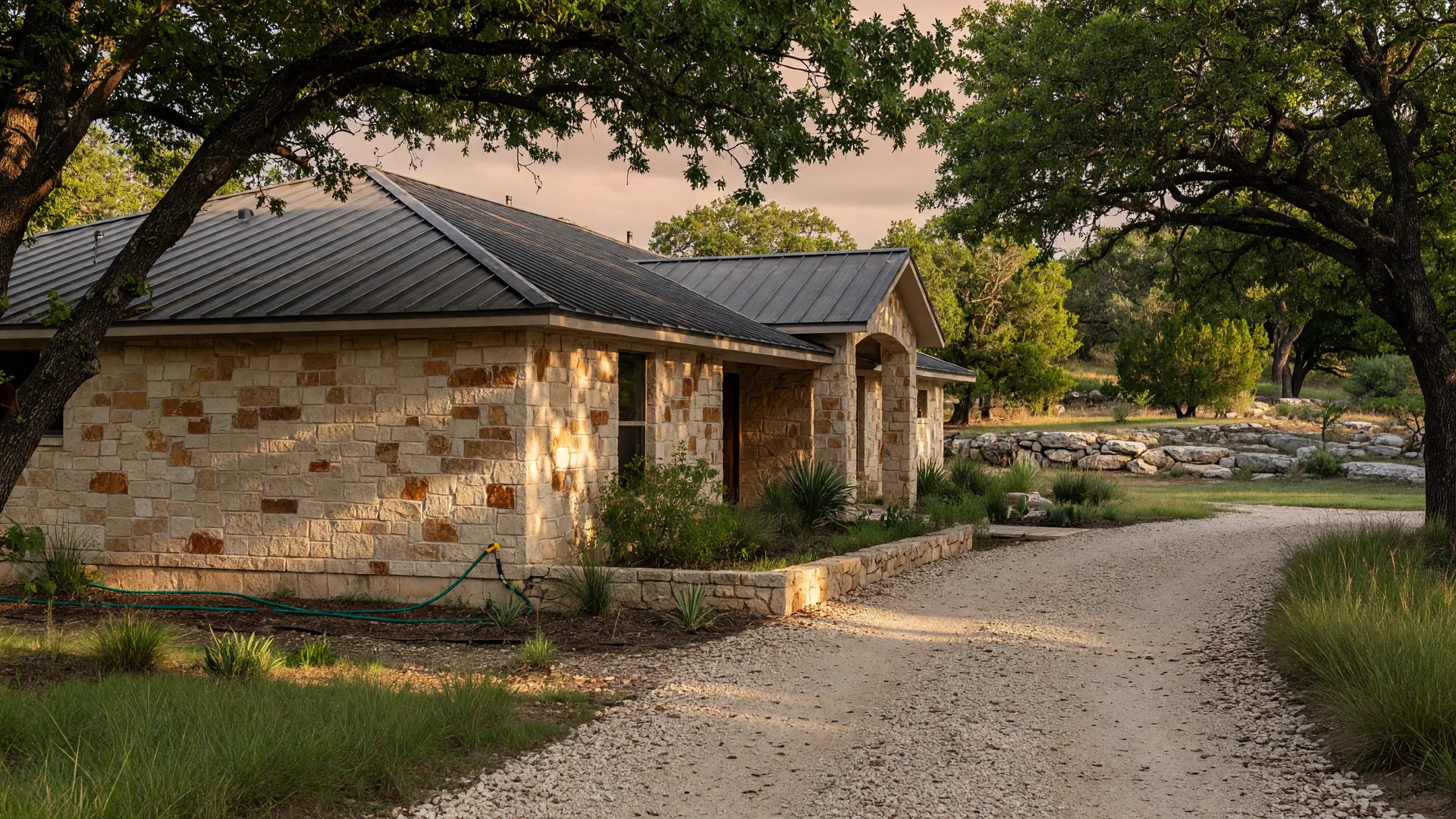
When California buyers evaluate a move to the Texas Hill Country, they focus on the obvious differences: property taxes, school ratings, commute times, home prices. The less obvious difference is what happens after you close. The home itself sits in a different climate on different soil with different infrastructure requirements, and the maintenance routine that served you well in California does not translate directly.
The Hill Country's expansive clay soil, limestone bedrock, thin topsoil, and dramatic weather cycles create specific demands on a home. Whether you are buying an existing home in Boerne, a new build in Fair Oaks Ranch, or acreage in Comfort, the maintenance requirements are real and recurring. Understanding them before you buy helps you budget accurately, avoid surprises, and keep your property in good condition.
This guide covers the five most significant differences in home maintenance that California transplants encounter, with realistic cost estimates and practical timelines so you know what you are signing up for.
Foundation Watering: The Requirement That Sounds Incorrect
The most unexpected maintenance task for California transplants is watering the foundation of the house. It sounds wrong. It is not wrong. In the Texas Hill Country, it is a requirement.
The Hill Country sits on expansive clay soil — soil that swells when wet and shrinks when dry. This movement places constant stress on concrete slab foundations. During the dry summer months, the clay around the foundation dries out, shrinks, and can cause the foundation to settle unevenly, leading to cracks, sticking doors and windows, and in severe cases, structural damage.
The solution is maintaining consistent soil moisture around the foundation perimeter with soaker hoses placed 12 to 18 inches from the slab. Foundation watering is done during dry periods, typically from late spring through early fall, when there has been no significant rainfall for several days. The standard recommendation is to run soaker hoses for 20 to 30 minutes per zone, two to three times per week during dry conditions, watering in the early morning hours (4 a.m. to 8 a.m.) when evaporation is lowest.
| System Type | Estimated Cost | Description |
|---|---|---|
| DIY soaker hose setup | $200–$300 | Manual hoses and timers placed around foundation perimeter |
| Above-ground automatic system | $600–$800 | Auto timer, hoses, connectors; seasonal setup and storage |
| In-ground sub-surface system | $2,000–$3,000 | Permanently buried drip lines; professional installation |
Beyond foundation watering, proper grading and extended downspouts that direct water at least 5 to 10 feet away from the foundation are essential. Many Hill Country homes are built on sloped lots, and without proper drainage, water pools against the foundation during heavy rain and then the clay dries and shrinks in the next dry spell, creating repeated stress cycles.
For California transplants, this is a genuine adjustment. You do not water a foundation in most California climates. In the Hill Country, skipping it for a season can result in foundation repair costs of $5,000 to $15,000 or more. The soaker hose routine is not optional maintenance — it is as fundamental as changing the HVAC filter.
"You do not water a foundation in most California climates. In the Hill Country, skipping it for a season can result in foundation repair costs of $5,000 to $15,000 or more. The soaker hose routine is not optional."
Septic Systems: What Rural Hill Country Homes Require
Homes inside Boerne city limits and newer subdivisions in Fair Oaks Ranch are connected to municipal sewer systems. But any home on acreage outside city limits — and many homes in Comfort, Spring Branch, and rural Kendall and Comal counties — relies on an on-site sewage facility (OSSF), commonly called a septic system.
The Hill Country's thin, rocky soils over limestone and karst create a specific problem: the ground does not absorb water well. Standard conventional septic systems with leach fields often cannot work here because the soil cannot handle the percolation requirements. Many Hill Country properties require aerobic treatment units (ATUs), which use oxygen to break down waste more effectively before discharging treated water.
The cost difference is significant. A conventional septic system in areas where the soil supports it runs $5,000 to $10,000. An aerobic system in the Hill Country runs $15,000 to $25,000 for a new installation. Systems are regulated by the Texas Commission on Environmental Quality (TCEQ), and aerobic systems require a maintenance contract with a licensed provider. The contract typically costs $200 to $400 per year and includes inspections, pump checks, and repairs.
Regular pumping is required every three to five years for conventional systems and every one to two years for aerobic systems, at a cost of $235 to $400 per pump. The Hill Country's flash flood and drought cycles also stress drainfields. After major storms, reducing water usage for a day or two allows the system to recover.
For California transplants accustomed to municipal sewer service, the transition to septic maintenance requires adjusting your mental model. You are now responsible for waste treatment on your property. The system requires attention, and a failed system is not just an inconvenience — it is a health hazard and a significant expense. Any home inspection on a rural property should include a thorough septic evaluation.
New aerobic septic system (Hill Country typical)
$15,000 to $25,000 installed
Annual maintenance contract (aerobic systems)
$200 to $400 per year
Regular pumping (every 1-5 years)
$235 to $400 per pump
Well Water: Testing, Equipment, and Hard Water
Many Hill Country properties on acreage draw water from private wells rather than municipal water systems. For California relocators accustomed to paying a monthly water bill and never thinking about the source, a private well is a significant shift in responsibility.
A typical Hill Country well includes a submersible pump, a pressure tank, and controls. The well depth varies dramatically by location — from 100 feet to over 600 feet depending on which aquifer you are tapping. The Edwards Aquifer is the primary source for much of the Hill Country, and wells drawing from it are subject to the Edwards Aquifer Authority's regulatory oversight in eight counties, including Bexar, Comal, and Kendall.
Annual water testing is essential for any private well. Standard tests should cover coliform bacteria, E. coli, hardness, iron, manganese, pH, and total dissolved solids (TDS). The Texas Commission on Environmental Quality provides guidance on testing protocols, and certified labs in the region offer well-water testing packages starting at $50 to $150.
Hard water is the most common issue in the Hill Country. The region's limestone geology produces groundwater with high mineral content — primarily calcium and magnesium. Hard water causes mineral buildup in water heaters, pipes, faucets, and appliances, reducing their efficiency and lifespan. A water softener is standard equipment for most Hill Country homes with wells, with installed costs ranging from $800 to $2,500 depending on system size and features.
Additional equipment may include sediment filters (to remove sand and silt common in Hill Country wells), iron filters (for the reddish staining that high iron levels cause), and UV purification systems (for bacterial disinfection). A complete well inspection during the home-buying process should include flow rate testing (minimum recommended: 5 to 10 gallons per minute), water quality analysis, and equipment age and condition assessment.
Key well water tests for Hill Country homes
Coliform bacteria and E. coli
Hardness (calcium and magnesium levels)
Iron and manganese (staining and taste)
pH level
Total dissolved solids (TDS)
"For California relocators accustomed to paying a monthly water bill and never thinking about the source, a private well represents a significant shift in responsibility. The water quality, flow rate, and equipment condition are now your concern."
Cedar Removal and Wildfire Risk: A Hill Country Reality
Ashe juniper — almost universally called "cedar" in Texas — is the dominant woody species across the Hill Country. It is also one of the most flammable plants in the region. Cedar trees produce volatile oils, create dense ladder fuels that allow ground fires to reach tree canopies, and grow in thick stands that can carry fire across large areas rapidly.
For homeowners on acreage, cedar management is not an aesthetic choice. The Texas A&M Forest Service recommends creating a defensible space of 30 to 100 feet around all structures by removing cedar, clearing dead vegetation, and pruning low branches on remaining trees. Shaded fuel breaks — created by selectively thinning and pruning cedar and live oak up to 100 feet from property lines — leave the canopy intact to shade out grasses while reducing fire risk.
| Cedar Clearing Type | Estimated Cost per Acre |
|---|---|
| Standard density clearing | $1,800 to $4,500 per acre |
| Heavy or old-growth clearing | $3,500 to $6,000+ per acre |
Individual cedar tree removal typically costs $472 to $643 per tree in the San Antonio area. For homes with heavy cedar encroachment, professional land clearing contractors provide per-acre pricing that works out significantly cheaper than per-tree removal.
The best time for cedar clearing is late fall and winter during dry conditions, when the ground is firm enough for equipment and before spring nesting season for migratory birds. Some counties and conservation programs offer cost-sharing assistance for cedar management on residential properties — check with the Kendall County or Comal County Texas A&M AgriLife Extension office.
For California relocators, the wildfire risk is real but manageable. The Hill Country does not face the same catastrophic fire regimes as California's Sierra Nevada or coastal ranges, but grass fires and brush fires spread quickly in the Hill Country's dry summer conditions. The defensible space requirement is similar to what homeowners in California's wildland-urban interface (WUI) are accustomed to. The preparation work is less extensive and the fire season is shorter, but the requirement to maintain clear space around structures is just as serious.
HVAC Care in the Climate That Tests Equipment
The Texas Hill Country's climate places unusual demands on HVAC equipment. Summer temperatures regularly exceed 95 to 100 degrees, and the cooling season runs from May through October. Winter temperatures can drop below freezing for stretches, requiring reliable heating as well. The equipment that handles both ends of that spectrum works harder and needs more attention than HVAC systems in milder climates.
HVAC systems in the Hill Country typically last 12 to 20 years, with many falling at the lower end of that range due to the demanding operating conditions. The most important maintenance tasks for Hill Country homeowners are straightforward and non-negotiable:
Filter Replacement
Replace HVAC filters every 30 to 60 days during the cooling season. The Hill Country's combination of heat, pollen, cedar dust, and dry soil produces air quality that clogs filters faster than in most California climates. A dirty filter forces the system to work harder, increases electricity consumption by 5 to 15 percent, and can cause the evaporator coil to freeze. Standard 1-inch filters cost $5 to $15 each. Setting a monthly reminder is one of the highest-impact low-cost maintenance habits you can develop.
Spring and Fall Professional Maintenance
A professional HVAC inspection before the summer cooling season and before the winter heating season is standard practice in the Hill Country. Spring maintenance typically includes checking refrigerant charge, cleaning the condenser coil (which accumulates dust and grass debris during the growing season), inspecting electrical connections, and verifying that the system is functioning at its rated efficiency. Fall maintenance focuses on the heating side — heat pump or furnace inspection, verifying gas connections for gas systems, and cleaning the indoor unit. A typical inspection costs $75 to $150 per visit.
Hard Water Effects on HVAC
If your home has hard well water, the mineral content affects any HVAC equipment that uses water — particularly evaporative cooling systems if present, and any hydronic heating components. A water softener protects HVAC equipment from mineral buildup and extends its service life. This is an indirect cost that applies primarily to homes with private wells.
| HVAC Task | Frequency | Estimated Cost |
|---|---|---|
| Filter replacement | Every 30-60 days | $5 to $15 per filter |
| Spring AC inspection | Annual, before cooling season | $75 to $150 |
| Fall heat inspection | Annual, before heating season | $75 to $150 |
| Full system replacement | Every 12-20 years | $5,000 to $12,000+ |
Seasonal Maintenance Calendar for Hill Country Homeowners
The maintenance cycle in the Hill Country follows the seasons more closely than in California, where the climate creates less variation. Here is what the year looks like for a typical Hill Country homeowner:
Spring (March through May)
- Schedule spring AC inspection before the first 95-degree day
- Inspect foundation for winter heaving and cracks
- Test well water for coliform and basic chemistry
- Clear gutters and extend downspouts away from foundation
- Inspect roof for winter storm damage
Summer (June through August)
- Water foundation regularly during dry periods (soaker hoses, 20-30 min per zone)
- Replace HVAC filter monthly
- Monitor septic system water usage; reduce load after heavy rain
- Inspect for signs of foundation movement (sticking doors, window cracks)
- Check water softener salt levels and refill as needed
Fall (September through November)
- Schedule fall heating system inspection
- Clear cedar and brush for defensible space while ground is dry
- Pump septic system if due (check maintenance records)
- Inspect weatherstripping around doors and windows
- Drain and winterize outdoor irrigation systems before first freeze
Winter (December through February)
- Monitor freeze warnings and drip faucets when temps drop below 26 degrees
- Schedule cedar clearing during dry winter conditions
- Replace HVAC filter every 60 days
- Check well equipment and pressure tank function
- Plan spring landscaping and grading improvements
How Hill Country Maintenance Compares to California
The maintenance profile of a Hill Country home is different from California in ways that matter for budgeting and planning.
What is different
Foundation watering does not exist in most of California. Septic systems are less common in California's urban and suburban developments but are the norm for rural properties here. Well water requires active management — testing, softeners, sediment filters — that municipal water users never think about. The cooling season in Texas runs longer and hotter than any California climate outside the desert, which means HVAC systems work harder and need more frequent attention. Cedar management is a Hill Country-specific task with no California equivalent.
What is comparable
The cost of professional HVAC maintenance in the Hill Country is comparable to or lower than California rates. Septic system maintenance costs are similar to rural California. The need for a defensible space around structures mirrors California's wildfire preparation requirements, though the fire season is shorter and the fuel types are different.
What costs more in the Hill Country
The combination of well water equipment (well pump, pressure tank, water softener, filtration) and septic system maintenance adds recurring costs that municipal utility customers in California never see. Cedar clearing on acreage properties is a genuine expense, typically $1,800 to $6,000 per acre depending on density. Foundation watering equipment costs are modest, but the cost of ignoring foundation maintenance is high.
What costs less
HVAC replacement costs in Texas are generally lower than in California due to lower labor rates and less stringent energy code requirements at the time of replacement. Professional service visits are $75 to $150 compared to $100 to $250 in many California markets.
"The maintenance profile of a Hill Country home is different from California in ways that matter for budgeting and planning. Foundation watering does not exist in most of California. Septic systems, well water, and cedar management are new responsibilities. Understanding them before you buy is the difference between being prepared and being surprised."
What to Ask Before You Buy
If you are evaluating a home in the Hill Country, add these questions to your due diligence checklist:
For every property
- Has the foundation been inspected recently? Are there signs of movement (cracks, sticking doors, uneven floors)?
- When was the HVAC system last serviced? What is the age and condition of the equipment?
- Is the property in a flood zone? What is the grading pattern around the foundation?
For rural properties on septic and well
- What type of septic system is installed (conventional vs. aerobic)? When was it last pumped and inspected?
- Is there an active maintenance contract for the aerobic system?
- What is the well depth and flow rate (gallons per minute)?
- When was the well water last tested? What were the results for hardness, iron, bacteria, and TDS?
- Does the property have a water softener? What is the age and condition of the equipment?
For properties with acreage
- What is the cedar density on the property? Has any clearing been done recently?
- Is there a defensible space of 30 to 100 feet around the home?
- What is the fire risk classification for the property's location?
- Is there propane service? Tank owned or leased? Age of tank and appliances?
Maintenance as a Quality-of-Life Factor
Home maintenance in the Texas Hill Country is not onerous, but it is different. The tasks are predictable, the costs are manageable, and the knowledge is learnable. What matters is going in with your eyes open.
The California homeowner who moves into a Boerne home on a slab foundation with city water and sewer will have a relatively light maintenance load — foundation watering during dry months, HVAC filter changes, and standard home upkeep. The California buyer who purchases 10 acres in Comfort with a private well and septic system inherits a more demanding set of responsibilities. Both are viable, but they are different, and the difference should be understood before the purchase, not discovered after it.
For a broader overview of what daily life looks like in different Hill Country communities, see the city comparison guide. For detailed guidance on well water and septic systems before you buy, start with the well water buying guide and the septic systems buying guide.

Written by
Bill Ross
Hill Country Homesteads Group, brokered by KW Boerne
Bill Ross is a Texas real estate agent with nearly four decades in high-tech sales and a network of 1,000+ California real estate agents for coordinated cross-state transactions. Featured in national coverage discussing his family's relocation from Silicon Valley to the Texas Hill Country.
Related Guides
What to Ask About Wells Before Buying
Flow rates, water quality testing, equipment costs, and what California buyers need to know about Hill Country wells.
Septic Systems Buying Guide
Aerobic vs. conventional systems, TCEQ requirements, costs, and what to inspect before closing.
Texas Wildlife for California Transplants
Deer, armadillos, snakes, scorpions, and coexisting with Hill Country fauna.
Cost of Living Comparison
California vs. Texas Hill Country — housing, taxes, insurance, and monthly expenses.
Sources
- Foundation watering recommendations and costs — Solid Base Foundation Repair; Level Your House. solidbasefoundations.com; levelyourhouse.com
- Hill Country septic systems — costs and regulatory requirements — Texas Commission on Environmental Quality (TCEQ); River Hills Builder. riverhillsbuilder.com
- Well water testing and maintenance — Hill Country specifics — Correia Realty Group; TruStone Homes. correarealtygroup.com; truestonehomes.com
- Cedar clearing costs and wildfire defensible space — Corral Bros Land Clearing; Bear Claw Clearing; Texas A&M Forest Service. corralbros.com; bearclawclearing.com
- Tree removal costs, San Antonio area — Homeyou; ArborHub. homeyou.com
- HVAC maintenance and replacement costs — Property Pulse Inspection; Jon Wayne Service Company. propertypulseinspection.com; jonwayne.com
- Edwards Aquifer regulatory oversight — Edwards Aquifer Authority. edwardsaquifer.org
- Wildfire defensible space recommendations — Texas A&M Forest Service; Travis County Preserve Neighbors. traviscountytx.gov
Last reviewed: July 2026. Costs are estimates based on current market data and may vary by property and provider.