
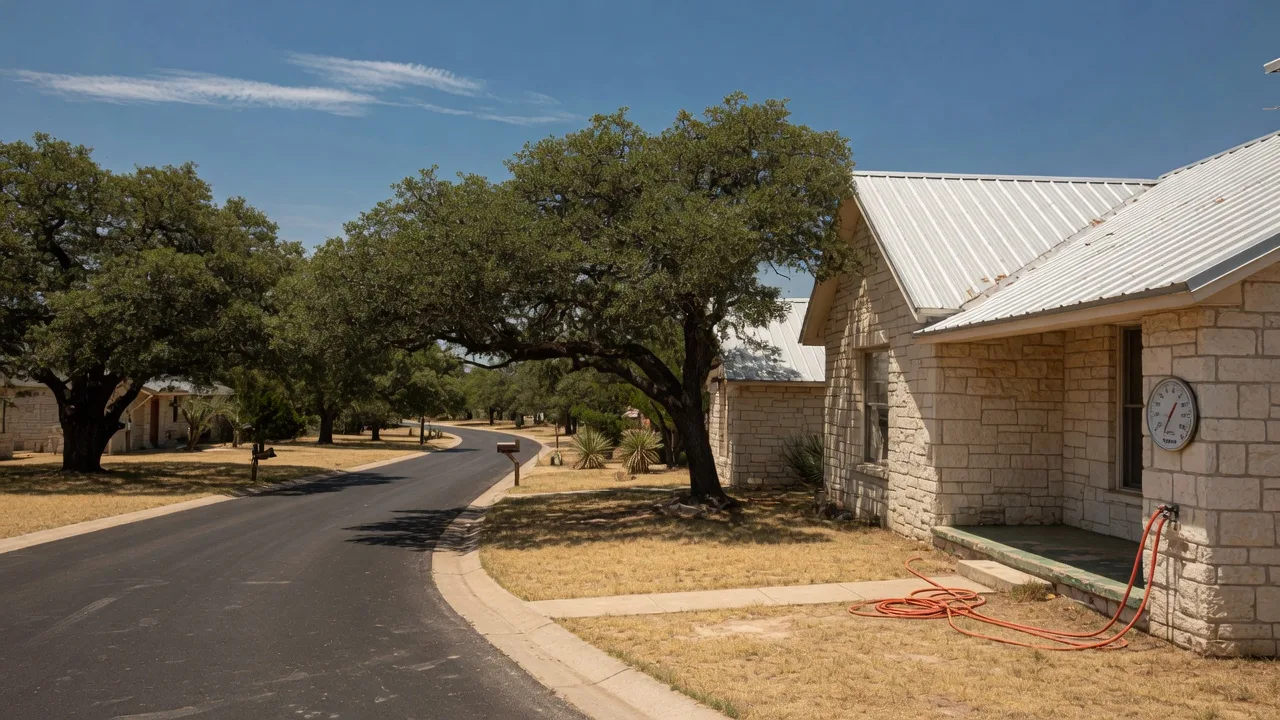
Every California buyer I have worked with says the same thing about Texas heat before they move: "I know it is hot. I have been to Palm Springs. I have visited Arizona. I can handle heat."
And every one of them, without exception, revises that assessment during their first August in the Hill Country.
The reason is not that Texas is simply hotter than the desert Southwest, though it certainly is during peak summer. It is that the Hill Country combines heat with a specific set of conditions that California's coastal climates do not prepare you for: humidity that feels nothing like what you expect at 100 degrees, overnight lows that never relieve the pressure, a sun that is physically more intense at this latitude, and a duration of heat that stretches for months rather than weeks.
This article is a realistic, data-driven explanation of what the heat actually feels like in the Texas Hill Country, how it compares to the climates California transplants are leaving behind, and what practical steps make adaptation manageable. It is not meant to scare you away. It is meant to ensure that when you arrive, you are prepared rather than surprised.
The Raw Numbers: What the Thermometer Actually Says
Let us start with the baseline data. San Antonio's climate, which is representative of the entire Hill Country region including Boerne and Fair Oaks Ranch, is classified as humid subtropical (Cfa under the Koppen system), while coastal California cities are Mediterranean (Csb) [1][2]. These are fundamentally different climate categories, and the difference matters far more than a simple comparison of high temperatures.
Temperature Comparison: Coastal California vs. Texas Hill Country
Average Summer Highs, June through August
| Location | June | July | August | Avg High | Avg Low (Aug) |
|---|---|---|---|---|---|
| San Francisco | 68F | 70F | 71F | 70F | 56F |
| Los Angeles | 77F | 83F | 84F | 81F | 64F |
| San Diego | 72F | 76F | 77F | 75F | 66F |
| Sacramento | 90F | 95F | 93F | 93F | 60F |
| Palm Springs | 102F | 108F | 106F | 105F | 78F |
| San Antonio | 93F | 96F | 97F | 95F | 76F |
| Boerne | 90F | 94F | 94F | 93F | 72F |
Sources: NOAA National Centers for Environmental Information; Western Regional Climate Center [1][2]. Boerne data interpolated from Kendall County station records. Averages based on 1991-2020 climate normals.
The raw high temperatures tell part of the story, but they actually understate the difference. The three factors that transform "hot" into a fundamentally different experience are humidity, nighttime lows, and duration.
Heat Index: Why 97 Degrees Does Not Feel Like 97 Degrees
The National Weather Service's heat index calculation accounts for the combined effect of temperature and humidity on the human body. At 97F with 55% humidity (a typical August afternoon in San Antonio), the heat index is approximately 108-112F [3]. That is the temperature your body actually experiences. The evaporation of sweat, your body's primary cooling mechanism, is significantly less effective in humid air because the air is already saturated with moisture and cannot accept additional water vapor readily.
By comparison, Palm Springs at 108F with 15% humidity produces a heat index of approximately 103F, five degrees lower than the actual temperature. Sacramento at 95F with 25% humidity produces a heat index around 92F. The Hill Country's combination of high heat and moderate humidity produces a heat index that is consistently 10-18 degrees higher than coastal California at any given temperature.
Heat Index Comparison: Same Temperature, Different Experience
How 95F Feels at Different Humidity Levels
| Location Type | Temperature | Humidity | Heat Index | Risk Category |
|---|---|---|---|---|
| Desert Southwest (Palm Springs) | 95F | 15% | 91F | Caution |
| Coastal California (LA) | 95F | 40% | 98F | Caution |
| Texas Hill Country | 95F | 55% | 106F | Extreme Caution |
| Texas Hill Country (heat wave) | 102F | 45% | 115F | Danger |
Heat index calculated using NWS methodology [3]. Risk categories per NWS heat safety guidelines: Caution (80-90F HI), Extreme Caution (90-103F HI), Danger (103-124F HI), Extreme Danger (125F+ HI). Hill Country conditions regularly fall into Extreme Caution and Danger categories during summer afternoons.
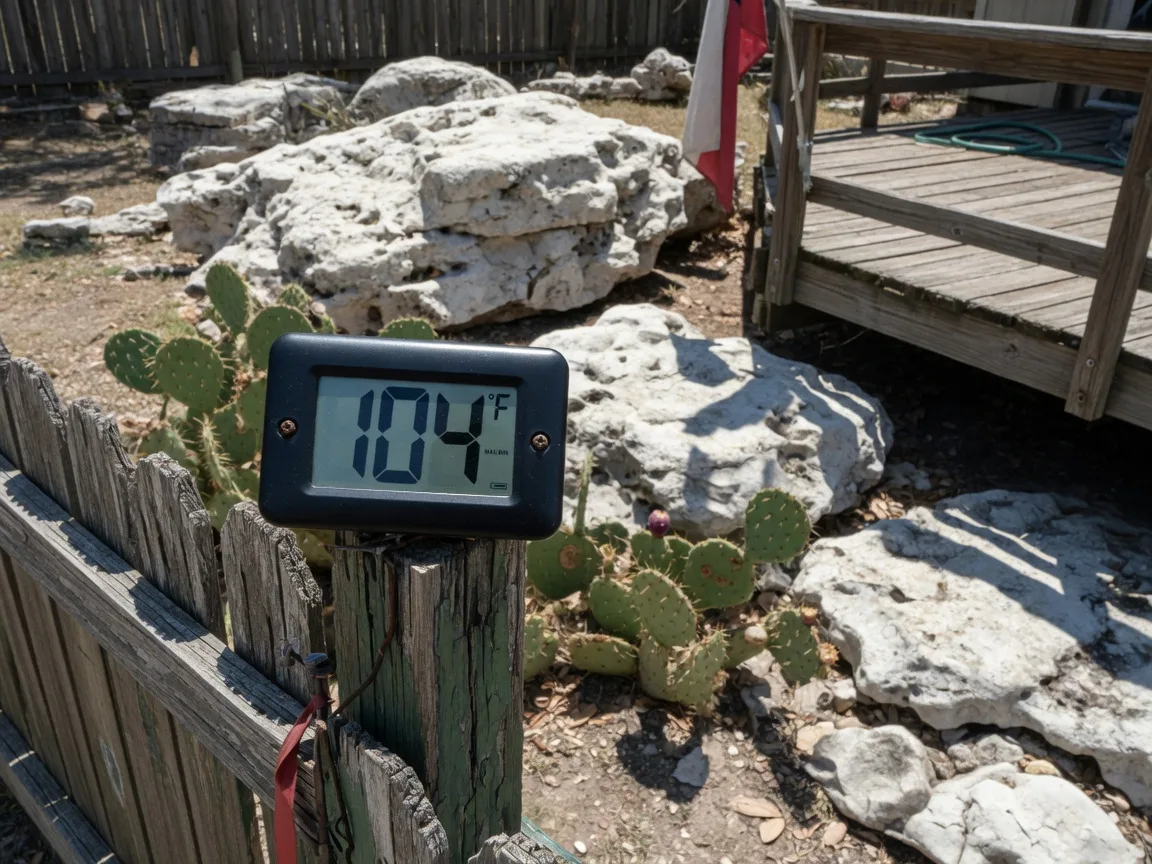
The Overnight Problem: When 80 Degrees Is Relief
Here is the difference that coastal Californians find hardest to believe until they experience it. In San Francisco, even during a heat wave, nighttime temperatures drop into the mid-50s. In Sacramento, the delta between daytime highs and nighttime lows is typically 30-35 degrees throughout the summer. This overnight cooling gives your body, your home, and your HVAC system a critical recovery window.
In the Texas Hill Country, the average diurnal temperature range in August is only 18-22 degrees. When the daytime high is 99F, the overnight low is typically around 77-79F [1][2]. During heat waves, this gap can shrink to 12-15 degrees. You go to sleep with the house still in the low 80s, and you wake up to an outside temperature already pushing 80 degrees at sunrise.
What this means in practice: Your air conditioning runs nearly continuously from late morning through early morning. There is no naturally cool window to open windows and let the house air out. The heat stress on your body accumulates because it never fully recovers overnight. This is why heat-related illness data shows that the majority of severe heat-related hospitalizations occur not during single extreme days but during multi-day heat waves where the body cannot recover between exposures [5].
For people with certain medical conditions, including heart disease, respiratory conditions, and kidney issues, the sustained nature of Hill Country heat is a more significant risk factor than the peak daytime temperature. The CDC recommends that people managing these conditions speak with their physician about heat exposure before relocating to a climate with limited overnight cooling [12].
Typical August Day: Temperature Profile
| Time of Day | San Francisco | Sacramento | San Antonio |
|---|---|---|---|
| 6:00 AM | 56F | 62F | 76F |
| 12:00 PM | 67F | 87F | 94F |
| 4:00 PM | 70F | 93F | 98F |
| 9:00 PM | 63F | 76F | 86F |
| Diurnal range | 14F | 31F | 22F |
Sources: NOAA National Centers for Environmental Information; Western Regional Climate Center [1][2]. Typical summer conditions, not extreme event data.
The Four-Month Window: Heat Season Is Not a Week
Coastal California experiences heat waves. A week of 85-90F in Los Angeles makes the news. People head to the beach. The marine layer pushes it back within a few days.
In the Hill Country, heat season runs from approximately June 1 through September 30, with May and October as transition months. Within that 16-week window, daytime highs exceed 90F on about 80-90 of those days, and exceed 100F on 10-20 of them depending on the year [1]. This is not a heat wave. This is summer.
What this means for your daily life:
- Outdoor activity is scheduled, not spontaneous. Gardening, walking, running, and home maintenance happen before 9:00 AM or after 7:00 PM. The middle of the day, roughly 11:00 AM to 6:00 PM, is indoor time for most people during the hottest months.
- Social patterns shift. Summer gatherings start later and end later. Evening pool parties, patio dinners at 8:00 PM, and early-morning coffee on the porch replace afternoon barbecues and midday errands.
- Pets need accommodation. Dogs cannot be walked on hot pavement during peak hours. Asphalt and concrete surface temperatures can reach 140-160F on a 100F day, which can burn paw pads within seconds. Grass surfaces are cooler but still uncomfortable above 95F.
- Your car becomes a heat hazard. Interior cabin temperatures in a parked car can reach 150-170F within 30 minutes on a Hill Country summer afternoon. Remote start, ceramic window tint, and sunshades are common adaptations.
- Your landscape changes. Many California plants will not survive a Hill Country summer without extensive irrigation. Lawns that naturally go dormant and turn brown in July and August are not dying. They are conserving water. This is normal.
The Sun Is Different at This Latitude
San Antonio sits at 29.5 degrees north latitude. San Francisco is at 37.8 degrees north. Los Angeles is at 34.1 degrees. This six- to eight-degree difference in latitude means the sun is more directly overhead during summer months in Texas, producing a higher UV index and more intense solar radiation.
The practical effect is that the Texas sun feels "heavier" than the California sun at the same air temperature. It is not imagination. The UV index in San Antonio during summer afternoons regularly reaches 10-11 (Extreme), compared to 6-9 (High to Very High) in coastal California cities [3]. The solar radiation reaching the ground is more intense because it passes through less atmosphere.
Skin protection is not optional. A broad-spectrum SPF 30+ sunscreen applied before going outside is a daily habit, not a beach-day exception. Sun protective clothing, wide-brimmed hats, and polarized sunglasses are standard gear. Hill Country residents take sun safety seriously because the consequences of not doing so are cumulative and visible.
Window tint on homes and cars is another common adaptation. Solar screens on south- and west-facing windows can reduce cooling load by 15-25% by blocking solar heat gain before it enters the home [9]. Ceramic window tint on vehicles reduces interior temperatures significantly and protects upholstery from UV degradation.
UV Index Comparison: Mid-Summer Afternoon
| City | Latitude | Typical UV Index (July) | Category |
|---|---|---|---|
| San Francisco | 37.8N | 8-9 | Very High |
| Los Angeles | 34.1N | 9-10 | Very High |
| Sacramento | 38.6N | 9-10 | Very High |
| San Antonio | 29.5N | 10-11 | Extreme |
Sources: NOAA UV Index forecast; EPA SunWise program [3]. UV index values are typical summer afternoon peak readings.
How Hill Country Residents Stay Cool: Practical Adaptation
The good news is that Hill Country residents have been dealing with this climate for generations, and the adaptation strategies are well-developed. Here is what actually works.
Home Design and Cooling Infrastructure
- Central air conditioning is standard. Every home built in the past 40 years has central AC. Older homes have been retrofitted. A properly sized and maintained system is essential. Buyers should verify the age and capacity of the HVAC system, and budget for replacement of units older than 12-15 years.
- Insulation and radiant barriers. Attic insulation to R-38 or higher is the standard for homes built after 2015. Radiant barrier sheathing in the attic can reduce cooling costs by 8-12% by reflecting heat away from the living space [9].
- Ceiling fans are everywhere. They are not decorative. A ceiling fan allows you to set the thermostat 3-4 degrees higher with no loss of comfort because the moving air accelerates evaporative cooling on your skin. Every room in a Hill Country home should have one.
- Programmable and smart thermostats are the norm. Setting the thermostat to 78F when home and 82F when away is the standard recommendation. Smart thermostats that learn your schedule and adjust automatically can save 10-15% on cooling costs.
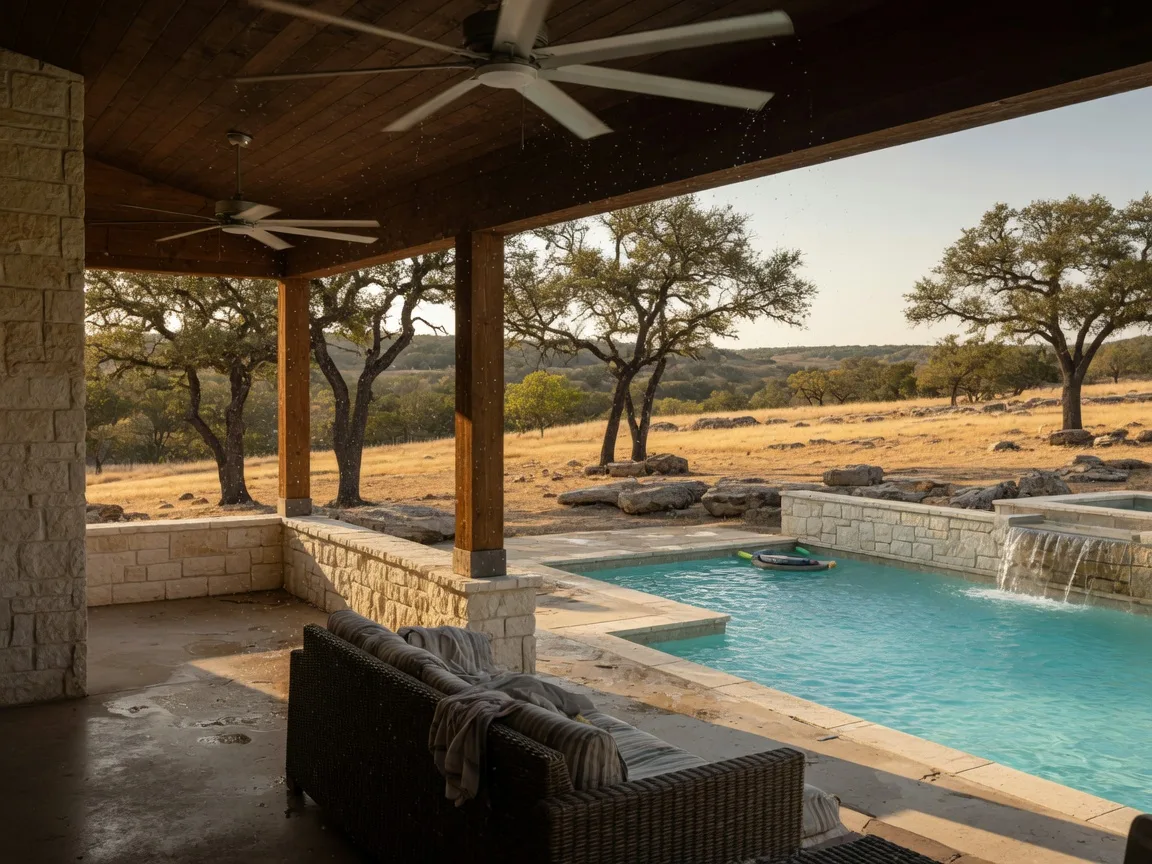
- Pool ownership is common. A pool is not just a luxury. For many families, it is the primary summer recreation strategy. However, pool ownership carries significant costs: installation ($50,000-$80,000 for a standard in-ground pool), ongoing chemical maintenance ($100-$200 per month), and increased electricity use for the pump and heater [11].
Daily Life Adjustments
- Morning and evening are your outdoor windows. The most pleasant hours are 6:00-10:00 AM and 7:00-9:00 PM. Gardening, exercise, dog walks, and home maintenance happen in these windows.
- Hydration is a discipline. Water intake needs to increase significantly. The general guideline is to drink half your body weight in ounces of water per day, and more if you are spending time outdoors. Electrolyte replacement becomes important during extended activity.
- Know the signs of heat exhaustion. Heavy sweating, weakness, cold clammy skin, nausea, and headache are early signs. Heat stroke, which is a medical emergency, presents with hot red skin, rapid strong pulse, body temperature above 103F, and altered consciousness [5][8].
- Acclimatization takes 7-14 days. Your body adjusts to heat by increasing sweat production, decreasing salt loss in sweat, and improving cardiovascular efficiency. But this adaptation takes time. Plan a lighter schedule for your first two weeks in the Hill Country during summer.
- Cars need preparation. Ceramic window tint, sunshades, and remote start are common and practical. Never leave children or pets in a parked car. The internal temperature can reach lethal levels within minutes.
The Balance: What the Other Nine Months Are Like
It is important to put the summer heat in context. The Hill Country summer is intense, but the other nine months of the year offer a climate that many California transplants come to prefer over what they left behind.
October and November are arguably the most beautiful months in the Hill Country. Daytime highs range from 70-80F in October to 60-70F in November. Humidity drops. The skies are clear. Evening temperatures are cool enough for a light jacket. This is the season for outdoor festivals, hiking, football, and the Hill Country Wine Trail. The golden autumn light on the limestone hills is genuinely stunning.
December through February are mild by most standards. Daytime highs in the 50s and 60s. Nighttime lows in the 30s and 40s. Freezing temperatures occur, but sustained cold snaps are uncommon. Snow is rare and usually melts within hours. The Hill Country winter is closer to a Bay Area "cold season" than anything a Midwest transplant would recognize as winter.
March through May is spring. March brings bluebonnets and wildflowers. April and May have daytime highs in the 70s and low 80s, with increasing humidity as summer approaches. May is a transition month. You will have days that feel like spring and days that feel like summer, sometimes in the same week.
The tradeoff that most California transplants make peace with is this: you trade the year-round moderate climate of coastal California for four months of significant heat and eight months of genuinely pleasant weather. For many people, that trade is worth it when combined with the other advantages of Hill Country living, lower housing costs, no state income tax, more space, and a slower pace of life.
For a full picture of how the seasons affect daily life in the Hill Country, our Social Calendar Reset guide covers how community events and outdoor activities shift throughout the year. The Hill Country Landscape Guide provides a deeper look at how the terrain and vegetation change across the seasons.
Hill Country Seasonal Temperatures (Boerne/San Antonio Area)
| Season | Months | Avg High | Avg Low | Character |
|---|---|---|---|---|
| Spring | Mar-May | 68-82F | 46-63F | Warm, increasingly humid, wildflower season |
| Summer | Jun-Sep | 90-97F | 72-76F | Hot, humid, limited overnight cooling |
| Fall | Oct-Nov | 70-80F | 48-60F | Mild, dry, clear skies, ideal outdoor season |
| Winter | Dec-Feb | 55-65F | 34-42F | Cool, occasional freezes, rare snow, mostly sunny |
Sources: NOAA National Centers for Environmental Information; Western Regional Climate Center [1][2].
Putting It in Perspective
I have helped dozens of California families relocate to the Hill Country. Every single one of them was surprised by the heat in their first summer, and every single one of them adapted within 12-18 months. The adjustment curve looks similar for nearly everyone:
- First summer: Hard. You will question your decision on the worst days. The heat is relentless, your cooling bills are higher than expected, and you will find yourself staying indoors more than you would like.
- First fall: Vindication. October and November in the Hill Country are so spectacular that they rewrite your memory of the preceding summer. The weather is perfect. You will wonder why everyone does not live here.
- Second summer: Familiar. You know what to expect. Your home has the right window coverings. You have established your morning and evening outdoor routines. The heat is still intense, but it is no longer surprising.
- By year three: Normal. The eight-month stretch of beautiful weather from October through May becomes your baseline. The summer heat becomes a predictable, manageable season rather than an obstacle.
Is the heat a reason not to move? For some people, yes. If you have a medical condition that makes heat management difficult, if you are someone who needs to be outdoors for extended hours during the middle of the day year-round, or if the idea of four months of limited outdoor activity sounds intolerable, then the Hill Country may not be the right fit. I have had honest conversations with prospective buyers who reached that conclusion, and it was the right call for them.
For most people, though, the heat is a manageable tradeoff rather than a dealbreaker. The key is to go into it with open eyes, realistic expectations, and a home that is equipped for the climate. The Hill Country's other advantages, the space, the cost of living, the community, the natural beauty, outweigh the inconvenience of summer heat for the vast majority of families who make the move.
Thinking About Moving? Let's Talk About the Full Picture.
The heat is one of the topics I cover honestly with every California buyer because it matters for quality of life. A move this significant deserves a full, clear picture of what daily life actually looks like, including the seasons that take adjustment.
I am happy to walk you through the specifics of Hill Country living based on nearly four decades of experience working with relocating families. No sales pitch, just the information you need to make a confident decision.
For more on the broader lifestyle adjustment, read The Texas Driveway Moment for what your first week will feel like, or the Social Calendar Reset for how the seasonal rhythm of daily life changes. And if you want to understand year-round costs, the Cost of Living Beyond Housing comparison includes energy and cooling costs by season.

Written by
Bill Ross
Hill Country Homesteads Group, brokered by KW Boerne
Bill Ross is a Texas real estate agent with nearly four decades in high-tech sales and a network of 1,000+ California real estate agents for coordinated cross-state transactions. Featured in national coverage discussing his family's relocation from Silicon Valley to the Texas Hill Country.
Related Guides
The Texas Driveway Moment
What Californians notice the first week in the Hill Country, from lot sizes and grocery runs to the neighbor with a casserole.
The Social Calendar Reset
How the seasonal rhythm of daily life changes from California year-round outdoor culture to the Hill Country four-season calendar.
Hill Country Landscape Guide
Terrain, climate, seasons, and vegetation of the Hill Country for California buyers evaluating the land.
Cost of Living Beyond Housing
Utilities, insurance, groceries, fuel, a city-by-city comparison including seasonal energy costs.
Frequently Asked Questions
These are the heat-related questions I hear most from California buyers evaluating a move to the Texas Hill Country. The concerns are consistent, and the answers are grounded in real experience and data.
How does Hill Country humidity compare to California coastal humidity?
Coastal California cities like San Francisco and Los Angeles typically see 65-85% humidity in summer months. The Texas Hill Country averages 50-65% humidity in summer, which is lower than the coast but higher than inland California. The difference is that in coastal California, the humidity comes with cool ocean air (60-70F). In the Hill Country, that humidity wraps around 95-105F air. The combination of high heat and moderate humidity creates a heat index 5-15 degrees hotter than the actual temperature, meaning a 100F day feels like 108-115F to your body. This is the part of Texas heat that coastal Californians underestimate the most.
Is the heat really that bad compared to California inland areas like Palm Springs or Sacramento?
Sacramento and the Central Valley see comparable high temperatures (95-105F) but are typically drier, with lower humidity. Palm Springs is hotter (105-115F) but with extremely low humidity. The Hill Country combination of 95-105F temperatures and 50-65% humidity produces a higher heat index than either. The bigger difference is duration: Sacramento and Palm Springs cool off significantly at night (often dropping 30-40 degrees). The Hill Country typically cools only 15-25 degrees overnight, meaning nights stay in the 70s, and the heat never fully lifts. This continuous heat exposure is what exhausts newcomers more than the daytime high itself.
How long does the intense heat last?
The Hill Country typically experiences temperatures at or above 95F from mid-June through late September, roughly 14-16 weeks. Within that window, there are usually 3-5 weeks of intense heat waves where daily highs exceed 100F. August is typically the hottest month. The "cool" season, what California transplants would call mild, runs from October through April, with daytime highs in the 60s and 70s. May, June, and September are transition months where you will experience both mild and hot conditions in the same week. The total heat season (temperatures consistently above 85F) lasts about five months.
Do homes in the Hill Country typically have air conditioning?
Yes. Central air conditioning is standard in virtually every home built in the Texas Hill Country over the past 40 years. Even older homes have been retrofitted with central AC or ductless mini-split systems. A properly sized and maintained HVAC system is non-negotiable for comfortable living. Home buyers should pay close attention to the age of the HVAC system. Units older than 12-15 years may struggle to keep up during heat waves and are expensive to replace ($5,000-$12,000 depending on system size and efficiency rating). Two-story homes with a single AC unit often have temperature differentials of 5-10 degrees between floors. Many homeowners supplement with attic radiant barriers, solar screens on south- and west-facing windows, and upgraded attic insulation to reduce cooling costs.
How much does it cost to cool a Hill Country home in summer?
Summer electricity bills in the Hill Country typically run $250-$500 per month for a 2,000-3,000 square foot home, depending on AC efficiency, thermostat settings, insulation quality, and electricity rate plan. August bills are usually the highest. Texas has a deregulated electricity market in the Hill Country (CPS Energy territory excepted), which means you can choose your rate plan. Time-of-use plans, fixed-rate plans, and free-weekend plans all have different economics depending on your household's cooling patterns. A programmable or smart thermostat, set to 78F when home and 82F when away, can reduce cooling costs by 10-15%. Ceiling fans in every room allow you to set the thermostat 3-4 degrees higher without sacrificing comfort because the moving air cools your skin.
Sources
- San Antonio climate normals and records — National Weather Service, San Antonio/Austin (2026). www.weather.gov/ewx/sanantonio
- Texas Hill Country temperature and precipitation data — Western Regional Climate Center (2025). wrcc.dri.edu/cgi-bin/cliMAIN.pl?tx4101
- Heat Index calculation and risk categories — National Weather Service, NWS Heat Safety (2026). www.weather.gov/safety/heat
- ERCOT: Summer 2025 peak demand and capacity report — Electric Reliability Council of Texas (2025). www.ercot.com/files/docs/2025/05/01/2025-summer-preliminary-seasonal-assessment.pdf
- Heat-related illness surveillance data, Texas — Texas Department of State Health Services (2025). www.dshs.texas.gov/heat/heat-illness-surveillance/
- Texas ERCOT HVAC energy use analysis — U.S. Energy Information Administration, Texas Household Energy Use (2024). www.eia.gov/consumption/residential/reports/2023/texas/
- Cool Pavement Pilot Program, San Antonio — City of San Antonio Office of Sustainability (2025). www.sanantonio.gov/sustainability/Heat
- Heat safety for outdoor workers and athletes, Texas — Occupational Safety and Health Administration, Heat Safety (2026). www.osha.gov/heat-exposure/
- ACEEE Residential Cooling Load and Efficiency Study — American Council for an Energy-Efficient Economy (2024). www.aceee.org/research-report/a2401
- U.S. Drought Monitor, Texas update — National Drought Mitigation Center / USDA / NOAA (2026). droughtmonitor.unl.edu/CurrentMap/StateDroughtMonitor.aspx?TX
- Texas pool installation costs and energy use — Pool & Spa News / Texas Pool Association (2025). www.poolspanews.com/business/texas-pool-market/2025
- Medicare heat-related hospitalization rates by region — CDC National Environmental Public Health Tracking (2025). ephtracking.cdc.gov/Applications/heat/
Last reviewed: August 2026. Temperature data, electricity costs, and health statistics reflect published 2024-2026 sources. Individual experiences vary; verify specific concerns with your physician, utility provider, and HVAC professional as applicable.