
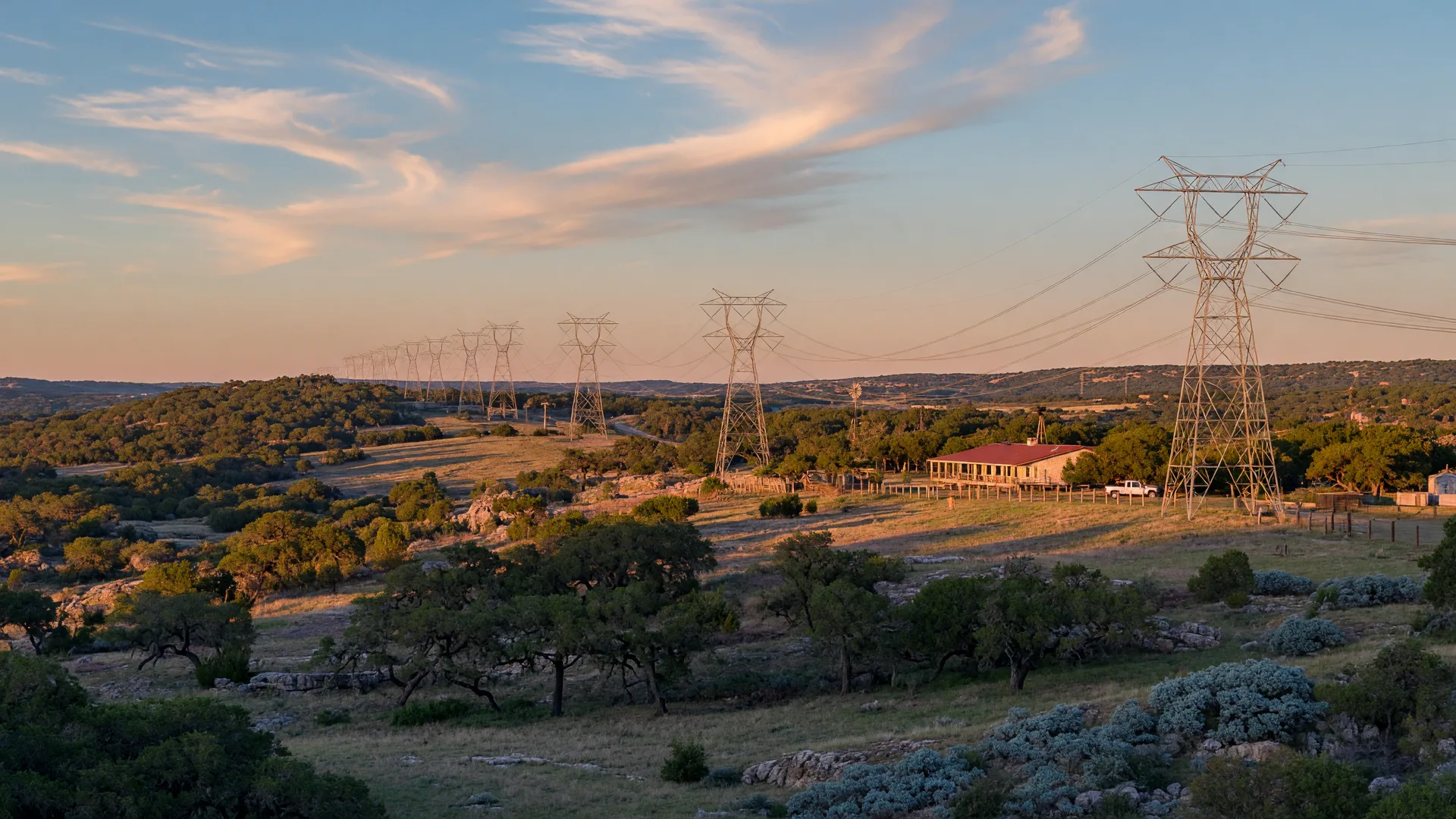
When California relocators evaluate the cost of living in Texas, the conversation usually centers on property taxes and the absence of state income tax. Electricity is often treated as a minor line item. It should not be. The Texas electricity market is structurally different from California's in ways that affect both your monthly costs and your daily experience — especially if you are moving to the Hill Country, where summer air conditioning runs from May through October.
This guide covers the ERCOT grid, the deregulated retail market, how to choose an electricity plan, what you will actually pay in Boerne and the surrounding area, and the real-world reliability considerations that matter for a family making a permanent move. The focus is on practical information for someone who has never lived in a deregulated electricity market before.
What Is ERCOT and Why Does It Matter?
ERCOT stands for the Electric Reliability Council of Texas. It is the independent system operator that manages the flow of electric power to approximately 90 percent of Texas customers — roughly 26 million people. ERCOT does not own power plants or transmission lines. It coordinates the market and ensures supply and demand remain balanced in real time.
The key structural feature of ERCOT is that it is electrically isolated from the rest of the United States. The Texas grid is not connected to the Eastern Interconnection or the Western Interconnection, which together cover the contiguous 48 states outside Texas. This isolation was maintained deliberately since the 1930s to keep the Texas grid outside federal jurisdiction under the Federal Power Act of 1935.
What that means in practice: ERCOT is regulated by the Public Utility Commission of Texas and the Texas Legislature, not by the Federal Energy Regulatory Commission (FERC). When the Texas grid faces a supply shortage, it cannot draw power from neighboring states. When it has excess power, it cannot export it to the Eastern or Western interconnections. The system is self-contained.
For California relocators, this is the most important structural difference. California's grid, managed by the California Independent System Operator (CAISO), is part of the Western Interconnection and can draw on or send power to 14 other states and Canadian provinces. ERCOT has no such buffer. The Winter Storm Uri event in February 2021, which caused widespread blackouts across Texas, was a direct consequence of this isolation combined with a generation fleet that was not winterized for extreme cold.
ERCOT has since implemented reforms — winterization mandates for generation facilities, improved weather forecasting integration, and increased reserve margins. The grid has added approximately 35 gigawatts of new generation capacity since 2021, primarily solar, wind, and battery storage. But the structural isolation remains. Anyone moving to Texas should understand what that means.
The Deregulated Retail Electricity Market
Most of Texas — including the Hill Country — operates under a deregulated retail electricity market. This means you choose your electricity provider and plan, rather than receiving service from a single regulated utility like PG&E, Southern California Edison, or SDG&E.
In a deregulated market, the system is split into three distinct entities:
- Generation: Companies that own and operate power plants (natural gas, coal, nuclear, solar, wind). They sell electricity into the wholesale market.
- Transmission and distribution (TDU): The company that owns the poles, wires, and meters that deliver electricity to your home. In the Boerne and Kendall County area, this is typically CPS Energy (for portions of the Hill Country) or the City of Boerne's municipal utility. This is not something you choose — it is determined by your address.
- Retail electric provider (REP): The company you choose to buy electricity from. They buy power on the wholesale market, add their margin, and bill you. There are more than 140 REPs operating in Texas, offering thousands of different plans.
The entity that handles outages and maintains the physical infrastructure is the TDU — not your REP. If your power goes out, you call the TDU. If you have a billing dispute, you call your REP. This is a common source of confusion for new residents.
"The deregulated Texas electricity market gives you choice, but it also requires you to pay attention. Hundreds of plans with different rate structures, contract lengths, and fine-print terms mean that picking the wrong plan can cost you hundreds of dollars more per year for the same electricity. The rule is simple: read the Electricity Facts Label before you sign anything."
How to Choose an Electricity Plan in Texas
Every electricity plan in Texas must include an Electricity Facts Label (EFL), a standardized document that lists the average price per kilowatt-hour at different usage levels, the base charge, the TDU pass-through charges, and any contract terms or early termination fees. The EFL is the single most important document when comparing plans. Do not rely on the teaser rate advertised on the provider's website — read the EFL.
Fixed-Rate Plans
A fixed-rate plan locks in a specific rate per kWh for the duration of the contract, typically 12, 24, or 36 months. Your rate does not change when wholesale prices rise or fall. This is the most common plan type for homeowners and the safest option for someone who wants predictable monthly bills. Fixed-rate plans often carry an early termination fee of $150 to $250 if you cancel before the contract ends.
Variable-Rate Plans
A variable-rate plan charges a rate that fluctuates monthly based on wholesale market conditions. These plans offer no price guarantee and can spike significantly during periods of high demand — summer afternoons, winter cold snaps. Variable-rate plans are generally a poor choice for homeowners who want budget predictability. They are best suited for short-term situations where you know you will move within a few months.
Time-of-Use Plans
Time-of-use plans charge lower rates during off-peak hours (typically overnight and midday on weekends) and higher rates during peak hours (typically weekday afternoons and evenings). For a family that can shift significant electricity usage to off-peak hours, these plans can save money. For a typical household with air conditioning running through the afternoon, the savings may not justify the complexity.
Free Nights or Free Weekends Plans
Some plans offer free electricity during certain hours — typically 9 p.m. to 6 a.m. or on weekends. These plans often have higher rates during the paid hours and can be deceptive. The average rate per kWh, including the free hours, is usually competitive with a standard fixed-rate plan, but you must be disciplined about shifting usage. If you run the air conditioning during the paid hours, the savings disappear.
What Electricity Costs in the Texas Hill Country
The Boerne area has a slightly different electricity landscape than the broader deregulated market. The City of Boerne operates its own municipal electric utility, which serves most of the incorporated city limits. Outside the city limits — in unincorporated Kendall County, Fair Oaks Ranch, and much of the surrounding Hill Country — residents are served by the deregulated market and choose their own REP.
City of Boerne (Municipal Utility)
As of 2025-2026, the City of Boerne charges a monthly customer fee of $15.24 plus tiered energy rates: $0.0458 per kWh for the first 900 kWh in winter, scaling up to $0.0615 per kWh above 2,500 kWh. Typical monthly bills for a Boerne residence range from approximately $130 to $180, depending on season and home size. Summer bills are higher due to air conditioning loads.
Deregulated Market (Fair Oaks Ranch, Kendall County, Surrounding Areas)
Fixed-rate plans in the deregulated market range from approximately 10 to 16 cents per kWh, depending on contract length, provider, and usage tier. A typical 2,000-square-foot home with average energy efficiency will see monthly bills of $150 to $250 in spring and fall, and $250 to $400 or more during peak summer months with heavy air conditioning use.
How This Compares to California
California's average residential electricity rate is approximately 31 to 35 cents per kWh as of 2025-2026, according to the U.S. Energy Information Administration. That is roughly two to three times the Texas rate. A California household with a monthly bill of $200 to $300 would see a comparable bill of $100 to $180 in the Hill Country — before accounting for the difference in air conditioning usage.
The caveat is that Texas summer air conditioning loads are significantly higher than California's. A California home in the Bay Area or coastal Los Angeles may run air conditioning 30 to 60 days per year. A Hill Country home will run air conditioning 150 to 200 days per year, often at a higher cooling load. The lower rate per kWh partially offsets the higher usage, but the total bill savings are smaller than the rate comparison alone suggests.
Comparison: Typical Monthly Electricity Bill
California (Bay Area/LA, 31-35 cents/kWh): $200 to $300 per month
Texas Hill Country (10-16 cents/kWh): $130 to $250 per month (spring/fall), $250 to $400 (summer)
Source: U.S. Energy Information Administration, 2025-2026 data; City of Boerne Electric Rates; EnergySage Boerne data.
Transmission and Distribution Charges: The Hidden Line Item
Every Texas electricity bill includes a transmission and distribution (TDU) charge, which is the fee the local utility charges to deliver electricity over its poles and wires to your home. This charge is set by the TDU and approved by the Public Utility Commission of Texas. It is not negotiable, and it is the same regardless of which REP you choose.
In the Boerne and Hill Country area, the TDU charges depend on your specific location. For homes served by CPS Energy (a municipally owned utility serving San Antonio and portions of the Hill Country), the TDU charge is included in the overall rate structure. For homes served by the City of Boerne's municipal utility, the fee structure is set by the city. For homes in deregulated areas served by other TDUs, the charge is itemized on every bill and typically ranges from $8 to $12 per month plus a small per-kWh fee.
The important point: the TDU charge is a pass-through that your REP cannot control. When comparing electricity plans, look at the total price per kWh, not just the generation charge. The EFL will show the total price including TDU fees.
Seasonal Electricity Costs in the Hill Country
The Hill Country summer runs from roughly May through October. During this period, air conditioning is the dominant electricity load. A 2,000-square-foot home with a 10-12 SEER air conditioning system will draw approximately 3,000 to 5,000 kWh per month during peak summer months. A newer home with a 16-18 SEER system and good insulation may draw 1,500 to 2,500 kWh per month.
Winter heating loads are comparatively modest. Most Hill Country homes use natural gas for heating, which is significantly cheaper than electric resistance heating. Electric heat pumps are becoming more common in newer construction but still represent a minority of homes. The winter months (November through February) typically see the lowest electricity bills of the year.
For California relocators accustomed to relatively mild summers, the seasonal swing in electricity bills can be surprising. A home that costs $130 to heat in January may cost $350 to cool in August. Budgeting for this seasonal variation is important — especially if you lock into a fixed-rate plan with a budget billing option that averages the annual cost into 12 equal payments.
Grid Reliability: What Changed After Winter Storm Uri
Winter Storm Uri in February 2021 was the most significant grid reliability event in Texas history. A prolonged period of below-freezing temperatures caused widespread generation failures — natural gas plants froze, wind turbines iced over, and coal plants experienced coal pile freezing. ERCOT was forced to implement rotating outages that affected approximately 4.5 million Texas homes, some for days. The estimated economic cost exceeded $200 billion, and the event resulted in hundreds of deaths.
Since Uri, the Texas Legislature and the Public Utility Commission have implemented several reforms:
- Winterization mandates: Senate Bill 3 (2021) and subsequent rules require generation facilities to weatherize against extreme cold and heat. The PUCT can fine generators that fail to meet winterization standards, up to $1 million per violation.
- Incentives for reliability: The Texas Energy Fund, created in 2023, provides low-interest loans and grants for new dispatchable generation capacity (natural gas, battery storage, and other sources that can be called on demand).
- Improved weather forecasting: ERCOT has enhanced its weather integration and now issues more frequent operational alerts during extreme weather events.
- Expanded emergency response: The Public Utility Commission has broader authority to order load reduction and coordinate emergency response across utilities.
The grid has performed better during subsequent cold weather events — Winter Storms Mara and Landon in early 2023, and Winter Storm Gerri in January 2024 — without widespread outages. However, ERCOT continues to issue conservation appeals during peak demand events, particularly in summer when air conditioning loads push the grid near its reserve margin.
For California relocators, the practical takeaway is that the Texas grid is more resilient than it was in 2021, but it is still a self-contained system with inherent vulnerability to extreme weather events. A home backup generator, battery storage, or both is a reasonable consideration for any Hill Country property — particularly for homes on well water, where a power outage means no water pressure.
"The most practical advice I give to relocating clients: budget for a whole-home generator or a transfer switch with a portable generator. The Texas grid is reliable day-to-day, but if you are on well water and the power goes out in August, you lose both air conditioning and water. That is not a risk you want to sit through twice."
Solar Power in the Texas Hill Country
Texas has some of the most favorable conditions for residential solar in the United States. The Hill Country receives an average of 220 to 230 sunny days per year, with annual solar irradiance of approximately 5.0 to 5.5 kWh per square meter per day. That is comparable to Southern California and slightly better than the Bay Area.
Texas offers a property tax exemption for the appraised value added by a solar installation — meaning your property taxes do not increase when you install solar panels. There is no statewide rebate program, but some local utilities and REPs offer incentives. The federal Investment Tax Credit (ITC) provides a 30 percent tax credit on the cost of installation, available through 2032.
Net metering in Texas is not guaranteed by state law, unlike California's regulated net metering policies. Instead, it is determined by individual REPs. Some providers offer net metering at the retail rate; others offer a lower wholesale rate or a buyback rate that is significantly less than the retail price. If you are considering solar, the choice of REP matters as much as the solar installation itself.
For California relocators accustomed to NEM 2.0 or 3.0, the Texas solar landscape is less regulated and more variable. The solar resource is excellent, but the financial return depends heavily on your electricity consumption patterns and the specific REP you choose.
Practical Tips for Setting Up Electricity in the Hill Country
Start the process before you close
In the deregulated market, you can choose your REP and plan before you take possession of the home. Most REPs require proof of occupancy and a move-in date, but you can set up service a week or two in advance. Do not wait until closing day — the last thing you want is to move into a house with no power in July.
Use comparison tools, but verify the EFL
Websites like PowerToChoose.org (the official PUCT marketplace) and EnergySage allow you to compare plans side by side. Always request the Electricity Facts Label for any plan you are considering. The advertised rate often assumes a specific usage level (typically 1,000 or 2,000 kWh per month). If your usage is higher or lower, your effective rate will differ.
Pay attention to the contract term
Twelve-month plans are the most common and offer a good balance of rate stability and flexibility. Longer terms (24 or 36 months) may offer slightly lower rates but lock you in with an early termination fee. If you are buying a home with the intention of staying for years, a longer fixed-rate contract makes sense. If you are renting first or uncertain about your timeline, a shorter term or a month-to-month plan is safer.
Seasonal bill averaging
Many REPs offer budget billing or levelized payment plans that average your annual usage into 12 equal monthly payments. This eliminates the seasonal bill spike and makes budgeting more predictable. The downside is that you may owe a true-up balance at the end of the year if your actual usage exceeds the estimate. Budget billing is a good option for anyone who prefers predictable monthly bills over seasonal savings.
Consider a home energy audit
Hill Country homes built before 2010 often have insulation levels, window efficiency, and duct sealing that are adequate for Texas but not optimal. A home energy audit can identify the most cost-effective improvements — attic insulation, duct sealing, radiant barrier, or window replacement — that reduce summer cooling loads. The payback period for these improvements is typically 2 to 5 years in the Hill Country climate, faster than in most regions.
Electricity Is a Line Item You Can Control
The Texas electricity market requires more attention than California's regulated utility model. You have to choose a provider, evaluate plan terms, and manage seasonal swings. But the combination of lower rates per kWh and the ability to choose a plan that fits your usage pattern means that most California relocators pay significantly less for electricity in Texas — even accounting for the higher summer cooling load.
The key is to treat electricity as a decision, not a default. Read the EFL. Understand the TDU charges. Pick a plan that matches your home's actual usage, not the teaser rate. And if you are buying a home in the Hill Country, evaluate whether a generator or solar installation makes sense for your specific situation.
For a broader comparison of the cost differences between California and the Texas Hill Country, see the cost of living comparison. For a detailed breakdown of utility setup and the logistics of the first 90 days after arrival, review the first 90 days guide.

Written by
Bill Ross
Hill Country Homesteads Group, brokered by KW Boerne
Bill Ross is a Texas real estate agent with nearly four decades in high-tech sales and a network of 1,000+ California real estate agents for coordinated cross-state transactions. Featured in national coverage discussing his family's relocation from Silicon Valley to the Texas Hill Country.
Related Guides
Cost of Living Comparison
California vs Texas — housing, taxes, insurance, utilities, and daily expenses.
First 90 Days After Leaving California
How to establish Texas residency, including utilities, driver's license, and vehicle registration.
Well Water and Power Outages
What to know about well water, generators, and infrastructure in the Hill Country.
What to Expect When Moving to Texas
Climate, culture, and practical adjustments for California relocators.
Sources
- ERCOT as operator of ~90% of Texas electric load (26 million customers) — ERCOT. ercot.com
- ERCOT grid isolation from Eastern/Western Interconnections, exemption from FERC jurisdiction under Federal Power Act of 1935 — Power Wizard. powerwizard.com
- Winter Storm Uri impacts: 4.5 million homes affected, estimated $200+ billion economic cost — Texas Electrical Authority. texaselectricalauthority.com
- City of Boerne electric rates: $15.24 monthly customer charge, tiered rates $0.0458-$0.0615/kWh — City of Boerne. ci.boerne.tx.us
- Texas average residential electricity rate (14.68-15.7 cents/kWh) — U.S. Energy Information Administration, 2025-2026.
- Boerne estimated average electricity cost (12 cents/kWh, $154-$187/month) — EnergySage. energysage.com
- Texas deregulated market: 140+ REPs, 1,500+ plans, PowerToChoose.org — Public Utility Commission of Texas. powertochoose.org
- California average residential electricity rate (31-35 cents/kWh) — U.S. Energy Information Administration; EcoWatch; Center for Jobs California Energy Price Data, 2025-2026.
- Southern California Edison average residential rate (31.2 cents/kWh) — Center for Jobs California Energy Price Data, December 2025.
- Texas solar irradiance (5.0-5.5 kWh/m2/day), 220-230 sunny days per year — National Renewable Energy Laboratory PVWatts.
- Federal ITC: 30% solar tax credit through 2032 — U.S. Department of Energy.
- Texas property tax exemption for solar installations — Texas Property Tax Code Section 11.27.
- Senate Bill 3 (2021) winterization mandates, PUCT enforcement authority — Texas Legislature.
- Texas Energy Fund for dispatchable generation (2023) — Public Utility Commission of Texas.
Last reviewed: July 2026. Sources verified for accuracy.