
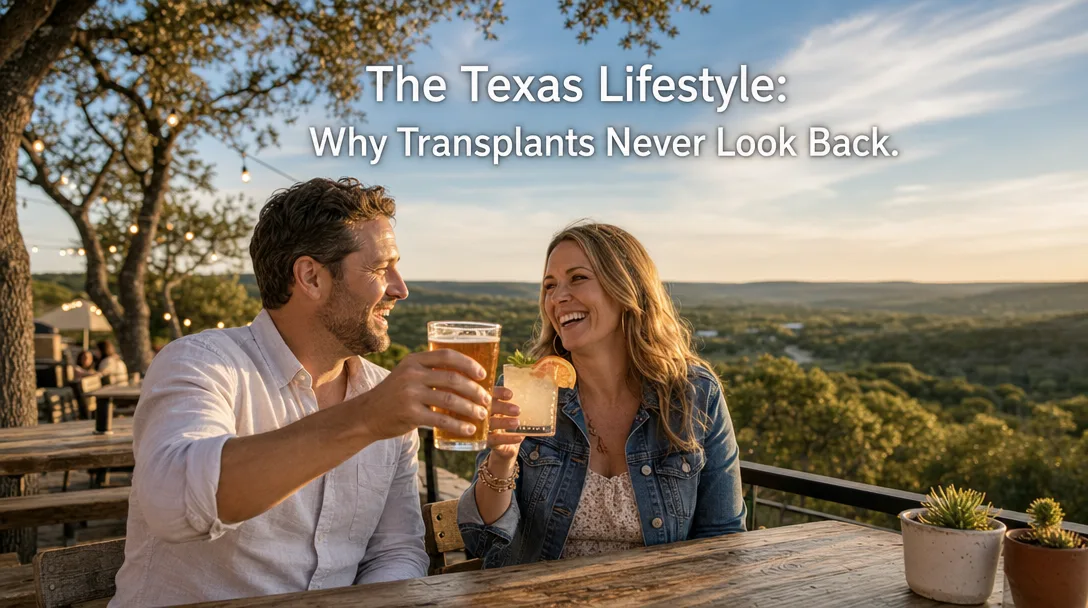
There comes a point when the question stops being whether you can afford to stay where you live and becomes whether staying is giving you the life you want. Maybe you have a good job but little financial breathing room. Maybe you are paying a substantial mortgage or rent for a home that feels too small. Or perhaps your days have become an exhausting sequence of work, traffic, errands, and obligations, with precious little time left to enjoy what you have worked for.
For Californians considering Texas, and for people in other expensive or fast-paced markets, the financial comparisons are usually where the research begins. But money is only part of the decision. The more personal question is what your ordinary life might actually look and feel like after the move.
What follows is an insider tour in five parts: the truth about Texas hospitality, the food culture that runs from world-ranked barbecue to a supermarket chain Texans treat as a lifestyle brand, the infrastructure that makes getting around genuinely easy, a side-by-side life upgrade chart of the daily pain points you are trading in and the Texas answers you are trading up to, and a short list of the things worth planning around so the win stays a win. There is also an FAQ for the questions that come up before anyone books the trip. Every sourced figure carries a bracketed number matching the source list at the end, and the honest tradeoffs are stated rather than hidden.
The Texas Hospitality Reality
How a state that absorbs half a million newcomers a year makes you feel like one of its own.
The Food
Brisket, Tex-Mex, H-E-B, and the travel center that is an event.
The Road to Anywhere
Frontage roads, Texas turnarounds, and where the weekend actually leads.
Everyday Life: California vs. Texas
Daily pain points versus Texas upgrades, with notes for NY, NJ, IL, WA, and CO readers.
How to Keep the Win
The honest tradeoffs, framed as plans rather than warnings.
Questions People Ask
Friendly, heat, taxes, friends, and where to start looking.
One Texas, Many Different Ways of Living
Texas is too large and varied to offer a single lifestyle. Living in central Houston, a Dallas suburb, downtown Austin, a West Texas ranching community, or the Hill Country can produce very different daily experiences. This article focuses primarily on Boerne, Fair Oaks Ranch, San Antonio, and surrounding communities in Kendall, Bexar, Comal, and Bandera counties. It draws on my experience relocating from Silicon Valley and living and working in this region.
That distinction matters. The combination of smaller communities, open landscapes, regional recreation, and access to San Antonio's metropolitan services is a specific lifestyle proposition. It is not a promise about every location in the state.
The Texas Hospitality Reality: Strangers Who Act Like Neighbors
I moved my family from Silicon Valley to the Hill Country as an adult, after nearly four decades in high-tech sales and marketing, so I remember exactly what the first week feels like. You go to the grocery store and the person at the register asks how you are doing and means it. You walk the dog and three neighbors introduce themselves. A handyman is at your new place on Tuesday and stays an extra hour because the job took longer than he quoted. None of it is scripted. It is the local operating system.
The migration numbers help explain why meeting someone who recently moved to Texas is hardly unusual. Census-based estimates indicate that more than half a million people relocated to Texas from other U.S. states in 2024, while Texas experienced substantial population growth between July 2024 and July 2025 [12][13]. Those figures do not prove that Texans are friendlier than residents of other states. What they establish is that newcomers are a significant part of Texas life. My observations about hospitality come from living here, meeting neighbors, and helping relocating families establish themselves.
The howdy is real, but it is not universal. Some neighborhoods are highly social, while others are more private. In my experience, the Hill Country offers many opportunities for neighborly interaction, and the large number of fellow transplants can make starting conversations easier. About 106,000 Californians moved to Texas in 2024, according to the cited migration estimate [14]. That does not guarantee immediate friendships, but it does mean many people understand what starting over feels like.
The reason this matters more than it sounds: your social life is the thing that decides whether a move works. You can fix a commute and a budget by spreadsheet. You cannot spreadsheet your way into friends. Texas lowers the barrier. Mornings at the school gate, the farmers market on the square, the monthly Market Days in Boerne, the neighbor who brings over the correct tool for whatever you are building, these are the places the social fabric gets woven, and a newcomer who shows up is often folded in within weeks rather than years, though how quickly meaningful friendships form depends on participation, location, personality, and circumstances. For the full playbook, the site's making friends guide and the month-by-month social calendar cover the exact rhythms.
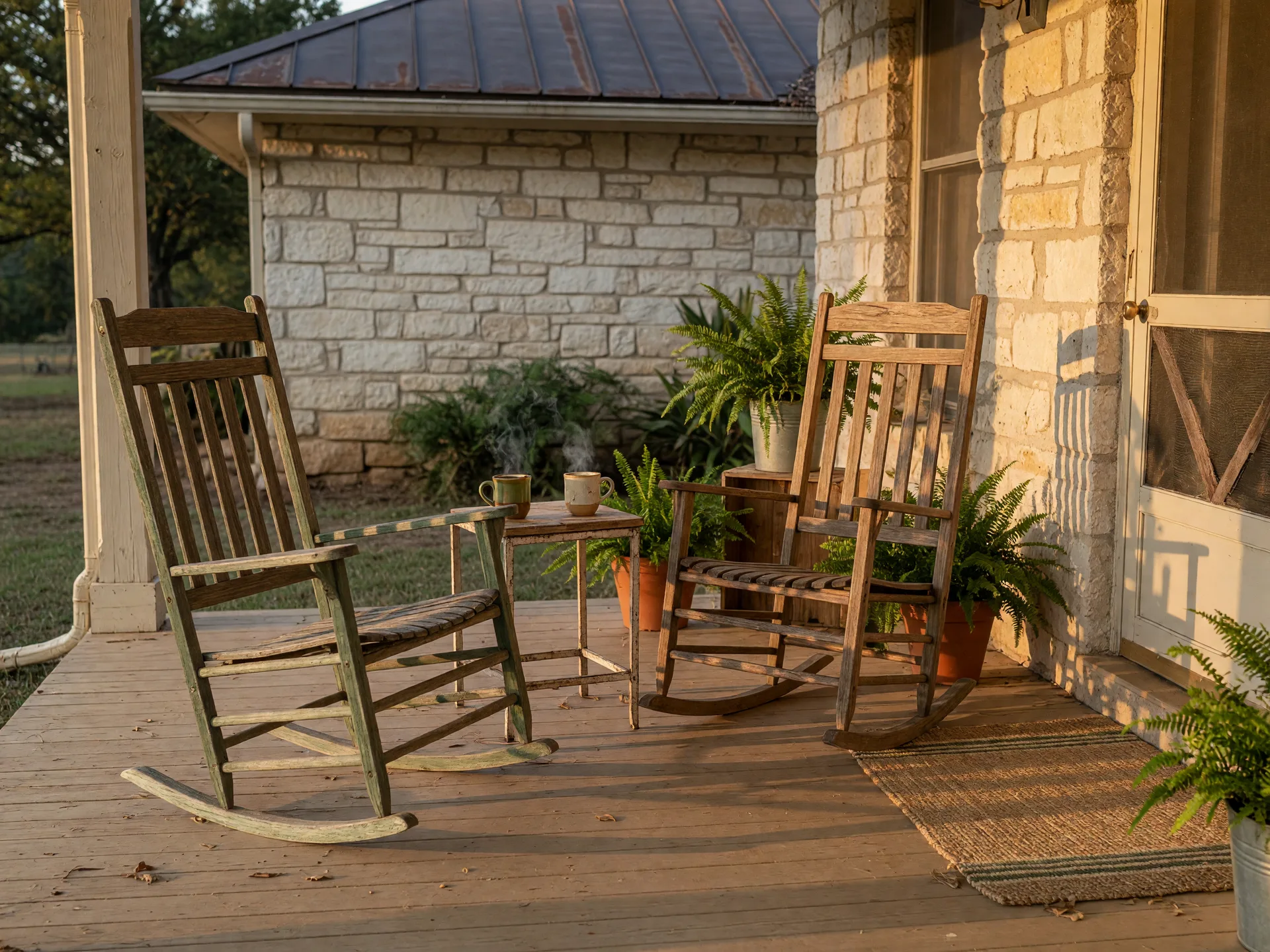
The porch is the local unit of social life: coffee with a neighbor is how the Hill Country says welcome. The first-week field guide walks what newcomers notice first. (Illustrative image.)
The Food: Brisket, Tex-Mex, and the Grocery Store That Is a Lifestyle
Texas food is not a menu, it is an identity, and you will absorb it whether or not you cook. Start with barbecue, the state religion. Texas Monthly has been ranking the state's barbecue since 1973, and its Top 50 list, first published in 1997, has now run seven editions; the 2025 edition put Burnt Bean Co. of Seguin at number one [15][16]. Central Texas barbecue traces to the German butcher shops of the early 1900s, where farmworkers bought smoked sausage and meat by the pound on butcher paper, and to the African American and Mexican American cooking traditions that met it there [17]. Today's brisket still runs on post oak, salt, black pepper, and patience. For newcomers, the practical lesson is that serious Central Texas barbecue is part of the regional food culture. Some acclaimed restaurants require a substantial drive, advance planning, or a long wait, while excellent local alternatives may be much closer.
Then there is the grocery store, and I do not use the term lightly. H-E-B was founded in 1905 as a one-room store in Kerrville, northwest of Boerne, by Florence Thornton Butt, and it remains family owned, with more than 400 stores in Texas and northern Mexico [2][3]. Texans treat it as a lifestyle brand because it behaves like one: hundreds of Texas-made products that rotate with the seasons, tortillas made in the store, a checkout that still feels like a people business, and the single best people-watching in any Hill Country town. It is also where you will meet more neighbors in a month than you did in a year of apartment elevator rides. The Hill Country dining guide, the Tex-Mex and barbecue guide, and the Boerne dining guide map the exact stops.
And yes, Buc-ee's deserves its own paragraph. The New Braunfels travel center held the record for the largest convenience store on Earth from 2012 until 2023, and the current record holder in Luling spans more than 75,000 square feet with 120 fuel pumps [4]. The San Marcos location opened on August 12, 2026, and a Boerne travel center has been reported as planned for 2027. As with any commercial construction project, the opening schedule may change [5]. The weekend road trip is still measured in Beaver Nuggets and clean restrooms as much as miles. For a state that plans road trips around where to stop, it is the standard every other pit stop gets judged against.
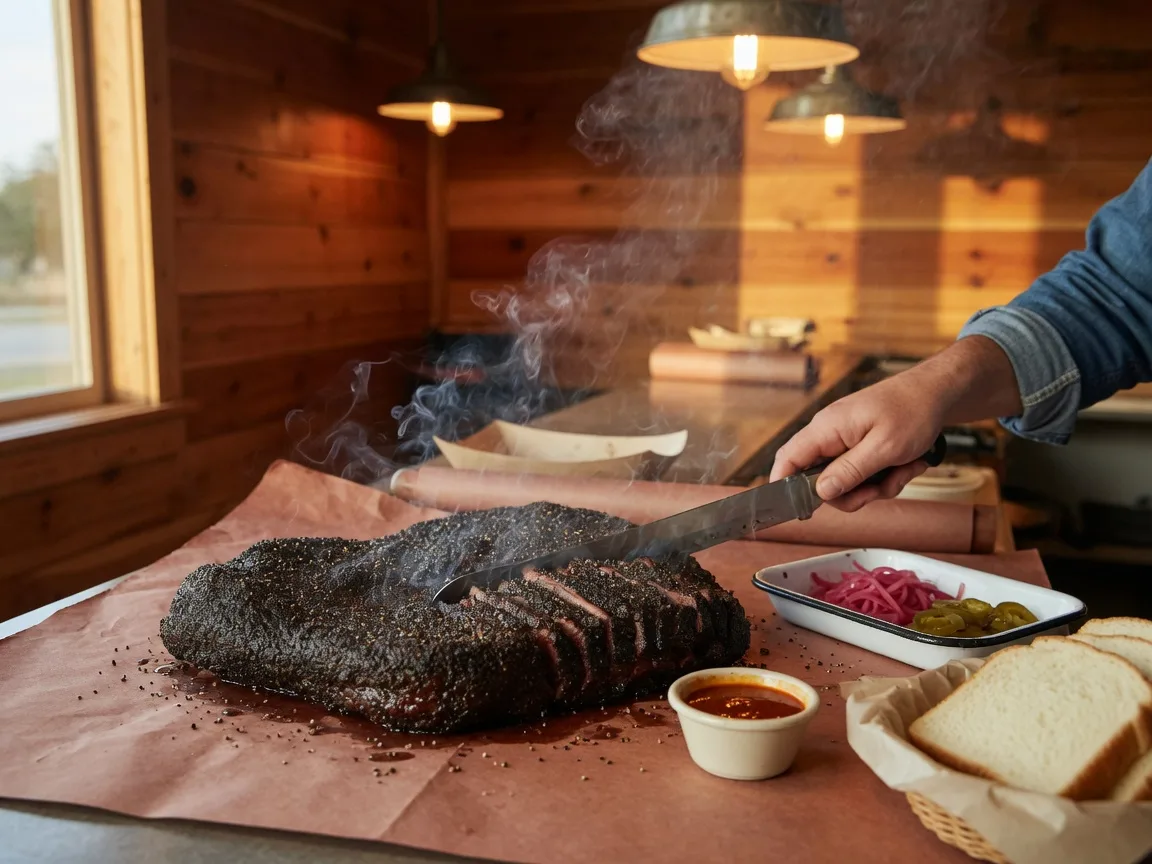
Texas Monthly has ranked the state's barbecue since 1973 and published its Top 50 list since 1997 [15][16]; in most Hill Country towns, a serious brisket counter is a short drive away. (Illustrative image.)
The Road to Anywhere: Frontage Roads, Texas Turnarounds, and Where the Weekend Leads
One distinctive feature of Texas highway design is the widespread use of frontage roads. These parallel roads provide access to businesses, neighborhoods, and connecting streets without requiring every local trip to enter the freeway. In some situations, they make shopping and errands more convenient, particularly along corridors designed around this system. They are not traffic-proof shortcuts: frontage roads can become congested, and busy intersections still create delays. Their advantage is the additional local access and routing flexibility they provide [6].
The Texas turnaround is another distinctive feature, though these lanes exist at certain interchanges, not all of them. Where properly designed, a dedicated lane lets a driver reverse direction without passing through the main signalized intersection, U-turning under the overpass from one frontage road to the other. TxDOT specifies where these lanes belong, and the federal crash-modification clearinghouse tracks the Texas U-turn as a standard statewide treatment [7][8]. Locals get a small burst of joy every time they hit one, and you may too, because it solves a problem you did not realize had been annoying you for years.
The numbers reward you too. In INRIX's 2025 Global Traffic Scorecard, Los Angeles drivers lost about 87 hours to congestion, fourth-worst in the country behind Chicago (112), New York (102), and Philadelphia (101), against a national average of 49 [9]. TomTom's 2025 Traffic Index ranks Los Angeles the most congested U.S. city at nearly 60 percent extra travel time, with San Francisco third at about 50 percent [10].
San Antonio is not traffic-free. Congestion along I-10, Loop 1604, and major commuter corridors can still test anyone's patience, particularly during construction or peak commuting periods. Nevertheless, TomTom's 2025 Traffic Index offers a meaningful comparison: Los Angeles recorded approximately 83 hours of rush-hour time lost, while San Antonio recorded approximately 29 hours using the same measurement framework. That is a substantial difference, although the time any individual driver saves depends on where they live, work, and travel. A Hill Country resident commuting into San Antonio during rush hour may experience a very different reality from someone working remotely or traveling primarily within Boerne.
The payoff is weekends that go somewhere. Boerne and Fair Oaks Ranch offer access to the San Antonio airport, downtown cultural destinations, Hill Country wineries, and Guadalupe River recreation. But travel times vary substantially by community, destination, traffic, and construction. Before choosing a home, test the trips you expect to make regularly rather than relying on a single regional average. The parks and recreation guide, wine country comparison, and San Antonio attractions guide turn the map into a to-do list.
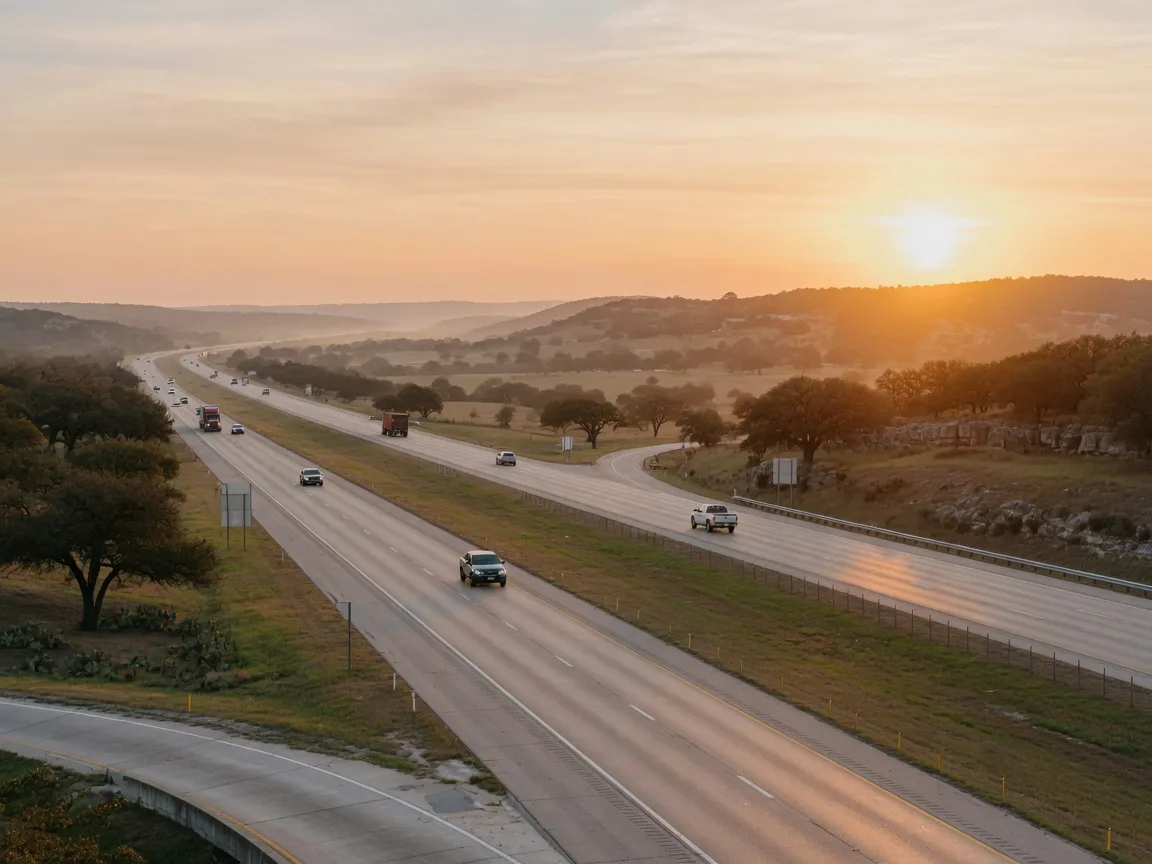
Frontage roads and Texas-turnaround lanes add local access and routing flexibility to everyday driving [6][7][8]. (Illustrative image.)
What You Do With the Time and Space
The Hill Country offers a distinctive mix of outdoor recreation and access to urban entertainment. Around Boerne and Fair Oaks Ranch, residents can explore community parks and walking trails and a steady rhythm of local events. A longer outing might lead to the Guadalupe River, a state natural area, or the wineries and small towns that define the broader Hill Country.
San Antonio adds museums, live performances, major sporting events, restaurants, and cultural institutions. For households accustomed to a major California metropolitan area, that access can make a smaller-town home base more practical.
The tradeoff is geographic. Some destinations require substantial driving, summer heat can limit daytime outdoor activity, and popular recreation areas may require reservations or advance planning. The benefit comes from choosing a community that puts your preferred activities within a travel range you actually enjoy.
The Right Community Depends on Your Stage of Life
A household with school-age children may prioritize neighborhood activities, school access, playgrounds, and proximity to other families. A professional in their late twenties or thirties may care more about restaurants, recreation, dating opportunities, and meeting people with similar interests. A couple approaching retirement may value a quieter setting, volunteer opportunities, healthcare access, and strong neighborhood connections.
These are not interchangeable lifestyles. A peaceful acreage property that appeals to one household might feel isolating to another. Similarly, someone seeking an active urban social environment may prefer parts of San Antonio over a more rural Hill Country location.
The useful question is not simply whether Texans are friendly. It is whether the community you are considering offers the kind of social life you want to build. The site's community comparison page works through which town fits which priorities.
What an Ordinary Saturday Might Look Like
Picture a Saturday in a well-chosen Hill Country neighborhood. You take the dog for a morning walk before the day gets hot, stop for groceries, spend part of the afternoon working in the yard or meeting friends, and finish with dinner in Boerne or San Antonio. On another weekend, you might visit a farmers market, explore a trail, or drive out to wine country.
None of those activities is exclusive to Texas. The potential difference is how your location, housing budget, available space, and everyday obligations fit together. A home with a usable backyard, convenient shopping, and manageable travel distances may give you more options for using your free time.
But location determines everything. A remote worker in Fair Oaks Ranch, a family commuting daily to downtown San Antonio, and a couple living on acreage outside Bandera will experience very different versions of Hill Country life.
Everyday Life: California Versus the Texas Hill Country
This table does not argue; it compares. Each row takes a daily pain point from living in a high-cost state and sets the Texas answer beside it. The right-hand column is for readers coming from New York, New Jersey, Illinois, Washington, or Colorado.
| The daily pain point | In California | The Texas upgrade | If you are coming from... |
|---|---|---|---|
| Traffic that eats the evening | Los Angeles drivers lost about 83 hours of rush-hour time in 2025, per TomTom's 2025 Traffic Index, which ranks it the most congested U.S. city [10][22]. | San Antonio drivers lost about 29 hours of rush-hour time in 2025 using the same TomTom measurement framework [11]. Frontage roads and turnaround lanes add local access and routing options; they do not make congestion disappear [6][7][8]. | New York, New Jersey, and Illinois: New York City drivers lost about 102 hours in 2025 and Chicago drivers about 112, the most in the country, so the relief applies to you too [9]. |
| Interactions that stay transactional | In some densely populated or fast-paced communities, busy schedules and commuting can make casual neighborhood interaction difficult. Experiences vary widely by city and neighborhood. | Many Hill Country communities offer accessible social opportunities through neighborhoods, local events, volunteer organizations, recreation groups, and civic activities. Participation and neighborhood fit matter more than state boundaries. | Readers from New York, New Jersey, Illinois, Washington, and Colorado should evaluate the social environment of specific Texas communities rather than assume a statewide cultural difference. |
| Taxes on what you earn | California taxes wages, salaries, and most personal income at the state level [1]. | Texas has no state personal income tax; the state sales tax is 6.25 percent, local add-ons can bring the combined rate to 8.25 percent, and property taxes fund local schools and services [1][18][19]. | New York, New Jersey, Illinois, and Colorado: the state income-tax line disappears, even where the property-tax line stays real [1]. Washington: you already pay no state tax on wages, so your gain shows up in housing costs rather than your paycheck. |
| Housing that buys less every year | Price per square foot in the big California metros runs multiples of the Texas comparison, documented on the site's cost of living page. | Depending on the origin market, financing terms, location, and property type, the same housing budget may provide more interior space, a larger lot, or a newer home in portions of the San Antonio metro and Texas Hill Country. Buyers must also account for property taxes, homeowners insurance, maintenance, and any HOA or utility costs. | Buyers from all five states should compare complete monthly ownership costs using their specific origin and destination markets. |
| Errands that feel like drudgery | Long, expensive, and impersonal. | Errands get easier and friendlier: H-E-B runs and Buc-ee's stops become low-grade recreation [2][3][4][5]. | All five states: errands stay errands, but they stop being the low point of the week. |
Traffic figures come from the INRIX 2025 Global Traffic Scorecard and TomTom's 2025 Traffic Index, which measure different things. INRIX reports general annual congestion delay per driver (hours lost across all dayparts), while TomTom reports rush-hour-specific time lost, so the California and Texas figures in the traffic row both come from TomTom's 2025 index and use the same measurement framework [9][10][11][22]. The tax row cites the Texas Comptroller on the absence of a state income tax, sales tax rates, and the basics of local property taxation [1][18][19]. The two qualitative rows compare daily experience rather than a measured statistic; the migration figures cited alongside them measure migration, not hospitality, and document the scale of newcomers Texas absorbs every year [12][13].
How to Keep the Win: Plan the Honest Tradeoffs, Not the Hype
Every real upgrade has a bill, and in Texas most of the bills are predictable. None of them should stop you. All of them should be planned for, so the win stays a win in year three instead of year one.
Some parts of California life are difficult to replace. If you regularly enjoy coastal weather, beaches, mountains, extensive public transportation, or a particular community's cultural and professional networks, those losses deserve serious consideration. The Hill Country offers different assets, not exact substitutes. For many people the exchange works exceptionally well; for others it may not. The purpose of a scouting visit is to discover which category you fall into before making an expensive commitment. The site's guide to what Californians miss after moving to Texas names the specific losses honestly.
- The heat is the one bill that comes due each summer. From June into September, 90-plus and often 95-plus degree afternoons are normal. Budget air conditioning as a utility, not an accessory, take a summer visit before you sign, and treat a pool as entertainment value rather than a splurge. The heat reality guide is the unvarnished version.
- Property tax is real and public. Texas has no state income tax, and the school district and county run on property taxes set by local taxing units [1][18]. Pull the exact rates for the address you are considering and file for the homestead exemption as soon as the house is your principal residence; you do not have to wait for January 1. Under current Texas law, qualifying residence homesteads receive a $140,000 exemption from school-district property taxation. Eligible homeowners age 65 or older, or who meet the applicable disability requirements, may qualify for an additional $60,000 school-district exemption. These exemptions reduce taxable value for qualifying school taxes; they are not deductions from every taxing jurisdiction's bill.
Texas also generally limits annual increases in the appraised value of an established qualifying residence homestead to 10 percent, subject to statutory rules and exceptions, including certain new improvements. This is not a 10-percent ceiling on property-tax bills, and buyers should not assume the previous owner's taxable value or tax bill will carry over after a purchase.
An eligible new owner may qualify for a homestead exemption during the acquisition year, subject to the statutory requirements and whether the previous owner received the exemption for that year. Confirm the property's applicable taxing units, assessed value, exemptions, and post-purchase tax estimate with the county appraisal district before committing to a purchase. Then budget the whole line. The Prop 13 versus Texas tax page and the homestead exemption guide show the math. - The car is the point, not the problem. Texas roads are built for people who drive, and outside the San Antonio core, public transit is not a realistic substitute for a car [6][7][8]. Choose your address around your commute and your weekly loop, and the system works for you. The commute guide and the city comparison help you match town to drive.
- Weather happens, and it has to be planned for. Hail, wind, heat, and flash flooding are the Hill Country's honest weather bill. The deadly July 2025 Guadalupe River floods are why this region is called Flash Flood Alley: check the FEMA flood map for any address near a creek or river, price flood insurance even outside a mapped zone because standard homeowners policies exclude flood, and never drive into a flooded low-water crossing [21]. For hail and wind, quote homeowners insurance on the exact property before you close: roof age, construction, and location all move the number, and a quote turns the line into a budget item instead of a surprise. A hard freeze can still strain the state's electric grid, as Winter Storm Uri did in February 2021, and a generator, a plan, and a full tank take the drama out of the rare storm. The grid guide explains what actually happens.
- Cedar fever is the seasonal surprise. From roughly December through February, Ashe juniper (mountain cedar) pollen blankets the Hill Country, and newcomers who never had allergies in California are often caught off guard. Talk to your doctor before your first winter, and don't assume a stuffy January is a cold.
- The pace is the product. If your week has been running on adrenaline and irritation, the slowdown will feel like freedom, then like boredom, then like freedom again. The first six months of adjusting are the price of admission. The driveway moment guide and the what to expect page explain the adjustment so it reads as a plan, not a surprise.
- The time-zone shift is the easiest tradeoff on this list. Central Time runs two hours ahead of Pacific, so a 9-to-5 California schedule becomes 11 AM to 7 PM on your new wall clock. Most remote workers shift instead: start at 7 or 8 AM Central, do heads-down work before the West Coast logs on, put recurring meetings in the overlap window of roughly 11 AM to 3 PM Central, and finish while California colleagues are still working. Ease into the earlier start by moving your alarm 15 minutes earlier every few days in the week before the move, then keep the same bedtime and wake time once you land. Washington readers face the same two-hour shift; Colorado is one hour behind Central; New York and New Jersey readers move the other way, since Central is an hour behind Eastern; Illinois is already on Central. Whether remote employees can adjust their schedules depends on employer expectations, team coverage requirements, and workplace policies. A move across state lines may also require employer approval because of payroll, tax withholding, insurance, labor-law, or business-registration considerations. Obtain written approval for the work location and schedule before making relocation commitments. The remote work guide covers the connectivity side of a cross-state remote setup.
- The property changes the experience. A larger lot or home can be liberating, but it can also require more time and money to maintain. Depending on the property, buyers should investigate landscaping requirements, irrigation, drainage, HOA or deed restrictions, foundation maintenance, pest control, and insurance. Some rural properties have private wells, septic systems, or other infrastructure that requires specialized maintenance. The home maintenance guide walks the recurring-cost reality for Hill Country properties.
Additional space is valuable only if the household actually wants the responsibilities that accompany it. Before buying acreage or a larger home, estimate the recurring costs and determine how much work you are comfortable taking on.
Five Questions to Answer Before Choosing a Hill Country Community
These five questions turn the inspiration above into a concrete decision. Work through them before you narrow your search.
- How much of my week will be spent driving, and where will those trips take me? Work, school, shopping, healthcare, and regular recreation should all be considered before choosing a neighborhood, not assumed after.
- What kind of social environment do I want? Walkable, event-oriented areas differ sharply from quieter subdivisions and rural properties. Spend time in both kinds and see which one you actually want to come home to.
- What will my complete monthly housing cost be? Include principal, interest, property taxes, insurance, HOA obligations, utilities, and maintenance where applicable, not just the mortgage payment.
- How will I handle the climate and property responsibilities? Visit during summer conditions and examine the maintenance requirements of the actual property before you commit to it.
- What am I willing to give up? Identify the California or other origin-state amenities, relationships, and conveniences that matter most, and decide honestly which ones you can live without.
If you can answer those five questions clearly, you are in a much better position to distinguish a genuine lifestyle improvement from a relocation that merely looks attractive on paper.
Frequently Asked Questions
The questions that come up in every serious conversation about making this move, answered straight.
Is Texas actually friendlier, or is that just what people say?
It holds up in practice, though the migration statistics do not prove it: those numbers measure population movement, not friendliness. What I can vouch for is what I have seen living here: howdy at the counter, waves on the back roads, neighbors who introduce themselves before you have unpacked. The scale of newcomers (more than half a million people moved into Texas from other states in 2024 [12][13]) does mean many people understand what starting over feels like. Making friends still requires showing up, and how quickly that gets answered depends on participation, location, personality, and circumstances. The site's making-friends guide spells out how it works in practice.
What exactly is a Texas turnaround, and why do locals love it?
It is a dedicated lane at an interchange that lets a driver on a one-way frontage road U-turn under the overpass to the other side, bypassing both cross streets entirely. TxDOT specifies where turnarounds belong, and the federal highway safety clearinghouse tracks them as a standard Texas treatment [7][8]. Locals love it because it turns the moment that used to mean a red light and a left turn into a smooth swoop. You will notice it within your first week of errands.
I keep hearing Texas has no state income tax. What do Texans actually pay instead?
Texas does not tax wages, salaries, or most personal income at the state level [1]. The state sales tax is 6.25 percent, and cities, counties, and special districts can add up to 2 percent more, for a combined maximum of 8.25 percent [19]. Local property taxes fund schools and services, with rates set by your local taxing units rather than the state [18]. The trade is a real one: the income-tax line disappears, and the property-tax line becomes the bill to budget. The site's property tax guides walk the exact math for Kendall, Bexar, Comal, and Bandera counties.
Moving to Texas does not automatically end every possible tax obligation to a former state. Income earned before the move, income sourced to another state, business interests, real estate, and certain deferred compensation arrangements can create continuing filing or tax obligations. People relocating with significant equity compensation, business income, or multistate tax situations should review their obligations with a qualified professional before the move.
How hot does it really get, and is the heat worth it?
It is the biggest caveat in this article. From June into September, 90-plus and often 95-plus degree afternoons are the norm, and air conditioning runs many months of the year. The compensation is everything else in this article: the space, the pace, and a winter that is genuinely mild. A summer visit before you buy is the standard advice, and the site's heat reality guide tells the unvarnished first-year version so the heat is a planned expense, not a shock.
I am in my twenties or thirties. Will I actually make friends in Boerne or San Antonio?
Making friends after a move is possible at any age, but it is rarely automatic. Boerne, Fair Oaks Ranch, and San Antonio provide different opportunities for meeting people, including recreation groups, volunteer organizations, professional networks, community events, and neighborhood activities.
For people in their twenties and thirties who want a particularly active nightlife, dating, or urban social scene, parts of San Antonio may offer more options than smaller Hill Country communities. Others may prefer the pace and environment of Boerne or Fair Oaks Ranch.
Before choosing where to live, spend time in the neighborhoods and social settings you would actually use. A community should match your interests and daily routine, not merely your housing budget. The making-friends guide and the month-by-month social calendar for your first Texas year are good places to start planning.
Where should I start looking: Boerne, Fair Oaks Ranch, or San Antonio?
Boerne offers a historic downtown, established community identity, local events, and a range of housing options. Fair Oaks Ranch combines residential neighborhoods, mature Hill Country landscapes, golf-oriented and other community amenities, and access to the San Antonio metropolitan area; lot sizes and housing styles vary considerably. San Antonio offers the widest range of urban neighborhoods, employment centers, cultural institutions, and metropolitan services.
The best choice depends on your commute, preferred neighborhood character, budget, schools where applicable, and the activities you want nearby. The city comparison page and the community guides work through which profile each community fits.
The Bottom Line
The strongest argument for moving to the Texas Hill Country is not that everything is better here. It is that the combination of housing choices, community life, recreation, and access to San Antonio may fit your priorities better than the place you currently call home.
Financial breathing room matters, but so do the ordinary details: whether you enjoy where you live, how far you drive, how often you see friends, and whether your home supports the life you want outside work.
The Hill Country has meaningful tradeoffs, including summer heat, car dependence, property taxes, insurance costs, severe-weather exposure, and the possibility of feeling isolated in the wrong location. Those considerations should be evaluated with the same seriousness as housing prices and tax savings.
For the right household, the result can be a substantial improvement in everyday quality of life. The way to find out is to run the numbers, visit the communities, and judge the experience against your own priorities.
If you are considering the move, I can help you compare communities, understand the housing tradeoffs, and plan a scouting visit around the places that best match your priorities. You do not need to be ready to buy to begin evaluating whether a move makes sense. The contact page is the easiest way to start.
If this article reads like it was written by someone who lives it, that is because it was. I am Bill Ross, founder of Hill Country Homesteads Group, brokered by Keller Williams Boerne, and I moved my own family from Silicon Valley to the Hill Country, so I know both sides of the comparison from the inside. My practice serves Boerne, Fair Oaks Ranch, San Antonio, and the surrounding communities across Kendall, Bexar, Comal, and Bandera counties, and I coordinate California-to-Texas moves through a direct network of more than 1,100 California real-estate agents. Whether you are six months out or six weeks out, the honest, no-pressure first step is a conversation about your specific situation. Reach me at movetotexas.net/contact, by email at Bill@HillCountryHomesteads.com, or by phone at (210) 294-9190 during business hours, 8 AM to 6 PM Central, Monday through Friday. The brokerage is at 116 Herff Rd, Suite 203, Boerne, TX 78006.
For more depth, the Hill Country Homesteads insights hub covers Boerne property taxes and community life in more detail, and the Texas probate guide at texasprobatehomes.net covers the estate side of a cross-state move. And if you are not ready to call yet, the start here page lays out the whole site in the order most people actually research it.
Sources
Numbered sources, as cited in the body above. Primary authorities come first wherever one exists; secondary media and market-data sources are labeled as such.
- Taxes FAQ: Does Texas have a state income tax?: Texas Comptroller of Public Accounts. comptroller.texas.gov/faq/
- Handbook of Texas: H-E-B (the company's 1905 Kerrville founding by Florence Thornton Butt, its family ownership, and its Texas-wide operation): Texas State Historical Association. www.tshaonline.org/handbook/entries/h-e-b
- It's the best grocery store: What makes Texas chain H-E-B such a fan favorite (H-E-B's roughly 400-plus stores and its outsize share of the Texas grocery market): Modern Retail (secondary). www.modernretail.co/marketing/its-the-best-grocery-store-what-makes-texas-chain-h-e-b-such-a-fan-favorite/
- World Record Holder (the New Braunfels travel center's 2012-2023 record as the largest convenience store, and the Luling store's current record of 75,593 square feet with 120 fuel pumps): Buc-ee's, company website. buc-ees.com/about/world-record-holder/
- Buc-ee's opening in San Marcos this year, Boerne in 2027 (San Marcos opened August 12, 2026; Boerne slated for 2027; the two bring Texas to 38 locations): Retail Customer Experience (secondary). www.retailcustomerexperience.com/news/buc-ees-opening-in-san-marcos-this-year-boerne-in-2027/
- Roadway Design Manual, Section 8.1.18: Frontage Roads (what frontage roads are and what they do along Texas freeways): Texas Department of Transportation. www.txdot.gov/manuals/des/rdw/chapter-8--freeways--4r-/8-1-design-considerations/8-1-18-frontage-roads.html
- Roadway Design Manual, Section 15.8: Frontage Road Turnarounds and Intersection Approaches (where and when Texas-turnaround lanes are provided): Texas Department of Transportation. www.txdot.gov/manuals/des/rdw/chapter-15-grade-separations-and-interchanges-/15-8-frontage-road-turnarounds-and-intersection-ap.html
- Countermeasure Fact Sheet: Install Texas U-turn (Texas Turnaround), described as a common Texas treatment at diamond interchanges: FHWA Crash Modification Factors Clearinghouse. cmfclearinghouse.fhwa.dot.gov/detail.php?facid=11017
- INRIX 2025 Global Traffic Scorecard, U.S. release (hours lost per driver: Chicago 112, New York City 102, Philadelphia 101, Los Angeles 87; national average 49): INRIX via Business Wire. www.businesswire.com/news/home/20251201243257/en/inrix-2025-global-traffic-scorecard-traffic-congestion-surges-worldwide-as-u.s.-safety-improves-for-the-first-time-in-four-years
- TomTom Traffic Index 2025, United States overview (Los Angeles 59.8 percent average congestion level and 83 hours lost in rush hour, No. 1 in the U.S.; San Francisco 49.7 percent, No. 3): TomTom. www.tomtom.com/traffic-index/united-states-of-america-country-traffic/
- San Antonio traffic report, 2025 (average congestion level 23.5 percent; about 29 hours lost in rush hour): TomTom Traffic Index. www.tomtom.com/traffic-index/city/san-antonio-tx/
- Vintage 2025 state population estimates, July 2024 to July 2025: Texas added about 391,000 residents, the largest numeric gain of any state, while California was among the states to lose population: U.S. Census Bureau. www.census.gov/data/tables/time-series/demo/popest/2020s-state-total.html
- What states are people in Texas moving to and from? (2024: about 556,000 people moved into Texas from other states; California, Florida, and New York were the top origins), based on U.S. Census Bureau American Community Survey data: USAFacts (secondary). usafacts.org/answers/what-states-are-people-moving-to-and-from/state/texas/
- Where People Are Moving to Texas From, 2024 Study (about 106,900 Californians moved to Texas, more than from any other state): SmartAsset (secondary). smartasset.com/data-studies/moving-texas-2024
- The 50 Best BBQ Joints in the World (the 2025 Top 50 list, with Burnt Bean Co. of Seguin ranked No. 1): Texas Monthly. www.texasmonthly.com/bbq/the-50-best-bbq-joints-in-the-world/
- The Texas Barbecue Quest That Started It All (the first Top 50 list in 1997 and the seven editions since, built on a 1973 piece ranking the state's barbecue): Texas Monthly. www.texasmonthly.com/the-stand-up-desk/looking-back-first-texas-monthly-bbq-top-fifty/
- Bringing Texas Barbecue History to the Table (the German butcher-shop, African American, and Mexican American traditions behind Central Texas barbecue): Texas Historical Commission. thc.texas.gov/blog/bringing-texas-barbecue-history-table
- Property Tax Basics (how local taxing units set property tax rates, and how exemptions and the homestead appraisal cap work): Texas Comptroller of Public Accounts. comptroller.texas.gov/taxes/property-tax/basics.php
- Sales and Use Tax (6.25 percent state rate; local jurisdictions may add up to 2 percent, for a maximum combined rate of 8.25 percent): Texas Comptroller of Public Accounts. comptroller.texas.gov/taxes/sales/
- Property Tax Exemptions (the $140,000 school-district residence homestead exemption, the additional $60,000 for owners 65 or older or disabled, and eligibility in the year a home is acquired): Texas Comptroller of Public Accounts. comptroller.texas.gov/taxes/property-tax/exemptions/
- FEMA Flood Map Service Center (official flood zone lookup by address): Federal Emergency Management Agency. msc.fema.gov/portal/home
- TomTom Traffic Index 2025, Los Angeles city page (the city recorded about 83 hours of rush-hour time lost in 2025): TomTom. www.tomtom.com/traffic-index/city/los-angeles-ca/
- Property Tax: How a Property Is Valued (how appraised value is set and the limits on annual increases in appraised value for qualifying residence homesteads): Texas Comptroller of Public Accounts. comptroller.texas.gov/taxes/property-tax/valuing-property.php
- Governor Abbott Attends Grand Opening of Buc-ee's in San Marcos (confirms the San Marcos location opened August 12, 2026): Office of the Texas Governor. gov.texas.gov/news/post/governor-abbott-attends-grand-opening-of-buc-ees-in-san-marcos
Last verified: October 13, 2026. Bill's business hours are 8 AM to 6 PM Central, Monday through Friday. The migration and census figures are the most recent annual releases at time of writing [12][13][14]; the traffic figures are the 2025 editions of the INRIX and TomTom indexes, released in December 2025 and January 2026 [9][10][11][22]; the Texas Monthly Top 50 list is the 2025 edition [15][16]. The Buc-ee's San Marcos opening is confirmed by the Texas Governor's Office [24], and the homestead material draws on the Comptroller's exemptions and valuing-property pages [20][23]. Commute and market measures move, so confirm anything time-sensitive against the source before relying on it. This is general educational and lifestyle content, not tax, legal, or financial advice for your specific situation.