
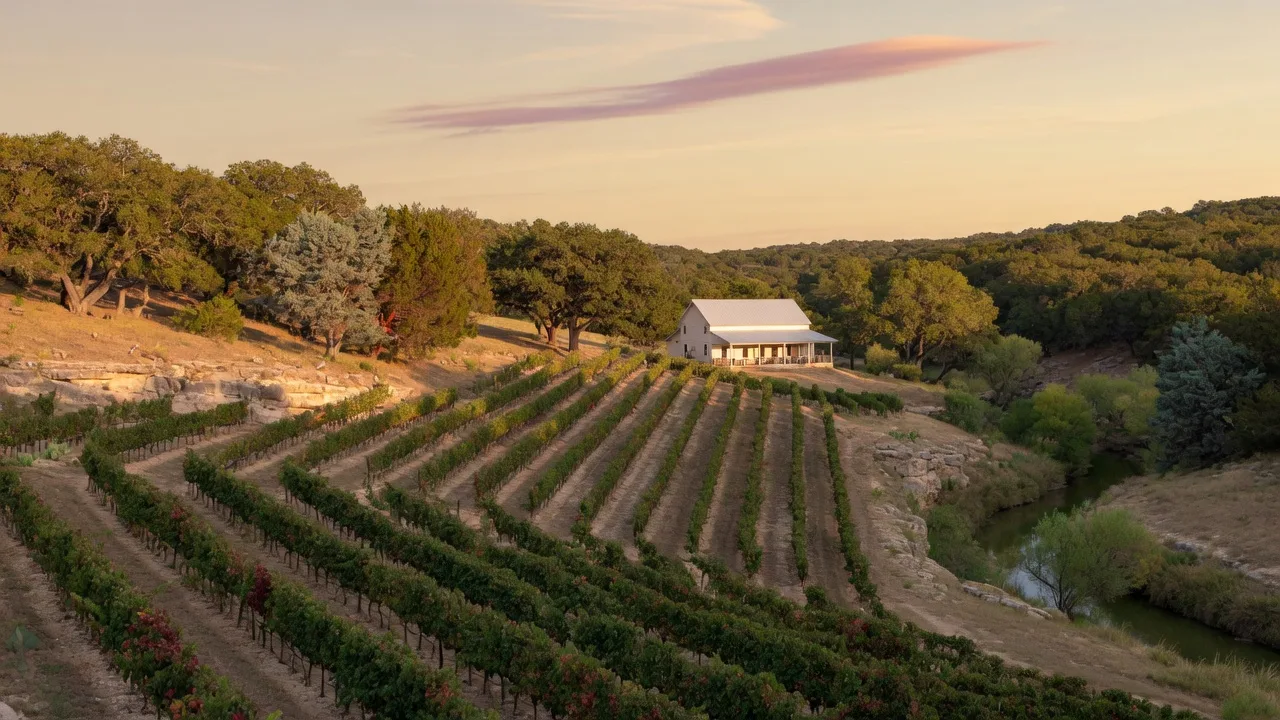
Texas wine country is real, and it is a different animal from California's. Trade tallies count more than 470 bonded wineries in Texas, and Texas Monthly reported more than 800 active winery permits in October 2025, the fifth most of any state. But the state plants only about 9,300 acres of wine grapes, roughly 85 percent of them in the Texas High Plains rather than the Hill Country, and the vines ripen about a month to two months ahead of California's crush. What a California drinker finds is not a Napa replica on a smaller scale. It is a younger, hotter, more casual wine region with its own grape list and its own economics.
This guide compares the two regions in numbers, explains why the grapes are different, shows what a tasting costs relative to home, and maps the wine pockets around Boerne with the verified winery stops you can reach in 30 minutes or less. It is written for people evaluating a move, not planning a vacation, so the focus stays on what wine country actually means for daily life in the Hill Country.
The Two Regions by the Numbers
| Metric | Texas | California |
|---|---|---|
| Winery count | 470+ bonded wineries in trade tallies; 800+ active winery permits (2025) | 4,864 wineries as of January 2025 |
| Wine-grape acreage | About 9,300 acres statewide (2024) | About 590,000 acres of wine-type grapes (2024 USDA crop report) |
| Where the grapes grow | Texas High Plains AVA grows more than 85 percent of the state's wine grapes | Coastal, interior valley, and mountain appellations statewide |
| Anchor AVA size | Hill Country AVA: about 9 million acres, third-largest AVA in the US, with roughly 2,000 planted acres and 100-plus wineries | Napa Valley AVA: about 252,500 acres total, with roughly 45,000 planted |
| Harvest window | Late June through October, with High Plains fruit finishing last | Classic crush runs August through November |
| Average tasting fee | About $25 per flight, typical range $20 to $45 | About $79 average in Napa (2025 survey) |
Two caveats matter before you compare further. First, winery counts are counted differently: permit figures include every bonded operation, while trade tallies count commercial producers, which is why the 470 and 800 numbers coexist. Second, California's acreage has been shrinking as vineyards are pulled, while Texas acreage has been growing from a very small base. Texas is the fifth-largest wine state by winery count, but it remains a tiny producer by volume, and that is exactly where the difference in character comes from.
Why the Grapes Are Different: Heat Drives the List
The stereotype that Texas only makes sweet wine is outdated. The modern Texas industry dates to the 1970s, and the vineyard list has matured around the one thing the state cannot negotiate: heat. The USDA's 2019 Texas vineyard survey put Cabernet Sauvignon first among planted varieties at about 430 bearing acres, followed by Merlot at about 220 and Tempranillo at about 190. The fastest-growing plantings between 2015 and 2019 were Mourvèdre, Cabernet Sauvignon, Tempranillo, Sangiovese, and Tannat, each adding roughly 90 to 170 acres. That is a heat-tolerant roster by design.
The varieties that define the region are the ones that ripen without coastal fog: Tempranillo, Mourvèdre, Grenache, Sangiovese, Syrah, Tannat, and Cinsault on the red side, and Viognier, Torrontés, Picpoul Blanc, and Roussanne on the white side, plus Blanc du Bois, a native hybrid that was the earliest thing picked in 2024 vintage reporting. Harvest tells the timing story better than any label: Blanc du Bois came off the coast in the final week of June, Viognier from the Llano Uplift was picked around July 2 in 2024, Hill Country reds ran mid-July through August, and the High Plains fruit, which supplies most of the grapes crushed in Texas, finished in September and October.
For a drinker coming from Napa or Sonoma, the honest expectation is this: Texas wine is a young category with meaningful vintage variation, so you buy by producer and vineyard rather than by appellation name. The upside is that a tasting room flight lets you compare five or six of these varieties side by side for the price of a glass in most California rooms. The Hill Country wineries overview covers what the bottles actually taste like in more depth.
What a Hill Country Tasting Costs Compared to Home
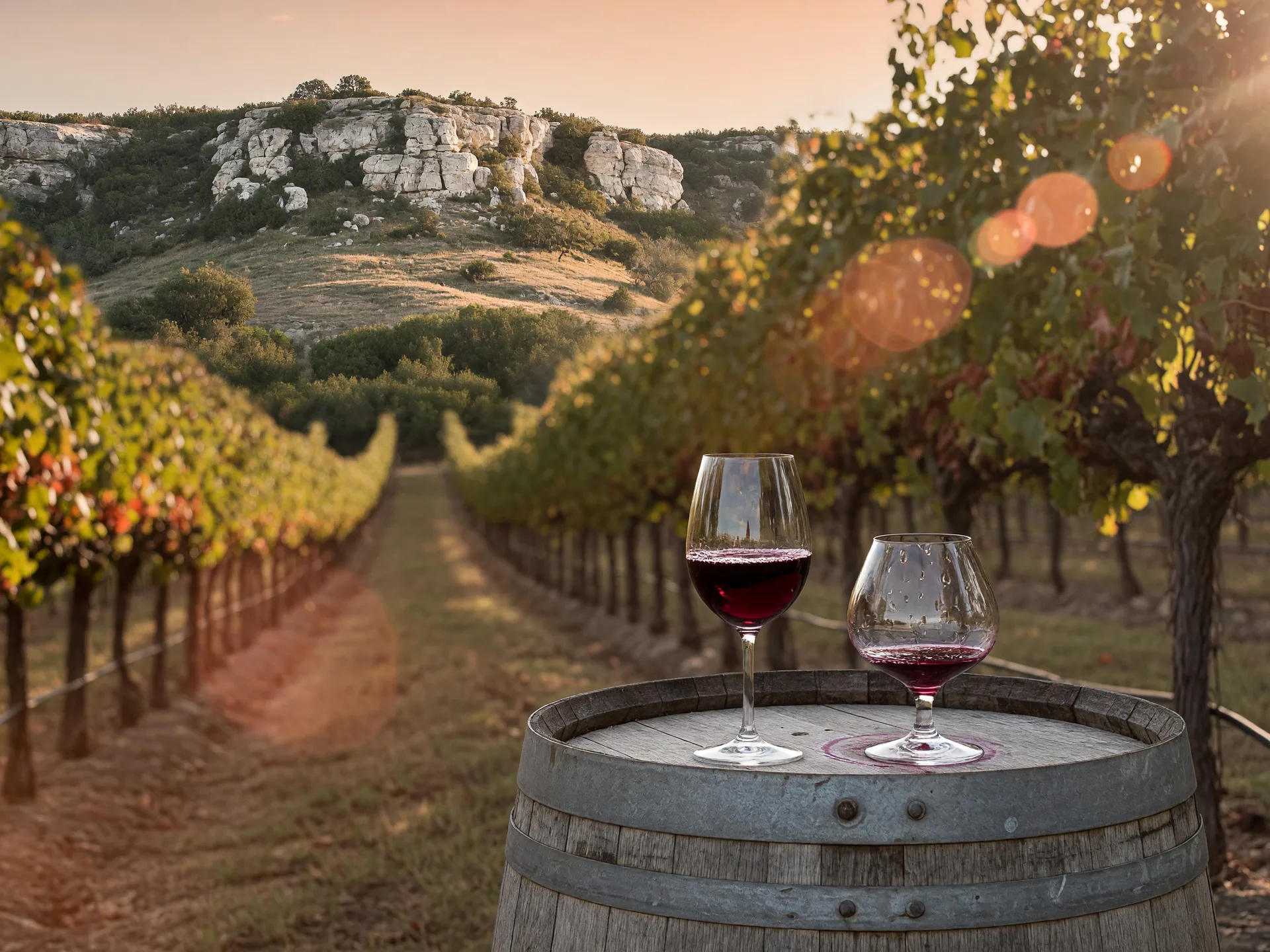
The price gap between the two wine countries is the number California buyers notice first, so it is worth stating plainly. The San Francisco Chronicle's 2025 tasting-fee survey put the average Napa tasting near $79, with basic bar flights commonly $25 to $40 and seated reserve experiences above $75. In the Hill Country, a standard flight averages around $25, with the typical range between $20 and $45, and most tasting rooms credit a flight toward a bottle purchase, with the exact policy stated at the register.
| Cost Line | Texas Hill Country | Napa Valley |
|---|---|---|
| Standard flight | About $25 average; $20 to $45 typical | $25 to $40 for bar flights; average near $79 overall |
| Seated or reserve experience | Less common; a handful of rooms book seated tastings by reservation | Commonly $75 and up |
| Bottle price | Most bottles $25 to $60 | Average bottle about $103 (2025 survey) |
| Flight credit toward purchase | Common; policy stated at the register | Less common at premium houses |
The full fee survey, reservation policies, and route details live in the Hill Country wine tasting guide with specific winery-by-winery numbers. For the cost-of-living question, the short version is that a tasting habit costs about a third of what it costs in Napa, and the drive from home is measured in minutes instead of airport time.
Where Wine Country Sits Around Boerne
Boerne and Fair Oaks Ranch sit at the near edge of the region's wine country, which changes how often it is actually used. Boerne itself has five tasting rooms in town. The Comfort and Sisterdale corridor, the closest true wine pocket, runs 20 to 30 minutes up Highway 87 and I-10. The famous concentration is the Highway 290 corridor west of Boerne: the Wine Road 290 directory lists 50-plus wineries and tasting rooms between Johnson City and Fredericksburg, downtown Fredericksburg counts more than 30 rooms, and Visit Fredericksburg tallies nearly 100 wineries, vineyards, and tasting rooms across Gillespie County.
| Wine Corridor | Distance from Boerne | Character |
|---|---|---|
| Boerne in-town rooms | 5 to 15 minutes | Five tasting rooms on the Hill Country Mile and nearby, including Platinum Brix and Missick Cellars |
| Comfort and Sisterdale | 20 to 30 minutes | Estate wineries and downtown Comfort rooms along Highway 87 |
| New Braunfels | 25 to 35 minutes | A small cluster near the Comal and Guadalupe rivers |
| Hye and Johnson City | 40 to 55 minutes | Some of the state's most respected producers on the 290 corridor |
| Fredericksburg | 45 to 60 minutes | The densest tasting concentration in Texas, in town and on surrounding farm roads |
| Spicewood and Burnet | 45 to 60 minutes | Hill Country lake-country rooms north and east of Marble Falls |
| Wimberley and Dripping Springs | 50 to 65 minutes | Austin-adjacent tasting rooms on the region's eastern edge |
Distances are one-way drive times from Boerne without traffic and are consistent with the site's wineries by area pages.
Five Winery Stops Within 30 Minutes of Boerne
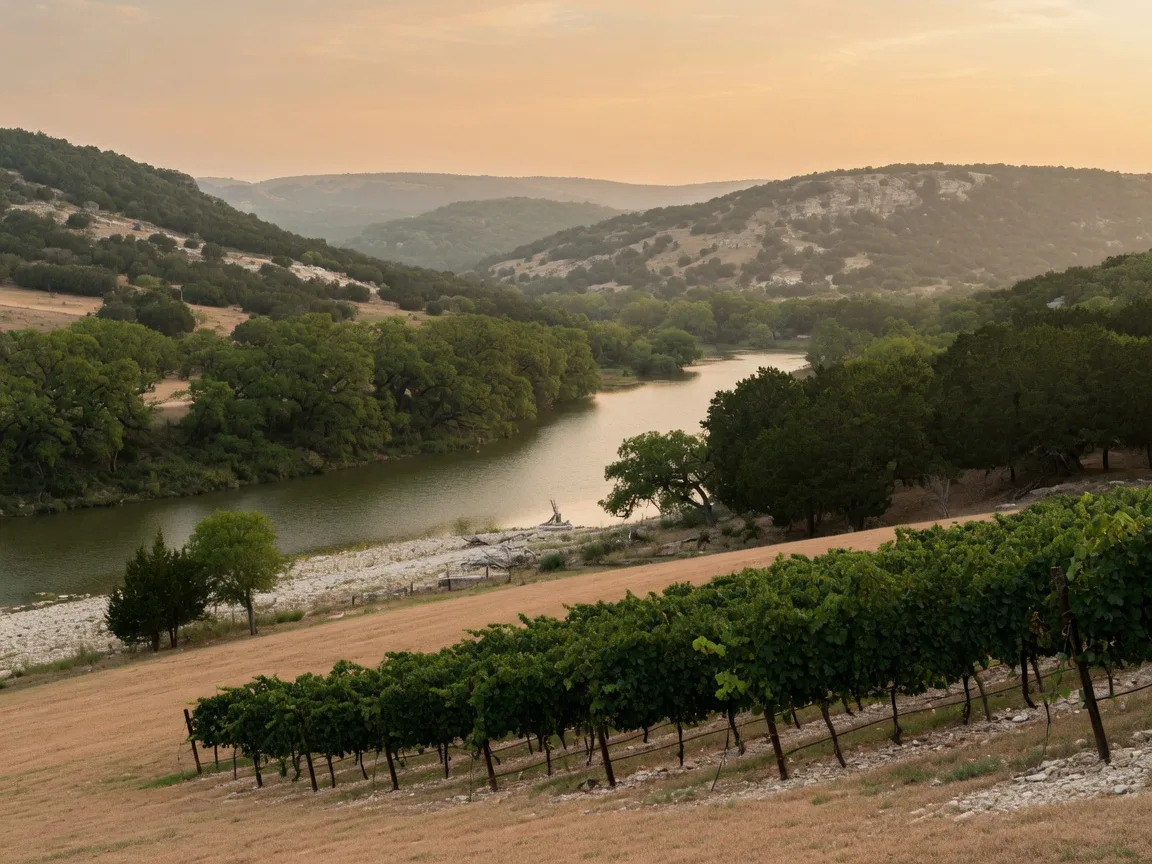
If you are house-hunting in Boerne, Fair Oaks Ranch, or Comfort, these are the five verified stops closest to home, each with its address and drive time from Boerne. They are the rooms most likely to answer the question of whether Texas wine is part of your year.
| Winery | Address | Drive | What to Expect |
|---|---|---|---|
| Sister Creek Vineyards | 1142 Sisterdale Rd, Boerne | 20 min | Family-run room in a restored barn in the Sisterdale Valley, with Tempranillo and other Texas varietals |
| Singing Water Vineyards | 316 Mill Dam Rd, Comfort | 25 min | 1880s barn on Bruins Creek; Cabernet Sauvignon, Merlot, Viognier, Pinot Grigio, and a Texas Reserve red blend |
| Newsom Vineyards | 1299 Highway 87, Comfort | 25 min | Tempranillo and Spanish-inspired varietals from Hill Country grapes, poured in Comfort's historic downtown |
| Comfort Cellars | 705 High St, Comfort | 25 min | Relaxed downtown Comfort room with a curated list of Texas wines, convenient on the way to Fredericksburg |
| Bending Branch Winery | 142 Lindner Branch Trl, Comfort | 30 min | Estate winery on 37 acres producing Tannat, Viognier, and Roussanne, with a hilltop tasting room with Hill Country views |
Full rosters with addresses and descriptions for every corridor live on the wineries by area pages, including the Comfort and Sisterdale guide and the Fredericksburg guide. The Comfort relocation guide covers what day-to-day life is like in the town those wineries call home.
How a Visit Works: The Saturday Pattern
The shape of a Hill Country tasting day is different from a California one. You typically stand at a bar or sit on a patio and work through a flight of five or six wines with a pourer, and the pace is relaxed rather than scripted. Because fees run $20 to $45 and most rooms credit a flight toward a bottle, a two-room afternoon costs about what a single Napa bar flight costs, and you usually leave with wine.
Reservations matter more as you get closer to the 290 corridor. Coordinates Vineyards in Hye and Ron Yates outside Johnson City book seated tastings through their own pages, and the busiest Fredericksburg rooms fill up on fall weekends, so book Saturday seats a week ahead on each winery's site rather than assuming walk-in availability. Harvest season, running roughly August through October, is the busiest window of the year across the region.
Practical notes for the day itself: tasting rooms are daytime operations, so plan stops between late morning and mid-afternoon; one corridor per visit with two or three stops is the right pace; and ride-share coverage thins the farther you get from San Antonio, so a designated driver is the default plan. Spring and fall are the seasons when the rooms are actually comfortable to sit outside, which matters for anyone used to coastal California summers.
What Wine Country Means for the Relocation Decision
For a California buyer, the difference worth internalizing is geographic more than viticultural. In Napa or Sonoma, wine country is a destination that requires lodging, a rental car, and a weekend. From a home in Boerne or Fair Oaks Ranch, the first tasting room is in town, the Comfort corridor is 20 to 30 minutes away, and the entire Wine Road 290 stretch is inside an hour's drive. That structural change is what turns wine country from a vacation line item into a weekly habit, and it shows up in the cost-of-living math as real money.
The honest tradeoffs are equally important. Texas wine is a young category: vintages vary more than California's, and the appellation names carry less meaning, so the tasting rooms matter more than the labels. Summer heat limits outdoor tasting from June through August, which is the reverse of California's coastal rhythm. And anyone who comes expecting Chardonnay and Pinot everywhere will be drinking Tempranillo, Mourvèdre, and Tannat instead, which is a feature of the region rather than a defect once the expectation is set.
For the broader lifestyle question, wine country is one input among several in the Hill Country's favor, and it connects to the region's other habits: the grape harvest season, the downtown Boerne weekend rhythm, and the commute reality that determines how often you actually get out. Taken together, they describe a place where weekend life has more texture per minute and per dollar than most California suburbs that cost the same.
The Bottom Line for California Buyers
Texas Hill Country wine country is smaller, younger, cheaper, and closer than California's, and it runs on a different grape list because the climate demands it. The state plants about 9,300 acres of wine grapes against California's roughly 590,000, yet it ranks fifth nationally by winery count, and the 290 corridor near Fredericksburg holds one of the densest tasting concentrations in the country. From a Boerne or Fair Oaks Ranch home, the closest rooms are 20 minutes away and the tasting fee averages around $25, which makes wine country a genuine part of weekly life rather than a vacation.
The comparison that matters for a move is not whether Texas wine matches Napa, because it does not and is not trying to. It is whether the near-home version of wine country fits how you actually live. If a Saturday of tasting, a patio lunch, and a couple of bottles for under $100 sounds like your year, the wine corridors between Boerne and Fredericksburg are a real point in the relocation column, and they are one of the reasons the Boerne and Fair Oaks Ranch head-to-head rarely comes down to lifestyle. If you want the tasting-fee and reservation details, the wine tasting guide has the full survey. If you want to talk about which neighborhoods put you closest to the parts of the region you would actually use, start a conversation and we can work through it with your specific budget and habits.
Frequently Asked Questions
Is Texas Hill Country wine country worth exploring for a California wine drinker?
Yes, if you go expecting a young, casual, value-driven region rather than a Napa replica. The tasting fee averages about $25 instead of the roughly $79 Napa average from the 2025 San Francisco Chronicle survey, and the closest rooms are 20 to 30 minutes from Boerne. The tradeoff is that Texas wine is a young industry: vintages vary, and the grapes that define the region are heat-tolerant varieties like Tempranillo, Mourvèdre, and Tannat rather than the Cabernet and Chardonnay most Californians default to.
How much does a Texas Hill Country tasting cost compared to California?
A standard Hill Country flight averages about $25, with the typical range between $20 and $45, and most rooms credit the flight toward a bottle purchase. Napa tasting fees averaged close to $79 in 2025, with basic bar flights running $25 to $40 and seated reserve experiences above $75. Bottle prices tell the same story: most Hill Country bottles sit between $25 and $60, while the average Napa bottle was about $103 in the same survey.
Which wineries are closest to Boerne and Fair Oaks Ranch?
Five rooms sit within 30 minutes: Sister Creek Vineyards (Sisterdale, about 20 minutes), Singing Water Vineyards (Comfort, about 25 minutes), Newsom Vineyards (Highway 87, about 25 minutes), Comfort Cellars (downtown Comfort, about 25 minutes), and Bending Branch Winery (Comfort, about 30 minutes). Five more tasting rooms operate inside Boerne itself. Fredericksburg and the Highway 290 corridor, with 50-plus wineries on the Wine Road 290 directory, run 45 to 60 minutes from Boerne.

Written by
Bill Ross
Hill Country Homesteads Group, brokered by KW Boerne
Bill Ross is a Texas real estate agent (TX license 778434) serving Boerne, Fair Oaks Ranch, San Antonio, and the surrounding Hill Country, with a direct network of 1,100+ California real estate agents for coordinated cross-state relocations. He has been recognized in USA Today and The Washington Post for his relocation expertise.
Related Guides
Hill Country Wine Tasting Guide
What tasting fees actually run in 2026, which rooms need reservations, and the three routes from Boerne to the 290 corridor.
Texas Hill Country Wineries Overview
The AVA, the main winery towns, notable producers, and what Texas wine actually tastes like.
Grape Harvest Season in the Hill Country
When the vintage runs, which grapes grow here, and the harvest events near Boerne, Comfort, and Fredericksburg.
Wineries by Area
The full winery roster with addresses, websites, and drive times from Boerne for every corridor.
Sources
- Texas winery counts (470+ bonded commercial wineries in trade tallies; 800+ active winery permits, fifth-largest wine state by winery count): Texas Wine & Grape Growers Association; Texas Monthly, October 2025. txwines.org; texasmonthly.com
- Texas vineyard acreage about 9,300 acres (2024) and Hill Country AVA details (established 1991, about 9 million acres, third-largest AVA in the US, roughly 2,000 planted acres): Wikipedia, Texas wine; Wikipedia, Texas Hill Country AVA; Wine Enthusiast. en.wikipedia.org; en.wikipedia.org; wineenthusiast.com
- Texas High Plains grows more than 85 percent of Texas wine grapes: Texas A&M AgriLife Today, September 2025. agrilifetoday.tamu.edu
- Most-planted varieties (Cabernet Sauvignon about 430 bearing acres, Merlot about 220, Tempranillo about 190) and fastest-growing plantings 2015 to 2019 (Mourvèdre, Cabernet Sauvignon, Tempranillo, Sangiovese, Tannat): USDA NASS 2019 Texas Wine Grape Varieties, in partnership with Texas A&M AgriLife and the Texas Wine & Grape Growers Association. aggie-horticulture.tamu.edu; txwinelover.com
- Harvest timing (Blanc du Bois final week of June, Viognier early July 2024, Hill Country reds mid-July through August, High Plains September and October; Texas generally one to two months ahead of California): Texas Wine Growers 2024 harvest recap; Siboney Cellars; foundingAUSTIN; California Wine Authority harvest calendar. texaswinegrowers.com; siboneycellars.com; californiawineauthority.com
- California winery count 4,864 (January 2025): San Francisco Chronicle, winery count analysis. sfchronicle.com
- California wine-type grape acreage about 590,000 (2024): USDA NASS California Grape Acreage Report, 2024 crop. nass.usda.gov
- Napa Valley AVA about 252,500 total acres with roughly 45,000 planted: TTB GIS boundary figures via Wikipedia; Napa Wine Authority. en.wikipedia.org; napawineauthority.com
- Tasting fees and bottle prices (Hill Country flight about $25, typical $20 to $45, bottles mostly $25 to $60; Napa average near $79, bar flights $25 to $40, reserve above $75, average bottle about $103): San Francisco Chronicle annual tasting-fee survey. sfchronicle.com; Jessup Cellars tasting cost guide. jessupcellars.com
- Wine Road 290 directory (50-plus wineries between Johnson City and Fredericksburg); nearly 100 wineries, vineyards, and tasting rooms in Fredericksburg and Gillespie County; 30-plus rooms in town: Wine Road 290; Visit Fredericksburg; Texas Highways, March 2026. wineroad290.com; visitfredericksburgtx.com; texashighways.com
- Winery names, addresses, websites, and drive times from Boerne (Sister Creek, Singing Water, Newsom, Comfort Cellars, Bending Branch; distances 20 to 30 minutes): Hill Country Homesteads wineries by area pages. /wineries/comfort-sisterdale/
Last reviewed: September 2026. Winery counts and acreage figures come from different reporting years and counting methods, so treat them as ranges rather than exact totals. Tasting fees and reservation policies change by season; confirm with each winery before planning a visit.