
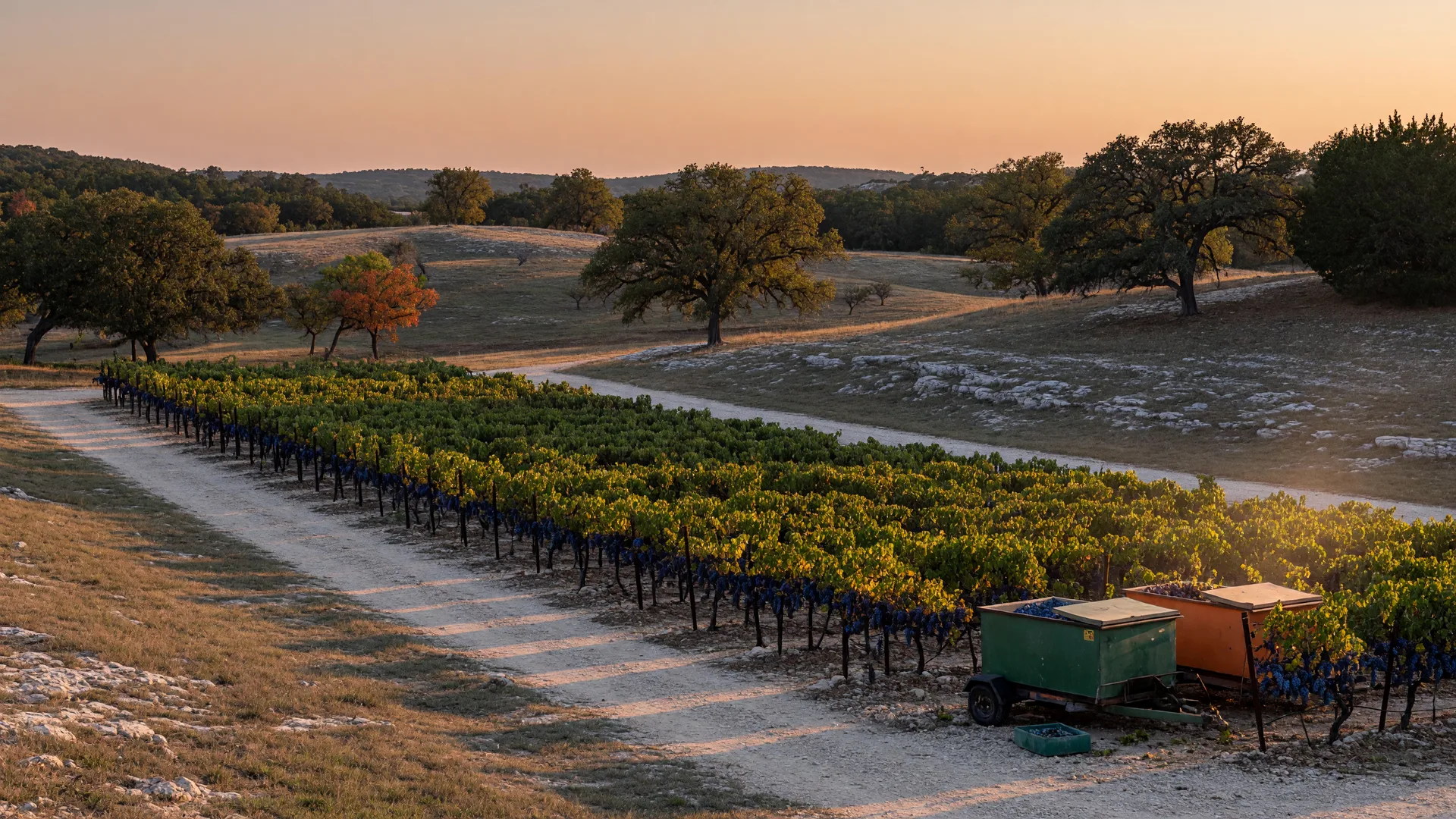
California buys the idea that wine means grapes ripening in cool maritime fog and being picked in October. Texas does not work on that clock. The Hill Country is hot, limestone-based, and far from the ocean, so its grapes ripen fast and its harvest lands months earlier: the first picks start in late July and the last reds come in during September. Understanding that calendar matters if you are moving here, because it drives when the tasting rooms are busy, when the festivals happen, and what the wines actually taste like.
This guide covers the real harvest window, the varieties that grow here and why, the scale of the region, the 2026 harvest events with their dates and prices, and the drive times from Boerne and Fair Oaks Ranch. If wine country is part of the lifestyle you are moving for, this is the season to see it at full strength.
When Harvest Happens: July Through September
The Texas Hill Country vintage typically runs July through September, and August is the busiest month. Early-ripening varieties, including Chardonnay, Tempranillo, and most whites, are picked from late July into early August. Reds such as Cabernet Sauvignon, Mourvèdre, and Tannat continue into September, which is where the region sits right now: the whites and early reds are in the tanks and the later reds are still on the vine.
The exact start shifts every year with the weather, not with a calendar. Heat is the main driver: warm summer temperatures ripen grapes faster and push sugar up, so a hot summer compresses the window and pulls picking earlier. A cool spring delays it. In 2019, a cool spring pushed the harvest weeks later than usual; in 2023, a hot summer accelerated it. Cold snaps, late freezes, and rain at picking time complicate the math. For a newcomer, the practical takeaway is that "harvest season" is a moving window roughly two months long, and September is when the tail end of the red vintage is happening.
| Window | What Is Being Picked |
|---|---|
| Late July to early August | Early whites (Chardonnay, Viognier), Tempranillo, early reds |
| August (peak) | The bulk of the crop; most harvest events fall here |
| September | Later reds: Cabernet Sauvignon, Mourvèdre, Tannat, other full-bodied reds |
The Grapes: A Mediterranean List, Not a Napa One
Because the Hill Country is hot, dry, and lime-rich, the varieties that thrive are the ones that evolved in hot Mediterranean climates, not the cool-weather grapes California is famous for. Tempranillo, Mourvèdre, Sangiovese, Syrah, and Viognier dominate the region's plantings, and the top whites are Roussanne, Marsanne, and Viognier. You will also find Aglianico, Alicante Bouschet, Barbera, Cabernet Franc, Cabernet Sauvignon, Carignane, Cinsault, Graciano, Grenache, Malbec, Montepulciano, Nero d'Avola, Tannat, Touriga Nacional, Vermentino, and Zinfandel across Hill Country vineyards.
The practical difference shows up in the glass. Texas reds are riper, higher in alcohol, and denser than their cool-climate counterparts, and the state's white wines in the Viognier and Roussanne style have developed a genuine reputation. If you walk into a Fredericksburg tasting room expecting the restrained, acid-driven style of Sonoma, you will be tasting against the wrong baseline. The reference points are Spanish and southern French reds and richer white grapes.
Texas is not a boutique afterthought, either. The state is the fifth-largest wine-producing state in the country, with roughly 400 to 500 wineries and about 9,300 acres of planted vineyards statewide, and the industry contributes an estimated $20.35 billion to the Texas economy. The Hill Country AVA, established in 1991, is one of the largest designated wine regions in the United States, and it contains the sub-AVAs Bell Mountain, Texas's first AVA from 1986, and the Fredericksburg in the Texas Hill Country AVA.
Harvest Events: Stomps, Festivals, and Crush Parties
Harvest season is when the region's wineries run their biggest events of the year, and many are within an easy drive of Boerne. The format varies: grape stomps, harvest festivals with grape picking, evening parties in the crush pad, and charity events. Most repeat annually with dates that shift by vintage, and all of them sell out or require tickets, so booking ahead matters.
| Event | Location | 2026 Dates | Cost |
|---|---|---|---|
| Lost Oak Cellars Harvest Fiesta and Grape Stomp | Boerne | August 1 | About $30, includes a commemorative tote |
| Texas Wine Collective "Sip, Stomp & Two-Step" | Fredericksburg | August 8 | About $85, includes BBQ dinner, music, and a shirt |
| Texas Hills Vineyard "I Love Lucy" Charity Grape Stomp | Johnson City | August 8-9 | Charity event with live music and costume contest |
| Messina Hof Hill Country Harvest Festival | US-290, Fredericksburg | August 21-22 | About $75; Moonlit Harvest Friday plus daytime grape picking and winemaking lessons |
| Becker Vineyards Annual Grape Stomp | Stonewall / Fredericksburg area | September 5-6 | Free, no reservation, first come first served |
| Coyote Canyon "Catch the Crush" Grape Stomp and Harvest Party | Comfort | October 9 | About $5 cover, $10 stomp fee per three-person team |
Dates and prices are the published 2026 events; most repeat annually with shifting dates, so confirm the current year on each winery's site before planning a visit.
What Harvest Season Feels Like for Residents
For people who live here, harvest is not a tourist interlude. It is the busiest stretch of the wine calendar, when tasting rooms run their biggest events, stock their latest releases, and fill up on Saturdays. The difference from California's peak is how the season behaves: Texas harvest peaks in late summer, when the region is also at its hottest, so the seasonal rhythm of wine country here is tied to August heat rather than October fog.
That timing has a second effect worth knowing. After the harvest events cool off in early autumn, October is the second visitor peak, driven by the post-harvest releases and the Fredericksburg Oktoberfest. The practical takeaway for a future resident: wine country is busy in spring wildflower season, in August at harvest, and again in October, and quiet and relaxed in winter. If you want the fullest expression of the local wine scene, plan a stretch of September and October.
The geography also keeps it close. From Boerne, the tasting rooms in town and along Sisterdale Road are the weeknight option; Comfort's wineries sit 17 to 20 minutes northwest on I-10 West; and downtown Fredericksburg, with more than 40 tasting rooms within walking distance of Main Street, is about 39 miles in around 42 to 45 minutes on US-87. The rest of the 290 corridor from Fredericksburg to Johnson City lines the drive with estate wineries.
Drive Times from Boerne and Fair Oaks Ranch
Wine country is genuinely local here, which is one of the reasons Texas buyers factor it into a relocation decision. The drive times below are typical under normal traffic and match the routes residents actually use.
| From Boerne To | Distance | Typical Drive |
|---|---|---|
| Comfort (Sisterdale Road wineries) | About 15 to 20 miles | 17 to 20 minutes via I-10 West |
| Downtown Fredericksburg | About 39 miles | 42 to 45 minutes via US-87 |
| Stonewall / Hye (290 corridor) | About 35 to 50 miles | 40 to 55 minutes |
| Johnson City | About 50 miles | 45 to 55 minutes |
| Austin (via US-281) | About 55 to 60 miles | 60 to 75 minutes depending on traffic |
How This Compares to What Californians Are Used To
For California relocators, the biggest adjustment is not whether the wine is good. It is the timing and the cost structure. In Napa and Sonoma, harvest runs August through October in cool evenings, and tasting fees commonly run $40 to $60 per person with mandatory reservations. In Texas, the vintage finishes a month or more earlier, tasting flights run about $20 to $45 per person, and most tasting rooms on the 290 corridor take walk-ins on weekdays, with reservations mainly needed on Saturdays and holidays or for groups of six or more.
The character of the wine differs on purpose. If you arrive expecting California-style restraint, the first bottle may read as big and ripe. Give it a second tasting with the Mediterranean frame in mind, and the region's Tempranillo, Mourvèdre, and Viognier make sense as the local answer to a hot, dry climate. Nearly every newcomer I have worked with finds a style they like somewhere on the 290 corridor or in the Comfort and Sisterdale pocket.
"California picks in October fog; Texas picks in August heat. That one fact explains the grape varieties, the tasting room calendar, and the style of wine in the glass. Plan a September or October visit and you will see the region's wine country at its liveliest."
The structural difference every California transplant should know
The Bottom Line for Relocators
Harvest season is the best reason to see Hill Country wine country at full strength, and September is exactly the right month to do it: the red crush is finishing, the harvest-event calendar has recent dates to study for next year, and the quieter post-harvest window is close behind. For a family evaluating a move, a September weekend that layers a Comfort tasting, a Fredericksburg stroll, and dinner in Boerne is both an excellent test drive of the lifestyle and a realistic picture of what residents do on an ordinary weekend.
Related reading: the wine tasting costs, reservations, and routes guide has the 2026 pricing and the three driving loops from Boerne; the wineries hub catalogs the tasting rooms by area; the wineries overview covers the AVA and the notable producers; and the fall in the Hill Country guide connects the wine calendar to the rest of the season. If you want to time a visit or a move around the wine country calendar, start a conversation and I will walk you through the timing.
Sources
- Harvest timing, July through September with August the peak, and heat-driven shifts in the vintage: Texas Hill Country AVA harvest reports and regional wine press. texaswinetrail.com; txwinelover.com
- Grape varieties grown in the Texas Hill Country AVA: Texas Hill Country AVA references. en.wikipedia.org
- Texas Hill Country AVA size and sub-AVAs (Bell Mountain, Fredericksburg): Alcohol and Tobacco Tax and Trade Bureau and Texas wine industry associations. txwines.org; texaswinetrail.com
- Texas statewide scale: fifth-largest wine-producing state, roughly 400 to 500 wineries, about 9,300 acres of vines, $20.35 billion economic impact: Texas Department of Agriculture, Texas A&M AgriLife crush report, and WineAmerica economic impact study. txwines.org; wineamerica.org
- Harvest event dates, locations, and pricing: Texas Wine Lover grape-stomping roundups and winery announcements. txwinelover.com; messinahof.com; coyotecanyonwinery.com
- Tasting flight pricing, reservation norms, and drive times: the Hill Country wine tasting guide on this site. movetotexas.net/blog/hill-country-wine-tasting-guide/
Last reviewed: September 2026. Harvest dates and event pricing shift by vintage and year; confirm current dates directly with each winery before planning a visit.