
Last updated: August 17, 2026.
If you are coming from coastal California, a backyard pool probably means one thing: a feature that makes your home feel like a resort for five months of the year and sits unused the other seven. You pay for the chemicals and the occasional pump repair, but the seasonal cost is manageable because the season is short [11].
Texas changes that equation completely. In the Hill Country, a pool is not a seasonal amenity. It is an eight-month (sometimes year-round) daily use feature, from late March through early November. It is where your family gathers on June afternoons when the temperature passes 100 degrees. It is the center of every summer weekend. But the costs are also not what you expect from a California perspective: higher electricity bills from longer pump runs, steeper chemical demands from hard Hill Country water, a property tax reassessment that catches many newcomers off guard, and a set of fencing and safety requirements that differ from California's strict two-barrier rule [7][9].
This article breaks down the full cost picture for a Texas pool: construction, monthly operation, maintenance, insurance, property tax impacts, and the less obvious expenses that California transplants tend to underestimate. If you are evaluating a home in Boerne, Fair Oaks Ranch, or San Antonio and wondering whether the pool you always wanted makes financial sense, here is the data you need to decide.
Construction Costs: What You Pay to Put the Water In
Pool construction in the Hill Country runs from roughly $35,000 to well over $150,000 depending on the type, size, features, and site-specific conditions. The three pool types available here are the same ones available in California, but the pricing dynamics shift because of local labor rates, material availability, and the rocky limestone soil that characterizes most Hill Country lots [1][2][3].
Pool Type Comparison: Texas Hill Country
| Type | Cost Range | Lifespan |
|---|---|---|
| Gunite (concrete) | $50,000 - $100,000+ | 20 - 30+ years |
| Fiberglass | $55,000 - $85,000 | 25 - 40+ years |
| Vinyl Liner | $35,000 - $60,000 | 15 - 25 years |
Sources: TexasUpdates 2026 [1], Texas Pools 2026 [2], Copano Pools 2026 [3]. All estimates include excavation, shell/structure, basic equipment (pump, filter, heater), and startup chemicals but exclude fencing, landscaping, hardscaping, and permit fees unless noted.
The Hill Country Site Premium
One cost factor that California buyers frequently miss is the limestone rock common to Hill Country building sites. Excavation through limestone adds $3,000 to $10,000 to a pool project compared to digging through soil. Some lots require rock sawing or blasting, which can push excavation costs to $8,000-$15,000 by themselves [2]. If you are looking at acreage properties in Fair Oaks Ranch or the unincorporated areas of Kendall County, ask the builder about a soil test before pricing the project. The difference between a soil site and a rock site is more than a line item; it can determine whether a pool is feasible at all.
Additional Construction Costs
Beyond the pool itself, the following costs are often separate quotes:
- Permits: $255-$1,020 in San Antonio and similar in Kendall County [9]
- Pool fence barrier: $1,500-$4,000 depending on material (wrought iron, aluminum, mesh) and linear footage [7]
- Hardscaping (patio, decking, coping): $5,000-$20,000, with limestone or travertine being the most common Hill Country choices
- Landscaping (grading, grass, plants, trees after construction): $2,000-$10,000
- Salt chlorine generator (upgrade): $1,500-$2,500 installed
- Solar cover and reel: $500-$1,500 (highly recommended for both heat retention and evaporation control)
- Automatic pool cover (safety cover): $6,000-$12,000
Total First-Year Cash Outlay
A typical mid-range gunite pool in the Hill Country (14x28 feet, 3.5-6 foot depth, with basic features) costs $85,000-$100,000 for the pool itself, plus $8,000-$18,000 for permits, fencing, and basic landscaping, before any property-tax effects. Total cost before property-tax effects: roughly $93,000-$118,000. A qualifying new improvement can increase the property's appraised value, but Texas property is generally valued as of January 1; the timing and amount of any increase should be confirmed with the appraisal district. And that is before you turn on the pump.
Annual Operating Costs: What It Costs to Keep the Water Blue
This is where the California-to-Texas difference hits hardest. In coastal California, you run the pump 4-6 hours a day for maybe 5 months and call it a year. In the Hill Country, you run the pump 8-12 hours a day for at least 8 months, and many homeowners keep it running year-round for water circulation in the mild winter months. The pump is not optional: without continuous circulation, algae blooms in 72 hours at 95-degree water temperature [4][6].
Estimated Annual Operating Costs (Texas Hill Country)
| Category | Annual Cost | Notes |
|---|---|---|
| Electricity (variable-speed pump, 8-12 hrs/day, 6 months/year) | $360 - $960 | Texas summer pump run times are long. A single-speed pump can double this number. |
| Pool heating (gas heater, 80 degrees target, April-October) | $600 - $2,400 | Highly variable. Solar covers reduce heating cost by 50-70%. Gas prices fluctuate. |
| Chemicals (chlorine, pH adjusters, algaecide, shock) | $600 - $1,500 | Salt systems reduce chemical costs but increase equipment expense. Inland Hill Country water is hard and requires more acid. |
| Water fill (evaporation + backwashing, 6 months) | $200 - $500 | Evaporation is significant in Hill Country summer heat. Well water may have mineral content issues. |
| Equipment repair/replacement reserve | $300 - $800 | Pumps last 8-12 years ($800-$2,000), heaters 5-10 years ($1,500-$3,500), filters 5-10 years ($400-$1,200). |
| Professional weekly service (optional) | $1,800 - $3,600 | Many California transplants who are used to shorter pool seasons find professional service worth the cost for the first year. |
Total annual operating cost (DIY chemicals, no heater): $1,460 - $3,760
Total with gas heating and professional service: $3,860 - $9,260
The single biggest variable is the heater. A gas pool heater burns through natural gas at an astonishing rate. Heating a 15,000-gallon pool from ground temperature (75 degrees in August, 55 degrees in April) to a comfortable 82-84 degrees can cost $100-$400 per month in gas alone. Many Texas pool owners skip the heater entirely and accept that the pool will be 82-86 degrees naturally from July through September. Others invest in a solar heating system ($3,000-$7,000 installed) to extend the shoulder months without recurring gas costs [4][6].
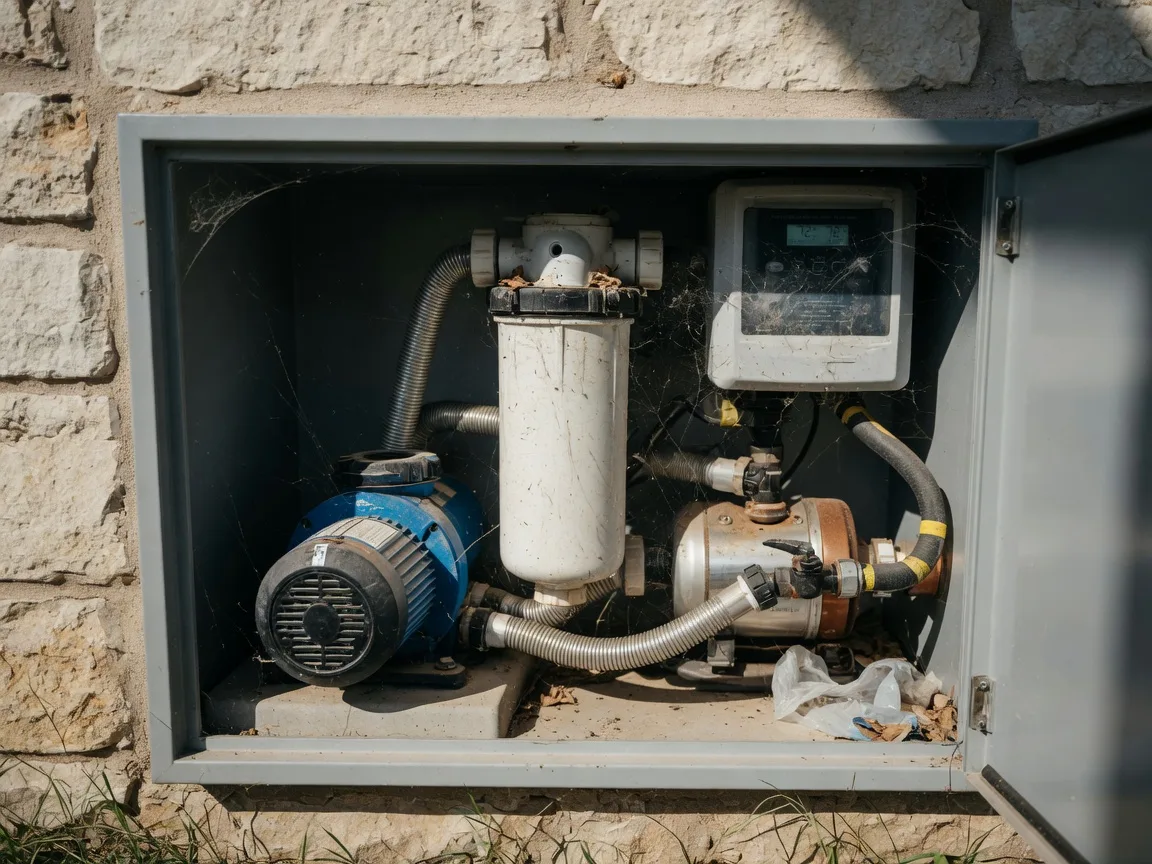
The equipment pad is the mechanical heart of every pool. A variable-speed pump (shown here) can cut electricity costs by 60-80% compared to older single-speed models. If you are buying a home with an existing pool, check whether the pump is variable-speed or single-speed before closing [6].
The Hidden Costs: Property Tax and Insurance
Property Tax Reassessment
In California, a newly constructed swimming pool generally constitutes assessable new construction. The assessor determines the market value added by the new improvement and establishes a new base-year value for that newly constructed portion; the pre-existing property's Proposition 13 base value is not generally reset merely because the pool was added. In Texas, a new in-ground pool can qualify as a new improvement and increase the property's market and appraised value. The amount is determined by the appraisal district's appraisal methodology and should not be assumed to equal the contractor's price or a fixed percentage of construction cost [10]. Texas Tax Code Section 23.01 generally requires taxable property to be appraised at its market value as of January 1, and the residence-homestead appraisal limitation separately allows the market value of qualifying new improvements to be added outside the ordinary 10 percent limitation; the timing and amount of any increase should be confirmed with the appraisal district.
If you are buying a home that already has a pool, the pool is already baked into the tax assessment, so there is no additional hit. But if you are adding a pool to an existing home, a valuation increase is a real cost to plan around: model it from the appraisal district's valuation of the completed improvement rather than from the contractor's price, and confirm the timing and amount with the appraisal district.
Homeowners Insurance
A pool will increase your homeowners insurance premium. Most carriers add $100-$300 per year for liability coverage. Texas does not require a specific pool liability policy, but most insurers will require a compliant safety barrier, and some require a signed liability waiver or an increased umbrella policy. The presence of a diving board or slide raises rates further and may trigger a requirement for deeper water (8+ feet in the diving area) [7].
If you are relocating from California, note that Texas umbrella policies (which cover pool-related liability above your homeowners limits) run approximately $350-$600 per year for $1 million in coverage, similar to California rates but with different underwriting requirements.
Does a Pool Add Resale Value in the Hill Country?
This is the question every buyer asks, and the answer is more nuanced than a simple yes or no.
In the Texas Hill Country, a well-designed, well-maintained pool is a positive for the majority of buyers in the $600,000+ price range. In the entry-level market ($350,000-$500,000), a pool is a neutral to slightly negative feature, as it adds maintenance cost that first-time buyers are often not prepared for. In the luxury market ($1 million+), not having a pool can actually be a disadvantage, as buyers expect the amenity at that price point [2].
The key variable is quality. A poorly designed pool -- odd shape, bad placement, cheap materials, or an awkward relationship to the house -- can actually reduce the pool of interested buyers. A well-executed pool that integrates naturally with the home, patio, and landscaping typically recovers 50-70% of its construction cost at resale. It will not pay for itself dollar for dollar, but it will make your home sell faster and potentially attract a higher-quality offer [2].
From a California perspective, the value equation is better in Texas because the usable season is longer. A pool that a San Diego buyer might value at $20,000 (for 5 months of use) is valued at $40,000-$50,000 by a Texas buyer (for 8 months of use) [11].
The Pool Math for a California Transplant
Total first-year cost for a mid-range gunite pool before property-tax effects: roughly $93,000-$118,000 (pool + fence + permits + landscaping). Annual operating cost: $1,460-$3,760 (DIY, no heat). Lifetime cost over 20 years (including resurfacing, equipment replacement, and property tax): $140,000-$180,000. Usable pool days per year in the Hill Country: 240+ versus 150 in coastal California. Cost per swim day over 20 years across 4,800 swim days: roughly $30-$38 per day. A California pool at those prices? The cost per swim day would be roughly $50-$65.
Safety and Regulations: How Texas Compares to California
California's pool safety requirements are among the strictest in the country. The California Pool Safety Act (HSC Section 115922) requires new and remodeled pools to have at least two of seven approved safety features, including a 60-inch barrier, exit alarms on doors, and pool covers meeting ASTM standards [11].
For a private single-family pool, Texas has no single statewide barrier statute. Texas Health and Safety Code Chapter 757 applies only to specified pools owned, controlled or maintained by a multiunit rental-complex owner or a property owners' association, together with specified rental-dwelling openings into those pool yards; it is not a universal private-single-family rule [8]. Municipal pool regulation is addressed through Texas Local Government Code Section 214.103 and locally adopted and enforced swimming-pool and spa codes, so the height, gate, and related barrier requirements for a given property depend on the exact address [13]. Texas does not mandate a statewide two-feature rule or statewide exit alarms the way California's Pool Safety Act does [11].
What this means for California transplants: you may feel that Texas regulations are insufficient from a safety perspective, especially if you have young children. There is nothing preventing you from exceeding state code. Many Hill Country homeowners voluntarily install door alarms, pool alarms, and safety covers that go beyond what Texas requires. The cost is modest ($200-$800 for alarms, $6,000-$12,000 for an automatic cover) and the additional peace of mind for families with small children is significant.
Pool Safety Requirements: California vs. Texas
| Requirement | California | Texas |
|---|---|---|
| Minimum fence height | 60 inches | Set by local code |
| Two-barrier rule | Required (2 of 7 approved features) | Not required |
| Door exit alarms | Required (one of 7 features) | Not required |
| Pool cover requirement | Approved as one of 7 features | Not required |
| Self-latching gate | Required | Required |
| Gate latch height | 54+ inches | 60 inches (on pool side) |
Sources: California HSC Section 115922 [11], Texas Local Government Code Section 214.103 [13]. Texas does not have a universal statewide barrier statute for private single-family pools. Texas Health and Safety Code Chapter 757 covers only specified pools owned, controlled or maintained by a multiunit rental-complex owner or a property owners' association, together with specified rental-dwelling openings into those pool yards. For a private pool, the applicable municipal swimming-pool and spa code, local amendments, deed restrictions, HOA rules, and insurer standards govern.
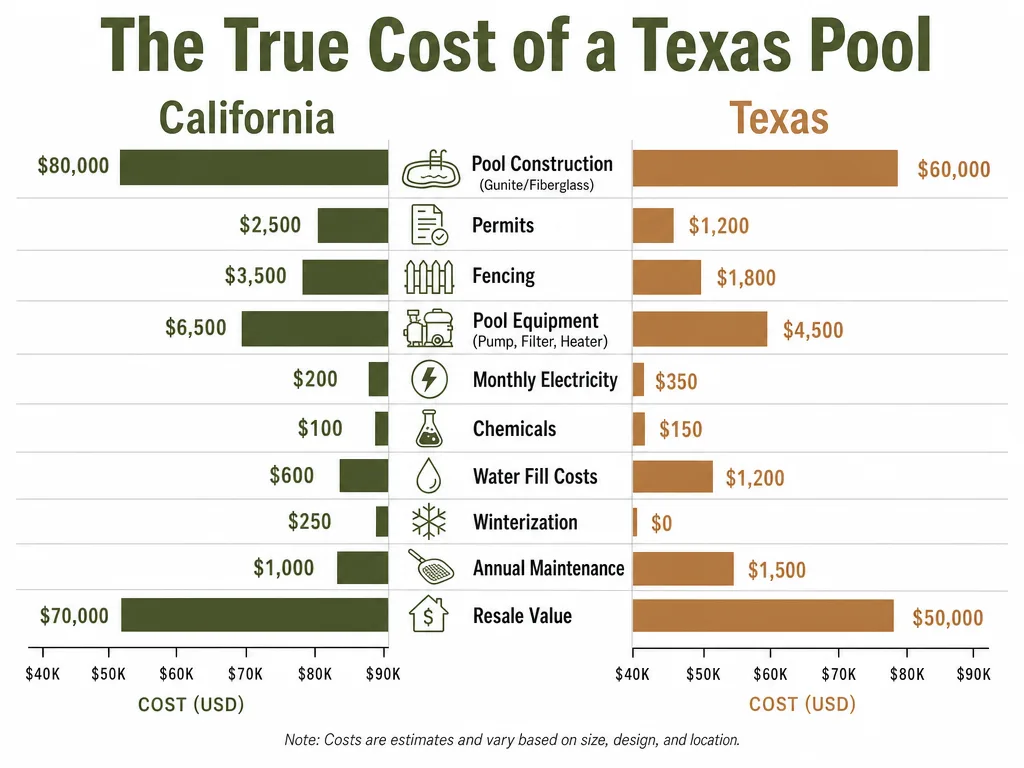
The full cost picture: construction, permits, fencing, equipment, chemicals, electricity, heating, water, professional maintenance, and resale value. The Texas numbers reflect Hill Country pricing, not statewide averages.
The Decision Framework: Should You Buy a Home With a Pool, Add One, or Skip It?
Based on what I see working with California buyers making this decision, here is a practical framework:
Buy a home with an existing pool
This is almost always the most cost-effective path. The pool is already in the tax assessment, already landscaped, already fenced, and already permitted. You see what you are getting. The key is the inspection: hire a licensed pool inspector (separate from your general home inspector) to evaluate the pump, heater, filter, plumbing, plaster/gel-coat condition, and safety barrier. A pool inspection costs $300-$500 and can save you $10,000 in unexpected repairs. Ask for maintenance records from the current owner. If they cannot produce them, assume deferred maintenance and adjust your offer accordingly [4].
Add a pool to an existing home
This path makes sense when you plan to stay in the home 7+ years. The financial breakeven for a $70,000 pool is roughly year 7-8 when you account for tax increases, operating costs, and the resale premium. If your horizon is shorter, you are better off buying a home that already has the pool. If your horizon is 10+ years, the pool pays for itself in quality-of-life value even if the resale math is neutral.
Skip the pool
A pool is not the right choice for every buyer. If you have very young children (under age 3), the safety concern may outweigh the lifestyle benefit. If you travel frequently during summer months, you will be paying for a pool you are not using. If you are on a fixed or tight budget, the annual operating cost ($1,500-$9,000) is a recurring expense that behaves more like a car payment than a utility bill. And if you are buying in the $350,000-$500,000 range, a home without a pool will be easier to sell when the time comes.
Frequently Asked Questions
These are the questions I hear most from California buyers evaluating whether a pool makes sense in the Hill Country.
I had a pool in California and barely used it 4 months of the year. Is a Texas pool really worth it?
The math changes because the usable season is dramatically longer. In coastal California, a heated pool might be comfortable May through September (5 months). In the Texas Hill Country, a heated pool is usable from late March through early November (8 months), and with a heater, year-round for hardy swimmers. That 60% longer season changes the cost-per-use calculation significantly. Many of my clients report using their Texas pool 2-3 times more often than their California pool. However, summer afternoons from late June through August are genuinely hot enough that swimming is the afternoon activity, not just an option.
Does adding a pool increase my property taxes in Texas?
It can. A new in-ground pool can qualify as a new improvement and increase the property's market and appraised value. The amount is determined by the appraisal district's appraisal methodology and should not be assumed to equal the contractor's price or a fixed percentage of construction cost. Texas Tax Code Section 23.01 generally requires taxable property to be appraised at its market value as of January 1, and the residence-homestead appraisal limitation separately allows the market value of qualifying new improvements to be added outside the ordinary 10 percent limitation; the timing and amount of any increase should be confirmed with the appraisal district for the exact address. The ongoing impact depends on the property's homestead status and exemptions and the combined tax rate at that address. This is one of the hidden costs many first-time Texas pool buyers miss, but the right way to plan for it is from the appraisal district's actual valuation, not a percentage-of-cost guess.
Can I use well water to fill my pool?
Yes, but with important caveats. Hill Country well water is typically hard (high calcium content), which can cause scale buildup on pool surfaces and equipment. Iron content is also common in the Edwards Aquifer region and can stain plaster. If you plan to fill from a well, test the water first and budget for a water softener or sequestering agents. Many pool builders in the Hill Country recommend having the pool filled via water delivery truck ($200-$400) for the initial fill to avoid introducing mineral problems from the start.
How long does pool construction actually take in the Hill Country?
This depends on the type. Fiberglass pools: 3-8 weeks from excavation to swim-ready. Gunite pools: 8-16 weeks, with most of that time being the curing process between gunite application and plaster. Vinyl liner: 4-10 weeks. The biggest variable is weather. Hill Country summers bring afternoon thunderstorms that can halt gunite work for days, and winter temperatures below 40 degrees stop plaster application. Most permits from San Antonio or Kendall County take about 3 weeks. The best time to start construction is early spring (March-April) to have the pool ready by June. If you sign a contract in June or July, you will likely be swimming the following spring.
Do I need a pool fence in Texas?
It depends on the jurisdiction, not on a single statewide rule. Texas Health and Safety Code Chapter 757 is not a universal private-single-family-pool statute: it applies only to specified pools owned, controlled or maintained by a multiunit rental-complex owner or a property owners' association, together with specified rental-dwelling openings into those pool yards. For a private single-family pool, the applicable municipal swimming-pool and spa code and any local amendments govern, as authorized under Texas Local Government Code Section 214.103, and deed restrictions, HOA requirements, and insurer standards can impose additional requirements. Confirm the barrier rules for the exact address before design or construction. Where a barrier is required, budget $1,500-$4,000 for a compliant pool fence, depending on material and linear footage. Many HOA communities in Fair Oaks Ranch and Boerne also have their own fencing requirements that may exceed the local code.
Make the Decision With Complete Information
A pool is one of the biggest single-expense decisions you will make after buying your home in Texas. The numbers in this article give you a starting point, but the real answer depends on your specific property, your budget, your timeline, and how your family actually lives.
If you are evaluating a home with a pool, want to know whether pool costs fit your relocation budget, or just want to talk through the tradeoffs with someone who has seen dozens of California families make this decision, I am happy to have that conversation. No pressure, no upsell, just the data and a practical plan.

Written by
Bill Ross
Hill Country Homesteads Group, brokered by KW Boerne
Bill Ross is a Texas real estate agent with nearly four decades in high-tech sales and a network of 1,100+ California real estate agents for coordinated cross-state transactions. Featured in national coverage discussing his family's relocation from Silicon Valley to the Texas Hill Country, Bill helps California families navigate every aspect of the move to the Hill Country.
Related Guides
The Texas Insurance Stack
How homeowners, flood, wind, hail, auto, and umbrella insurance work in Texas versus California.
Cost of Living Beyond Housing
Utilities, insurance, groceries, fuel, and dining costs compared between California and the Hill Country.
The Texas Heat Reality
What hot actually means when you are coming from coastal California, with adaptation strategies.
Hill Country Home Maintenance
A practical guide to what California transplants need to know about maintaining a Hill Country home.
Sources
- TexasUpdates.com --- Average Cost of a Pool in Texas (2026) -- Texas Updates, 2026. texasupdates.com/average-cost-of-a-pool-in-texas/
- Texas Pools --- How Much Does a Custom Gunite Pool Cost in Texas in 2026? -- Texas Pools, 2026. www.texaspools.com/how-much-does-a-custom-gunite-pool-cost-in-texas-in-2026/
- Copano Pools --- Fiberglass Pool Cost in San Antonio, New Braunfels & Seguin (2026) -- Copano Pools, 2026. copanopools.com/fiberglass-pool-cost-in-san-antonio-new-braunfels-seguin-2026-pricing-guide/
- BluePoolWater --- Pool Maintenance Cost in Texas (2026) -- BluePoolWater, 2026. bluepoolwater.com/blog/pool-maintenance-cost-in-texas/
- BluePoolWater --- Cost of Pool Cleaning Service in San Antonio (2026) -- BluePoolWater, 2026. bluepoolwater.com/blog/cost-of-pool-cleaning-service-san-antonio/
- River Pools --- Monthly Electrical Costs to Run a Swimming Pool -- River Pools, 2026. www.riverpoolsandspas.com/blog/monthly-electrical-costs-to-run-swimming-pool
- FenceMyPool --- Texas Pool Fence Requirements & Laws (2026) -- FenceMyPool, 2026. fencemypool.com/state-requirements/texas/
- Texas Health and Safety Code Section 757.004 --- Pool Yard Enclosure Gates -- Texas Public Law. texas.public.law/statutes/tex._health_and_safety_code_section_757.004
- PermitMint --- Pool & Hot Tub Permit in San Antonio, TX (2026) -- PermitMint, 2026. permitmint.com/permits/texas/san-antonio/pool/
- Kendall County Appraisal District --- Residential Property Tax Rates -- KCAD. www.kendallcad.org/
- California Health and Safety Code Section 115922 --- Pool Safety Act -- California Legislative Information. leginfo.legislature.ca.gov/faces/codes_displaySection.xhtml?lawCode=HSC§ionNum=115922
- IRS --- Section 1031 Like-Kind Exchanges (investment property reference) -- IRS. www.irs.gov/businesses/small-businesses-self-employed/like-kind-exchanges-real-estate
- Texas Local Government Code Section 214.103 --- Municipal Swimming Pool and Spa Code -- Texas Local Government Code, Section 214.103 (Subchapter C, Swimming Pools and Spas): adopts the International Swimming Pool and Spa Code as the municipal swimming pool and spa code, allows municipalities to adopt local amendments, and prohibits pool and spa ordinances less stringent than the adopted code. statutes.capitol.texas.gov/Docs/LG/htm/LG.214.htm
Last reviewed: August 17, 2026. Costs and regulations reflect current market data as of the date of publication. Pool construction costs vary by contractor, site conditions, and material selection. Verify all costs with licensed local contractors.