
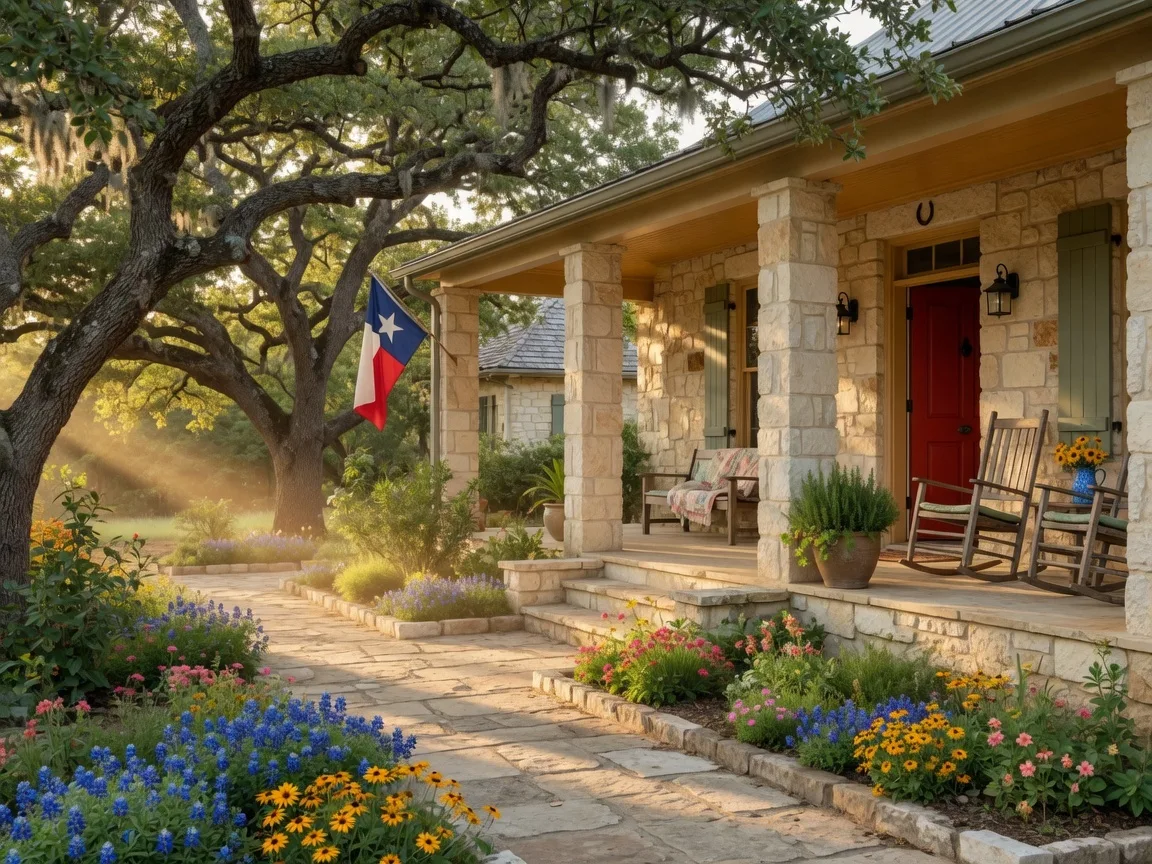
Moving from California to the Texas Hill Country means trading the Mission burrito for a plate of enchiladas and learning to plan a week around a 45-minute drive. This is a practical guide to that adjustment: how Tex-Mex really differs from the Cal-Mex you left behind, where the serious barbecue lives near Boerne, what the 45-minute drive does to your calendar, and why the grocery bill is usually the first pleasant surprise. The short version is that you will eat better than you expect and drive farther than you expect, and both turn out to be more of an upgrade than a sacrifice.
I have walked dozens of California families through this exact transition, and the food and distance questions come up in the very first conversation, almost without fail. The questions are practical: will I find anything close to what I eat now, and how far will I have to drive for a good dinner? Both deserve honest, specific answers, not the usual "everything is bigger in Texas" boosterism. This article is the honest version, built on real cuisines, real restaurants, and real drive times.
The tone here is the one I use with my own clients: direct, practical, and honest about tradeoffs. The food you leave behind is genuinely good, and pretending otherwise does not help anyone. The food you are moving toward is also genuinely good, and the quicker you treat the difference as discovery rather than downgrade, the faster the Hill Country starts to feel like home.
The Two Mexican Foods Nobody Warns You About
Most California transplants assume the Mexican food in Texas is simply a regional version of the same cuisine. It is not. Tex-Mex is its own tradition, born in San Antonio and built on a completely different set of ingredients than the California style you grew up with. The lineage matters: chili con carne, the first iconic Tex-Mex dish, was popularized in the 1880s by the "chili queens" who served it from the plazas of San Antonio [2]. The name itself began as shorthand for the Texas Mexican Railway in 1875, traveled through Tejano cooking, and entered the food vocabulary for good in the 1960s and 1970s, after Diana Kennedy's 1972 cookbook drew a firm line between authentic Mexican cuisine and Texas "mixed plates" [1][2].
The defining traits follow from that history. Tex-Mex leans on yellow American cheese, cumin, and chili powder, on beef and pork, on refried pinto beans and flour tortillas, and on deep-fried corn tortillas in the form of the crispy taco and the nacho [1][3]. The plates are smothered and substantial, and the flavor profile is warm, earthy, and spice-forward rather than bright and fresh.
Cal-Mex, the style you know from California, went a different direction. Its signature invention is the Mission burrito, the big foil-wrapped flour tortilla stuffed with rice, beans, meat, and salsa that took shape in San Francisco's Mission District in the 1960s (El Faro claims September 26, 1961; Taqueria La Cumbre claims 1969) [4]. It is lighter and produce-forward, built on the abundant California pantry: avocado, tomato, cabbage, lime, cilantro, black beans, and often fish and seafood [3][4]. The California burrito, with carne asada, cheese, and French fries, came later in San Diego in the 1980s [3][4].
The practical takeaway is simple. If you want a Mission burrito or a Baja fish taco the way you had them in California, the honest answer is that you will not find an identical one in Boerne or Fair Oaks Ranch. What you will find is excellent Tex-Mex, done with pride and consistency. The two cuisines are cousins, not competitors, and most transplants end up loyal to both: Tex-Mex for Thursday night comfort, and a planned trip to a good taqueria in San Antonio when the craving for the old style hits.
Tex-Mex vs Cal-Mex, Side by Side
Here is the comparison table I walk clients through, because it settles most of the confusion in one glance. It is adapted from published breakdowns of the two cuisines [1][3].
| Element | Tex-Mex (what you will find) | Cal-Mex (what you left) |
|---|---|---|
| Cheese | Yellow American cheese and cheddar, melted over the plate [1] | Fresh cotija and lighter applications; less is more [3] |
| Tortilla | Flour tortillas and crispy deep-fried corn shells [1] | Big soft flour tortillas, plus corn for street-style tacos [3] |
| The signature dish | Enchilada plates, chili con carne, nachos, crispy tacos [1][2] | The Mission burrito, the California burrito, fish tacos [3][4] |
| The flavor | Cumin, chili powder, beef, warm and earthy [1][3] | Avocado, lime, cilantro, bright and produce-forward [3] |
| The style | Smothered, cheesy, substantial mixed plates | Hand-held burritos and tacos, lighter and quicker |
In Boerne, you can test this difference immediately. Las Guitarras Cocina Mexicana on South Main is a solid introduction to the local style [13], and Mary's Tacos is a local favorite for breakfast tacos done the Texas way [14]. For tamales and barbacoa, Tellez Tamales & Barbacoa, family-owned since 1975, is the classic stop along the Bandera Road corridor in northwest San Antonio near Helotes, serving handmade tamales, barbacoa, menudo, and fresh tortillas from early morning until early afternoon (locations at 6501 Bandera Road in Leon Valley and 1802 Bandera Road; closed Mondays and Tuesdays). The Dining in Boerne guide covers the full local scene, and the San Antonio dining guide is worth a bookmark for the nights you want more variety.
Where the Serious Barbecue Lives
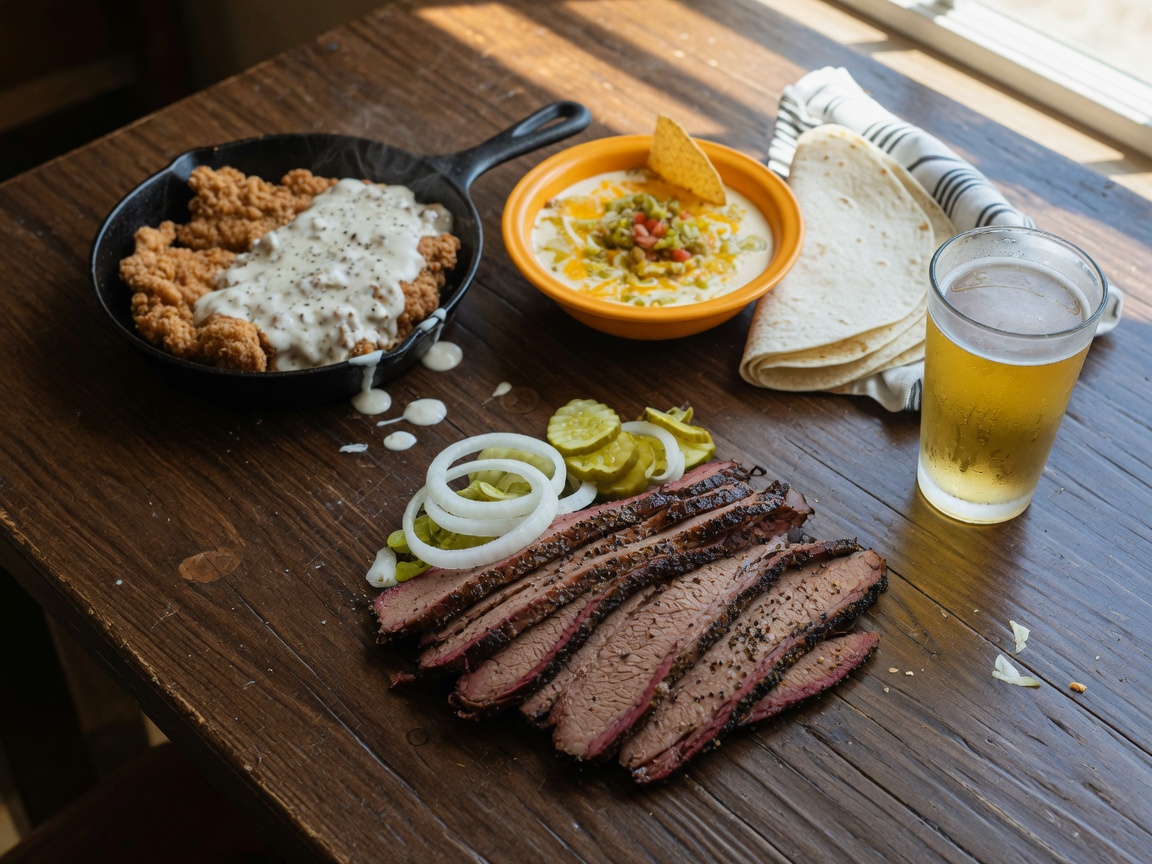
If Tex-Mex is the everyday food, barbecue is the religion. The style you will find in Boerne and San Antonio is Central Texas barbecue, and it is a specific thing: whole-packer beef brisket seasoned simply with coarse salt and black pepper, smoked low and slow over post oak for 12 to 18 hours, with sauce served on the side rather than slathered on [5][6]. The result is beef-forward, meat-first cooking where the bark and the smoke ring do the talking. It is a genuinely different tradition from the Santa Maria tri-tip or the grilled meats many Californians are used to, and it is one of the great pleasures of living here [5].
You do not have to drive far for it. Boerne itself has a real smokehouse scene: Klein Smokehaus on North Main, Fritze's BBQ also on North Main, Smoke in the Hills BBQ on Walnut Grove, plus Pure Country BBQ and a few more, all within minutes of downtown [10][11][12]. When you want the destination experience, San Antonio holds the anchors. 2M Smokehouse serves USDA Prime brisket at $38 a pound, smoked up to 16 hours over post oak, and has earned both a Michelin Guide honoree nod and a James Beard semifinalist mention [7][9]. Pinkerton's in downtown San Antonio sells Prime brisket at $35 a pound and is one of the most consistent cooks in the city [8]. Texas Monthly's San Antonio roundup is the best single reference for the full list [9].
For the true pilgrim's drive, Burnt Bean Co. in Seguin, about an hour away, has been ranked the number one barbecue in Texas by Texas Monthly [9]. It is a real trip, the kind you plan for a Saturday, and it is a perfect example of the 45-minute-drive mindset: in California you would call an hour a day trip, and here it is just a good excuse to leave after breakfast.
The 45-Minute Drive, in Minutes
The geography adjustment is the second half of this article's title, and it is just as real as the food. In the Hill Country, your everyday errands are close: the grocery store, the hardware store, and the school are usually 10 to 15 minutes from a Boerne-area home. The dinner out, the airport, and the bigger experiences live 30 to 45 minutes away, and that distance is considered completely normal [19]. Here are the real numbers, in normal traffic:
| Destination from Boerne | Distance | Drive Time |
|---|---|---|
| Downtown San Antonio | ~31 miles [15] | 30 to 40 minutes [15][19] |
| San Antonio International Airport (SAT) | ~29 miles [16] | 30 to 40 minutes; 40 to 50 at peak [16] |
| Fredericksburg | ~39 miles [17] | 40 to 45 minutes [17] |
| Austin | ~84 to 97 miles [18] | 1 hour 30 min to 1 hour 45 min [18] |
The adjustment is not that everything is farther in absolute terms. It is that a 30-minute drive, which reads as a major expedition in the Bay Area or coastal LA, is simply the default radius here [19]. People batch the trip: the feed store, the H-E-B, the post office, and lunch all happen on one loop. By the end of the first month, most transplants have learned this instinctively, because the alternative is four separate 15-minute drives. Our commute and drive-times guide covers the daily routes in detail, including the I-10 and Loop 1604 rebuild status.
There is also an upside that nobody warns you about. The drive itself becomes part of the experience. The back roads through the Hill Country, with the live oaks, the limestone, and the wide sky, are genuinely beautiful, and a 40-minute drive to Fredericksburg for dinner is less a chore than a small outing. The first-week field guide describes how this shift in the sense of distance lands on day one, and it is one of the adjustments that most transplants end up loving.
The Grocery Difference: H-E-B
The single most pleasant surprise of the food adjustment, in my experience, is the grocery store. H-E-B is a Texas institution. It began in 1905 in Kerrville, a short drive from Boerne, and now runs more than 400 stores entirely in Texas and Mexico [21]. It has been ranked the number one grocery store in the United States by the Dunnhumby Retailer Preference Index for four straight years, ahead of Trader Joe's, Walmart, Amazon, and Costco [22]. In San Antonio, its home market, H-E-B held 50.3 percent of the grocery market in 2024, up from 47 percent two years earlier [20].
What this means in practice is that the store closest to your new home is likely the best grocery store in the country, and the prices are lower than you are used to. California is the most expensive state for groceries in the nation, and published comparisons put Texas groceries roughly 22 to 29 percent cheaper overall [23]. The fresh tortillas, the salsa bar, the house brands, and the butcher case all tend to convert even the most skeptical transplant within a month.
The adjustment is logistical as much as culinary. In California, many households shop daily or near-daily, because the stores are close and the trips are small. In the Hill Country, the weekly H-E-B run becomes a small ritual, a bigger cart, a cooler for the drive home in summer, and a familiar checkout line where the cashier learns your name. It is the kind of thing that sounds mundane and turns out to matter more than almost anything else in the first year.
How Long the Adjustment Takes
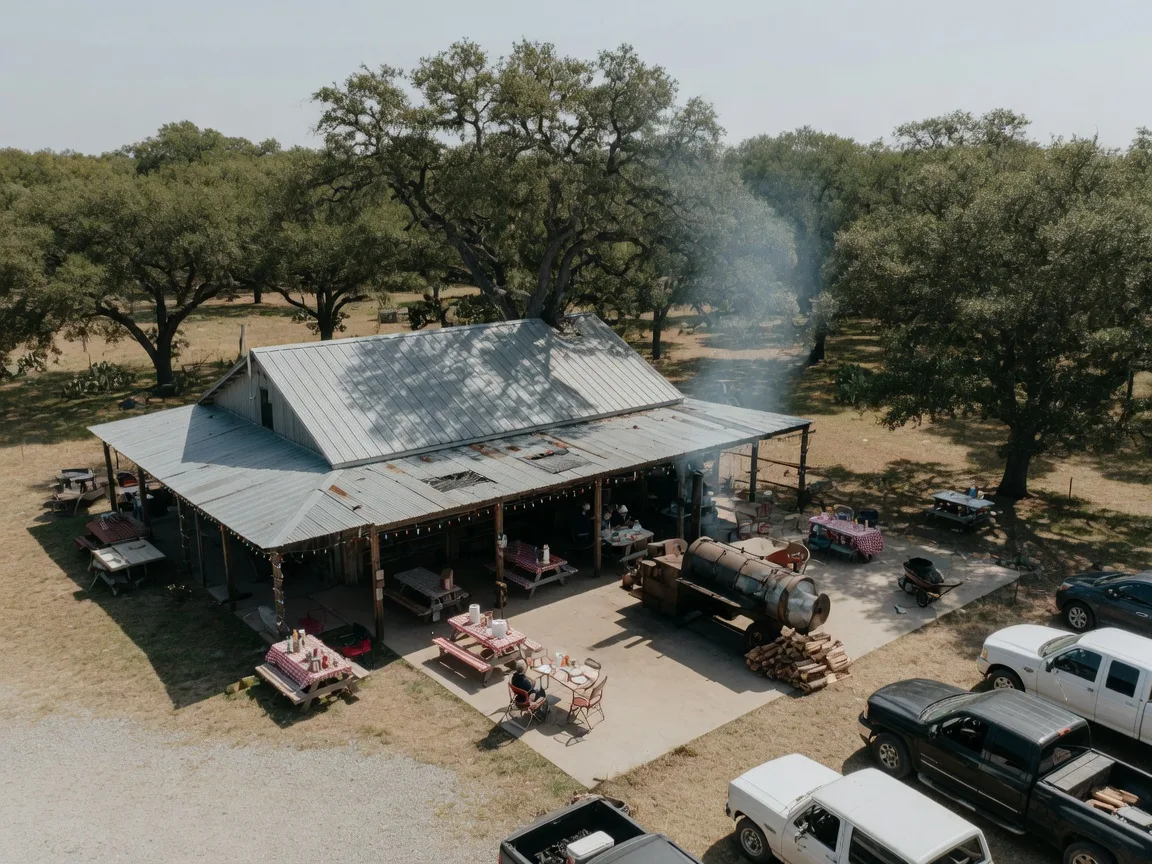
Most California transplants report that the culinary and geographic adjustment runs three to six months. The first month is the hardest, because the comparison reflex is strongest: every plate of Tex-Mex is measured against the taqueria you left, and every 30-minute drive is measured against the five-minute errand run you used to take. By month three, the new defaults start to feel normal. By month six, the weekly H-E-B run and the 45-minute drive to a good dinner are simply how life works.
Four habits separate the families who adjust fastest. They give Tex-Mex three or four real tries before passing judgment. They learn to batch errands into loops instead of treating each trip as a discrete event. They plan one standing San Antonio night out a month, both for the dining variety and for the practice of the drive. And they make peace with the fact that they will cook more at home, because the density of takeout options is simply not what it was in the Bay Area or LA.
The craving for California food is real, and the honest answer is that it does not fully go away. It gets managed. Most of my clients report that a trip back to California, timed partly around restaurants, becomes a small tradition, and that the foods they miss most are the ones they now make at home better than they ever did before. For the broader settling-in picture, the guide to making friends in Texas, the month-by-month social calendar, and what Californians miss most after moving are the natural companions to this article.
Planning the Move? Start With the Honest Version.
Every California-to-Texas move involves a food and geography adjustment that nobody fully prepares you for. Knowing what the cuisines actually are, where the good food lives, and how far you will really drive makes the difference between a frustrating first six months and a smooth one.
If you are evaluating a move from California to the Hill Country, I am happy to walk you through what the transition looks like in practice, not the brochure version, but the version based on real experience with real families. I can tell you which Boerne restaurants are worth the visit, how the drive times actually feel, and how to set up your first month so the food and distance adjustments do not slow you down.
For the dining side of the adjustment, see the Dining in Boerne guide and the Hill Country dining guide. For the wine side of the table, the Hill Country wine comparison is a good place to start. And for the broader cost picture, the cost of living beyond housing guide covers utilities, insurance, and fuel alongside the grocery line.

Written by
Bill Ross
Hill Country Homesteads Group, brokered by KW Boerne
Bill Ross is the founder of Hill Country Homesteads Group, a Texas real estate practice serving Boerne, Fair Oaks Ranch, San Antonio, and the surrounding Hill Country. Drawing on nearly four decades in high-tech sales and a network of over 1,000 California real estate agents, he coordinates cross-state relocations for coast-to-coast clients. He has been recognized in USA Today and The Washington Post for his relocation expertise.
Related Guides
Dining in Boerne: A California Transplant's Guide
Local restaurants with addresses and price ranges, from breakfast tacos to steak nights, plus the farmers market rhythm.
The San Antonio Restaurant Scene
Where to eat in San Antonio when you want variety, depth, and the cuisines the Hill Country does not have yet.
The Boerne to San Antonio Commute
Real drive times, routes, and the 2026 I-10 and Loop 1604 rebuild, for the 45-minute drive you will make weekly.
The Texas Driveway Moment: A First-Week Field Guide
What Californians notice in their first week in the Hill Country: the space, the distance, the services, and the people.
Frequently Asked Questions
These are the food and distance questions I hear most from California buyers evaluating the Hill Country. The cravings are predictable, the drive times are verifiable, and the adjustment is manageable.
Is Tex-Mex just a worse version of the Mexican food I am used to in California?
No, and treating it that way is the fastest way to make the first year harder. Tex-Mex is its own proud regional cuisine with roots in San Antonio, built on beef, cumin, chili powder, refried beans, flour tortillas, and yellow cheese [1][2]. Cal-Mex, the style you know from California, is lighter and produce-forward, built around the Mission burrito and fresh fish tacos [3][4]. They are cousins, not competitors. Give Tex-Mex at least three or four real tries before you judge it, and most transplants end up loyal to both, one for comfort and one for when they visit California.
Can I find good barbecue close to Boerne, or do I have to drive to San Antonio?
You do not have to drive to San Antonio for good barbecue, though San Antonio has the famous anchors. Boerne itself has a real smokehouse scene: Klein Smokehaus on Main Street, Fritze's BBQ, Smoke in the Hills BBQ, and a few more, all within a short drive of downtown [10][11][12]. When you want the destination experience, 2M Smokehouse (USDA Prime brisket at $38 a pound, a Michelin honoree) and Pinkerton's in downtown San Antonio are the standard answers [7][8]. The point is you are never far from a serious brisket, which is not something you could say about most of California.
Is everything really a 45-minute drive in the Texas Hill Country?
Not everything, but the rhythm is real. Your everyday errands, the grocery store, the hardware store, the kids' school, are usually 10 to 15 minutes from a Boerne-area home. A sit-down dinner in San Antonio or a trip to the airport runs 30 to 40 minutes, and a drive to Fredericksburg is about 40 to 45 minutes [15][16][17]. The difference from California is not that everything is farther. It is that a 30-minute drive, which reads as a major expedition in the Bay Area or LA, is simply normal here [19]. Most transplants adjust within a few months and learn to batch errands, which is the real skill.
Will my grocery bill actually go down after moving to Texas?
For most households, yes, and it is usually the first pleasant surprise of the move. California is the most expensive state for groceries in the country, and published comparisons put Texas groceries roughly 22 to 29 percent cheaper overall [23]. On top of that, you will do most of your shopping at H-E-B, the regional chain that has been ranked the number one grocery store in the United States for four straight years and dominates the San Antonio market [20][22]. The fresh tortillas alone tend to win over even the most skeptical transplant.
How do I handle the craving for California-style food after I move?
Plan for it instead of pretending it will not happen. The foods California transplants report missing most are the seafood, the authentic regional Mexican, the Korean and Asian options, and the density of the restaurant scene back home. The practical answers are to learn to make your favorites at home, to take the occasional drive to San Antonio where the dining variety is genuinely deep, and to time a trip back to California partly around restaurants. Nobody expects you to abandon your palate overnight. The goal is to add Tex-Mex, BBQ, and Gulf seafood to it, not to replace what you love.
Sources
- Tex-Mex: history, defining traits, and the 1963 New York Times usage: Wikipedia, “Tex-Mex”. en.wikipedia.org/wiki/Tex-Mex
- Tracing the history of Tex-Mex, from the chili queens of San Antonio onward: History.com. www.history.com/articles/tracing-the-history-of-tex-mex
- What separates Cal-Mex from Tex-Mex cuisine: Chowhound (2025). www.chowhound.com/1733282/cal-mex-vs-tex-mex/
- A brief history of San Francisco's Mission-style burritos: Food Republic. www.foodrepublic.com/1295598/history-of-mission-style-burritos/
- Barbecue in Texas: the regional styles explained: Wikipedia, “Barbecue in Texas”. en.wikipedia.org/wiki/Barbecue_in_Texas
- Central Texas style smoked brisket: salt-and-pepper rub, post oak, low and slow: Crossbuck BBQ. www.crossbuckbbq.com/central-texas-style-smoked-brisket.html
- 2M Smokehouse menu: USDA Prime brisket, post oak, up to 16 hours: 2M Smokehouse. www.2msmokehousesatx.com/menu
- Pinkerton's Barbecue San Antonio menu: Pinkerton's Barbecue. pinkertonsbbq.com/san-antonio
- Where to eat barbecue in San Antonio, including the Texas Monthly rankings: Texas Monthly. www.texasmonthly.com/bbq/where-eat-barbecue-san-antonio/
- Klein Smokehaus, Boerne: Klein Smokehaus. kleinsmokehaus.com/
- Fritze's BBQ, Boerne: Fritze's BBQ. fritzestx.com/
- Smoke in the Hills BBQ, Boerne: Smoke in the Hills BBQ. smokeinthehillsbbq.com/
- Las Guitarras Cocina Mexicana, Boerne: Las Guitarras Cocina Mexicana. lasguitarrascocinamexicana.com/
- Mary's Tacos, Boerne: Mary's Tacos. marystacosinboerne.com/
- Boerne to San Antonio driving distance and time: TravelMath. www.travelmath.com/drive-distance/from/Boerne,+TX/to/San+Antonio,+TX
- San Antonio International Airport distances and travel times: MM Transfers. www.mmtransfers.com/post/san-antonio-airport-distances-travel-times
- Boerne to Fredericksburg driving distance and time: TravelMath. www.travelmath.com/drive-distance/from/Boerne,+TX/to/Fredericksburg,+TX
- Boerne to Austin driving time: TravelMath. www.travelmath.com/driving-time/from/Boerne,+TX/to/Austin,+TX
- Everything to know about Boerne, Texas: distances and daily life: MySA, City Guide. www.mysanantonio.com/news/hill-country/article/boerne-texas-city-guide-20804882.php
- H-E-B grows its grocery market share in San Antonio to 50.3 percent: Axios San Antonio (April 2025). www.axios.com/local/san-antonio/2025/04/24/heb-san-antonio-texas-grows-market-share
- Here's what to know about H-E-B, the top grocery store in Texas: Houston Chronicle (2024). www.houstonchronicle.com/business/article/heb-what-to-know-19380080.php
- Texas grocer H-E-B bags No. 1 ranking as best supermarket in the US: CultureMap Dallas (2026). dallas.culturemap.com/news/restaurants-bars/best-grocery-stores-heb-no1/
- Cost of living: California vs Texas, including grocery costs: MyLifeElsewhere. www.mylifeelsewhere.com/cost-of-living/california-usa/texas-usa
Last reviewed: October 2026. Drive times reflect published distance sources in normal traffic and vary by route, time of day, and construction. Menu prices are published by-the-pound figures at the time of writing and may change. Restaurant availability changes; verify hours and menu details directly before you visit.