
When California buyers evaluate a move to the Texas Hill Country, they research school districts, property taxes, and commute times. Those are the right questions. But the question that often surfaces later: after the home is purchased and the family has settled in: is about culture. What is there to do? What history does this place have? What kind of community life will my family step into?
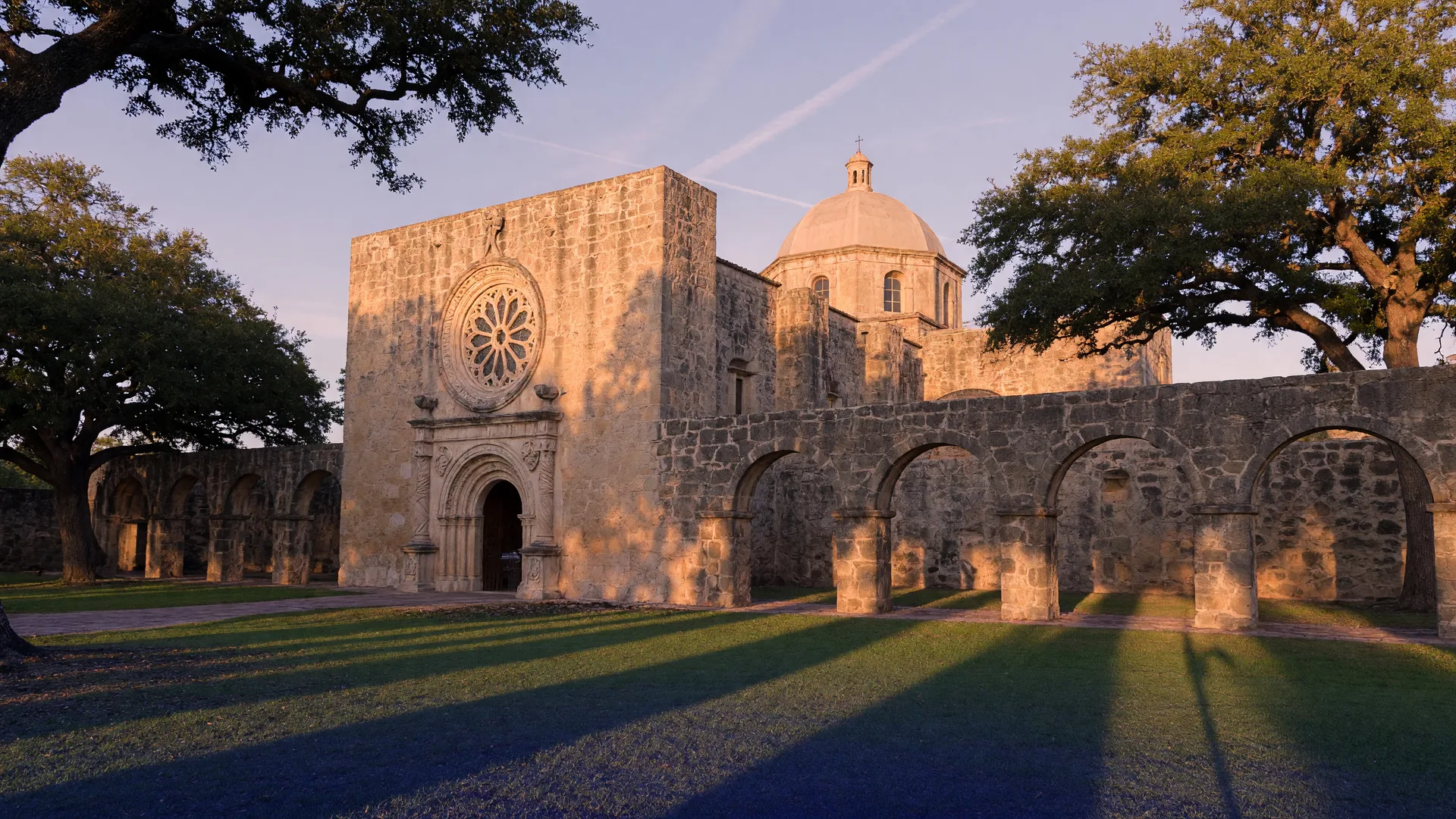
Few answers are as direct as the San Antonio Missions. The four 18th-century Spanish colonial missions: Concepción, San José, San Juan, and Espada: form the largest concentration of their kind in North America. Together with the Alamo, they were designated a UNESCO World Heritage Site in 2015, the first and still the only such site in Texas. They are free to visit, open year-round, connected by an 8-mile paved river trail, and located about 30 to 40 minutes from Boerne and Fair Oaks Ranch.
For California relocators, the missions offer something specific: a direct connection to a history that predates the California mission system by several decades, a genuine cultural asset that rivals any in the state, and a resource for weekend outings that does not require planning a vacation. This guide covers what the missions are, where they are, how to visit them, and why they matter for your family's new life in the Hill Country.
The Missions at a Glance
| Mission | Founded | Address | Key Feature |
|---|---|---|---|
| Mission Concepción | 1716 (moved here 1731) | 807 Mission Rd | Best-preserved original frescoes |
| Mission San José | 1720 | 6701 San José Dr | Largest mission; visitor center; Rosa's Window |
| Mission San Juan | 1716 (moved here 1731) | 9101 Graf Rd | Working farmlands and acequia system |
| Mission Espada | 1690 (moved here 1731) | 10040 Espada Rd | Oldest operating acequia in the US |
All four missions are open daily 9 a.m. to 5 p.m. (extended to 7 p.m. Memorial Day through Labor Day). Admission is free. No reservations required.
What the Missions Are and Why They Matter
The San Antonio Missions were established in the early 18th century by Franciscan friars under Spanish colonial authority. Their purpose was religious conversion, cultural assimilation, and the establishment of Spanish claims in the New World. Each mission functioned as a self-sustaining community: a church, a convent, workshops, farmlands, and irrigation systems all enclosed within protective limestone walls.
What distinguishes the San Antonio Missions from virtually every other mission site in the United States is their completeness and their continuity of use. All four missions within the national historical park remain active Catholic parishes, serving congregations that trace their roots back to the original mission communities. The buildings are original: not reconstructions. The limestone walls, the carved stone portals, the frescoes, and the bells are the same ones installed in the 1700s.
This is worth pausing over. California has 21 Spanish missions along El Camino Real, founded between 1769 and 1833: all well-preserved, all architecturally significant. But most function primarily as museums or tourist sites. The San Antonio Missions are different: they are living places, used weekly for mass, baptisms, weddings, and community events. The continuity of occupation gives them a quality that no museum reproduction can replicate. When you walk into Mission Concepción, you are standing in a building that has been used continuously for worship since 1755.
In 2015, the five missions: the four in the national park plus the Alamo: were designated a UNESCO World Heritage Site, recognized for their "outstanding universal value" as the most complete concentration of Spanish frontier missionary architecture in North America. Texas has only this one UNESCO World Heritage Site. California has nine, including Yosemite, Redwood, and the San Antonio Missions' closest cultural analog: the California missions themselves.
The Alamo: The Fifth Mission
The Alamo: originally Mission San Antonio de Valero: was the first Spanish mission established in San Antonio, founded in 1718. It is the most famous of the five San Antonio missions, not for its architecture but for the 1836 Battle of the Alamo, the pivotal event of the Texas Revolution in which a small garrison of Texan defenders fell to the Mexican army. The site is operated by the Alamo Trust and is not part of the National Park Service's historical park, but it shares the UNESCO World Heritage designation with the other four missions.
For new residents, the Alamo is worth visiting once for the historical context, but it functions primarily as a tourist attraction located downtown, near the River Walk. It is the most visited site in Texas. Admission to the grounds is free, but a timed-entry ticket is required to enter the historic church. Parking is available in downtown garages. Allow one to two hours. The site is open daily 9 a.m. to 5:30 p.m. Mornings and weekdays are significantly less crowded.
The Mission Reach Trail: Connecting All Four Missions
The Mission Reach is an 8-mile extension of the San Antonio River Walk, completed in 2013, that connects all four national park missions along the San Antonio River. It begins near the King William Historic District south of downtown and runs south to Mission Espada. The trail is paved, roughly 10 to 12 feet wide, and shared by walkers, runners, and cyclists.
The Mission Reach is the most practical way to visit multiple missions in a single trip. A cyclist can cover all four missions and back in roughly two hours of easy riding. A walker can do the full distance in a morning or afternoon with a planned route. The trail connects to the rest of the River Walk system: roughly 15 miles total when you include the downtown loop and the Museum Reach north to the Pearl district.
The trail surface is asphalt and concrete, suitable for road bikes, hybrid bikes, and running shoes. Water fountains and rest areas are available at each mission. The trail also functions as a paddling route: the Mission Reach Paddling Trail runs alongside the walking path for kayakers and canoeists who want to approach the missions from the river.
Mission Reach trail details:
- 8 miles one way, paved asphalt and concrete
- Connects all four missions from King William District to Mission Espada
- Links to the 15-mile River Walk system
- Bike rentals available at several access points along the trail
- Also offers a parallel paddling trail on the San Antonio River
- Access points marked by blue poles along the corridor
How to Visit: Practical Tips for New Residents
The San Antonio Missions are free. There is no entrance fee, no timed-entry ticket, and no reservation required for the four national park missions. The National Park Service recommends starting at the Visitor Center at Mission San José (6701 San José Drive), where you can pick up a map, watch the orientation film, and plan your route. Ranger-led tours are available at San José daily at 10 a.m., 11 a.m., 2 p.m., and 3 p.m.
Hours
All four missions are open daily 9 a.m. to 5 p.m. From Memorial Day through Labor Day, hours extend to 7 a.m. to 7 p.m. The park is closed on Thanksgiving, Christmas, and New Year's Day. The grounds and church interiors are accessible during park hours.
Distances from Boerne and Fair Oaks Ranch
- Boerne to Mission Concepción: approximately 33 miles, 38 minutes via I-10 East and I-37 South
- Boerne to Mission San José: approximately 34 miles, 40 minutes via I-10 East and US-90 East
- Fair Oaks Ranch to Mission San José: approximately 30 miles, 35 minutes via Ralph Fair Road and I-10
- From Boerne to the Mission Reach trailhead at Roosevelt Park: approximately 32 miles, 37 minutes
Recommended visit strategies
First visit (1.5 to 2 hours): Start at Mission San José. Tour the church, the granary, the convento, and the Rosa's Window: the ornate carved stone portal that is one of the finest pieces of Spanish colonial architecture in the United States. Walk the grounds. Visit the gift shop or watch the film. On a single visit to San José, you see the best the park system offers.
Bicycle day (half-day): Park at Mission San José, rent a bike or bring your own, and ride the Mission Reach trail south to Espada and back. Stop at each mission along the way. The full loop is roughly 12 miles out and back from San José to Espada. This is the most rewarding way to experience all four missions in one outing.
Paddling trip (half-day): Launch at the Mission Reach Paddling Trail access points. The paddle from Roosevelt Park to Mission Espada takes approximately two to three hours depending on water levels. Kayak rentals are available through outfitters near the River Walk.
Combination day: Visit the missions in the morning, then walk or bike the Mission Reach trail to the Pearl District for lunch. The trail connects north through the Museum Reach to the Pearl, approximately 6 miles from Mission San José. This is a full-day outing that combines history, outdoor activity, and the best dining in the city.
The Acequia System: Engineering That Still Works
One detail California relocators with an interest in infrastructure will appreciate: the San Antonio Missions were built with an irrigation system that still functions today. The Spanish friars and indigenous laborers constructed acequias: stone-lined irrigation canals: that diverted water from the San Antonio River to the mission farmlands. Mission Espada's acequia is the oldest continuously operating irrigation system in the United States. It has been in use since the 1730s.
The acequia system is relevant to California relocators in a practical sense: the water history of South Texas intersects with the same questions about water rights, aquifer management, and irrigation that come up when you buy a home on acreage in the Hill Country. The missions solved this problem 300 years ago with gravity-fed stone channels. The solutions have changed, but the underlying reality: that water defines what you can build and grow in this region: has not.
Why the Missions Matter for Families Considering the Move
The San Antonio Missions serve a practical purpose for California families relocating to the Hill Country that goes beyond tourism. They provide something that new residents in any community need: a sense of place, a point of pride, and a routine destination that makes the new city feel like home.
For families with children, the missions function as an outdoor classroom. Mission San José offers Junior Ranger programs through the National Park Service. The Mission Reach trail is safe, paved, and suitable for family bike rides. Mission Concepción's interior frescoes: the best-preserved original mission frescoes in the United States: give children a direct visual experience of 18th-century colonial life that no textbook can match.
For adults, the missions offer the kind of cultural infrastructure that is easy to take for granted until it is absent: places you can visit any weekend, at no cost, in a setting that combines history, architecture, and outdoor recreation. For California relocators who are used to having Yosemite, the California coast, or the Sierra Nevada within a few hours, the missions fill a different niche. They are not wilderness. They are human-made heritage, and they are as accessible as a 40-minute drive.
How to Get Started
The best first visit is the simplest: drive to Mission San José on a Saturday morning, walk the grounds, and decide whether you want to bike the trail on your next visit. The Visitor Center will give you the context you need, and the site itself will tell you whether the missions are something you will return to regularly.
For California relocators who grew up visiting the California missions on school field trips, the San Antonio Missions offer a comparison that is worth making in person. The California missions are older? No: the San Antonio missions were founded earlier, several of them before 1720, predating the California chain by 50 years. The California missions are more numerous? Yes, but none of them preserve the original interior frescoes that Mission Concepción does, and none function as a single UNESCO World Heritage Site that connects four intact mission complexes via a river trail.
The missions do not replace California's natural landscape any more than the Hill Country replaces the Pacific coast. They offer something that is genuinely their own: a depth of preserved colonial history that has no equivalent elsewhere in the United States, located within an easy drive of Boerne and Fair Oaks Ranch. That proximity: rural Hill Country living with a UNESCO World Heritage Site 40 minutes away: is part of what makes this region work for families who want both space and cultural access.
For a broader guide to San Antonio's cultural institutions and urban amenities, see the San Antonio lifestyle guide. For the River Walk, the Pearl District, museums, and dining, that article provides the full picture of what the city offers new residents. The missions are the piece of San Antonio that requires a separate guide because they are different in kind: not an attraction you visit once, but a place you return to.

Written by
Bill Ross
Hill Country Homesteads Group, brokered by KW Boerne
Bill Ross is a Texas real estate agent specializing in California-to-Texas relocation, with a network of 1,100+ California real estate agents for coordinated cross-state transactions. His practice serves Boerne, Fair Oaks Ranch, San Antonio, and the surrounding Hill Country.
Related Guides
San Antonio Lifestyle for California Relocators
River Walk, Pearl District, museums, dining, sports, and urban amenities in San Antonio.
Phil Hardberger Park Guide
San Antonio's premier urban park with the Land Bridge, trails, and ecology center.
Enchanted Rock State Natural Area
Hiking, climbing, stargazing at Texas's most iconic pink granite dome.
Active Outdoor Recreation in the Hill Country
Mountain biking, road cycling, trail running, climbing, and disc golf near Boerne.
Sources
- San Antonio Missions National Historical Park: visitor information, hours, fees, ranger tours: National Park Service. nps.gov/saan
- UNESCO World Heritage Site designation (2015): UNESCO World Heritage Centre. whc.unesco.org
- The Alamo: hours, admission, visiting tips: The Alamo. thealamo.org
- Mission Reach trail details: length, surface, access points: San Antonio River Authority. sariverauthority.org
- Mission Reach Paddling Trail: Texas Parks and Wildlife Department. tpwd.texas.gov
- Mission Concepción frescoes: best-preserved original mission frescoes in the US: National Park Service. nps.gov/saan
- San Antonio Missions UNESCO designation and California missions comparison context: UNESCO World Heritage Centre; California Missions Foundation.
- Distances from Boerne to missions: Google Maps; withinhours.com.
Last reviewed: August 2026. Sources verified for accuracy.