
Published:
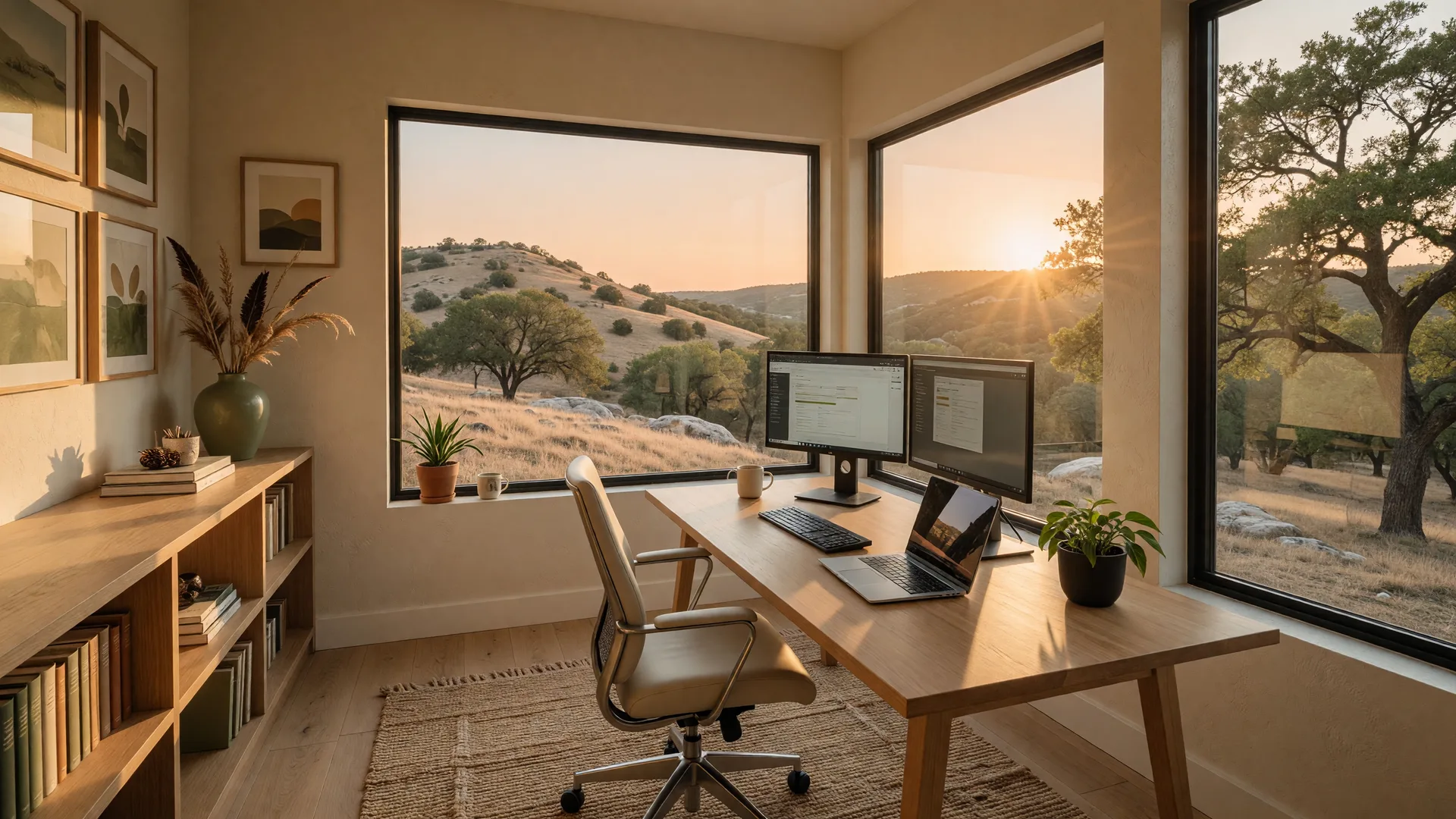
If you are a software engineer, product manager, or technical leader in the Bay Area or Los Angeles who can work from a Texas home, you have probably watched the remote-work pendulum swing twice since 2021. It swung hard toward full-time remote, and now it has settled somewhere more honest: hybrid. About 28 percent of paid workdays in the San Jose-San Francisco-Oakland metro were done from home in May 2026, roughly flat from a year earlier, but only about 11 percent of Bay Area workers were fully remote in early 2025, and a majority of the workforce had returned to the office at least part time by late 2025 [1][2][3]. That shift is the single most important thing to understand before you shop for a Texas home in late 2026, because it changes which features actually matter.
I am Bill Ross, a Texas real estate agent serving Boerne, Fair Oaks Ranch, San Antonio, and the surrounding Hill Country. I have worked with dozens of California tech professionals on exactly this move, and the ones who are happy with it three years in planned for the hybrid reality instead of betting on a fully remote future that never fully arrived. This article is the 2026 update of that advice: what the remote work data actually shows, the real income tax savings at 2026 rates, the home features that survive contact with a hybrid schedule, the address-level internet truth, the late-2026 housing and mortgage numbers, and the airport and coworking logistics that make the quarterly trip work. No hype. Just the numbers and the practical details.
The 2026 Remote Work Reality: Hybrid Won
The story you hear from colleagues is usually behind by a year. The 2021 story was full-time remote forever. The 2025 story was return-to-office. The 2026 reality, in the data, is a stable hybrid equilibrium. In the San Jose-San Francisco-Oakland metro, about 28 percent of paid workdays happened from home in May 2026, almost exactly the same as a year earlier, which suggests the shakeout is done and hybrid is the settled pattern [1][3]. Fully remote work is a minority position: about 11 percent of Bay Area workers were fully remote in early 2025, and by August 2025 a Mercury News poll found 63 percent of Bay Area workers back in the office full time [1][2].
The California numbers look similar at the state level. The Public Policy Institute of California found about 14 percent of Californians worked remotely all the time as of late 2024, and the Legislative Analyst's Office reports roughly one-eighth of California workers now work from home, about triple the pre-pandemic rate, with technology among the most remote-heavy job groups [5][6]. Even the job-posting data moved: remote-work postings for tech talent in the San Francisco Bay Area fell to about 10 percent of all tech postings by June 2025, down from 24 percent in mid-2022 [4].
What does this mean for a Texas home search? Three practical things. First, assume you will fly back to California a few times a year, which makes airport access a real feature, not a nice-to-have. Second, the home office is no longer optional, but it is also no longer the only room that matters, because a hybrid schedule means the office is used intensely while you are there and the rest of the house carries the normal life. Third, the migration itself has not stopped: the busiest state-to-state move in the country is still California to Texas, with 77,161 people counted in the 2024 American Community Survey and industry trackers regularly reporting the flow near 100,000 a year [7][8]. Remote-capable tech workers are a meaningful share of that flow, and they are buying homes in Boerne, Fair Oaks Ranch, and northwest San Antonio.
The remote work numbers that matter for your home search
| Measure | Figure | What it means |
|---|---|---|
| Bay Area workdays from home, May 2026 | ~28% | Hybrid is the settled pattern, flat year over year [1][3] |
| Bay Area workers fully remote, early 2025 | ~11% | Fully remote is now a minority position [1] |
| Bay Area remote tech postings, June 2025 | ~10% | Down from 24% in mid-2022; employers expect hybrid [4] |
| Californians who moved to Texas, 2024 | 77,161 | Still the busiest state-to-state route; ~100K/yr by some counts [7][8] |
Figures from the sources cited in brackets, which mix employer surveys, Census-based counts, and job-posting data; they are directional, not a single authoritative series [1][3][4][7].
The 2026 Income Tax Math: What a Tech Salary Saves
The income tax column is the cleanest part of the relocation math, and the 2026 numbers are concrete. California taxes earned income with marginal rates from 1 percent up to 12.3 percent, and for a single filer the 9.3 percent bracket runs from roughly $75,197 to $384,109 of taxable income after the 2026 inflation indexing [9][10]. The 1 percent mental health services surcharge only applies above $1 million in taxable income, so it does not touch a typical tech salary. On top of the income tax, California withholds a 1.3 percent State Disability Insurance payroll tax on all wages, with the wage cap eliminated as of 2024, so a $200,000 salary carries about $2,600 a year in SDI alone [11].
Texas has no state personal income tax and no state disability payroll tax, so both lines drop to zero on the day you are a Texas resident [9][11]. Federal taxes are identical in both states, which keeps the comparison honest. The table below uses published 2026 California brackets and rates to estimate the annual state-level savings for a single filer at four common tech salaries. These are estimates for planning, not a tax return, and your residency timing and any California-source income need a professional's review.
Estimated annual state-level savings for a single filer, moving to Texas
| Salary | CA state income tax | CA SDI (1.3%) | Combined CA burden | Texas |
|---|---|---|---|---|
| $150,000 | ~$9,700 | ~$1,950 | ~$11,650 | $0 |
| $200,000 | ~$14,400 | ~$2,600 | ~$17,000 | $0 |
| $250,000 | ~$19,000 | ~$3,250 | ~$22,250 | $0 |
| $300,000 | ~$23,700 | ~$3,900 | ~$27,600 | $0 |
Estimates use the 2026 California single-filer brackets and the 1.3% SDI rate on all wages, before federal tax, credits, and deductions beyond the standard deduction [9][10][11]. Federal taxes are identical in both states and are not shown. These are planning estimates, not a tax return.
Two honest caveats. First, if your employer applies a geographic pay adjustment for a lower-cost area, the gross number shrinks, and at the margin some of the savings disappears. Even a 15 percent reduction on a $200,000 salary leaves a Texas employee ahead on take-home because the state tax column vanishes and housing costs are far lower [9]. Second, California taxes former residents on California-source income for a period after the move, so the timing of your last California paycheck, your RSU vesting, and your bonus matters. Run the residency timing with your tax professional before you move, not after [9].
The Home Features That Survive a Hybrid Schedule
The 2021 version of this list said the office was everything. The 2026 version is more balanced, because a hybrid worker uses the office intensely for a few days and then lives in the rest of the house. The features below are the ones Bay Area and LA professionals actually trip over in a Texas search, ranked by how often they come up.
A Closed Office, Not an Open Nook
Video calls need a door. A dedicated room with a door, away from the kitchen and living area, is the single most-requested feature. A four-to-five-bedroom Hill Country home provides it as the standard layout, where a comparable Bay Area floor plan runs well into seven figures [21].
Two Work Spaces for Dual-Remote Households
Many California tech households have two remote-capable adults. Two separate closed spaces are non-negotiable for most couples. Identify which room becomes office number two before you fall in love with a floor plan, because a 2,400 to 3,200 square foot Hill Country home makes it work and a California condo often does not [21].
Fiber at the Exact Address, Verified Before the Offer
Coverage maps are neighborhood-level, not address-level. Fiber reaches about 80 percent of Boerne homes and a strong share of Fair Oaks Ranch, but the difference between one street and the next is real. Run the provider's address lookup before writing an offer; it takes five minutes and prevents the worst surprise in the entire move [12][13][14][15][16].
Airport Access for the Quarterly Trip
Because hybrid is the reality, you will fly to California several times a year. San Antonio International is roughly 29 miles and 30 to 40 minutes from Boerne, with direct flights to the California cities that matter [29]. A quarter of an hour closer to the airport is worth real money in a home search; an extra hour is not.
Power and Backup, Especially in Summer
Texas summers test the HVAC and the grid. A remote worker depends on power for income, so generators and battery backup are becoming common in upper-end listings, and they matter more than a California buyer expects. Ask about the home's outage experience before you buy [16].
Outdoor Space and the Anti-Cubicle Factor
After years of a 4-foot patio, a real Hill Country lot is the feature nobody prices in and everyone loves. It is also the office break room: a place to stand, breathe, and walk between calls. It costs less per square foot than any room in the house and it compounds the quality of daily life [21].
The Internet Reality: Fiber Where You Expect It, and Where You Don't
For a remote tech worker, the connection is the office. Most demanding work, video conferencing, cloud development, large uploads, and VPN traffic, runs comfortably on symmetric fiber, and the Hill Country developed corridors are generally well served in 2026. The catch is always the same: verify the exact address, because availability is street by street, not neighborhood by neighborhood [12][13][14].
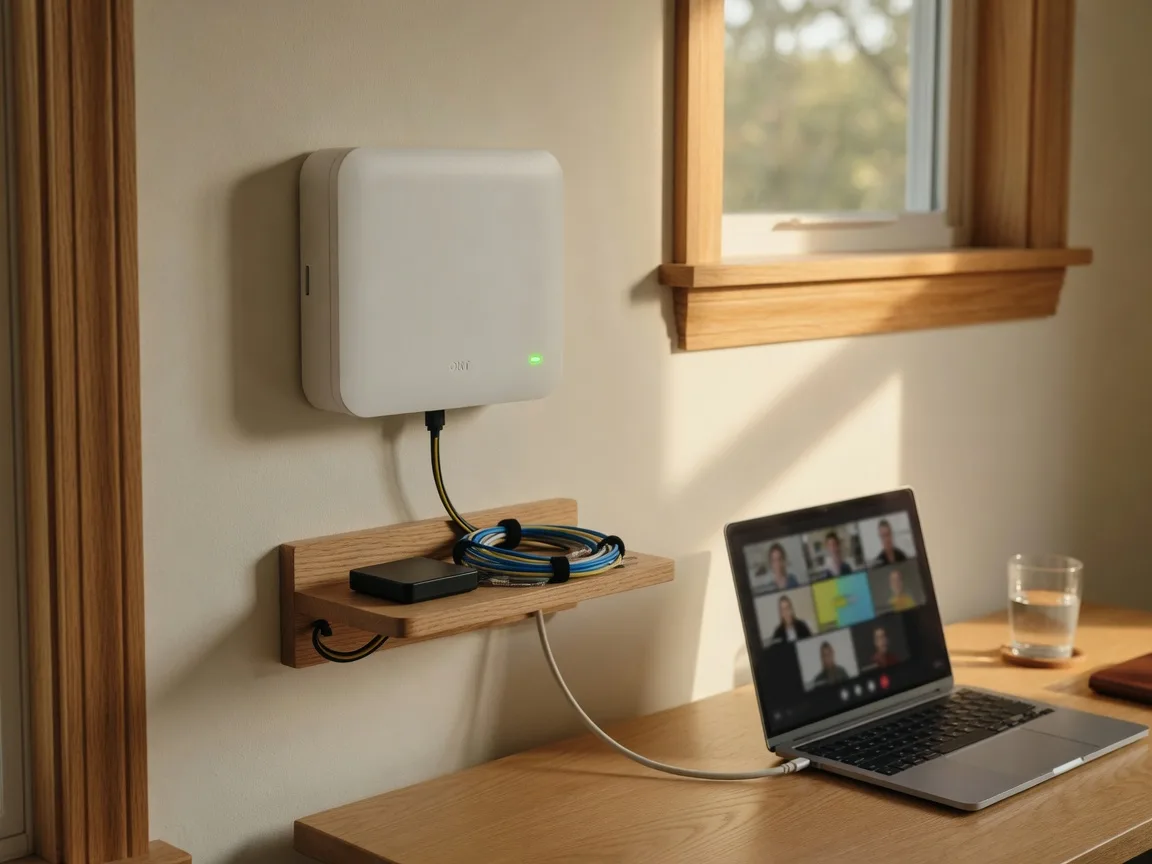
Internet providers in Boerne and Fair Oaks Ranch (2026)
| Provider | Where it reaches | What it offers |
|---|---|---|
| GVTC (cooperative fiber) | ~80% of Boerne; official Fiber Project partner in Fair Oaks Ranch | Symmetric gigabit and multi-gig, up to 5 Gbps [12][13][14][16] |
| AT&T Fiber | ~24% of Boerne; ~45% of Fair Oaks Ranch | Symmetric fiber up to 5 Gbps where available [13][15] |
| Spectrum | ~37-51% of Boerne; ~49% of Fair Oaks Ranch | Cable up to 1 Gbps; fiber product in parts of the area [12][15] |
Availability percentages come from third-party broadband data sites and vary by source and over time [12][13][15]. Always confirm with the provider's own address-level lookup before an offer.
Newer subdivisions built since roughly 2020 are very likely to have fiber because the developer pulled conduit during construction. Older sections of town and rural acreage outside the main corridors are where you need to check. If the dream home sits on rural acreage without fiber, fixed wireless and satellite are options, but for daily video-heavy work they are not equivalent to fiber, and I would not gloss over that during a property visit. Ask your agent to verify the provider's address-level lookup before you write the offer [12][14][16].
Late-2026 Housing and Mortgage Numbers
The late-2026 market numbers are concrete and they are the reason the move works. In Boerne (78006), the median sold price ran about $600,000 in October 2026 reporting, with earlier 2026 data near $675,000 [17][18]. Fair Oaks Ranch (78015) sold around $750,000 to $785,000 depending on the source [19][20]. The Texas statewide median was roughly $340,000 in the second quarter of 2026 [21][22]. Against a Bay Area or coastal LA median that sits well into seven figures, the Hill Country premium still looks like a discount, and the dollar-for-dollar comparison is stark once you count bedrooms, lot size, and a dedicated office.
What a Bay Area remote budget buys in the Hill Country (late 2026)
| Budget | Bay Area / coastal LA | Texas Hill Country |
|---|---|---|
| $600K | A modest condo or small older home | Near the Boerne 78006 median: a 3-to-4-bedroom home with a real lot [17][18] |
| $750K | A small starter home in most coastal metros | Fair Oaks Ranch territory: 4-to-5 bedrooms, office space, newer construction [19][20] |
| $1M+ | A dated single-family home in most of the Bay Area | Estate acreage, golf-course communities, or a large custom home with land [20][21] |
Medians are directional market data from the sources in brackets and vary by reporting source and ZIP versus city definitions [17][18][19][20][21]. Budget outcomes generalize across floor plans and finishes.
The mortgage side is where the 2026 numbers get attention. The national 30-year fixed rate was roughly 7.2 to 7.5 percent in mid-October 2026, with Freddie Mac's weekly survey at 7.40 percent on October 15 [23][24]. The structural difference between the states is the jumbo threshold: Texas uses the $832,750 baseline conforming limit in every county, while California's high-cost coastal counties go up to $1,249,125 [25][26]. In plain terms, a loan that is jumbo in Texas can be conforming in the Bay Area, so a Texas buyer above $832,750 should expect jumbo pricing and typically a 20 percent down payment for the best rate [25][26].
For a California buyer buying in Texas before selling in California, the financing order matters. Bridge financing, a HELOC on the California home, or a contingent sale can carry the gap, and the mechanics of a cross-state synchronized closing are where a practiced local team pays for itself. That is one of the reasons my practice keeps a network of over a thousand California agents: the sale and purchase close in coordination, and the money arrives on time [25][26].
Coworking, the Airport Run, and the Logistics
A hybrid schedule means two logistics matter more than a fully remote schedule would have: a place to work when you need a change of scene, and a tolerable route to the airport. Both are solved in the Hill Country.
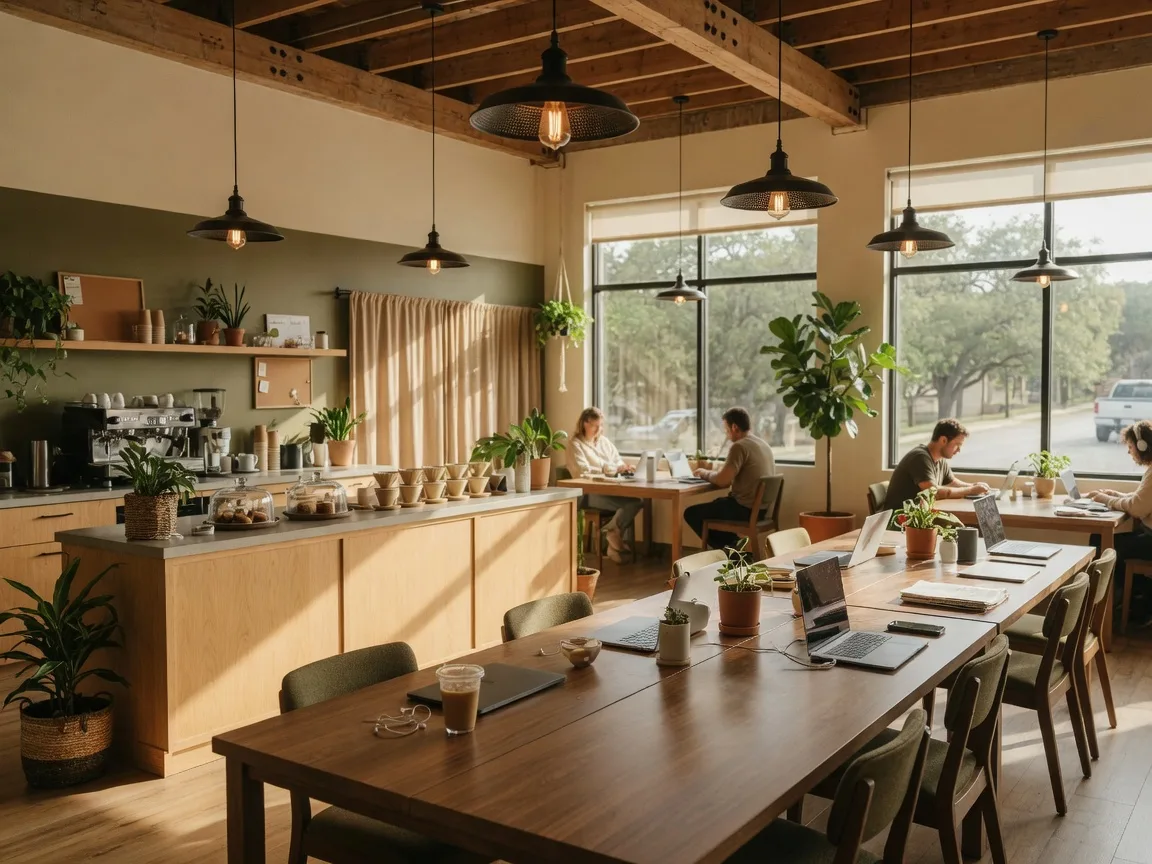
Boerne has real coworking. Office Box Boerne on East Blanco Road calls itself the town's coworking community, with desks, lounges, and meeting rooms, and Das GreenHaus on Upper Balcones Road is a nonprofit incubator and coworking space with flexible workspaces and a maker space [27][28]. Both are a short drive from the residential neighborhoods where California buyers land, and both give a hybrid worker an office day that is not the kitchen table.
The airport math is simple and good. San Antonio International (SAT) is roughly 29 miles from Boerne, about a 30 to 40 minute drive, with direct flights to the California cities that matter most [29]. Austin-Bergstrom is roughly 100 miles away, closer to a two-hour drive, and generally a worse choice for a regular California trip [29]. For a hybrid worker flying a handful of times a year, the SAT run is an easy half-day, and homes near the I-10 corridor between Boerne and San Antonio cut it further. If you promise your employer a quarterly cadence, test the drive once on a weekday before you commit.
The last logistics item is Texas power and summer. A remote worker's income depends on electricity, so ask about the home's outage history, and consider a generator or battery backup for the office circuit if the home does not have one. This is a Hill Country-specific cost that a California buyer rarely budgets for, and it belongs in the plan [16].
The 2026 Home Search Checklist
If you are a Bay Area or LA remote tech professional ready to start the search, here is the short list I want you to carry into every property visit [12][16][23][29]:
- Run the address-level internet lookup for fiber before writing an offer. This is the number one surprise-avoider in this entire move.
- Count the closed offices. One per remote adult, with a door, away from living areas. Identify office number two before you fall in love with a floor plan.
- Ask about the home's power and backup experience. Texas summers test HVAC and the grid; generators and battery backup are common in upper-end listings and matter for a remote worker.
- Test the airport run. Drive to SAT once on a weekday and confirm which California direct flights exist before you promise your employer a cadence.
- Budget the Texas property tax line properly. File the homestead exemption in year one, let the 10 percent appraisal cap work, and plan a property tax protest each spring, exactly as our property tax guide for California buyers explains.
- Get pre-approved with a Texas lender before you shop. The rate environment and the jumbo threshold above $832,750 shape what you can offer, and the lender drives your cross-state timing [23][25][26].
The Bottom Line for a Remote Tech Buyer
The honest summary has four sentences. Hybrid is the settled reality, so plan for a real office, a tolerable airport run, and a floor plan that works for two adults on a call at once [1][2][3]. The state tax savings are real and measurable at 2026 rates, roughly $17,000 a year at a $200,000 salary before federal tax and housing, and Texas makes both lines zero [9][11]. The Hill Country delivers the floor plan at a fraction of the California price, with Boerne near $600,000, Fair Oaks Ranch around $750,000, and a statewide median near $340,000 [17][19][21]. And the two details that decide whether the move feels great or grating, address-level fiber and power reliability, are both verifiable before you buy [12][16].
That is the framework I use with every California tech buyer, whether they are six months out or six weeks out. If you are weighing a specific home and a specific commute, the most useful next step is to run the address-level fiber check, pull your current salary and RSU timing, and compare two or three floor plans against your actual work habits. I help remote tech professionals do exactly that in Boerne, Fair Oaks Ranch, San Antonio, and the surrounding Hill Country, and a direct conversation about your situation costs nothing and saves the expensive mistakes.
Related Reading
Remote Tech Worker Home Priorities
The earlier field guide to the same move: office floor plans, fiber verification, and the airport question in detail.
California Remote Workers and the Texas Income Tax Nexus
The residency and California-source income rules that decide whether the zero-tax win actually sticks.
California Mortgage vs Texas Mortgage
Lending differences, rate expectations, and what you qualify for when financing a Texas home.
Buying in Texas Before Selling in California
Bridge loans, contingencies, and the cross-state timing for a sale-and-purchase that closes in coordination.
Frequently Asked Questions
These are the questions that come up after the initial walk-through, the ones that show whether a remote tech buyer is reading the 2026 reality or still planning for the 2021 version of it.
Is fully remote work still realistic in 2026, or is hybrid the new normal for Bay Area and LA tech?
The honest answer is that hybrid is the new normal. About 28 percent of paid workdays in the San Jose-San Francisco-Oakland metro were done from home in May 2026, roughly flat from a year earlier, but only about 11 percent of Bay Area workers were fully remote in early 2025 and a majority had returned to the office at least part time by late 2025 [1][2]. What that means for a home search is concrete: plan for a few trips to California each year, verify the airport run, and make sure the home has a real, closed office. The days of assuming you will never set foot in an office are mostly over.
How much state income tax does a Bay Area or LA tech salary save by moving to Texas in 2026?
For a single filer at a $200,000 salary, California state income tax lands around $14,400 a year and the 1.3 percent SDI payroll tax adds roughly $2,600, for a combined state payroll burden near $17,000 [8][9]. At $150,000 the combined total is roughly $11,600, and at $250,000 it approaches $22,300. In Texas both lines are zero, because Texas has no state personal income tax and no state disability payroll deduction [8][9]. Federal taxes do not change. These are estimates from published 2026 brackets, not a tax return, and your residency timing and California-source income need a professional's review.
Will I actually get fiber internet at the address I buy in Boerne or Fair Oaks Ranch?
In the developed corridors, usually yes, but only at the exact address. Fiber is available to roughly 80 percent of Boerne homes, led by GVTC with symmetric gigabit and multi-gig plans, with AT&T fiber and Spectrum covering a meaningful share of addresses [11][12][13]. In Fair Oaks Ranch, AT&T fiber reaches roughly 45 percent of homes and the city's official GVTC Fiber Project is expanding service with gigabit-class speeds [14][15][16]. Coverage varies street by street, so run the provider's address-level lookup before you write an offer. Newer subdivisions built since about 2020 are very likely to have fiber because the conduit went in during construction.
What does a Bay Area or LA tech budget actually buy in the Hill Country in late 2026?
The late-2026 medians tell the story. Boerne (78006) sold around a $600,000 median with earlier 2026 reporting near $675,000, Fair Oaks Ranch (78015) sold around $750,000 to $785,000, and the Texas statewide median was roughly $340,000 [17][18][19][20][21]. A budget that buys a modest condo or a small older home in the Bay Area or coastal LA typically buys a four-to-five-bedroom Hill Country home on a real lot with a dedicated home office, a second work space, and room for everything that had no place in California [21][22]. The monthly payment math depends on rates, which we get to below.
How does the 30-year mortgage rate in late 2026 affect a California-to-Texas purchase?
The national 30-year fixed rate was roughly 7.2 to 7.5 percent in mid-October 2026, with Freddie Mac's weekly survey at 7.40 percent on October 15 [23][24]. The structural difference between the states is the jumbo threshold: Texas uses the $832,750 baseline conforming limit in every county, while California's high-cost coastal counties go up to $1,249,125, so a loan that is jumbo in Texas may be conforming in the Bay Area [25][26]. Down payment expectations are similar in both states, roughly 10 to 20 percent with 20 percent the practical standard for the best pricing. Get a pre-approval from a Texas lender before you shop, because the lender also drives your cross-state timing.
Sources
- Report: Only 11% of Bay Area workers fully remote, San Mateo Daily Journal. www.smdailyjournal.com/news/local/report-only-11-of-bay-area-workers-fully-remote/article_8e3cabc1-0d5d-41db-9b25-a65b5c32f2a1.html
- In-person work takes a big leap in the Bay Area, The Mercury News / BANG poll. www.mercurynews.com/2025/10/13/in-person-work-bay-area-remote-on-site-poll/
- Bay Area companies want employees back in the office. Remote work isn't budging, SF Chronicle / Yahoo Finance. finance.yahoo.com/small-business/articles/bay-area-companies-want-employees-120000873.html
- Scoring Tech Talent 2025, CBRE. www.cbre.com/insights/books/scoring-tech-talent-2025
- Remote Work Is Here to Stay, Public Policy Institute of California (PPIC). www.ppic.org/blog/remote-work-is-here-to-stay/
- The Rise of Remote Work: Effects on California's Labor Market, Legislative Analyst's Office. lao.ca.gov/Publications/Report/5182
- Map shows states causing California exodus (2024 Census ACS), Newsweek. www.newsweek.com/map-shows-states-causing-california-exodus-11399718
- California-to-Texas Migration Holds Steady at 100K Annually, StorageCafe. www.storagecafe.com/blog/california-to-texas-moving-2025/
- 2026 Tax News: indexing, standard deduction, and rates, California Franchise Tax Board. www.ftb.ca.gov/about-ftb/newsroom/tax-news/index.html
- California Income Tax Brackets for 2026, USTax.tools. ustax.tools/tax-insights/california-income-tax-brackets-2026/
- Rates and Withholding: 2026 SDI rate, California Employment Development Department. edd.ca.gov/en/payroll_taxes/rates_and_withholding/
- Top Internet Providers in Boerne, TX, BroadbandNow. broadbandnow.com/Texas/Boerne
- Top 5 Internet Providers in Boerne, TX, HighSpeedInternet.com. www.highspeedinternet.com/tx/boerne
- GVTC Fiber Internet Plans, GVTC Communications. gvtc.com/residential/internet
- Top 5 Internet Providers in Fair Oaks Ranch, TX, HighSpeedInternet.com. www.highspeedinternet.com/tx/fair-oaks-ranch
- Internet Providers in Fair Oaks Ranch, TX, BroadbandMap. broadbandmap.com/internet-providers/fair-oaks-ranch-tx/
- GVTC Fiber Project, City of Fair Oaks Ranch. www.fairoaksranchtx.org/632/GVTC-Fiber-Project
- Boerne, TX 78006 Housing Market (October 2026), Resideline. resideline.com/market/78006/
- 78006 Boerne, TX Home Price Trends, HAR.com. www.har.com/zipcode_78006/pricetrends
- Fair Oaks Ranch, TX Housing Market, Homes.com. www.homes.com/fair-oaks-ranch-tx/
- Fair Oaks Ranch Housing Market, Redfin. www.redfin.com/city/6483/TX/Fair-Oaks-Ranch/housing-market
- Texas Home Prices Hold Steady: Q2 2026 median, Texas Association of REALTORS. briefglance.com/companies/texas-association-of-realtors-inc/pulses/60953
- 2026 Texas Real Estate Forecast, Texas Real Estate Research Center. trerc.tamu.edu/reports/2026-texas-real-estate-forecast/
- Primary Mortgage Market Survey (October 15, 2026), Freddie Mac. www.freddiemac.com/pmms
- Compare Today's 30-Year Mortgage Rates, Bankrate. www.bankrate.com/mortgages/30-year-mortgage-rates/
- Jumbo Loan Rates in California: 2026 Buyer Guide, JVM Lending. www.jvmlending.com/blog/jumbo-loan-rates-california/
- What Is a Jumbo Loan in Texas? 2026 Limits and Rates, JVM Lending. www.jvmlending.com/blog/what-is-a-jumbo-loan-in-texas/
- Office Box Boerne: Co-working Community, Office Box Boerne. officeboxboerne.com/
- Das GreenHaus: Business Incubator and Coworking in Boerne, Das GreenHaus. www.dasgreenhaus.org/
- Driving Distance from Boerne, TX to San Antonio International, Travelmath. www.travelmath.com/drive-distance/from/Boerne,+TX/to/SAT
Last reviewed: October 21, 2026. This article reflects remote-work data, California 2026 tax rates, internet availability reporting, and market data available as of mid-October 2026, and it is general information rather than legal, tax, financial, or real estate advice. Verify every rate, exemption, speed, price, and rule with the cited source, the provider's address-level lookup, your lender, and a qualified tax professional before you act. Market prices, tax rates, internet availability, and mortgage rates change.