
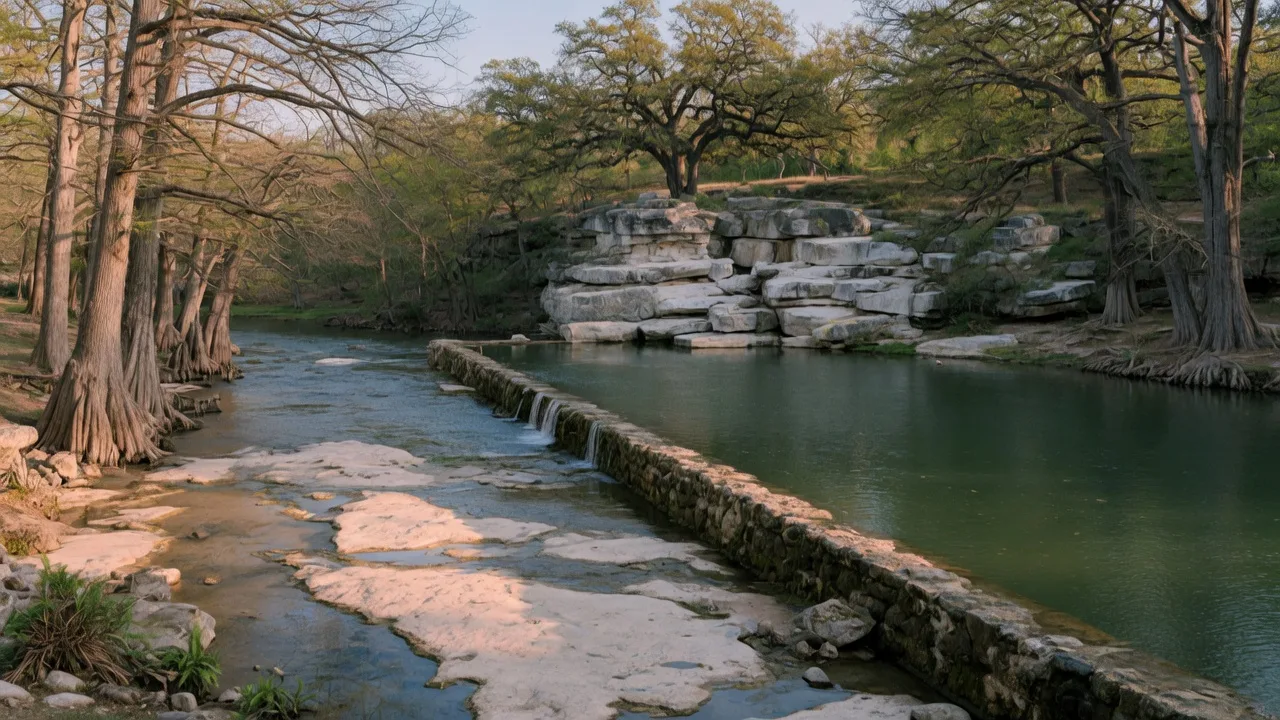
Blanco, Texas is the Hill Country town on US 281 between San Antonio and Austin, about halfway between the two metros and roughly 28 miles northwest of Boerne. The 2020 Census counted 1,682 residents in the city, with estimates now above 2,000, making it the largest community in Blanco County even though the county seat moved to Johnson City more than a century ago. The spring-fed Blanco River runs through town, and a Civilian Conservation Corps state park built in 1934 sits within walking distance of the courthouse square.
For a California family comparing small-town Hill Country options, Blanco occupies a specific niche: real walkability on a historic square, a river you can swim in without leaving town, and acreage at entry prices below most of Boerne and Fredericksburg, in exchange for thin retail, a roughly hour-long drive to either major airport, and a small school district rather than a powerhouse one. This guide walks through the geography, the market, the schools, the river and flood reality, the daily essentials, and the honest tradeoffs so you can decide whether Blanco belongs on the short list.
Where Blanco Sits: The US-281 Corridor
Blanco's position on US 281 is its defining feature. The highway runs north and south from San Antonio through Bulverde, Blanco, and Johnson City toward the Llano and Marble Falls country, and it is the same corridor many San Antonio-area buyers already know. The town sits at roughly 1,306 feet of elevation in a county that is almost entirely rural Hill Country, so most of the drive between Blanco and its neighbors is two-lane or divided highway through limestone hills and live oak pasture.
The drive times below are the honest numbers for a relocation visit. Plan around them, because every errand beyond the basics involves one of these routes.
| Destination | Distance | Typical Drive |
|---|---|---|
| Downtown San Antonio | About 50 miles | About 60 minutes on US 281 |
| Austin | About 45-50 miles | About 50-60 minutes |
| Boerne | About 28 miles | 35-45 minutes |
| Fredericksburg | About 34 miles | 40-45 minutes |
| Johnson City | About 14 miles | 16-20 minutes on US 281 |
| Blanco State Park | In town | 5-minute walk from the square |
San Antonio International Airport (SAT) sits on the north side of the city, so the airport drive follows the same US 281 stretch and lands around the hour mark in normal traffic. Austin-Bergstrom (AUS) is roughly the same distance east. California transplants used to counting a 45-minute drive as a long commute should note that every one of these is an event, not an errand. The exception is the things that matter most in Blanco: the square, the park, the river, and the schools are all minutes away.
Blanco at a Glance
| Detail | Value |
|---|---|
| Population | 1,682 at the 2020 Census; recent estimates above 2,000 |
| County | Blanco County (county seat is Johnson City) |
| ZIP code | 78606 |
| Elevation | About 1,306 feet |
| River | Spring-fed Blanco River runs through town |
| State park in town | Blanco State Park, 104.6 acres, established 1934 |
| Grocery anchor | Lowe's Market on Blanco Avenue; no H-E-B in town |
| Electric utility | Pedernales Electric Cooperative (PEC) |
| School district | Blanco ISD, TEA rating B, about 1,100 students |
What the Blanco Housing Market Looks Like in Late 2026
The Blanco market splits into two products, and it helps to keep them separate. In town, the inventory is older limestone cottages, 1920s-1970s homes on tree-lined streets, and a smaller set of renovated and new builds within walking distance of the square and the park. Outside town and along the 281 approaches, the product is acreage: one-to-five-acre homesites and larger ranch tracts where the listing price often has more to do with the land than the house.
Data aggregators disagree on the median because of that split, so treat any single number as one view. Redfin's median sale price for the city of Blanco ran about $463,000 (about $272 per square foot) over the three months ending April 2026, while the wider 78606 ZIP posted a median sale closer to $435,000 (about $214 per square foot) with roughly 178 days on market. RealtyTrac estimated the median home value at about $467,000 with median listings near $489,000 as of July 2026, and HAR's average list price ran much higher, near $730,000, because large acreage homes with an average of 4,235 square feet pull the average up.
The direction of the market matters for timing. The ZIP saw double-digit year-over-year appreciation into mid-2024 and 2025, then cooled: inventory climbed to roughly 146 active listings in 78606, days on market lengthened well beyond the 2021-2023 pace, and price per square foot pulled back from the 2024-2025 peak. Blanco County's overall median sale price was about $430,000 in mid-2025, up about 20 percent year over year, before the cooling took hold. Agricultural acreage in the county typically trades in the $3,500 to $8,000 per acre range, while improved tract land with highway frontage lists far higher. This is a buyer's-with-negotiating-room market in late 2026, not a bidding frenzy, and the range of days on market means patience is rewarded.
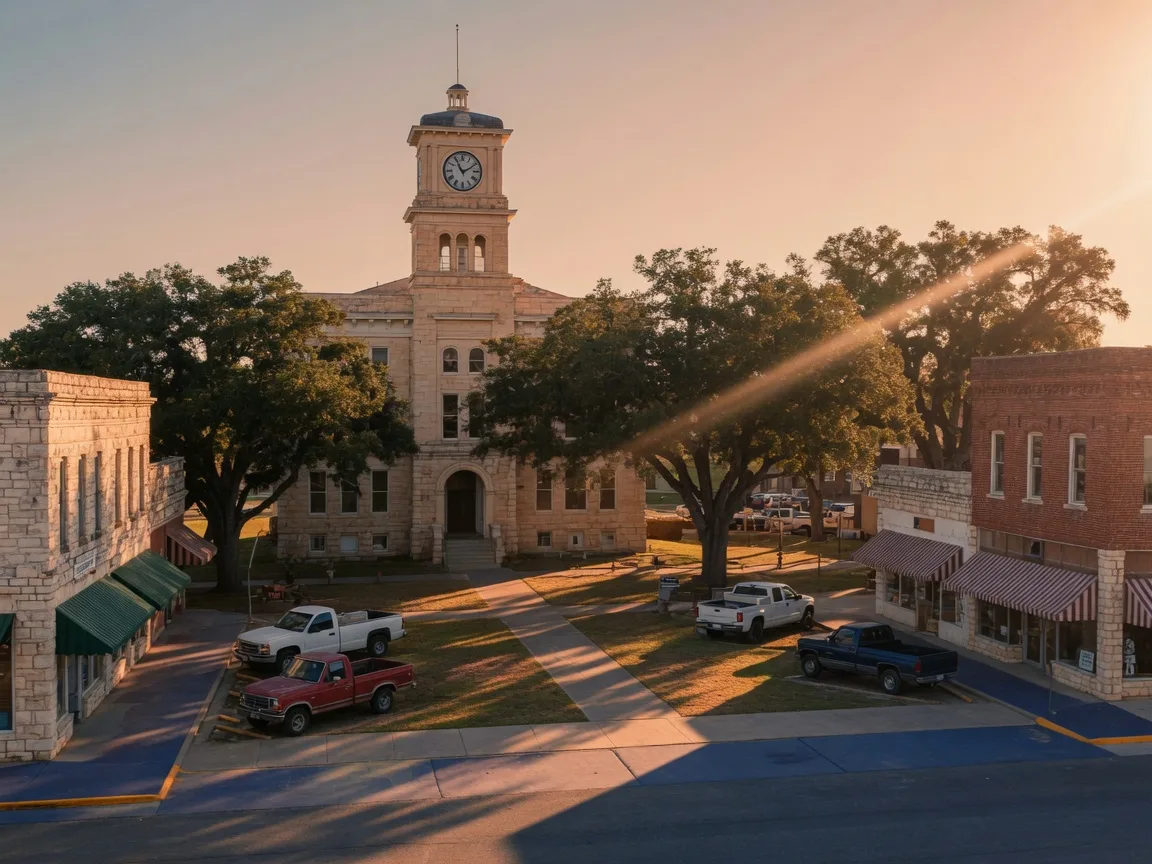
Compared with its neighbors, Blanco is the walkable-value play. Boerne is more expensive and more established, with a bigger retail base and an A-rated school district. Comfort is smaller and quieter, closer to the I-10 wine corridor. Fredericksburg is the retail and wine destination, priced accordingly. Blanco gives you the closest thing to a real small-town Main Street at the lowest entry point of the four, and it is the only one of them where you can walk from a courthouse square to a state park and a swimming river in five minutes.
"Blanco is the small town that still functions like one. You can live in a single-story house on a quiet street, walk to coffee and the square on Saturday, and swim in the river at a state park that is closer than your nearest California grocery store. The tradeoff is distance to everything big, and you should measure that before you fall for the charm."
The honest summary of Blanco's appeal, stated plainly
The Schools: Blanco ISD Is Small on Purpose
Blanco Independent School District serves the town and the surrounding county with about 1,100 students across three campuses: Blanco Elementary (kindergarten through fifth grade, roughly 500 students), Blanco Middle School (grades 6 through 8), and Blanco High School (grades 9 through 12). The district earned a B rating from the Texas Education Agency in the current accountability cycle, with an overall score of 82 out of 100 for 2024-25 and 81 for 2025-26. Blanco High School picked up five distinction designations, covering English, math, science, social studies, and top-quartile academic growth among its peer group.
The honest comparison for a California family: this is not Boerne ISD. It is a small rural district with UIL Class 3A athletics (the Panthers), small class sizes, and a close-knit community where teachers know students by name. Gifted and talented, career and technical education, and dual credit paths exist, but the menu is smaller than a large suburban district. Families moving to Blanco for a specific program should verify the offerings with the district directly, because rural districts staff to their enrollment. The one hard rule applies everywhere in Texas: campus zoning follows the exact street address, so confirm the feeder for any specific property before you write an offer. The Texas school district explainer on this site walks through how to read ratings and enrollment rules.
The Blanco River and Blanco State Park: The Town's Centerpiece
Blanco State Park at 101 Park Road 23 is a 104.6-acre park established in 1934 as one of the first Texas parks built by the Civilian Conservation Corps. It holds about a mile of frontage on the spring-fed Blanco River, and its location, right at the edge of downtown, makes it the most accessible state park in the Hill Country for daily use. Day-use entry is $5 per person for ages 13 and older, children 12 and under are free, and Texas Parks and Wildlife recommends reserving day passes in advance. The park is open daily with seasonal hours, roughly 9:00 AM to 6:00 PM, so check the TPWD page before a visit.
Swimming is allowed anywhere along the river, with a shallow wading pool for small children next to Falls Dam. Tubing, canoeing, and kayaking are permitted, boats must use electric motors only, and shoreline fishing requires no license inside park boundaries. Camping is modest: roughly 30 sites, with premium water-and-electric hookups at $25 a night, full-hookup sites at $23 a night, and seven screened shelters at $30 a night that sleep eight with a fan and electricity. There are no cabins. The park is not Guadalupe River State Park, which is bigger and sits about 45 minutes away, but it is the park you would actually use every weekend. See the Guadalupe River State Park guide for the closest big-river alternative.
The Flood Reality Californians Need to Take Seriously
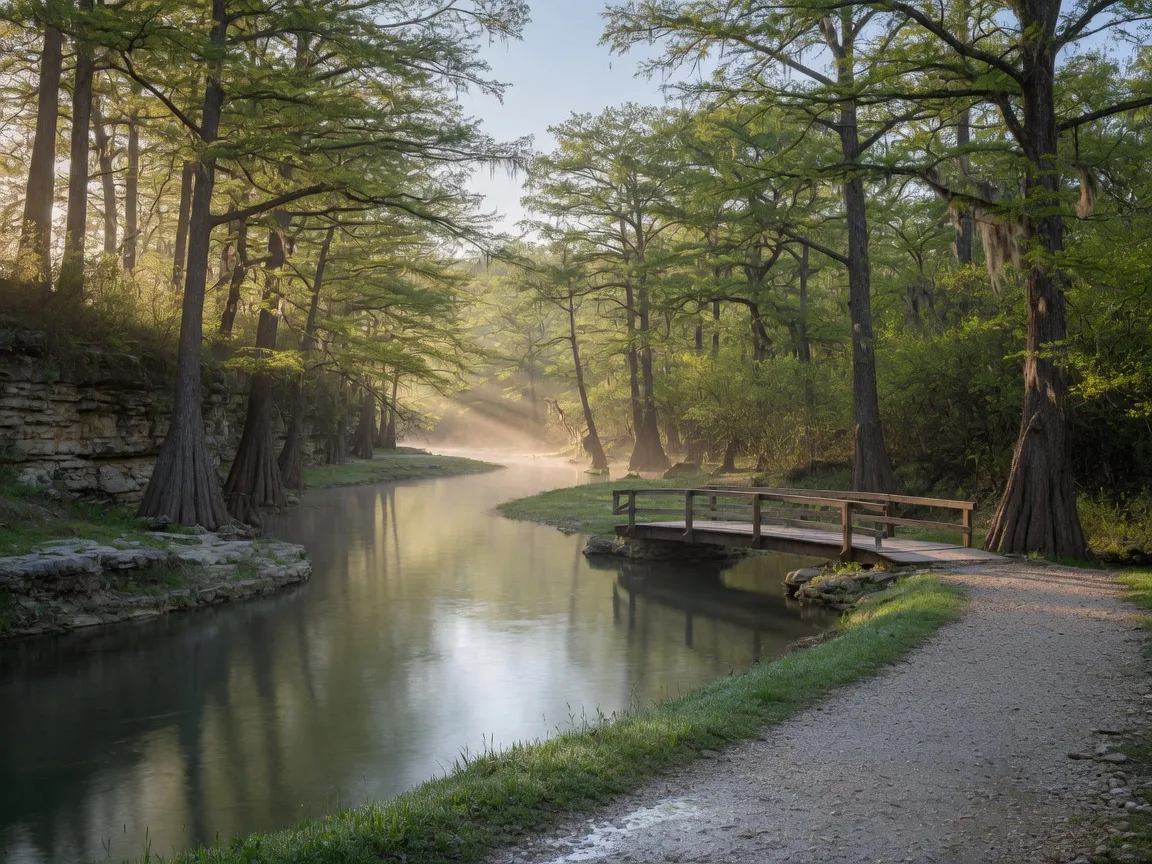
Living next to a Texas hill-country river comes with a history lesson. Over Memorial Day weekend in 2015, six to thirteen inches of rain fell across the Blanco River headwaters in a matter of hours, and the river rose with almost no warning. Homes in town filled with several feet of water, the Blanco Settlement RV park and cabins were destroyed, twelve people died along the Blanco River system, and federal officials classified the event as a 120- to 500-year flood. The town rebuilt, but the flood remains the single most important due-diligence item for any river-adjacent property.
What this means practically: if a listing sits in the floodplain or near the river, check FEMA flood maps, ask about flood insurance cost before you make an offer, and understand that the 2015 flood raised the bar for what banks and insurers expect. Higher-elevation lots in town did not flood. Respect the floodplain and the insurance line item, and the river is an asset; ignore them and it becomes the most expensive mistake of the move.
Local Life: The Square, the Brewery, and Getting Essentials
Daily life in Blanco centers on the Old Blanco County Courthouse square, a four-block classic with a limestone courthouse, awnied storefronts, and parking angled around the green. The square hosts Blanco Market Days on the third Saturday of the month from March through December (no August market), 9:00 AM to 4:00 PM, and the December date doubles as the Christmas Market. Coffee and morning spots include Buchanans Coffee House at 301 4th Street and the Blanco Feed Store at 419 8th Street, which runs a cafe out of the historic feed store. For lunch and dinner, Redbud Cafe at 410 4th Street and Chess Club Cafe at 1020 US 281 are the checked, operating anchors, each with strong local review counts.
The big-ticket local institution is Real Ale Brewing Company at 2250 North US Highway 281, the craft brewery founded in 1996 that now also runs Real Spirits Distilling on the same site. The taproom and beer garden pour 16-plus beers including Fireman's #4 Blonde Ale and Devil's Backbone Tripel, plus cocktails, wine, and pizza from a rotating food pop-up, with free brewery tours on Friday and Saturday afternoons. Hours vary by season, so check the brewery's site before driving out.
The retail gap is the honest catch. Blanco has no H-E-B: the grocery anchors are Lowe's Market on Blanco Avenue and a Dollar General on the south side of town, adequate for daily basics but not for a full shopping trip. The nearest full-size H-E-B Plus is about 25 to 30 minutes southeast on US 281 to Texas 46 West in the Spring Branch area, and Boerne's fuller retail is a 35 to 45 minute drive. Plan grocery runs like a small-town resident and you will be fine; expect a California-level convenience retail experience and you will be disappointed. The Boerne downtown guide and the Hill Country dining guide cover the fuller regional restaurant picture.
Annual Events Worth Planning Around
Blanco's calendar is small-town Texas with a Hill Country accent, and the anchor is the Blanco Lavender Festival, held the first weekend of June on the courthouse square with farm tours at Hill Country Lavender Farm and live music in Bindseil Park. The 2026 edition runs June 5 through 7, the 21st annual, and admission is free. The Blanco Classic Car Show lands on the third Saturday in May at Blanco State Park. In August, the Blanco County Fair and Rodeo runs at the county fairgrounds in Johnson City, about 15 minutes north, with livestock shows, carnival, and rodeo action. December brings the courthouse lighting, a lighted Christmas parade around the square, and the Christmas Market, which is the December Market Day. For the full regional calendar, the Hill Country seasonal events guide and the Boerne events guide are the best planning tools.
Water, Septic, and Infrastructure
Inside the city limits, the City of Blanco supplies municipal water and sewer through its public works and utilities department, which simplifies life considerably. Outside the city, the standard Hill Country acreage pattern applies: private wells and on-site septic systems, with septic permitted by Blanco County and groundwater overseen by the Blanco-Pedernales Groundwater Conservation District. County subdivision rules require water availability reports for lots that rely on private wells, so the well question is settled early in most rural listings.
Electricity across Blanco County is Pedernales Electric Cooperative, the member-owned cooperative headquartered in Johnson City with a district office in Blanco, so there is no deregulated provider shopping like there is in the San Antonio metro. Broadband varies by address; some in-town streets have fiber while rural tracts rely on fixed wireless or satellite, so verify internet at the exact property before you commit, especially for remote work. The wells and groundwater guide is the full education on aquifers, testing, and well costs.
Property Taxes: The Blanco County Math
Blanco County's tax structure is simpler than the metro counties, and the combined bill is lower. Using the final adopted 2024 rates published by the Blanco Central Appraisal District, the combined rate inside the City of Blanco lands at about $1.688 per $100 of assessed value: Blanco County at $0.370, Blanco ISD at $0.7919, the City of Blanco at $0.4094, and two emergency services districts at $0.10 each. Outside the city limits, the combined rate drops to about $1.279 per $100, since the city tax disappears. That works out to roughly 1.7 percent inside town and about 1.3 percent outside on assessed value, before exemptions.
Rates move each year under Texas truth-in-taxation rules. The district proposed $0.8652 for 2026 and the city has run just above $0.41 in recent cycles, so verify the current adopted rates on the Blanco Central Appraisal District page for any serious purchase. The homestead exemption is the single biggest lever: filing removes $140,000 of value from school taxes and caps annual appraisal growth at 10 percent. File Texas Comptroller Form 50-114 with the Blanco CAD at 615 North Nugent Avenue in Johnson City by April 30 of the tax year, no fee, and it carries forward automatically. The homestead exemption guide and the property tax protest guide on this site cover the filing and the appeal process in detail.
Who Should Choose Blanco, and Who Should Not
Good fits
- Buyers who want a real walkable square and Main Street at prices below Boerne or Fredericksburg.
- Remote workers or flexible commuters who fly a few times a year and love being minutes from a river.
- Families who value small classrooms in a small district over a large suburban menu.
- Acreage buyers who accept well and septic upkeep and want the county's lower tax load outside town.
- People who like the LBJ country corridor, with Johnson City and Fredericksburg as weekend towns.
Poor fits
- Daily downtown San Antonio or Austin commuters, for whom an hour each way will wear fast.
- Buyers who need a full-size H-E-B, big-box retail, and medical specialists within minutes.
- Families specifically targeting an A-rated school district such as Boerne or Comal ISD.
- Shoppers who want the gated, country-club amenity lifestyle of Fair Oaks Ranch or Cordillera Ranch.
- Anyone unwilling to research floodplain status and flood insurance on river-adjacent property.
How to Scout Blanco Like a Buyer
A weekend in Blanco will answer most questions faster than a month of listings. Start with the drive that would become your life: US 281 from the San Antonio side through Bulverde to Blanco, then the side loop north to Johnson City and back, and the Texas 46 cut over to Boerne. Time those windows yourself, in real traffic, on the actual days you would drive. Then park on the square and walk the four blocks to Blanco State Park, which is the single best test of whether the town's charm applies to you.
Three due-diligence items deserve in-person attention. First, for any house outside city limits, confirm the well and septic setup and pull county records on both. Second, for anything near the river, pull the FEMA flood map and a flood insurance quote before you get emotionally attached. Third, verify the school feeder and the broadband service for the exact address with the district and the internet provider, because rural addresses vary street by street. The neighborhood scouting map article walks through the full approach for a relocation visit, and the city comparison page shows how Blanco stacks against the rest of the region on housing, taxes, and daily life.
The Bottom Line
Blanco is not for every California buyer, and that is the point. It is for the buyer who wants the Hill Country's small-town version of home: a square you can walk, a river you can swim, a state park in your daily radius, and acreage priced below the region's headline towns, with the understanding that everything big is an hour away and the grocery anchor is a Lowe's Market, not an H-E-B. Measured against California prices and the distance to any comparable experience at home, the numbers usually land well.
For the full picture of how Blanco fits the region, start with the three-city comparison and the community guides, then read the moving logistics page. And if you are seriously evaluating Blanco or any Hill Country town, reach out for a no-pressure conversation about your specific situation. A direct conversation saves time, and you will know within an hour whether the tradeoffs match your move.

Written by
Bill Ross
Hill Country Homesteads Group, brokered by KW Boerne
Bill Ross is a Texas real estate agent with nearly four decades in high-tech sales and a network of 1,100+ California real estate agents for coordinated cross-state transactions. His practice covers Boerne, Fair Oaks Ranch, San Antonio, and the surrounding Hill Country, including the 281 corridor. Recognized in USA Today and The Washington Post for relocation expertise, he built the California to Texas Relocation Guide to answer the practical questions buyers actually ask.
Related Guides
Comfort, Texas: A Relocation Guide
The quiet I-10 town between Boerne and Fredericksburg, for buyers comparing small-town Hill Country options.
Fredericksburg, Texas: A Relocation Guide
The wine-country town about 45 minutes west of Blanco, with a fuller retail and dining base.
Guadalupe River State Park Guide
The biggest, closest state park to Boerne with 4 miles of river frontage, camping, and 13 miles of trails.
Wells, Water, and Groundwater
Aquifer rules, testing, and well costs for acreage homes across the Hill Country, including Blanco County.
Sources
- Blanco population, economy, and geography -- U.S. Census Bureau 2020 data via city and county profiles; TSHA Handbook of Texas Online, Blanco County entry. tshaonline.org
- Distances and drive times -- route calculators (TravelMath, Distance-Cities) cross-checked against regional driving routes; Tour Texas, Blanco destination profile. tourtexas.com
- Blanco ISD accountability ratings, enrollment, and campuses -- Texas Education Agency via TxSchools.gov and the Texas Tribune Schools Explorer. txschools.gov
- Blanco State Park acreage, fees, hours, swimming, and camping -- Texas Parks and Wildlife Department. tpwd.texas.gov
- 2015 Memorial Day weekend flood on the Blanco River -- National Weather Service event summary and contemporary news coverage. weather.gov
- 78606 and Blanco County housing market figures -- Redfin, RealtyTrac, and HAR market data as of mid-2026. redfin.com
- Combined ad valorem tax rates and homestead filing -- Blanco Central Appraisal District, tax rates page and Final 2024 Adopted Tax Rates; Texas Comptroller Form 50-114. blancocad.com
- City of Blanco water and sewer service -- City of Blanco Public Works & Utilities. cityofblancotx.gov
- Electric service and septic/well regulation -- Pedernales Electric Cooperative; Blanco County subdivision and OSSF regulations.
- Real Ale Brewing Company taproom, tours, and hours -- Real Ale Brewing official site. realalebrewing.com
- Local dining and coffee verified by address -- Redbud Cafe, Buchanans Coffee House, Chess Club Cafe, and Blanco Feed Store listings.
- Blanco events calendar -- Blanco Lavender Festival, Historic Blanco Market Day, and Visit Blanco event listings. blancolavenderfest.com
Last reviewed: October 22, 2026. Sources verified for accuracy at publication.