
Part One: The Conversation
Let me start with something I believe is true about you, because I have sat across the table from a great many families who feel exactly this way. You are tired. Not the ordinary tired of a busy week. The deeper kind, the one that comes from doing everything right and still feeling like the ground under your family keeps getting smaller. The housing costs squeeze a little harder every year. The patio barely fits a grill. The kids share a room because that is what the budget allows. And somewhere in the quiet moments, you have started to wonder whether the life you are building is the life you actually wanted.
If that is you, this article is for you. I am Bill Ross, and I help families move from California to the Texas Hill Country. I want to talk to you the way I would talk to a friend at my kitchen table, honestly and without a sales pitch, because I know how big a decision this is. This is not a list of listings. It is a walk through what a real move looks like, with the real numbers in front of us, so you can decide with your eyes open.
Here is the bottom line up front, so you can hear it before any of the detail: a real lot changes more of your daily life than the house does, and the move itself is a big positive. In the pages ahead I will walk you through what space you are actually buying in Boerne and Fair Oaks Ranch, tell you straight what Texas costs in property tax, insurance, and summer heat, put real price bands around the first-year projects families build, and hand you the short list of steps that keep the win yours. There are tables and sources here when you want them, because you deserve the real numbers. But the story comes first. Then you decide.
Part Two: The Walkthrough
Before and After
Before we get into the numbers, look at these two pictures. They say more than any paragraph I could write. The first is the outdoor room so many California households know by heart. The second is what that same family finds waiting in the Hill Country. Neither is a photograph of a specific property; they are illustrations of two versions of the same life. Look at them the way you would look at a before-and-after photo of a room you were thinking about changing.
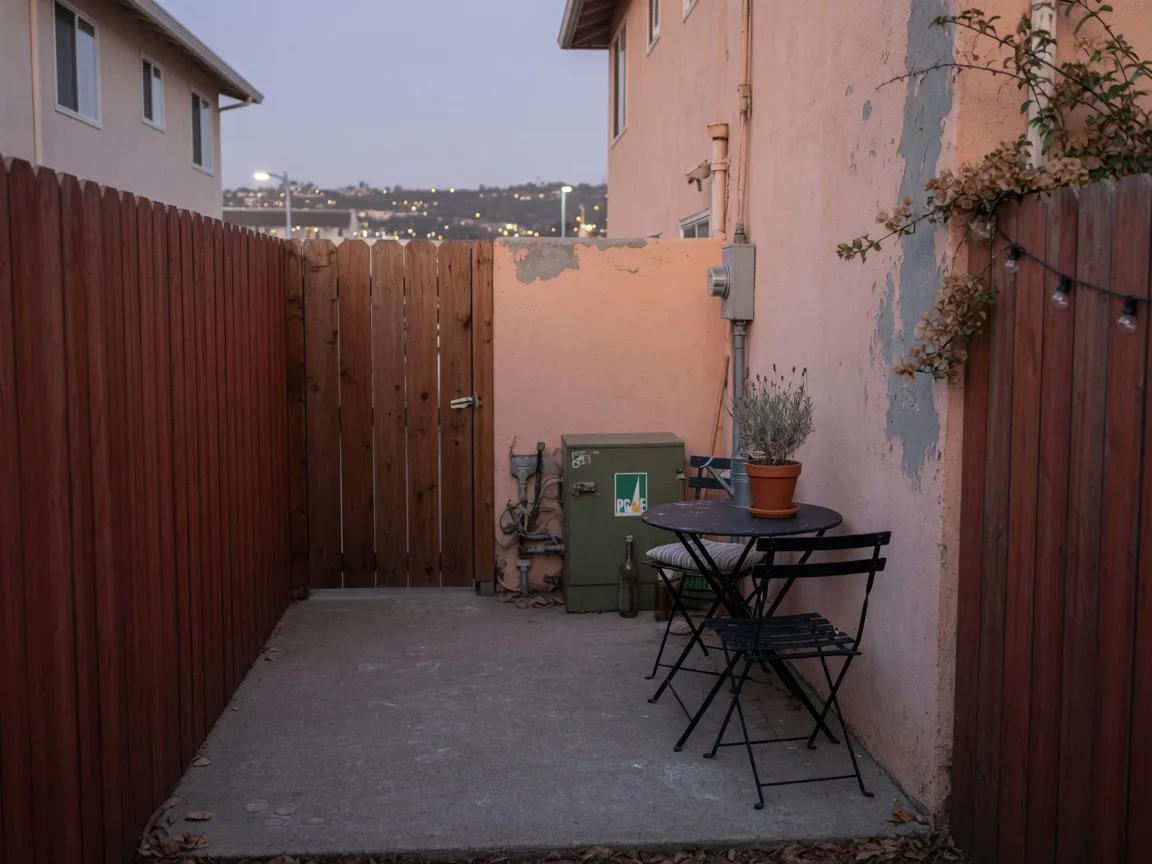
The version you know
A patio that fits a bistro table, a grill, and a plant or two. The '4-foot patio' is deliberate shorthand for the compact private outdoor space many California buyers are accustomed to, not a claim that the typical California patio literally measures four feet. A 2021 StorageCafe analysis of residential-lot data found overall median lot sizes of roughly 2,701 square feet in San Francisco, 6,882 in Los Angeles and 6,534 in San Diego; after the house, setbacks, and driveway, the private outdoor space left is often a strip [1].
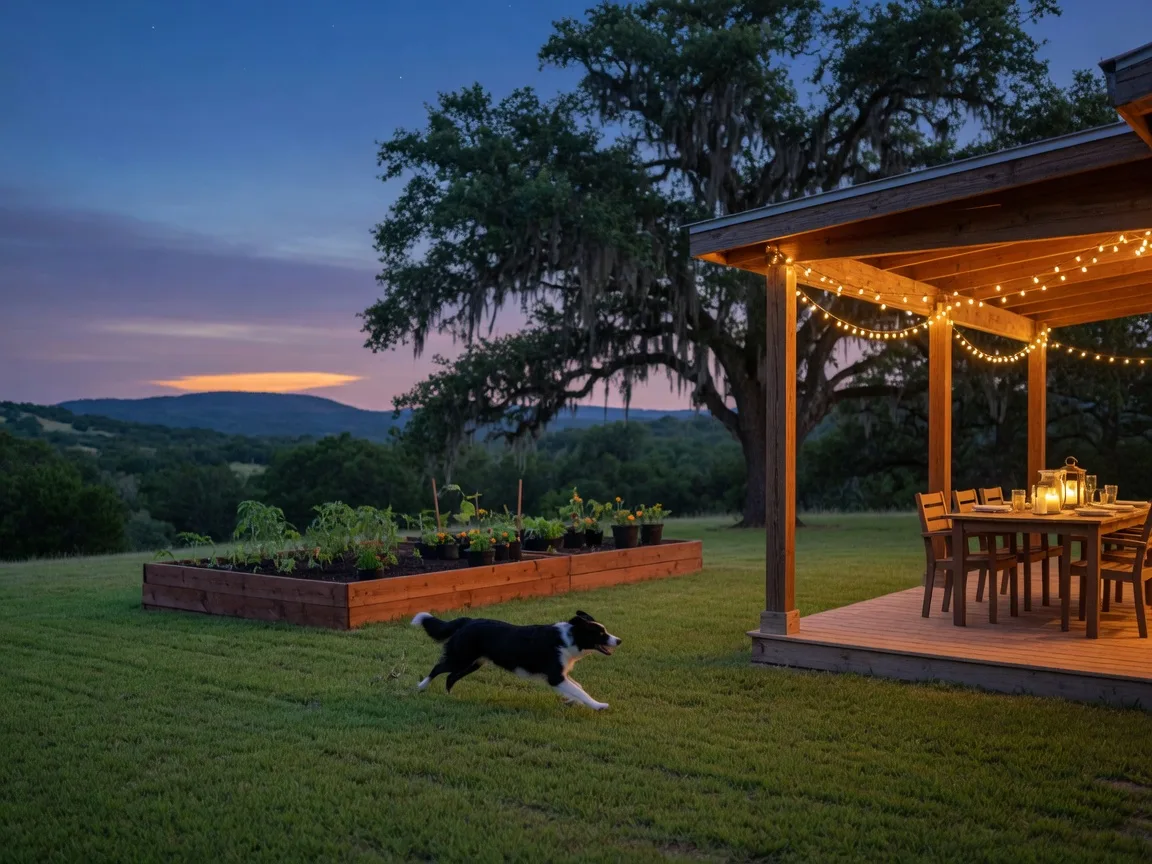
The version ahead
A porch, a yard that fits a six-seat table, a garden, room for the dog, and a horizon. Boerne and Fair Oaks Ranch offer a much wider range of lot sizes than the median alone suggests, including many quarter-acre, half-acre, acre-plus and larger properties. The actual distribution varies substantially by subdivision and location [2][3].
The Table People Save
Here it is, California on the left and the Hill Country on the right. Every line is sourced to the list at the bottom of the page; there is not a single invented saving in here, and I would not insult you with one. This is the table people screenshot and send to the spouse who still thinks the patio is the whole story. Go ahead and keep it. You will want it when the conversation gets real.
| The line | California, the version you know | Texas Hill Country, the version ahead |
|---|---|---|
| Your outdoor room | A patio that fits a bistro table and a grill, or a balcony. A 2021 StorageCafe analysis of residential-lot data found overall median lot sizes of roughly 2,701 square feet in San Francisco, 6,882 in Los Angeles and 6,534 in San Diego. These are historical metro/city comparison data, not 2026 listing statistics; many attached homes have far less private space than the lot [1]. | A porch plus a yard that fits a six-seat table, a garden, a shop, room for the dog, and a horizon [2][3]. |
| Market price context | At coastal California medians far above $1 million, square footage and lot size are the tradeoffs you make [41]. | Zillow's typical home value in Boerne was about $557,000 and about $702,500 in Fair Oaks Ranch as of August 31, 2026 [4][5]. |
| This is a market-context comparison, not a comparison of matched homes at an identical purchase price. | ||
| State income tax | A graduated income tax with a top rate of 13.3 percent, including the 1 percent surcharge on income above $1 million, plus State Disability Insurance withholding on wages | Zero individual state income tax. The modeled difference for a $200,000 married-filing-jointly W-2 household runs approximately $12,500 a year before any local additions [42][31]. |
| Property tax | Prop 13 caps annual growth, but the base value on which you pay is already high | For a Boerne property in Kendall County subject to the City of Boerne, Kendall County, Boerne ISD and Cow Creek GCD, the 2026 combined rate is approximately $1.8635 per $100 of taxable value, assuming Cow Creek GCD adopted its proposed $0.0050 rate. Individual parcels can have different taxing jurisdictions, so verify the actual tax-rate area before calculating a purchase. A $140,000 school homestead exemption helps manage it, and Texas generally limits annual increases in the appraised value of a qualifying residence homestead to 10 percent, plus the market value of new improvements; the limitation applies to appraised value, not directly to the tax rate or the tax bill [7][10][11]. |
| Insurance | A real bill, and wildfire exposure is property-specific and drives coverage availability | Texas homeowners insurance averaged $3,489 statewide in 2025; quote the exact address, including flood where relevant [12]. |
| Summer heat | Mild coastal summers many households take for granted | Genuinely hot June through September; budget the air conditioning and plan outdoor life for morning and evening [13][14][15]. |
| Your first-year project | A new planter you hope survives the year | Porch furniture that stays out, raised beds, a shop, and a pool that finally fits the lot [25][26][27][28][29][39]. |
Tax, Heat, and Insurance Are Operating Costs, Not Deal-Breakers
Ask a California buyer what scares them about Texas and you get the same three names every time: property tax, heat, and insurance. I've heard them from a hundred families, and they're fair questions. So let me be straight with you about each one. Start with property tax. Yes, California's rates are generally lower. But here's the point that actually matters: would you rather pay 1.25% on a $5 million home, or 2% on a nicer, newer, bigger home on a larger lot in an excellent school district for $750,000? To get the equivalent of a $750,000 Texas house in California, you'd have to spend upwards of $4 million, and more in many areas. Run the actual dollars and the picture flips. As an illustrative example with round rates, on a $4 million California home at roughly 1.25%, you're paying about $50,000 a year in property tax before any exemption. On a $750,000 Boerne home at roughly 2%, you're paying about $15,000 a year before exemptions. So yes, California's rate is lower, but you're writing a far bigger check every year on a house that costs several times more, and you get a fraction of the space and lot for it. The rate is not the number that matters. The annual bill is, and that is where the win shows up. The rate is higher, but the house you're paying it on costs a fraction of what it would in California. That is the whole story. For a Boerne property in Kendall County, the 2026 combined rate is about $1.8635 per $100 of taxable value, assuming Cow Creek GCD adopted its proposed $0.0050 rate [7]. On a home near $557,000, that's roughly $10,400 a year before exemptions; the $140,000 school-district homestead exemption trims about $1,400 of it [4][10]. Insurance averaged $3,489 statewide in 2025 [12]. Heat is a season, and the utility line is the bill you plan for [13][14][15].
Here is the part that quietly saves families real money, so I want you to hear it in full. After closing and occupying the property as your principal residence, file with the appraisal district. A buyer who acquires a home after January 1 may qualify for the general residence-homestead exemption for the applicable portion of that tax year if the previous owner did not receive the same exemption for that year and the buyer otherwise qualifies. Your lender's initial escrow analysis may not yet reflect an approved exemption, so confirm the exemption and escrow treatment with both the appraisal district and the lender. Acreage buyers should also ask about agricultural or wildlife-management valuation. It can cut the tax on the land sharply, but it carries qualification rules, an ongoing management plan, and a rollback tax if the use changes. Do not assume a seller's valuation carries over on your terms; confirm it with the appraisal district before you price the land [10].
And now for the two columns that make families breathe easier, and I do not say that lightly. First, take-home: Texas collects no individual state income tax. An explicit 2025 example: a married-filing-jointly household with $200,000 of California W-2 income, using the standard deduction and standard joint personal-exemption credit, would have roughly $10,100 of California personal income tax plus about $2,400 of SDI at the 2025 1.2% rate, approximately $12,500 combined before other adjustments or credits. Actual results vary with deductions, credits, income sources and individual circumstances [42][31]. Second, housing: Zillow's typical home value in Boerne was about $557,000 on August 31, 2026, while coastal California medians sit well above $1 million in the markets this site compares [4][41]. Compare like with like. Put the annual property tax, insurance, and summer electric bill against two annual lines: the state income tax you stop paying, and the smaller mortgage payment on a lower purchase price. In the illustrative household used here, the modeled Texas carrying-cost increase is smaller than the modeled differences in income tax and housing cost. A household's actual result can differ substantially with income, California tax basis, purchase price, mortgage rate, insurance cost, utility use, exemptions and the Texas property's taxing jurisdictions. In raw dollars the property tax line often shrinks too. For a newly purchased $1.4 million San Jose home, the 1% Proposition 13 base levy alone would be about $14,000 annually. Voter-approved debt, special assessments and other parcel-specific charges can increase the actual bill. After a new base-year value is established following a qualifying change in ownership, Proposition 13 generally limits annual increases in assessed value to no more than 2%, absent another reassessable event [46]. A $557,000 Boerne home runs about $9,000 after the school homestead exemption [41]. That arithmetic is the managed version of the win: the carrying costs are real, and the headroom is bigger [34][35][42]. Run it with your own numbers, because every household is different.
Your property tax estimate
Enter the price you are considering and the rate that applies to the exact address. The preset reflects the 2026 combined rate for the specified Boerne taxing jurisdictions, assuming Cow Creek GCD adopted its proposed $0.0050 rate. Your actual rate depends on the parcel's taxing entities. The 2.0 percent line is a common planning range used across the Hill Country for screening. The estimate is before homestead exemptions, which lower the bill.
Estimated annual property tax before exemptions:
Educational estimate only, for planning. Actual tax is set from the property's taxable value and its specific taxing units, and homestead exemptions lower it [10][11]. Verify with the appraisal district before relying on the number.
Tax-rate data: 2026 tax year unless otherwise stated. Verify the taxing jurisdictions for the specific parcel.
Save This Page
I want you to keep this page, and I will tell you why. This is the page you bookmark before you have even picked a town, and the page you pull back up when the two of you sit down to talk budget. Make it annual with two dates, and the tax side of the move stops being a mystery. In April and May, appraisal notices arrive. The protest deadline is generally May 15 or 30 days after the notice is delivered, whichever is later. In August and September, taxing units adopt rates; bills go out in the fall and are generally due by January 31 [45]. Re-run the worksheet once a year, and again before you make an offer. Two dates a year, and you are never caught off guard.
The one-page version
- 2021 StorageCafe research puts typical coastal California overall median lots near 2,701 sq ft in San Francisco, 6,882 in Los Angeles, and 6,534 in San Diego; typical Boerne lots run near 0.46 acre and Fair Oaks Ranch near 0.51 acre in the October 2, 2026 listing-aggregation snapshot, with acreage options to 5-plus [1][2][3].
- Boerne city combined property tax rate: approximately $1.8635 per $100 in tax year 2026 for a Boerne property subject to the City of Boerne, Kendall County, Boerne ISD and Cow Creek GCD, assuming Cow Creek GCD adopted its proposed $0.0050 rate. Individual parcels can have different taxing jurisdictions, so verify the actual tax-rate area. Texas generally limits annual increases in the appraised value of a qualifying residence homestead to 10 percent, plus the market value of new improvements, and the $140,000 school homestead exemption applies [7][10][11].
- Texas homeowners insurance averaged $3,489 statewide in 2025; quote the exact address, including flood where it applies [12].
- First-year outdoor budget: porch furniture $1,500-$3,500, raised beds $200-$1,500 per bed, shop or shed $3,000-$10,000, pool from about $40,000 installed to roughly $119,000 all-in for year one [25][26][27][28][29][39].
- Choose the lifestyle first: HOA lock-and-leave communities versus no-HOA acreage. A no-HOA parcel can provide substantially more latitude for a workshop, trailer, chickens or similar uses, but verify deed restrictions and applicable regulations before assuming a particular use is permitted. Either is legitimate; read the rules before the option period [32][33][56].
- Dogs land easy: Texas does not require a health certificate for dogs or cats entering the state. Most airlines, however, require one issued by a veterinarian within seven to ten days before travel, so check the carrier's exact requirements. Dogs and cats 12 weeks of age or older entering Texas must be currently vaccinated against rabies and accompanied by appropriate vaccination documentation; then six-plus miles of leashed trails at Cibolo Nature Center, Boerne City Lake Park, and the enclosed dog park at Joshua Springs [16][17][18][30][40].
- Re-check twice a year: April-May for the appraisal notice and protest deadline, and September-October when rates are adopted and bills go out [45].
Educational summary; figures are approximate ranges from the sources cited below and change with the market and the exact address. Verify anything you rely on before acting.
Lot-Size Reality: What the Ground Actually Looks Like
Here is the ground truth, and I want you to feel it before you read a number. A typical California lot is small, often under 7,000 square feet in the coastal metros, and in San Francisco it's closer to 2,700 [1][47]. The Hill Country starts where those numbers end: the typical Boerne lot runs about 19,994 square feet, roughly half an acre, and Fair Oaks Ranch about 22,215, roughly half an acre too [2][3]. Five-acre-and-larger parcels are a normal search category in parts of Kendall and Bandera Counties. That is the whole story: the same budget buys you a real yard, and the table below shows what that ground can actually hold.
| Lot | What that much land can physically accommodate |
|---|---|
| 2,701-6,882 sq ft | A small patio or balcony: a bistro table, a grill, and a plant or two. The question of grass never comes up. These are the overall median lot sizes from a 2021 StorageCafe analysis of residential-lot data in San Francisco (2,701 sq ft), Los Angeles (6,882 sq ft), and San Diego (6,534 sq ft), historical comparison data rather than 2026 listings [1]. |
| Roughly 10,900 sq ft (0.25 acre) | A real backyard: a six-seat table set that stays out, a grill area, a swingset, and a garden bed or two, with room left to run. |
| Roughly 21,800 sq ft (0.5 acre) | Everything above plus a shop or large shed, a pool and patio, or a full vegetable garden, without giving up lawn. |
| Roughly 43,600 sq ft (1 acre) | A pool, a shop, a guest-friendly outdoor room, and the trailer or boat parked out of sight. |
| 5+ acres | A workshop, a smoker setup, horses or a hobby farm, kids who disappear for the afternoon, parents who stay two weeks without a hotel. |
Lot-size data: California figures are the 2021 StorageCafe analysis of residential-lot data (historical metro/city comparison data, not 2026 listing statistics) [1]; Boerne and Fair Oaks Ranch figures are from current listing aggregations. Current listing-aggregation snapshot accessed October 2, 2026; figures change as inventory changes. Figures are approximations, not survey measurements, and any one property can differ. Verify the exact parcel with the county before you build on assumptions [2][3].
Four First-Year Space Projects
These are the four things my clients actually build in their first year, and I have watched them change how a family lives in a house. Each one carries an honest, researched cost band, because you deserve to know what something really costs before you fall in love with it. None of them requires a remodel. All of them finally fit on the lot that was waiting for you.
Porch furniture that stays out
$1,500-$3,500
This is the first purchase most of my clients make, and it is the one they mention in their first phone call after closing. A six-seat cushioned dining set built for weather, left out from March through December. On a covered Hill Country porch it lasts years, and the smell of cedar and drying grass replaces the smell of a managed landscape. With a sufficiently deep covered porch, you generally have more flexibility to leave outdoor furniture protected from routine sun and light rain. You will still stow cushions ahead of hail and spring thunderstorms, and quick-dry, solution-dyed fabric is worth the extra cost [25][26].
Raised beds that survive
$200-$1,500 per bed
This is the project that makes the whole yard feel real, and it takes less than people expect before they see dirt. Raised beds avoid much of the excavation required in rocky native soil. Angi's 2026 cost guide puts raised beds broadly around $200-$1,500 each depending on materials, size and labor; soil delivery, irrigation, deer protection and custom fabrication can increase the total. Two to four beds give you a garden that works in year one: tomatoes in June, peppers through October, herbs outside the kitchen door. They do not stop deer: a whitetail clears a raised bed without breaking stride, so in heavy deer country, protect vulnerable vegetables with deer-resistant planting choices, netted hoops or a properly designed garden enclosure [27].
A shop or shed
$3,000-$10,000+
This is where your stuff finally gets to breathe, and the number that surprises California buyers is how cheap covered space is. A 10×12- to 12×20-foot metal building can run roughly $3,000–$10,000 installed, depending on size and finish, before site work and any slab or pad, which are often priced separately. That changes what you can store: bicycles, tools, the smoker and kayaks [28][29]. In a no-HOA parcel it can be the start of a workshop; in a master-planned community, check the architectural guidelines first, and inside city limits confirm whether the building needs a permit.
Before you price any project, pull the survey. Utility and drainage easements, building setbacks, septic drain fields, and floodplain lines decide where a shop or pool can go. A lot that looks like a half-acre of open ground can have far less buildable area. During the option period, ask whether the seller has an existing survey and whether the title company and lender will accept it. Depending on the transaction, an existing survey may be accompanied by a T-47 affidavit or T-47.1 declaration. Changes involving improvements, fences, easements or boundaries can result in a new survey being required [50].
A pool, finally possible
From about $40,000 installed to roughly $119,000 all-in for year one
And now the one everyone asks about, so you deserve the honest version up front. On a quarter-acre or more, a pool stops being a space negotiation and becomes a design decision. Vinyl-liner pools start around $40,000 and fiberglass runs roughly $55,000-$85,000 installed in the San Antonio market. A mid-range gunite pool can require roughly $93,000-$118,000 for the pool itself plus the cited ranges for permits, fencing and basic landscaping, before later property-tax effects [22][23][24][39]. A qualifying new improvement can increase the property's appraised value, but Texas property is generally valued as of January 1; the timing and amount of any increase should be confirmed with the appraisal district. The season is the other half of the math. An unheated Hill Country pool is often usable roughly May through October, depending on weather, shade, water temperature and personal preference, and that longer season lowers the cost per swim [39]. The full build, the operating budget, and the resale picture live in the true-cost article.
The pool sits in its own row because it is a different scale of decision. Read the true cost of a Texas pool for the installed cost, the operating budget, the property-tax effect, and the resale picture before you sign anything [39].
| Project | Typical first-year range (2026 pricing) | The honest notes |
|---|---|---|
| Porch furniture that stays out | $1,500-$3,500 | A durable six-seat cushioned dining set built for weather. With a sufficiently deep covered porch, you generally have more flexibility to leave outdoor furniture protected from routine sun and light rain [25][26]. |
| Raised beds that survive | $200-$1,500 per bed | Raised beds avoid much of the excavation required in rocky native soil. Angi's 2026 cost guide puts raised beds broadly around $200-$1,500 each depending on materials, size and labor; soil delivery, irrigation, deer protection and custom fabrication can increase the total [27]. |
| A shop or shed | $3,000-$10,000+ | A 10x12 to 12x20 metal building installed; site work and any slab or pad costs may be additional. Conditioned workshop space costs more; HOA architectural approval may be required first [28][29]. |
| A pool, finally possible | From about $40,000 installed to roughly $119,000 all-in for year one | Vinyl liner from about $40,000 and fiberglass about $55,000-$85,000 installed; a mid-range gunite pool can require roughly $93,000-$118,000 for the pool itself plus the cited ranges for permits, fencing and basic landscaping, before later property-tax effects [22][23][24][39]. |
Cost bands are researched 2026 ranges for the San Antonio and Hill Country market, not quotes. Site conditions, HOA requirements, contractor selection, and material choices move every line [25][26][27][28][29][39].
Find the Buildable Envelope Before You Commit to the Acreage
Here's something I wish every family heard before their first acreage showing: an acre on paper isn't always an acre you can use the way you expect. I've watched people fall in love with a lot and then realize the only buildable corner is the one holding the septic field. So before your option period ends, take an hour to map the property's practical buildable envelope. It may be the most valuable hour you spend on this whole move.
That hour covers the things that matter: survey boundaries, easements and setbacks; any floodplain or drainage; where the septic, drain field and reserve sit (or where a future system could go); whether water comes from a utility or a well; the recorded deed restrictions even with no HOA; slope and limestone; electric, propane, broadband and driveway access; and property-specific insurance quotes. It sounds like a lot, but it's really just making sure the acre you're buying is the acre you can actually use. That's the acre worth paying for, and it's the one that will let you enjoy the move instead of stress about it later.
HOA or No HOA: A Menu, Not a Scare
Let me clear up one of the biggest misunderstandings I hear from families, because it decides which side of the line you belong on. On a no-HOA parcel, you may avoid an HOA architectural-review committee, but 'no HOA' does not mean 'no restrictions.' Recorded deed restrictions, easements, setbacks, septic requirements, floodplain rules, utility requirements, road-access agreements and applicable city or county regulations can still control what you build and where [56].
The HOA question is really two lifestyles, and neither one is wrong. I have helped wonderful families choose both, and I can tell you the choice comes down to who you are, not who is right. The lock-and-leave life lives in the master-planned communities of Boerne and Fair Oaks Ranch: maintained common areas, gates, consistent streets, and rules that keep the neighborhood tidy while you travel for work or pleasure. The workshop-and-trailer life lives on the no-HOA parcels in unincorporated Kendall, Comal, and Bandera Counties: the shop goes up without a review, the trailer parks where it fits, and you own every maintenance duty the community would otherwise share, including the well and the septic where they apply [33]. Acreage also brings county burn bans and wildfire exposure. County burn bans can restrict outdoor burning during periods of elevated fire risk, and individual orders may impose additional restrictions. Check the current county order before burning brush or performing outdoor hot work because the rules and status can change quickly.
Here is the practical rule I give every family, and it will save you months of frustration: pick the lifestyle first, then read the HOA documents before the option period ends. The table below is the honest menu of what each side of the line allows. Find your project on it, and you will know which world you belong in.
| Hobby or project | HOA-friendly | Acreage-friendly |
|---|---|---|
| Raised garden and vegetables | Usually yes; some HOAs restrict front-yard planting | Usually; verify recorded restrictions and site constraints. |
| Six-seat outdoor dining and a smoker | Yes, with the ordinary setback and enclosure rules | Usually; comply with current fire restrictions and applicable setbacks. |
| Swimming pool | Yes, with architectural review, barrier rules, and often specific fence standards | Potentially; verify permitting/barrier requirements, septic location, easements, setbacks and floodplain constraints. |
| Wood shop or large shed | Often size-limited; approval required for detached buildings | Potentially; verify deed restrictions, easements, setbacks, septic/floodplain constraints and applicable permits. |
| Boat, RV, or trailer | Usually must live in the garage, if the garage fits it | Potentially; verify recorded restrictions and applicable local rules. |
| Chickens | Many HOAs say no | Potentially; verify deed restrictions and applicable local rules. |
| A dog with room to run | Yes, with leash rules and a fenced yard | Generally compatible with larger private lots; use secure fencing and comply with applicable animal-control requirements. |
Read the actual covenants, not the summary. HOA rules vary community by community, and the fine print on accessory buildings, boat and trailer parking, and fencing is where families discover whether their project list survives. Your agent should hand you the HOA documents during the option period; if they do not, ask [32].
The Dogs Get a Yard, Too
I have a soft spot for this section, because for so many of the families I work with, the dog is not a complication; the dog is the argument. A California renter with a 60-pound dog spends every rental application proving the dog is an asset. In the Hill Country, the yard settles it: on a quarter-acre or more, the dog gets a fenced zoomies lane, a shady spot under the live oak, and a walk that starts at your own back door. Picture that for a second, because it is a real part of the win.
And the room for your dog extends well past your own fence. Cibolo Nature Center in Boerne has more than six miles of trails through prairie, marsh, creek and woodland. The trails are free and open from dawn to dusk daily, and dogs must remain leashed [16]. Boerne City Lake Park adds a lake, trails, and open space under posted pet rules; admission is free for city residents and $10-$20 a day for everyone else [17]. Kendall County's Joshua Springs Park & Preserve, on FM 289 between Boerne and Comfort, encompasses 365 acres and includes eight miles of multi-use trails, a nine-acre lake and a two-acre off-leash dog park [18].
And the trip itself is easier than you fear. The move itself is mechanical and well-trodden. Texas does not require a health certificate for dogs or cats entering the state. Most airlines, however, require one issued by a veterinarian within seven to ten days before travel, so check the carrier's exact requirements. Dogs and cats 12 weeks of age or older entering Texas must be currently vaccinated against rabies and accompanied by appropriate vaccination documentation [30]. Driving the I-10 corridor is a two- or three-day trip with pet-friendly hotels along the way. The full checklist, airline rules, vaccine timing, and vet handoff in Boerne live in the moving with pets guide [40].
What Else Lives on the Lot
One of the best parts of a Hill Country lot is the company it comes with. Texas has an abundance of wildlife, and the only real downside is that deer love to eat almost anything. If you like to garden, just plan for fences, deer-resistant planting choices, or netted hoops, and your garden will do fine.
The rest is easy to live with once you know it: keep brush and woodpiles away from the house, ask your vet about year-round heartworm and tick prevention, and if you have a dog, rattlesnake-avoidance training is a fun, useful class. Fire ants and scorpions come with the ground here, and simple habits keep them out of your way. Your live oaks are the shade you bought the lot for, and they stay healthy with one simple habit: Texas A&M Forest Service recommends avoiding oak pruning and other unnecessary oak wounds during the highest-risk period, generally February through June, and painting fresh oak wounds right away [51]. If anyone in the family has allergies, know that mountain cedar (Ashe juniper) pollen peaks from December into February. Newcomers call it cedar fever, but it's seasonal, predictable, and manageable. None of this should scare you. It's all just part of what makes the Hill Country feel alive, and it's all stuff you can plan around and enjoy.
Quiet and Dark Skies: The Luxury People Used to Rent
I want to tell you about something I see every single year, because it is the closest thing I know to a preview of your future life here. There is a cohort of buyers every year who drive three hours to a rented cabin, pay for a weekend, and sit on a porch listening to nothing. That weekend is the most honest preview of normal life here. A larger lot often creates more separation from neighbors, but road noise and surrounding land uses vary. Visit the property at different times of day, including commute hours, before assuming it will be quiet. Lots backing onto I-10, FM 3351, or a busy collector road are the exception, so stand in the backyard at rush hour before you write the offer [2][3].
And the dark skies are not a marketing line; they are certified. Enchanted Rock State Natural Area, about an hour and a half from Boerne, is an International Dark Sky Park, and South Llano River State Park near Junction, about an hour and a half west on I-10, is a Gold-tier International Dark Sky Park [19][20]. Fredericksburg (designated 2020) and Blanco (designated 2022), each roughly 40 miles from Boerne by road, are International Dark Sky Communities. They belong to a Hill Country cluster that also includes Dripping Springs, Horseshoe Bay, and the Wimberley Valley [21]. Closer to San Antonio, the city's glow washes out the faint stars. In darker portions of the Hill Country, the Milky Way can be visible under clear, moonless conditions, but visibility varies with local lighting, weather, haze and lunar phase. People used to drive hours to rent that.
The Pillar Pages That Go Deeper
This article is the space and lifestyle version of the decision, the one you read at the kitchen table. The full columns, with more tables and more math, live on these four pages. Follow the ones that keep pulling at you; that pull is telling you something, and it is worth listening to.
California vs Texas cost of living
Housing, taxes, insurance, utilities, fuel, and groceries side by side, with the annual-savings ranges [34].
Open the comparisonProp 13 vs Texas property tax
Assessment caps compared with the $140,000 homestead exemption, Texas's 10 percent appraised-value growth limit on a residence homestead, and the protest process [35].
Open the tax guideSchools and education
Boerne ISD, Comal ISD, and Northside ISD ratings, funding, transfers, and how Texas schools compare with California [36].
Open the schools guideNeighborhoods and communities
Boerne and Fair Oaks Ranch, subdivision by subdivision, with price ranges, lot sizes, HOAs, and schools [32].
Open the community guideKeep reading from here: the month-by-month lifestyle calendar [37], the climate and what to expect guide [38], the water and infrastructure guide [33], the house article for the price-band shopping math [41], and the zero-state-income-tax article for the take-home column [42].
If You Are Coming From Somewhere Else
Maybe you are not coming from California at all, and I want you to know this article is still yours. California is the primary comparison on this site, but the same worksheet can be used from any origin market. The important point is not to generalize from a state name: income taxes, property taxes and housing costs need to be modeled separately. That is the only honest way to compare, and it is exactly how I would run it with you.
- From New York: New York has a graduated individual income tax with a top marginal state rate of 10.9%; New York City residents can also owe city income tax [31]. Because housing costs vary enormously across New York, compare the specific origin market with the specific Hill Country destination rather than applying a statewide housing assumption.
- From New Jersey: New Jersey has a graduated individual income tax with a top marginal rate of 10.75% [31]. Tax Foundation's 2026 property-tax comparison, using 2024 owner-occupied housing data, reports an effective property-tax rate of 1.88% for New Jersey [57]. A Texas comparison should still be run using the actual purchase price, exemptions and taxing jurisdictions for the Texas property.
- From Illinois: Illinois imposes a 4.95% individual income tax [31]. Tax Foundation's 2026 analysis reports a 1.88% effective property-tax rate on owner-occupied housing using 2024 data [57]. Do not assume that moving to Texas automatically produces property-tax savings; compare the actual properties and tax bills.
- From Washington: Washington does not impose a broad individual income tax on wages [31], so eliminating wage income tax is not the principal comparison. Housing may be. Zillow's typical Seattle home value was approximately $833,000 as of August 31, 2026 [58], versus approximately $557,000 in Boerne using the same metric and date [4].
- From Colorado: Colorado imposes a flat individual income tax [31], but housing should be compared market by market. Zillow's typical Denver home value was approximately $525,000 as of August 31, 2026 [59], slightly below Boerne's approximately $557,000 [4]. A Denver-to-Boerne move therefore should not be presented as automatically producing a housing-price advantage.
Frequently Asked Questions
These are the questions that come up every single time a family runs this space math for real, the ones that keep people up at night and the ones they are too polite to ask first. I have answered all of them at real kitchen tables, and here they are, answered the way I would answer them sitting across from you.
Won't Texas property taxes eat the space advantage?
They are the single most important line to model, and they are manageable. For a Boerne property in Kendall County subject to the City of Boerne, Kendall County, Boerne ISD and Cow Creek GCD, the 2026 combined rate is approximately $1.8635 per $100 of taxable value, assuming Cow Creek GCD adopted its proposed $0.0050 rate. Individual parcels can have different taxing jurisdictions, so verify the actual tax-rate area before calculating a purchase [7]. On a typical-value Boerne home near $557,000, the before-exemption bill is roughly $10,400 a year; the mandatory $140,000 school-district homestead exemption trims about $1,400 of that, and qualifying owners aged 65 or older or disabled get another $60,000 school exemption plus a ceiling that freezes their school taxes [4][10]. Texas generally limits annual increases in the appraised value of a qualifying residence homestead to 10 percent, plus the market value of new improvements. The limitation applies to appraised value; it does not directly cap the tax rate or the resulting tax bill, and you can protest a value you believe is wrong [11]. Pair that with zero state income tax, and in this modeled example the housing-price and take-home gaps land ahead [42]. The full walk-through is in the Prop 13 vs Texas property tax guide [35].
How hot is it really, and do we lose the outdoor life?
Genuinely hot, and you should not pretend otherwise. San Antonio's 1991-2020 normals put the average August high near 97 degrees, and Boerne's August average high runs near 94 [13][14]. The number that surprises people is frequency: San Antonio averaged roughly 10 days at 100 degrees a year in the historical record and about 26 a year over the past couple of decades [15]. The answer is not to give up outdoors; it is to shift it. Morning coffee and evening dinners outlast the afternoon, a pool turns late June through August into the best months, and the Hill Country's mild fall, winter, and spring are longer than most people expect. The full seasonal picture is in the what to expect guide [38] and the month-by-month lifestyle calendar [37].
Is a no-HOA acreage lot worth the tradeoffs?
It depends entirely on your lifestyle, which is why I treat it as a menu. A master-planned community with an HOA delivers maintained common areas, gates, and consistent streets, and it sets rules: architectural approval for sheds and pools, and usually no boat or trailer parked in the drive. An unincorporated Kendall, Comal, or Bandera County parcel can provide substantially more latitude for a workshop, trailer, chickens or similar uses, but verify deed restrictions and applicable regulations before assuming a particular use is permitted [56]; it also hands you the maintenance, the septic, and sometimes the well [33]. Read the HOA documents before the option period and decide which set of freedoms matters more. Both are legitimate; the mistake is picking one and not reading the rules.
Can we realistically build a pool in year one?
Yes, with planning and on the right lot. Vinyl-liner pools start around $40,000 and fiberglass runs roughly $55,000-$85,000 installed; a mid-range gunite pool can require roughly $93,000-$118,000 for the pool itself plus the cited ranges for permits, fencing and basic landscaping, before later property-tax effects [22][23][24][39]. Pool-access and barrier requirements depend on the property's jurisdiction and applicable code. Inside a municipality, the applicable municipal swimming-pool and spa code and local amendments govern; deed restrictions, HOA requirements and insurer standards can impose additional requirements. Do not assume that Texas Health and Safety Code Chapter 757 creates a universal 48-inch-fence requirement for every private single-family pool. Confirm the requirements for the exact address before design or construction [39]. Budget the operating line too: chemicals, electricity, and equipment reserves run roughly $1,500-$3,800 a year before any heating [39]. The true cost of a Texas pool is the article to read before you commit to the water [39].
What does a typical Boerne or Fair Oaks Ranch lot actually mean for a family?
Listing-data medians put the typical Boerne lot near 19,994 square feet, roughly 0.46 of an acre, and the typical Fair Oaks Ranch lot near 22,215 square feet, about 0.51 of an acre, with many homes on larger tracts and Boerne's average pulled much higher by acreage parcels. Current listing-aggregation snapshot accessed October 2, 2026; figures change as inventory changes [2][3]. For a family of four, a half-acre means the swing set and the garden and still-an-open lawn. A one-acre estate lot adds the shop or the pool without crowding anything. If your plan includes horses, a workshop, or serious distance from neighbors, that is the Bandera and Kendall County acreage market, where five-acre-and-larger parcels are a normal search category, although prices vary widely with location, improvements, utilities, restrictions, water, access and terrain [32]. Schools follow the exact address, so confirm the assignment before you commit [36].
How do the dogs make the trip, and will they have room here?
Yes on both. Texas does not require a health certificate for dogs or cats entering the state. Most airlines, however, require one issued by a veterinarian within seven to ten days before travel, so check the carrier's exact requirements. Dogs and cats 12 weeks of age or older entering Texas must be currently vaccinated against rabies and accompanied by appropriate vaccination documentation [30]. Drive time is easier than people expect: the I-10 corridor from Southern California to Boerne is a two- or three-day trip with pet-friendly hotels. Once you land, the yard is the story. Cibolo Nature Center has more than six miles of trails with leashed dogs welcome [16]; Boerne City Lake Park adds a lake and open space [17]; and Kendall County's Joshua Springs Park and Preserve has an enclosed dog park [18]. On a half-acre, the dog gets a zoomies lane. The full logistics, airline rules, and vet checklist are in the moving with pets guide [40].
We are renters in California. Does any of this apply to us?
It applies most of all. Rent provides housing and flexibility but does not build home equity. Buying can build equity over time, but the comparison should include the full cost of ownership: principal, interest, property tax, insurance, HOA dues where applicable, maintenance, closing costs and the opportunity cost of the down payment. The question is whether the same monthly number, or one close to it, buys space and ownership here. The Texas State Affordable Housing Corporation offers down-payment-assistance programs subject to program-specific income, credit and underwriting requirements. Purchase-price limits depend on the particular program: TSAHC's stand-alone Non-Bond DPA does not have a purchase-price limit, while Bond DPA and MCC transactions are subject to applicable purchase-price rules. Check the current program requirements with a participating lender [60]. The state's zero income tax also improves the take-home side of the budget [42]. Run the worksheet on this page with the purchase price you can actually reach, add the property tax, insurance, and utility lines, and compare it with your current rent. The renter-to-owner math, with the programs and the honest month-one costs, is laid out in the house article [41].
Part Three: Keeping the Win
How to Keep the Win
Here is the part I am most glad to give you, because it is the difference between a move that works and a move that works beautifully. The win is real, and it is yours to keep. These seven steps are not warnings; they are the way the win gets locked in, done once and up front so it pays off for years. Think of them as the way you make sure the life you are moving toward actually arrives. Walk them in order and the patio-for-yard trade works exactly the way it should.
- 1
Confirm the exact address's taxing units, and the tax line becomes a number you planned for.
For a Boerne property in Kendall County subject to the City of Boerne, Kendall County, Boerne ISD and Cow Creek GCD, the 2026 combined rate is approximately $1.8635 per $100 of taxable value, assuming Cow Creek GCD adopted its proposed $0.0050 rate. Individual parcels can have different taxing jurisdictions, so confirming the actual tax-rate area before you calculate is how the estimate becomes the bill you already planned for [7]. Outside city limits there is no city levy, but county, school, groundwater, emergency-services and other applicable special-district taxes may still apply, which is exactly why you confirm the address rather than applying a generic Hill Country percentage. Then the management tools do their work: the mandatory $140,000 school-district homestead exemption, and Texas generally limiting annual increases in the appraised value of a qualifying residence homestead to 10 percent, plus the market value of new improvements. The limitation applies to appraised value; it does not directly cap the tax rate or the resulting tax bill, and knowing that is how you plan with confidence [10][11]. The full walk-through is in the Prop 13 vs Texas property tax guide [35].
- 2
Quote the exact address, including flood, and insurance becomes a known line.
Texas homeowners insurance averaged $3,489 per year statewide in 2025, and the way to make that average work for you is a property-specific quote [12]. Near a river or any creek, check the FEMA flood map and quote flood separately, because Hill Country water rises fast. FEMA's mapped Special Flood Hazard Areas are not the whole risk picture; drainage paths, low-water crossings, steep terrain and properties outside mapped high-risk zones still warrant property-specific review, and doing that review before the option period ends is how the coverage is right when you need it. NFIP flood-insurance policies generally take effect 30 days after purchase, with important exceptions, including certain coverage purchased while making, increasing, extending or renewing a mortgage; confirm the timing for your particular transaction with the flood-insurance carrier or agent, and the win stays covered [49].
- 3
Plan the day around morning and evening, and the outdoor life stays yours.
June through September is genuinely hot, the air conditioning runs hard, and the summer electric bill is the one every newcomer notices [13][14][15]. The way you keep the heat from taking anything from you is to budget the utility line, buy a house with good insulation and shade, and plan the day around morning and evening. The outdoor life does not go away; it shifts hours.
- 4
Read the HOA documents early, and your project list moves through on the first pass.
In a master-planned community, the shed, the pool, the fence, and even the color of the raised beds can require architectural review. The way to keep those projects on track is simple: read the HOA documents before you commit and decide which freedoms you actually need. The menu in this article is there to help you pick the right side of that line.
- 5
Read the water and infrastructure guide, and the acreage stays a win.
Out in the county, bigger lots often mean a private well, a septic system, and your own water quality and maintenance duties [33]. That is not a reason to avoid acreage; it is a reason to come into it knowing the plan, which is what the water and infrastructure guide gives you before you commit to a 10-acre view.
- 6
Check the serving utility's current drought stage when you plan, and the yard stays green through a dry year.
Water supply depends on the address and serving utility, and knowing which one serves you is the first step. Boerne uses both surface water and groundwater: in 2025, approximately 65% of its supply came from Canyon Lake through GBRA, 14% from Boerne Lake and 21% from groundwater [54]. Fair Oaks Ranch uses Trinity Aquifer wells together with treated surface water purchased from GBRA [55]. Drought restrictions are imposed by the applicable utility or groundwater district and are staged, so checking the current drought stage before you plan major landscaping or schedule a pool fill keeps those plans on schedule [52][53]. Fair Oaks Ranch's current drought plan, for example, limits irrigation to once every other week in Stage 3 and prohibits sprinkler/irrigation-system landscape watering in Stage 4. Stage 4 also restricts new pool permits and requires pools already under construction to be filled from a source other than Fair Oaks Ranch Utilities [52]. On well-served property outside the cities, drought restrictions and well rules come from the applicable groundwater district, such as Cow Creek GCD [53], and the seller's well log with recent yield and water-quality tests tells you what you are working with [33].
- 7
Confirm appraisal timing with the appraisal district, and the tax plan lands on schedule.
After you close and occupy the property as your principal residence, file for the homestead exemption with the appraisal district, and confirm the exemption and escrow treatment with both the appraisal district and the lender, because the exemption is the biggest single lever on the annual bill [10]. And because a qualifying new improvement can increase the property's appraised value and Texas property is generally valued as of January 1, confirm the timing and amount of any appraisal increase with the appraisal district before you price a new pool or shop. Done that way, the improvement adds to the yard, not to the surprise [39].
What to Do Next
So let me bring all of this back to you, because I want you to leave this page with a clear picture, not a fog of numbers. Here is where all of that leaves you. You trade a patio for a lot; you trade a state income tax for a property tax you can lower with the homestead exemption, limit with the 10 percent appraised-value growth limit, and protest every spring. If you itemize deductions, eligible real-property taxes may be deductible for federal income-tax purposes, subject to the combined state-and-local-tax deduction limit and other applicable federal rules. You trade mild summers for real ones with a longer fall, winter, and spring; and you trade the noise for quiet and dark skies you used to rent by the weekend [2][3][7][10][11][12][13][14][15][19][20][21][42]. The space is not a footnote to the move. For most of the families I work with, it is the move.
The next step is not a sales call, and I want you to hear that clearly. It is a conversation, and it is how the move plan gets started. The Start Here page walks you through building that plan in order, and the city comparison page lays the communities side by side. When you are ready to talk specifics, reach out to Bill Ross at Hill Country Homesteads Group, brokered by Keller Williams Boerne, for a no-pressure conversation about your situation, your lot-size questions, and your timeline. I coordinate California-to-Texas purchases through a direct network of more than 1,100 California real-estate agents, so your California side and your Texas side move on the same schedule.
Reach me through the contact page, by email at Bill@HillCountryHomesteads.com, or by phone at (210) 294-9190 during business hours, 8 AM to 6 PM Central, Monday through Friday. The brokerage is at 116 Herff Rd, Suite 203, Boerne, TX 78006. There is no pressure and no pitch; there is just a real conversation with someone who has helped a lot of families make this exact move.
The same framework lives across the two sister sites: hillcountryhomesteads.com carries the Boerne and Kendall County market work, and texasprobatehomes.net covers the estate and probate side of a cross-state move [43][44].
And the last thing, the note I want you to carry out of this article: the move to Texas is a big positive. It is a trade you make on purpose, with the real numbers in your hand, for a yard your family will live in every single day, a porch that holds a dinner table, and a sky that goes dark at night. That is the win, and it is closer than the spreadsheets make it feel.
Sources
Official and primary sources are used for tax, insurance, climate, park, dark-sky, and pet-travel facts wherever available. Market measures (lot sizes, prices, project costs) rely on the dated secondary sources identified below and should be read as researched ranges rather than quotes or survey measurements. Each source is labeled primary or secondary.
- Lot Sizes and Home Sizes in Top 20 Biggest US Cities (2021) : StorageCafe / Point2 study (secondary): 2021 analysis of residential-lot data; overall median lot sizes approximately 2,701 sq ft in San Francisco, 6,882 in Los Angeles, and 6,534 in San Diego; historical metro/city comparison data, not 2026 listing statistics. www.storagecafe.com/blog/lot-size-home-size-in-top-20-biggest-us-cities/
- Boerne, TX real estate lot-size data : Barlowe Daly Realty listing aggregation (secondary): median Boerne lot approximately 19,994 sq ft (about 0.46 acre). Current listing-aggregation snapshot accessed October 2, 2026; figures change as inventory changes. barlowedaly.com/boerne-TX
- Fair Oaks Ranch, TX lot-size data : Glass Realty Group listing data (secondary): median Fair Oaks Ranch lot approximately 22,215 sq ft (about 0.51 acre). Current listing-aggregation snapshot accessed October 2, 2026; figures change as inventory changes. glassrealtygrp.com/neighborhood/157200561/Fair-Oaks-Ranch-TX
- Boerne, TX home values : Zillow Home Value Index (ZHVI), secondary: typical Boerne home value approximately $557,428 as of August 31, 2026. www.zillow.com/home-values/8154/boerne-tx/
- Fair Oaks Ranch, TX home values : Zillow Home Value Index (ZHVI), secondary: typical Fair Oaks Ranch home value approximately $702,497 as of August 31, 2026. www.zillow.com/fair-oaks-ranch-tx/
- Boerne, TX housing market : Redfin (secondary): median sale price approximately $504,666 (all home types) as of August 2026, with the three-month average price near $544,000. www.redfin.com/city/2371/TX/Boerne/housing-market
- City of Boerne Current Tax Rates, Tax Year 2026 : City of Boerne (primary): combined rate inside Boerne city limits $1.8645 per $100 in tax year 2025, comprising City of Boerne $0.4716, Kendall County $0.3770, Boerne ISD $1.0109, and Cow Creek Groundwater Conservation District $0.005; for tax year 2026 the City of Boerne adopted $0.4790 (Sept. 8, 2026), Kendall County's 2026 rate table shows a county component of $0.3730 with the 2026 Cow Creek GCD row not yet populated in the available public material, and Boerne ISD adopted $1.0065; the 2026 combined figure of $1.8635 per $100 used in this article assumes Cow Creek GCD adopted its proposed $0.0050 rate, which should be confirmed with the district or Kendall Central Appraisal District before treating the combined figure as final. www.ci.boerne.tx.us/646/Current-Tax-Rates · www.boernestar.com/article/14091,boerne-oks-164-million-budget
- Bexar County 2025 Official Tax Rates and Exemptions : Bexar County (primary): total 2025 county rate approximately $0.30 per $100. www.bexar.org/4032/2025-Official-Tax-Rates-Exemptions
- Comal County Tax Rates : Comal County (primary): 2025 adopted county rate $0.305015 per $100. www.comalcounty.gov/372/Tax-Rates
- Residence Homestead Exemptions : Texas Comptroller of Public Accounts (primary): mandatory $140,000 school-district residence homestead exemption, plus an additional $60,000 school-district exemption for qualifying owners aged 65 or older or disabled. comptroller.texas.gov/taxes/property-tax/exemptions/
- Residence Homestead Appraisal Limitation : Texas Comptroller of Public Accounts (primary): appraised value of a residence homestead generally may not increase more than 10 percent per year, subject to statutory timing and new-improvement rules. comptroller.texas.gov/taxes/property-tax/valuing-property.php
- Texas Homeowners Insurance Market Overview : Texas Department of Insurance (primary): statewide average homeowners premium of $3,489 for 2025; statewide average only, not a property-specific quote. www.tdi.texas.gov/general/texas-homeowners-insurance-market-overview.html
- San Antonio Average Temperature by Month : Extreme Weather Watch, NOAA 1991-2020 normals (secondary): San Antonio average August high approximately 96.7 degrees F; average July high approximately 95. www.extremeweatherwatch.com/cities/san-antonio/average-temperature-by-month
- Boerne Climate and Demographics : City of Boerne (primary): average July high in Boerne roughly 92-93 degrees F, with August the hottest month near 94; lows in the low 70s. www.ci.boerne.tx.us/2101/Climate-and-Demographics
- San Antonio triples average for 100-degree days in 30 years : San Antonio Express-News (secondary): San Antonio historically averaged about 10 days at or above 100 degrees per year, and about 26 a year over the past two decades. www.expressnews.com/san-antonio-weather/article/triple-digit-heat-100-degree-days-frequency-19577793.php
- Cibolo Nature Center : Cibolo Center for Conservation (primary): more than six miles of trails through five ecosystems; trails free and open dawn to dusk daily; dogs must remain leashed on the trails. cibolo.org/locations/cibolo-nature-center/
- Boerne City Lake Park : City of Boerne (primary): lake and park with fishing (license required), trails, 18-hole disc golf, and a covered playground; open 5 a.m. to 10 p.m.; free for city residents, $10-$20 daily entry otherwise. www.ci.boerne.tx.us/169/Boerne-City-Lake-Park
- Joshua Springs Park and Preserve : Kendall County (primary): Joshua Springs Park & Preserve encompasses 365 acres on FM 289 between Boerne and Comfort, with eight miles of multi-use trails, a nine-acre lake, and a two-acre off-leash dog park; Visit Boerne (secondary): directory listing for the park. www.co.kendall.tx.us/facilities/facility/details/Joshua-Springs-Park-Preserve-9 · www.visitboerne.org/directory-listing/joshua-springs-park-and-preserve
- Enchanted Rock State Natural Area, International Dark Sky Park : DarkSky International (primary): Enchanted Rock State Natural Area is certified as an International Dark Sky Park. darksky.org/places/enchanted-rock-state-natural-area-dark-sky-park/
- South Llano River State Park, International Dark Sky Park : Texas Parks and Wildlife Department (primary): South Llano River State Park designated a Gold-tier International Dark Sky Park in 2017. tpwd.texas.gov/state-parks/south-llano-river
- Dark Sky Communities in the Texas Hill Country : Hill Country Alliance (secondary): Fredericksburg (designated 2020) and Blanco (designated 2022) are International Dark Sky Communities in a Hill Country cluster that also includes Dripping Springs, Horseshoe Bay, and the Wimberley Valley. hillcountryalliance.org/stargazing-under-texas-dark-skies/
- Average Cost of a Pool in Texas, 2026 : TexasUpdates.com (secondary): in-ground pools in Texas generally range from about $40,000 to $150,000-plus. texasupdates.com/average-cost-of-a-pool-in-texas/
- How Much Does a Custom Gunite Pool Cost in Texas in 2026? : Texas Pools (secondary): typical San Antonio-area gunite pools run roughly $50,000-$100,000, with larger custom builds higher. www.texaspools.com/how-much-does-a-custom-gunite-pool-cost-in-texas-in-2026/
- Fiberglass Pool Cost in San Antonio, New Braunfels and Seguin, 2026 : Copano Pools (secondary): fiberglass pools installed in the San Antonio market roughly $55,000-$85,000; vinyl-liner pools start lower. copanopools.com/fiberglass-pool-cost-in-san-antonio-new-braunfels-seguin-2026-pricing-guide/
- Patio Furniture Costs: Budgeting Tips Guide : Purple Leaf (secondary): a good-quality six-seat outdoor dining set with cushions typically runs about $1,000-$4,000, with most buyers in the $1,500-$3,500 range. purpleleafshop.com/blogs/news/patio-furniture-costs-budgeting-tips-guide
- How Much Does High Quality Patio Furniture Cost? 2026 Investment Guide : Tropicraft Patio (secondary): premium six-seat sets run roughly $2,600-$4,300, aluminum sets about $1,200-$3,000. www.tropicraftpatio.com/post/how-much-does-high-quality-patio-furniture-cost-a-2026-investment-guide
- Angi Cost Guides: Raised Garden Beds and Sheds : Angi (secondary): Angi's 2026 raised-bed cost guide reports a broad range of roughly $200-$1,500 per raised bed depending on materials, size, labor and features, and does not publish a specific 4x8 package price; shed assembly guides put typical installed steel sheds around $1,500-$7,000. www.angi.com/articles/what-would-be-cost-hire-6x8-metal-shed-assembly.htm · www.angi.com/articles/flowerbed-installation-cost.htm
- Metal Building Prices : BuildingsGuide (secondary): installed turnkey steel buildings run roughly $24-$43 per square foot, meaning about $2,900-$5,200 for a 10x12 and roughly $5,800-$10,300 for a 12x20 before interior finishing. www.buildingsguide.com/metal-building-prices/
- 12x20 Metal Garage Building Installed : Alan's Factory Outlet (secondary): turnkey 12x20 steel garage and shop buildings list from about $3,540-$4,190 installed before site work. alansfactoryoutlet.com/product/12x20-regular-style-metal-garage/
- Animal Import and Export Requirements : Texas Department of State Health Services (primary), supplementing federal USDA entry rules: a Certificate of Veterinary Inspection is not required for dogs and cats entering Texas; dogs and cats 12 weeks of age or older must be currently vaccinated against rabies and accompanied by a current rabies vaccination certificate; airlines independently require a veterinarian-issued health certificate within seven to ten days of travel. www.dshs.texas.gov/notifiable-conditions/zoonosis-control/laws/animal-import-export-requirements
- Tax Foundation State Individual Income Tax Structures : Tax Foundation (secondary): California maintains the highest top marginal state income tax rate; New York's top rate is 10.9 percent with an additional New York City resident tax; New Jersey's top rate is 10.75 percent; Illinois uses a 4.95 percent flat rate; Colorado uses a 4.4 percent flat rate; Washington has no broad income tax on wages. taxfoundation.org/data/all/state/state-income-tax-rates-2026/
- Neighborhoods: Boerne, Fair Oaks Ranch, and the Hill Country : MoveToTexas.net pillar page (secondary, internal): community profiles, price ranges, lot sizes, HOAs, and schools. movetotexas.net/neighborhoods/
- Water and Infrastructure: Wells, Septic, Edwards Aquifer : MoveToTexas.net pillar page (secondary, internal): what acreage buyers need to know about private wells, septic systems, and aquifer rules. movetotexas.net/water-infrastructure/
- California vs Texas Cost of Living : MoveToTexas.net pillar page (secondary, internal): housing, taxes, insurance, utilities, fuel, and groceries side by side. movetotexas.net/real-cost-comparison/
- Proposition 13 vs Texas Property Tax : MoveToTexas.net pillar page (secondary, internal): homestead exemption, the 10 percent appraised-value growth limit for a residence homestead, protest process, and millage context. movetotexas.net/prop-13-vs-texas-tax/
- Schools and Education in the Texas Hill Country : MoveToTexas.net pillar page (secondary, internal): district ratings, funding, transfers, and enrollment. movetotexas.net/schools-education/
- The Month-by-Month Lifestyle Calendar : MoveToTexas.net article (secondary, internal): the seasonal rhythms of the Hill Country year. movetotexas.net/lifestyle-calendar/
- Climate and What to Expect : MoveToTexas.net article (secondary, internal): seasonal weather, humidity, and the adjustment for California transplants. movetotexas.net/what-to-expect/
- The True Cost of a Texas Pool : MoveToTexas.net article (secondary, internal): installed cost, operating budget, property-tax effect, and resale picture for a Hill Country pool. movetotexas.net/blog/true-cost-texas-pool/
- Moving with Pets to the Texas Hill Country : MoveToTexas.net article (secondary, internal): Texas DSHS entry requirements, airline health-certificate requirements, pet-friendly routes, and vet handoff. movetotexas.net/pet-relocation/
- The House California Stopped Selling You : MoveToTexas.net article (secondary, internal): what $600K, $800K, and $1.2M buy versus San Jose, the Westside, and coastal Orange County, including San Jose's median sale price near $1.4 million. movetotexas.net/insights/the-house-california-stopped-selling-you/
- Your Paycheck in Texas: Zero State Income Tax : MoveToTexas.net article (secondary, internal): modeled take-home difference at a $200,000 married-filing-jointly W-2 household; the 2025 California personal income tax plus SDI example on this page lands near $12,500 combined, and the Paycheck article models its own California income-tax-plus-SDI line (using the 2025 tax table as directed by the 2026 Form 540-ES instructions and the 2026, not 2025, SDI rate), with the honest property tax and insurance net-out. movetotexas.net/insights/your-paycheck-in-texas-zero-state-income-tax/
- Hill Country Homesteads Group : Sister site (secondary): Bill Ross's Boerne and Kendall County market work and listings. www.hillcountryhomesteads.com
- Texas Probate Homes : Sister site (secondary): estate and probate real estate guidance for families whose decision includes a property held for a generation. texasprobatehomes.net
- Texas Property Tax Calendar : Texas Comptroller of Public Accounts (primary): the annual property tax timeline, including spring appraisal notices and fall rate-setting. comptroller.texas.gov/taxes/property-tax/calendar.php
- Understanding Proposition 13 : Santa Clara County Assessor's Office (primary): a change of ownership generally establishes a new base-year value; the basic Proposition 13 levy is 1 percent of taxable value; voter-approved indebtedness, assessments and parcel-specific charges can increase the actual bill; after establishment of the base-year value, Proposition 13 generally limits annual assessed-value increases to no more than 2 percent, absent another reassessable event. asr.santaclaracounty.gov/faq/understanding-proposition-13
- The 2022 U.S. Lot Size Index : Angi (secondary): an analysis of 312,456 Zillow listings of houses for sale as of May 2022; California's statewide average residential lot approximately 8,327 sq ft, the second-smallest in the country, ahead of only Nevada; the underlying Zillow listing sample was collected in 2022. www.angi.com/articles/lot-size-index.htm
- City of Fair Oaks Ranch Taxes (Truth in Taxation) : City of Fair Oaks Ranch (primary): FY2026-27 adopted property tax rate of $0.311760 per $100 of taxable value, comprising $0.274473 maintenance and operations and $0.037287 debt service; the combined rate at a specific address depends on the county (Bexar or Kendall) and school district (Boerne ISD or Comal ISD), so confirm the components for the exact address. fairoaksranch.gov/514/Taxes-Truth-in-Taxation
- Buy a Flood Insurance Policy (30-Day Waiting Period and Exceptions) : FEMA / National Flood Insurance Program via FloodSmart (primary): most new NFIP policies take effect 30 days after purchase, but important exceptions apply, including coverage purchased while making, increasing, extending or renewing a mortgage. www.floodsmart.gov/policy-terms
- T-47 Residential Real Property Affidavit and T-47.1 Declaration : Texas Department of Insurance, Title Insurance Basic Manual (primary): the T-47 Residential Real Property Affidavit and the T-47.1 Declaration in Lieu of Affidavit are promulgated by TDI for use when a survey is not supplied to the title company. www.tdi.texas.gov/title/documents/formT-47.pdf
- Prevent the Spread of Oak Wilt in Texas : Texas A&M Forest Service (primary): avoid pruning or wounding oak trees from February through June, and paint all oak wounds immediately at any time of year, to reduce oak wilt risk. tfsweb.tamu.edu/prevent-the-spread-of-oak-wilt-in-texas/
- Drought Contingency Plan : City of Fair Oaks Ranch (primary): four-stage drought contingency plan with stage-triggered restrictions on nonessential water use, including assigned watering days and pool-fill restrictions. fairoaksranch.gov/230/Drought-Contingency-Plan
- Drought Conditions and Well Rules : Cow Creek Groundwater Conservation District (primary): staged drought restrictions tied to Trinity Aquifer levels for the groundwater district serving Kendall County, plus well registration and permitting rules for private wells. ccgcd.org/drought-conditions/
- 2025 Annual Drinking Water Quality Report : City of Boerne (primary): in 2025 approximately 65% of Boerne's water supply came from Canyon Lake purchased through GBRA, 14% from Boerne Lake and 21% from groundwater. www.ci.boerne.tx.us/waterquality
- City's Water Sources : City of Fair Oaks Ranch (primary): Fair Oaks Ranch Utilities combines city-owned Trinity Aquifer wells with treated surface water purchased from GBRA. www.fairoaksranchtx.org/222/Citys-Water-Sources
- Restrictive Covenants (Property Owners' Associations Research Guide) : Texas State Law Library (primary): recorded restrictive covenants, also called deed restrictions or CC&Rs, run with the land and can bind a property even when there is no active homeowners association. guides.sll.texas.gov/property-owners-associations/ccrs
- Property Taxes by State and County, 2026 (Tax Foundation) : Tax Foundation (secondary): Table 2 reports property taxes paid as a percentage of owner-occupied housing value using 2024 data; reported statewide effective rates are 1.88% for New Jersey and 1.88% for Illinois, with Texas at 1.40%. These are statewide effective measurements on owner-occupied housing, not statutory rates on a particular parcel. taxfoundation.org/data/all/state/property-taxes-by-state-county/
- Seattle, WA home values : Zillow Home Value Index (ZHVI), secondary: typical Seattle home value approximately $833,000 as of August 31, 2026. www.zillow.com/home-values/16037/seattle-wa/
- Denver, CO home values : Zillow Home Value Index (ZHVI), secondary: typical Denver home value approximately $524,695 as of August 31, 2026. www.zillow.com/home-values/11093/denver-co/
- TSAHC Lender Guidelines: Assistance Options (Non-Bond DPA, Bond DPA, MCC) : Texas State Affordable Housing Corporation (primary): stand-alone Non-Bond DPA has no purchase-price limit; Bond DPA and MCC transactions are subject to applicable purchase-price rules; programs are subject to income, credit and underwriting requirements. kb.tsahc.org/39170/kb/article/102806/33-assistance-options-nonbond-dpa-with-or-without-mcc-bond-dpa
Sources and published rates reviewed October 2, 2026. Taxing jurisdictions, drought restrictions, burn-ban status, insurance requirements and market data can change; verify parcel-specific conditions before relying on them for a transaction. For tax year 2026, the City of Boerne adopted $0.4790 per $100 on September 8, 2026, and Boerne ISD adopted $1.0065; confirm Kendall County's and Cow Creek's 2026 rates with the appraisal district and taxing units before relying on any estimate [7][45]. Confirm anything time-sensitive with the appraisal district, the Texas Department of Insurance, your lender, and a licensed contractor. This is general educational information about real estate and lifestyle, not legal, tax, or financial advice. Bill Ross is available at (210) 294-9190 during business hours, 8 AM to 6 PM Central, Monday through Friday.