
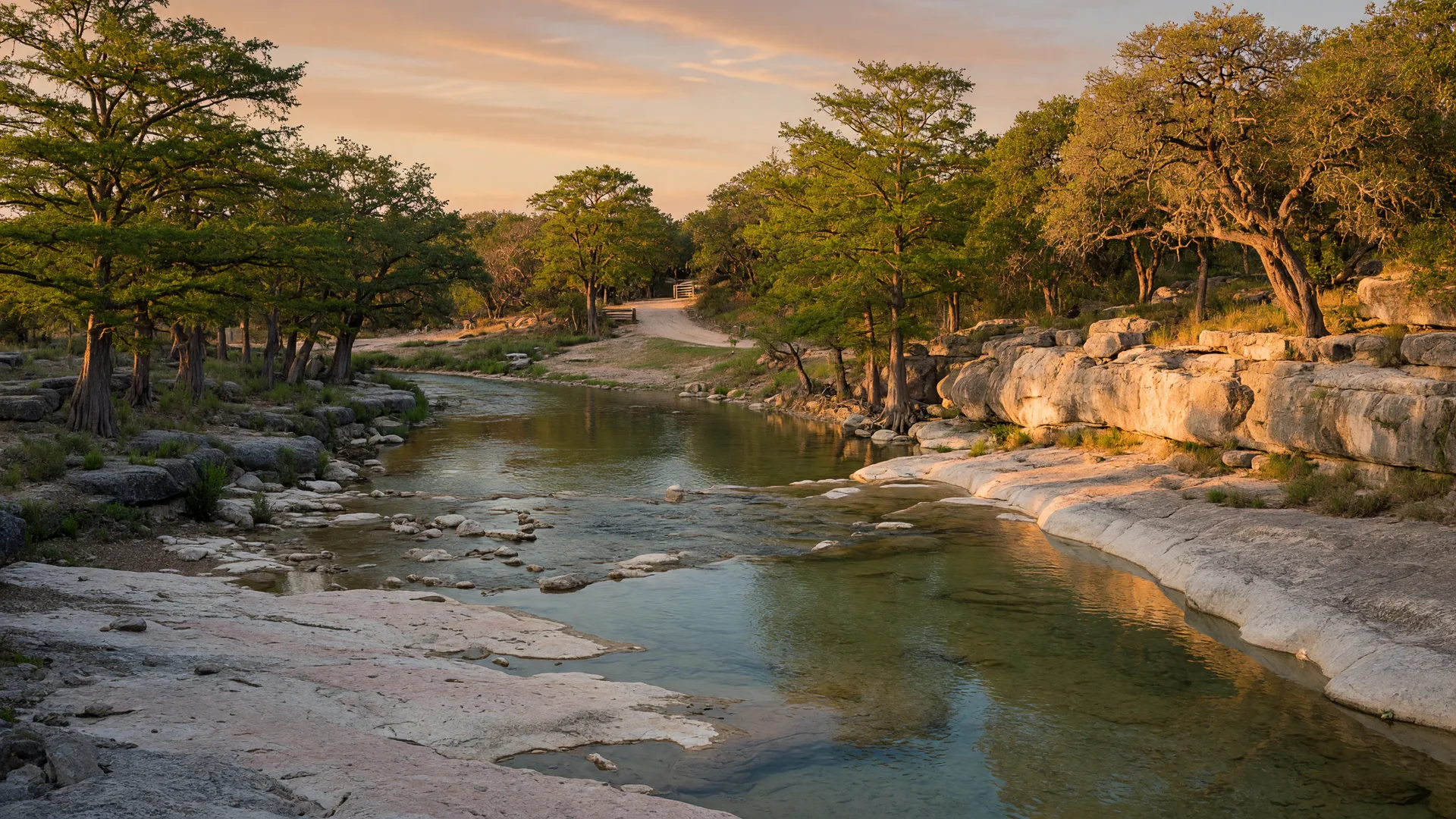
New residents of the Texas Hill Country hear about the Texas State Parks Pass during their first month, usually after one awkward moment at a park entrance. The pass covers day-use entry to every Texas state park, and for Californians used to paying per vehicle in their home state, the Texas practice of charging per person is the first surprise.
The short answer: buy the pass if you expect to visit fee-charging parks about once a month, and skip it if your routine runs on free city parks. The rest of this article shows the exact math, the updated $95 price, what the five parks closest to Boerne, Fair Oaks Ranch, and San Antonio charge without it, and the reservation rules that still apply to pass holders.
What the Texas State Parks Pass Costs and Covers
The Texas State Parks Pass is a 12-month pass issued by Texas Parks and Wildlife (TPWD). The current price is $95. It was $70 until September 1, 2024, when it went to $95, so any guide or forum post quoting $70 is out of date.
One pass covers the named cardholder plus every person arriving in the same vehicle, for day-use entry at all Texas state parks and state natural areas. TPWD lists more than 80 of them. There is no per-person ticket at the gate when the pass holder is present. A second pass for another adult at the same address can be added for roughly $25, which matters in households where two adults make trips separately.
The pass carries two benefits beyond entry: half off the second consecutive night of camping at participating parks, and 10 percent off most items in park stores and rental counters. Neither alone justifies the price. Both move the break-even point for households that camp.
What the pass does not do: it does not cover municipal or county parks, it does not guarantee entry when a park is at capacity, and the named cardholder must be present. It is a day-use entry pass for Texas state parks, nothing more.
The Five Parks in Your Immediate Orbit
For residents of Boerne, Fair Oaks Ranch, and northwest San Antonio, the outdoor routine centers on five parks. Four of them charge an entry fee. The fees below are per person, ages 13 and up, with children 12 and under free.
| Park | Day-Use Fee (13+) | Distance from Boerne |
|---|---|---|
| Guadalupe River State Park | $7 | About 30 minutes |
| Government Canyon State Natural Area | $6 | About 40 to 45 minutes |
| Enchanted Rock State Natural Area | $8 | About 44 miles, 50 minutes |
| Boerne City Park | Free | 3 to 5 minutes, in town |
| Phil Hardberger Park (San Antonio) | Free | About 30 to 40 minutes |
Guadalupe River State Park is the closest state park to Boerne, with four miles of river frontage and 13 miles of trails. Government Canyon is the closest large natural area to San Antonio, with roughly 40 miles of trails. Enchanted Rock is the regional signature destination, built around a dome of pink granite, and it requires a reservation on prominent weekends. Boerne City Park and Phil Hardberger are city-owned and free to enter, which matters for the math below. For a fuller comparison of these five parks, see our Hill Country park comparison guide.
The Break-Even Math
Texas charges day-use entry per person, ages 13 and up. That is different from California, and it changes the math by household size. A couple pays double the per-person rate when they visit together. A family with children under 13 pays the same as a couple, because kids 12 and under enter free. A solo adult pays the listed per-person fee.
Against a $95 pass, here is what the break-even looks like at each entry fee:
| Park | Cost, Solo Adult | Cost, Two Adults | Visits to Cover $95, Solo | Visits to Cover $95, Two Adults |
|---|---|---|---|---|
| Guadalupe River | $7 | $14 | 14 visits | 7 visits |
| Government Canyon | $6 | $12 | 16 visits | 8 visits |
| Enchanted Rock | $8 | $16 | 12 visits | 6 visits |
Read the table this way: at Guadalupe River State Park, a solo adult pays $7 and would need 14 visits in 12 months for the pass to pay for itself. A couple pays $14 per trip and needs just 7 visits. Because most households visit as two adults, or as parents with children under 13, the two-adult column is the honest planning number for most families.
Mixed usage makes the decision easier. A couple that visits Guadalupe River three times a year, Government Canyon twice, and Enchanted Rock twice pays $42, $24, and $32 at the gate, about $98 total, essentially the pass price, before the camping discount. As a planning rule, most households break even somewhere between six and twelve fee-charging park visits a year. If your plan lands at or above that range, buy the pass: the camping discount and the store discount give you the benefit of the doubt on the other side of the line.
If you plan fewer than six fee-charging park visits a year, pay at the gate. The pass is not a membership discount, it is a volume discount.
Where the Pass Adds Value Beyond Entry
The entry fee is the headline, but two benefits matter for Hill Country residents in particular.
Camping: the pass takes half off the second consecutive night at participating parks. A two-night river trip at Guadalupe or a weekend trip to Enchanted Rock that saves $25 to $40 on the site fee recovers almost half the pass on one trip. For households that camp a few times a year, this is the benefit that makes the pass clearly worthwhile.
Store and rental discounts: 10 percent off most park store and rental items is small but painless, and it applies to the same visits you are already making. A canoe rental or a park store trip puts a few dollars back, nothing that justifies the pass alone.
The quieter advantage is payment convenience. At parks that require reservations, the pass covers the entry portion, so the reservation process is one transaction instead of two. At Enchanted Rock, for example, a pass holder still reserves a day-use spot, but does not pay the gate fee on top of it.
When the Pass Is a Waste of Money
If your park habit is Boerne City Park, the Cibolo Nature Center, or the trails along the Cibolo Creek, the state pass buys you nothing. Those properties are free every day and the pass does not cover municipal parks, county parks, or the independent trails that many Hill Country residents use weekly.
The same is true for households that visit state parks three or four times a year. At $7 to $8 per person, a couple spends $42 to $64 a year at the gate. The $95 pass loses by roughly $30 to $55 in that case, and the added household pass for a spouse eats the difference.
Two profiles should skip the pass: the family that does its daily outdoor life at Boerne City Park and the occasional visitors who want a park day on a long weekend. Both are better off paying per visit.
Do Pass Holders Still Need Reservations?
Yes, at the parks that require them. A pass pays entry fees, but it does not hold a spot when a park is at capacity. This matters most at the three parks near home:
Enchanted Rock State Natural Area requires an advance day-use reservation on weekends, school breaks, and holidays, and recommends it on other days. Reservations open up to 30 days ahead. The pass covers the entry portion of the reservation, but it does not excuse the reservation.
Guadalupe River State Park fills to capacity on spring and fall weekends. TPWD sells day-pass reservations online roughly a month ahead, and the reliable move is to reserve before you drive. Weekday visits rarely need it.
Government Canyon State Natural Area sells weekend entry in two windows: morning entry from 7 to 11, and afternoon entry from 3 to 10. Pre-purchasing the day pass on weekends is recommended because the park fills to its parking capacity.
How Texas Fees Compare to California
California relocators already have a state-park mental model formed in California, and Texas is structurally different. California charges per vehicle, typically about $10 per day, with popular coastal parks running higher on peak weekends. A family of four in one car pays roughly $10 in California. The same family in Texas pays per adult, $7 to $8 each, or $14 to $16 for the same car.
The annual passes line up closer than the daily fees:
| Pass | Price | What It Covers |
|---|---|---|
| Texas State Parks Pass | $95 | More than 80 Texas state parks; holder plus everyone in one vehicle |
| California Explorer Day Use, annual | $195 | Most California state parks, one vehicle |
| Golden Poppy Day Use, annual | $125 | Selected redwood and reservoir parks |
The result is that Texas fee-per-person can feel more expensive for a full car of adults, while the Texas annual pass at $95 is well under both California annual options. For a household that visits regularly, the Texas pass delivers more parks per dollar than either California pass, which is a small but real cost-of-living improvement for outdoor families.
The Bottom Line
Buy the $95 Texas State Parks Pass if you expect to visit fee-charging parks about once a month, as a solo adult, or about every other month for a couple. The pass breaks even between month 6 and month 12, and the camping discount removes the downside.
Skip it if your routine runs on Boerne City Park, Phil Hardberger Park, and the free municipal network, or if you honestly see yourself at a state park three or four times a year.
The pass is one small line in a relocation budget, but it is a useful introduction to how Texas prices access: per person, not per vehicle, with a resident card that assumes you go regularly. In the Hill Country the assumption holds, the parks are 30 to 50 minutes from home, the seasons are long, and residents genuinely go. For the fuller park-by-park comparison, see the park comparison guide, and for the rest of the region's outdoor scene, start with the active outdoor recreation guide.

Written by
Bill Ross
Hill Country Homesteads Group, brokered by KW Boerne
Bill Ross is a Texas real estate agent with nearly four decades in high-tech sales and a network of 1,000+ California real estate agents for coordinated cross-state transactions. Featured in national coverage discussing his family's relocation from Silicon Valley to the Texas Hill Country.
Related Guides
Choosing Your Hill Country Park
Compare the five main parks by distance, fees, and best use for relocators.
Guadalupe River State Park Guide
Four miles of river frontage, 13 miles of trails, camping, and swimming, with fees and hours.
Enchanted Rock State Natural Area Guide
The pink granite dome, reservation rules, and the best times to go.
Active Outdoor Recreation Guide
Cycling, trail running, disc golf, and the annual state parks pass in the Hill Country.
Sources
- Texas State Parks Pass price ($95), coverage, additional cardholders, camping and store benefits : Texas Parks and Wildlife Department, Park Passes and Day Pass FAQ pages. tpwd.texas.gov; Day Pass FAQ
- Price increase from $70 to $95 effective September 1, 2024 : KXAN and TPWD announcements. kxan.com
- Guadalupe River State Park day-use fee ($7 per person, ages 13+) : TPWD. tpwd.texas.gov
- Enchanted Rock day-use fee ($8) and weekend reservation requirement : TPWD. tpwd.texas.gov
- Government Canyon day-use fee ($6) and weekend morning/afternoon entry windows : TPWD via ReserveAmerica. reserveamerica.com
- California state park day-use fees and annual passes ($195 Explorer, $125 Golden Poppy) : California State Parks. parks.ca.gov; store.parks.ca.gov
Last reviewed: September 3, 2026. Fees and pass pricing verified against TPWD and California State Parks sources.