
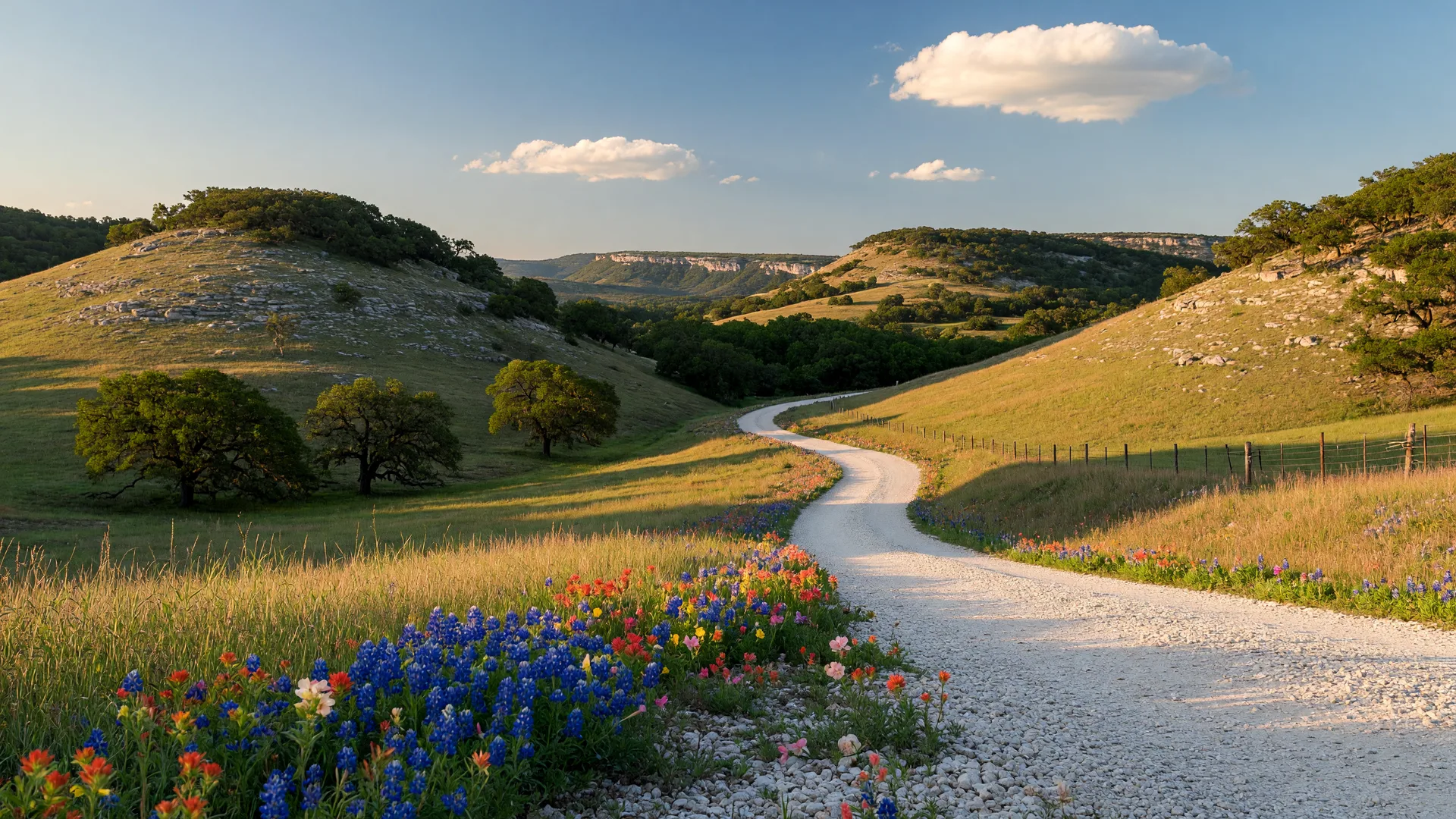
The Texas Hill Country looks nothing like California, and it changes through the year in ways that surprise relocators. The grass is green in January and straw-brown in July. The big wildflower season runs March through April, not May through June. The worst allergy season is midwinter, not spring. This guide walks the landscape month by month, with the frost dates, rainfall, pollen seasons, and watering rules that define daily life on the land around Boerne, Fair Oaks Ranch, and San Antonio.
Boerne sits at roughly 1,447 feet in USDA hardiness zone 8b, where average winter extremes stay near 15 to 20 degrees Fahrenheit. The region averages about 37 inches of rain a year, more than coastal California in most years, but the rain arrives in concentrated windows: heavy in May and June, again in September and October, and thin in July and August. The result is a landscape that swings between lush green and pale gold twice a year, and a calendar that rewards people who know which months are which.
All temperature and rainfall figures below are 30-year normals for the Boerne area unless noted. Frost dates are averages, not promises; in the Hill Country they can shift two to four weeks in either direction depending on the year and the microclimate.
How the Hill Country Calendar Differs from California's
The single biggest adjustment is the meaning of the seasons. California's iconic green season runs from the first winter rains through spring, and the hills turn gold by June. The Hill Country does the opposite: the winter landscape is genuinely green, because the live oaks, Ashe junipers, and winter grasses never fully drop, and the driest, brownest look comes in late summer, not late spring.
The second adjustment is the frost window. The average last spring frost in Boerne lands in late March (the Old Farmer's Almanac lists it around March 27), and the average first fall frost arrives in mid-November, giving a frost-free season of roughly 220 to 250 days. San Antonio proper runs warmer and longer at about 250 to 280 frost-free days. For a Californian used to zone 9 and 10 coastal growing seasons, that late-March frost date is the line you plan the yard around.
The third is the trees. Live oaks are semi-evergreen: they do not drop their leaves in fall the way California oaks and maples do. Instead they exchange their leaves in spring, shedding the old crop as the new one pushes in, typically from March through early May. That means the Hill Country's dramatic seasonal events are scattered differently across the year, which is exactly what the month-by-month calendar below tracks.
Winter (December through February): The Green Season Nobody Warns You About
January is the coldest month, with average highs near 61 and lows near 35 degrees. December and January are also among the driest months of the year, at about 2.2 and 2.1 inches of rain. But the land stays green. The live oaks hold their canopies, the Ashe junipers keep their dense blue-green foliage, and the winter grasses and creeks keep the valleys alive. This is the season that surprises California transplants most: a Hill Country January looks more like a soft Pacific Northwest day than a California winter, except for the occasional hard freeze.
The defining winter event is not on the ground, it is in the air. Ashe juniper, known locally as mountain cedar, pollinates in December through early March, peaking around mid-January, and it is the cause of cedar fever, the region's biggest winter allergy season. The pollen clouds are visible on still mornings, and it is the exception among trees because it releases in winter rather than spring.
Two more winter notes for property owners. Warm-season lawns (Bermuda, St. Augustine, Zoysia) are fully dormant from late fall through early spring, so a tan lawn in January is normal. And live oaks begin their spring leaf exchange early: old leaves start yellowing in late January and February, a few weeks before the new leaves push. A live oak dropping leaves in February looks alarming to a new resident; it is the tree working on schedule.
Hard freezes below 15 degrees are rare but real. Winter Storm Uri in February 2021 and the February 2023 ice storm both shut the region down briefly, and they are the reason the well, septic, and irrigation pre-freeze checklist is worth doing in December.
Spring (March through May): Wildflowers, Pollen, and the Green-Up
Spring is the Hill Country at its most photogenic, and it arrives in a specific order. Bluebonnets typically open in early March and run through mid-April, with the Hill Country peak in late March to mid-April. The wider wildflower season runs mid-March through early May, with April usually the peak for paintbrush, coreopsis, and the roadside mix. The timing shifts each year with winter rainfall and cold snaps, and a single late freeze can trim the peak.
As the wildflowers open, the lawns green up. Warm-season turf comes out of dormancy in late March and April as soil temperatures climb, and by May the Hill Country is at its greenest, lushest state of the year. May is also the wettest month, averaging about 4.6 inches of rain, which is why the region looks its most generous right before the summer heat arrives.
The price of spring is pollen. Live oaks shed their old leaves in March through May, dropping half or more of the previous year's leaves and regrowing within about a month, and live oak pollen peaks in late March to early April. That window, right after the cedar season finally ends, is the region's second allergy season. The practical result: keep the air filters fresh in April and expect the live oaks to look ragged for a few weeks in March as they trade their foliage.
This is also the season for the classic Hill Country drives. The wildflower loop roads around Boerne and the drives to Fredericksburg and Comfort are best from late March through mid-April, and the bluebonnet photo season is shorter than most people assume, so it rewards locals who know the two-week window.
Summer (June through August): Heat, Dormant Lawns, and the Rivers
Summer is when the Hill Country calendar diverges hardest from California's. Highs climb from the low 90s in June to a peak near 94 in August in Boerne (about 95 in San Antonio), with warm nights in the 68 to 70 range. June is still wet, averaging 4.6 inches, but rainfall thins through July and August, and the grass responds by doing something most new residents misread as death: warm-season lawns go dormant again, this time from heat and dryness, and turn a uniform straw color that lasts until the September rains.
The watering rules follow the drought, and they are concrete. The San Antonio Water System ties its stages to the 10-day rolling average of the Edwards Aquifer. When the average drops to 660 feet, Stage 1 limits watering to one day a week; at 650 feet, Stage 2 sets the hours to 5 to 10 a.m. and 9 p.m. to midnight; at about 640 feet, Stage 3 applies. SAWS returned to Stage 3 in September 2026 after easing to Stage 2 on August 4, 2026, and the first watering violation carries a $137 charge. In Kendall County, including most of Boerne and Fair Oaks Ranch, the Cow Creek Groundwater Conservation District sets the drought stage for wells and rural properties, with watering allowed in a 7 to 10 a.m. or 7 to 10 p.m. window on your assigned day, and the district has sat in Stage 2 since its July 13, 2026 board meeting.
The landscape answer to summer is water, and the region's rivers are the draw. Guadalupe River State Park, about 30 to 35 minutes from Boerne at 3350 Park Road 31 in Spring Branch, has 4 miles of river frontage and is the closest swimming and tubing water to Boerne and Fair Oaks Ranch, with a $7 day-use fee. The spring-fed river runs cooler than the air, and the swimming season runs roughly May through September.
The practical summer rhythm for locals: outdoor time before 10 a.m. or after 6 p.m., lawns left brown and unwatered in July and August, and weekend mornings on the river before the parking lots fill.
Fall (September through November): The Second Spring
Fall is the Hill Country's second green season, and for many locals it is the best one. September brings the rains back (about 3.4 inches) and October is the second-wettest month at about 4.4 inches. The heat breaks, the grass greens back up from its summer dormancy, and the landscape resets to the lush look of May. Daytime highs ease from the high 80s in September to the low 70s by November.
The fall events on the land are quieter than spring's but just as specific. Live oaks drop their acorns from roughly late September through December, with the peak in October and November, which is the season for the crunching drifts under the trees and for the deer activity that follows. Fall color is concentrated and requires a short drive: Lost Maples State Natural Area, about 63 miles from Boerne, turns its bigtooth maples crimson from late October through mid-November, most often in the first two weeks of November. It is the single reliable fall-color destination within an easy drive.
November is when the lawn cycle closes. The average first frost lands in mid-November, and as soil temperatures cool toward the 50-to-60-degree range, warm-season turf enters winter dormancy again, turning straw until the following March. For planting, fall is the opposite of a dead season: October through early December is the best window in Texas for trees, shrubs, and perennials, because roots establish through the winter in warm soil before the summer heat.
Fall is also the best hiking weather of the year, which is why Enchanted Rock, about 44 miles from Boerne, and Government Canyon, 12,064 acres on the northwest edge of San Antonio, are at their busiest from October through May. A Saturday on the dome or the canyons in November is the calendar working in your favor.
The Month-by-Month Landscape Reference Table
Boerne-area normals. Temperatures are average daily highs and lows in degrees Fahrenheit; rainfall is monthly average in inches.
| Month | What the land looks like | What to watch for | High / Low | Rain |
|---|---|---|---|---|
| January | Dormant lawns, green live oaks and cedars, creeks running | Cedar pollen builds toward its mid-January peak | 61 / 35 | 2.1 |
| February | Live oaks start dropping old leaves; earliest wildflowers on warm hillsides | Last hard-freeze window; oak leaf exchange begins | 65 / 38 | 2.4 |
| March | Bluebonnets open; lawns begin to green up | Average last frost near March 27; live oak pollen builds | 71 / 46 | 3.0 |
| April | Wildflower peak; live oaks fully re-leaf; grass green | Live oak pollen peak; the bluebonnet drive window | 79 / 53 | 2.3 |
| May | Peak green and lush; river season starts | Wettest month; thunderstorms; mosquitoes | 85 / 62 | 4.6 |
| June | Still green; heat arrives; grass growth slows | Morning yardwork; watering hours tighten | 90 / 68 | 4.6 |
| July | Lawns begin to brown in the heat | Drought stage can tighten; rivers busy by mid-morning | 92 / 70 | 3.3 |
| August | Hottest, driest look; lawns straw-colored | SAWS stages active; the brown lawn is normal | 94 / 69 | 2.7 |
| September | Rains return; grass greens back up | The second spring begins; fall planting window opens | 89 / 64 | 3.4 |
| October | Green again; live oaks drop acorns; fall color window opens | Second-wettest month; Lost Maples trip window | 80 / 55 | 4.4 |
| November | Fall color peaks; lawns re-enter dormancy | Average first frost near mid-November | 71 / 45 | 3.1 |
| December | Winter green returns; creeks full | Cedar season ramps up; holiday freeze risk | 62 / 37 | 2.2 |
What This Means for Your Yard, Your Watering, and Your Expectations
The landscape calendar translates directly into a property routine. Plant after the last frost in late March for warm-season lawns and summer annuals. Plant trees, shrubs, and perennials in October through early December, the fall window that gives roots a full winter to establish before the summer heat. And treat the July-through-August brown lawn as the normal state of the land, not a problem to fix by overwatering.
The watering rules are location-specific, and knowing which set applies to you prevents both a fine and a dead lawn. Inside SAWS territory in San Antonio, the Edwards Aquifer 10-day average sets your stage and your once-a-week watering window, with a $137 first-violation charge. In Kendall County, the Cow Creek Groundwater Conservation District sets the stage for wells and rural properties, with watering windows of 7 to 10 a.m. or 7 to 10 p.m. on your assigned day. Both districts tighten through the summer and ease after the rains return in the fall, so the rule to memorize is simply to check the current stage for your district before setting a sprinkler schedule.
Expectations matter as much as rules. The Hill Country is not a place where a uniformly green, watered lawn reads as the standard of care. Native landscaping built around live oaks, mountain laurel, agarita, and low-water grasses thrives here precisely because it matches the calendar, green when the land is green and tolerant when it is not. A yard that follows the native rhythm costs less, uses less water, and looks right in every season.
How the Landscape Shapes Where You Buy
The seasonal calendar is the same across the region, but the land underneath varies by lot, and that variation is worth seeing in person before you buy. Elevation and slope drive both views and drainage: limestone bedrock drains fast, and the serious flooding concentrates in creeks and low-water crossings rather than on hillsides. A sloped, rocky lot with a view often means a longer driveway, a well, and a septic system to evaluate, while a flat lot in town trades the view for infrastructure that already exists.
The native vegetation is part of the value. A mature live oak canopy is worth tens of thousands of dollars and decades of shade, which is why lots with big trees price differently from cleared ones. Dense Ashe juniper, by contrast, is usually seen as brush: it blocks views, fuels cedar fever, and is routinely cleared by owners who want sight lines. Wildlife pressure follows the cover, so deer browse is part of landscaping reality on the acreage side of Boerne and Fair Oaks Ranch.
For the full picture on terrain, vegetation, and what it costs to live on the land, the deeper guides on this site cover wells, septic, and the landscape in detail. The short version for a first visit: come in spring to see the land at its greenest, come again in late summer to see it at its most honest, and judge a property by both.

Written by
Bill Ross
Hill Country Homesteads Group, brokered by KW Boerne
Bill Ross is a Texas real estate agent (TX license 778434) serving Boerne, Fair Oaks Ranch, San Antonio, and the surrounding Hill Country, with a direct network of 1,100+ California real estate agents for coordinated cross-state relocations. He has been recognized in USA Today and The Washington Post for his relocation expertise, and his own family made the Silicon Valley to the Hill Country transition.
Related Guides
The Texas Hill Country Landscape: What California Buyers Should Know
The terrain, climate, vegetation, and water features that define the Hill Country and shape daily life.
Choosing Your Hill Country Park: A Comparison Guide
Guadalupe River, Enchanted Rock, Government Canyon, Boerne City Park, and Phil Hardberger Park compared by distance, cost, and best use.
Cedar Fever in the Texas Hill Country
The midwinter Ashe juniper pollen season, the pollen counts, and the first-winter relief playbook.
Is the Texas State Parks Pass Worth It?
The break-even math at Guadalupe River, Government Canyon, and Enchanted Rock for year-round park users.
Frequently Asked Questions
The landscape questions California relocators actually ask, with answers that trace to the sources below.
Is the Texas Hill Country really that dry?
The Hill Country gets roughly 32 to 37 inches of rain a year, which is more than coastal California in most years. The issue is timing, not volume. The rain arrives in concentrated windows, May and June and again September and October, and the long, hot dry stretch runs July through August. That is why the landscape looks brown in late summer and green in April and October. California transplants who assume drought everywhere in Texas are usually surprised by how green the winters and springs are.
When should I plant my yard in Boerne?
For warm-season turf and summer annuals, wait until after the average last frost, which lands in late March in Boerne (the Old Farmer's Almanac puts it around March 27). For trees, shrubs, and perennials, fall is the better window: October through early December, when the soil is warm, the rains return, and roots establish through the winter before the summer heat arrives. October is the classic tree-planting month in Texas for exactly this reason.
Do the drought watering restrictions apply to me?
It depends on your water source. If you are in SAWS service territory in San Antonio, the SAWS drought stages set your watering days and hours, currently a once-a-week window of 5 to 10 a.m. or 9 p.m. to midnight at Stage 3, with a $137 first-violation charge. In Kendall County, including most of Boerne and Fair Oaks Ranch, the Cow Creek Groundwater Conservation District sets the drought stage for wells and rural properties, with watering windows of 7 to 10 a.m. or 7 to 10 p.m. on your assigned day. Check the current stage for your district before you set a sprinkler schedule, because the hours change as stages tighten.
Why is my Texas lawn brown in July?
Warm-season grasses like Bermuda, St. Augustine, and Zoysia go dormant in the summer heat, and a straw-colored lawn in July and August is the normal Hill Country look, not a sign the grass is dead. The same grass greens back up in September and October when the rains return and the heat breaks. Overwatering to force green in August works against the grass and against the drought rules. The genuinely green windows of the year are April through early June and September through October.
When is the best time of year to buy or move in the Hill Country?
For the landscape itself, the best first impression is March through May, when the wildflowers are out, the oaks have re-leafed, and the weather is the most forgiving. For the practical side of a move, September through November is the sweet spot: the heat breaks, the rains return, the rivers and parks are busy but not crowded, and the spring move-in crunch has passed. A winter move has the quietest market but the least flattering view of the land, because the dormant lawns and bare live oaks are in their leaf-exchange phase.
Sources
- Average first and last frost dates for Boerne, TX - Old Farmer's Almanac. www.almanac.com/gardening/frostdates/TX/Boerne
- Average last frost dates for Texas, Boerne range March 21-31 - PlantMaps. www.plantmaps.com/en/us/lf/state/texas/average-last-frost-dates-map
- First and last frost dates and frost-free days for Boerne - Garden.org. garden.org/apps/frost-dates/Boerne,+TX/
- Monthly high, low, and rainfall averages for Boerne (annual rainfall about 37 inches) - US Climate Data. usclimatedata.com/climate/boerne/texas/united-states/ustx0134
- NOAA 1991-2020 climate normals for San Antonio - US Climate Data. usclimatedata.com/climate/san-antonio/texas/united-states/ustx1200
- Boerne climate and demographics, city elevation about 1,447 feet - City of Boerne. www.ci.boerne.tx.us/2101/Climate-and-Demographics
- Boerne, Texas hardiness zone 8b - PlantMaps. www.plantmaps.com/hardiness-zones-for-boerne-texas
- Bluebonnet and wildflower season timing in the Texas Hill Country - Explore Lonestar. www.explorelonestar.com/guides/seasonal/texas-bluebonnets/
- Cedar fever season arrives in Texas (Ashe juniper pollen, peak mid-January) - Texas A&M Stories. stories.tamu.edu/news/2024/12/18/cedar-fever-season-has-arrived-in-texas/
- Annual Texas live oak leaf drop in spring - Texas A&M Plant Clinic. plantclinic.tamu.edu/2011/03/30/annual-texas-live-oak-leaf-drop/
- Oak pollen season in Central Texas, peak late March to early April - KSAT. www.ksat.com/weather/2026/03/11/oak-alert-its-officially-oak-season-in-san-antonio/
- How warm-season grasses go dormant in winter (and green back up in spring) - The Turfgrass Group. theturfgrassgroup.com/bermuda-grass/how-to-manage-bermudagrass-in-winter-for-texas-lawns/
- When grass goes dormant in Texas, and when it greens up - Pepper's Home and Garden. peppershomeandgarden.com/grass-dormant-texas/
- SAWS drought stages tied to the Edwards Aquifer 10-day average (Stage 3 active September 2026) - San Antonio Water System. www.saws.org/conservation/drought-restrictions/
- SAWS Stage 3 watering rules, $137 first-violation charge - San Antonio Water System. www.saws.org/conservation/drought-restrictions/stage-3/
- Cow Creek Groundwater Conservation District drought stage and watering rules for Kendall County (Stage 2 as of July 13, 2026) - Cow Creek GCD. ccgcd.org/drought-conditions/
- Lost Maples State Natural Area fall color window and day-use entry - Texas Parks and Wildlife. tpwd.texas.gov/state-parks/lost-maples
- Guadalupe River State Park: river access, trails, and busy season - Texas Parks and Wildlife. tpwd.texas.gov/state-parks/guadalupe-river
Last reviewed: October 20, 2026. Climate normals, frost dates, pollen seasons, and watering-stage data verified against the sources listed above.