
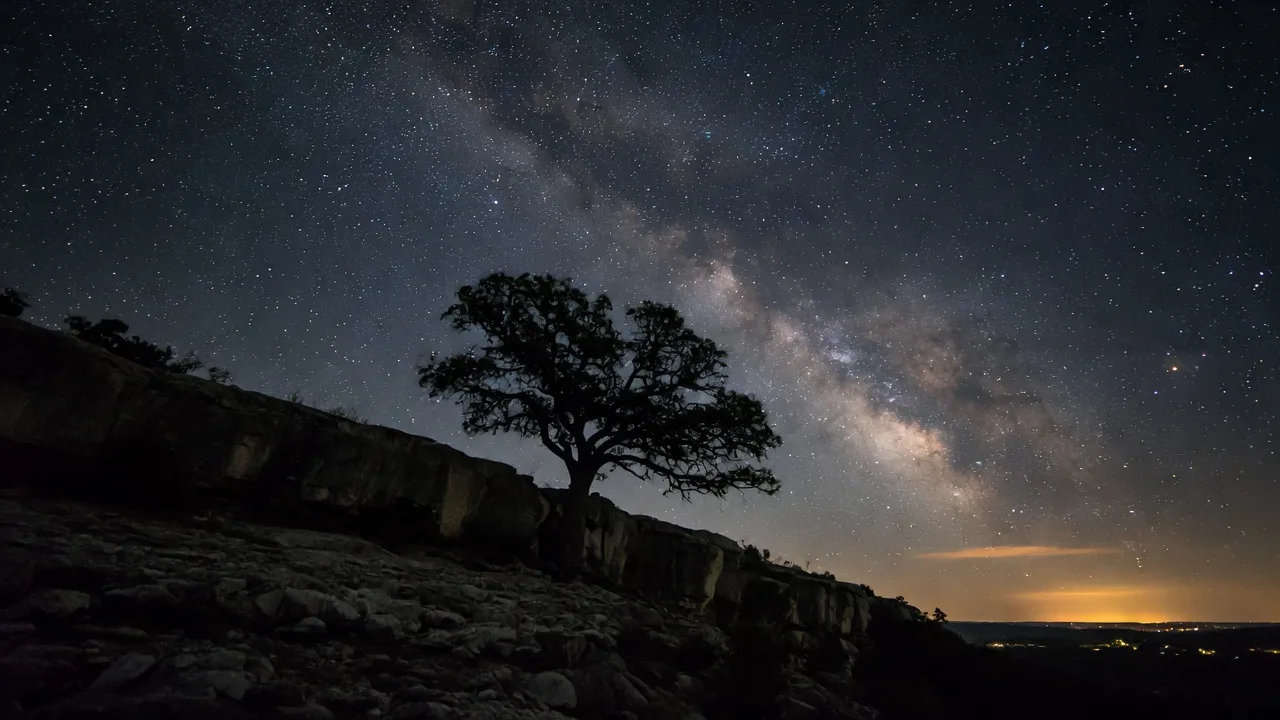
When California buyers evaluate a move to the Texas Hill Country, they compare school ratings, property tax rates, and commute times. Few of them consider the night sky. And that is understandable, because if you have lived in any major California metro area, you have likely never seen one.
The Bortle scale, which measures night sky brightness on a scale of 1 (pristine dark) to 9 (inner-city), puts San Francisco, Los Angeles, and San Jose at Bortle 8 to 9. At those levels, only the Moon, a few planets, and the brightest handful of stars are visible. The Milky Way is invisible. The night sky is a uniform, washed-out gray-brown glow.
In the Texas Hill Country, the situation is different. Enchanted Rock State Natural Area, 56 miles from Boerne, carries a Bortle 3 rating and is a certified International Dark Sky Park. South Llano River State Park, about 90 miles northwest, holds the same designation. The communities of Fredericksburg and Dripping Springs are certified International Dark Sky Communities. And Boerne itself has enacted a dark sky ordinance and is pursuing formal certification. For families relocating from California, the night sky is a genuine, tangible amenity that most do not know they are getting.
Why the Hill Country Sky Is Different from California's
The Texas Hill Country's dark skies are the result of three factors: low population density, municipal lighting ordinances, and the region's geography. The area between Boerne, Fredericksburg, Kerrville, and Junction contains large tracts of sparsely populated ranchland and Hill Country parks that sit far from major light sources. Unlike the densely urbanized coastal corridors of California, where development is continuous from Santa Barbara to San Diego and from San Francisco to San Jose, the Hill Country has meaningful gaps between its communities.
Those gaps are protected by a growing network of local dark sky ordinances. Fredericksburg became an International Dark Sky Community in 2020. Dripping Springs was the first in Texas in 2011. Wimberley, Blanco, Llano, and Mason have all passed lighting ordinances. Boerne adopted its own dark sky ordinance that includes requirements for commercial illumination plans, sharp cut-off luminaires to prevent uplighting, and prohibitions on sky glow. The city is actively working toward International Dark Sky Community designation, with proposals in 2026 to streamline lighting rules while tightening lumen-per-acre caps and measurable light-trespass limits.
The result is a region where the night sky is actively protected, not just accidentally dark. The difference from a typical California metro area is not incremental. It is categorical.
Stargazing Locations at a Glance: Distances from Boerne
| Location | Bortle Class | Drive from Boerne | Designation | Fee |
|---|---|---|---|---|
| Enchanted Rock SNA | Bortle 3 | 56 miles / 1 hr | Dark Sky Park | $8 per adult |
| South Llano River SP | Bortle 3 | 90 miles / 1.5 hr | Dark Sky Park | $5 per adult |
| Devil's Sinkhole SNA | Bortle 2 | 85 miles / 1.5 hr | Dark Sky Sanctuary | By reservation |
| Lost Maples SNA | Bortle 3 | 75 miles / 1.3 hr | Natural Area | $6 per adult |
| Fredericksburg | Bortle 4 | 45 miles / 45 min | Dark Sky Community | Free (public parks) |
An annual Texas State Parks pass ($70 per adult) covers entry at all state parks, including Enchanted Rock, South Llano River, and Lost Maples.
Enchanted Rock State Natural Area: The Premier Dark Sky Destination
Enchanted Rock was designated an International Dark Sky Park in 2014, receiving Gold-Tier status — the highest designation level — from the International Dark-Sky Association. It was one of the first Texas state parks to earn this recognition, and it remains the closest certified dark sky park to the San Antonio and Boerne corridor.
The park's Bortle Class 3 rating means that under favorable conditions, the Milky Way is clearly visible to the naked eye, along with bright nebulae, open star clusters, and the Andromeda Galaxy. Texas Parks and Wildlife installed a sky quality meter at the park that posts real-time darkness readings every 15 minutes during the night, providing a continuous measure of how dark the conditions are.
The best stargazing at Enchanted Rock occurs during new moon phases, when moonlight does not wash out the fainter celestial objects. Spring through early fall offers the richest views of the Milky Way core, with the best viewing between 10 p.m. and 2 a.m. The park occasionally hosts public stargazing events with telescopes and ranger interpretation; checking the Texas Parks and Wildlife events calendar before planning a visit is worthwhile.
For families with children, stargazing at Enchanted Rock is one of the most accessible introductions to the night sky. The granite dome provides a natural, elevated viewing platform with an unobstructed 360-degree horizon. No special equipment is required — binoculars help, but the naked-eye view on a clear new-moon night is the experience residents talk about.
Address
16710 Ranch Road 965, Fredericksburg, TX 78624
Distance from Boerne
Approximately 56 miles, about 1 hour via TX-46 West and Ranch Road 965
Best Stargazing Period
New moon nights, spring through early fall, 10 p.m. to 2 a.m. Check the TPWD events calendar for public stargazing programs.
Fee
$8 per adult day-use. Park may close when capacity is reached on weekends. Arrive early or reserve ahead.
Dark Sky Communities: Fredericksburg, Dripping Springs, and Boerne
Beyond the state parks, several Hill Country communities have made formal commitments to preserving dark skies, which means you do not need to drive to a park to see stars. You can walk outside your own house.
Fredericksburg
Fredericksburg was designated an International Dark Sky Community by unanimous vote of the International Dark-Sky Association in February 2020. The city has adopted outdoor lighting standards that require fully shielded fixtures and limit lighting in residential and commercial areas. For California relocators considering Fredericksburg, this means the night sky above town is measurably darker than most suburban communities in the United States. Lady Bird Johnson Municipal Park, within city limits, offers a convenient stargazing spot without leaving town.
Dripping Springs
Dripping Springs was the first International Dark Sky Community in Texas, designated in 2011. The town about 25 miles west of Austin passed a smart lighting ordinance that has served as a model for other Hill Country communities. The designation reflects a sustained commitment that has kept Dripping Springs' night sky dark as the town has grown.
Boerne
Boerne's own dark sky effort is active and ongoing. The city adopted a dark sky ordinance that includes illumination plan requirements for commercial developments, prohibitions on uplighting, and requirements for sharp cut-off fixtures that minimize sky glow. In 2026, city planning staff proposed updated rules that would streamline the ordinance by replacing class-based categories with residential versus nonresidential distinctions and adopting measurable lumen-per-acre caps and light-trespass limits. Boerne's environmental program manager has spoken at the Hill Country Dark Sky Conference about the city's work through community partnerships, public outreach, and infrastructure improvements. Kendall County is also pursuing a \"Dark Sky County\" designation.
Within Boerne city limits, the current Bortle reading is approximately 7 to 8 downtown and improves to 5 to 6 in outlying residential areas. On the outer edges of Fair Oaks Ranch and the rural subdivisions west of town, conditions improve further. Boerne City Park and the Cibolo Nature Center provide accessible stargazing spots on clear nights within the city's darker edges.
What You Can Actually See: Comparing the California Night Sky to the Hill Country
| Celestial Object | Bortle 8-9 (LA, SF, San Jose) | Bortle 3 (Enchanted Rock) |
|---|---|---|
| Milky Way | Invisible | Clearly visible at arms width |
| Andromeda Galaxy | Invisible without telescope | Visible as a faint smudge |
| Orion Nebula | Invisible without telescope | Visible as a hazy patch |
| Zodiacal Light | Invisible | Faint cone visible after sunset |
| Stars visible to naked eye | ~50-200 | ~2,500-5,000 |
Stargazing Calendar: When and Where to Go
The Hill Country stargazing calendar follows the Moon. The best viewing nights fall in the window from three days before to about five days after the new moon, when moonlight does not interfere with faint celestial objects. That means roughly eight to ten good nights per month, concentrated around the new moon period. The following table maps those windows to the meteor showers and celestial events worth planning for.
Perseid Meteor Shower
AugustPeak: Mid-August. Best viewed from Enchanted Rock or Lost Maples.
The Perseids are the most reliable meteor shower in the Hill Country. At Bortle 3 sites, observers can typically count 60 to 90 meteors per hour near the peak. The summer night temperatures (low 70s) make sustained overnight viewing comfortable.
Geminid Meteor Shower
DecemberPeak: Mid-December. Best viewed from South Llano River State Park.
The Geminids are known for producing bright, slow-moving fireballs. Clear winter skies in the Hill Country provide excellent visibility, though temperatures at night can drop to freezing. The longer winter nights mean more viewing time before midnight.
Milky Way Season
March - OctoberCore visible from late spring through early fall.
The Milky Way core is visible in the Hill Country from approximately 10 p.m. to 2 a.m. during the spring through early fall months. The most dramatic views come in July and August, when the galactic center is directly overhead. Enchanted Rock and Lost Maples provide the best viewing conditions.
Fredericksburg Night Sky Events
Year-roundLady Bird Johnson Municipal Park and local observatory programs.
Fredericksburg offers regular night sky programs and stargazing events coordinated through the city and local astronomy groups. The Hill Country Astronomy Club and the University of Texas' McDonald Observatory occasionally host outreach events in the region.
Getting Started: Practical Advice for New Hill Country Residents
Equipment You Do Not Need
You do not need a telescope to enjoy the Hill Country night sky. A quality pair of 10x50 binoculars, which cost roughly $50 to $150, will reveal more detail in the Milky Way, open star clusters like the Pleiades, and the Andromeda Galaxy than most beginners can process. A telescope is a long-term purchase that many casual stargazers abandon after a few uses. Start with binoculars and a dark sky app.
Equipment Worth Having
A red-light flashlight preserves your night vision and costs under $20. A reclining camp chair or blanket lets you look up without neck strain. Sky-Safari, Stellarium, or any dark sky app tells you what you are looking at. That is the complete beginner kit. If you decide to invest further, a Dobsonian telescope in the 6- to 8-inch range provides a substantial step up in capability, but this is an upgrade path, not a starting requirement.
Planning Your First Stargazing Night
Choose a new moon weekend. Check the weather forecast — you want clear skies and low humidity. Drive to Enchanted Rock, arriving before sunset so you can hike the summit trail and watch the sunset from the dome. Bring blankets or warm clothing even in summer; Hill Country nights cool down quickly, and you will be sitting still. Let your eyes adjust for 20 to 30 minutes after the sky is fully dark. Then look up.
Stargazing Apps
Sky-Safari, Stellarium Mobile, and Night Sky are the most commonly used astronomy apps for identifying celestial objects. All three work well at Bortle 3 sites, where the star density is high enough that the apps can accurately track what you are seeing. Star Walk 2 and Google Sky Map are simpler, free alternatives that work for occasional use.
Dark Sky Ordinances and Your Property
If you are buying a home in a Hill Country community that has adopted a dark sky ordinance, you will need to comply with local outdoor lighting rules. This typically means using fully shielded, downward-facing fixtures on your property and avoiding uplighting, floodlights, and unshielded security lights. These restrictions help preserve the night sky for everyone and are generally straightforward to meet. Standard residential lighting fixtures sold at local hardware stores in Boerne and Kerrville already comply with the requirements in most cases.
"The thing that surprised me most about moving to the Hill Country was walking outside on a clear night and seeing the Milky Way from my driveway. I lived in Los Angeles for fifteen years and forgot that the sky actually has stars."
The Night Sky as Part of the Relocation Decision
The dark sky is not the primary reason most California families choose the Texas Hill Country. Schools, housing costs, property taxes, and lifestyle rank higher on every checklist. But it is one of the unexpected benefits that residents consistently mention after the move. The ability to walk outside on a clear night and see the Milky Way, to watch a meteor shower from your own backyard, or to drive 45 minutes to a certified dark sky park — these are real, tangible parts of daily life here that most relocators do not anticipate.
Texas ranks behind only Utah and Arizona in the number of communities with dark sky designations. The Hill Country is the heart of that movement. For families coming from the light-polluted skylines of California's major metros, the transition to a place that takes its night sky seriously is one of the most pleasant surprises the move delivers.
For a broader guide to the Hill Country's outdoor recreation, see the active outdoor recreation guide. For state park information including Enchanted Rock, Guadalupe River State Park, and Government Canyon, see the state and local parks guide. For the full landscape overview, see the Hill Country landscape guide.

Written by
Bill Ross
Hill Country Homesteads Group, brokered by KW Boerne
Bill Ross is a Texas real estate agent and founder of Hill Country Homesteads Group, guiding California families through relocation to Boerne, Fair Oaks Ranch, and the surrounding Hill Country communities. His network of 1,100-plus California agents enables coordinated cross-state transitions, and his expertise has been featured in USA Today and The Washington Post for relocation guidance.
Related Guides
Enchanted Rock Guide
Hiking, climbing, camping, and stargazing at the Hill Country's signature landmark, 56 miles from Boerne.
Active Outdoor Recreation Guide
Mountain biking, rock climbing, road cycling, trail running, and disc golf near Boerne.
State and Local Parks Near Boerne
Enchanted Rock, Guadalupe River State Park, Government Canyon, and more with distances and fees.
The Texas Hill Country Landscape
Terrain, climate, seasons, and vegetation — what the land looks and feels like through the year.
Sources
- Enchanted Rock International Dark Sky Park designation and Gold-Tier status — DarkSky International. darksky.org
- Enchanted Rock stargazing and sky quality meter — Texas Parks and Wildlife Department. tpwd.texas.gov
- Fredericksburg International Dark Sky Community designation — DarkSky International. darksky.org
- Boerne dark sky ordinance and pursuit of International Dark Sky designation — City of Boerne. citizenportal.ai
- Proposed Boerne dark sky ordinance updates (2026) — CitizenPortal.ai. citizenportal.ai
- Boerne Bortle scale and night sky conditions — The Boerne Star. boernestar.com
- Hill Country Dark Sky Conference and regional efforts — Hill Country Alliance. hillcountryalliance.org
- Texas stargazing map, Bortle ratings, and park designations — Texas Parks and Wildlife Department. tpwd.texas.gov; howtexas.com
- California city Bortle values (San Francisco, Los Angeles, San Jose) — DarkSky International data, various sources including skyviewtents.com and californiacurated.com.
- South Llano River State Park Dark Sky Park — Texas Parks and Wildlife Department. tpwd.texas.gov
- Dripping Springs first International Dark Sky Community in Texas — DarkSky International. darksky.org
- Hill Country stargazing locations map — Atlas Obscura. atlasobscura.com
- Boerne representative at Dark Sky Conference — The Boerne Star. boernestar.com
Last reviewed: August 2026. Dark sky designations, fees, and park information verified against current sources.