

This guide helps California families interpret the major differences between California and Texas public schools, including statewide assessments, accountability systems, enrollment, athletics, immunization requirements and student-support services. Because the two states use different standards and scoring systems, the comparisons below are for orientation — not official score conversions.
For a broader framework on how to evaluate Texas school districts from California, including how Texas school funding works and what questions to ask when comparing campuses, see the guide on evaluating Texas school districts from California. See our community comparison for families evaluating Hill Country options. For a complete relocation timeline that syncs school enrollment with your move, read the 12-month relocation timeline.
Section 1: Testing — CAASPP / Smarter Balanced vs. STAAR
What California Parents Know: CAASPP
Within the California Assessment of Student Performance and Progress (CAASPP), California administers the Smarter Balanced summative assessments in English language arts/literacy (ELA) and mathematics in grades 3-8 and grade 11. The California Science Test (CAST), which is a separate CAASPP assessment, is administered in grades 5 and 8 and once in high school.
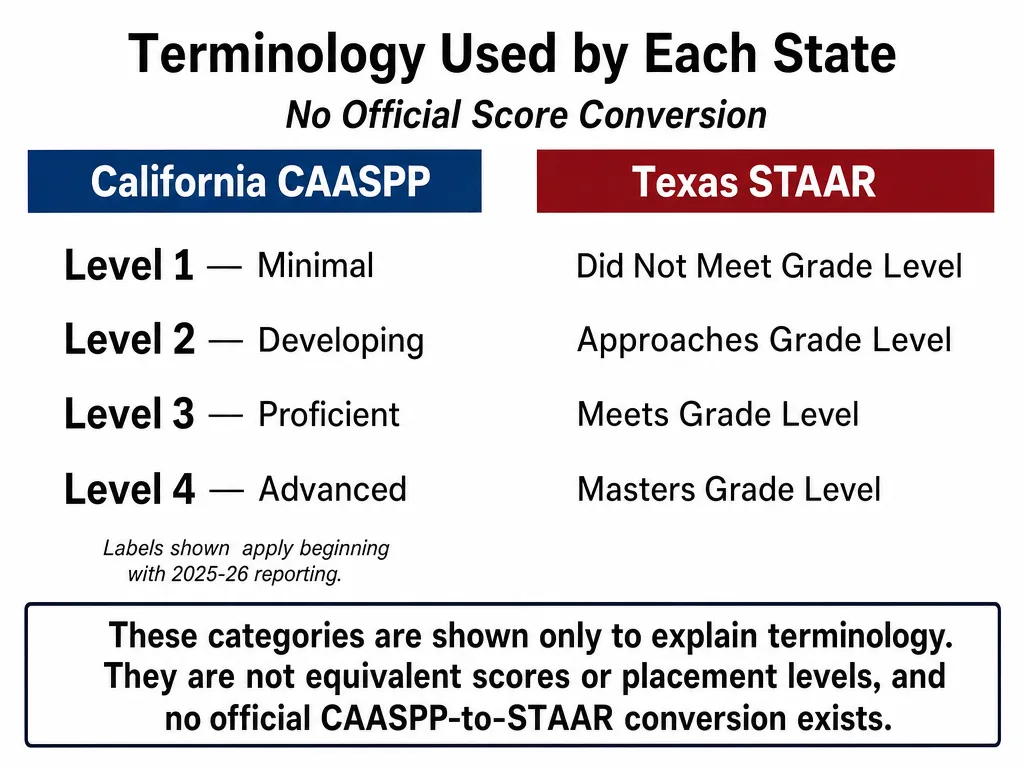
For the 2024-25 results, California's reporting labels were Level 1 — Standard Not Met, Level 2 — Standard Nearly Met, Level 3 — Standard Met and Level 4 — Standard Exceeded. Beginning with 2025-26 reporting, California changed those labels to Level 1 — Minimal, Level 2 — Developing, Level 3 — Proficient and Level 4 — Advanced; the underlying cut scores did not change. California's statewide 2024-25 ELA results were 29.4% at Level 1, 21.8% at Level 2, 26.5% at Level 3 and 22.3% at Level 4. In mathematics, 37.3% of students scored at Levels 3 or 4, up from 35.5% in 2023-24. CDE's explanatory material describes Levels 2-4 as demonstrating grade-level knowledge and skills with increasing accuracy and complexity, while Level 1 represents minimal grade-level knowledge and skills. [1][2][36]
What Texas Uses: STAAR
STAAR includes Reading Language Arts (RLA) and mathematics in grades 3-8, science in grades 5 and 8, and social studies in grade 8. At the high-school level, STAAR end-of-course assessments are administered for English I, English II, Algebra I, Biology and U.S. History. [32]
STAAR uses four performance levels: Did Not Meet Grade Level, Approaches Grade Level, Meets Grade Level, and Masters Grade Level. [31]
How They Compare
| Feature | California (CAASPP) | Texas (STAAR) |
|---|---|---|
| Reading Language Arts (RLA) | Grades 3-8, Grade 11 | Grades 3-8, English I & II EOC |
| Math Testing | Grades 3-8, Grade 11 | Grades 3-8, Algebra I EOC |
| Science | Grades 5, 8, once in HS | Grades 5, 8, Biology EOC |
| Social Studies | Not tested statewide | Grade 8 Social Studies and U.S. History EOC; both continue under the assessment program beginning in 2027-28 |
| Performance Levels | 4 levels; beginning with 2025-26 reporting: Minimal, Developing, Proficient and Advanced | 4 levels (Did Not Meet through Masters) |
| ELA/Math delivery | Smarter Balanced ELA and mathematics assessments are computer-adaptive | STAAR is administered online but is not computer-adaptive |
| Standards basis | California Common Core State Standards for ELA/mathematics; California NGSS for science | Texas Essential Knowledge and Skills (TEKS) |
Last verified: August 2026.
California parents should not expect the same computer-adaptive testing experience their child had with Smarter Balanced. Current STAAR is administered online but does not select harder or easier questions in response to an individual student's answers. Do not interpret "not computer-adaptive" to mean that every student in every administration, accommodation or testing circumstance necessarily receives an identical set of test items.
Important: No official CAASPP-to-STAAR score conversion exists
There is no official CAASPP-to-STAAR score conversion. Both systems use four broad achievement categories, but their cut scores and underlying standards are independently established. A California Level 3 or 4 result and a Texas Meets or Masters result can both describe stronger performance within their respective systems, but they should not be treated as equivalent scores or placement levels. For an individual student, Texas districts may also review transcripts, coursework and other records when making placement decisions.
For individual Smarter Balanced results, CDE says scores generally become available to the local educational agency within three to four weeks after a student tests; the LEA then has 20 days to distribute the student score report to parents/guardians. California's statewide public results are released later. These are different timelines.
Texas release dates vary by assessment and year. In 2026, spring EOC results became available June 10 and most grades 3-8 results June 16; Grade 5 and 8 science results followed on July 31, 2026, after TEA completed standard setting for assessments aligned to the updated science TEKS. Families should use the Texas Assessment Family Portal or current TEA calendar for the applicable year. If you are moving mid-year and your child does not take STAAR, the new campus will use prior records and possibly additional assessments to place them. But STAAR results are not required for enrollment. [33][34]
Texas Assessment Changes Beginning in 2027-28
House Bill 8 replaces STAAR beginning with the 2027-28 school year with an instructionally supportive assessment program referred to in statute as the Student Success Tool (SST). For grades 3-8, the new program will include beginning-of-year, middle-of-year and end-of-year assessments. The beginning- and middle-of-year assessments will be adaptive; the end-of-year assessment will be static. The assessments must be shorter than STAAR, and TEA must provide results to school systems within two business days after the testing window closes.
HB 8 retains the Grade 8 Social Studies assessment and the U.S. History EOC. It eliminates the English II EOC as an assessment and graduation requirement beginning in 2027-28. Students in the graduating classes of 2026 and 2027 remain subject to the English II EOC graduation requirement. TEA states that additional information for the graduating class of 2028 and later will be provided as implementation details are finalized. Current 2026-27 STAAR requirements remain in effect until the transition. [6]
STAAR Redesign: Test Format Differences
Additionally, the current STAAR redesign limits multiple-choice questions to a maximum of 75% of the test, incorporating interactive and open-ended item types. This means the test format differs from what California families may expect from Smarter Balanced — students encounter constructed-response and multi-select questions alongside traditional multiple-choice items.
Note: ELPAC vs. TELPAS
English-language proficiency is a separate testing system. California uses ELPAC for eligible English learners; Texas uses TELPAS for emergent bilingual students in grades K-12. These assessments should not be confused with CAASPP or STAAR. Families should include current English-language-proficiency records with their transfer documentation. [20][21]
Section 2: Accountability — California's Dashboard vs. Texas A-F Ratings
California's School Dashboard
California uses the California School Dashboard, a multiple-measures accountability system. Current state indicators include academic indicators for English language arts and mathematics, the Science Indicator, English Learner Progress, Chronic Absenteeism, Suspension Rate, Graduation Rate and the College/Career Indicator, along with local measures. For applicable state indicators, the Dashboard's color-coded performance levels incorporate both current-year Status and Change from the prior year. There is not a separate statewide Dashboard indicator called "academic growth." A school or district can therefore show different performance levels across different indicators and student groups. [3]
Texas A-F Accountability System
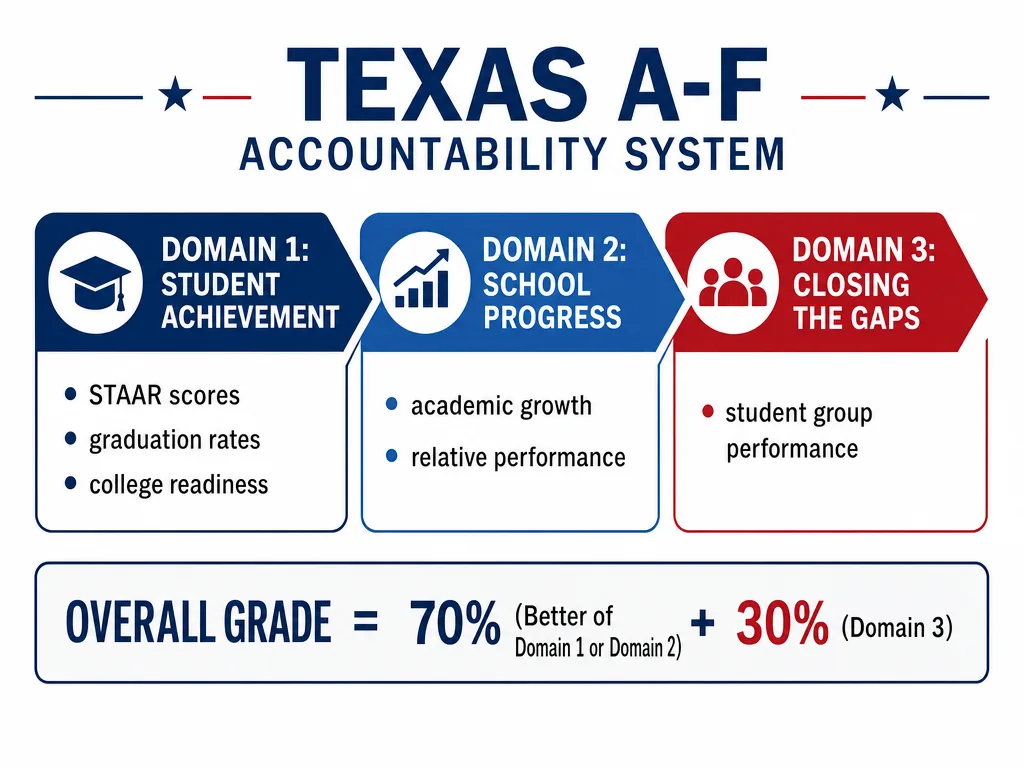
Texas's A-F accountability framework predates House Bill 22. House Bill 22 (2017) revised the accountability system into the three domains used today: Student Achievement, School Progress and Closing the Gaps.
- Domain 1: Student Achievement — what students know and can do (STAAR scores, graduation rates, college/career/military readiness)
- Domain 2: School Progress — how far students have grown academically, plus performance compared to similar schools
- Domain 3: Closing the Gaps — how different student groups are performing
TEA assigns an overall A-F accountability rating to rated public-school districts and campuses; some districts or campuses receive a Not Rated designation under TEA rules. For rated districts and campuses, the overall score generally weights 70% of the better result from Student Achievement or School Progress and 30% from Closing the Gaps, subject to TEA rules governing applicable domains, rating caps and other special circumstances. The scale is A (90-100), B (80-89), C (70-79), D (60-69), F (59 or below). [4]
Texas Accountability Release Note
TEA publicly posted preliminary 2024 and 2025 A-F ratings on August 15, 2025 after litigation had delayed the 2024 release. Districts and campuses then had an appeals process. TEA released final 2024 and 2025 accountability ratings on December 11, 2025. As of this article's August 8, 2026 review date, TEA says information and resources related to the 2026 ratings will be available August 14, 2026 at 12 p.m. Families reading after that date should check TXschools.gov for the current rating.
Why the Two Accountability Systems Cannot Be Converted Directly
California:
- Reports multiple academic and school-condition indicators.
- Performance colors are attached to individual indicators and student groups.
- Colors incorporate both current Status and Change over time.
- The Dashboard does not function as a single A-F school grade.
Texas:
- Assigns an overall A-F district/campus accountability rating.
- Uses Student Achievement, School Progress and Closing the Gaps.
- For 2026, the better of Student Achievement or School Progress is weighted 70%, with Closing the Gaps weighted 30%, subject to additional accountability rules.
Bottom line: A California Dashboard color should not be converted into a Texas letter grade. Families should compare the underlying measures — achievement, growth, graduation, college/career readiness and student-group outcomes — rather than trying to translate one state's headline label into the other.
Local District Ratings
Boerne ISD
- 2025 TEA rating: A
- Six consecutive issued A ratings through 2025
- 27 Distinction Designations in 2025
- Boerne ISD reports that it was one of 31 Texas districts to receive six consecutive A ratings, and has since extended that streak to seven consecutive accountability cycles through 2026. [5][7]
Our Boerne ISD guide provides detailed enrollment information.
Comal ISD
- 2025 TEA rating: B, with an overall score of 87
- Nineteen campuses earned an A rating in 2025
- Twenty-five campuses received a combined 71 Distinction Designations. [30]
Section 3: Enrollment and Transfer Timing Matrix — Boerne ISD and Comal ISD
For a deeper look at enrollment traps across multiple Hill Country districts including Comfort ISD, see the dedicated guide on school enrollment calendars and traps.
Important: Transfer and School Choice windows are separate from enrollment at a student's assigned campus. Families moving into the district should confirm the assigned campus using the exact residence address and current district boundary information.
Boerne ISD Key Dates and Requirements
| Item | Date / Requirement | Notes |
|---|---|---|
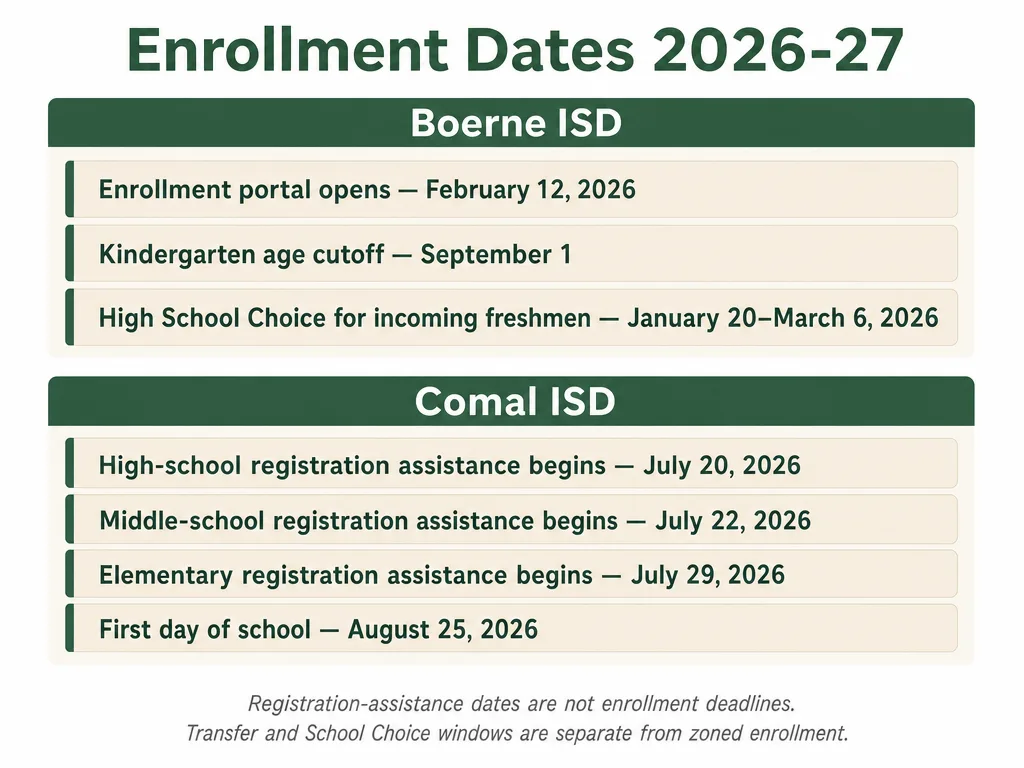
| New Resident / Zoned Enrollment | Portal opens February 12, 2026 | Online registration through Skyward portal for students attending their assigned campus |
| Kindergarten Age Cutoff | September 1 | Child must be 5 years old by September 1 |
| High School Choice (Incoming Freshmen) | January 20 – March 6 | School Choice window, separate from zoned enrollment. Apply during this period. |
| High School Choice (New-to-District) | Ongoing | School Choice available upon initial enrollment. Separate from assigned-campus enrollment. |
| New-to-Campus Out-of-Zone Transfer | Closed April 30 | Transfer window, not the deadline for new resident zoned enrollment |
| Transfer Renewal | Closed February 20 | For existing transfer students renewing their out-of-zone placement |
| Immunization Documentation | Required as applicable. Provide a current immunization record, a valid Texas exemption, or qualifying provisional-enrollment documentation under Texas DSHS rules. | See Notes |
| 7th Grade Entry Immunizations | Tdap and MCV4 required | Grade 7 entry requirements; verify current DSHS timing and catch-up rules. |
| Registration documents | Student birth certificate or other accepted proof of identity; immunization documentation; proof of Boerne ISD residency; current transcript or report card; and any additional documentation requested by the campus registrar | BISD campus enrollment pages also list a Social Security card. If a Social Security number is not provided, Texas enrollment guidance provides for an alternative state-approved student identification number. A campus may also request a parent/guardian photo ID or applicable custody documentation. [7][22] |
Last verified: August 2026, based on Boerne ISD’s published 2026-27 enrollment calendar.
UIL Regular-Attendance and 15-Day Rule
For high-school UIL competition, a student satisfies the regular-attendance requirement by attending the school since the sixth class day of the present school year or by being enrolled and in regular attendance for at least 15 calendar days before the contest or competition. When the 15-day provision applies, the student becomes eligible on the fifteenth day, assuming every other applicable eligibility requirement is satisfied. This is not a semester-based rule, is not limited to varsity competition and is not specifically a "mid-year transfer" rule. UIL states that the 15-day rule does not apply at the junior-high level. Applicable UIL exceptions may also apply. Families should have the receiving school determine the student's actual eligibility. [11]
Comal ISD Key Dates and Requirements
| Item | Date / Requirement | Notes |
|---|---|---|
| High School Registration Assistance | July 20, 2026 | Campus staff available to offer registration assistance beginning this day (not a registration-confirmation deadline) |
| Middle School Registration Assistance | July 22, 2026 | Campus staff available to offer registration assistance beginning this day (not a registration-confirmation deadline) |
| Elementary School Registration Assistance | July 29, 2026 | Campus staff available to offer registration assistance beginning this day (not a registration-confirmation deadline) |
| Optional Transfers | Separate deadlines apply | Student-transfer deadlines follow a separate timeline from new-resident zoned enrollment. Confirm with the district. |
| First Day of School | August 25, 2026 | First day of school for 2026-27. This is not a registration deadline; new-student registration is handled separately through Skyward. |
| Kindergarten Age Cutoff | September 1 | Child must be 5 years old by September 1 |
| Immunization Documentation | Required as applicable. Follow district/campus submission instructions for current immunization documentation; Texas law also provides for valid exemptions and qualifying provisional enrollment. | See Notes |
| 7th Grade Entry Immunizations | Tdap and MCV4 required | Must have before 7th grade entry |
| Kindergarten Entry | Booster vaccines required | Must be current |
| Registration documents | Proof of residency dated within 30 days of registration; immunization documentation; unofficial transcript or report card; child's birth certificate; parent/guardian proof of identity; and custody papers when applicable | If the family does not own or rent the residence, Comal ISD requires its notarized Residency Statement. [8] |
Last verified: August 2026, based on Comal ISD’s published 2026-27 registration calendar.
The Immunization Trap: California vs. Texas
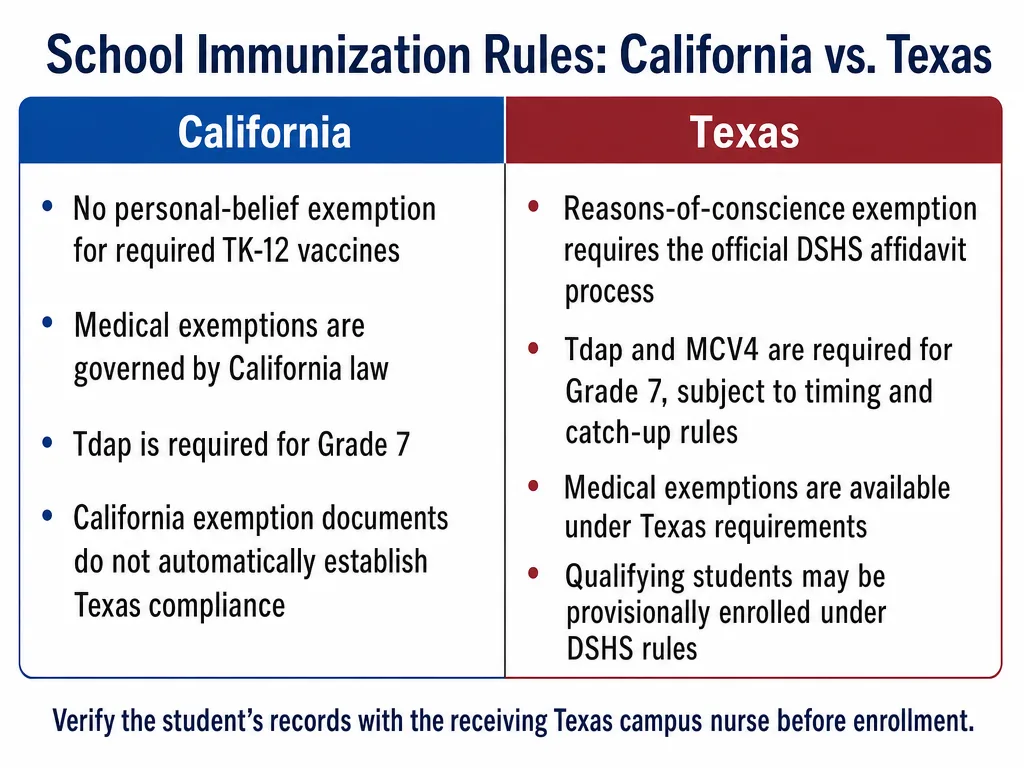
California and Texas have overlapping but different school immunization requirements. Texas requires some vaccines for school attendance that California does not require statewide at the same grade level, while the two states also differ substantially in their exemption rules.
| Issue | California | Texas |
|---|---|---|
| Core K-12 vaccines | DTaP/Tdap, polio, hepatitis B, MMR and varicella, subject to applicable grade/age, dose and timing requirements | DTaP/Tdap/Td, polio, MMR, hepatitis B, varicella, hepatitis A and grade-specific requirements |
| 7th-grade Tdap | Required | Required, subject to Texas timing/catch-up rules |
| Meningococcal (MCV4) | Not a statewide K-12 school-entry requirement comparable to Texas's Grade 7 rule | One dose required for Grade 7 |
| Hepatitis A | Recommended but not a statewide K-12 school-entry requirement | Two doses required for K-12 |
| Nonmedical exemption | California generally does not permit personal-belief/nonmedical exemptions from required school vaccines | Texas permits a notarized exemption for reasons of conscience, including religious beliefs, under state rules |
| Provisional enrollment | State-specific conditional-admission rules apply | Certain students who have begun required vaccine series and meet DSHS conditions may qualify for provisional enrollment |
Last verified: August 2026, based on Texas DSHS and California CDPH requirements. [9][10][28]
Critical warning for California parents
Do not assume that California immunization or exemption documentation automatically establishes compliance in Texas. The receiving Texas school applies Texas requirements and will need acceptable vaccination documentation, a valid Texas exemption or documentation supporting provisional enrollment when applicable.
Disclaimer: School vaccine rules can change. Verify the current requirements with DSHS and the receiving district/campus nurse before relying on this guide.
California TK vs. Texas Pre-K
Families with four-year-olds can encounter a major structural difference. Beginning in 2025-26, California LEAs that operate kindergarten must make Transitional Kindergarten available to children who turn four by September 1.
Texas public prekindergarten is not a direct equivalent to California's universal TK model. Texas provides free public pre-K to children who meet the applicable age requirement plus at least one state eligibility criterion; availability for three-year-olds also depends on the local program.
A California family currently using TK should therefore contact the Texas district early rather than assuming the child will automatically have an equivalent public pre-K seat after moving. [17][18]
Section 4: Sports Eligibility — CIF vs. UIL
California: CIF (California Interscholastic Federation)
CIF is organized into 10 geographic Sections. Competition normally begins within a Section, while state or regional championship opportunities also exist in many sports. The championship pathway and divisional structure vary by sport. CIF classification and playoff divisions are determined under Section- and sport-specific rules. Enrollment may be relevant, but families should not assume California divisions are determined solely by school size. Transfer eligibility depends on the student's circumstances, prior participation, residence change and applicable CIF Section rules. Families with a student-athlete should have the California athletic director and the receiving Texas athletic department review the individual situation rather than relying on a generic one-semester rule. CIF scholastic eligibility generally requires an unweighted 2.0 GPA, current enrollment in at least the equivalent of 20 semester credits of work, and passing at least the equivalent of 20 semester credits at the completion of the most recent grading period, subject to applicable CIF Section, school and exception/probation rules. [14][27] Sports seasons follow a similar calendar to Texas but with some differences in start dates. [14]
Texas: UIL (University Interscholastic League)
UIL classifies schools primarily by enrollment into conferences such as 1A-6A; geography is then used in district/realignment assignments. The largest classification (6A) includes schools with enrollment of 2,215 or more students (cutoff figures are reset every two years by UIL, most recently for the 2026-27/2027-28 cycle). UIL transfer rules differ materially from CIF rules and are highly fact-specific, so families should verify varsity eligibility before relying on a general transfer timeline. If a District Executive Committee determines that a student changed schools for athletic purposes, the student is ineligible for varsity competition for at least one calendar year. A bona fide family move can have a different result, but the student must satisfy all applicable residence, enrollment and athletic-eligibility requirements. Texas uses "No Pass, No Play" academic-eligibility rules. A grade below 70 in a non-exempt course at the applicable grading-period evaluation can result in temporary extracurricular ineligibility, subject to statutory/UIL exceptions and subsequent grade checks. Local policies can also matter. UIL conducts state championships in football, basketball, baseball, softball, track and field and numerous other sports. The football state championships are held at AT&T Stadium in Arlington; venues differ for other sports. [11][25]
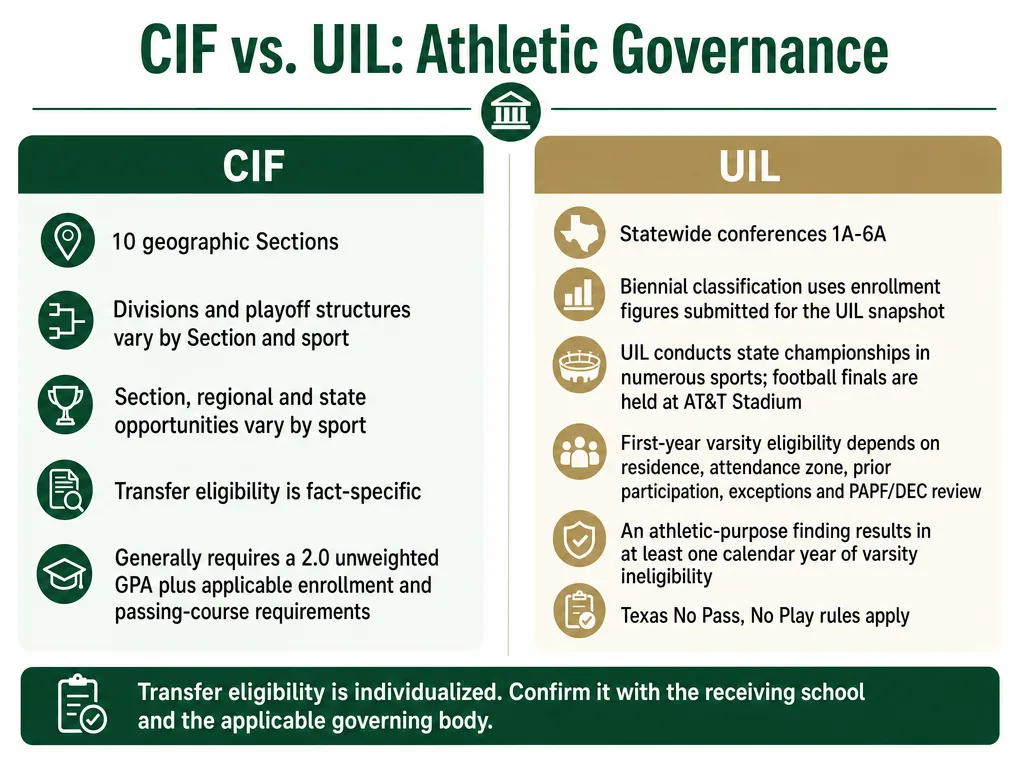
The Scale Difference
| Feature | California (CIF) | Texas (UIL) |
|---|---|---|
| Governing Body | CIF (10 Sections) | UIL (statewide) |
| Classifications | Varies by Section | 1A through 6A |
| State Championships | Section + state/regional opportunities by sport | UIL state championships |
| Transfer Sit-Out | Varies by Section and student circumstances | At least one calendar year of varsity athletic ineligibility if the District Executive Committee finds that the student changed schools for athletic purposes; the period can be longer under UIL rules. |
| Academic Requirement | Generally a 2.0 unweighted GPA plus applicable 20-semester-credit enrollment/passing requirements, subject to CIF rules, Section rules and applicable exceptions. | No Pass, No Play; a grade below 70 in a nonexempt course can result in temporary ineligibility, subject to UIL/TEA rules. |
Last verified: August 2026, based on current UIL and CIF handbooks.
Unlike CIF, which governs California interscholastic athletics, UIL also administers Texas academic, music and theatre competitions. Those nonathletic UIL programs should be evaluated separately from the CIF-to-UIL athletics comparison.
What California Parents Should Know About Texas Sports Culture
Both states have strong high-school athletic traditions, but UIL competition can be especially visible in many Texas communities. The scale of facilities, attendance and community involvement varies considerably by district and campus.
Key cultural differences:
- Friday Night Lights is real. For example, Allen High School near Dallas has a stadium seating over 18,000, though this is not representative of every Hill Country district. The scale of facilities, attendance and community involvement varies considerably by district and campus.
- Marching band can be a highly visible extracurricular in Texas. UIL administers music competition, but program size, participation, performance history and available ensembles vary by campus. Families for whom music is important should review the receiving campus's actual course offerings, rehearsal commitments, audition procedures and competition schedule.
- UIL academics and fine arts are competitive. UIL sponsors extensive high-school academic, music and theatre competition, including debate, journalism, mathematics, science, one-act play and theatrical design. Texas high-school visual artists also have a statewide competition pathway through the Texas Art Education Association's Visual Arts Scholastic Event (VASE), which is not the same as a UIL high-school visual-art contest.
- Transfer rules are different and highly fact-specific. UIL transfer eligibility is not determined by a simple one-year rule. If a District Executive Committee determines that a student changed schools for athletic purposes, the student is ineligible for varsity competition for at least one calendar year. A bona fide family move can have a different result, but the student must satisfy all applicable residence, enrollment and athletic-eligibility requirements. [11][12]
- UIL realigns classifications every two years. For 2026-28, Comal ISD's Pieper High School moves to 6A (2,215+ students), while Boerne ISD's Boerne High (1,540) and Champion High (2,025) remain 5A. These classifications are based on enrollment figures submitted to UIL in October 2025 for the 2026-27 and 2027-28 biennium. They are snapshot figures, not continuously updated current-enrollment counts. UIL rules, including applicable opt-up and realignment procedures, can also affect classification and district assignment. [12]
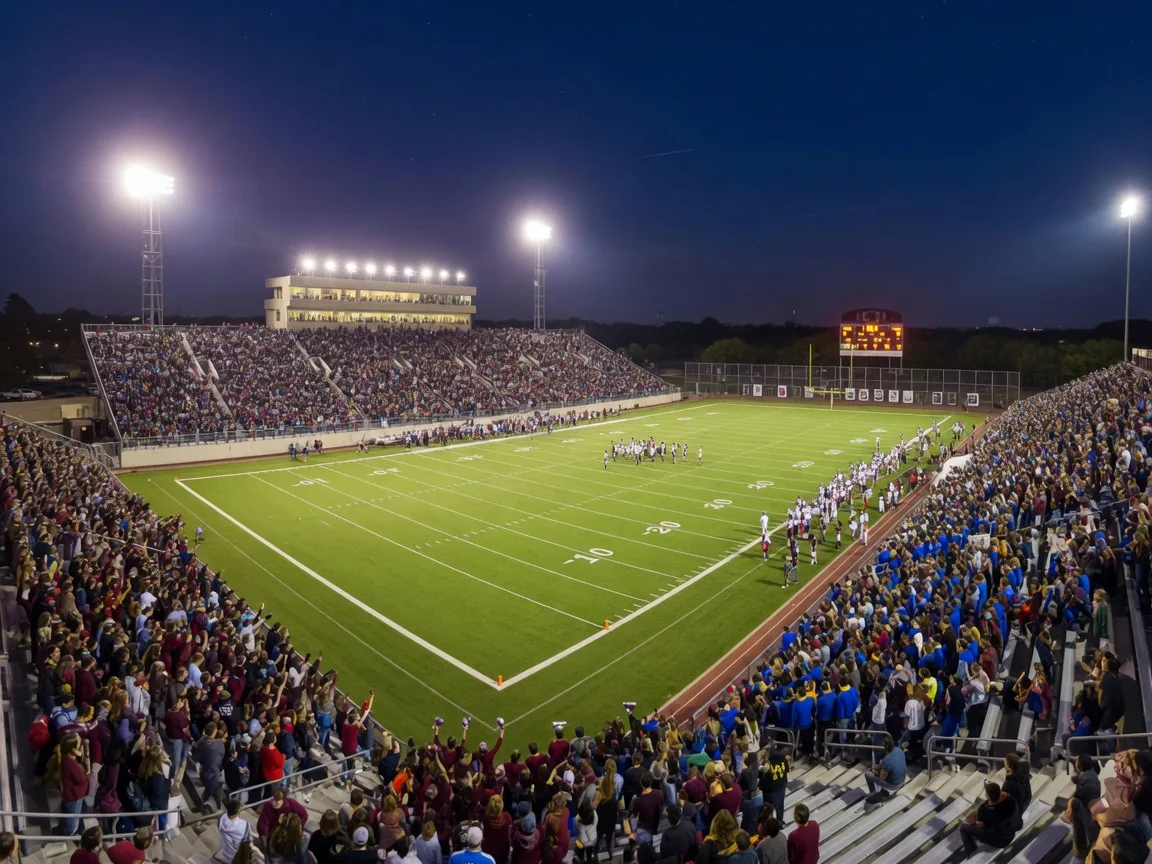
Key UIL Transfer Requirements for California Transfers
For 2026-27, UIL requires a New Student Eligibility Questionnaire for new students in grades 9-12 before high-school athletic competition. Students with prior athletic practice/participation in grades 8-12 may also require a Previous Athletic Participation Form (PAPF), particularly for varsity eligibility. The previous school can be outside Texas. UIL moved the 2026-27 PAPF process into its new Rank One portal. The PAPF process is parent-initiated after the receiving school has uploaded the student. Former-school information and District Executive Committee approval are part of the eligibility process. Practical tip: Before leaving California, save the former school's athletic-director contact information and participation history. After enrolling in Texas, contact the receiving school's athletic department immediately and follow its UIL/Rank One process. Do not rely on an old printable PAPF as the current procedure.
Varsity eligibility at a new high school is fact-specific. A student whose parents establish a bona fide residence within the receiving school's attendance zone may be eligible immediately after the required eligibility questionnaire and, when applicable, PAPF process are satisfactorily completed and all other UIL requirements are met. A student who does not satisfy the parent-residence rule may be ineligible for varsity athletics during the first year at the school unless a UIL exception or hardship waiver applies. Separately, if the District Executive Committee determines that the student changed schools for athletic purposes, the student is ineligible for varsity competition for at least one calendar year. [11][26] A high-school student who has not been in regular attendance at the receiving school since the sixth class day of the present school year generally must be enrolled and in regular attendance for at least 15 calendar days before a UIL contest or competition, subject to applicable UIL rules and exceptions. [11] The receiving school and District Executive Committee should make the actual eligibility determination.
Section 5: The Enrollment Decision Matrix
How to Use This Guide When House Hunting
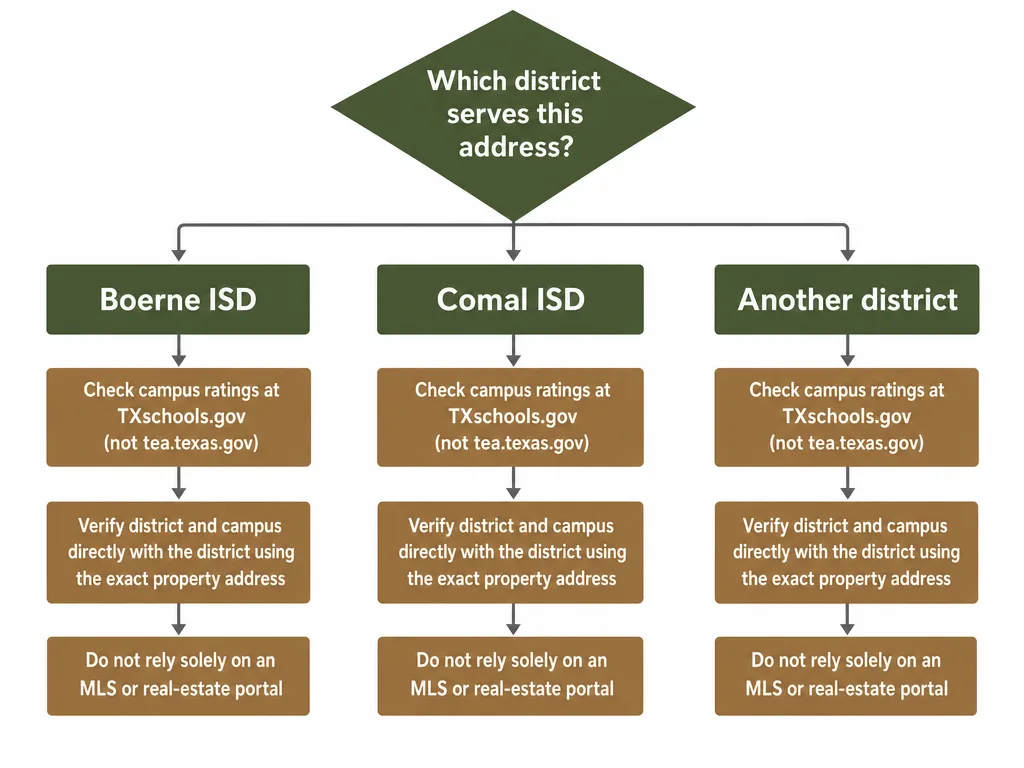
Verify the assigned campus using the exact property address directly with the school district. TEA states that attendance zones and campus assignments are determined locally, and TEA does not maintain official attendance-zone maps. Do not rely solely on MLS, portal or third-party school-boundary data. [22]
| Factor | What to Check | Why It Matters |
|---|---|---|
| School District Boundary | Which ISD serves this address? | Boerne ISD vs Comal ISD vs other districts |
| Campus-Level A-F Rating | Not just the district rating — check the specific campus | A district can be a "B" but have individual campuses rated "C" |
| STAAR Scores | Look at campus-level STAAR data on TXschools.gov | This shows performance under Texas TEKS and the STAAR system; it is not directly equivalent to CAASPP performance. |
| Immunization Requirements | Compare your child's current records against Texas DSHS requirements | Missing or insufficient documentation can delay school attendance; valid Texas exemptions and DSHS provisional-enrollment rules may apply. |
| Transfer Eligibility | If your child attends a school outside your zone, check transfer deadlines | Windows close early (January-March for Boerne ISD High School Choice) |
| Sports Eligibility | If your child is an athlete, understand UIL transfer rules before committing | UIL eligibility depends on move type, DEC finding, and rules |
| Extracurricular Offerings | Check the specific campus for band, fine arts, UIL academics | Not all campuses offer the same programs |
| Before/After School Care | Important for working parents — check availability | Availability, eligibility, operating hours, registration procedures and cost vary by campus and provider. |
High-School Transfers: Request a Credit Audit
California course names and credits should not be assumed to map one-for-one to Texas graduation requirements. Texas students follow the applicable state graduation program, and the receiving district evaluates an out-of-state student's transcripts/coursework for placement and credit.
For a high-school move, ask the receiving counselor for a written credit/graduation audit showing:
- credits accepted and still needed
- Texas-specific graduation-course requirements
- endorsement/advanced-course implications
- which EOC requirements apply to the student's graduating class
- whether any course must be repeated, substituted or validated
This is especially important during the transition created by House Bill 8 because English II EOC is eliminated beginning in 2027-28 while TEA has separate guidance for the 2026 and 2027 graduating classes. [19]
Sources: tea.texas.gov/student-readiness-and-high-school/high-school-graduation-requirements, tea.texas.gov/taa-letters/overview-house-bill-8
Section 6: Special Education Transition — California IEP vs. Texas ARD
Navigating the special education transition across state lines can feel like learning a completely new language. While both California and Texas operate under the federal Individuals with Disabilities Education Act (IDEA), their terminology, governance structures, and meeting timelines differ significantly.
The Terminology Translation
California (IEP Team Meeting): Led by the Individualized Education Program (IEP) team to review assessments, goals, and services.
Texas (ARD Committee Meeting): Known as the Admission, Review, and Dismissal (ARD) Committee. Required ARD committee membership generally includes the parent or parents; at least one regular-education teacher if the student is, or may be, participating in the regular-education environment; at least one special-education teacher or special-education provider; a representative of the school district/LEA; and an individual who can interpret the instructional implications of evaluation results. Other required or appropriate participants may apply depending on the student's circumstances. Texas procedures seek mutual agreement, but agreement is not guaranteed. If mutual agreement is not reached, the ARD meeting may recess for up to 10 school days unless the parties agree otherwise. If disagreement remains after reconvening, the LEA may implement the IEP it determines appropriate, while the parent retains procedural rights and must be offered an opportunity to document disagreement.
Transferring a California IEP to Texas
1. Verification. For Texas transfer purposes, verification means the receiving LEA obtains the student's IEP that was in effect in the previous district.
2. Comparable services. In consultation with the parent, the new Texas LEA must provide FAPE, including services comparable to those described in the previous IEP while the transfer process is underway.
3. If a new evaluation is NOT necessary. The Texas LEA has 20 school days from verification to develop, adopt and implement a new IEP.
4. If the Texas LEA determines a full individual and initial evaluation (FIIE) IS necessary. The initial-evaluation and initial-ARD timelines apply instead; the process is not governed by the simple 20-school-day deadline above.
5. Summer registration. If a student enrolls over the summer and the receiving Texas LEA obtains verification of the special-education and related services in the previous IEP, the new LEA must either implement that previous IEP in full on the first day of the new school year or convene an ARD committee meeting during the summer to revise the IEP for implementation on the first day. If the prior services cannot be verified before school begins, the applicable transfer timelines depend on whether the student previously attended a Texas district or an out-of-state district. [15][37]
Because timelines depend on whether an evaluation is necessary, parents should provide the current IEP and evaluation records as early as possible and contact the receiving district's special-education department before or immediately after enrollment.
Strategic Insights for Special Education Relocation
Documentation practices. Clear, current IEP documentation is extremely helpful during a move because the receiving district uses the prior IEP and other records to understand the student's existing services. Federal transfer rules call for comparable services during the transition, not necessarily an identical word-for-word recreation of the California program.
Review IEP content before moving. Before moving, review the current IEP for accurate present levels, measurable goals, service frequency/duration, accommodations, assistive technology and related services. Clear records make the transfer process easier in any state.
Evaluation cycles. A recent California reevaluation can provide useful information to the receiving Texas LEA, but families should not assume that completing a reevaluation immediately before moving will always be the best choice or will eliminate the possibility of additional evaluation in Texas. If a reevaluation is due near the move date, discuss the timing with the current IEP team and the receiving district. Bring the most recent evaluation and eligibility records so the Texas LEA can determine whether further evaluation is necessary.
Psychoeducational and evaluation records. Bring copies of the most recent eligibility/evaluation reports, including psychoeducational, speech-language, occupational/physical therapy or other relevant evaluations. These records can help the receiving district decide whether additional evaluation is necessary. Also bring related-service progress reports or service records, if available.
Section 504 Plans
A 504 plan does not use the IDEA/ARD transfer procedure described above. Federal OCR guidance says that when a student with a disability transfers with an existing Section 504 plan, the receiving district should review the plan and supporting documentation. If the receiving district's knowledgeable group determines the plan is appropriate, it must implement it; otherwise the district must evaluate the student consistent with Section 504 requirements. [16]
Source: ed.gov
Last verified: August 2026, based on Texas Administrative Code Section 89.1055 and federal IDEA requirements.
Section 7: The California Departure Document Checklist
Keep accessible copies of important school records during an interstate move. Texas public schools use the Texas Records Exchange (TREx) to request and receive records for students who have attended or will attend Texas public schools; interstate record-transfer procedures differ. The receiving Texas district may still request official records directly from the student's previous California school. Parent-carried copies can help counselors review information promptly, but they do not replace official records when the receiving district requires them. [35]
Recommended records to keep accessible during the move:
- Copies of recent transcripts, report cards and course schedules
- Course descriptions/syllabi when high-school credit placement could be unclear
- CAASPP and other relevant assessment reports
- Current immunization record and supporting documentation
- Current IEP or Section 504 plan
- Most recent special-education eligibility/evaluation reports
- IEP progress reports and related-service records, if available
- Advanced-course/AP/IB/dual-credit records when applicable
- Former school counselor, registrar and athletic-director contact information
- Athletic participation history for students planning UIL sports
- Fine-arts audition/portfolio information when relevant
Hand-carried copies are useful for avoiding delays, but the receiving district may still obtain official records directly from the previous school.
Athletic Records and the UIL Rank One Process
For 2026-27, the receiving school processes required UIL eligibility documentation through the UIL Rank One system. The New Student Eligibility Questionnaire applies to new students in grades 9-12 before any high-school athletic contest, and a PAPF may also be required based on prior participation. In Rank One, the PAPF process is parent-initiated after the receiving school uploads the student. Families should follow the receiving athletic department's instructions rather than attempting to create or manage the school's portal process independently. [11][13]
- Athletic Participation History: Log of sports played in grades 8-12.
- Former Coach/AD Contact Info: Required for the online PAPF form.
- Physical and medical-history forms: Ask the receiving athletic department whether the student's existing physical satisfies UIL and local requirements. At minimum, UIL requires a physical before the first year of junior-high athletics and upon entering the first and third years of high-school athletics; a local district may require an annual physical. A UIL medical-history form is required annually. Do not assume that every transfer automatically needs a new physical. [11]
For fine arts, carry relevant ensemble records, chair placements, audition materials, portfolios and competition ratings to the receiving school.
Last verified: August 2026.
Section 8: Frequently Asked Questions
How do California CAASPP scores compare to Texas STAAR scores?
They are not directly comparable because California and Texas assess different state standards and establish their performance standards independently. No official CAASPP-to-STAAR score conversion exists, and a California Level 3 (Proficient) or Level 4 (Advanced) result should not be assumed to equal Texas Meets Grade Level or Masters Grade Level. The categories can help families understand each state's terminology, but they should not be treated as equivalent scores or placement levels. Texas districts may also review transcripts, coursework, prior records and other information when making individual placement decisions. [1][31]
What is the Texas A-F accountability rating and how do I read it?
Texas assigns each campus and district a letter grade from A to F based on three domains: Student Achievement, School Progress, and Closing the Gaps. An "A" (90-100) is the highest rating. A 'B' corresponds to a score of 80-89 under the TEA accountability scale. Check the specific campus rating, not just the district, because performance can vary significantly between schools in the same district. [4]
How can I compare Boerne ISD and Comal ISD?
Start with current TEA campus/district accountability data, then compare the specific programs important to your child — advanced coursework, special education, athletics, fine arts, CTE, language programs, transportation and the campus assigned to the exact residence. State ratings are one data point rather than a complete measure of school fit. [5][30]
When should we enroll our child in a Texas school?
Boerne ISD's enrollment portal opens February 12, 2026 for the 2026-2027 school year. Comal ISD registration assistance dates are July 20 (high schools), July 22 (middle schools), and July 29 (elementary schools). For mid-year enrollment, eligible resident students may enroll when they move into a Texas public-school district. Optional transfers, choice programs and particular campus assignments may have separate eligibility, capacity and deadline rules. [7][8]
What immunization records do we need for Texas enrollment?
Texas requires acceptable documentation showing compliance with current Texas Department of State Health Services school immunization requirements. For Grade 7, the requirements include Tdap and MCV4, subject to DSHS timing and catch-up rules. Do not assume that an immunization record or exemption from another state automatically establishes Texas compliance. An out-of-state nonmedical exemption form is not valid as a Texas reasons-of-conscience exemption; families seeking that Texas exemption must follow the current DSHS affidavit process. Medical exemptions and qualifying provisional enrollment have separate Texas rules. Verify the student's status with the receiving school nurse before enrollment. [9][10][28]
Can my child play sports immediately after transferring from California?
UIL requires a New Student Eligibility Questionnaire for new students in grades 9-12 before high-school athletic competition. Students with prior athletic practice/participation in grades 8-12 may also require a Previous Athletic Participation Form (PAPF), now processed through UIL's Rank One portal after the receiving school uploads the student. A student who moves with the student's parents may be eligible immediately if all UIL eligibility requirements are met, but the receiving school and District Executive Committee should make the actual eligibility determination. See Section 4 for the full UIL transfer rules. [11][13]
How does Texas fine arts compare to California?
UIL sponsors extensive high-school academic, music and theatre competition, including debate, journalism, mathematics, science, one-act play and theatrical design. Texas high-school visual artists also have a statewide competition pathway through the Texas Art Education Association's Visual Arts Scholastic Event (VASE), which is not the same as a UIL high-school visual-art contest. Texas campuses may offer band, choir, theatre and visual-arts programs, but the available disciplines and depth of each program vary by campus. Offerings and program depth vary by campus, so families should compare the specific band, choir, theatre, visual-arts and competition opportunities available at the campus their child would actually attend. [23][24]
Why are TEA ratings missing for some Texas schools?
Texas accountability releases were disrupted by litigation, including a delayed release of the 2024 ratings. TEA publicly posted preliminary 2024 and 2025 A-F ratings in August 2025 and released final 2024 and 2025 ratings after the appeals process on December 11, 2025. As of this article's August 8, 2026 review date, TEA says information and resources related to the 2026 ratings will be available August 14, 2026 at 12 p.m. A particular campus may also be listed as Not Rated for reasons specific to TEA's accountability rules, so families should check the individual campus at TXschools.gov rather than assuming a missing letter grade is caused by litigation. [5][29]
How does my child's California IEP transfer to a Texas school?
See Section 6 for a detailed explanation of the California-to-Texas special education transfer process, including the 20-school-day timeline (conditional on whether a new evaluation is needed), comparable services, and Section 504 plan procedures. [15]
What documents should we bring from California when enrolling in a Texas school?
See the full document checklist in Section 7. Key records include transcripts, report cards, immunization records, IEP/504 plans, evaluation reports, and athletic participation history. Hand-carried copies are useful for avoiding delays, but the receiving district may still obtain official records directly from the previous school. [22]
Coordinating an interstate move requires local precision on both sides of the state line. If you are beginning to map out your timeline, reach out for a private, data-driven strategy session. We can coordinate your California sale contingencies with a targeted Texas neighborhood search, with careful attention to the timing and logistics of your move.
Sources
- [1] California Department of Education, 2024-25 Assessment Data Release: https://www.cde.ca.gov/ta/tg/ca/assessmentreleasefaq2025.asp
- [2] California Department of Education, CAASPP Reporting Label Communication: https://www.cde.ca.gov/Nr/ne/yr25/yr25rel43.asp
- [3] California Department of Education, Dashboard Communications Toolkit: https://www.cde.ca.gov/ta/ac/cm/dashboardtoolkit.asp
- [4] Texas Education Agency, 2025 A-F Accountability Rating System: https://tea.texas.gov/school-and-district-leaders/accountability/academic-accountability/performance-reporting/2025-accountability-rating-system
- [5] Texas Education Agency, Final 2024 and 2025 Accountability Ratings: https://tea.texas.gov/about-tea/news-and-multimedia/correspondence/taa-letters/final-2024-2025-accountability-ratings-2025-federal-report-cards-2026-27-peg-list-available
- [6] Texas Education Agency, Overview House Bill 8: https://tea.texas.gov/taa-letters/overview-house-bill-8
- [7] Boerne ISD, Enrollment/Registration: https://www.boerneisd.net/departments/technology-services/student-information-systems/enroll and https://www.boerneisd.net/departments/administrative-services/student-transfers
- [8] Comal ISD, New Student Registration: https://www.comalisd.org/apps/pages/registration/26-27/NewStudents
- [9] Texas DSHS, Immunization Requirements: https://www.dshs.texas.gov/immunizations/school/requirements
- [10] Texas DSHS, Immunization Exemptions: https://www.dshs.texas.gov/immunizations/school/exemptions
- [11] UIL, Eligibility Rules: https://www.uiltexas.org/policy/eligibility and https://www.uiltexas.org/policy/constitution/general/eligibility
- [12] UIL, Conference Cutoffs: https://www.uiltexas.org/athletics/conference-cutoffs
- [13] UIL, Rank One Portal: https://www.uiltexas.org/uil-portal
- [14] CIF, Governance Constitution: https://cifstate.prestosports.com/governance/constitution/index
- [15] TEA Special Education Transfer Guide: https://spedsupport.tea.texas.gov/resource-library/students-disabilities-who-transfer-state-and-out-state-quick-guide
- [17] California Department of Education, Transitional Kindergarten FAQ: https://www.cde.ca.gov/FG/it/tkfiscalfaq.asp
- [18] TEA, Prekindergarten Registration: https://tea.texas.gov/educators/early-childhood-education/prekindergarten/prekindergarten-registration-and-enrollment
- [21] TEA, TELPAS: https://tea.texas.gov/student-assessment/telpas
- [22] TEA, Enrollment in Public School: https://tea.texas.gov/about-tea/contact-us/general-inquiry/enrollment-public-school
- [23] Texas Art Education Association, VASE: https://www.taea.org/vase/
- [24] UIL, Academic Competitions: https://www.uiltexas.org/academics
- [25] UIL, Academic Requirements: https://www.uiltexas.org/policy/tea-uil-side-by-side/academic-requirements
- [26] UIL, DEC QA: https://www.uiltexas.org/policy/dec/qa
- [27] CIF, Transfer Eligibility: https://cifstate.prestosports.com/governance/transfer_eligibility
- [29] TEA, 2026 Accountability Rating System: https://tea.texas.gov/school-and-district-leaders/accountability/academic-accountability/performance-reporting/2026-accountability-rating-system
- [30] Comal ISD, Accountability: https://www.comalisd.org/apps/pages/curriculum/accountability
- [36] California CAASPP Reporting-Label Communication: https://www.caaspp-elpac.org/training-and-communication/communication/email/05-04-26-caaspp
- [37] TEA ARD Committee Requirements: https://tea.texas.gov/taa-letters/admission-review-and-dismissal-ard-committee-requirements
School boundaries, registration dates, transfer rules, accountability ratings, immunization requirements and UIL eligibility rules can change. Verify time-sensitive information with the applicable district, TEA, DSHS or UIL before making an enrollment, housing or athletic-eligibility decision.
Last reviewed: August 10, 2026.

Bill Ross
Real Estate Agent · Hill Country Homesteads Group
Bill Ross is the founder of Hill Country Homesteads Group, a Texas real estate practice serving Boerne, Fair Oaks Ranch, San Antonio, and the surrounding Hill Country communities. Drawing on nearly four decades in high-tech sales and marketing, Bill offers a direct, strategic, and client-first framework. His practice specializes in guiding out-of-state relocations — leveraging a unique, direct professional network of over 1,100 California real estate agents to coordinate seamless transitions for coast-to-coast clients.
Common Questions About California to Texas School Transfers
How do I transfer my child from a California school to Boerne ISD?
Start by creating a Skyward Family Access account on the Boerne ISD website. You will need your child's birth certificate, immunization records (compare against Texas DSHS requirements, which differ from California's), proof of residency within Boerne ISD boundaries, and previous school records. Request transcripts from your California school early -- they can take one to three weeks. See our full school comparison guide for detailed enrollment steps.
Are Texas school ratings better than California schools?
Texas and California use different rating systems, so direct comparisons are difficult. Texas schools are rated by the Texas Education Agency (TEA) using letter grades A through F, while California uses the California School Dashboard. Both systems measure different things. What matters most is the specific school your child will attend -- research the assigned campus using your exact property address, not just the district name.
Related Reading
- Moving to Texas With Kids: School Enrollment, Transfers, and Calendar Traps
- 12-Month California to Hill Country Relocation Timeline
- Boerne, Bandera, Comfort, Kerrville & Fair Oaks Ranch: A Five-Community Comparison
- How California Families Can Evaluate Texas School Districts Before They Move
- Your California Estate Plan May Not Travel Cleanly: What to Review After Moving to Texas
- Texas School Districts Explained: ISDs, Ratings, Transfer Policies, and What California Parents Need to Know
- Boerne ISD: A Complete Guide for California Families Moving to Texas
- Protesting Your Property Tax Appraisal in Bexar, Kendall, Comal, and Bandera Counties