
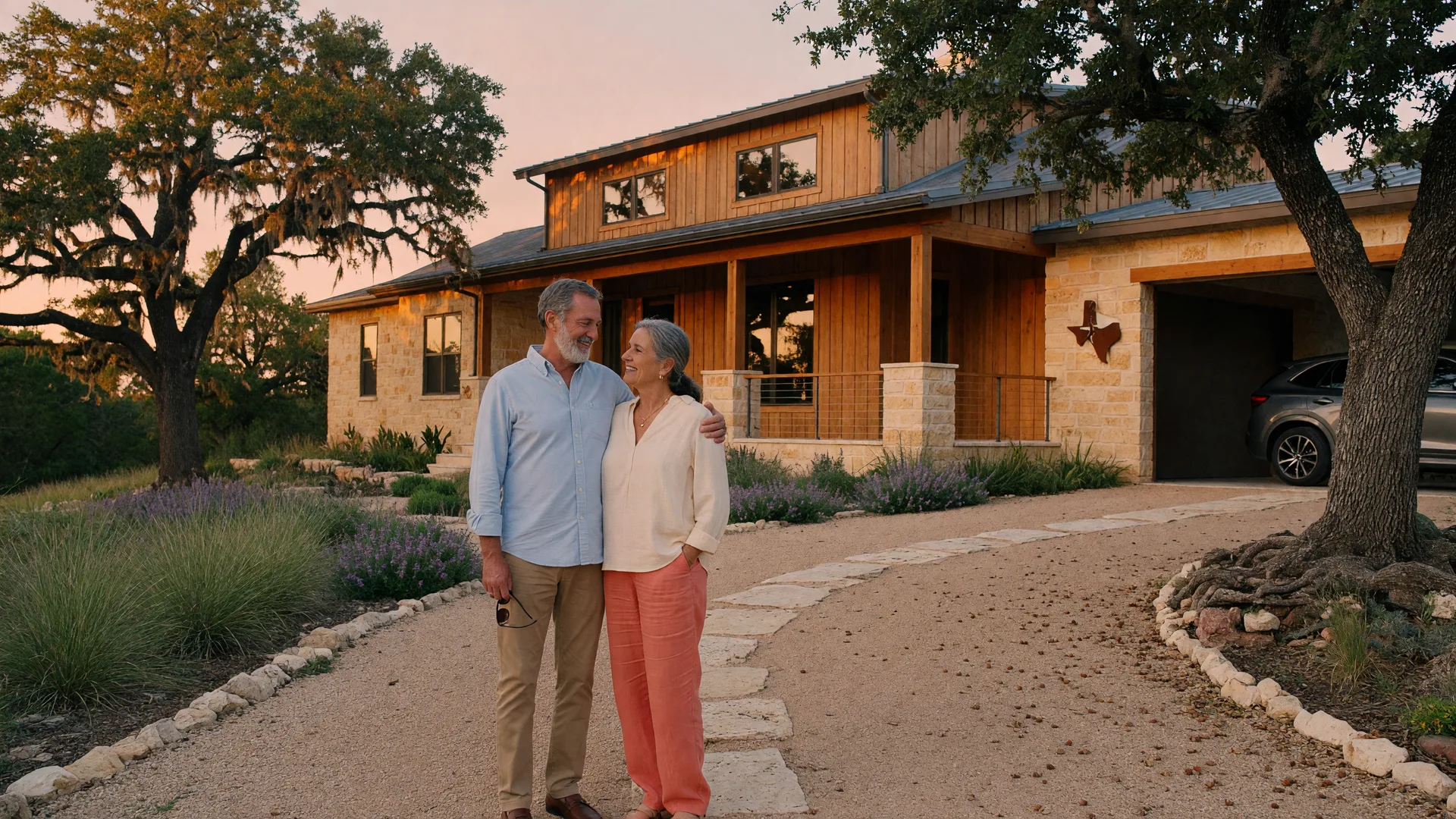
The empty-nester transition is one of the most common relocation triggers I see among California clients. The house that was perfect for raising a family now has three unused bedrooms, a backyard that nobody plays in, and a monthly carrying cost that feels harder to justify with every passing year. The question these homeowners ask themselves is not whether to downsize, but where to downsize so the next chapter actually feels like an upgrade, not a compromise.
For a growing number of California empty-nesters, the answer is the Texas Hill Country. Boerne, Fair Oaks Ranch, and the surrounding communities offer a combination that is hard to find in California: homes that are genuinely easier to maintain, property that retains its character, a cost structure that frees up significant cash flow, and a lifestyle that rewards the kind of time you have more of when you are no longer chauffeuring kids and attending weekend tournaments. This article walks through the practical financial, social, and logistical realities of making that move, so you can evaluate whether it fits your specific situation.
The Financial Case: Why Downsizing Across State Lines Is Different
For empty-nesters, the financial math of relocation is fundamentally different from the math faced by a young family or a first-time buyer. You already own a home with significant equity. You have a clear understanding of your monthly expenses. And you are entering a life stage where the question is not "how much house can we afford," but "how much of our housing cost can we redirect to things we actually want to do." [1]
The Equity Unlock
A typical scenario I work through with California empty-nesters looks like this:
- Current home: A 2,800-square-foot home in the East Bay, Silicon Valley, or coastal Los Angeles, worth $1.2 million to $2.0 million. Owned for 15 to 25 years, with a mortgage balance of $200,000 to $400,000.
- Downsize target: A 2,000- to 2,400-square-foot home in Boerne or Fair Oaks Ranch, priced at $450,000 to $650,000. This is a well-built, modern home with three bedrooms, an office, a covered patio, and a manageable lot. It is not a compromise house. It is a right-sized house.
- Outcome: After selling in California, paying transaction costs and applicable capital gains, and buying the Texas home in cash (or with a small mortgage), the typical empty-nester locks away $500,000 to $1.2 million in freed equity. That equity becomes a retirement account, a travel fund, or an investment portfolio, not another 10 years of a monthly housing payment that barely moves the principal.
The specific numbers for selling a $1.45 million California home and purchasing a $525,000 Texas home (after commissions, transfer taxes, and capital gains) are detailed in our California equity to Texas wealth article. For empty-nesters, the key difference is that you do not need to roll that equity into a larger mortgage. You can take it as freed wealth.
"An East Bay couple sold their 3,000-square-foot home for $1.4 million, paid roughly $95,000 in transaction costs and capital gains, and bought a 2,200-square-foot modern home in Boerne for $510,000 in cash. They eliminated their mortgage entirely, cut their monthly housing costs from $6,800 to $1,100 in property taxes and insurance, and freed over $800,000 in equity. Their annual savings: approximately $68,000."
Tax Advantages That Compound Over Time
The tax environment for California empty-nesters in Texas is meaningfully different from what you experience today [2][3]:
- No state income tax on retirement distributions. Once you start drawing from 401(k)s, IRAs, or pensions, Texas takes nothing. California would take 1% to 13.3% of every distribution, depending on your bracket.
- The Texas homestead exemption. Homeowners 65 and older receive an additional $60,000 exemption on top of the base $140,000 homestead exemption. School district taxes on the first $60,000 of assessed value are also frozen for over-65 homeowners. This can reduce an already moderate Texas property tax bill by $1,500 to $2,500 per year depending on the county [3].
- No state estate or inheritance tax. Texas has no state-level estate tax. Combined with the federal estate tax exemption (currently $13.61 million for 2026), most empty-nesters moving to Texas do not need to structure their estate around state tax avoidance, a meaningful simplification for estate planning.
For the full breakdown of how the homestead exemption works and how to file, see our Texas Homestead Exemption guide.
Right-Sizing: What Empty-Nesters Actually Buy in the Hill Country
When California empty-nesters get serious about the Hill Country, they are not looking for a retirement community in the traditional sense. They are looking for a home that fits their current life, not the life they had 20 years ago. Here is what that typically looks like in practice.
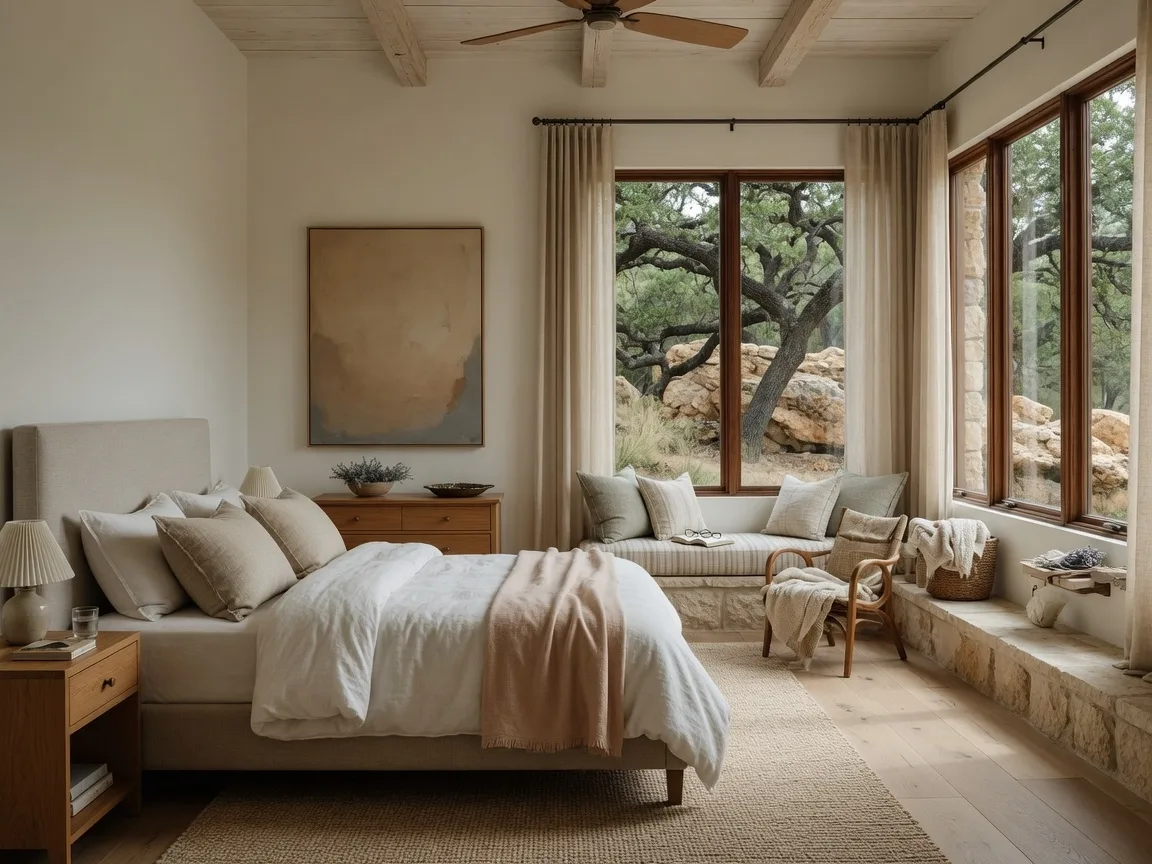
Single-Story Living
One of the most common requirements I hear from empty-nester buyers is "no stairs." The Hill Country has a substantial inventory of single-story homes, especially in the newer master-planned communities of Fair Oaks Ranch (Front Gate, Elkhorn Ridge) and the active adult neighborhoods in Boerne. A 2,000- to 2,400-square-foot single-story home with an open floor plan, a primary suite with a walk-in shower (not a tub), and a covered patio that extends the living space outdoors is the standard request. This configuration is not hard to find in the $450,000 to $650,000 range [4].
Office and Guest Space
The third bedroom in a downsized home normally serves double duty as a home office and a guest room. California empty-nesters who are still working (or who consult, freelance, or manage investments) value a dedicated room with good internet connectivity (Boerne has fiber-optic service from GVTC in most areas, and Spectrum covers the rest of the Hill Country [5]). A secondary bedroom for visiting children or grandchildren is the other nonnegotiable. The key insight: you do not need a 2,800-square-foot house to host guests. You need one well-configured guest room and a comfortable living area.
Acreage That Does Not Create Work
Many California empty-nesters are drawn to the Hill Country's acreage lifestyle, but the reality of maintaining five acres in your 60s is different from the fantasy. The empty-nesters who are happiest in their move typically choose a half-acre to one-and-a-half-acre lot with enough space for privacy, a garden, and room for the dog, but not so much that weekends disappear into mowing, cedar removal, and brush clearing. Master-planned communities in Fair Oaks Ranch handle most exterior maintenance through HOA services, which appeals to homeowners who want the Hill Country character without the physical demands of rural property management.
"The emptiest feeling is not the house. It is paying for space you do not use. When you downsize from 3,200 to 2,100 square feet, you lose the unused square footage, maintain the daily-use spaces, and wake up with $4,000 more in your pocket every single month."
Social Integration: Building a New Community After the Kids Leave
The social challenge of moving as an empty-nester is different from moving as a young family. When you have kids in school, your social network builds organically through school events, extracurricular activities, and neighborhood playdates. As an empty-nester, building that network requires more intentionality, but the Hill Country community structure makes it easier than many California transplants expect [6].
What Works Well
- Neighborly culture. Hill Country towns like Boerne still operate with a front-porch, wave-to-your-neighbor social rhythm. In many neighborhoods, people introduce themselves within the first week. A California empty-nester told me she had been invited to two dinner parties and a neighborhood wine night before her moving boxes were unpacked.
- Active adult communities. If you want built-in social infrastructure, communities like Regency at Esperanza (Boerne's premier 55+ active adult neighborhood) include a clubhouse, fitness center, pickleball courts, and a full social calendar. Many residents told me they made more friends in their first six months there than in the last five years in their California neighborhood [7].
- Civic and volunteer organizations. Boerne has an active Rotary Club, Kiwanis, a public library foundation, a visitors center volunteer program, and multiple church and faith communities that welcome new members. For empty-nesters with time to give, these organizations provide a ready-made network of people who share your values.
- Hill Country social activities. Wine clubs, golf leagues, hiking groups, book clubs, and cooking classes are all active in the area. The Boerne Senior Center and the Fair Oaks Ranch community center both run regular events and classes.
What Requires Adjustment
- Distance from adult children. If your children live in California, the flight time from San Antonio to San Francisco is about 3.5 hours, and to Los Angeles about 3 hours. That is manageable for quarterly visits and holidays, but it is not a weekend drive. Empty-nesters who thrive in the move plan for their children to visit during the cooler months (October through May) and plan their own California trips for the summer.
- Slower pace of connection. While Hill Country residents are warm and welcoming, deep friendships still take time. The first year can feel socially thin for some movers. Joining at least two organizations (one social, one interest-based) within the first three months is the most consistent advice I hear from successful relocators.
- Aging parent considerations. If you have parents still in California, the distance adds complexity to caregiving responsibilities. Some empty-nesters choose to relocate their parents to Texas as well, typically to one of the area's continuing care retirement communities like Morningside at Menger Springs in Boerne [8].
For a deeper look at how social dynamics work in the Hill Country, read our full guide on Making Friends in Texas.
Estate Planning: What Empty-Nesters Need to Update Before They Move
Empty-nesters are at the life stage where estate planning moves from "something we should do someday" to a practical necessity. Relocating from California to Texas adds several layers to that process that are worth understanding before you move [9].
Trust and Will Considerations
Both California and Texas are community property states, which simplifies the transition for married couples. But the specifics of trust administration, probate, and power of attorney differ significantly. A revocable living trust drafted under California law may still function in Texas, but it is not guaranteed to handle Texas property correctly. Key differences [9]:
- Texas does not have a statutory durable power of attorney form that exactly matches California's form. If your California power of attorney does not comply with Texas's statutory requirements, a Texas bank or title company may not accept it for real estate transactions or financial matters.
- Texas probate for small estates is simpler than California's process, with a Small Estate Affidavit available for estates under $75,000 (California's limit is $184,500, but the Texas process is less bureaucratic for what it covers).
- Self-proving affidavits are standard in Texas and simplify the will validation process. If your California will does not include one, your heirs may need to locate and depose witnesses, a complication your estate plan was supposed to avoid.
Beneficiary Updates
Beneficiary designations on retirement accounts, life insurance policies, and payable-on-death accounts are governed by state law. Moving to Texas does not automatically invalidate existing designations, but it does change how spousal waivers, contingent beneficiaries, and trust beneficiaries are interpreted. Any account that names "my spouse" as the beneficiary (instead of a specific name) may create ambiguity under Texas law if the reference is to "my spouse under California law."
The practical advice: before you move, work with an estate planning attorney who practices in both states (or who regularly handles California-to-Texas relocations) to update your core documents. This is not optional. It is a standard step in any cross-state move for empty-nesters with accumulated assets. Our estate planning guide covers the specific updates most California movers need.
Healthcare Access for the Empty-Nester Stage
Healthcare access becomes a more central concern in the empty-nester years, and it is one of the questions I spend the most time on with California clients considering the Hill Country. The honest answer is that San Antonio's medical infrastructure is strong, and Hill Country residents benefit from it [10]:
- Methodist Healthcare System: The flagship Methodist Hospital on San Antonio's north side is approximately 30 to 35 minutes from Boerne and Fair Oaks Ranch. Methodist also has a campus in Stone Oak and an ambulatory surgery center near Loop 1604 and I-10. Strong cardiology, orthopedics, and oncology programs.
- University Health: The county hospital system, affiliated with UT Health San Antonio, provides specialist access across most disciplines. Its trauma center is Level I, and its transplant program is one of the most active in Texas.
- Primary care in Boerne: Boerne has multiple primary care clinics affiliated with Methodist and Baptist Health systems, plus independent practices. For routine care and chronic disease management, most Boerne residents do not need to drive to San Antonio.
- Medicare acceptance: The San Antonio area has strong Medicare Advantage and Medicare Supplement networks. UnitedHealthcare, Humana, Aetna, and Blue Cross Blue Shield of Texas all have broad provider networks in Kendall and Bexar counties.
For a complete overview of the healthcare landscape, see our Hill Country healthcare guide. For the comparison of major systems, our healthcare and estate planning comparison article runs the California vs. Texas numbers in detail.
Lifestyle Comparisons: What You Gain and What Changes
Every empty-nester I have worked with who ultimately relocated to the Hill Country describes the lifestyle difference in similar terms: it is not a sacrifice to a smaller existence, but a trade from one kind of life to another.
What Empty-Nesters Say They Gain
- Time. Without a big house to maintain, a long commute to endure, and the spending pressure of a high-cost area, empty-nesters report gaining 10 to 15 hours of discretionary time per week. That time goes to hobbies, exercise, travel planning, and relationships.
- Financial breathing room. The monthly savings from downsizing in a lower-cost market is not theoretical. It changes daily decisions about dining out, travel, and gifts for grandchildren.
- Access to nature. Hill Country living puts outdoor recreation within minutes: hiking at Government Canyon State Natural Area, kayaking on the Guadalupe River, birding at the Cibolo Nature Center, and wine touring on the 290 corridor. For many California empty-nesters, this feels like a return to the outdoor life they valued before the Bay Area or Los Angeles became too expensive and crowded to enjoy it.
- Community warmth. The social accessibility of Hill Country towns is a recurring theme. People say "good morning" on the trail. Neighbors bring over cookies. The hardware store owner remembers your name. For empty-nesters leaving a California neighborhood where they might have lived for 15 years without knowing their neighbors, this shift can be surprisingly meaningful.
What Requires Honest Adjustment
- Summer heat. This is the most common adjustment California empty-nesters need to make. June through September in the Hill Country means daytime highs in the mid-90s to low 100s. Outdoor activities shift to early morning or evening. The good news: homes in the Hill Country are built for this: central air conditioning is standard, and covered patios with ceiling fans extend outdoor living through the summer. The adaptation period is real, but most empty-nesters adjust by the second summer and plan their California visits during July and August.
- Distance. The nearest major airport (San Antonio International) is about 30 minutes from Boerne. The nearest cosmopolitan city (San Antonio) is about 30 minutes and offers world-class dining, museums, the River Walk, and the Pearl district. But if you are used to walking out your front door and having a dozen restaurants within five minutes, the adjustment is real. Most empty-nesters find that the tradeoff of more space, lower costs, and quieter nights is worth the reduction in instant urban access.
- Different pace. Hill Country towns move at a slower tempo than California metros. Appointments may not start exactly on time. Service providers may quote a two-week lead time and mean it. For empty-nesters coming from the Bay Area or Los Angeles, where speed and efficiency are cultural values, the adjustment can feel frustrating at first. It also tends to be something people come to appreciate after the first year.
The Trial Run: Visit Before You Commit
The strongest recommendation I can offer any California empty-nester considering the move: visit the Hill Country for at least a week. Not a weekend. A week. Stay in an Airbnb or VRBO in the neighborhood you are considering. Drive the commute to San Antonio. Visit the grocery stores (H-E-B is the standard. You will either love it or find it overwhelming). Eat at the local restaurants. Attend a community event. And do this during the summer if possible, so you experience the heat firsthand rather than discovering it after you have already bought a home [11].
Multiple visits across different seasons are even better. The Hill Country is spectacular in the spring (bluebonnets, mild temperatures) and fall (cool mornings, golden light). It is brutally hot in the summer. It can be grey and cold in January. You need to experience all of these to know whether this is truly the right place for your next chapter.
If you are not ready to buy, consider renting first. Our guide on renting before buying explains how a three-month rental in the Hill Country eliminates more risk than any amount of online research and weekend visits.
Frequently Asked Questions
Should I sell my California home before buying in Texas, or buy first and sell later?
If you have the cash reserves to make a Texas down payment without tapping your California equity, buying first gives you a clean transition with no timing pressure. If you need the equity from your California sale to fund the Texas purchase, selling first (or coordinating simultaneous closings) is the more common approach. As a practice, we coordinate over 1,100 California real estate agents to synchronize cross-state transactions, which allows many of our clients to close on both properties on the same day. That eliminates the bridge loan and temporary housing gap that is the biggest stress point in any cross-state move.
How much property tax will I pay on a $500,000 home in Boerne vs. my current California home?
On a $500,000 home in Kendall County, your combined property tax rate (school district, county, city, and special districts) will be approximately 2.05% to 2.25%, resulting in an annual tax bill of $10,250 to $11,250 before any exemptions. With the Texas homestead exemption of $140,000, your assessed value drops to $360,000, making the bill roughly $7,400 to $8,100 per year. If you are 65 or older, the additional $60,000 exemption brings your bill down further to roughly $6,200 to $6,800. Compare that to your current California property tax, which is likely $12,000 to $25,000+ per year on a home worth $1.2 million or more. and you can see why the Texas tax bill, while higher as a percentage of home value, is lower in absolute dollars.
If I move to Texas but my adult children stay in California, how hard is it to fly back?
San Antonio International Airport (SAT) is approximately 30 minutes from Boerne and Fair Oaks Ranch. Direct flights to Los Angeles (about 3 hours) and San Francisco (about 3.5 hours) are available on Southwest, American, United, and Delta. Fares vary depending on advance booking, but round trips typically run $200 to $400. Many empty-nesters I work with plan quarterly or bi-monthly visits to California and host their children and grandchildren in Texas during the cooler months (October through May), which is also when the Hill Country is at its most beautiful for visitors.
Is the Hill Country right for empty-nesters who still work remotely or part-time?
Yes, and this is one of the fastest-growing segments of Hill Country buyers. Boerne has reliable high-speed internet through GVTC fiber (up to 1 Gbps) and Spectrum cable internet. The community is home to a growing number of remote professionals, consultants, and semi-retired entrepreneurs. The fiber coverage in Fair Oaks Ranch is similarly strong. The Hill Country is not a disconnected rural landscape. It is a suburban and exurban region with modern telecommunications infrastructure. If your work requires proximity to a major airport or regular client meetings in San Antonio, Boerne's 30-minute drive to SAT and 30-minute drive to downtown San Antonio keeps you connected.
How do Texas property taxes for empty-nesters compare if I am not yet 65?
If you are under 65, you qualify for the general homestead exemption of $140,000 off your assessed value (this is the statewide base, and some counties offer additional optional percentages). You do not qualify for the over-65 additional $60,000 exemption or the school tax ceiling freeze. On a $500,000 home in Kendall County, your tax bill with just the general exemption would be roughly $7,400 to $8,100 per year. When you turn 65, you can apply for the additional exemption by filing a simple form with the county appraisal district (no penalty for applying late once you reach eligibility age). The school tax freeze is particularly valuable: it caps your school district taxes at the amount you paid the year you turned 65, even as property values and tax rates increase.
Making an Informed Decision About Your Next Chapter
The decision to downsize and relocate as an empty-nester is not just a financial calculation. It is a lifestyle decision about how you want to spend the next 20 years. The Texas Hill Country offers a combination that is genuinely rare: a lower cost of living that does not force you to downgrade your quality of life, a community structure that welcomes newcomers, and access to nature, culture, and urban amenities that keeps life interesting without being overwhelming.
If you are evaluating whether the move fits your specific situation, I am happy to walk through the numbers. A conversation about your home equity, your desired timeline, your social priorities, and your healthcare needs will help you make a decision grounded in facts rather than assumptions.
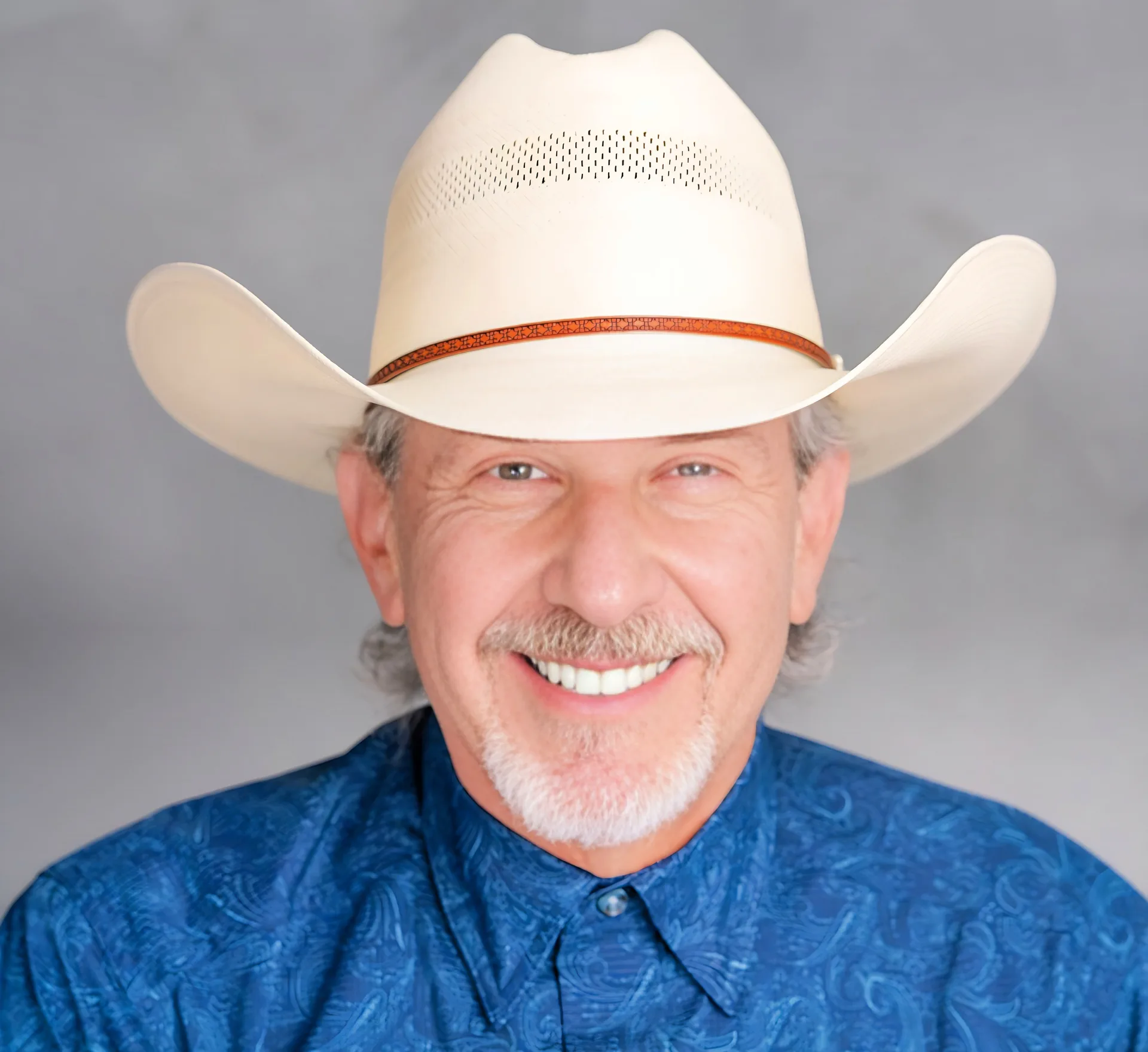
Written by
Bill Ross
Hill Country Homesteads Group, brokered by KW Boerne
Bill Ross is a Texas real estate agent with nearly four decades in high-tech sales and a network of 1,100+ California real estate agents for coordinated cross-state transactions. Featured in national coverage discussing his family's relocation from Silicon Valley to the Texas Hill Country, Bill specializes in guiding empty-nesters, retirees, professionals, and families relocating from California to the Texas Hill Country.
Related Guides
California Home Equity to Texas Wealth
The real math behind selling in CA and buying in TX -- transaction costs, capital gains, and monthly budgets with real numbers.
Estate Planning After Moving to Texas
Why your California trust, will, and powers of attorney need professional review after relocating to Texas.
Making Friends in the Texas Hill Country
A practical guide for California transplants on how to build genuine friendships after the move.
Healthcare in the Hill Country
Hospitals, primary care, specialists, and Medicare access near Boerne, Fair Oaks Ranch, and San Antonio.
Sources
- Empty-nester downsizing trends in Texas. Texas Real Estate Source; Texas Relocation Council. texasrealestatesource.com
- California state income tax rates (1%–13.3%). California Franchise Tax Board. ftb.ca.gov
- Texas homestead exemption: general and over-65 provisions. Texas Comptroller of Public Accounts. comptroller.texas.gov
- Boerne and Fair Oaks Ranch home prices and inventory. Redfin; Zillow (2026). redfin.com
- GVTC fiber internet availability in Boerne. GVTC Communications. gvtc.com
- Social integration for midlife relocators. American Sociological Association; Journal of Social and Personal Relationships. journals.sagepub.com
- Regency at Esperanza active adult community, Boerne. 55places.com. 55places.com
- Morningside at Menger Springs retirement community, Boerne. Morningside Ministries. mmliving.org
- Cross-state estate planning: California vs. Texas trust and probate laws. American Bar Association; State Bar of Texas. texasbar.com
- San Antonio hospital systems and healthcare infrastructure. Methodist Healthcare; University Health. sahealth.com
- Relocation trial period best practices. Movoto; Texas Relocation Report (2026). movoto.com
Last reviewed: October 2026. Tax rates, home prices, and provider networks reflect 2025–2026 published data. Verify specific rates and details with current sources before making decisions.