
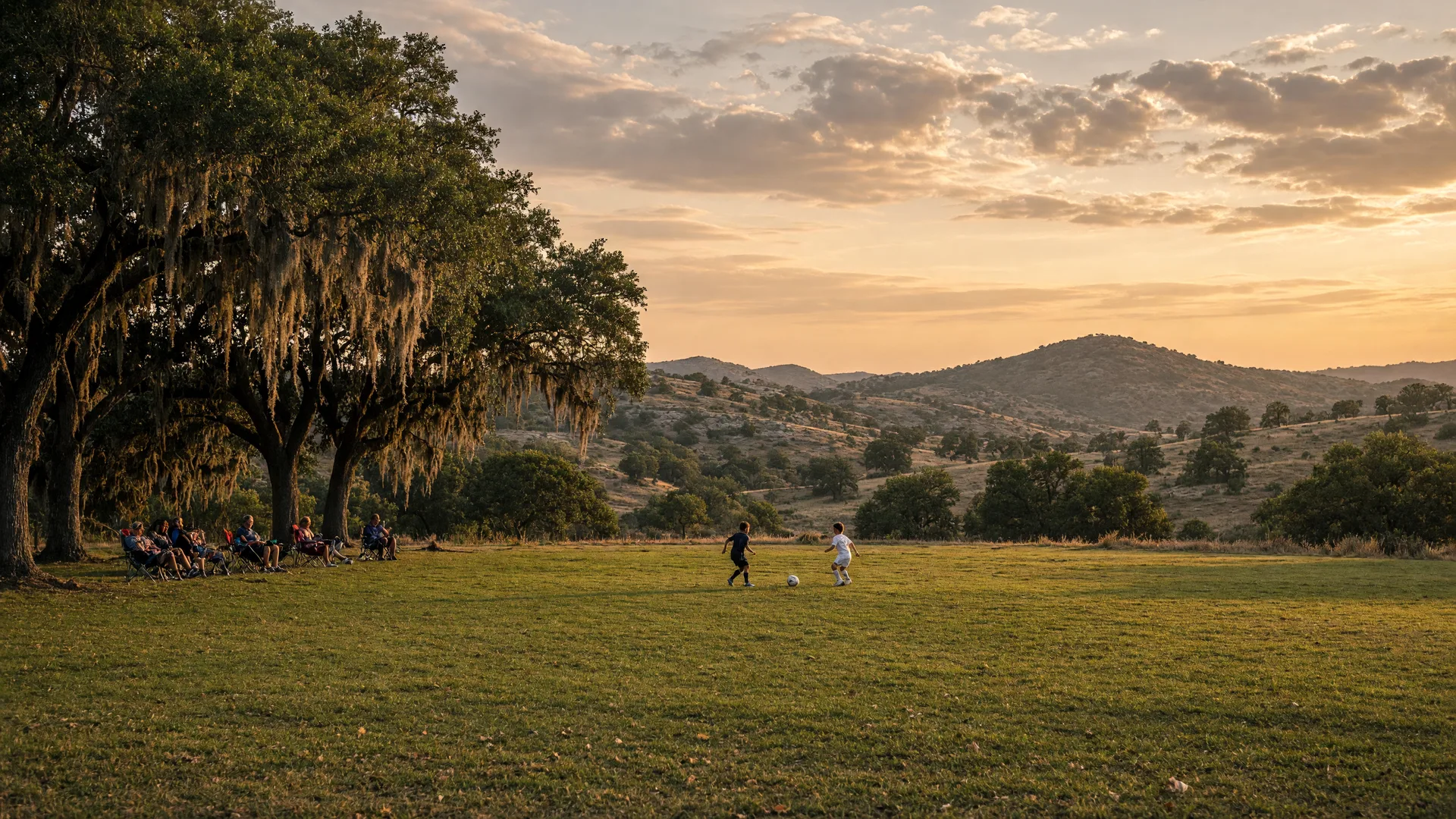
If your child plays a sport, plays an instrument, or competes in anything after school, the move from California to Texas changes more than the zip code. It changes the governing body that runs competition, the academic rule that decides whether your child can play at all, the cost of club sports, and the seasonal calendar. Most of the advice you will find online about this is written around the old numbers, so let me update it: the UIL realigned every Texas school district in February 2026 for the next two school years, national high school sports participation hit an all-time record in 2024-25, and Boerne ISD opened a brand-new 11-lane competition pool in December 2025 [1][4][16].
The short version of what changed: the Hill Country schools your family is likely buying into, Boerne High School, Champion High School, and Smithson Valley High School, all compete in UIL Class 5A in the 2026-28 alignment, Texas still applies a strict 70-or-above eligibility rule with no GPA averaging, and a competitive youth soccer player in San Antonio pays roughly half of what the same season costs all-in in the Bay Area [1][2][3][5][13][14]. The rest of this guide walks through each of those pieces with the current numbers, then gives you the timing advice I give my own relocation clients.
I am Bill Ross, a Texas real estate agent in Boerne who works with relocating California families every week. I am not a coach, a school counselor, or an athletic director. I am a neighbor who has watched a lot of families land here with a sports calendar in hand, and I want you to arrive knowing the rules of the game instead of learning them after a season is lost.
What Changed for 2026-28: The UIL Realignment
Every two years the University Interscholastic League reclassifies every public school in Texas by enrollment and redraws every district. The 2026-28 realignment was announced February 2, 2026, and it sets the schedule your child would play under for the 2026-27 and 2027-28 school years [1][2][3]. For the schools California families most often buy into, the picture is stable and competitive:
- Boerne High School competes in UIL Class 5A, football Division II, in District 13-5A DII (Region IV) alongside Legacy Ranch, Liberty Hill, New Braunfels, New Braunfels Long Creek, Alamo Heights, and San Antonio Veterans Memorial [2][3].
- Boerne Champion High School competes in UIL Class 5A, football Division I, in District 13-5A DI (Region IV) alongside Smithson Valley, Seguin, Austin Anderson, Austin McCallum, Bastrop Cedar Creek, Kyle Lehman, Lockhart, and Manor [2][3].
- Smithson Valley High School (Comal ISD) also competes in UIL Class 5A, football Division I, in that same District 13-5A DI [2][3].
For basketball and volleyball, Smithson Valley sits in 5A District 25 while Boerne and Champion share 5A District 26 [2]. That district assignment matters for travel: most league games are within a 45-minute drive, and the regional playoffs stay inside South Texas until the state tournament.
UIL Alignment, 2026-28: Schools California Families Buy Into
| School | UIL Class | Football Division | District (2026-28) |
|---|---|---|---|
| Boerne High School | 5A | Division II | 13-5A DII |
| Boerne Champion High School | 5A | Division I | 13-5A DI |
| Smithson Valley High School | 5A | Division I | 13-5A DI |
| Alamo Heights High School | 5A | Division II | 13-5A DII |
| San Antonio Veterans Memorial HS | 5A | Division II | 13-5A DII |
Sources: UIL 2026-28 realignment release and San Antonio-area coverage [1][2][3]. Classification applies to the 2026-27 and 2027-28 school years.
The other headline number is national, and it tells you the direction of the sport. The National Federation of State High School Associations reported an all-time record 8,266,244 high school participants in 2024-25, the third straight record year, up more than 200,000 from the year before, with 4,723,907 boys and 3,536,984 girls [4]. Texas remains one of the largest and most competitive high school sports states in the country, and the Hill Country districts are growing with it [4][21].
UIL vs CIF: The Structural Difference That Shapes Everything
California runs school sports through the California Interscholastic Federation, split into 10 sections with their own championships. Texas runs them through the University Interscholastic League, which crowns a single state champion per enrollment classification per sport [1][20]. That is not a paperwork difference. It changes the playoff structure, the recruiting resume, and the culture around the sport.
In the UIL, a team that wins its district advances through a defined regional bracket to a single state tournament, and one champion is crowned per classification [20]. In the CIF, a Southern Section champion and a Sac-Joaquin Section champion can both win titles without ever facing each other. For a college coach, a UIL state tournament appearance is a standardized credential they recognize instantly. For a California family, the practical translation is that the Texas path is narrower and deeper: fewer, more selective rounds, and every playoff game matters.
Private schools sit outside the UIL in Texas. They compete under the Texas Association of Private and Parochial Schools (TAPPS) or, in a few cases, the Southwest Preparatory Conference, while California private schools play inside the same CIF sections as public schools [20]. If your child is at a Texas private school, expect a smaller competitive pool than a large public UIL program, which matters most for serious athletes and marching band students.
No Pass No Play: The Rule California Families Underestimate
This is the rule that surprises California parents the most, and it is the one most likely to cost a season. Texas law, in place since House Bill 72 in 1984, requires a public school student to pass every enrolled course with a grade of 70 or above to participate in any extracurricular activity, from varsity football to marching band to academic UIL [5][6]. A single grade below 70 in any single course triggers a three-week suspension from all participation. Advanced Placement, IB, and dual-credit courses carry a lower passing threshold of 60, but the three-week suspension still applies below that [5].
California's CIF standard is different in a way that matters. CIF eligibility requires a cumulative 2.0 GPA across all enrolled courses and at least 20 semester units passed in the previous grading period [7]. A California student can fail one class and stay eligible if the overall GPA holds at 2.0. In Texas, that same student sits out for three weeks, no averaging allowed.
There is a built-in grace period: students are automatically eligible for the first six weeks of the school year, and eligibility is checked at the end of each grading period after that [5]. For a family moving over the summer, that first six-week buffer is your runway. For a family moving mid-year, your child may land mid-grading-period, so check the campus calendar and your child's current grades before you enroll.
What This Means for the Move
A child who was eligible in California with a 2.0 GPA and one failing grade would be ineligible in Texas. This is not a reason to avoid the move, but it is a reason to check the current report card before you choose a move-in date. If a grade is close to 70, a summer move with the six-week grace period buys time to recover it before the first eligibility check.
The same rule covers fine arts: a band student below 70 in any class misses the Friday night performance, not just practice. That is true at every public school in Texas, kindergarten through 12th grade [5][6].
What Youth Sports Cost in 2026: Texas vs California
Start with the national baseline: the Aspen Institute's State of Play research found the average American family spent about $1,016 on a child's primary sport in 2024, up 46 percent from $693 in 2019, and about $1,491 when you count every sport a child plays [8][9]. Competitive club sports sit far above those averages, and this is where the Texas advantage shows up.
For soccer, the sport with the most club infrastructure in both states, the 2026-27 published fees tell the story [10][11][12][13][14]:
- San Antonio entry select: about $1,530 a year at Premier Futbol Academy's Competitive 1 level [10].
- San Antonio mid-level: about $2,725 at River City Rangers' WDDOA Prime level [11].
- San Antonio ECNL: $3,400 in club fees at Classics Elite for girls U13-U17, with industry models putting a full ECNL season between $3,500 and $6,500 once team fees and travel are counted [12].
- Bay Area select: about $1,900 in program fees at Mustang Soccer plus $500 to $1,500 in team fees and separate uniform and travel costs, which pushes a realistic all-in total toward $5,000 to $7,000 [13].
- Bay Area elite: the Aspen Institute-cited range for a competitive Bay Area player is $10,000 to $15,000 a year once fees, tournaments, travel, and extras are counted [14].
Anytime Soccer's 2026 cost analysis ranked the San Francisco Bay Area as the most expensive city in America for youth club soccer, which matches what the families I work with report [24]. Tournament travel compounds the gap: a Bay Area club team drives to Southern California or flies to out-of-state showcases, while a Hill Country team reaches Austin, San Antonio, Dallas, and Houston within a three- to four-hour drive [24].
Annual Cost of One Child Playing Club Soccer, 2026-27
Bar widths are proportional on a $16,000 scale. Sources: club fee pages for Premier FA, River City Rangers, Classics Elite, and Mustang Soccer, plus Aspen Institute and NorCal Pitch for all-in ranges [10][11][12][13][14]. Verify with each club before budgeting; fees and travel plans change yearly.
The broader cost picture holds across sports. Travel baseball, AAU basketball, and competitive cheer all run cheaper in the San Antonio area than in coastal California, largely because facilities, coaches, and tournament travel cost less, and private lessons typically run $50 to $100 an hour against $75 to $150 in California's big metros [24]. The one area that can be a surprise is the extras: Texas heat means early-morning and evening practice slots, summer tournament schedules move indoors or late, and a serious swimmer now has a new, high-quality home pool in Boerne [16][17].
What the Hill Country Districts Offer Now
Boerne ISD holds an A rating with an overall score of 92 in the August 2026 TEA accountability ratings, and it runs two UIL Class 5A high schools, Boerne High School and Champion High School, plus a middle school structure that feeds both [15][21]. The district fields varsity teams in football, basketball, cross country, track and field, soccer, softball, baseball, golf, tennis, volleyball, swimming and diving, and cheer, with athletic participation open to any enrolled student who meets the academic rule [21].
The facility news is what changed most since last summer. The Boerne ISD Aquatic Learning Center, funded by the 2022 bond and dedicated December 15, 2025, is an 11-lane, 25-yard competition pool with depths from 4 to 16 feet, built to serve both high school swim and water polo teams [16][17]. For a California family whose child swims year-round, that is a materially different Hill Country picture than the one described in older guides. The district's stadium, which traces its roots to 1987 when Boerne bought Trinity University's WPA-era stands for one dollar, has been upgraded through successive bonds with end-zone seating, a field house, and new turf in 2023 [17].
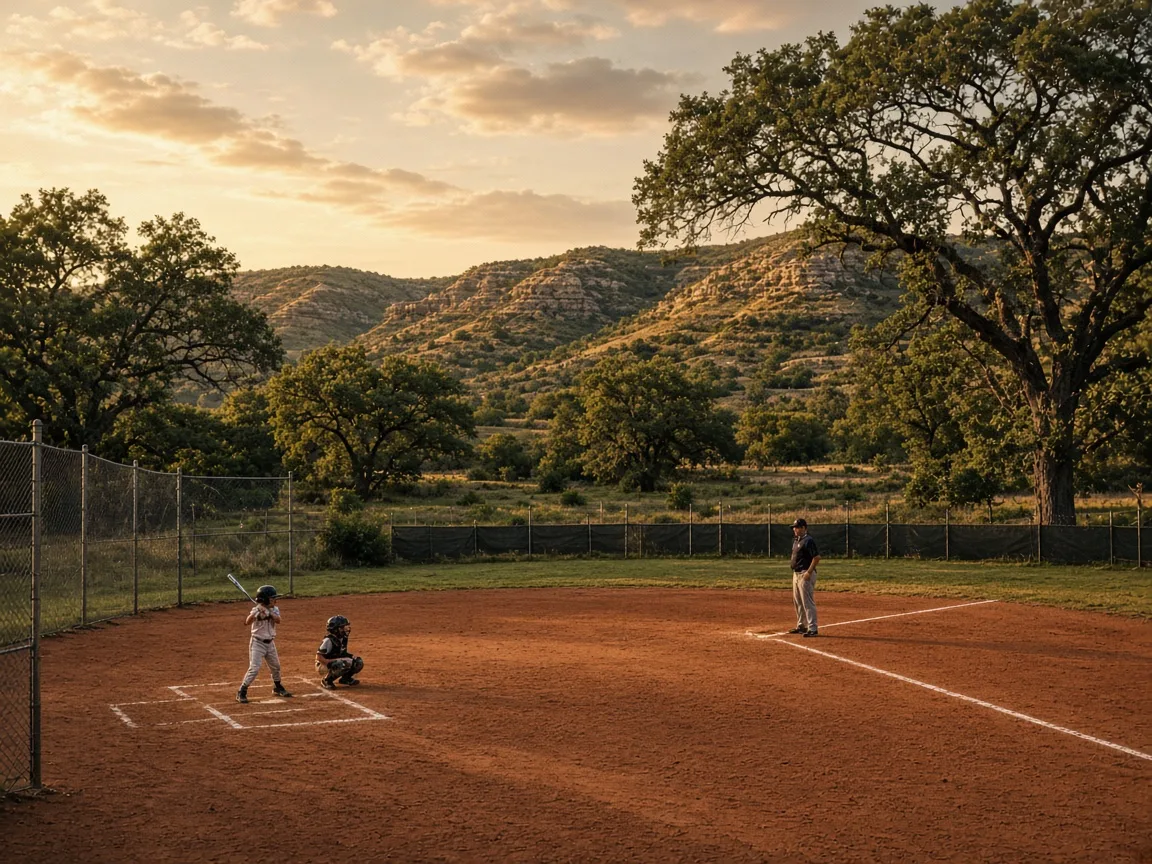
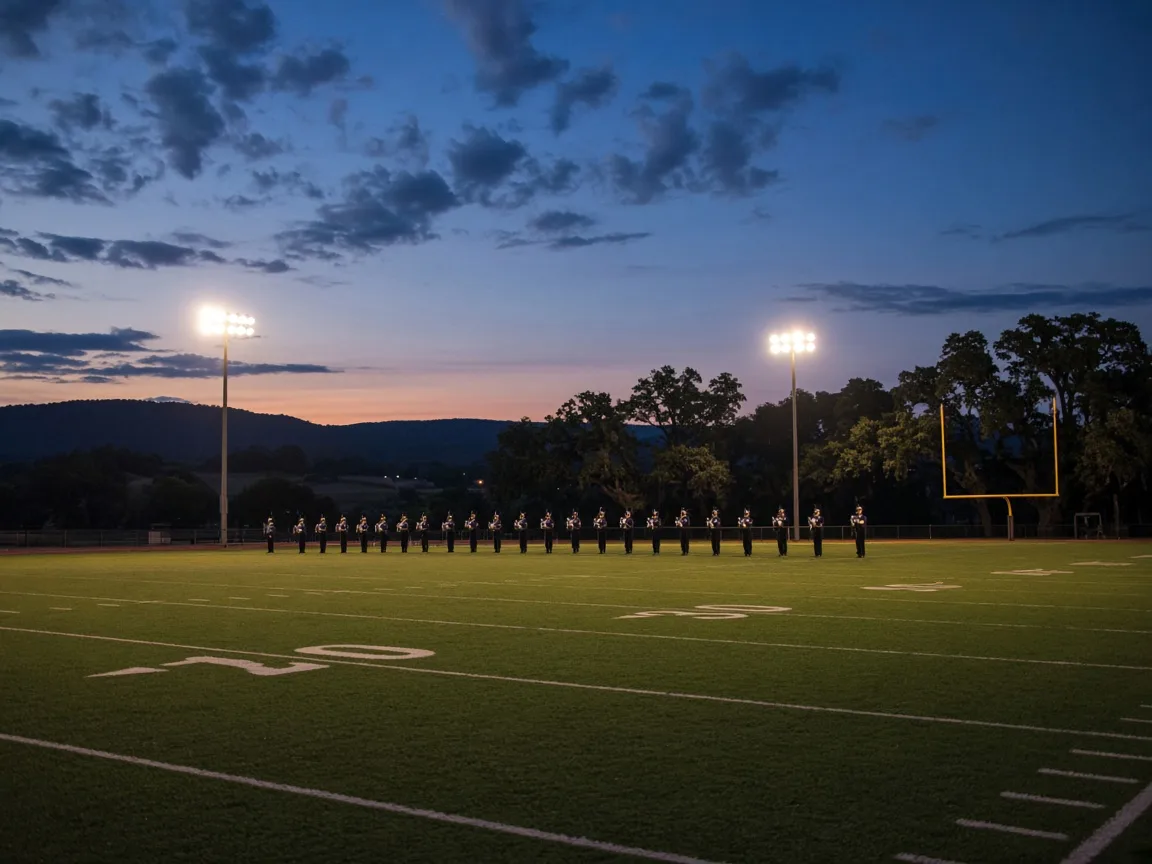
The arts side is just as organized. Boerne ISD's fine arts program runs from kindergarten through 12th grade, with band, choir, theater, and visual arts at every level [22]. The marching band results are the ones Texas families brag about: Boerne High School placed second in Class AA at the 2025 Bands of America Central Texas Regional and took the Outstanding Visual Performance caption award [19]. In 2024 the same program won $15,000 in new instruments through the Metallica "For Whom the Band Tolls" contest, replacing a bass line that dated to 2010 [18]. Marching band in Texas is a serious commitment, with summer rehearsals and a competition season that runs into November, and the UIL governs music contests alongside athletics [20][22].
On the San Antonio side, Northside ISD operates one of the largest athletic programs in Texas, with multiple Class 6A high schools and the full UIL sports menu, plus magnet and fine arts academies at several campuses [23]. Families who want big-school competition, deep football programs, or specialized arts tracks often choose the Northside side of the Hill Country for exactly this reason.
Outside school walls, the club landscape is well developed. Soccer families have River City Rangers, Premier Futbol Academy, Classics Elite, and Lonestar SC, with ECNL and Texas Club Soccer League divisions [10][11][12]. Baseball and softball families find USSSA, Perfect Game, and Pony League tournaments close by. AAU basketball is established in San Antonio. And the Hill Country adds two options that are rare in California: a genuinely active equestrian community supporting the Texas High School Equestrian Association, and FFA programs with livestock shows at the Kendall County Show and the San Antonio Stock Show. That last one is a culture shift worth celebrating rather than fearing.
The Seasonal Calendar: Heat, Football, and Band Season
Coastal California families are used to practicing outdoors in every season. Texas runs on a different clock. August afternoons in San Antonio average 96 degrees, so summer practices, club games, and band rehearsals happen early in the morning or after 7 p.m., and the air-conditioned gym is your friend from June through September [15].
The UIL calendar fixes the school sports year: football, volleyball, and cross country in the fall; basketball and soccer in the winter and early spring; baseball, softball, track, golf, and tennis in the spring; and swimming through the winter with the state meet in February [20][21]. Friday night football in a Texas 5A district is a community event in a way it is not anywhere in California, and the band, the cheer squad, and the drill team perform alongside it. If your child wants the full experience, fall is the season that delivers it.
The honest planning advice: schedule the move for the summer if you can, enroll before the first six-week grading period, and expect the first Texas summer to dictate the family calendar. The mild fall and spring months are the payoff, and they are genuinely excellent for outdoor sports.
College Recruitment: What the UIL Path Changes
The single-state-champion structure gives Texas athletes a standardized resume line that California's section-based system does not. A UIL state tournament appearance is a credential college coaches across the country recognize, and the playoff bracket produces consistent exposure: district, regional, and state rounds are all on record [20]. Texas universities, including UT Austin, Texas A&M, Texas Tech, Baylor, TCU, and Texas State, recruit UIL programs heavily, and the density of Division I programs in the state means more coaches within a three-hour drive of Boerne than most California families realize.
For a serious athlete, the practical advice is to verify the campus coaching staff and program depth before you commit to a district, since an address fixes the attendance zone. For a student whose sport is more recreation than recruiting, any of the Hill Country schools offers a full menu without the California price tag.
The Practical Checklist for the Relocating Family
Over years of walking California families through this, the advice that actually protects a season collapses into six steps:
- Check the report card before you pick a move-in date. If any grade is below 70, move in the summer so the six-week grace period gives time to recover it [5].
- Start enrollment at the district the day your contract is signed. Attendance zones are set by address, and the campus you are zoned to fixes the team and the band program [15][21].
- Schedule the sports physical with a Texas-licensed provider. UIL requires a current physical on file before participation, and California physicals are not automatically accepted [20][21].
- Contact the campus athletic coordinator and fine arts director before the move. Tryout dates, team size limits, and band camp schedules are set in the summer, and a one-week window missed is a season lost.
- Budget the all-in cost, not the club fee. San Antonio select soccer is affordable, but travel, tournaments, and gear add up, and the published fee is only the beginning [10][11][12][24].
- Talk to the coach, not just the brochure. Ratings, facilities, and realignment lists are data; fit is felt. A 20-minute call with a varsity coach tells you more about program culture than any website.
If the season is already underway when you land, it is not lost. Texas allows mid-season transfers, your child can join club teams at any point, and the first year is about adjustment as much as competition. Move smart, enroll early, and let the six-week grace period do its job.
Every Family's Extracurricular Situation Is Different. Let's Talk About Yours.
The school your address feeds determines the team, the band program, the facilities, and the competition level your child gets for four years. I work with California families every week on this exact question, and I know the Boerne ISD and Comal ISD attendance zones, the UIL alignment details, and the club landscape that affect the decision.
For the broader school picture, start with our Texas School Districts Explained guide, the Boerne ISD Guide, the Private vs Public Schools update, and the 2026 Playbook for Families Moving for Schools.

Written by
Bill Ross
Hill Country Homesteads Group, brokered by KW Boerne
Bill Ross is a Texas real estate agent serving Boerne, Fair Oaks Ranch, San Antonio, and the surrounding Hill Country. With nearly four decades in high-tech and a network of 1,000-plus California agents, he specializes in guiding out-of-state relocations, including the school and extracurricular decisions that families face when moving between states.
Related Guides
Texas School Districts Explained
TEA ratings, address-based enrollment, transfer rules, and the funding gap for California parents.
Boerne ISD Guide for California Families
Campus profiles, feeder patterns, AP and dual credit programs, and enrollment guidance.
Private vs Public Schools in Texas
The 2026-27 tuition picture, TEFA first-year results, and the UIL vs TAPPS difference.
Moving for the Schools: 2026 Playbook
TEA ratings, funding, STAAR to Student Success Tool, and the enrollment calendar.
Frequently Asked Questions
These are the youth sports and extracurricular questions I hear most from California families evaluating a move to the Texas Hill Country, answered with the November 2026 numbers.
Will my child be able to compete at the same level after moving from California to Texas?
In most cases yes, but the pathway looks different. Texas public schools compete under the UIL, which crowns a single state champion per enrollment classification, while California's CIF runs 10 sections with their own champions [1][20]. In the 2026-28 alignment, Boerne High School, Champion High School, and Smithson Valley High School all compete in UIL Class 5A, with Boerne in the Division II football district and Champion and Smithson Valley in Division I [1][2][3]. The competition level in the Hill Country is as high or higher than most California leagues, club programs are strong within a reasonable drive, and your child will likely need to try out for teams rather than being automatically placed. Plan for the academic eligibility rules too: Texas requires a 70 or above in every course, with no GPA averaging like California's 2.0 standard [5][6][7].
How much less will youth sports cost in the Hill Country than in California?
The club fees are closer than families expect, and the all-in gap is large. A San Antonio entry-level select soccer program runs about $1,530 a year, a mid-level program about $2,725, and an ECNL program about $3,400 in club fees before travel [10][11][12]. Bay Area select fees start near $1,900 plus team fees, and all-in costs for a competitive Bay Area player typically land between $5,000 and $7,000 a year, with the Aspen Institute citing family spending of $10,000 to $15,000 a year at the elite level [13][14]. Tournament travel is also shorter from the Hill Country, with most Texas tournaments within a three- to four-hour drive [24].
What is No Pass No Play and how is it different from California's eligibility rules?
Texas law (House Bill 72, 1984, now part of the Texas Education Code) requires a public school student to pass every enrolled course with a grade of 70 or above to participate in any extracurricular activity, including athletics, fine arts performances, academic UIL competitions, and clubs [5][6]. A grade below 70 in any single course triggers a three-week suspension from all participation. Advanced Placement, IB, and dual-credit courses have a lower passing threshold of 60, but the suspension still applies below that [5]. California's CIF instead requires a cumulative 2.0 GPA and at least 20 semester units passed, so a California student who fails one class can stay eligible while the same student would sit out three weeks in Texas [7].
What are the best youth sports options near Boerne for a competitive child?
For soccer, River City Rangers, Premier Futbol Academy, Classics Elite, and Lonestar SC anchor the San Antonio competitive scene, with ECNL and Texas Club Soccer League divisions available [10][11][12]. Baseball and softball families find USSSA and Perfect Game tournaments within a short drive, and the San Antonio area has a deep AAU basketball culture. Swimmers now have a new home facility: the Boerne ISD Aquatic Learning Center, an 11-lane 25-yard competition pool dedicated in December 2025, serves both Boerne and Champion high school teams [16][17]. Equestrian families will find an unusually active community for the Texas High School Equestrian Association, and FFA is a major program with livestock shows at the Kendall County Show and the San Antonio Stock Show [23].
When should we move so our child does not lose a season?
The cleanest timing is to move over the summer, before the first six-week grading period of the Texas school year, because students are automatically eligible for the first six weeks and eligibility checks begin at the first grading period [5]. Moving during a season means transferring mid-season, which works but costs your child a period of adjustment. Start the enrollment paperwork at the new district as soon as you have a contract on a house, schedule the sports physical with a Texas-licensed provider, and check the UIL calendar for the sport, since football runs in the fall, basketball in the winter, and baseball and soccer in the spring [20][21]. If a varsity slot matters, talk to the campus athletic coordinator before the move, because Texas tryout and team-size rules differ from California's.
Sources
- 2026-2028 UIL Reclassification and Realignment Information. University Interscholastic League (2026). www.uiltexas.org/press-releases/detail/2026-2028-uil-reclassification-and-realignment-information
- Here's where UIL aligned San Antonio area schools for 2026-27, 2027-28. San Antonio Express-News (2026). www.expressnews.com/sports/high-school/article/uil-aligned-san-antonio-area-schools-2026-27-21327500.php
- New district alignments for Chargers, Greyhounds, Bobcats. The Boerne Star (2026). www.boernestar.com/article/12652,new-district-alignments-for-chargers-greyhounds-bobcats
- Participation in High School Sports Hits Record High with Sizable Increase in 2024-25. National Federation of State High School Associations (2025). nfhs.org/stories/participation-in-high-school-sports-hits-record-high-with-sizable-increase-in-2024-25
- UIL-TEA Side-by-Side Academic Requirements (No Pass No Play). University Interscholastic League (2026). www.uiltexas.org/policy/tea-uil-side-by-side/academic-requirements
- No Pass No Play Overview. Texas Education Code history, via Wikiwand. www.wikiwand.com/en/articles/No_Pass_No_Play
- CIF Student Eligibility Brochure. California Interscholastic Federation (2026). www.cif-la.org/ourpages/forms/CIF%20student%20eligibility%20brochure.pdf
- State of Play 2025: Our Annual Report on Trends in Youth Sports. Aspen Institute Project Play (2025). projectplay.org/state-of-play-2025/introduction
- The Cost of Playing Youth Sports Isn't What It Used to Be, Up 46 Percent. NewsRadio 740 KTRH (January 2026). ktrh.iheart.com/featured/houston-texas-news/content/2026-01-08-the-cost-of-playing-youth-sports-isnt-what-it-use-to-be-up-46-percent/
- Premier Futbol Academy (San Antonio) Pricing. Premier Futbol Academy (2026). www.premierfasa.com/pricing
- River City Rangers Soccer Club: Select Fees 2026-27. River City Rangers (2026). www.rivercityrangers.org/select-fees/
- Classics Elite Soccer Academy: Girls ECNL Fees 2025-2026. Classics Elite Soccer Academy (2026). www.classicselite.com/ecnl
- Mustang Soccer League: Level III Select 2026-2027 Fees. Mustang Soccer League, Danville CA (2026). mustangsoccer.com/comp-level-iii
- Youth Soccer Costs and Financial Aid in Northern California. NorCal Pitch (2026). norcalpitch.com/affordability/
- TEA Releases 2026 A-F Accountability Ratings. Texas Education Agency (2026). tea.texas.gov/about-tea/newsroom/tea-releases-2026-f-accountability-ratings-txschoolsgov
- Boerne ISD Aquatic Learning Center reaches substantial completion. Community Impact (2026). communityimpact.com/san-antonio/education/boerne-isd-aquatic-learning-center-reaches-substantial-completion/
- Boerne ISD Bond Program. Boerne Independent School District (2026). www.boerneisd.net/departments/operations/bond-program/
- Boerne High School receives $15,000 in band instruments from Metallica. KSAT (2024). www.ksat.com/news/local/2024/04/30/boerne-high-school-receives-15000-in-band-instruments-from-rock-band-metallica/
- Central Texas Regional 2025 Results. Music for All / Bands of America (2025). marching.musicforall.org/result/central-texas-regional-2025/
- About the UIL. University Interscholastic League (2026). www.uiltexas.org/about
- Boerne ISD Athletics. Boerne Independent School District (2026). bhs.boerneisd.net/athletics
- Boerne ISD Fine Arts. Boerne Independent School District (2026). tx50000022.schoolwires.net/Domain/104
- Northside ISD Athletics and Extracurriculars. Northside Independent School District (2026). www.nisd.net/nsite/extracurriculars/athletics
- The Most and Least Expensive Cities for Youth Club Soccer in America (2026). Anytime Soccer (2026). anytime-soccer.com/most-least-expensive-us-cities-for-club-soccer-in-2026-cost-guide/
Last reviewed: November 20, 2026. UIL alignments, participation data, club fees, and facility details reflect published 2026-27 information and are subject to change. Verify with each school district, club, and the University Interscholastic League before making decisions based on this article.