
Published:
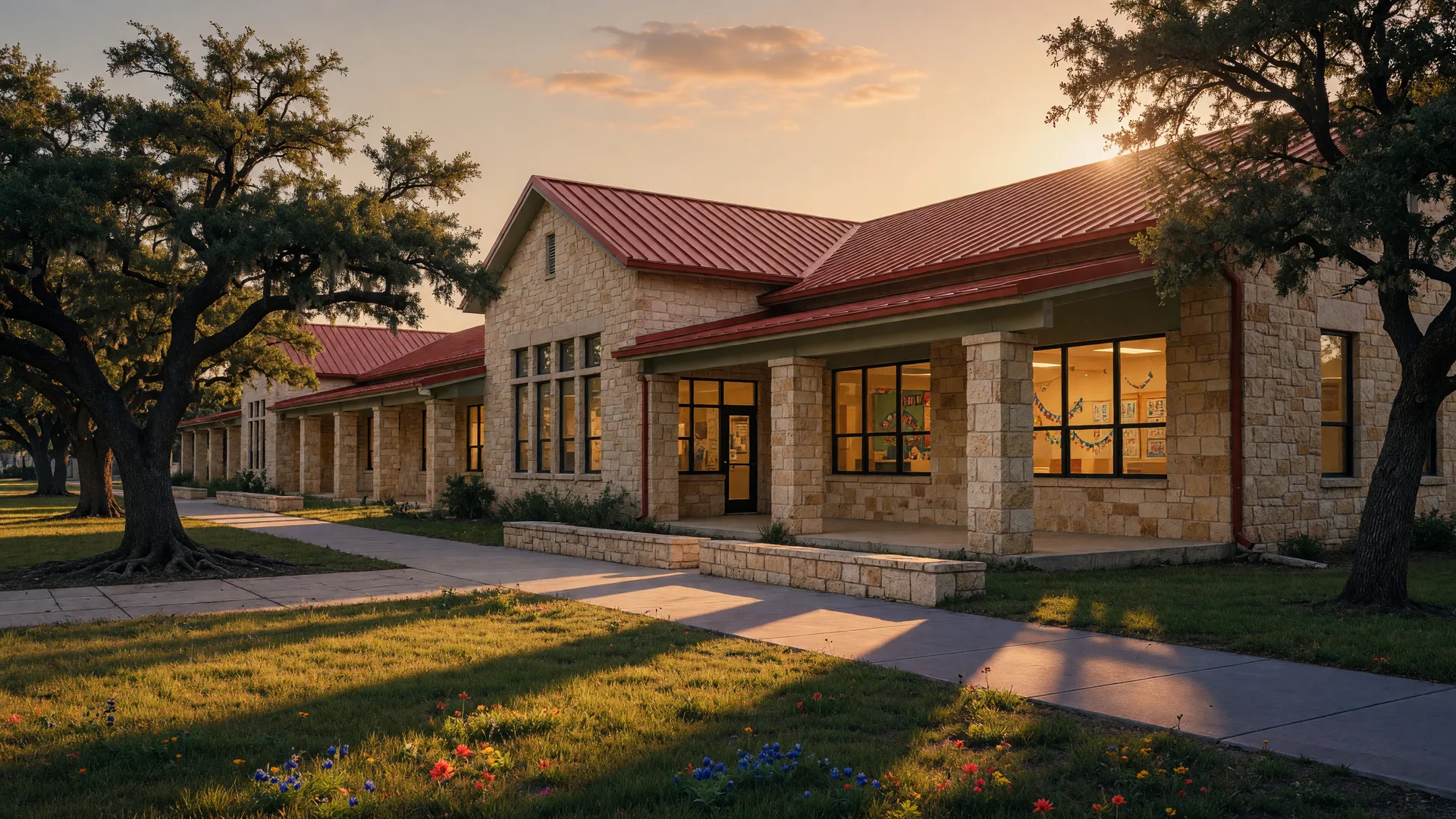
If you are a California family moving to Texas for the schools, the first thing to unlearn is the idea that one number can tell you which district is best. Texas grades its districts A through F, California colors its Dashboard red through blue, and the two systems measure different things in different years [1][4][5]. The 2026 version of this comparison is unusually good news for anyone shopping Boerne, Fair Oaks Ranch, and northwest San Antonio: the newest accountability ratings were released August 14, 2026, and they give Boerne ISD an A with an overall score of 92, Comal ISD a B with an 88, and Northside ISD a C with a 78 [1][2][3].
I am Bill Ross, a Texas real estate agent serving Boerne, Fair Oaks Ranch, San Antonio, and the surrounding Hill Country, and I work with California families on this exact decision every week. This article is the playbook I walk those families through: how to read the 2026 ratings against the California system, what the funding gap actually means, where STAAR is going and what replaces it, how transfers and the new Texas Education Freedom Accounts really work in 2026, and the enrollment calendar that quietly decides whether your children start on time or spend a semester catching up. No hype, just the numbers and the dates.
The 2026 Ratings Reality: A, B, C, and What the Letters Miss
The Texas Education Agency released the 2026 A-F accountability ratings on August 14, 2026, covering 1,202 districts and 9,105 campuses [1]. Each district gets one overall letter built from three domains: Student Achievement, School Progress, and Closing the Gaps, which measures how well the district closes performance gaps among student groups [1][2]. The overview for the Hill Country and San Antonio area is straightforward. Boerne ISD earned an A with an overall score of 92, with a Student Achievement domain of A, School Progress of B, and Closing the Gaps of A [1][2]. Comal ISD earned a B with an overall score of 88, its third straight year of improvement [3]. Northside ISD, the huge district covering much of far northwest San Antonio, earned a C with an overall score of 78, up three points from 75 the year before [1][2].
The trap is comparing these letters directly with California's Dashboard. California uses a five-by-five color grid with status and change indicators across academics, chronic absenteeism, suspension rates, and English learner progress, and it does not issue a single overall letter [5]. Texas tests through STAAR and its successor and grades outcomes; California tests through CAASPP and grades status-and-change [4][5]. A California family should not translate "Boerne is an A" into "like a blue Dashboard" because the systems are not built the same way. The better move is to read the campus-level report card for the exact school your future address feeds, because district letters hide campus differences, and to ask the district what the domain scores look like for the grade levels your children will actually enter [2][12].
2026 TEA accountability ratings for the districts families most often compare
| District | 2026 letter | Overall score | Where it serves |
|---|---|---|---|
| Boerne ISD | A | 92 | Boerne, Fair Oaks Ranch, much of Kendall County and the I-10 corridor [1][2][12] |
| Comal ISD | B | 88 | Comal County including Spring Branch, Bulverde, and Canyon Lake areas [1][3] |
| Northside ISD | C | 78 | Far northwest San Antonio including the Leon Springs and Helotes corridors [1][2] |
District-level ratings released August 14, 2026 [1][2][3]. Campus ratings can differ from the district letter, so verify the specific feeder elementary and middle school for any address you are considering [2][12].
The Funding Reality: Less Per Student, and What That Does and Does Not Mean
The spending gap between the states is the number that surprises every California family, so let us put it on the table early. In the U.S. Census Bureau's FY 2024 school finance survey, Texas spent about $12,895 per student and ranked 42nd among the states, while California spent about $20,791 per student and ranked 13th [6]. That is roughly $7,900 more per California student, about 61 percent more, against a national average near $17,619 [6].
Here is the honest version of what that gap does and does not mean. It does not mean every Texas campus is worse; it means Texas leans on local property tax revenue more than most states, and outcomes vary much more by district. The state's recapture system, commonly called Robin Hood, is one reason the quality is uneven: property-wealthy districts send excess local revenue to the state to fund less wealthy districts under Chapter 49 of the Education Code [7][8]. In the 2025-26 school year, 192 districts were subject to recapture, and in fiscal 2024-25 the state collected nearly $3 billion from 225 districts, up from about $1.4 billion two years earlier [7][8]. The system is also under legal pressure: the Midland school district voted in July 2026 to challenge its roughly $83 million recapture payment, and Texas courts have historically upheld recapture [7].
What this means for a California family is practical. The districts that rate highest, like Boerne ISD, combine strong local tax bases with moderate tax rates and consistently high outcomes, and the campus report card, class sizes, and special education and English learner support at your specific feeder school tell you more than the state funding column [7][12]. Compare schools the way you would compare neighborhoods: on the campus-level data, not the state-level headlines.
Per-student spending, Texas vs California (U.S. Census Bureau, FY 2024)
| State or benchmark | Spending per student | National rank |
|---|---|---|
| California | ~$20,791 | 13th |
| United States average | ~$17,619 | - |
| Texas | ~$12,895 | 42nd |
FY 2024 school finance survey figures from the U.S. Census Bureau [6]. Methods vary by source, and other estimates give California between roughly $18,000 and $21,000; the gap direction is consistent across sources.
STAAR Is Ending: What Replaces It and Why It Matters for Your Kids
If your children arrive in time for the 2026-27 school year, they take STAAR, the same test family California families have read about for years. If they arrive in 2027-28, they take something new. House Bill 8, signed in September 2025, replaces STAAR with the Student Success Tool, or SST, starting in the 2027-28 school year, and the Texas Education Agency confirmed in an August 2026 letter to administrators that STAAR remains in place through the 2026-27 administration [9][10][11].
The change is bigger than a name. For grades 3-8, SST replaces one big spring exam with three shorter tests each year: a beginning-of-year test in September, a middle-of-year test in January or February, and an end-of-year test in May that counts toward school accountability [11]. The first two are computer-adaptive and drawn from a menu of state-approved, nationally recognized assessments, and the end-of-year test is a TEA-developed static test [11]. Results come back as percentile ranks with a turnaround of about two days, instead of the weeks that STAAR scoring once took [11]. In high school, the Algebra I, Biology, English I, and U.S. History end-of-course exams remain, while the English II end-of-course exam and its graduation requirement are eliminated [11].
For a family making a schooling decision in late 2026, the practical read is this. The transition year is loaded: 2026-27 is the last full STAAR year, and districts are simultaneously publishing new enrollment materials and preparing staff for SST [9][11]. A mid-transition move is routine for Texas districts, and neither the agency nor the districts are treating it as disruptive. The more useful fact is that SST gives parents data three times a year instead of once, so a child who lands in Texas mid-year is far easier to monitor under the new system than under the old one [11].
The Districts in Play: Boerne, Comal, and Northside in the 2026-27 School Year
The three districts that dominate a California family's search each have a distinct character, and the 2026-27 calendars are set. Boerne ISD, the A-rated district serving Boerne, Fair Oaks Ranch, and much of the Kendall County corridor, started the 2026-27 year on Tuesday, August 11, 2026, and ends Thursday, May 27, 2027, with spring break March 8-12, 2027 [13][12]. New families enroll online through Skyward from the district website, with proof of residency, the child's birth certificate, immunization records, and a parent or guardian ID uploaded before the registrar follows up [13].
Comal ISD, covering Spring Branch, Bulverde, and the Canyon Lake corridor east of the Hill Country core, started its 2026-27 year on Tuesday, August 25, 2026, the latest start of the three, and also ends May 27, 2027 [14]. Northside ISD, the far northwest San Antonio district that serves Leon Springs, Helotes, and the Loop 1604 corridor, started earliest of the three, on Monday, August 10, 2026, and ends May 26, 2027 [15]. The spread of three weeks between the earliest and latest first days matters more than most families expect, because a move planned around a California mid-August frame lands differently in each district.
2026-27 school calendars at a glance
| District | First day | Last day | Enrollment path |
|---|---|---|---|
| Northside ISD | Mon, Aug 10, 2026 | May 26, 2027 | District online enrollment (NISD) [15] |
| Boerne ISD | Tue, Aug 11, 2026 | May 27, 2027 | Skyward online new-student enrollment [13] |
| Comal ISD | Tue, Aug 25, 2026 | May 27, 2027 | District online enrollment (CISD) [14] |
Board-approved calendars for the 2026-27 school year [13][14][15]. Confirm the current-year dates on each district site, because calendars shift slightly year to year.
One more district-level point that California families routinely miss: the high school your child can attend is decided by attendance zone, and in Boerne ISD the choice between Boerne High School and Boerne-Samuel V. Champion High School is offered to incoming ninth graders and to students enrolling in the district for the first time, on a published January-to-March timeline each year [19]. If you have an eighth grader or a rising ninth grader, the spring before the move is a hard deadline, not a soft one [19].
Transfers, Choice, and the New Education Freedom Accounts
The single biggest myth among California families shopping Texas schools is that you can rent anywhere and transfer into the district you like. Texas law allows inter-district transfers by mutual agreement under Education Code 25.035, and a student under 21 can transfer to another district if the receiving district and the parent agree in writing under 25.036, but neither creates a right to attend and the receiving district can charge tuition under the voluntary route [16]. A 2025 bill to create statewide open enrollment, SB 686, passed the Texas Senate and died in a House committee, so open enrollment remains fully voluntary and district-by-district in 2026 [17].
Boerne ISD processes non-resident transfers under board policy FDA and is explicit about limits: for 2026-27, certain campuses, including Fabra Elementary and Fair Oaks Ranch, are closed to new transfer applications, and the district may deny or revoke a transfer when a receiving school reaches roughly 90 percent capacity [18]. Comal ISD is narrower still: transfers are accepted only for specified exemptions, including active-duty military parents, families buying or building a home in a Comal ISD attendance zone, and documented bullying cases, with approval depending on space, staffing, and the student's record [20]. If a specific school is the reason for the move, the reliable strategy is to buy or rent inside the attendance zone that feeds it.
The other 2026 change California families should know about is the Texas Education Freedom Accounts program. In its first year, 2026-27, the accounts provide about $10,474 a year for a student in private school, $2,000 for a homeschooled or other non-public student, and up to $30,000 for a student with a qualifying disability or IEP, with the money usable for approved educational expenses such as tuition and tutoring [21][22]. The 2026-27 application window (February 4 through March 31, 2026) is closed, and as of October 1, 2026, the program reported 116,574 students participating with more than 121,000 on its year-one waitlist [22][23]. For 2027-28, no application window had opened as of late 2026, but the Comptroller's site runs an interest list for notification [21]. In plain terms: the accounts are real, they are funded, and they do not replace the public school decision, but they expand private and at-home options in a way California families should price into the comparison [21][22][23].
Texas Education Freedom Accounts, 2026-27 inaugural year
| Student category | Annual amount | Status as of late 2026 |
|---|---|---|
| Private school student | ~$10,474 | 2026-27 window closed (Feb 4 to Mar 31, 2026) [21][22] |
| Homeschool / other non-public | $2,000 | Paid for funded accounts; 2027-28 interest list open [21][22] |
| Disability / IEP | Up to $30,000 | Qualifying students eligible at the higher tier [22] |
Amounts and dates from the Texas Comptroller's TEFA reporting [21][22][23]. Program rules and windows change; verify on educationfreedom.texas.gov before relying on them.
The Enrollment Punchline: Documents, Shots, and the Calendar
Enrollment is paperwork, and the paperwork is specific. Under Texas Education Code 25.002 and standard district practice, a new family must show proof of the child's identity (usually a birth certificate or passport), a current immunization record or valid exemption, proof of residency such as a lease, a recent utility bill, or a deed or property tax statement showing the parent's name and street address, and records from the previous school [24][25][26]. A Social Security number is not required; the district must assign a state-approved ID if none is provided [25]. Children must be five years old on or before September 1 of the school year to enter kindergarten [24].
The immunization list is short but strict. For kindergarten entry, Texas requires five DTaP doses (four qualify if the fourth was given on or after the fourth birthday), four polio doses, two MMR doses, three hepatitis B doses, two varicella doses, and two hepatitis A doses, with age rules on several [27][28]. For seventh grade, a Tdap booster and one meningococcal dose are added, with a date rule tied to the eleventh birthday [27][28]. Exemptions are limited to medical reasons, military service, or a signed conscientious exemption affidavit [27]. A child missing shots may be provisionally enrolled while completing the series, but the school cannot hold the child out indefinitely [27][28].

Which brings us to the calendar, the part California families underestimate most. In 2026, Northside ISD started August 10, Boerne ISD started August 11, and Comal ISD started August 25 [13][14][15]. A family closing on a Boerne home in mid-September is already a month into the school year. The fix is to work backward from the first day: hold your California closing early enough to have Texas possession, utility connections, and driver's license and vehicle registration steps done before the district's enrollment deadline, and upload the new-student packet as soon as you have a contract or lease address [13][25]. Every week of buffer removes a headache that is much harder to fix after the school year starts.
The Six-Step District Evaluation Framework
Here is the framework I use with California families, updated for the 2026-27 reality. Work it in this order and the decision makes itself [1][2][12][24][25]:
- Start with the campus, not the district. Pull the 2026 A-F rating for the exact feeder elementary and middle school for the address you are considering, and read the domain scores, not just the letter [2][12].
- Check the calendar first, then the house. Note the first day for the district that serves the home (August 10 to August 25 in 2026 for the main three), and plan the closing around it [13][14][15].
- Confirm enrollment documents against the Texas list. Birth certificate or passport, immunization record or exemption, proof of residency dated recently, and prior school records. Upload the packet the day you have an address [24][25][26].
- Verify the transfer reality before counting on it. If you will live outside the zone, check the district's transfer policy and capacity limits, and assume no transfer until it is approved in writing [16][18][20].
- Price the choice options. If private school or homeschooling is on the table, run the TEFA amounts against tuition, and note the application window for the year you need [21][22].
- Handle the special-education and ESL questions directly. Ask each district how the feeder campus staffs special education, gifted, and English learner programs, and confirm the IEP or 504 transfer process before the move [25][26].
The Bottom Line for Families Moving for Schools
The honest summary fits in four sentences. The 2026 ratings give California families a real answer set: Boerne ISD an A at 92, Comal ISD a B at 88, and Northside ISD a C at 78, with campus-level detail that matters more than the letter [1][2]. Texas spends less per student than California, and the quality is uneven, so the evaluation has to happen at the campus level, not the state level [6][12]. STAAR ends after 2026-27 and the Student Success Tool replaces it with three shorter tests a year, which means more data on your child, not less [9][11]. And the calendar is the silent decision-maker: districts start between August 10 and August 25, enrollment is document-based, and the spring before ninth grade locks in Boerne's high school choice, so timing the move around the school year is not a nice-to-have, it is the plan [13][19][24].
I help California families work through exactly this sequence in Boerne, Fair Oaks Ranch, San Antonio, and the surrounding Hill Country. The most useful next step, whether you are six months out or six weeks out, is to pull the campus ratings for two or three addresses, compare the calendars, and confirm the enrollment documents you will need to gather from the California school. A direct conversation about your specific children and your specific timeline costs nothing, and it is the fastest way to make sure the move for schools actually lands the way you intend.
Related Reading
Families Moving for Schools: How to Evaluate Texas School Districts
The full framework for reading A-F ratings, STAAR vs CAASPP, and funding when you are just starting the search.
Boerne ISD: A Complete Guide for California Families
Campus profiles, feeder patterns, and programs inside the A-rated district most relocating families ask about first.
The School District Enrollment Calendar Trap
Why California families miss Texas enrollment deadlines every year, and how Boerne ISD, Comal ISD, and Northside ISD windows actually work.
California vs Texas Schools: A Side-by-Side Comparison
The school system comparison that translates California's CAASPP and Dashboard into STAAR and A-F terms.
Frequently Asked Questions
These are the questions California parents ask once they start pricing specific districts, the ones that separate a plan from a wish.
What do the TEA A-F ratings actually mean for my child?
The A-F rating is a single letter for a district and for each campus, based on three domains: Student Achievement, School Progress, and Closing the Gaps [1]. It is a different measure from California's Dashboard, which uses five-by-five color tables and status-and-change indicators across academic and non-academic areas [4][5]. A letter is a useful screen, not a promise: Boerne ISD earned an A with an overall score of 92 in the August 2026 ratings, Comal ISD a B with an 88, and Northside ISD a C with a 78 [1][2][3]. Read the campus report card for the exact school your address feeds, not just the district letter, and ask what the fine print under the domains says about the specific grade levels your kids will enter.
Texas spends about $7,900 less per student than California. Does that mean worse schools?
The per-student gap is real: the U.S. Census Bureau's FY 2024 finance survey put Texas near $12,895 per student and California near $20,791, roughly 61 percent more [6]. Spending per student is not the same as school quality per student, and the gap is not evenly distributed. Wealthy Hill Country districts contribute to the state's recapture system, sending excess local property tax revenue to less wealthy districts, and in the 2025-26 school year 192 districts were subject to that recapture [7][8]. Measure a specific district by its own report card, its class sizes, its special education and ESL staffing, and its campus culture, not by the state funding column alone.
Can my children transfer into Boerne ISD if we buy or rent outside the district?
Sometimes, but never assume it. Texas law allows inter-district transfers by agreement under Education Code 25.035 and voluntary transfer under 25.036, and a statewide open enrollment bill (SB 686) passed the Senate in 2025 but died in a House committee, so there is no right to transfer [16][17]. Boerne ISD admits non-resident transfers under board policy FDA and reports that for 2026-27 some campuses, including Fabra Elementary and Fair Oaks Ranch, are closed to new transfer applications; it may also deny a transfer when a receiving school hits about 90 percent capacity [18]. Comal ISD accepts transfers only for specific exemptions, including families buying or building a home in a Comal ISD attendance zone [20]. If school choice is the driver, rent or buy inside the zone that feeds the campus you want.
My youngest is starting school in 2027-28. What changes when STAAR is replaced?
STAAR is administered through the 2026-27 school year, and House Bill 8 replaces it with the Student Success Tool (SST) starting in 2027-28 [9][10][11]. For grades 3-8, SST means three shorter tests a year: a beginning-of-year test around September, a middle-of-year test in January or February, and an end-of-year test in May that counts toward school accountability [11]. Results come back as percentile ranks with a much faster turnaround, about two days, instead of the weeks STAAR results take [11]. The high school end-of-course exams in Algebra I, Biology, English I, and U.S. History stay, while the English II end-of-course requirement ends [11]. For a family arriving in 2027, the practical effect is more frequent, more useful information and a school year that runs three checkpoints instead of one big spring exam.
When in the calendar year is it hardest to move kids between California and Texas?
The hardest window is the two months after each district's first day, because Texas districts start early and each runs its own calendar. In 2026, Boerne ISD started August 11, Northside ISD August 10, and Comal ISD August 25 [13][14][15]. A family that arrives in mid-August can enroll on schedule. A family that arrives in October is a mid-year transfer, which still works but adds documents, immunization checks, and often a delay while the registrar verifies records [24][25][26]. The other hard window is the spring of the year before high school: Boerne's high school choice decisions for incoming ninth graders run on a set January-to-March timeline, and missing it locks in the attendance-zone campus for the year [19]. Plan the move so the kids are in Texas and enrolled before the first day, and treat the spring before ninth grade as a hard deadline for high school choice.
Sources
- TEA Releases 2026 A-F Accountability Ratings on TXschools.gov, Texas Education Agency. tea.texas.gov/about-tea/newsroom/tea-releases-2026-f-accountability-ratings-txschoolsgov
- Latest TEA ratings show mixed results for San Antonio-area school districts, KSAT. www.ksat.com/news/local/2026/08/14/latest-tea-ratings-show-mixed-results-for-san-antonio-area-school-districts/
- Comal ISD celebrates third year of overall improvement in TEA accountability score, FOX San Antonio. foxsanantonio.com/newsletter-daily/comal-isd-celebrates-third-year-of-overall-improvement-in-tea-accountability-score
- CAASPP Description (CalEdFacts), California Department of Education. www.cde.ca.gov/ta/tg/ai/cefcaaspp.asp
- Dashboard Performance Levels and Categories, five-by-five color tables, California School Dashboard / CDE. www.cde.ca.gov/ta/ac/cm/fivebyfivecolortables.asp
- Public School Spending Per Pupil Reaches Historic High in 2024, U.S. Census Bureau. www.census.gov/newsroom/press-releases/2026/school-system-finances.html
- What to know about the Texas 'Robin Hood' school funding system, The Texas Tribune. www.texastribune.org/2026/07/24/what-to-know-texas-school-finance-robin-hood-funding/
- Excess Local Revenue (Chapter 49), Texas Education Agency. tea.texas.gov/finance-and-grants/state-funding/excess-local-revenue
- Overview of House Bill 8, Texas Education Agency. tea.texas.gov/taa-letters/overview-house-bill-8
- Texas is officially replacing STAAR, The Texas Tribune. www.texastribune.org/2025/09/03/texas-staar-standardized-test-accountability-2/
- HB 8 Update and Resources (To the Administrator Addressed, August 20, 2026), Texas Education Agency. tea.texas.gov/sites/default/files/taa-letters/taa-2026-08-20-hb8-update-and-resources.pdf
- Texas School Report Cards: Boerne ISD (2025-26), Texas Education Agency / TXschools.gov. txschools.gov/?view=district&id=130901&lng=en
- Boerne ISD 2026-27 academic calendar approved, Community Impact. communityimpact.com/san-antonio/boerne-fair-oaks-ranch/education/2026/01/21/boerne-isd-2026-27-academic-calendar-approved/
- Comal ISD board approves academic calendars for 2026-27 and 2027-28, Comal ISD. www.comalisd.org/apps/news/article/2157164?categoryId=11993
- Northside ISD board approves instructional calendars, Northside ISD. www.nisd.net/news/board-approves-instructional-calendars
- Texas Education Code Section 25.035, Transfers Between Districts, Texas Statutes. texas.public.law/statutes/tex._educ._code_section_25.035
- TX SB 686 (2025) bill status, LegiScan. legiscan.com/TX/bill/SB686/2025
- Boerne ISD Student Transfer Applications (2026-27), Boerne ISD. www.boerneisd.net/departments/administrative-services/student-transfers
- Boerne ISD High School Choice Timeline & Rules, Boerne ISD. www.boerneisd.net/departments/administrative-services/attendance-zones-and-boundaries/high-school-choice
- Comal ISD 2026-2027 Student Transfer Procedures, Comal ISD. www.comalisd.org/apps/pages/StudentTransferProcedures
- Texas Education Freedom Accounts: Families, Texas Comptroller of Public Accounts. educationfreedom.texas.gov/families/
- TEFA Annual Demographic Report 2026-27, Texas Comptroller of Public Accounts. educationfreedom.texas.gov/wp-content/uploads/2026/07/TEFA-Annual-Demographic-Report.pdf
- Comprehensive Overview of Texas Education Freedom Account Applications, Texas Comptroller of Public Accounts. comptroller.texas.gov/about/media-center/news/20260402-texas-comptrollers-office-releases-comprehensive-overview-of-texas-education-freedom-account-applications-1775142014682
- Enrollment in Public School, Texas Education Agency. tea.texas.gov/about-tea/contact-us/general-inquiry/enrollment-public-school
- How To Enroll a Student in Texas Public Schools, Texas Association of School Boards. www.tasb.org/resources/how-to-enroll-a-student-in-texas-public-schools
- Texas Education Code Section 25.002, Admission, Texas Statutes. texas.public.law/statutes/tex._educ._code_section_25.002
- School Immunization Requirements, Texas Department of State Health Services. www.dshs.texas.gov/immunizations/school/requirements
- 2026-27 Texas Minimum State Vaccine Requirements for Students Grades K-12, Texas Department of State Health Services. www.dshs.texas.gov/sites/default/files/LIDS-Immunizations/pdf/pdf_stock/6-14.pdf
Last reviewed: October 28, 2026. This article reflects the 2026 A-F accountability ratings released August 14, 2026, the House Bill 8 transition plan for STAAR, FY 2024 Census funding data, district calendars for the 2026-27 school year, and transfer and Education Freedom Account rules as reported in these sources. It is general information rather than legal, tax, financial, or real estate advice. Verify every rating, date, document requirement, exemption, and program rule with the cited source and the district before you act. Ratings, calendars, transfer policies, and program windows change.