
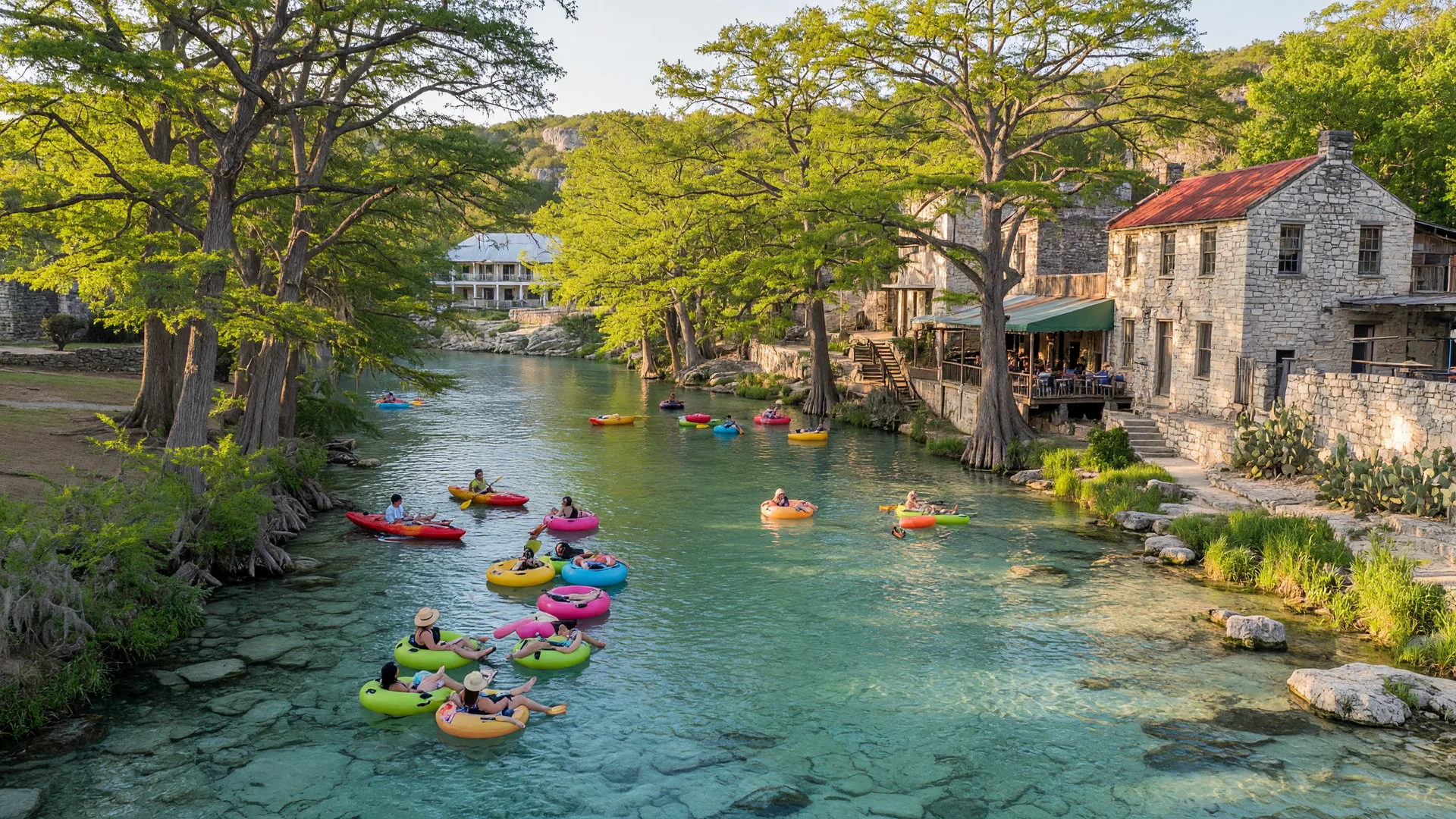
Most California relocators evaluating the Texas Hill Country focus on Boerne, Fair Oaks Ranch, and Fredericksburg. Those communities get the attention because they fit the mental picture of Hill Country living — small towns with historic downtowns, limited commercial sprawl, and a slower pace. That picture is accurate, but it omits one of the most practical options in the region: New Braunfels.
New Braunfels is the largest city in the Hill Country corridor between San Antonio and Austin, with an estimated population of approximately 105,000 to 122,000 as of 2025. It is not a small town. It is a functioning mid-sized city with two school districts, a regional hospital, an established dining scene, year-round river recreation, and a historic core that has been preserved rather than replaced. For California buyers who want Hill Country access without sacrificing urban infrastructure — a real grocery store within five minutes, a hospital within ten, and a school system with proven ratings — New Braunfels warrants serious consideration.
This guide covers the practical details: home prices and property taxes, school district ratings, river-based recreation, the Gruene Historic District, commute times, and how New Braunfels compares to other Hill Country communities for different buyer profiles.
Location: Between San Antonio and Austin
New Braunfels sits in Comal County, approximately 32 miles northeast of downtown San Antonio and 40 miles south of downtown Austin. The city occupies a position on the Interstate 35 corridor that is unique among Hill Country communities — it is the only Hill Country town of substantial size that provides practical access to both of Texas's largest metro regions.
For California relocators, the comparison that lands best is this: New Braunfels is roughly equivalent in distance to a San Francisco East Bay commute. A drive from downtown New Braunfels to downtown San Antonio takes about 35 to 40 minutes on I-35. A drive to downtown Austin runs approximately 45 to 55 minutes, depending on traffic. The corridor between San Antonio and Austin — often called the I-35 megaregion — is one of the fastest-growing transportation corridors in the United States, and New Braunfels sits at its geographic center.
The city's position matters for employment. Residents can work in San Antonio (35 minutes), Austin (50 minutes), or within New Braunfels itself, which has a growing employment base in healthcare, education, retail, and the service industries tied to tourism and river recreation.
| Destination | Drive Time | Distance |
|---|---|---|
| Downtown San Antonio | 35–40 minutes | 32 miles |
| San Antonio Airport | 30–40 minutes | 28 miles |
| Downtown Austin | 45–55 minutes | 47 miles |
| Austin-Bergstrom Airport | 50–60 minutes | 50 miles |
| Boerne | 45–55 minutes | 40 miles |
| The Guadalupe River / Gruene | 10–15 minutes | 5 miles |
Drive times are approximate and vary with I-35 traffic. Peak-hour commutes to San Antonio or Austin can add 15 to 20 minutes.
Population and Growth
New Braunfels has been one of the fastest-growing cities in Texas for the past decade. The population has increased by roughly 50 percent since 2010, driven by the same factors that attract California relocators statewide: no state income tax, lower housing costs, and proximity to the San Antonio-Austin employment corridor.
The growth is visible. New subdivisions extend north and east of the historic core, and the commercial corridors along I-35 and Highway 46 have filled with retailers, restaurants, and services that serve a growing population. For California relocators accustomed to seeing growth managed through strict environmental review and community planning processes, the pace of development in New Braunfels can feel fast. It is worth understanding that this is not a small town that happens to be growing — it is a mid-sized city that has become a regional growth center, and the infrastructure investments (road widening, school construction, hospital expansion) reflect that reality.
The median home value in New Braunfels is approximately $340,000, with median sale prices in early 2026 ranging from $370,000 to $400,000 depending on the neighborhood. This is higher than the Texas statewide median but significantly lower than any California metro area with comparable amenities.
School Districts: New Braunfels ISD and Comal ISD
New Braunfels is served by two school districts, which is an important detail for relocators. The boundary between them roughly follows the city's historic core, and the quality difference between them matters for home-buying decisions.
Comal Independent School District
Comal ISD covers much of the newer residential development in and around New Braunfels, including the areas north toward Canyon Lake and east toward the Guadalupe River. The district is rated A overall by the Texas Education Agency and receives a Niche grade of A, ranking #6 in the San Antonio area and #52 in Texas. The district is one of the top-rated school systems in the Hill Country corridor, comparable to Boerne ISD in academic performance.
Key campuses include Smithson Valley High School (a recognized TEA "A" campus with strong college preparatory programs), Pieper High School (a newer campus that opened in 2021), and several well-regarded middle and elementary schools. Comal ISD has kept pace with enrollment growth through bond-funded construction — the district passed a $460 million bond in 2023 to fund new campuses and renovations.
New Braunfels Independent School District
New Braunfels ISD serves the historic downtown area and the neighborhoods immediately surrounding it. The district is rated B+ by Niche, ranking #14 in the San Antonio area. New Braunfels High School is the district's primary comprehensive campus, with a well-established career and technical education (CTE) program and dual-credit partnerships with area colleges.
For California families, the two-district system means that your choice of neighborhood effectively determines which school your children attend. Homes in the Comal ISD portion of the city generally command a premium, reflecting the district's higher rating and the demand from relocating families.
Key District Data
Comal ISD: Niche grade A, ranked #6 in San Antonio area, #52 in Texas.
New Braunfels ISD: Niche grade B+, ranked #14 in San Antonio area.
Comal ISD 2023 bond: $460 million for new campuses and renovations.
Property Taxes in New Braunfels
For California relocators comparing property tax systems, the combined property tax rate in New Braunfels sits in the range typical for growing Texas cities. The 2024 tax rates break down as follows:
| Taxing Entity | Rate per $100 Valuation |
|---|---|
| Comal ISD | $1.0869 |
| City of New Braunfels | $0.4089 |
| Comal County | $0.2642 |
| Combined effective rate | Approximately 1.41% |
On a median-priced New Braunfels home of approximately $340,000, the annual property tax bill is roughly $4,800 to $5,000 before any exemptions. The Texas General Homestead Exemption ($40,000 for school district taxes) reduces the taxable value by that amount, lowering the annual bill by approximately $435. School district taxes account for the majority of the total rate — approximately 77 percent of the combined levy.
For comparison, a similarly valued home in Boerne or Fair Oaks Ranch carries a similar combined rate in the 1.5 to 1.7 percent range, while a California home of equivalent value in a mid-tier coastal community would typically carry a Proposition 13-protected rate of roughly 1.1 to 1.2 percent after the purchase-year reassessment. The Texas rate is higher, but on a home that costs a fraction of a comparable California property, the dollar difference is less dramatic than most buyers expect.
The Comal River and Guadalupe River: Year-Round Recreation
New Braunfels is defined by its rivers. The Comal River runs through the center of the city and is the shortest navigable river in Texas, flowing approximately 2.5 miles from Comal Springs (the largest spring system in Texas) to its confluence with the Guadalupe River. The Comal is spring-fed, clear, and maintains a constant temperature of approximately 70 to 72 degrees year-round.
The Guadalupe River forms the city's eastern boundary and provides additional tubing, kayaking, and fishing opportunities. The Guadalupe through New Braunfels is wider and deeper than the Comal, supporting commercial outfitters, riverside restaurants, and the water recreation economy that is central to the city's identity.
For California relocators accustomed to the cold, often turbulent rivers of the Sierra Nevada or the Pacific coastline, the Hill Country rivers are a different experience — warmer, slower, and more accessible. Tubing down the Comal River on a summer afternoon is not a wilderness adventure. It is a social, family-oriented activity that residents do repeatedly throughout the season. The river is an amenity that gets used, not a landscape feature that gets admired from a distance.
Comal River
Length: Approximately 2.5 miles from Comal Springs to the Guadalupe confluence.
Source: Comal Springs, the largest spring system in Texas, fed by the Edwards Aquifer.
Water temperature: 70 to 72 degrees, year-round.
Activities: Tubing, kayaking, paddleboarding, swimming.
The Gruene Historic District
Gruene (pronounced "green") is a historic district within the New Braunfels city limits, located approximately 5 minutes from downtown along the Guadalupe River. It was founded in the 1870s as a German cotton-farming community and has been preserved as a National Register Historic District. The district is one of the most visited destinations in the Texas Hill Country, drawing an estimated 1.5 million visitors annually.
Gruene Hall
Gruene Hall is the centerpiece of the district. Built in 1878, it is one of the oldest continuously operating dance halls in Texas. The hall is an un-air-conditioned, wooden-floored structure that has hosted performances by George Strait, Willie Nelson, Lyle Lovett, and virtually every notable name in Texas and country music over the past five decades. The hall operates year-round, with live music most nights and a Sunday afternoon dance. There is no cover charge for most afternoon shows. The experience is genuine — it is not a restored tourist attraction but an active music venue that has operated in its original form since the 19th century.
Dining in Gruene
The district supports a dense cluster of dining options within a few blocks. The Gristmill River Restaurant & Bar occupies a restored 1870s cotton gin overlooking the Guadalupe River and is the most recognizable dining destination in Gruene. The restaurant serves American and Southern fare with a strong local following. Gruene River Grill, located on the main thoroughfare, offers a more contemporary menu in a historic stone building. Coopers Old Time Pit Bar-B-Que and Black's Barbecue, both originating from Llano and Lockhart respectively, operate outposts in the district, providing Texas barbecue options without the drive to the established barbecue cities.
For California relocators, Gruene is the closest thing in the Hill Country to a Northern California wine-country town: a preserved historic district anchored by a landmark venue, with multiple dining options, river views, and a steady stream of weekend visitors. It is a year-round draw, not a seasonal attraction.
Schlitterbahn Waterpark and Wurstfest
Schlitterbahn Waterpark opened in New Braunfels in 1979 and grew into one of the most visited water parks in the United States, drawing over 1 million visitors annually at its peak. The park uses natural Comal River water for several of its rides and attractions, which is a distinctive feature — most water parks rely on chlorinated recirculation systems. Schlitterbahn's original section along the Comal River remains open, with newer expansions to the north. The park operates seasonally from late April through September.
Wurstfest is an annual 10-day German heritage festival held each November in New Braunfels. The event draws over 100,000 visitors and features German food (particularly sausages, or "wurst"), beer from Texas and German breweries, live music across multiple stages, carnival rides, and cultural exhibitions. The festival has been held continuously since 1961 and is one of the largest German-themed festivals in Texas.
For residents, both Schlitterbahn and Wurstfest function as community touchpoints. Season passes to Schlitterbahn are a standard purchase for families with children. Wurstfest is the kind of annual event that defines a community's calendar — residents know it is coming, plan around it, and participate whether they attend every event or simply adjust their routines for the crowds and traffic.
The Dining Scene: Beyond River Food
The dining scene in New Braunfels extends well beyond the river-oriented restaurants in Gruene. The city's German heritage and recent growth have created a dining landscape that spans traditional German cuisine, Texas barbecue, contemporary American, and an emerging craft beer culture.
Krause's Biergarten & Cafe
434 South Market Street. A historic New Braunfels establishment operating since the 1920s. German-influenced menu with schnitzel, sausages, and a full bar. The biergarten is one of the best outdoor dining spaces in the city.
Muck & Fuss
161 South Castell Avenue. A craft beer and burger bar in downtown New Braunfels. Over 50 beers on tap and a burger-focused menu. Consistently rated as one of the best casual dining options in the city.
McAdoo's Seafood
1297 North Walnut Avenue. The go-to seafood option in New Braunfels for residents who do not want to drive to San Antonio. Extensive menu with Gulf Coast specialties. Good for families and group dinners.
The Alpine Haus
220 West San Antonio Street, Suite 102. German and Bavarian cuisine in an intimate downtown setting. Known for schnitzel, spaetzle, and seasonal German specialties. A popular date-night spot.
Buttermilk Cafe
1104 North Walnut Avenue. A breakfast and lunch cafe that has become a New Braunfels institution. Known for pancakes, omelets, and Southern-style lunch plates. Expect a wait on weekend mornings.
Gruene River Grill
1259 Gruene Road. Contemporary American cuisine in the heart of Gruene. The patio overlooks the Guadalupe River. The menu changes seasonally with a focus on local ingredients.
Healthcare Access
New Braunfels has a regional hospital — Christus Santa Rosa Hospital-New Braunfels — located on Highway 46 near I-35. The hospital is a full-service facility with 142 beds, an emergency department, surgical services, and a level III trauma center. For specialized care not available at the local hospital, residents drive 30 to 40 minutes to the South Texas Medical Center in San Antonio, which provides comprehensive specialty services including oncology, cardiology, and advanced surgery.
The city also supports multiple urgent care centers, primary care clinics, and dental practices. Healthcare access in New Braunfels is substantially better than in smaller Hill Country communities like Comfort or Bandera, where residents must drive 20 to 30 minutes for basic medical services.
New Braunfels vs. Boerne vs. San Antonio: A Practical Comparison
The choice between New Braunfels, Boerne, and San Antonio depends on what you value most in a community. Here is an honest comparison of the three.
New Braunfels
Best suited for buyers who want Hill Country recreation with the infrastructure of a mid-sized city. New Braunfels offers river-based outdoor recreation that is more accessible and more central to daily life than any other Hill Country community. The schools (particularly Comal ISD) are strong. The commute to both San Antonio and Austin is practical. The tradeoffs are density and traffic — New Braunfels is a growing city of 100,000-plus, and the I-35 corridor carries significant congestion during peak hours. It does not feel like a small town in the way Boerne does.
Boerne
Best suited for buyers who prioritize small-town character, walkable downtown, and top-rated schools above all else. Boerne's Hill Country Mile, Cibolo Creek Trail, and Boerne ISD are the community's defining assets. The tradeoff is that San Antonio is a 35- to 45-minute drive for most urban amenities, and Boerne itself does not have a regional hospital or major shopping district.
San Antonio
Best suited for buyers who want urban density, cultural institutions, and the broadest employment options. San Antonio provides access to the River Walk, museums, professional sports, and the Medical Center — all within city limits. The tradeoff is that San Antonio lacks the immediate outdoor access and the community feel of the smaller Hill Country towns.
What California Relocators Should Know About New Braunfels
Based on the experience of California buyers who have moved to New Braunfels, a few practical observations are worth sharing.
The river culture is real
Residents do not just visit the Comal and Guadalupe Rivers a few times per year. The rivers are integrated into daily life from May through September. Families buy season passes to Schlitterbahn. People tube the Comal on weekday evenings. The river is the defining amenity of the community, not a scenic backdrop.
I-35 traffic is the main complaint
New Braunfels's position on I-35 gives it access to both San Antonio and Austin, but the corridor carries heavy traffic — particularly on Friday afternoons and during major events. Residents learn to time their commutes carefully and use alternative routes (Ranch Road 306, Highway 46) when practical. This is not Bay Area or LA-level congestion, but it is real and it is the most common frustration voiced by residents.
The heat is comparable to the rest of the Hill Country
New Braunfels sits at approximately 630 feet above sea level — lower than Boerne (1,400 feet) and consequently warmer in summer. Summer highs regularly exceed 95 to 100 degrees. The river partially offsets the heat, but the summer climate here is the same as the rest of the region. If August heat is a dealbreaker, the Hill Country in general may not be the right fit.
German heritage is woven into the community
New Braunfels was founded by German immigrants in 1845, and the cultural influence is visible in architecture, food, festivals, and community identity. Wurstfest is the most visible expression, but the influence extends to the city's approach to community events, its food culture, and the general character of public life. For California relocators, this cultural depth is one of the features that gives the city a distinct identity — it is not a generic suburb.
Home prices are rising but still accessible
The median home price in New Braunfels has increased significantly over the past five years, driven by the same in-migration that has affected the entire Hill Country. A median-priced home in New Braunfels still costs roughly 40 to 60 percent less than a comparable home in the Bay Area or coastal Southern California, but the gap is narrowing. Buyers considering New Braunfels should evaluate current pricing against their timeline rather than assuming the market will stay where it is.
"New Braunfels often gets overlooked by California relocators who only look at Boerne and Fair Oaks Ranch. That is a mistake. New Braunfels offers river recreation that no other Hill Country town matches, strong schools, and access to both San Antonio and Austin. It is a different package than Boerne — more urban, more river-focused, more connected to the I-35 corridor. For the right buyer, it is a better fit."
Is New Braunfels Right for You?
New Braunfels is the right choice for California relocators who want Hill Country living with more urban infrastructure and less distance to major employment centers. It is particularly well-suited for buyers who value river recreation, strong public schools (particularly in the Comal ISD portion), and the ability to access both San Antonio and Austin without choosing one as a primary city.
It is a less natural fit for buyers who want a walkable small town with a historic downtown core. Boerne's Hill Country Mile offers a more concentrated, pedestrian-friendly downtown experience than New Braunfels's larger but more dispersed commercial districts. It is also less suited for buyers who want maximum land — Fair Oaks Ranch and the communities west of Boerne on Highway 46 offer larger lots and more rural settings than New Braunfels's standard suburban subdivisions.
For a broader comparison of Hill Country communities and how they stack up against each other, see the city comparison guide. For a detailed breakdown of housing costs, property taxes, and cost of living, review the cost of living comparison. And for a practical guide to the overall relocation timeline, the relocation checklist covers the 90-day process from California listing to Texas closing.

Written by
Bill Ross
Hill Country Homesteads Group, brokered by KW Boerne
Bill Ross is a Texas real estate agent with nearly four decades in high-tech sales and a network of 1,100+ California real estate agents for coordinated cross-state transactions. Featured in national coverage discussing his family's relocation from Silicon Valley to the Texas Hill Country.
Related Guides
Boerne vs Fair Oaks Ranch vs San Antonio
Compare Hill Country communities for families, retirees, and remote workers.
Boerne vs Fair Oaks Ranch for Families
Schools, home prices, lifestyle differences, and which community fits your family.
Texas Hill Country Wineries Guide
The 290 corridor, notable tasting rooms, and distances from Hill Country communities.
State and Local Parks Near Boerne
Enchanted Rock, Guadalupe River, Government Canyon, and more with distances and fees.
Sources
- New Braunfels population (approximately 105,000-122,000) — U.S. Census Bureau QuickFacts; StateDemographics.com. census.gov; statedemographics.com
- Median home value (~$340,000) and median sale prices ($370,000-$400,000) — Zillow Home Values Index; Texas Ally, New Braunfels real estate data. texasally.com
- New Braunfels ISD (Niche grade B+, #14 in San Antonio area) — Niche. niche.com
- Comal ISD (Niche grade A, #6 in San Antonio area, #52 in Texas) — Niche. niche.com
- Comal ISD 2023 bond ($460 million) — Community Impact, Comal ISD bond election results.
- City of New Braunfels property tax rate ($0.408936 per $100) — Community Impact, New Braunfels City Council 2024-25 budget. communityimpact.com
- Comal County tax rate ($0.26423 per $100) — Herald-Zeitung, Comal County Commissioners. herald-zeitung.com
- Comal ISD tax rate ($1.0869 per $100) — Herald-Zeitung, Comal ISD 2024 tax rate. herald-zeitung.com
- Comal River — shortest navigable river in Texas, constant 70-72 degree temperature, Comal Springs — Texas Parks and Wildlife Department; Texas Water Development Board, Comal Springs data.
- Gruene Hall — built 1878, oldest continuously operating dance hall in Texas — Gruene Hall Official Site. gruenehall.com
- Gruene Hall history and capacity — National Register of Historic Places.
- Wurstfest — 10-day festival in November, 100,000+ visitors — Wurstfest Official Site. wurstfest.com
- Schlitterbahn New Braunfels — opened 1979, 1+ million annual visitors at peak — Schlitterbahn Waterpark official history.
- New Braunfels elevation (~630 feet) — U.S. Geological Survey.
- Christus Santa Rosa Hospital-New Braunfels — 142 beds, level III trauma center — Christus Health. christushealth.org
Last reviewed: August 2026. Sources verified for accuracy.