
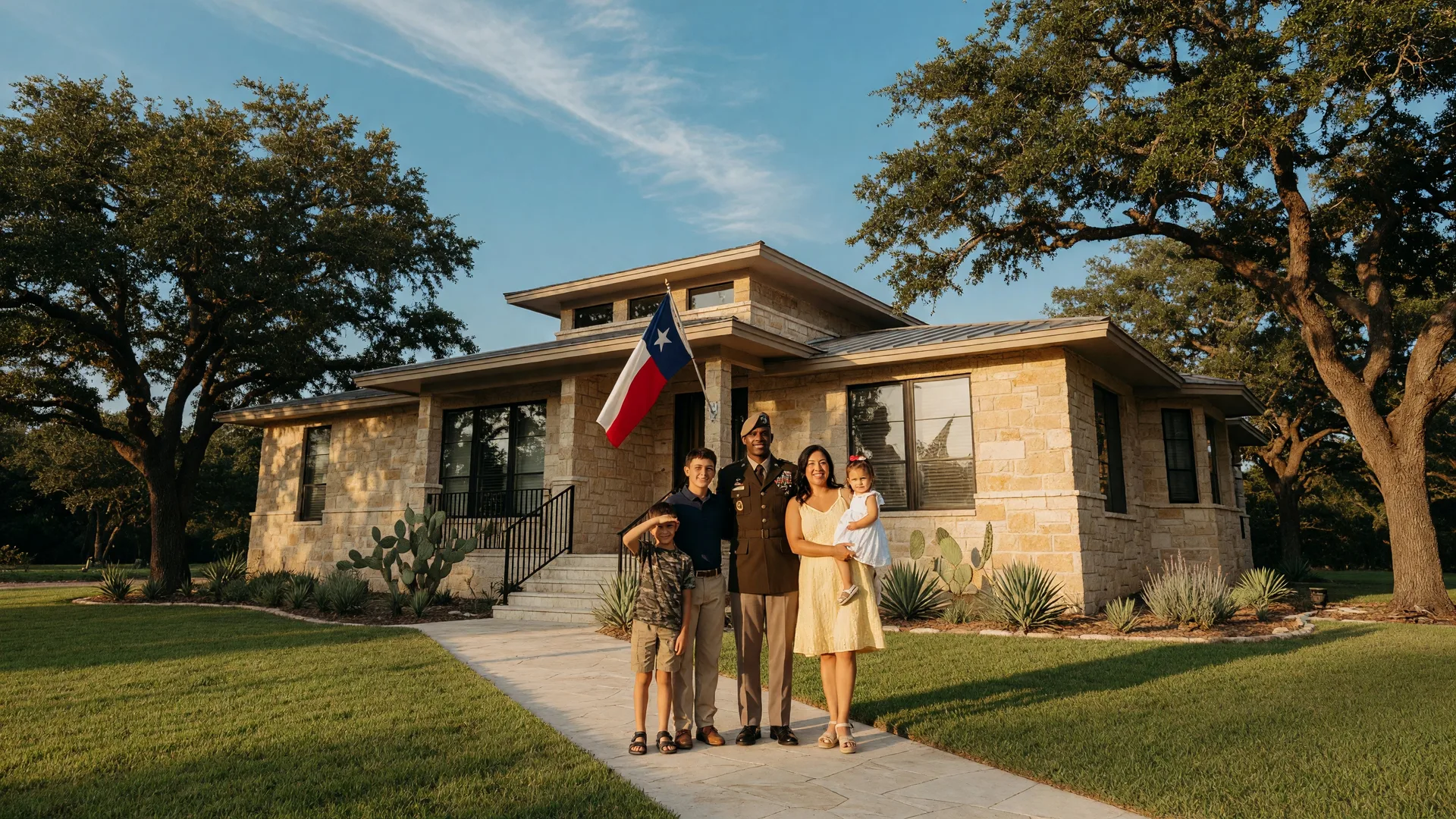
San Antonio military relocation is supported by strong infrastructure. If you are active-duty military or a veteran living in California and considering a move to Texas, the short answer is: Texas makes the financial math work strongly in your favor. Between zero state income tax on military retirement pay, the most generous disabled veteran property tax exemptions in the country, and direct access to Joint Base San Antonio — one of the largest military concentrations in the United States — the Texas Hill Country is a natural destination for service members transitioning to civilian life or relocating with a new assignment.
This guide covers everything you need to evaluate the move: VA loans Boerne are available with strong benefits, and a VA loan Realtor San Antonio can help you navigate them. VA loan entitlements and limits for 2026, property tax exemptions based on disability rating, base proximity and commuting times from Hill Country communities, education benefits through the Hazlewood Act, and the Texas Veterans Land Board loan programs that most California service members have never heard of.
Joint Base San Antonio: The Military Anchor
San Antonio has been a military town since 1845, and it remains one of the most strategically important military hubs in the country. Joint Base San Antonio (JBSA) comprises three primary installations, all within commuting distance of the Hill Country [1]:
- Fort Sam Houston — Home to Brooke Army Medical Center (BAMC), Army North, Army South, and the U.S. Army Medical Center of Excellence. Located on San Antonio's north side, approximately 30 minutes from Boerne and Fair Oaks Ranch.
- Lackland Air Force Base — The gateway to Air Force basic military training, operated by the 37th Training Wing, training up to 80,000 personnel annually. Southwest San Antonio, about 40 minutes from the Hill Country.
- Randolph Air Force Base — Headquarters of Air Education and Training Command (AETC) and home to the 12th Flying Training Wing. Northeast San Antonio, approximately 40–45 minutes from Boerne.
In addition to the main bases, Camp Bullis (17 miles northwest of San Antonio) and Camp Stanley Storage Activity (approximately 20 miles northwest near Leon Springs and Fair Oaks Ranch) provide training and logistics support that keep the region deeply connected to the military mission [1].

For active-duty personnel with a new assignment to JBSA, the choice of where to live matters for quality of life. Boerne and Fair Oaks Ranch offer the best combination of excellent schools (Boerne ISD rated A by the Texas Education Agency), larger lot sizes, and a Hill Country lifestyle, with commute times to Fort Sam Houston of roughly 30–40 minutes via I-10 and Loop 1604. Housing in these communities is more expensive than San Antonio proper but significantly less than what a California military family is accustomed to paying.
VA Home Loans in Texas: What You Need to Know
The VA home loan is the single most powerful home-buying tool available to military families, and it works the same way in Texas as it does in California — no down payment, no private mortgage insurance (PMI), competitive interest rates, and limited closing costs. But a few Texas-specific details matter [2]:
Loan Limits for 2026
For 2026, the standard VA loan limit is $832,750 for borrowers with partial entitlement. Borrowers with full entitlement — meaning they have never used a VA loan before, or have restored their entitlement — face no county-specific loan cap in Texas. Given that the median home sale price in Boerne (78006) is approximately $450,000 per Redfin's late-2026 reporting (with local agent estimates ranging higher), most military buyers in the Hill Country will have ample room within their VA entitlement [2].
Funding Fee Exemptions
The VA funding fee is normally 2.15% of the loan amount for first-time use and 3.30% for subsequent use. Veterans receiving VA disability compensation — at any rating level — are exempt from the funding fee entirely. So are surviving spouses of veterans who died in service or from a service-connected disability. On a $500,000 home, that saves you between $10,750 and $16,500 [2].
Texas-Specific Advantages for VA Buyers
Texas does not impose a state transfer tax or documentary stamp tax on real estate transactions, which reduces closing costs compared to many states. Texas also prohibits the collection of prepayment penalties, so there is no cost to refinancing your VA loan if rates drop. And because Texas has no state income tax, the savings from the no-down-payment, no-PMI structure of a VA loan are compounded by lower overall housing costs. A California military family paying $4,500 per month for a rental near Camp Pendleton or Travis AFB can typically buy a comparable or superior home in the Hill Country for a lower monthly payment — even with property taxes included.
"For a veteran with a 100% disability rating buying a $450,000 home in Boerne with a VA loan, the combination of zero down payment, no funding fee, no PMI, and the full property tax exemption can reduce the monthly housing cost by $1,200 or more compared to a conventional loan with 5% down."
Property Tax Exemptions: Texas's Most Generous Veteran Benefit
The single most valuable benefit Texas offers disabled veterans is the property tax exemption system. Unlike California, which offers only limited property tax relief for disabled veterans, Texas provides a graduated exemption scale based on VA disability rating — and a complete exemption for the most severely disabled [3]:
| VA Disability Rating | Exemption Amount | Estimated Annual Savings* |
|---|---|---|
| 10%–29% | $5,000 off assessed value | ~$100 / year |
| 30%–49% | $7,500 off assessed value | ~$150 / year |
| 50%–69% | $10,000 off assessed value | ~$210 / year |
| 70%–89% | $12,000 off assessed value | ~$250 / year |
| 100% or Individual Unemployability | 100% of home value exempt | ~$10,000+ / year |
*Based on a $500,000 home in Kendall County with combined tax rate of ~2.05%. Actual savings vary by county and property value.
The 100% disabled veteran exemption (Tax Code §11.131) is extraordinary. Veterans with a 100% disability rating or Individual Unemployability (IU) receive a full property tax exemption on their residence homestead — with no cap on home value, no income test, and no expiration. This means a veteran with a 100% rating who owns a $700,000 home in Boerne pays exactly zero in school district taxes, county taxes, and city taxes. In a high-tax county like Comal or Kendall, that can save $12,000 to $16,000 per year [4].
These exemptions can also be claimed retroactively for up to five prior tax years by filing Form 50-114 with the county appraisal district. Surviving spouses of disabled veterans may retain or transfer the exemption [4].
Why This Matters More Than California's Benefit
California offers a disabled veteran property tax exemption under Cal. Rev. & Tax Code §205.5, but it is limited to veterans with a 100% rating who also meet strict income limits and property value caps. In most California counties, the maximum exemption is approximately $150,000 of assessed value — not the full value. For a California veteran with a 100% rating on a home assessed at $600,000, the savings might be $2,000 per year at Prop 13 rates. In Texas, the same veteran on the same home value saves $10,000 to $14,000 per year [3][4].
For veterans with partial disability ratings (50%–89%), the Texas benefit is still meaningful, but the gap between full and partial exemption is a sharp incentive to ensure your VA disability rating is current before applying.
No State Income Tax: What It Means for Military and Retirement Pay
Texas has no state personal income tax. For military families, this has a direct and significant impact on take-home pay:
- Military retirement pay: Every dollar of your military pension is untaxed by the state of Texas. If you separate after 20 years with a pension of $48,000 per year, California would take roughly $1,800 to $2,400 each year. In Texas, it is $0.
- VA disability compensation: VA disability benefits are federally tax-free, so state tax does not apply in either state. But the combined structure — tax-free disability income plus tax-free military retirement — gives Texas veterans a fundamentally lower cost of living.
- TSP distributions: Thrift Savings Plan withdrawals are taxed by California as ordinary income (rates from 1% to 13.3%). Texas taxes them at 0%. On a $60,000 annual TSP distribution, a California veteran in the 9.3% bracket loses $5,580 to the state. In Texas, that entire amount stays in your pocket.
- Wages earned while on active duty: If you are stationed in Texas while on active duty, your military base pay is not subject to state income tax regardless. But Texas also imposes no state income tax on any secondary employment, consulting, or gig work you do outside of your military duties.
Combined annual tax savings for a veteran with a $50,000 military pension, $30,000 in TSP distributions, and $25,000 in VA disability compensation relocating from California to Texas: approximately $8,000 to $10,000 per year, every year, for life.
The Texas Veterans Land Board: A Benefit Californians Don't Have
The Texas Veterans Land Board (VLB) administers three loan programs that give Texas veterans access to below-market financing for land, homes, and home improvements. These programs are funded by the state of Texas and are not available to veterans living in California [5]:
VLB Veterans Land Loan Program
Purchase 1 to 20+ acres of land in Texas with as little as 5% down and below-market fixed interest rates. This is particularly valuable in the Hill Country, where acreage properties are common. Veterans with a 30%+ disability rating receive an additional interest rate discount [5].
VLB Veterans Housing Assistance Program
Low-interest home purchase loans with rates typically 0.25% to 0.50% below current market rates for qualified veterans. Unlike the VA loan, VLB loans can be used simultaneously with certain other programs, though most veterans find the VA loan's zero-down feature more advantageous than the VLB's slightly lower rate if they are buying with limited cash.
VLB Veterans Home Improvement Loans
Financing for renovations, repairs, and accessibility modifications — useful for adapting a Hill Country home for mobility needs. The VLB Home Improvement loan can be used in combination with VA disability grant programs like the SAH (Specially Adapted Housing) grant [5].
A key advantage: VLB loans can be stacked with federal VA benefits. A veteran could use a VA loan for the primary purchase, then use a VLB land loan to purchase adjacent acreage, or use a VLB improvement loan after closing. Most California veterans are unaware of these programs because they do not live in a state that offers them.
The Hazlewood Act: Free College Tuition for Veterans and Their Families
The Hazlewood Act is a Texas state law that provides up to 150 credit hours of free tuition and mandatory fee waivers at any Texas public college, university, or community college. This benefit is available to qualifying Texas veterans and, through the Legacy Program, can be transferred to dependent children [6].
What makes Hazlewood particularly valuable compared to California's equivalent programs:
- No time limit: There is no expiration date for the benefit. You can use it for yourself now, save it for your children later, or split it.
- Stackable with the GI Bill: The Hazlewood Act covers tuition and fees not already paid by the federal GI Bill. This means a veteran can use both benefits to cover full tuition at a Texas public university without any out-of-pocket cost — a combination not available in many states.
- Legacy transfer: If a veteran does not use all 150 hours, the remaining hours can be transferred to dependents. For a family with college-age children, this can be worth $30,000 to $60,000 in tuition savings per child at Texas public universities.
- Coverage includes all public institutions: From the University of Texas at San Antonio and Texas State University to Alamo Colleges (San Antonio's community college system), all public Texas higher education institutions participate.
Eligibility requirement: To qualify for Hazlewood, you must have been a Texas resident at the time of entering the service or have established Texas residency after separation. However, veterans who move to Texas and establish residency for at least 12 consecutive months before the start of the academic term generally qualify. If you are on active duty and receiving PCS orders to Joint Base San Antonio, that assignment establishes your eligibility [6].
Additional Texas Benefits for Military and Veterans
Beyond the major financial programs, Texas offers a long list of smaller but meaningful benefits that collectively make daily life easier for military families [7]:
- Free driver's license and vehicle registration for 100% disabled veterans.
- Free Super Combo hunting and fishing license for 100% disabled veterans.
- Texas State Parks Pass (Parklands Passport) for free entry to all Texas state parks.
- Veteran hiring preferences for state employment, with priority consideration for qualified veterans.
- Property tax deferral for deployed service members — active-duty personnel deployed outside the U.S. can defer property tax payments for up to 60 days after returning, with no penalty or interest (Tax Code §31.02).
- Homestead exemption maintenance on PCS orders — Texas homeowners who receive PCS orders can maintain their homestead exemption when transferred to any location within the U.S. (Senate Bill 833), meaning you do not lose your homeowner tax savings if you are reassigned temporarily.
- Active-duty address-matching waiver for homestead exemption applications, allowing military members and their spouses to claim the exemption even when their ID address does not match their home address.

Which Hill Country Community Fits Your Profile?
The best community for a military family depends on your assignment location, your housing preferences, and whether you plan to stay after separation.
Boerne
Best for: Officers, senior NCOs, and veterans seeking an established Hill Country town with top-rated schools and a strong community identity. Boerne ISD is rated A by the Texas Education Agency with all campuses earning high marks [8]. Commute to Fort Sam Houston: approximately 35 minutes. Commute to Lackland: approximately 40 minutes. Homes range from the $350s to over $1 million, with the Redfin median sale price around $450,000 in late 2026 (local agent estimates range higher). The downside: it is a 35–40 minute drive to base, which some active-duty families find too long for daily commuting.
Fair Oaks Ranch
Best for: Families who want a master-planned community with golf course access, larger lots, and a shorter commute to Camp Stanley/Camp Bullis. The Fair Oaks Ranch community offers a private golf club, trails, and multiple parks. Commute to Fort Sam Houston: approximately 30 minutes. Homes range from the $400s to the $900s, with newer construction in the upper end. The community skews heavily toward professionals and military retirees.
San Antonio (North Central)
Best for: Active-duty personnel who want the shortest possible commute and the broadest range of housing options. Neighborhoods near the Stone Oak area, The Dominion, or the Hill Country Village area offer 15–25 minute commutes to Fort Sam Houston and Randolph. These neighborhoods still feel suburban, with San Antonio ISD or North East ISD schools. Home prices are generally lower than Boerne's, with the median in the $350–$450,000 range.
Leon Springs / Grey Forest
Best for: Personnel assigned to Camp Stanley/Camp Bullis who want acreage and privacy. These unincorporated areas offer larger lots (1–10+ acres) with no city taxes and no HOA. Schools are served by Northside ISD or Bandera ISD. Homes are typically older or custom-built, with prices ranging from the $400s to the $800s. The tradeoff: well water and septic systems instead of municipal utilities, and fewer nearby amenities than Boerne or Fair Oaks Ranch offer.
Military Relocation Checklist: What to Do Before You Move
If you are separating from active duty or receiving PCS orders to San Antonio, here is the practical sequence of steps:
- Run your Certificate of Eligibility (COE) for your VA loan. Even if you have used your VA loan before, confirm your remaining entitlement. If you have a VA loan on a California property you plan to keep as a rental, you may need to request restoration of entitlement or calculate your remaining entitlement.
- File your VA disability claim (if applicable) before separation. The Benefits Delivery at Discharge (BDD) program lets you file your claim 180 to 90 days before separation. Getting your disability rating established before you buy in Texas means you immediately qualify for the corresponding property tax exemption.
- Research Texas county appraisal district filing requirements. Each county (Kendall, Bexar, Comal, Bandera) has its own forms and deadlines for the disabled veteran exemption. The filing deadline for the current tax year is typically April 30, but you can file late for future-year benefits.
- Consider renting first (at least 3 months). If you are new to Texas, renting gives you time to learn the neighborhoods, confirm your commute tolerance, and understand property tax rates before committing to a purchase. See our guide on renting before buying for a full breakdown of the costs and benefits.
- Establish Texas residency immediately. Get your Texas driver's license within 90 days of establishing residency (adults with a valid out-of-state license are generally exempt from knowledge and skills exams), register your vehicles, register to vote, and change your address with USPS. These steps protect your homestead exemption eligibility and are documented in our 90-day residency guide.
- Contact the Texas Veterans Land Board. If you are interested in VLB loan programs or land purchase options, contact the VLB office before you start house hunting. Their programs require specific pre-approval processes that differ from the VA loan process.
Frequently Asked Questions
If I am still on active duty and stationed in California, can I buy a home in Texas with a VA loan before I move?
Yes. The VA loan is available to active-duty service members regardless of duty station. You can purchase a home in Texas using your VA loan entitlement while still stationed in California, provided you intend to occupy the home within a reasonable time — which means within 60 days of your PCS or separation date. This is a common strategy for service members who want to have a home ready when they arrive.
Can I use the VA loan more than once?
Yes. VA loan entitlement is reusable. If you sell the home you bought with your VA loan and pay off the loan, your full entitlement is restored. If you keep the home as a rental and pay down the loan, you can request restoration of entitlement (known as Tier 2 entitlement). In 2026, full-entitlement borrowers face no county loan limit in Texas.
Does the 100% disabled veteran property tax exemption apply to any property I own, or only my primary residence?
The full 100% exemption under Tax Code §11.131 applies only to your residence homestead — the home where you live. The partial exemption under §11.22 (for ratings below 100%) can apply to any one property you own, not necessarily your homestead. If you own a second home or rental property, you can apply the partial exemption there while the homestead exemption applies to your primary residence.
How long do I need to live in Texas before I qualify for the Hazlewood Act?
Veterans who establish Texas residency for at least 12 consecutive months before the start of the academic term generally qualify for Hazlewood. However, if you entered the military from Texas originally, you qualify immediately upon separation. Active-duty personnel receiving PCS orders to a Texas base establish eligibility upon assignment. The rules are complex and depend on when and where you entered service — review them on the Texas Veterans Commission website.
Is there a difference in property tax treatment for veterans who separate vs. retire in Texas?
No. The property tax exemption is based on your VA disability rating, not on the nature of your separation. A veteran who separated after four years of service with a 50% disability rating receives the same $10,000 exemption as a 20-year retiree with the same rating. The key variable is your official VA disability rating, not your years of service or separation category.
Making an Informed Decision
Texas has earned its reputation as the most veteran-friendly state in the country — and the Hill Country, with its proximity to Joint Base San Antonio, its excellent school districts, and its combination of rural character and urban access, is one of the best places in Texas for military families to put down roots.
The financial benefits are substantial: zero state income tax on military retirement and TSP distributions, the most generous disabled veteran property tax exemption system in the country, VA loan advantages including funding fee waivers, and state-level programs like the Hazlewood Act and VLB loans that have no California equivalent.
If you are an active-duty service member receiving orders to San Antonio, or a California veteran considering the Hill Country for your next chapter, I would be glad to walk through your specific situation. The right community depends on your assignment, your budget, your disability rating, and your family's priorities — and those are details worth getting right.
Reach out for a no-pressure conversation about the numbers that apply to your specific situation.

Written by
Bill Ross
Hill Country Homesteads Group, brokered by KW Boerne
Bill Ross is a Texas real estate agent with nearly four decades in high-tech sales and a network of 1,100+ California real estate agents for coordinated cross-state transactions. Featured in national coverage discussing his family's relocation from Silicon Valley to the Texas Hill Country, Bill specializes in guiding military families, retirees, and professionals relocating from California to the Texas Hill Country.
Sources
- Joint Base San Antonio: installations and economic impact. JBSA.mil; Texas Comptroller of Public Accounts. jbsa.mil
- 2026 VA loan limits and funding fee rules. VA.gov; VA Loans Texas. valoanstexas.com
- Texas disabled veteran property tax exemptions (Tax Code §11.22, §11.131). Texas Comptroller of Public Accounts. comptroller.texas.gov
- California vs. Texas disabled veteran exemptions comparison. ValoanNetwork; Texas Veterans Commission. valoannetwork.com
- Texas Veterans Land Board (VLB) loan programs. Texas General Land Office. glo.texas.gov
- Hazlewood Act tuition exemption. Texas Veterans Commission; ValoanNetwork. valoannetwork.com
- Texas military and veterans benefits overview. MyArmyBenefits. myarmybenefits.us.army.mil
- Boerne ISD ratings and campus profiles. Texas Education Agency. boerneisd.net
- Texas military benefits summary. VetCalc.org. vetcalc.org