
Published:
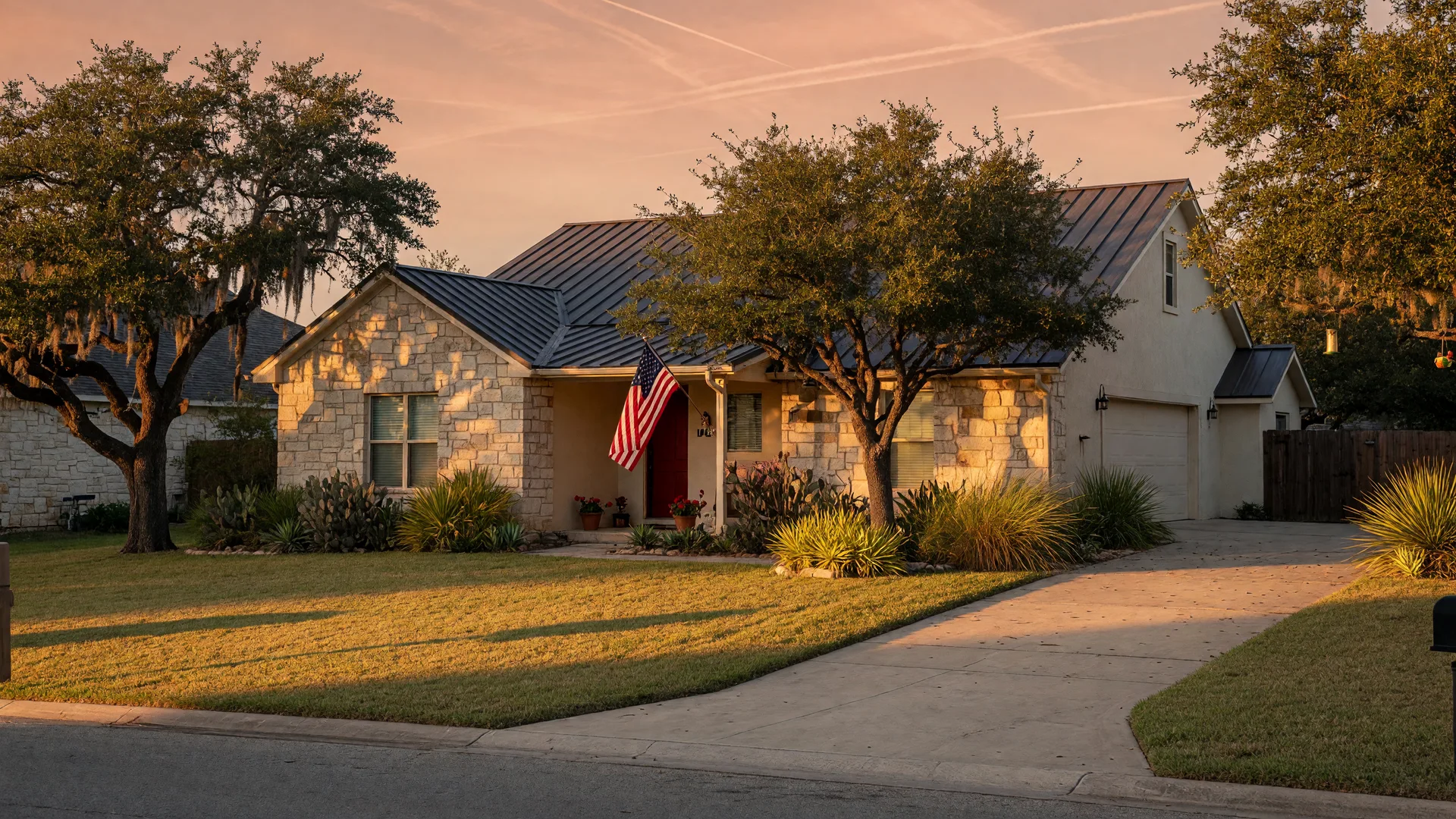
If you are a service member or veteran weighing a move to the Texas Hill Country, the honest 2026 headline is this: the VA loan lets you buy with no down payment and no mortgage insurance, Texas exempts a severely disabled veteran's home from property tax entirely, and Joint Base San Antonio puts three major installations within commuting range of Boerne, Fair Oaks Ranch, and San Antonio [1][4][5][12]. Texas has no state income tax, so military retirement pay and VA disability compensation are not taxed at the state level, and the Veterans Land Board adds its own loan programs on top of the federal VA benefit [8][11].
I am Bill Ross, a Texas real estate agent serving Boerne, Fair Oaks Ranch, San Antonio, and the surrounding Hill Country, and I have helped military families on both ends of this move: the ones retiring out of California bases and the ones PCS-ing into San Antonio and choosing where to live. This article is the framework I use with those families. We will cover the VA loan math that actually matters in 2026, the property tax exemptions that can change a veteran's budget by thousands a year, the Texas benefits beyond the loan, the base-proximity reality across the Hill Country towns, and the practical steps in the move. No hype, no sales pitch. Just the rules and the numbers.
Why Military Families Land in San Antonio and the Hill Country
San Antonio is one of the largest military communities in the country, and the reason is Joint Base San Antonio, the largest joint base in the Department of Defense. JBSA spans roughly 46,000 acres and is made up of three primary operating locations: Fort Sam Houston, Lackland, and Randolph, with Camp Bullis nearby [12][13]. Fort Sam Houston sits in northeast San Antonio, about four miles from downtown, and is the home of Army medical training and the San Antonio Military Medical Center. Lackland is on the southwest side and is where the Air Force does much of its basic training. Randolph, in the northeastern suburbs near Universal City, is the Air Force's pilot and training hub [12][13].
The practical question for a relocating family is where to live, and the answer depends on which base the assignment is at. Boerne sits roughly 30 miles north of San Antonio on the I-10 corridor, Fair Oaks Ranch is about 27 miles northwest of downtown and roughly 8 miles southeast of Boerne, and both are within commuting range of all three JBSA locations, with the tradeoff that Lackland on the southwest side is the longest drive [13]. Families who want the shortest commute cluster closer to the base they work at, while families who want the Hill Country lifestyle accept a longer drive for the schools, the lots, and the slower pace.
Commuting From the Hill Country to Joint Base San Antonio
| Installation | Location | Distance from Boerne | What it hosts |
|---|---|---|---|
| JBSA-Fort Sam Houston | Northeast San Antonio, ~4 mi from downtown | ~30-35 mi | Army medical training, San Antonio Military Medical Center [12][13] |
| JBSA-Lackland | Southwest San Antonio | Longest drive from Boerne | Air Force basic military training [12][13] |
| JBSA-Randolph | Northeastern suburbs, Universal City area | ~35-40 mi | Pilot and navigator training [12][13] |
Distances are approximate driving distances from Boerne based on the JBSA installation locations [12][13]. Fair Oaks Ranch is roughly 8 miles southeast of Boerne, so its drive times are a few minutes shorter. Confirm your actual commute against your duty station before you commit to a neighborhood.
The VA Loan Math: Zero Down, No PMI, and the Funding Fee
The VA loan is the single most valuable financing advantage a relocating service member or veteran brings to Texas. A qualified borrower with full entitlement can finance 100 percent of the purchase with no down payment, and there is no private mortgage insurance, which is a line item that can run hundreds of dollars a month on a conventional loan [1][3]. There is no VA loan limit when you have full entitlement, because the VA backs 25 percent of whatever the lender approves, so the 2026 conforming limit of $832,750 only matters for borrowers with partial remaining entitlement [1][2].
The tradeoff is the funding fee, a one-time cost the VA charges to keep the program funded. For a first-time use on a purchase with less than 5 percent down, the fee is 2.15 percent of the loan; it drops to 1.5 percent with 5 to 9.99 percent down and 1.25 percent with 10 percent or more down [1]. On a $500,000 loan at 2.15 percent, that is $10,750, which can be financed into the loan rather than paid out of pocket. The fee disappears entirely for veterans who receive VA disability compensation, which pairs with the property tax exemptions below to make a disabled veteran's Texas purchase dramatically more affordable [1].
Rates in 2026 have hovered roughly a quarter point below conventional, with the national average 30-year VA rate around 6.0 to 7.25 percent over the year and the FRED Optimal Blue VA index near 7.0 percent in early October 2026 [17][18]. Because the VA backs the loan, lenders can offer more forgiving terms, but the exact rate you receive depends on your credit, your debt-to-income ratio, and the lender, so it is worth comparing at least two VA lenders before you commit [18].
2026 VA Funding Fee, First-Time Use, Purchase Loans
| Down payment | Funding fee | On a $500,000 loan |
|---|---|---|
| Less than 5% | 2.15% | $10,750 |
| 5% to 9.99% | 1.50% | $7,500 |
| 10% or more | 1.25% | $6,250 |
| Receiving VA disability compensation | Exempt (no fee) | $0 |
Funding fee percentages from the VA funding fee schedule [1]. Subsequent-use purchases carry a higher fee (3.3% with less than 5% down), and veterans receiving disability compensation are exempt [1]. The fee can be financed into the loan rather than paid at closing.
The Property Tax Exemption That Changes Veteran Budgets
Texas has no state income tax, which means the state shifts its revenue load onto property taxes, and that is exactly where Texas gives veterans their biggest break. Under Tax Code Section 11.22, a veteran with a service-connected disability rating can exempt a fixed dollar amount of assessed value on any one property they own and designate: $5,000 at a 10 to 29 percent rating, $7,500 at 30 to 49 percent, $10,000 at 50 to 69 percent, $12,000 at 70 to 99 percent, and the full 100 percent of assessed value at a 100 percent rating [4][6]. This exemption is not limited to a homestead, so a veteran can apply it to the property that makes the most sense for their situation [4].
The second and more powerful exemption lives in Section 11.131. A veteran who is rated 100 percent service-connected disabled and is receiving 100 percent compensation from the VA, or is classified as individually unemployable, gets the entire appraised value of their residence homestead exempted from property tax [5][7]. The unremarried surviving spouse of a qualifying veteran keeps the exemption [5]. On a $600,000 Boerne home at an effective rate near 1.7 percent, that is a tax bill of roughly $10,000 a year that simply disappears. For a veteran rated below 100 percent, the Section 11.22 exemption still removes real money from the assessed value every single year, and it compounds because the exempted value is also shielded from future appraisal growth [4][6].
The Disabled Veterans Exemption by Rating (Texas Tax Code 11.22)
| Service-connected rating | Exempt assessed value | Approx. annual savings at 1.7% |
|---|---|---|
| 10% - 29% | $5,000 | ~$85 |
| 30% - 49% | $7,500 | ~$128 |
| 50% - 69% | $10,000 | ~$170 |
| 70% - 99% | $12,000 | ~$204 |
| 100% | Full assessed value | ~$10,000 on a $600K home |
Exemption amounts from Texas Tax Code Section 11.22 and the Comptroller's disabled veteran FAQ [4][6]. The 100 percent residence homestead exemption under Section 11.131 is separate and applies to the veteran's principal residence [5][7]. Savings are illustrative at a 1.7 percent effective rate; your actual rate varies by county and tax district. File the exemption application with your county appraisal district, generally by April 30 of the tax year [4].
The Texas Benefits Stack: Beyond the VA Loan
The property tax exemption is the headline, but Texas layers several other benefits on top of it that make the state unusually friendly to veterans. The most obvious is the absence of a state income tax: Texas has none, so military retirement pay, VA disability compensation, and Survivor Benefit Plan payments are all free of state income tax, a recurring advantage for a retiree leaving a state that taxes pensions and retirement income [11].
The Texas Veterans Land Board runs its own loan programs, separate from the federal VA loan. VLB home loans are available up to $806,500 for a primary residence in Texas at competitive rates, with rate reductions for veterans who hold a 30 percent or higher service-connected disability rating [8][9]. VLB also offers land loans up to $200,000 for veterans buying rural acreage, which matters in the Hill Country where buying a lot now and building later is a common path [8][9]. Many veterans compare a VA loan, with its zero-down and no-PMI structure, against a VLB loan for its rate, and a good lender can run both for your situation.
For families with children heading to college, the Hazelwood Act exempts qualifying veterans from tuition and most fees at Texas public colleges and universities, up to 150 semester credit hours, and the benefit extends to spouses and dependent children under the Hazlewood Legacy program [10]. That is a substantial education advantage that a relocating family often does not discover until after the move, so it is worth knowing before you choose a school district [10].
The Texas Benefits Stack at a Glance
| Benefit | What it is | Who it helps |
|---|---|---|
| No state income tax | Military retirement pay, VA disability, and SBP free of state tax [11] | Retirees and disabled veterans |
| Disabled veterans property tax exemption | Up to 100% of assessed value exempt by rating [4][5][6][7] | Veterans rated 10% to 100% |
| VLB home loans | Up to $806,500 primary residence loans at competitive rates [8][9] | Veterans buying in Texas |
| VLB land loans | Up to $200,000 for rural acreage [8][9] | Veterans buying Hill Country lots |
| Hazlewood Act | Up to 150 credit hours of tuition exemption at Texas public colleges [10] | Veterans, spouses, and dependents |
Compiled from the cited Texas General Land Office, Texas Veterans Commission, and U.S. Army benefit sources [8][9][10][11][19]. Eligibility rules apply to each benefit; verify your own status with the relevant agency before you rely on a figure.
Where to Buy: San Antonio, Boerne, and Fair Oaks Ranch
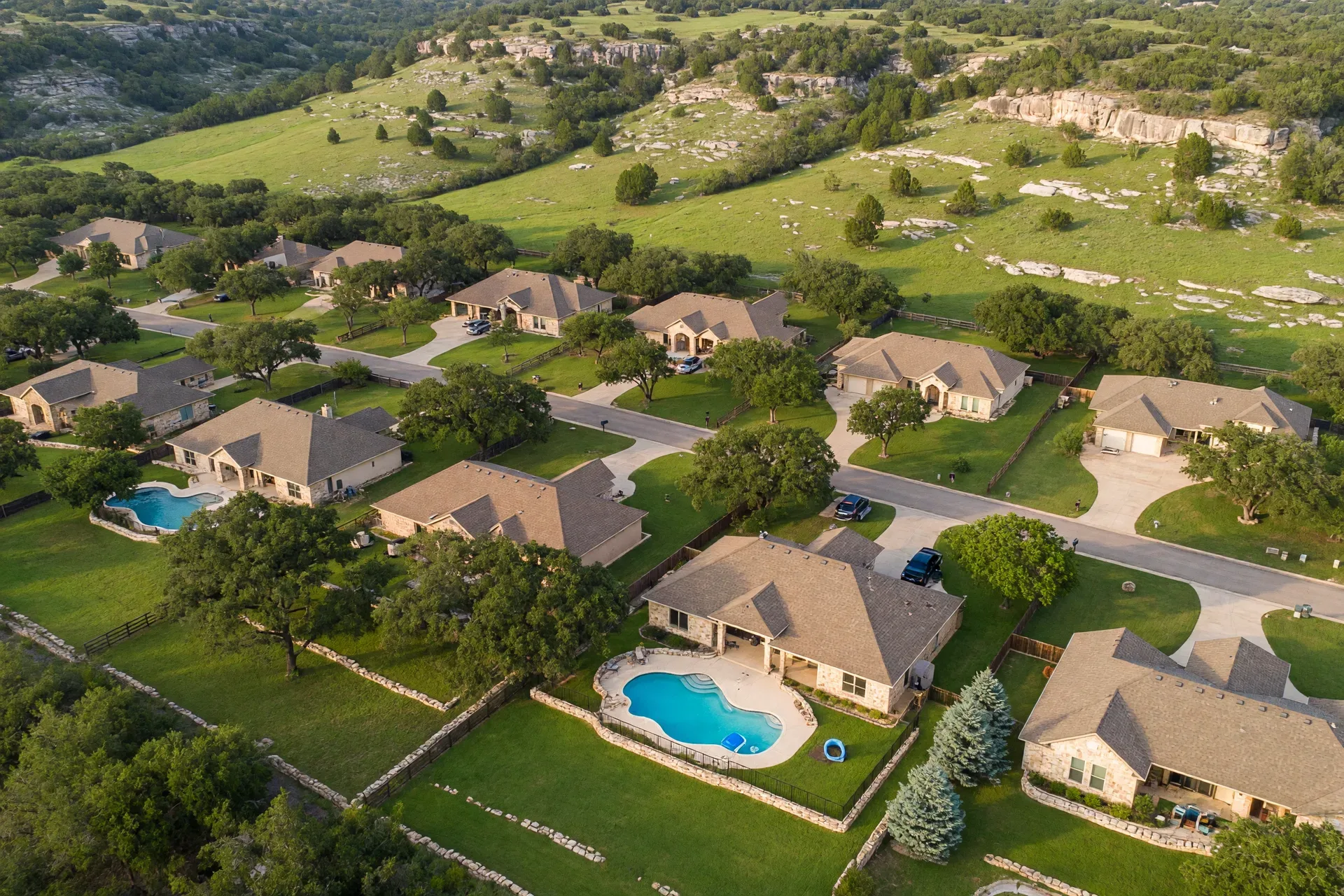
The base you report to and the lifestyle you want drive the neighborhood decision, and the 2026 price picture makes the tradeoffs concrete. San Antonio proper offers the shortest commutes and the widest range of prices, with a median sale price around $265,000 to $299,000 depending on the source and month [14]. Boerne, roughly 30 miles north, trades a longer drive for top-rated schools and Hill Country character, with a median closer to $450,000 to $665,000 depending on how the market is measured [15]. Fair Oaks Ranch, about 27 miles northwest of downtown and the closest of the three to Boerne, sits at the high end with medians near $712,000 to $785,000, and it is overwhelmingly owner-occupied with newer construction and gated communities [16].
For a military buyer, the VA loan changes the calculus at every price point because the zero-down structure removes the biggest barrier to entry. A family that has been renting on a base can move into a $500,000 Boerne home with no down payment, no PMI, and a funding fee that may be waived entirely if the veteran receives disability compensation [1]. The property tax exemptions then soften the ongoing cost, which is the line that surprises California buyers most because California's Prop 13 caps hide the true tax burden [4][5].
The 2026 Price and Commute Snapshot
| Location | Median home price (2026) | Approx. drive to downtown San Antonio | Best fit |
|---|---|---|---|
| San Antonio | ~$265K - $299K | Shortest, closest to bases | Shortest commute, widest price range [14] |
| Boerne | ~$450K - $665K | ~30 miles north, I-10 | Top-rated schools, Hill Country character [15] |
| Fair Oaks Ranch | ~$712K - $785K | ~27 miles NW | Newer construction, gated communities, acreage [16] |
Median price ranges compiled from the cited 2026 market reports, which vary by data source and month [14][15][16]. Ranges, not exact figures, are shown because different sources measure the median differently. Confirm current pricing and your actual commute against your duty station before you buy.
The Practical Steps: Certificate of Eligibility to Closing
The VA loan process starts with a Certificate of Eligibility, which your lender can request for you through the VA's automated system, usually within a day [1][3]. From there the process looks like any Texas purchase, with two VA-specific rules to plan around: the home must be your primary residence, and you generally must occupy it within 60 days of closing and keep it as your primary home [1]. That means the VA loan is not a tool for buying an investment property or a weekend place, no matter how good the financing looks.
The property itself has to meet VA minimum property requirements, which is a structural and safety standard rather than a cosmetic one. Most Hill Country homes pass without issue, but a home with significant deferred maintenance, an unsafe well or septic system, or a roof near the end of its life can raise flags, so the Texas option period and a thorough inspection matter even more on a VA purchase [1]. The good news is that a VA appraisal is ordered through the VA's process, which protects the buyer from overpaying for a property the VA will not back.
For a family moving from California, the cross-state timing is the part that most often needs coordination. Selling a California home and buying in Texas can be sequenced with a bridge loan, a rent-back, or a synchronized closing, and the coordination of the two closings is where an experienced local team earns its keep. I work with a network of California agents to line up both sides, so a family does not end up owning two homes or none.
The Bottom Line for a Military Family
The honest summary for a military family or veteran moving to the Hill Country has three sentences. The VA loan is the strongest financing tool most relocating families bring with them, because zero down and no PMI remove the biggest barrier to entry, and the funding fee disappears for veterans receiving disability compensation [1][3]. Texas then layers real recurring relief on top: no state income tax on military retirement pay, a disabled veterans property tax exemption that can reach 100 percent of a home's value, and the Veterans Land Board's own loan programs [4][5][8][11]. And Joint Base San Antonio puts three major installations within commuting range of Boerne, Fair Oaks Ranch, and San Antonio, so a family does not have to choose between the duty station and the Hill Country lifestyle [12][13].
That is the framework I use with military families, whether they are retiring out of a California base or PCS-ing into San Antonio and deciding where to live. If you are weighing a specific assignment and a specific neighborhood, the most useful next step is to pull your Certificate of Eligibility, confirm your disability rating and its exemption, and compare a VA loan against a VLB loan for the property you are considering. I help military families with that process in Boerne, Fair Oaks Ranch, San Antonio, and the surrounding Hill Country, and a direct conversation about your situation costs nothing and saves the expensive mistakes.
Related Reading
The Military Relocation Foundation
The original look at VA loans, benefits, and base proximity for veterans moving to Texas.
The San Antonio Military Guide
The California-to-San Antonio military pipeline, PCS timeline, and community comparison.
Coordinating the Two Closings
How to sell in California and buy in Texas without owning two homes or none.
The Texas Homestead Exemption
How the general homestead exemption works, how much it saves, and how to file.
Frequently Asked Questions
These are the questions that come up after the initial walk-through, the ones that show whether a military family is really reading Texas rules and numbers or just hoping they work like California's.
Can I use a VA loan to buy a home in the Texas Hill Country with no down payment?
Yes, for a primary residence. A qualified veteran with full entitlement can finance 100 percent of the purchase with no down payment and no mortgage insurance, and there is no VA loan limit when you have full entitlement, so the VA backs 25 percent of whatever the lender approves [1][2][3]. The home must be your primary residence, you generally must occupy it within 60 days of closing, and you plan to keep it as your primary home [1]. That makes the VA loan one of the strongest financing tools a relocating service member or veteran can bring to the Hill Country, especially against a Boerne or Fair Oaks Ranch price where a 20 percent conventional down payment would be a large cash outlay.
What is the disabled veterans property tax exemption in Texas, and how much can it save?
Texas gives disabled veterans two separate exemptions. Under Tax Code Section 11.22, a veteran with a service-connected rating of 10 to 29 percent exempts $5,000 of assessed value on one designated property, rising to $7,500 at 30 to 49 percent, $10,000 at 50 to 69 percent, $12,000 at 70 to 99 percent, and the full 100 percent of assessed value at a 100 percent rating [4][6]. Under Section 11.131, a veteran who is 100 percent disabled and receiving 100 percent VA compensation gets the entire appraised value of their residence homestead exempted, and the unremarried surviving spouse keeps it [5][7]. On a $600,000 Boerne home at roughly 1.7 percent, a full exemption removes a tax bill near $10,000 a year, which is the single biggest financial benefit Texas offers a severely disabled veteran.
Do Texas veterans pay state income tax on military retirement pay?
No. Texas has no state personal income tax at all, so military retirement pay, VA disability compensation, and Survivor Benefit Plan payments are all free of state income tax [11]. That is a real, recurring difference for a retiree moving from a state that taxes pensions and retirement income, and it compounds every year on top of the housing and property tax picture. It is also why the property tax exemptions above matter so much: Texas shifts its revenue load onto property taxes, so the exemption is where the state relief for veterans actually lives [4][5].
Which military bases can I commute to from Boerne or Fair Oaks Ranch?
Joint Base San Antonio is the largest joint base in the Department of Defense, spanning roughly 46,000 acres and made up of Fort Sam Houston, Lackland, and Randolph, with Camp Bullis nearby [12][13]. Fort Sam Houston sits in northeast San Antonio, about 30 to 35 miles from Boerne, Lackland is on the southwest side roughly a 20-minute drive from downtown, and Randolph is in the northeastern suburbs near Universal City [12][13]. Fair Oaks Ranch is about 27 miles northwest of downtown San Antonio and roughly 8 miles southeast of Boerne, which puts it in commuting range of all three locations, with the tradeoff of a longer drive to Lackland [13].
What does the Texas Veterans Land Board offer on top of a VA loan?
The Texas Veterans Land Board runs its own loan programs for veterans, separate from the federal VA loan. VLB home loans are available up to $806,500 for a primary residence in Texas at competitive rates, with rate reductions for veterans who have a 30 percent or higher service-connected disability rating [8][9]. VLB also offers land loans up to $200,000 for veterans buying rural acreage, which matters in the Hill Country where a lot and a future build is a common path [8][9]. Many veterans weigh a VA loan for the zero-down and no-PMI structure against a VLB loan for its rate, and a good lender can compare both for your specific situation.
Sources
- VA Funding Fee and Loan Closing Costs, U.S. Department of Veterans Affairs. www.va.gov/housing-assistance/home-loans/funding-fee-and-closing-costs/
- VA Loan Limits in 2026: What Buyers Need to Know, The Federal Savings Bank. www.thefederalsavingsbank.com/Blog/va-loan-limits-in-2026-what-buyers-need-to-know/
- VA Home Loans, U.S. Department of Veterans Affairs. www.va.gov/housing-assistance/home-loans/
- Disabled Veteran and Surviving Spouse Exemptions FAQ, Texas Comptroller of Public Accounts. comptroller.texas.gov/taxes/property-tax/exemptions/disabledvet-faq.php
- 100 Percent Disabled Veteran and Surviving Spouse FAQ, Texas Comptroller of Public Accounts. comptroller.texas.gov/taxes/property-tax/exemptions/disabledvet-100-faq.php
- Texas Tax Code Section 11.22, Disabled Veterans, Justia. law.justia.com/codes/texas/tax-code/title-1/subtitle-c/chapter-11/subchapter-b/section-11-22/
- Texas Tax Code Section 11.131, Residence Homestead of Disabled Veteran, FindLaw. codes.findlaw.com/tx/tax-code/tax-sect-11-131/
- Loans for Veterans, Texas General Land Office, Veterans Land Board. www.glo.texas.gov/veterans/loans-veterans
- VLB Home Loans, Texas General Land Office. www.glo.texas.gov/veterans/home-loans
- Hazlewood Act, Texas Veterans Commission. tvc.texas.gov/education/hazlewood/
- States That Don't Tax Military Retirement Pay (2026 List), Military.com. www.military.com/benefits/military-pay/state-retirement-income-tax.html
- Joint Base San Antonio: Information, jbsa.mil. www.jbsa.mil/Information/
- Joint Base San Antonio In-Depth Overview, Military OneSource. installations.militaryonesource.mil/in-depth-overview/joint-base-san-antonio-lackland-randolph-sam-houston
- San Antonio Housing Market, Redfin. www.redfin.com/city/16657/TX/San-Antonio/housing-market
- Boerne Housing Market, Redfin. www.redfin.com/city/2371/TX/Boerne/housing-market
- Fair Oaks Ranch Housing Market, Redfin. www.redfin.com/city/6483/TX/Fair-Oaks-Ranch/housing-market
- 30-Year Fixed Rate Veterans Affairs Mortgage Index, FRED, Federal Reserve Bank of St. Louis. fred.stlouisfed.org/series/OBMMIVA30YF
- Compare Current VA Loan Rates, Bankrate. www.bankrate.com/mortgages/va-loan-rates/
- Texas Military and Veterans Benefits, U.S. Army. myarmybenefits.us.army.mil/Benefit-Library/State/Territory-Benefits/Texas
Last reviewed: October 7, 2026. This article reflects VA program details, Texas law, and market reporting as of early October 2026, and it is general information rather than legal, tax, financial, or benefits advice. Verify every rate, exemption, and eligibility rule with the VA, your county appraisal district, the Texas Veterans Land Board, and your own lender before you act. Market prices and mortgage rates change weekly.