
Remote and hybrid workers who keep their jobs while moving to the Texas Hill Country usually do not have to trade the salary for the space. Many keep both, provided three things hold: the employer agrees, the company's pay policy does not cut salary by location, and the California residency break is done cleanly. This playbook is written for Gen Z and Millennial workers, roughly mid-twenties to mid-forties in 2026, who have watched the rent or mortgage statement climb and wondered whether the life they actually want has to wait for the next promotion.
A remote move that works touches three different systems at once, so the plan has three parts. First, the practical landing: why the Hill Country works for a remote job, from Central Time to the airports to the internet to the office that is not a closet. Second, the money: the comparison that shows what you gain, with property tax, heat, and insurance treated honestly as operating costs you plan for, not hidden traps. Third, the moves that protect it all: the employer conversation, the domicile steps that keep the tax win, and the home-office setup that keeps your routine intact.
The comparison runs California as the primary column, with a note at the end for readers coming from New York, New Jersey, Illinois, Washington, or Colorado, where much of the same housing and tax gap applies. Every sourced figure carries a bracketed number matching the source list at the end. Figures were last verified on October 16, 2026, and the dated line below the sources tells you when to re-check them.
Why Texas is a strong remote landing
Time zone, airports, fiber and Starlink, and an office that is not a closet.
The comparison: California left, Hill Country right
What you gain, with property tax, heat, and insurance as planned operating costs.
The setup checklist for remote employees
Ten steps with timing and status, the one you screenshot and print.
The employer conversation
A script that is confident, not anxious, for asking to stay remote or hybrid.
Domicile steps that protect the tax win
The clean paper trail that keeps the no-state-income-tax result yours.
The home office that is not a closet
The minimum viable room, with cost ranges and what to skip.
Coworking and third places
Where the spouse or partner who needs people can find a desk in Boerne and San Antonio.
Save this page
The printable one-page version and the annual calendar for domicile and employer steps.
Share this article
Same standup. Different window. We built the remote-move checklist you can keep until domicile is clean.

Why Texas Is a Strong Remote Landing
Start with the clock, because it is the part remote workers notice on day one. The Hill Country sits in Central Time, two hours ahead of California and one hour behind the East Coast. A 9:00 a.m. Pacific standup with a Bay Area team lands at 11:00 a.m. in Boerne. A 9:00 a.m. Eastern kickoff with New York lands at 8:00 a.m. instead of the 6:00 a.m. it was in California. The tradeoff runs the other way at day's end: a 4:00 p.m. Pacific meeting is 6:00 p.m. Central, so a team that stacks meetings late in the California afternoon will push into your evening. Central Time puts you inside both coasts' workdays instead of on the early edge of one of them. For hybrid workers, that changes the math on which hours are actually meeting hours.
Then the airports. San Antonio International (SAT) flies nonstop to San Francisco, Los Angeles, San Diego, Seattle, and Newark, the five routes on the table below [2][3][4]. For East Coast and Midwest teams, SAT also flies nonstop to New York-JFK, Boston, Washington National and Dulles, Chicago O'Hare, and Atlanta [2]. Austin-Bergstrom (AUS) is roughly 90 minutes up I-35 and carries more capacity when you need a backup or a cheaper fare [5]. Boerne sits about 40 to 45 minutes from SAT and about 75 to 90 minutes from AUS, which puts a quarterly all-hands in either city within a morning.
Internet is the one utility a remote worker cannot negotiate, and the Hill Country is no longer a dead zone. Boerne and the Kendall County corridor have fiber from GVTC (itself a member-owned cooperative), AT&T Fiber, and Frontier, cable from Spectrum, and fixed wireless from Bee Creek Communications on the rural edges [6][7][8]. Bandera Electric Cooperative's BEC Fiber serves much of Bandera County [35]. On the unincorporated acreage tracts, Starlink has become the standard answer where wired service does not reach, which is why serious buyers on rural tracts test the address before they write the offer [9]. The rule is simple: check the actual address, not the town, because coverage changes street to street.
Finally, the office. The houses in the price bands this site works in, roughly $400,000 to $1.2 million across Kendall, Bexar, Comal, and Bandera counties, regularly carry a third or fourth bedroom that becomes a real office [10][11][12]. You get a door, a window, and a room that is not the kitchen counter. That one fact, more than any tax line, is what Gen Z and Millennial buyers tell me they notice first when they tour. For scale, Redfin's three-month medians ending August 2026 put Boerne at about $505,000 and Kendall County at about $618,000 [10][11].
Nonstop flight times from San Antonio (SAT), one-way
| Route | Nonstop carrier | Typical flight time | Note |
|---|---|---|---|
| SAT to SFO (San Francisco) | United | About 3h20m to 4h15m | Confirm specific travel dates and seasonal availability with the operating airline |
| SAT to LAX (Los Angeles) | American, Delta, Southwest | About 2h45m to 3h30m | Confirm specific travel dates and seasonal availability with the operating airline |
| SAT to SAN (San Diego) | Southwest | About 2h55m to 3h05m | Confirm specific travel dates and seasonal availability with the operating airline |
| SAT to SEA (Seattle) | Alaska | About 4h25m | Confirm specific travel dates and seasonal availability with the operating airline |
| SAT to EWR (Newark) | United | About 3h25m to 4h15m | Confirm specific travel dates and seasonal availability with the operating airline |
Scheduled one-way block times and nonstop carriers from San Antonio International Airport, as of October 2026 [2][3][4]. Block times vary by direction, aircraft, and winds, so treat these as planning ranges, not quotes. AUS is the backup airport about 75 to 90 minutes up I-35 when you want more capacity [5].
The Comparison: California Left, Hill Country Right
The honest way to run this comparison is to put the California version of the same life on the left and the Hill Country version on the right, then ask what you gain and what you pay for it. Lead with the gain: the house and the paycheck. Then treat property tax, heat, and insurance as operating costs, each one knowable in advance and each one a line in the budget rather than a surprise.
| Line | California (or your high-cost state) | Texas Hill Country |
|---|---|---|
| Housing | Housing costs vary significantly by neighborhood, property type, financing, and existing mortgage terms. | A comparable purchase budget may provide substantially more interior space or land. The actual monthly cost depends on the purchase price, mortgage rate, down payment, property taxes, homeowners insurance, HOA assessments, utilities, and ongoing maintenance. Compare individual properties using the same financing assumptions. |
| State income tax | Wages, bonus, and RSUs taxed by California | No state income tax on wages [1] |
| Home office | The kitchen table, the bedroom corner, or a premium for a second bedroom | A standard spare bedroom, common in these price bands [10][11][12] |
| Time zone fit | West Coast hours, with East Coast meetings starting as early as 6:00 a.m. | Central Time, inside the workday for both coasts; late-afternoon Pacific meetings run into your evening |
| Property tax | A low rate applied to a very high price | Visible and real; the $140,000 homestead exemption comes off the school-district value [13] |
| Electricity | About 33.6 cents per kWh, July 2026 state average [25] | About 15.9 cents per kWh, July 2026 state average [25] |
| Insurance | Varies; often bundled into the payment | A quote line; Texas averages run high, so get a real number before you commit [26] |
| Summer | Familiar heat in much of the state | Hot; air conditioning runs many months, so budget for the summer bill |
This is an educational comparison, not a quote or tax advice. The electricity figures are July 2026 state averages of the residential price per kilowatt-hour from the U.S. Energy Information Administration [25]. A lower rate does not mean a proportionally lower bill: a Hill Country summer means more air-conditioning kilowatt-hours, so budget on expected usage, not the rate alone. Insurance requires an actual quote from a Texas-licensed carrier [26]. Property tax depends on the address, the appraisal district, and your exemption status [13]. Housing medians and per-square-foot figures come from the sources in the list below and measure the rolling three months ending August 2026 [10][11][12].
The Setup Checklist for Remote Employees
Print this one, because it is the checklist a remote employee actually works from, from your first conversation with your employer through your relocation, Texas residency documentation, and the filing of your move-year California income-tax return, if required. The status column is yours to fill in.
| Step | What to do | Do it by | Status |
|---|---|---|---|
| 1. Confirm remote eligibility | Obtain written authorization from the employer's designated decision-maker confirming that the employee may permanently perform the role from the specified Texas work location. The authorization should address compensation changes, approved work location, benefits, required office visits, and any applicable conditions. A manager's informal approval is insufficient if company policy requires HR, legal, payroll, or other authorization. | Before you list your California home | |
| 2. Ask about the payroll state | Ask HR how they handle payroll state, state withholding, benefits, and any location-based pay adjustment when an employee relocates | 4 to 6 weeks before move month | |
| 3. Read the remote policy | Find the company's remote policy and note what it says about location and equipment | The same week as step 1 | |
| 4. Test the internet at the address | Run a speed test at the home; check fiber or Starlink coverage for the exact address [6][7][8][9] | Before you write an offer | |
| 5. Pick the office room | Measure the spare bedroom, check outlets and window light | During escrow | |
| 6. Update equipment and shipping address | Laptop, monitor, phone, and any company hardware to the new address | 1 week before the move | |
| 7. Establish the Texas paper trail | Driver license within 90 days, vehicle registration within 30 days, voter registration, banking [16] | Within the first 90 days | |
| 8. File the homestead exemption | File Form 50-114 with the county appraisal district; if the seller had no homestead exemption that year, claim a prorated exemption within one year of closing, otherwise file by April 30 of the following year [13] | Right after closing and move-in | |
| 9. Set up utilities and mail forwarding | Internet, power, water, and USPS forwarding | Move-in day | |
| 10. Book the first trip back | A return flight for the first all-hands or office week [2][3][4] | Within your first 90 days |
Steps 7 and 8 are the ones that protect the money, and the domicile section below walks each of them in detail. The 30-day vehicle-registration clock is a Texas DMV rule, and the 90-day driver-license clock is a Texas Department of Public Safety rule that the DMV's new-resident page summarizes [16].
The Employer Conversation: Confident, Not Anxious
The fear under the whole move is that the job goes away. Here is the honest version: for a role that is already remote or hybrid, it often does not, because this conversation is about keeping a proven performer, not asking for a favor. Interstate employment can create compliance obligations that require the company's explicit approval, so make the ask early and in writing. You are offering the company a way to keep a known quantity without a relocation package, without a headcount change, and without losing a day of output. Frame it that way and it stops being anxious.
For a company that already runs a multi-state payroll, the change is mostly administrative: a new payroll state, a new work address, and a Texas unemployment-tax account if the company does not already have one. It is not always zero-cost or zero-change, and you should know the three places it can bite before you walk in. First, compensation: many larger employers set pay by location band, and a move from a Bay Area or Los Angeles band to a San Antonio band can mean a pay cut, so ask whether the pay policy adjusts for location before you assume the number stays the same. Second, benefits: California-only HMO networks, Kaiser Permanente in particular, do not operate in Texas, so confirm which medical plan covers you here. Third, California payroll programs end when California payroll ends, including State Disability Insurance and Paid Family Leave, and Texas has no state equivalent. That matters if you are planning a baby in the next year or two. None of these is a reason not to ask. They are the reason to ask early and in writing. That is why the confident version of this conversation opens with your plan, not with your worry.
The script
Opening
"I want to keep this role and keep doing my best work. I am planning to move to Texas in the next few months, and I would like to work through how we make that work together."
Fully remote
"My role is already fully remote. I want to confirm how the company handles payroll state, benefits, and any location-based pay adjustment when an employee relocates, so we can get the paperwork right on my side."
Hybrid
"I want to keep my hybrid arrangement and come in for the in-person weeks. Can we talk about what that looks like, including travel costs and how payroll handles California tax on the days I work on-site?"
Close
"My plan is to give you four to six weeks of notice before the move, so payroll, equipment, and any travel schedule have no surprises."
Notes on delivery. Give four to six weeks of notice for a payroll change, not four days, because the payroll state affects withholdings, benefits administration, and state unemployment filings. Bring your plan, your timeline, and the company's own remote policy with you to the conversation. Do not present the move as a decision that is already final and non-negotiable, and do not frame it as a threat that you will leave if they say no. You are asking to keep doing the job you already do, from a new address, with the company's rules respected. If the answer is a firm no, you find out before you list the California home, which is why step 1 of the checklist comes first.
Protect the Tax Win: Clean Domicile Steps
The no-state-income-tax win is real, and it belongs to the people who actually complete the residency change. Texas does not tax wages, and a 2019 constitutional amendment bars the Legislature from imposing a personal income tax [1][40]. But California taxes you as a resident until it believes you are not one, and its own guidance, FTB Publication 1031, makes the test a facts-and-circumstances question centered on where your closest connections sit, including where you live, vote, bank, register your car, and spend your days [14]. The steps below are the clean, boring version of passing that test, and they are the same steps every serious cross-state mover completes.
Keep a contemporaneous calendar of where you are. California presumes residency if you spend more than nine months of a year in the state, so the move-year calendar is your evidence, not your memory [14].
The nine-month rule is not a shortcut to California nonresident status. Spending fewer than nine months in California does not establish a presumption that you are a nonresident. Residency is determined from the complete facts and circumstances of your situation, including the permanence of your move and the location of your strongest personal connections.
Move the paper trail to Texas. Driver license within 90 days, vehicle registration within 30 days, voter registration, banking, insurance, and your tax preparer all to the Texas address [16].
File the homestead exemption on your new home. It takes $140,000 off the school-district taxable value [13]. Qualifying Texas residence homesteads receive a limitation on annual increases in appraised value. Once the limitation applies, the capped appraised value generally cannot increase by more than 10% per year, plus the value of qualifying new improvements, subject to the property's market value. The limitation ordinarily begins January 1 of the tax year following the year the owner first qualifies for the residence homestead exemption. This is not a 10% cap on annual property-tax bills. It is one form, Comptroller Form 50-114, filed with the county appraisal district. If the seller did not already have a homestead exemption on the house that year, you can file right after closing for a prorated exemption and have until the first anniversary of closing to apply. Otherwise, file by April 30 of the following year.
Do the part-year California return (Form 540NR) with someone who does nonresident sourcing. If your income is more than a plain W-2, the honest box below explains when that someone is a CPA [14][15].
Employees and contractors face different sourcing rules
For a California nonresident receiving ordinary W-2 employment wages, California generally sources compensation according to where the employee physically performs the services. Independent contractors and sole proprietors can face different rules. California may treat service income as California-source income when the customer receives the benefit of the services in California, even though the contractor performs the work from Texas. A contractor should not assume that changing residence eliminates all California filing and tax obligations.
The full mechanics live in the California exit tax guide and the remote-work residency pathway on this site, and the checklist format is on the establishing-residency checklist. The short version: the tax win is protected by a paper trail you build over the first 90 days and a calendar you keep all year, not by hiding anything.
The Home Office That Is Not a Closet
You have heard the jokes about the California apartment where the office is the hallway. The Hill Country version is a spare bedroom with a door, and in the price bands this site works in, roughly $400,000 to $1.2 million across Kendall, Bexar, Comal, and Bandera counties, it is the rule rather than the exception [10][11][12]. The room is the house; you do not build an office, you furnish one.
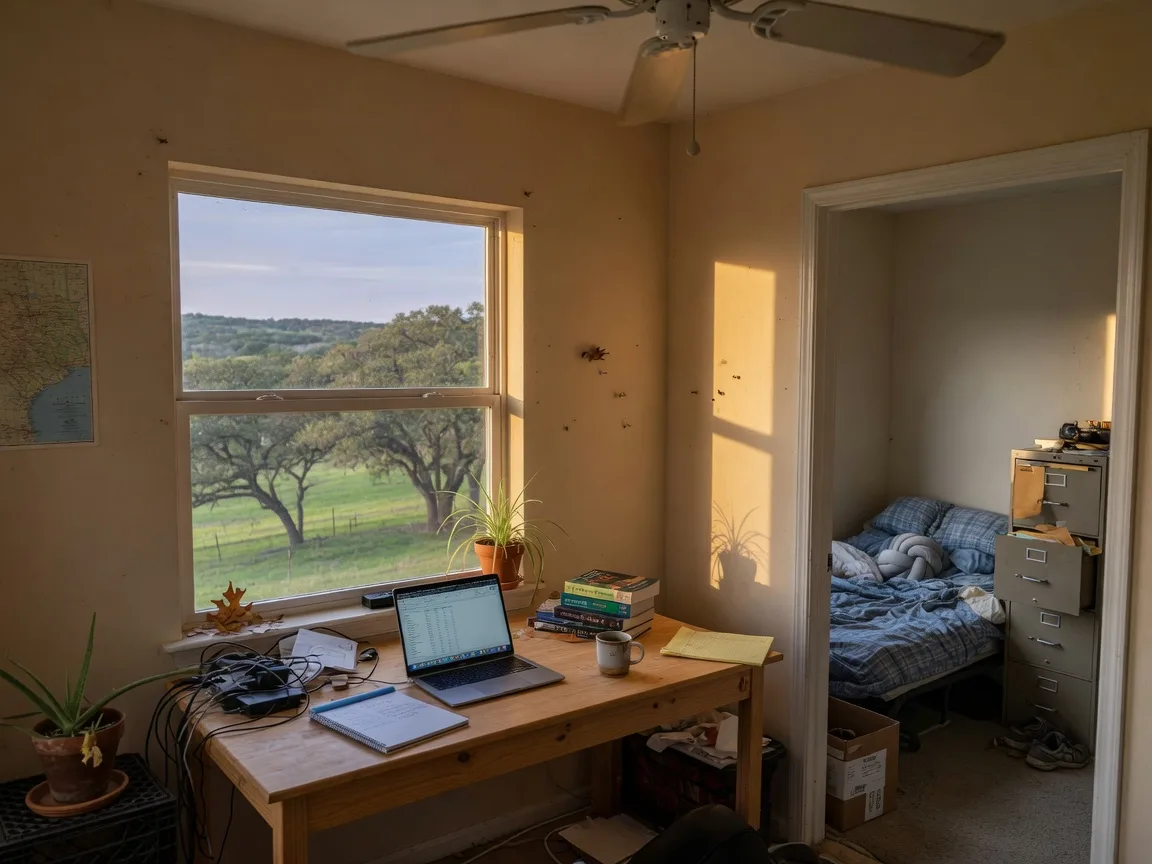
A spare bedroom with a window and a door is standard in these price bands. The upgrade over the kitchen table is the door, and the door closes at 5:00.
The minimum viable room
| What to set up | Rough cost range | What to skip |
|---|---|---|
| Desk and chair | $300 to $1,200 | Skip the standing desk until you know you need it |
| Second monitor and dock | $200 to $800 | Skip it if one laptop screen is enough |
| Camera and light | $100 to $300 | Skip the ring light; a north window is better |
| Router or mesh | $100 to $400 | Skip it if the fiber handoff already covers the room |
| UPS battery backup | $100 to $200 | Do not skip: Texas storms and grid events make this cheap insurance |
| Rug or sound panel | $50 to $200 | Skip it if the room is already quiet |
| The door | Included in the house | The whole point; close it at 5:00 |
Total: roughly $1,000 to $3,000 to outfit a real room, against the premium a second bedroom costs in a California market. These are planning ranges for common home-office gear, not quotes or endorsements.
Coworking and Third Places: When the Spouse or Partner Needs People
If the spouse or partner needs people, or you need a change of scene three days a week, both Boerne and San Antonio have real options. Boerne has at least three dedicated workspaces. Office Box on East Blanco Road runs coworking memberships, dedicated desks, and private offices [17]. Das GreenHaus on Upper Balcones Road is a nonprofit business incubator launched by the Boerne Kendall County Economic Development Corporation, with private offices and flexible workspace [18]. Regus on River Road, near the Hill Country Mile, sells day passes, coworking memberships, and private offices [36]. The Patrick Heath Public Library on North Main offers free WiFi and bookable study rooms [19], and the coffee shops on the Hill Country Mile double as the neighborhood's informal third place.
San Antonio widens the menu for the days you want a real office environment: Geekdom downtown, Common Desk at Travis Park Plaza, Pearl Cowork at the Historic Pearl, Venture X on the River Walk, and 500 Sixth near Broadway [20][21][22][23][24]. From Boerne, downtown San Antonio is 35 to 45 minutes, so the city desk is a day-trip, not a daily commute. For a partner with a California-flavored social life, that is a short drive to people, meetings, and lunch options, with the Hill Country on the way home.
The Honest Box: When You Need a CPA
Some California-source income and some employer setups call for a CPA. You likely want a cross-state CPA on the move-year return if any of these is true:
- You have unvested RSUs or stock options, because California can tax the California-sourced share of equity compensation even after you leave [15].
- You plan to sell your California home before, during, or after relocating. California real estate sales are subject to state withholding rules, but qualifying exemptions can eliminate the withholding requirement. In particular, Form 593 permits exemptions for qualifying principal-residence transactions and for property last used as the seller's principal residence, subject to the form's requirements. Moving to Texas does not automatically eliminate California tax on a taxable real-estate gain, and withholding is not the same as final tax liability. Ask the title or escrow company and a multistate tax adviser to review the transaction before closing.
- You have California rental, business, or other source income.
- Your employer keeps you on a California payroll after you move, or you will keep working in-person days in California under a hybrid schedule; those California workdays stay California-taxable [39].
A plain W-2 employee whose employer moves payroll to Texas can often handle the move with the steps in this article, no specialist required. If any of the four checks above applies, budget a few hundred to a couple of thousand dollars for a CPA who does California nonresident sourcing, and put it in the move budget like any other cost. The tax win is real, and so are the edge cases.
If You Are Coming From New York, New Jersey, Illinois, Washington, or Colorado
Most of this playbook applies to you exactly as written: the airports, the internet, the office room, the employer conversation, and the Texas residency paperwork are the same for any origin state. The tax arithmetic is the part that differs, because each of those states has its own income-tax system and the savings are not the same number as California's.
New York and New Jersey use graduated rates whose top statutory brackets reach about 10.9% and 10.75% only at much higher income levels. Illinois applies a flat 4.95% individual rate. Colorado applies a flat 4.4% rate for 2026 [34]. Washington has no tax on wages today, but it taxes certain long-term capital gains, and in March 2026 it enacted a 9.9% tax on income above $1 million that takes effect in 2028 and is already being challenged in court [37]. The Texas side is the same for everyone: no state income tax on wages [1]. If you are moving from New York City, remember that the city adds its own resident personal income tax on top of the state rate, which generally ends when you stop being a city resident. The bigger New York trap is the convenience-of-the-employer rule. If your employer assigns you to a New York office and you work remotely from Texas for your own convenience, New York generally counts those home-office days as New York workdays and keeps taxing those wages. The exception is a Texas home office that qualifies as a bona fide employer office under the state's narrow factor test [38]. Connecticut and New Jersey apply a mirror version only to residents of states that have their own convenience rule, which Texas does not. If your employer is based in New York, get a CPA's read before you count the savings.
Run your own origin-state number rather than reusing the California figures in the comparison above, and keep the same domicile discipline, especially from New York, which is as aggressive as California about who it still considers a resident. The Texas property-tax, homestead, and insurance lines in this article apply to households from any state.
Frequently Asked Questions
The questions that come up every time a remote worker runs this arithmetic for real, answered the way I would answer them across a kitchen table.
Do I really keep my California salary if I move to Texas?
If your employer agrees and your role stays the same, the salary does not have to change because you moved, but check before you assume it won't. Many larger employers set pay by location band and adjust it when an employee moves to a lower-cost market, so ask HR whether that policy applies to you and get the answer in writing. What changes is what is left of it, because Texas takes no state income-tax cut of wages [1]. The employer conversation in this article is about making the payroll change clean on the company's side, including state withholding, benefits, and the new payroll state.
Will my employer say no to the move?
When employers say no, the reasons are usually practical: the company is not set up to run payroll in Texas and does not want to be, the role has in-person duties, or pay is tied to an office location. That is why the script in this article starts the conversation early, four to six weeks out, frames the move as keeping a known performer while securing the company's explicit approval for an interstate arrangement, and brings the company's own remote policy to the table. If the answer is genuinely no, you learn it early with time to decide, which is better than learning it after you have listed your California home.
Does California tax my income after I move to Texas?
Once you are a true Texas resident and your work is performed from Texas, wages for services performed in Texas are generally no longer California-taxable, because California sources wages to the state where the services are performed [39]. The flip side matters for hybrid workers: days you physically work in California, including office weeks and on-site visits, are California-source wages and stay California-taxable after the move, so keep a log of California workdays and confirm payroll withholds for them. The hard part is ending California residency, which is why the domicile section exists: California presumes residency if you spend more than nine months of a year in the state, and it weighs your home, license, registration, voting, banking, and family connections to decide where you really live [14]. Equity compensation has its own sourcing rules and can stay partly California-taxable after the move [15]. The California exit tax guide on this site covers the full mechanics.
Is the internet good enough to work from Boerne or Fair Oaks Ranch?
Usually, but not everywhere, which is why the address test comes before the offer. Boerne and the Kendall County corridor have fiber from GVTC, AT&T Fiber, and Frontier, cable from Spectrum, and fixed wireless from Bee Creek on the rural edges; BEC Fiber serves much of Bandera County; and Starlink covers the rural tracts without wired service [6][7][8][9][35]. Run a speed test at the exact address, and keep a cell backup for the rare outage.
How much office do I actually get in these price bands?
A full room. Detached homes in the roughly $400,000 to $1.2 million band across Kendall, Bexar, Comal, and Bandera counties regularly carry a third or fourth bedroom that converts to an office [10][11][12]. The price-band breakdowns on this site show exactly what each budget buys, including the office room, in Boerne, Fair Oaks Ranch, San Antonio, and the surrounding communities.
Is the commute to SAT or AUS a problem if I fly a lot?
SAT is about 40 to 45 minutes from Boerne and flies nonstop to SFO, LAX, SAN, SEA, and EWR [2][3][4]. AUS is about 75 to 90 minutes up I-35 when you want more capacity or a cheaper fare [5]. For a quarterly or monthly all-hands, that is an ordinary morning. For a weekly flight, it is a real cost of time and should go into the budget like any commute.
Do I need a CPA for the move?
Not always, and the honest box in this article tells you exactly when you do: unvested equity, a California home sale in the same year, California rental or business income, or an employer that keeps you on a California payroll or hybrid workdays in California [15][39]. A plain W-2 employee with a clean payroll change can often handle the move with the steps in this article. If any of the four checks applies, budget for a cross-state CPA who does California nonresident sourcing.
I am coming from New York, New Jersey, Illinois, Washington, or Colorado. Does this apply to me?
Most of the practical playbook does: the airports, the internet, the office room, the employer conversation, and the Texas residency paperwork are the same for any origin state. The tax arithmetic differs, because each of those states has its own income-tax system and the savings are not the same number as California's. New York and New Jersey use graduated rates whose top statutory brackets reach about 10.9% and 10.75% only at higher income levels; Illinois uses a 4.95% flat rate; Colorado uses a flat 4.4% rate [34]; Washington has no tax on wages today but enacted a 9.9% tax on income above $1 million that starts in 2028 [37]. If your employer is based in New York, its convenience-of-the-employer rule can keep your remote wages New York-taxable after you move [38]. Run your own origin-state number rather than reusing the California figures, and keep the same domicile discipline, especially from New York, which is as aggressive as California about who it still considers a resident.
Keep reading: the rest of the spreadsheet
This playbook covers the remote-work side of the decision. The cost, tax, school, and community pages hold the other columns, so you can see the whole picture before you decide anything.
California vs Texas cost of living
Housing, taxes, insurance, utilities, fuel, and groceries, side by side, with the honest categories where Texas costs more.
Open the comparisonProp 13 vs Texas property tax
How California's assessment caps compare with the Texas homestead exemption, the 10% appraisal cap, and the protest process.
Open the tax guideSchools and education guide
Boerne ISD, Comal ISD, and Northside ISD ratings and what they mean at your exact address, for the family you are planning.
Open the schools guideHill Country communities
The neighborhood-by-neighborhood breakdown, from Boerne to Fair Oaks Ranch to San Antonio proper.
Explore the communitiesFor the residency and sourcing mechanics in more depth, the California exit tax guide and the remote-work tax pathway cover the part-year return, the domicile checklist, and California-source income.
Save This Page
This is the page you reopen when the employer conversation is next week or the appraisal district form is sitting in your inbox. Bookmark it, print the one-page version, and put the annual dates on your calendar once.
The one-page version
- Salary retention depends on your employer's written approval: a detached home with a real office room in the $400,000 to $1.2 million band [10][11][12].
- Central Time works both coasts; SAT flies nonstop to SFO, LAX, SAN, SEA, and EWR [2][3][4].
- Run an address-specific broadband check: fiber from GVTC, AT&T, and Frontier, Spectrum cable, BEC Fiber in Bandera County, Starlink on rural tracts [6][7][8][9][35].
- Obtain written employer authorization for the Texas work location before listing the California home; ask HR about the payroll state 4 to 6 weeks out.
- Domicile: license within 90 days, registration within 30 days, voter and bank to Texas, calendar kept [14][16].
- File the homestead exemption (Form 50-114): $140,000 off the school-district value, and the appraised-value increase limitation starts the following tax year; it is not a cap on the tax bill. File right after closing if the seller had no exemption that year, otherwise by April 30 of the following year [13].
- Outfit the room for roughly $1,000 to $3,000; the door is the upgrade.
- Move-year California return (Form 540NR) if you have California-source income in the move year [14][15].
- CPA if you have unvested equity, a California home sale, California income, or a California payroll or hybrid workdays in California [15][39].
Educational summary; figures are approximate, sourced, and last verified October 16, 2026. Verify with the sources listed below before relying on them.
The annual calendar
Put these dates on the calendar once, and the move stays clean. Reuse the two checklists every time the question comes up.
Move year
- Before listing the California home: written employer authorization for the Texas work location.
- 4 to 6 weeks before the move: employer conversation and payroll state change.
- Within 30 days: vehicle registration [16].
- Within 90 days: driver license [16].
- Through the move year: keep the calendar of where you are [14].
- Move year: file the California part-year return (Form 540NR) if California-source income applies [14][15].
- Right after closing: file the homestead exemption (Form 50-114); the deadline is one year from closing for a partial-year claim, or April 30 of the following year otherwise [13].
Every year after
- January: confirm the homestead exemption is still on the property [13].
- Summer: re-quote the homeowners insurance at renewal [26].
- Fall: run a speed test on the office connection; confirm fiber or Starlink still meets the job's needs.
Employer steps
- Written employer authorization for the Texas work location, before listing the California home.
- Payroll state change confirmed with HR.
- Equipment and shipping address updated.
- First in-person trip booked [2][3][4].
Domicile steps
- Driver license within 90 days [16].
- Vehicle registration within 30 days [16].
- Voter registration and banking addresses to Texas.
- Homestead exemption filed [13].
- Part-year return with a qualified preparer if needed [14][15].
What to Do Next
If this article reads like your situation, the next step is not to call me. It is to run the checklist on the Build My Move Plan page, which walks the decision in order: the budget, the town, the timeline, and the first 90 days. The cost comparison and the property tax guide hold the rest of the spreadsheet, and the schools guide covers the district question most families ask next.
When you have run the numbers and want a second set of eyes, that is the moment for a conversation. I have watched dozens of remote workers make this exact call, and the difficult parts are almost always the logistics and the paperwork, not hidden line items, which is why I put them on the page before a buyer commits. Bill Ross at Hill Country Homesteads Group, brokered by Keller Williams Boerne, coordinates California-to-Texas moves through a direct network of more than 1,100 California real-estate agents. Reach me through the contact page, by email at Bill@HillCountryHomesteads.com, or by phone at (210) 294-9190 during business hours, 8 AM to 6 PM Central, Monday through Friday. The brokerage is at 116 Herff Rd, Suite 203, Boerne, TX 78006. A no-pressure conversation about your specific situation is the only thing on offer, and it costs you nothing but an hour.
The same framework lives across the other two sites: the Hill Country Homesteads homepage carries the Boerne and Kendall County market work, and texasprobatehomes.net covers the estate and probate side of a cross-state move.
Sources
Numbered sources. Items 27 through 33 are related guides on this site for further reading; all others are cited in the body above. Primary authorities come first wherever one exists; secondary sources are labeled as such. Each citation supports the figure it is attached to; the flight, internet, and market figures are the published readings referenced here.
- Taxes FAQ: Does Texas have a state income tax?: Texas Comptroller of Public Accounts. comptroller.texas.gov/faq/
- Nonstop Destinations from San Antonio International Airport: City of San Antonio, flysanantonio.com. flysanantonio.com/home/flights/nonstop-destinations/
- Direct Flights from San Antonio (SAT): nonstop routes to SFO, LAX, SAN, SEA, and EWR with scheduled block times, updated October 2026: hopnonstop (secondary). hopnonstop.com/direct-flights-from-san-antonio/
- Flights from San Antonio (SAT): carrier and schedule data for SAT-SFO, SAT-LAX, SAT-SAN, SAT-SEA, and SAT-EWR, October 2026: FlightConnections (secondary). www.flightconnections.com/flights-from-san-antonio-sat
- AUS December 2025 Passenger Traffic and Year-End Numbers: about 21.7 million passengers in 2025: City of Austin, flyaustin.com. www.flyaustin.com/news/aus-december-2025-passenger-traffic-and-year-end-numbers
- Utility and Fiber Options for Boerne and Kendall County: Boerne Kendall County Economic Development Corporation. bkcedc.com/energy-options/
- Top Internet Providers in Boerne, TX: fiber availability by provider, 2026: HighSpeedInternet.com (secondary). www.highspeedinternet.com/tx/boerne
- Bee Creek Communications coverage: Fredericksburg-based fixed-wireless internet serving Kendall, Kerr, and Gillespie counties, part of VTX1 Companies since 2022: Bee Creek Communications. beecreek.net/
- Starlink Internet in Texas (2026): satellite service as the default option where wired broadband is absent, including Hill Country installers: InternetProviders.ai (secondary). www.internetproviders.ai/providers/starlink/tx/
- Boerne, TX Housing Market: median closed sale price about $505,000 and median price per square foot of closed sales about $215, rolling three months ending August 2026: Redfin (secondary). www.redfin.com/city/2371/TX/Boerne/housing-market
- Kendall County, TX Housing Market: median sale price about $618,000 and median price per square foot about $233, three months ending August 2026: Redfin (secondary). www.redfin.com/county/2769/TX/Kendall-County/housing-market
- San Antonio, TX Housing Market: median closed sale price of about $257,000 and median price per square foot of about $161 for the city of San Antonio, three months ending September 2026: Redfin (secondary). www.redfin.com/city/16657/TX/San-Antonio/housing-market
- Property Tax Exemptions: the $140,000 residence homestead exemption on the school-district taxable value (raised from $100,000 by Proposition 13, November 2025), Form 50-114, and purchase-year filing under Tax Code 11.42(f) and the filing process through the county appraisal district (Tax Code 11.13): Texas Comptroller of Public Accounts. comptroller.texas.gov/taxes/property-tax/exemptions/
- FTB Publication 1031, Guidelines for Determining Resident Status: California's facts-and-circumstances residency analysis, the more-than-nine-months presumption, and the nonexclusive factors used to weigh a taxpayer's connections: California Franchise Tax Board. www.ftb.ca.gov/forms/2025/2025-1031-publication.pdf
- FTB Publication 1004, Equity-Based Compensation Guidelines: California sourcing of stock options, restricted stock and RSUs when residency changes: California Franchise Tax Board. www.ftb.ca.gov/forms/misc/1004.html
- New to Texas: vehicle registration and driver license timelines for new residents (register within 30 days, driver license within 90 days): Texas Department of Motor Vehicles. www.txdmv.gov/motorists/new-to-texas
- Office Box Boerne: coworking memberships, dedicated desks, and private offices in Boerne: Office Box Boerne. officeboxboerne.com/
- Das GreenHaus Business Incubator: nonprofit business incubator with private offices and flexible workspace at 7 Upper Balcones Road, launched by the Boerne Kendall County Economic Development Corporation: Das GreenHaus. www.dasgreenhaus.org/
- Patrick Heath Public Library: bookable study rooms, conference room, and free WiFi in Boerne: City of Boerne. www.ci.boerne.tx.us/1082/Facilities-Reservations
- Geekdom: downtown San Antonio coworking and startup community hub: Geekdom. geekdom.com/
- Common Desk at Travis Park Plaza: San Antonio coworking memberships: Common Desk. thecommondesk.com/locations/travisparkplaza-coworking
- Pearl Cowork: coworking at the Historic Pearl in San Antonio: Pearl Cowork. atpearl.com/cowork/
- Venture X San Antonio River Walk: premium coworking and private offices: Venture X. venturex.com/locations/usa/tx/san-antonio-riverwalk/
- 500 Sixth Coworking: private office suites and day passes in San Antonio: 500 Sixth. www.500sixth.com/
- Electric Power Monthly, Table 5.6.A: July 2026 average residential electricity prices, California about 33.6 cents per kWh versus Texas about 15.9 cents per kWh: U.S. Energy Information Administration. www.eia.gov/electricity/monthly/epm_table_grapher.php?t=epmt_5_6_a
- Texas homeowners insurance market overview: statewide average premium context; the rate for your address is a quote, not an average: Texas Department of Insurance. www.tdi.texas.gov/general/texas-homeowners-insurance-market-overview.html
- California vs Texas cost of living: this site's real-cost-comparison pillar page: MoveToTexas.net (secondary). movetotexas.net/real-cost-comparison/
- Prop 13 vs Texas property tax: this site's property tax guide: MoveToTexas.net (secondary). movetotexas.net/prop-13-vs-texas-tax/
- Texas schools: this site's schools and education guide: MoveToTexas.net (secondary). movetotexas.net/schools-education/
- Hill Country communities: this site's community index: MoveToTexas.net (secondary). movetotexas.net/communities/
- California Exit Tax and Residency: this site's exit tax guide: MoveToTexas.net (secondary). movetotexas.net/california-exit-tax/
- Remote Work and California Tax: this site's residency and sourcing pathway: MoveToTexas.net (secondary). movetotexas.net/start-here/remote-work-california-tax/
- Build My Move Plan: this site's start-here planning module: MoveToTexas.net (secondary). movetotexas.net/start-here/california-texas-moving-plan/
- State Individual Income Tax Rates and Brackets, 2026: New York, New Jersey, Illinois, Washington, and Colorado rate structure used in the origin-state note: Tax Foundation (secondary). taxfoundation.org/data/all/state/state-income-tax-rates-2026/
- BEC Fiber: fiber internet from Bandera Electric Cooperative across much of its Bandera County service area: Bandera Electric Cooperative. www.bec.org/internet/
- Regus Boerne – River Road: day passes, coworking memberships, and private offices at 1018 River Road, Boerne: Regus. www.regus.com/en/us/11644
- SB 6346 (2026), Establishing a tax on millionaires: 9.9% tax on Washington income above $1 million, effective January 1, 2028: Washington State Legislature. app.leg.wa.gov/billsummary?BillNumber=6346&Year=2025
- TSB-M-06(5)I, New York Tax Treatment of Nonresidents and Part-Year Residents: Application of the Convenience of the Employer Test to Telecommuters and Others: New York State Department of Taxation and Finance. www.tax.ny.gov/pdf/memos/income/m06_5i.pdf
- FTB Publication 1100, Taxation of Nonresidents and Individuals Who Change Residency: sourcing of wages and part-year return mechanics: California Franchise Tax Board. www.ftb.ca.gov/forms/misc/1100.html
- Texas Constitution, Article VIII, Section 24-a: prohibition on a state personal income tax (2019 amendment): Texas Legislature. statutes.capitol.texas.gov/Docs/CN/htm/CN.8.htm
Last verified October 16, 2026. The flight schedules, carrier routes, internet coverage, electricity averages, and market figures cited above are the published readings referenced here and will be updated as new data appears. Confirm anything time-sensitive with the airline, the internet provider for your exact address, the Texas Comptroller, the California Franchise Tax Board, the Texas DMV, the county appraisal district, and a qualified tax professional before relying on it. This is general educational information about moving, taxes, and real estate, not legal, tax, or financial advice for your specific situation. Bill Ross is available at (210) 294-9190 during business hours, 8 AM to 6 PM Central, Monday through Friday.