
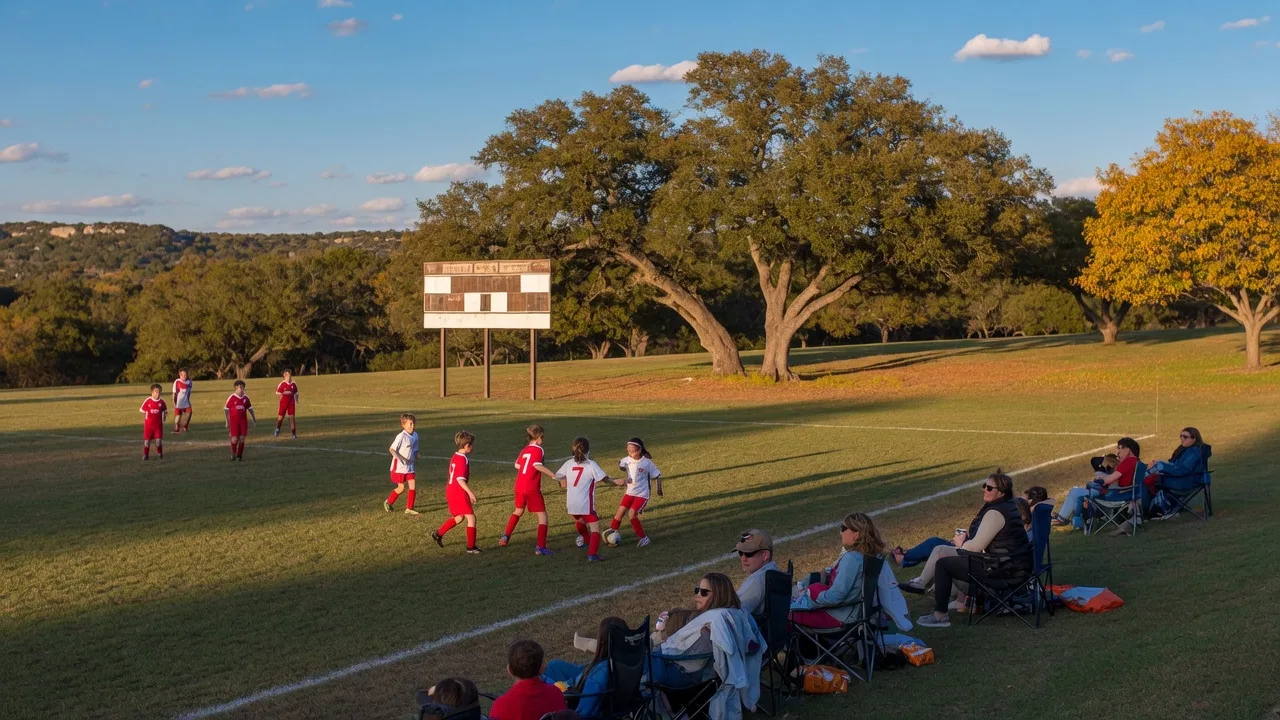
For a California family with children involved in sports, music, dance, or any extracurricular activity, the move to Texas raises a practical question: what changes? The answer is both reassuring and important to understand beforehand. Texas has one of the most comprehensive and competitive youth extracurricular systems in the country, but it operates under different rules, different governing bodies, and a different cost structure than what California families are used to.
This guide covers the real differences between California and Texas youth extracurriculars, with specific data on costs, eligibility rules, school programs, and what families moving to the Hill Country can expect. Bill Ross and the Hill Country Homesteads Group work with relocating families every week, and this is one of the topics parents ask about most often.
UIL vs CIF: Two Different Systems
The single biggest structural difference between California and Texas school sports is the governing body. California uses the California Interscholastic Federation (CIF), which divides the state into 10 sections, each with its own championships. Texas uses the University Interscholastic League (UIL), which crowns a single state champion per enrollment classification. These are not minor administrative differences; they shape how competition works, how college recruitment happens, and how the season calendar is structured. [1]
How UIL Works
The UIL governs athletic, academic, and music competitions for Texas public schools. It is administered through the University of Texas at Austin and has been in operation since 1910. Schools are classified into six conferences based on enrollment, from 1A (smallest) to 6A (largest, with 2,215 or more students). Each conference has 32 districts grouped into four regions, and the playoff structure produces a single state champion per conference per sport. [2]
Boerne High School and Samuel V. Champion High School, both in Boerne ISD, compete in UIL Class 5A. Northside ISD high schools in San Antonio, such as Brennan, Brandeis, and Clark, compete in UIL Class 6A. The classification determines the level of competition your child will face and, for some sports, the number of playoff rounds required to reach a state title.
How CIF Works
The CIF covers both public and private schools in California and is divided into 10 sections (San Diego, Southern, Los Angeles City, Central, Central Coast, Sac-Joaquin, North Coast, Oakland, San Francisco, and Northern). Each section runs its own championships, meaning California does not have a single state champion in most sports. A team from the CIF Southern Section and a team from the CIF Sac-Joaquin Section may both claim a section title, but they never play each other to determine an overall state champion. [3]
Private schools in California compete within the same CIF sections as public schools. In Texas, private schools are governed separately by the Texas Association of Private and Parochial Schools (TAPPS), which runs its own league structure and championships.
What This Means for Your Child
The UIL's single-state-champion structure means that the path to a state title is clearly defined and consistent statewide. It also means that the competition level in Texas is compressed into fewer classifications per sport, which can make the playoff bracket more competitive. A family moving from California where their child competed in a CIF section championship will find that a Texas UIL district championship carries similarly high stakes, but the road to the state tournament involves fewer but more selective rounds.
No Pass No Play: The Texas Rule That Changes Everything
Texas law requires public school students to pass every enrolled course with a grade of 70 or above to participate in any extracurricular activity. This rule, established by House Bill 72 in 1984, applies to all grade levels from kindergarten through 12th grade and covers every UIL activity — athletics, fine arts performances, academic competitions, and clubs. [4]
Here is how it actually works. Students are automatically eligible for the first six weeks of the school year. After that, eligibility is checked at the end of each grading period. If a student receives a grade below 70 in any single course, they become ineligible for a three-week period. During those three weeks, they may attend practice or rehearsal, but they cannot compete in games, performances, or contests. [5]
Advanced Placement, International Baccalaureate, and dual-enrollment courses have a lower passing threshold of 60, but the three-week suspension still applies if the student falls below that mark. The rationale is that these courses carry more rigorous content, and the state recognizes that a 60 in AP Biology represents a higher level of mastery than a 70 in a standard course.
California's CIF eligibility standard is fundamentally different. Students must maintain a cumulative 2.0 grade point average across all enrolled courses, and they must have passed at least 20 semester units in the previous grading period. A California student who fails one class can remain eligible if their overall GPA stays at or above 2.0. In Texas, that same student loses eligibility immediately. [6]
What This Means for the Move
California families moving to Texas need to understand that the academic bar for extracurricular participation is higher and less forgiving. A child who was eligible in California with a 2.0 GPA and one failing grade would be ineligible in Texas. This is not a reason to avoid the move, but it is a reason to check your child's current grades and have a conversation before the school year starts. The first six-week grace period provides a buffer, but it expires quickly.
Cost Comparison: Texas Youth Sports vs California
Youth sports are less expensive in Texas than in California, and the gap is substantial. The primary drivers are lower club fees, shorter tournament travel distances, and lower costs for facilities and private training. [7]
| Activity | California Bay Area | Texas Hill Country | Difference |
|---|---|---|---|
| Club Soccer (select) | $4,500 - $10,000 / yr | $2,000 - $4,000 / yr | 50-60% less |
| Travel Baseball | $4,000 - $8,000 / yr | $1,600 - $3,500 / yr | 50-60% less |
| AAU Basketball | $3,000 - $8,000 / yr | $2,000 - $5,000 / yr | 30-40% less |
| Competitive Cheer | $3,000 - $8,000 / yr | $2,000 - $5,000 / yr | 30-40% less |
| Private Lessons (per hour) | $75 - $150 / hr | $50 - $100 / hr | 30-35% less |
The San Francisco Bay Area was ranked the most expensive city in America for club soccer in a 2026 analysis, with elite program fees reaching $10,000 or more per year. [8] A comparable select-level program at River City Rangers in San Antonio costs roughly $2,925 per year. [9] The national average for youth sports spending per child is approximately $1,016 per year according to the Aspen Institute, but competitive club sports in major metro areas can exceed this by five to fifteen times. [10]
Tournament travel is another significant factor. A Bay Area club soccer team may travel to Southern California or out of state for top-tier tournaments. A Hill Country club team can reach tournaments in Austin, San Antonio, Dallas, and Houston within a three-to-four-hour drive, which reduces hotel and travel costs considerably.
What Boerne ISD and Northside ISD Offer
Boerne Independent School District operates two UIL Class 5A high schools, Boerne High School and Samuel V. Champion High School, plus Boerne Middle School North, Boerne Middle School South, and six elementary schools. The district fields varsity teams in football, basketball, cross country, track and field, soccer, softball, baseball, golf, tennis, volleyball, swimming and diving, and cheer. [11]
Fine arts programs in Boerne ISD are comprehensive and begin in kindergarten. Elementary students receive general music and art instruction. Starting in sixth grade, students can join band, choir, or orchestra. By high school, the fine arts offerings include marching band, concert band, jazz band, colorguard, show choir, theatre productions, and dance/drill team. Boerne ISD's marching bands and theatre programs have earned state-level recognition in UIL competitions. [12]
Northside Independent School District, serving the San Antonio side of the Hill Country, operates 15 high school campuses, most competing in UIL Class 6A. NISD fields the full range of UIL sports and has one of the largest athletic programs in Texas. Each high school has its own booster club, band program, choir, theatre program, and student organizations. The district offers academic UIL, Academic Decathlon, and specialized clubs at each campus. [13]
Extracurricular Options Beyond Sports
Texas schools offer a wide range of non-athletic extracurriculars that are part of the UIL system or school-sponsored programs:
- Academic UIL: Competitions in debate, journalism, mathematics, science, spelling, literary criticism, and social studies — with district, regional, and state championships.
- Future Farmers of America (FFA): Major program in the Hill Country, with livestock shows, agricultural mechanics, and leadership competitions at the Kendall County Show and San Antonio Stock Show.
- National Honor Society, Student Council, and class-specific honor societies: Available at every Boerne ISD and NISD campus.
- Esports: Both Boerne High School and Boerne Middle School North have competitive esports teams.
- Boerne Outdoor Academy (BOA): A Boerne High School club focused on outdoor recreation, environmental stewardship, and Hill Country conservation.
Club Sports: The Texas Landscape
Club sports in Texas operate independently from UIL school programs, just as they do in California. Families with children competing at an elite level will find well-established clubs in the San Antonio area that compete regionally and nationally.
Soccer: The Texas Club Soccer League (TCSL) and the Elite Clubs National League (ECNL) both have Texas divisions. River City Rangers, Lonestar SC, and San Antonio FC's youth academy are the primary competitive clubs serving the Hill Country. For a family moving from the Bay Area where their child played for De Anza Force or San Jose Earthquakes Academy, the transition to a Texas ECNL club is straightforward and the cost is significantly lower. [14]
Baseball and Softball: Texas has one of the strongest youth baseball cultures in the country. USSSA baseball, Perfect Game tournaments, and Pony League are all active in the San Antonio area. Hill Country players have access to tournament-caliber facilities within a 30-minute drive, and the competition level is comparable to what California families would find in the Bay Area or Southern California.
Basketball: AAU basketball is well established in San Antonio, with programs like SA Runners, Texas Titans, and SA Celtics competing in national AAU circuits. Texas basketball is increasingly competitive at the high school level, with UIL Class 6A and 5A programs producing Division I recruits each year.
Equestrian: This is one area where the Hill Country offers opportunities that California families may not have had. With the rural landscape, numerous equestrian facilities in Boerne, Fair Oaks Ranch, and Bandera, and programs like the Texas High School Equestrian Association, families with children interested in riding will find an active community.
College Recruitment: A Different Pathway
The UIL's single-state-champion structure creates a clear resume line for college recruitment. A Texas high school athlete who competes at the UIL state tournament has a known, standardized credential that college coaches across the country recognize. California's section-based system means that a section championship in the CIF Southern Section is viewed differently than one in the CIF Oakland Section, and the lack of a single state champion means recruitment can be more fragmented.
Texas universities recruit Texas high school athletes heavily. The University of Texas, Texas A&M, Texas Tech, Baylor, TCU, and Texas State all maintain strong recruiting pipelines into UIL programs. For a California family whose child hopes to play a sport in college, the move to Texas does not hurt their chances. If anything, the visibility of the UIL playoff system and the density of Texas college programs may improve them. [15]
The Seasonal Calendar: What Changes
California families are used to year-round outdoor sports calendars. The weather in most of coastal California allows for outdoor practices and games in every season. Texas has a different rhythm. Summer heat from June through August means that outdoor practices are often scheduled early in the morning or late in the evening. School sports seasons are more sharply defined by the UIL calendar, with football in the fall, basketball in the winter, and baseball and soccer in the spring.
Marching band season in Texas is a major time commitment. Color guard and drum line rehearsals begin in the summer, and the competition season runs from September through November, culminating in UIL marching contests and the state marching championship. For a California family used to a less structured marching band calendar, the Texas band commitment can come as a surprise.
The upside is that indoor sports, club practices held in air-conditioned facilities, and Hill Country outdoor activities during the mild fall and spring months make the calendar workable. The key is knowing the schedule in advance and planning around it.
Practical Advice for the Relocating Family
If you have children in competitive sports or fine arts programs and you are planning a move to the Texas Hill Country, here is what I recommend based on working with dozens of relocating families:
- Contact the coach or club director before you move. Most coaches in Boerne ISD and Northside ISD are accustomed to working with relocating families. They can tell you what tryout dates look like, what the off-season training schedule is, and what the team culture is like.
- Check the UIL classification of your child's new school. Boerne High School and Champion High School are Class 5A. Northside ISD schools are Class 6A. The classification determines travel distances, playoff competition, and the overall level of play.
- Understand the No Pass No Play timeline. The first six-week grace period means your child will be automatically eligible at the start of the school year. Mark the end of those six weeks on your calendar and stay on top of progress reports.
- Research club tryout windows. Club sports in Texas hold tryouts in the spring and summer for the following seasonal year. If you are moving in the middle of a club season, ask about rolling enrollment or guest player opportunities.
- Budget for lower costs. Your youth sports spending will likely drop by 30 to 50 percent after the move. That is real money that can go toward other priorities in your new home.
Frequently Asked Questions
Will my child be able to continue their sport at the same competitive level after moving from California to Texas?
In most cases, yes — but the pathway looks different. Texas uses the UIL system for public schools, which crowns a single state champion per enrollment classification. California's CIF system has multiple section champions. The level of competition in Texas is generally as high or higher, particularly in football, soccer, track, volleyball, and basketball. Club sports in Texas are well organized, and the Hill Country has strong club programs within a reasonable drive. Your child may need to try out for teams rather than being automatically placed, and the academic eligibility rules are stricter in Texas — one failing grade means a three-week suspension from all extracurriculars, not just a GPA dip.
How much more or less will youth sports cost in Texas compared to California?
Youth sports in the Texas Hill Country typically cost 30 to 50 percent less than equivalent competitive programs in the California Bay Area or coastal Los Angeles. Club soccer in the Bay Area can run $4,500 to $10,000 per year; comparable programs in San Antonio and the Hill Country run $2,000 to $4,000. Travel baseball follows a similar pattern. Private lessons in Texas run $50 to $100 per hour versus $75 to $150 in California. Tournament travel distances are shorter — most Texas tournaments are within a three-hour drive of Boerne, while Bay Area club teams often travel to Southern California or out of state for the same level of competition.
What is the No Pass No Play rule and how is it different from California eligibility?
Texas law requires students to pass every enrolled course with a grade of 70 or above to participate in any extracurricular activity — athletics, fine arts, academic UIL competitions, or clubs. Failing a single class triggers a three-week suspension from all extracurricular participation. California's CIF uses a cumulative 2.0 GPA standard, meaning a student could fail one class and remain eligible if their overall GPA stays at 2.0. The Texas rule applies to every public school student in grades K through 12, and it covers every school-sponsored extracurricular activity. Advanced Placement and honors courses have a lower passing threshold of 60, but the three-week suspension still applies if a student falls below that.
What youth sports are most popular in the Texas Hill Country?
Football is the centerpiece of Texas school sports culture, and the Hill Country is no exception. Boerne High School and Champion High School, both UIL Class 5A, field competitive football programs with strong community support. Soccer is the largest participation sport in Texas with approximately 247,000 youth players statewide, and club soccer is well established in San Antonio and the Hill Country. Volleyball, basketball, baseball, softball, track and field, cross country, golf, tennis, and swimming all have robust school and club programs. Equestrian sports are popular in the Hill Country given the rural landscape, and competitive cheer and dance are deeply embedded in Texas school culture.
How do fine arts extracurriculars compare between California and Texas schools?
Texas public schools invest heavily in fine arts programs, and UIL governs academic and music competitions alongside athletics. Marching band in Texas is a major extracurricular commitment with fall competitions, UIL marching contests, and Friday night football performances. Choir and theatre programs in Boerne ISD and Northside ISD have earned state-level recognition. Orchestra is offered from sixth grade through high school. California has strong fine arts programs in many districts, but the UIL structure gives Texas programs a consistent competitive framework with statewide recognition. Boerne ISD's fine arts program spans kindergarten through 12th grade, with dedicated facilities and staff at every campus.
Sources
- National Federation of State High School Associations (2025). High School Sports Participation Hits Record High in 2024-25
- University Interscholastic League (2026). UIL-TEA Side-by-Side Academic Requirements (No Pass No Play)
- Wikiwand. No Pass No Play Overview
- California Interscholastic Federation (2026). CIF Student Eligibility Brochure
- University Interscholastic League (2026). About the UIL
- Wikipedia. California Interscholastic Federation Overview
- Touchwall (2026). Texas UIL State Championships Guide
- Anytime Soccer (2026). The Most and Least Expensive Cities for Youth Club Soccer in America (2026)
- River City Rangers (2026). River City Rangers Soccer Club Select Fees
- The Tourneylist (2026). What Youth Sports Really Cost for One Child Over a Full Year
- Flicktec (2026). Youth Soccer Costs (2026): What Parents Really Pay by Level
- Aspen Institute Project Play (2022). Costs to Play Trends — State of Play 2022
- Boerne Independent School District (2026). Boerne ISD Athletics
- Boerne Independent School District (2026). Boerne ISD Fine Arts Programs
- Northside Independent School District (2026). Northside ISD Athletics
- Know the Pitch (2026). How Much Does Travel Baseball Cost? Complete Parent Budget Guide
- Boerne Independent School District (2026). Boerne High School Clubs
- Boerne Independent School District (2026). Boerne ISD Student Clubs Overview
- University Interscholastic League (2026). UIL Eligibility Talking Points

Bill Ross
Real Estate Agent · Hill Country Homesteads Group · Keller Williams Boerne
Bill Ross brings nearly four decades of strategic experience to his real estate practice, specializing in California-to-Texas relocations. He is recognized in USA Today and The Washington Post for his relocation expertise and maintains a network of over 1,100 California real estate agents to coordinate seamless cross-state moves.