
This article is for the person who looks around their life and quietly wonders whether the city they invested in still makes sense. Maybe you rent in a place where buying a first home feels years away. Maybe you own a modest condo or a small house and have simply outgrown it, with a growing family, a new remote-work setup, or a long list of evenings you would give back for more space and less commute.
If that describes you, you are not failing, and you are not alone. The housing market in much of California, and in parts of New York and Illinois too, has become a system where a normal middle-class life can feel out of reach for reasons that have nothing to do with your effort or ambition.
Relocating to the Texas Hill Country and the San Antonio area is a legitimate, strategic choice, not an escape and not an admission of defeat. This article walks through thirteen honest reasons why the numbers and the life you want may point in the same direction, and it closes with what the change can actually give you.
Watch: Bill Ross on whether your housing market still fits the life you want
A quick look at what staying is costing you, and when a move to the Texas Hill Country may be worth a closer look.
The question worth asking
At some point, the question stops being whether you can afford to remain where you live and becomes whether the sacrifices required to stay are still worth making.
That is a difficult distinction, especially if you have spent years building a career, friendships, and a life in one place.
But there is a difference between staying somewhere because it continues to serve you and staying because you have never seriously considered another possibility.
You do not have to decide to leave. You do owe yourself an honest look at what staying is costing you, what moving might make possible, and which choice offers the better future.
1. You can earn a good living and still be priced out of a normal middle-class life
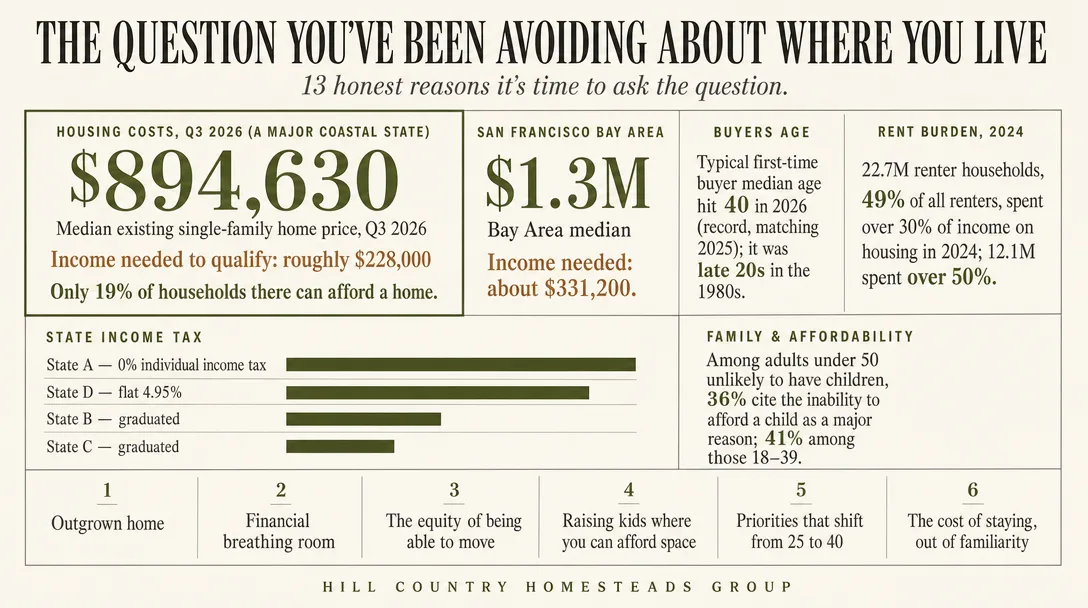
California's median existing single-family home price was $894,630 in the third quarter of 2026 [1]. Under the California Association of REALTORS assumptions, qualifying to buy it required roughly $228,000 in annual household income, and only 19 percent of California households could afford it [1]. In the San Francisco Bay Area, the median was $1.3 million, requiring about $331,200 in household income [1].
According to the California Association of REALTORS, that median-priced home carried an estimated monthly payment of approximately $5,700 in the third quarter of 2026, including principal, interest, property taxes, and insurance. The calculation used an effective 30-year fixed mortgage rate of 6.80 percent. Put another way, the problem is not simply the purchase price. It is the amount of household income required every month to support it [1].
Read those numbers again in plain language. A household earning well above the state's median income, with two solid professional salaries, can still be locked out of the typical single-family home. That is not a sign that you are doing something wrong. It is the structure of the market.
2. Waiting for your market to become affordable can mean putting your life on hold indefinitely
According to the National Association of REALTORS' 2026 Profile of Home Buyers and Sellers, the median age of first-time homebuyers nationally remained at a record-high 40, compared with the late 20s during the 1980s. First-time buyers accounted for only 22 percent of buyers in the latest survey [2]. A record share of older, all-cash first-time buyers pulls that number up; those who financed their purchase had a median age of 38, still roughly a decade later than the 1980s norm [2].
Think about what that number means. A full cohort now enters homeownership a decade or more later than the generation before it, not because it wants to wait, but because the math forced the wait. Buying a first home became a midlife milestone instead of a young-adult one. You can choose to hold that timeline, but you should choose it on purpose, not drift into it assuming the market will one day fix itself.
3. Renting indefinitely can prevent you from building the financial foundation you want
In its 2026 housing research, Harvard University's Joint Center for Housing Studies reported that 22.7 million U.S. renter households, approximately 49 percent of all renter households, spent more than 30 percent of their income on rent and utilities in 2024 [3]. Of those, 12.1 million spent more than half their income on housing [3].
When rent swallows that large a share of your pay, savings slow to a crawl, an emergency fund stays thin, and the down payment you need to ever leave the rental market keeps receding. The cause is not a lack of discipline. It is that the housing line in expensive markets leaves too little for everything else.
4. The home you can afford may have little resemblance to the life you want
Some households do own a home and still feel the squeeze. A modest condo, a two-bedroom townhouse, or a small single-family home can be a real asset and still be the wrong size for the life you are living now.
A growing family needs another bedroom. A remote worker needs a dedicated office with a door. Someone who entertains wants a larger kitchen, outdoor space, or a usable backyard. In expensive markets, the price of those upgrades is steep enough that households quietly make do with less than they want, and call it normal.

5. A lower cost of living can give you something more valuable than a bigger house: financial breathing room
When housing costs fall, savings have room to grow again. The released money can support retirement contributions, college savings, debt reduction, travel, family activities, or an emergency fund. That is the real opportunity in a lower-cost market: not the largest possible house, but an appropriately sized home plus disposable income you actually keep.
Breadth of options matters more than a single number. A household that goes from stretched to comfortable has more choices about jobs, time, and family than one that trades space for tightness everywhere else.
What the price difference can actually mean
A meaningful comparison requires looking at actual markets rather than simply comparing state averages.
In California, a household evaluating the state's median-priced single-family home in the third quarter of 2026 faced a purchase price of $894,630 and an estimated monthly payment of $5,700 under California Association of REALTORS assumptions [1].
By comparison, recent San Antonio-area market reports have placed the area's median home price substantially below the California figure. The San Antonio Board of REALTORS reported a median home price of about $303,000 for the San Antonio-New Braunfels metro area in September 2026 [6]. That figure describes the metro area as a whole, so it should not be read as the median for Boerne, Fair Oaks Ranch, or other Hill Country communities, which sell at their own prices. That price difference can change what a household can afford, how much down payment it needs, and how much income remains available after paying for housing.
However, San Antonio, Boerne, Fair Oaks Ranch, and other Hill Country communities are not interchangeable housing markets. Some offer relatively affordable entry-level homes, while others command substantial premiums for location, schools, lot size, or amenities.
The meaningful comparison is not between an expensive California house and the least expensive house available in Texas. It is between two homes that would realistically meet the same household's needs, using current local prices, comparable financing assumptions, and the full monthly cost of ownership.
Under identical financing assumptions, the difference shows up directly in the monthly budget. At a 6.80 percent 30-year fixed rate with 20 percent down, principal and interest on a home at the $894,630 California median come to roughly $4,670 a month, before California property taxes and insurance; the $5,700 California Association of REALTORS figure adds those on top. Using the same rate, term, and down payment on a home at the roughly $303,000 San Antonio-area median, principal and interest are about $1,580 a month [1][6]. Property taxes and homeowners insurance are then itemized separately in Texas, and both vary by location: combined property tax rates in Kendall County typically run from about 1.8 to 2.4 percent of taxable value and in Bexar County from about 2.2 to 2.7 percent, and insurance is quoted on the specific property and coverage level. Verify both for any specific home before comparing the two markets.
6. Your most valuable financial asset may be your ability to move
For an existing homeowner with substantial California home equity, relocating can fundamentally change the household balance sheet. That equity becomes buying power in a market where it goes much further, and the move can be structured around the sale of the California home and the purchase of a Texas home as separate, coordinated steps. Before you count that equity, subtract what the sale will actually cost: federal capital gains above the primary-residence exclusion ($250,000 single, $500,000 married filing jointly), California tax on the gain, California real estate withholding at closing, and selling costs. The site's capital gains and home sale guide (https://movetotexas.net/california-exit-tax/capital-gains-home-sale/) walks through each one.
The point is not that moving always wins. It is that location can be a lever, and a large equity position is a stronger lever in a lower-cost market than it is when it only ever buys more of the same expensive market.
7. Keeping more of your paycheck can change your long-term financial outlook
Texas has no individual state income tax [4]. California and New York have graduated state income taxes, with top rates of 13.3 percent and 10.9 percent, and Illinois has a flat 4.95 percent individual income tax in 2026 [4]. New York City residents also pay a separate city income tax. Most middle-income households pay well below the top rates, so run your own bracket, not the headline number.
The savings from that line are most meaningful for upper-middle-income professionals and dual-income households, which is exactly the audience that feels the most squeeze in expensive markets. It is not an argument to move on taxes alone, but it is a real and continuing difference that compounds with the housing savings.
One important qualification: moving to Texas does not automatically eliminate every state income tax obligation. Someone who continues earning income sourced to another state may still owe taxes there, depending on that state's laws and the nature of the work performed. California residents selling a home or changing residency should also evaluate capital gains, property-sale withholding, and residency documentation with a qualified tax professional. The California exit tax and changing-residency guide (california-exit-tax/changing-residency/) covers the California side.
A relocation can create meaningful tax savings, but those savings should be calculated from the household's actual income sources, filing status, and new cost of living, not simply by comparing headline tax rates.
The state-by-state picture at a glance
This table summarizes the state income tax differences and some of the housing considerations that relocating households should investigate. Housing affordability varies substantially within each state; the descriptions are not a direct comparison of equivalent metropolitan markets.
| State | Individual income tax | Typical housing affordability |
|---|---|---|
| Texas | No individual state income tax [4] | San Antonio and surrounding communities offer housing choices across a wide range of prices. However, Boerne, Fair Oaks Ranch, and other desirable Hill Country neighborhoods may carry significant price premiums, and property taxes and insurance can materially affect affordability. |
| California | Graduated state income tax, so higher earners pay a higher rate [4] | State median existing single-family home price of $894,630 in the third quarter of 2026; only about 19 percent of California households could afford one [1]. |
| New York | Graduated state income tax, so higher earners pay a higher rate [4] | Housing costs vary substantially between New York City and other parts of the state. Buyers should compare specific metropolitan areas rather than assume statewide affordability is uniform. |
| Illinois | Flat 4.95 percent individual income tax in 2026 [4] | Home prices and property taxes vary considerably by community. Buyers should evaluate the combined purchase price, property taxes, insurance, and commuting costs rather than purchase price alone. |
State income tax information reflects published 2026 rates from the Tax Foundation. California housing statistics are from the California Association of REALTORS. The housing descriptions are qualitative and should not be interpreted as standardized statewide affordability comparisons. Property tax rates, insurance premiums, and local housing prices require separate verification.
What the monthly gap looks like
Under C.A.R.'s assumptions, the median California single-family home carried an estimated monthly payment of $5,700, including principal, interest, taxes, and insurance, in the third quarter of 2026. The national figure was $2,760 [1]. At the same 6.80 percent rate with 20 percent down, principal and interest on a home at the roughly $303,000 San Antonio-area median comes to about $1,580 a month [1][6]. Texas property tax and insurance add meaningfully to that number, and the full payment is still a fraction of the California figure. Your actual cost depends on the county, the taxing districts, and the insurance quote, so get all three for any specific home before you compare.
8. The cost of living can influence whether you start a family, or how large a family you have
In a 2024 Pew Research Center survey of adults under 50 who did not have children and said they were unlikely ever to become parents, 36 percent identified the inability to afford raising a child as a major reason. Among respondents ages 18 to 39 within that group, the figure was 41 percent [5]. The most common reason overall was simply not wanting children, cited by 57 percent, so cost is one input among several, not the whole story [5].
That finding does not establish housing costs as the sole or primary reason people postpone parenthood, but it illustrates how financial constraints can shape deeply personal decisions.
This is among the most personal decisions a household makes, and no article should push anyone in a direction. But the honest observation is that housing cost is a quiet input to that decision, and that a household with genuine financial breathing room is making family decisions from a place of more choice than a household stretched to its limit.
9. Your children should not have to grow up in a home you have already outgrown
Children benefit from space to play, study, pursue hobbies, and be outdoors. Parents often want separate bedrooms, quieter work spaces, and room for visiting relatives. In expensive markets, families sometimes stay in cramped homes because moving larger would be financially difficult, and the whole household learns to make peace with less space than it needs.
That arrangement is understandable, and it is also a trade. A home that fits the whole family is a real quality-of-life input, not a luxury.
10. Choosing where to raise children should involve more than finding the least expensive housing
Schools, neighborhood conditions, recreation, commuting demands, and access to family activities all shape quality of life, and they vary a great deal from place to place even when the price tag looks similar.
This is why a relocation is a research project, not a single spreadsheet cell. The right town for one family is a small one with top-rated schools and a quiet pace; for another it is the edge of a larger city with more hands-on options. Sorting those factors into a short list is part of building the life you actually want.
11. Years spent working to afford a location are years you cannot spend enjoying your life
Expensive housing often brings indirect costs that rarely appear on a statement: longer commutes, extra hours, side jobs, and postponed vacations or family time. None of those are inherently wrong, but together they form a hidden tax on your time.
The useful question is what you are buying with those hours. If the extra commuting and working are funding a home and life you actively want, that can be a fair trade. If they are simply the price of staying in a place you have outgrown, the trade may be costing more than it returns.
12. The lifestyle that appealed to you at 25 may no longer be the life you want at 35 or 45
At 25, nightlife, restaurants, a major employment center, or a tight circle of friends may be what matters most. At 40, a backyard, room for visiting family, a dedicated workspace, or a quieter neighborhood may matter more. Neither is inherently better. People change, and life stages are real.
The issue is that keeping yourself tied to a location can be costly when its advantages no longer fit your needs. If you are paying a large premium for a city you no longer use the way you used to, you may be funding a lifestyle you do not really have anymore.
One question you must answer before relocating: what happens to your income?
A lower home price means much less if the move also substantially reduces your household earnings.
For remote workers, the starting point is confirming that their employer permits permanent employment from Texas, whether compensation changes based on location, and whether office attendance requirements could change.
For people seeking local employment, the calculation should use realistic offers or verified salary ranges for jobs in the San Antonio area, not the salary they currently earn in California.
The same applies to dual-income households. A move that works financially on two California salaries may look very different if one person must change careers, accept a lower-paying position, or temporarily leave the workforce.
The objective is not simply to find a less expensive house. It is to improve the relationship between what your household earns, what it spends, and the quality of life those dollars make possible.
13. Staying somewhere familiar should not automatically take priority over building the future you want
Moving is hard, and the difficulty is real. Friendships, professional networks, routines, and emotional attachments are all genuine, and none of them should be dismissed lightly.
But remaining somewhere purely out of familiarity also carries a real cost, one that is easy to miss because it is spread across years. The question is not whether the goodbye is hard. It is whether you are staying because of what the place gives you now, or because leaving feels uncomfortable.
When this move is the wrong answer
The honest version includes the cases where Texas does not win.
- Your income depends on a job market Texas cannot match. A specialized role concentrated in the Bay Area or Manhattan can mean a pay cut large enough to erase the housing savings.
- You work remotely for a New York employer. New York may keep taxing your wages after you leave (see the FAQ below).
- You want walkable density without a car. The San Antonio area is built around driving.
- Heat is a health issue for someone in your household. Take the summers seriously.
- Your budget assumes Boerne or Fair Oaks Ranch prices match the metro median. They do not.
- Aging parents, a co-parenting arrangement, or a support network anchor you where you are. Distance is a real cost, not a footnote.
None of these rules the move out. Each is a reason to price it honestly before you commit.
The win: financial breathing room and a home that fits
Taken together, these thirteen considerations point toward something more consequential than simply owning a larger home. At the center of most of them is the same two-part outcome: enough financial breathing room to live the life you want, and a home that actually fits the stage of life you are in. That is the win. It is not about outrunning problems or about making a statement. It is about putting the people and priorities you care about in a home that supports them.
For many Millennial and Gen Z households, the San Antonio area and the Texas Hill Country offer a realistic path to that combination: no state income tax [4], a metro median home price roughly one-third of California's [1][6], and towns where a middle-class life is still attainable on solid professional incomes. The Hill Country itself costs more than the metro median, so a first-time buyer may start closer to San Antonio and move outward as equity builds.
Last verified: November 2026. Market figures and tax rates change, so treat the numbers here as a snapshot and confirm current values before you commit.

What you may have to give up
A serious relocation decision involves more than identifying the advantages of the destination.
Texas summers are long and hot. Some Hill Country communities require substantially more driving than residents of California's urban and suburban employment centers may be accustomed to. Property taxes and homeowners insurance can offset part of the financial savings from lower home prices and the absence of a state income tax.
Families should also evaluate healthcare access, school attendance boundaries, childcare availability, proximity to airports, and the practical consequences of living farther from relatives and longtime friends.
For someone accustomed to a major California metropolitan area, certain specialized employment opportunities, cultural amenities, or transportation options may be less convenient.
And not every California homeowner will save money by moving. Someone with a low mortgage rate, a favorable property tax assessment, and substantial existing equity may already have a financially advantageous housing arrangement.
These are legitimate reasons to evaluate a move carefully, not reasons to dismiss it.
The appropriate question is whether the benefits of a particular Texas community outweigh its costs and tradeoffs for your household.
Understand the practical differences before you move
Homes in the Texas Hill Country do not all have the same infrastructure or ongoing ownership costs.
Depending on the property and neighborhood, a home may receive municipal water and sewer service, rely on a private well or septic system, or be located within a Municipal Utility District or another special taxing district.
These differences matter. Wells and septic systems require appropriate inspections and maintenance. Water availability, drought restrictions, and the cost of maintaining acreage can also affect the experience of owning a property.
Before purchasing, buyers should verify the property's water source, wastewater system, applicable taxing districts, HOA requirements, insurance costs, and any location-specific restrictions. The site's Water & Infrastructure guide (water-infrastructure/) covers wells, septic systems, and water districts in detail.
The goal is not to discourage a move. It is to make sure the home that looks right on paper also works in everyday life.
Five questions to answer before deciding whether to stay or move
Before putting a house on the market or beginning a home search, ask yourself:
- What would a home that genuinely meets my needs cost in my current community, including taxes, insurance, and maintenance?
- What would a comparable home cost in a specific Texas community, using realistic purchase prices and complete monthly ownership expenses?
- Would my household income remain stable after relocating, and how would any salary adjustment affect the savings?
- What nonfinancial considerations matter most to us, including family proximity, schools, healthcare, career opportunities, social connections, and daily lifestyle?
- If we make no change for another five years, are we likely to be satisfied with the financial and personal consequences?
You do not need perfect answers to every question before beginning your research. But you should be able to answer them before making a major financial commitment.
For some households, the conclusion will be to remain where they are. Others may discover that a different community offers more of what they value at a cost they can comfortably support.
Either result is better than making the decision by default.
Planning your move?
If you have been questioning whether the cost of staying where you live is still justified, the next step does not have to be listing your home or committing to a move.
Start by comparing what your present housing budget provides with what the same household resources could support in San Antonio or the Texas Hill Country.
I relocated from California myself, and I work with buyers evaluating precisely these decisions. If the numbers and the lifestyle suggest Texas deserves a closer look, I can help you understand the communities, housing options, and practical steps involved.
The objective is not to convince you to leave. It is to help you make an informed decision about where your next chapter makes the most sense.

Bill Ross
Founder, Hill Country Homesteads Group · Real-Estate Agent, TX #778434
Bill relocated from California himself and built a practice around out-of-state moves, coordinating with a network of more than 1,100 California real-estate agents. He serves Boerne, Fair Oaks Ranch, San Antonio, and the surrounding Hill Country.
Email Bill@HillCountryHomesteads.com · Hill Country Homesteads Group, brokered by KW Boerne, 116 Herff Rd, Suite 203, Boerne, TX 78006.
Frequently Asked Questions
The candid version of the questions I hear most often from younger buyers and renters weighing a move.
Is this only about buying a bigger house?
No. The goal is not the largest possible house. It is a home that matches the stage of life you are actually in, paired with money left over for the things you value. For one household that means an extra bedroom for a growing family; for another it means a dedicated home office, a usable backyard, or the freedom to pay down debt and save. A fitting home plus preserved disposable income outperforms a bigger house that leaves you stretched.
Are Texas jobs realistic, especially for remote and dual-income households?
For many people, yes. The San Antonio area has a deep and growing job market across healthcare, the military and defense economy, financial services, and a long list of field service and professional roles, and remote work keeps many transplants on a California or national salary. The honest approach is to secure income you can rely on before you move, whether that means transferring within an employer, interviewing locally, or confirming a remote-role policy in writing. Each household should run the numbers for its own two incomes rather than assume a single outcome. One caution for remote workers: New York's "convenience of the employer" rule can keep wages from a New York-based employer taxable by New York after you move, and California can still tax income tied to work performed there, such as stock compensation earned while you were a resident. Confirm both with a CPA before you count on the full income tax savings. The California exit tax guide (https://movetotexas.net/california-exit-tax/) covers the California side.
What do taxes actually look like after the move?
Texas does not levy an individual state income tax, but property taxes, homeowners insurance, and local sales taxes must be considered when estimating the true cost of living. Eligible homeowners may qualify for a Texas residence homestead exemption when the property becomes their principal residence. Under current Texas law, the general school district homestead exemption is $140,000 of qualifying taxable value [8]. Homeowners who acquire and qualify for a residence homestead during the year may be eligible for a prorated exemption for the remaining portion of that tax year, provided the applicable requirements are met [8]. The homestead appraisal limitation generally restricts annual increases in appraised value to 10 percent, excluding qualifying new improvements, beginning January 1 of the tax year following the year the homeowner qualifies. It does not guarantee that the property's tax bill cannot increase by more than 10 percent [9]. Homeowners should verify eligibility, identification requirements, filing procedures, and applicable exemptions with the county appraisal district before relying on estimated tax savings.
What is the Texas Hill Country actually like?
It is rolling limestone hills, oak and juniper forest, spring-fed rivers, and small towns such as Boerne and Fair Oaks Ranch set between open land and San Antonio about 30 to 40 minutes away. For many relocating families it offers a slower daily rhythm, bigger lots, quieter streets, and strong school districts, with the tradeoff that you drive more than you would in a dense city. Summers are genuinely hot, and Hill Country towns cost more than the San Antonio-area median, so match the town to your budget before you match it to the scenery. The best way to test it is to spend a few days in two or three towns, ideally in more than one season, before you commit.
How does a renter or a first-time buyer make the move work?
The same discipline that applies to any big move applies here, in smaller steps. Establish reliable income first, run the full monthly projection (housing, property tax, insurance, utilities, commuting), then line up the sequence: where you will live, how you will finance it, and which state forms and deadlines matter. Texas still has first-time buyer assistance programs with income limits, including the Texas State Affordable Housing Corporation programs covered in the TSAHC grant guide (https://movetotexas.net/tsahc-grant-guidance/), and renting for a year before buying is a common and sensible way to learn the area without pressure. A conversation with a local real-estate advisor can help you order the steps for your specific situation rather than guessing.
Sources
- California housing affordability, third quarter 2026: state median existing single-family home price of $894,630, qualifying income of $228,000 and an estimated $5,700 monthly payment at a 6.80 percent rate, with 19 percent of households able to afford it; San Francisco Bay Area median of $1.3 million requiring $331,200; U.S. median of $432,900 with a $2,760 monthly payment. California Association of REALTORS, released October 30, 2026. www.car.org/aboutus/mediacenter/newsreleases/2026releases/3qtr2026hai
- 2026 Profile of Home Buyers and Sellers: first-time buyers accounted for 22 percent of buyers, and the median first-time buyer age remained at a record-high 40, versus the late 20s in the 1980s; median age of 38 for first-time buyers who financed and 54 for all-cash first-time buyers. National Association of REALTORS, released November 5, 2026. www.nar.realtor/newsroom/first-time-home-buyer-share-inches-up-to-22-median-age-remains-at-record-high-of-40
- Rental markets research: a record 22.7 million U.S. renter households (approximately 49 percent) were cost burdened in 2024, including 12.1 million severely burdened. Harvard Joint Center for Housing Studies. www.jchs.harvard.edu/press-releases/new-report-finds-cooling-rental-markets-affordability-crisis-deepens-renters
- 2026 State Individual Income Tax Rates and Brackets: which states levy an individual income tax, its structure (none, flat, or graduated), and the 2026 rates for Texas, California, New York, and Illinois. Tax Foundation. taxfoundation.org/data/all/state/state-income-tax-rates-2026/
- The Experiences of U.S. Adults Who Don't Have Children (2024 survey): among childless adults under 50 who said they were unlikely to have children, 57 percent said they just don't want to and 36 percent cited the inability to afford a child, rising to 41 percent among those ages 18 to 39. Pew Research Center. www.pewresearch.org/social-trends/2024/07/25/the-experiences-of-u-s-adults-who-dont-have-children/
- San Antonio-New Braunfels metro market report, September 2026: median home price of $302,999, down about 2 percent from September 2025. San Antonio Board of REALTORS. sabor.com/market-research-and-statistics/
- Property taxes on owner-occupied housing by state: effective property tax rates, with Illinois among the highest and Texas among the higher-ranked states. Tax Foundation. taxfoundation.org/data/all/state/how-high-are-property-taxes-your-state/
- Residence Homestead Exemption guidance: eligibility, application requirements, and the $140,000 general school district homestead exemption. Texas Comptroller of Public Accounts. comptroller.texas.gov/taxes/property-tax/exemptions/
- Appraisal limitation guidance: the 10 percent cap on annual increases in the appraised value of a residence homestead, excluding qualifying new improvements. Texas Comptroller of Public Accounts. comptroller.texas.gov/taxes/property-tax/appraisal-tax-limitations.php
- Residence Homestead Exemption Application (Form 50-114). Texas Comptroller of Public Accounts. comptroller.texas.gov/forms/50-114.pdf
Last verified: November 2026. Figures are the most recent published values at the time of writing and change frequently. This article is an informational guide, not financial or legal advice. Confirm current market data, tax rates, and program details before making a decision.