
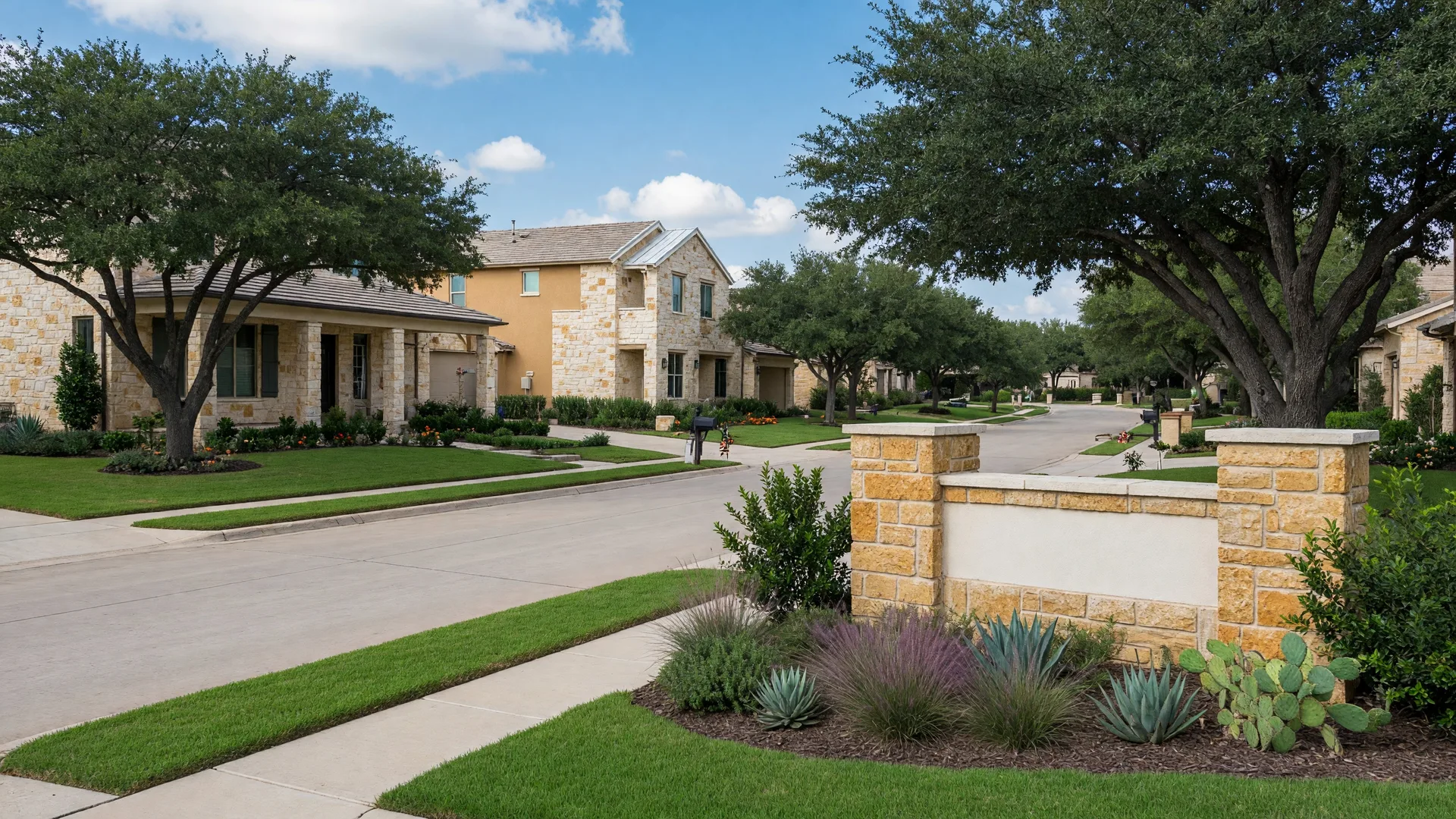
Of all the unglamorous but essential adjustments California buyers face when moving to the Texas Hill Country, the homeowners association question is the one that gets the least attention in relocation guides. Everyone talks about property taxes and homestead exemptions. Almost nobody walks you through the fact that your new Texas HOA may have broader enforcement powers, fewer statutory limits on fines, and a significantly more active architectural review committee than the California HOA you left behind.
This matters because the Hill Country is, by and large, an HOA-heavy market. Most subdivisions built in Boerne, Fair Oaks Ranch, and the surrounding communities since the 1980s carry covenants, conditions, and restrictions (CC&Rs) that govern everything from exterior paint colors to fence materials to the type of landscaping you can plant in your front yard. Some of these CC&Rs are more detailed and more strictly enforced than anything a typical California suburban homeowner has experienced. Others are more flexible than California rules in surprising ways.
The goal of this article is to bridge that gap. If you are a California homeowner evaluating Hill Country property, you need to understand not just what the HOA fees are, but what the HOA can do, what it cannot do, and how the legal framework differs between the two states. A mismatch between your expectations and the actual enforcement culture is one of the most common sources of frustration for California transplants in their first year.
The Legal Framework: How Texas and California HOA Laws Diverge
The most fundamental difference between California and Texas HOA law is the governing philosophy. California's Davis-Stirling Common Interest Development Act (Civil Code Sections 4000-6150) is one of the most comprehensive and homeowner-protective HOA statutes in the country. It prescribes detailed procedures for board elections, meeting notices, fine enforcement, dispute resolution, and foreclosure [2]. The legislature has steadily added homeowner protections over two decades, culminating in Assembly Bill 130 (effective January 2025), which capped fines for governing document violations at $100 per violation during the first year and tightened due process requirements [3].
Texas takes a different approach. The Texas Residential Property Owners Protection Act (Property Code Chapter 209) provides important protections — including mandatory notice and hearing before fines, a prohibition on foreclosure for fines alone, and a requirement that residential foreclosures proceed through courts rather than through a nonjudicial trustee sale [1]. But Chapter 209 leaves more discretion to the HOA board than California law does. There is no statutory cap on fines. There is no minimum dollar threshold before an HOA can pursue foreclosure for unpaid assessments. And the procedural requirements, while real, are less prescriptive than California's [7].
What this means in practice: a Texas HOA board that wants to enforce its CC&Rs aggressively has more legal room to do so than its California counterpart. A $500 fine for an unapproved fence color might be perfectly enforceable in Texas, provided the HOA followed the notice and hearing requirements of Chapter 209. In California, the same fine would likely exceed the statutory cap under AB 130.
HOA Law Comparison: California vs. Texas
| Category | California | Texas |
|---|---|---|
| Governing Statute | Davis-Stirling Act (Civ. Code § 4000-6150) | Chapter 209, Texas Property Code |
| Fine Caps | $100/violation first year (AB 130) | No statutory cap |
| Foreclosure Threshold | $1,800 or 12 months delinquent | No minimum threshold |
| Foreclosure Type | Nonjudicial (trustee sale) common | Judicial (court order) required for residential |
| Redemption Period | 90 days | 180 days |
| Fine Foreclosure | Prohibited | Prohibited (§ 209.009) |
| Special Assessment Cap | 5%/year or 20%/year caps | Declaration determines; no statutory cap |
| Architectural Review | Must be reasonable; homeowner-friendly | Broad discretion; declaration-driven |
Sources: Texas Property Code Chapter 209 [1], California Davis-Stirling Act [2], AB 130 [3], Nolo [4][10].
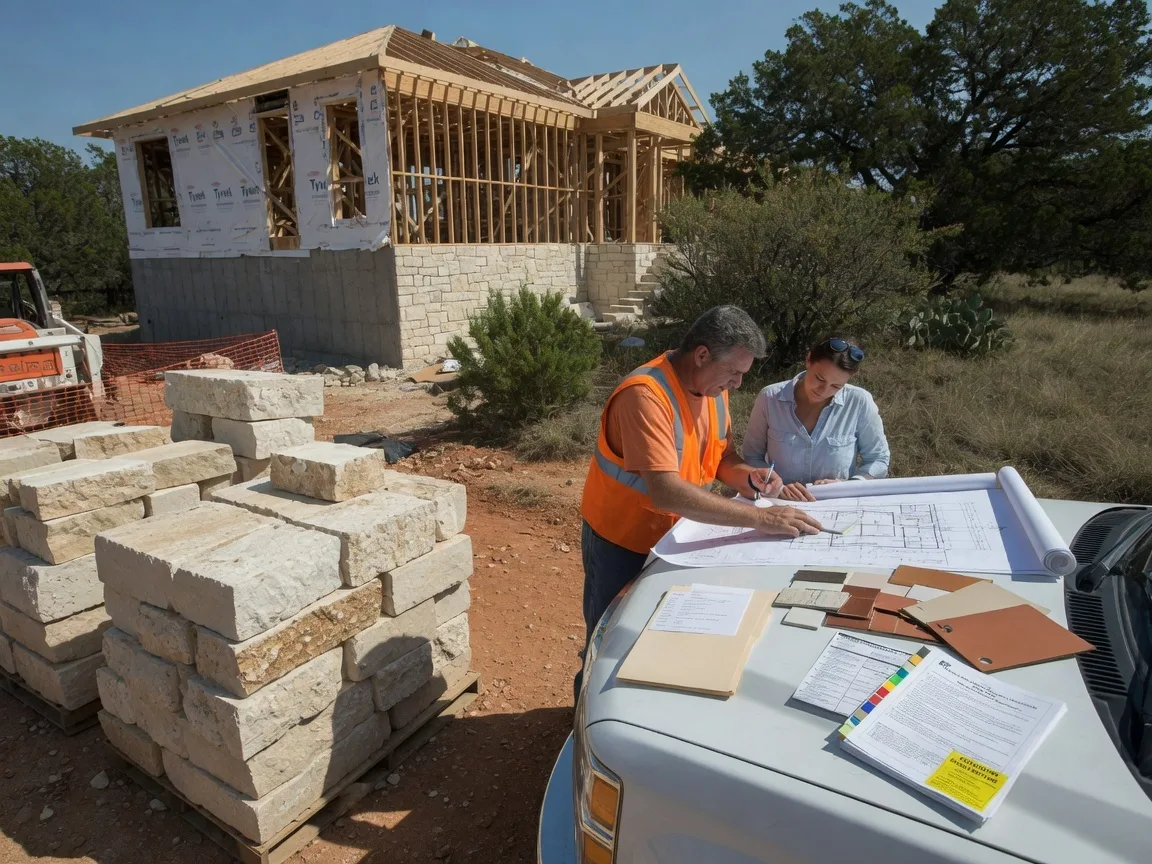
What You Will Actually Pay: HOA Fees in the Hill Country
HOA fees in the Hill Country vary more than most California buyers expect. In California's suburban developments, HOA dues are relatively standardized — typically $200 to $400 per month in a master-planned community with amenities like pools, gyms, and security gates. You pay the monthly fee, you get the amenities, and the association handles common-area maintenance.
In the Hill Country, the range is wider and the relationship between fees and services is less predictable. Here is what you can expect in the Boerne and Fair Oaks Ranch area, based on current market data [5][6]:
- Standard subdivision (no amenities, basic maintenance): $800 to $1,500 per year ($67 to $125 per month). These associations typically cover entrance landscaping, common-area mowing, and little else. Many do not maintain a reserve fund for significant capital improvements, which means special assessments are possible.
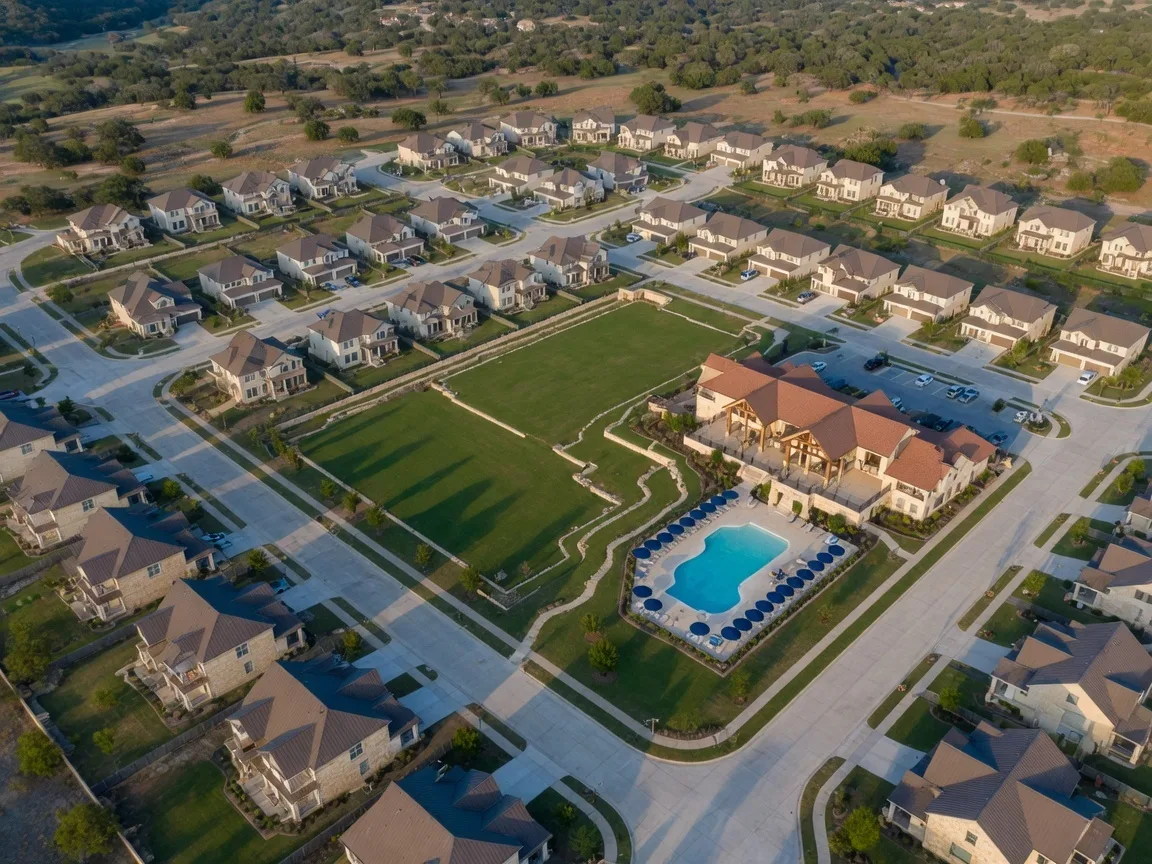
- Subdivision with amenities (pool, park, clubhouse): $1,500 to $3,000 per year ($125 to $250 per month). These are common in newer developments in Boerne and along the Fair Oaks Ranch corridor.
- Golf community (Fair Oaks Ranch, Cordillera Ranch): Initiation fees of $2,500 to $10,000 plus monthly dues of $400 to $700, often with a food and beverage minimum. These are separate from the standard HOA dues and are typically optional — you can live in the community without joining the golf club [5].
- Voluntary or no HOA: Zero monthly fee, but also no enforcement mechanism for neighborhood standards. Older subdivisions, rural acreage properties, and some downtown Boerne neighborhoods fall into this category.
The critical difference from California is the scope of what the HOA fee covers. Many California HOA dues include master insurance policies, structural maintenance for attached homes, and significant reserve funds for roof replacement, siding, and paving. In the Hill Country, because most homes are single-family detached residences on larger lots, the HOA typically covers less. You are still responsible for your own roof, your own foundation, your own driveway, and your own water and sewer infrastructure. The HOA fee covers common elements only — entrances, signage, any shared landscaping, and occasionally a community pool or park [5].
One important nuance: Some Hill Country subdivisions also have Public Improvement Districts (PIDs) or Municipal Utility Districts (MUDs) that appear as separate line items on your property tax bill or as a separate assessment. These are not HOA fees, but they function similarly in that they pay for infrastructure like roads, drainage, and water mains. Our guide to special districts and MUDs covers this in detail, but the short version is this: always ask your agent or title company for the full list of recurring assessments on any property you are considering, not just the HOA dues.
Typical HOA Fees: Hill Country vs. California Suburbs
| Property Type | California (Monthly) | Texas Hill Country (Monthly) |
|---|---|---|
| Standard subdivision, no amenities | $150-$300 | $67-$125 |
| Subdivision with pool/park | $250-$450 | $125-$250 |
| Gated community | $300-$600 | $150-$300 |
| Golf club membership | $500-$1,000+ | $400-$700 (optional) |
| Condo/townhome (includes insurance) | $300-$600 | $250-$400 (less common) |
| No HOA / voluntary | $0 | $0 |
Sources: Weigand Real Estate [5], My Boerne Home [6]. Figures are 2026 estimates and vary by specific community.
Enforcement Culture: What Gets Enforced and How
The legal framework matters, but the enforcement culture matters more. Two HOAs with identical CC&Rs can feel completely different depending on whether the board is active, whether the management company is diligent, and whether the neighborhood has a history of enforcement disputes.
In California, the enforcement culture tends to be reactive and complaint-driven. HOAs respond to violations when neighbors report them, but the board rarely patrols for issues. Fines escalate slowly. Architectural applications are typically approved unless they clearly violate the CC&Rs. The cultural default is permissive — a reflection of California's broader emphasis on individual property rights within the common-interest framework [2][3].
In the Texas Hill Country, the enforcement culture varies more dramatically between HOAs. Some are effectively dormant — the board meets once a year, the management company sends a bill, and nobody pays attention to what color anyone's fence is. Others are active and proactive. The architectural review committee walks the neighborhood quarterly. Violation notices go out for visible weeds, unapproved exterior modifications, and vehicles parked on the street beyond the allowed period. The board views enforcement as a fiduciary duty to maintain property values [7][9].
The difference is partly cultural and partly structural. Hill Country subdivisions with larger lot sizes and higher home values tend to have more active HOAs because the stakes — and the expected property values — are higher. A $1.2 million home in Fair Oaks Ranch is more sensitive to a neighbor's deteriorating fence than a $500,000 condo in a dense California suburb. The board that does not enforce its CC&Rs is seen as negligent by homeowners who paid a premium for a deed-restricted community with predictable standards.
What to look for when buying: Ask for the HOA's violation records for the past 24 months (request this in writing through your agent). An HOA that has sent zero violation notices in two years may be inactive or toothless — which could mean lower enforcement risk but also lower property-value protection. An HOA that has sent hundreds of notices may be overzealous. The sweet spot is an HOA that enforces consistently, fairly, and with documented procedures that match the requirements of Chapter 209.
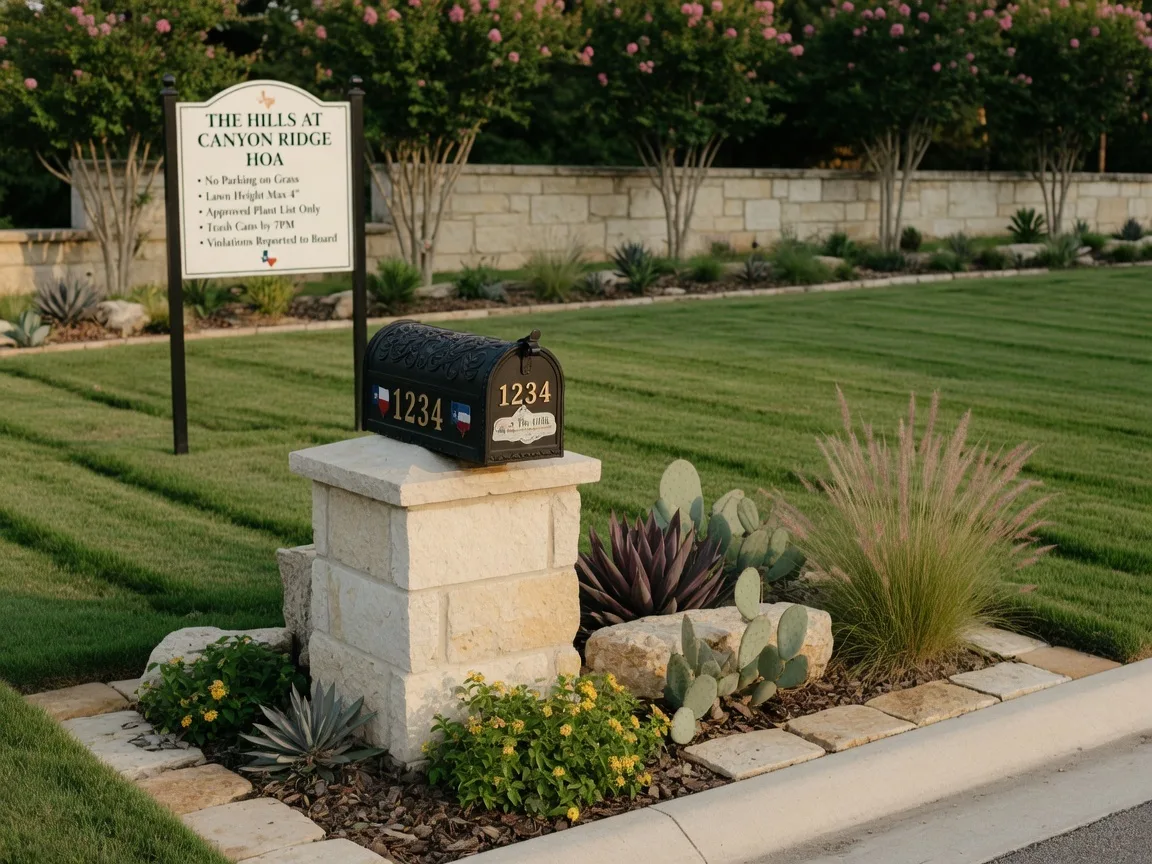
Architectural Review Committees: The Texas Approach
For California buyers, architectural review committees (ARCs) can be the biggest culture shock of all. In California, many HOAs have architectural guidelines, but the review process is often lightweight — submit a sketch, wait for the committee's sign-off, and proceed unless there is a clear violation. In Texas, the ARC process can be more rigorous, particularly in higher-end Hill Country communities [9].
The reason is rooted in the region's building culture. Hill Country architecture is defined by specific materials — limestone, stucco, native stone, metal roofing — and many CC&Rs contain detailed design standards meant to preserve the visual character of the neighborhood. A typical set of Hill Country architectural guidelines might include:
- Approved exterior materials: Limestone, native stone, brick, stucco, or stone veneer. Some HOAs prohibit vinyl siding, synthetic stucco (EIFS), or any material that does not match the predominant exterior of the neighborhood.
- Color palette restrictions: Approved paint colors limited to earth tones — beiges, taupes, warm grays, olive greens. Bright colors and dark hues (navy, black, deep red) are often prohibited.
- Fence and wall standards: Height limits (typically 6 feet for backyard fences, 3 to 4 feet for front-yard fences), material restrictions (wrought iron, cedar, or stone), and setback requirements from property lines.
- Roofing materials: Concrete tile, clay tile, or composition shingles in approved colors. Metal roofing is increasingly common but may require specific profiles and colors.
- Landscaping requirements: Some HOAs mandate front-yard landscaping within a certain period after closing, specify minimum numbers of trees, or restrict artificial turf and certain plant species. Hill Country HOAs increasingly incorporate water conservation guidelines consistent with regional aquifer management [8].
- Dark-sky lighting: Many Hill Country HOAs restrict exterior lighting to downward-facing fixtures that minimize light pollution. This reflects the region's commitment to dark-sky preservation and is not common in California HOA rules.
The practical effect: If you buy in a Hill Country subdivision with a strong ARC, your ability to customize your home's exterior is more limited than what you may be used to. The trade-off is that your neighbor cannot paint their house bright blue or install a chain-link fence in the front yard. The consistency that some California homeowners find restrictive is the same consistency that protects your property value over the long term.
Special Assessments: A Bigger Risk in Texas
One area where California buyers are particularly vulnerable to surprise costs is special assessments. California's Davis-Stirling Act imposes a statutory framework that caps special assessment increases at 5 percent per year or 20 percent annually (depending on circumstances) unless the membership votes to exceed those limits [2]. This provides meaningful protection against sudden, large assessments.
Texas does not have a comparable statutory cap. The board may levy a special assessment for any purpose permitted by the declaration, and the amount is limited only by what the declaration allows and what the board determines is necessary. If the declaration gives the board authority to assess members for capital improvements, reserve shortfalls, or emergency repairs, the board can do so without a membership vote in many cases [1][9].
This matters for two reasons. First, many Hill Country HOAs were established with relatively low initial reserve contributions. If a community with 20-year-old roads faces a $2 million repaving project and has only $300,000 in reserves, the board may need to impose a special assessment of $5,000 to $15,000 per home, depending on the size of the subdivision. Second, Texas's extreme weather — including hailstorms, ice storms, and drought-related foundation issues — creates infrastructure costs that can hit HOAs without warning.
How to protect yourself: Before closing on any property with an HOA, review the most recent reserve study and the association's current reserve balance relative to the replacement cost of common elements. A well-funded HOA that has been running annual contributions sufficient to cover expected capital needs is a lower-risk association. An HOA with low reserves and aging infrastructure is a candidate for special assessments. Your agent can request these documents as part of due diligence.
HOA Foreclosure: A Real but Manageable Risk
I want to be direct about this because it comes up in almost every conversation I have with California buyers who are nervous about HOAs. Yes, a Texas HOA can foreclose on your home for unpaid assessments. No, it is not common, and Texas law provides meaningful protections that California does not.
Under Texas Property Code Section 209.009, an HOA can foreclose only for unpaid regular or special assessments — not for fines, penalties, or attorney's fees related to violations. And for residential property, the foreclosure must be judicial, meaning the HOA must file a lawsuit in district court and obtain a court order. This is more cumbersome and expensive for the HOA than the nonjudicial foreclosure process common in California, which can proceed through a trustee sale without court involvement [1][10].
Texas also provides a 180-day right of redemption after a foreclosure sale, during which you can repurchase your property by paying the full amount owed plus costs. This is twice the 90-day redemption period available in California. In practice, the redemption period means that even in a worst-case scenario, you have six months to reclaim the property [10].
The more important protection is practical: most HOAs do not want to foreclose. Foreclosing is expensive, time-consuming, and damaging to the community's reputation. The median HOA foreclosure in Texas involves a homeowner who is significantly delinquent — typically a year or more behind on assessments and unresponsive to repeated notices and payment-plan offers. The HOAs that pursue foreclosure are those that have exhausted every other option and are trying to protect the financial integrity of the community.
The bottom line: If you pay your assessments and communicate with the HOA if you run into financial difficulty, the risk of foreclosure is effectively zero. The statutory protections are real, and the practical barriers to foreclosure are higher than most California buyers assume based on the popular reputation of Texas HOA enforcement [1][6][10].
The Questions You Should Ask Before Buying
Here is the practical checklist I give every California buyer looking at a property with an HOA in the Hill Country. Run through these questions with your agent before making an offer:
- What is the current HOA fee, and what does it cover? Get the exact dollar amount and a breakdown of what the fee includes — common-area maintenance, insurance, reserves, amenities. Ask whether the fee has increased in each of the past three years and by how much.
- What is the reserve balance, and when was the last reserve study conducted? A healthy HOA should have a reserve study no more than three years old and a reserve balance that covers at least 70 percent of the estimated replacement cost of common elements.
- When was the last special assessment, and what was it for? If the HOA has levied special assessments in the past five years, understand why. If the assessments were for capital improvements that the reserves should have covered, that suggests the HOA has been underfunding reserves.
- Are there any pending or recent enforcement actions against the seller? The seller's disclosure should note any unresolved HOA violations. If there are active violations that transfer with the property, you inherit them.
- What is the ARC approval process, and how long does it take? If you plan to make exterior improvements — adding a fence, changing landscaping, installing a pool, replacing a roof — understand what the ARC requires and how long approval typically takes. Some HOAs respond within 30 days; others take 60 to 90 days.
- Is the HOA self-managed or professionally managed? Professionally managed HOAs tend to be more consistent in enforcement and better at maintaining records. Self-managed HOAs can be more variable depending on the competence of the board.
- Is there a PID or MUD assessment separate from the HOA? As mentioned above, some Hill Country subdivisions have overlapping assessment structures. Ask your title company to identify every recorded assessment on the property.
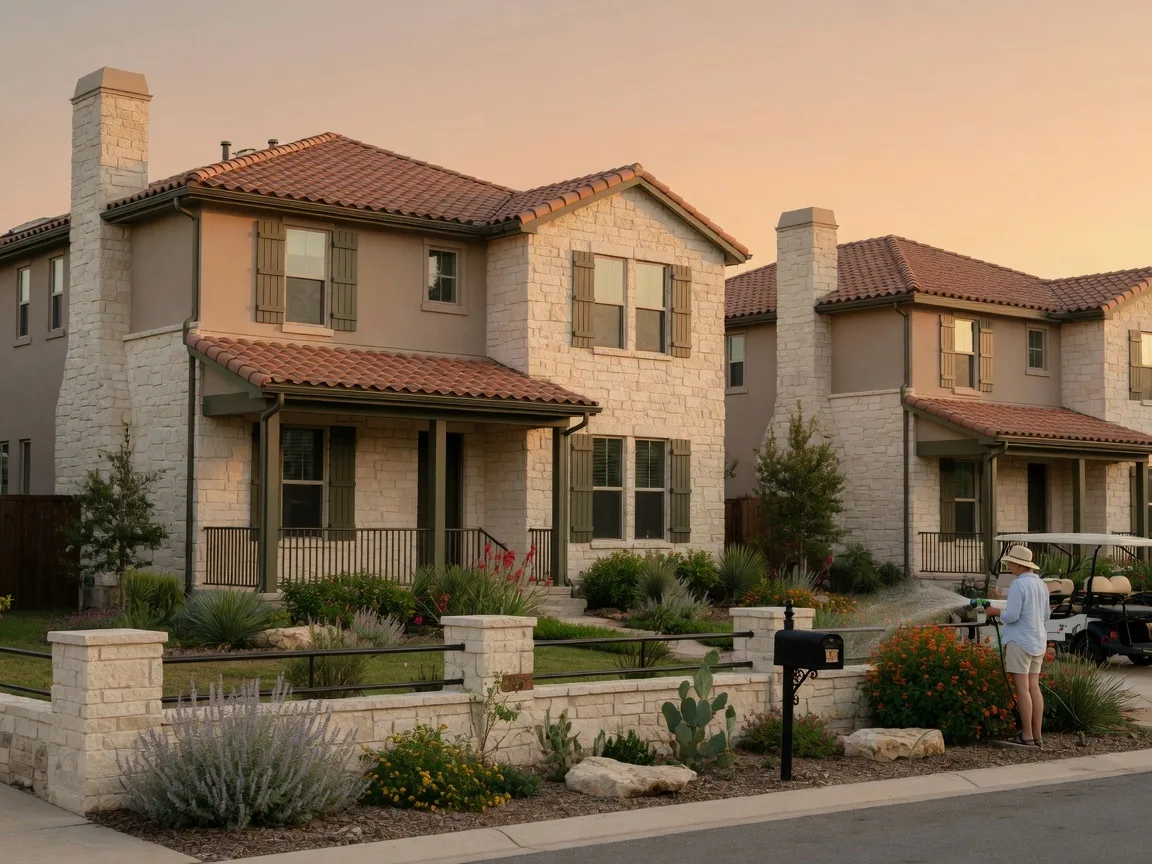
The No-HOA Alternative: Freedom, Trade-offs, and Responsibility
Not every Hill Country property carries an HOA. Older subdivisions, unincorporated areas of Kendall County, and much of the rural acreage west of Boerne have no CC&Rs and no homeowners association. If the idea of an ARC reviewing your fence design sounds unappealing, these areas may be more your speed.
The trade-off is that without an HOA, your neighbor's property choices are regulated only by county nuisance ordinances, which are less restrictive and slower to enforce. A neighbor who paints their house an unusual color, stores a boat in the driveway, or lets their landscaping go unmaintained is your problem only to the extent that the county code enforcement office is willing to get involved. In Kendall County, code enforcement is complaint-driven and response times vary.
For many California transplants, the no-HOA option feels liberating at first. Over time, some come to appreciate the structure that an active HOA provides. Others remain committed to the freedom of rural acreage. The right choice depends entirely on your tolerance for neighbor-driven variation and your willingness to handle things informally rather than through an association. There is no universally correct answer — only the answer that fits your personality and your expectations for neighborhood consistency.
The HOA Question Is Part of the Bigger Picture
Every relocation involves learning a new set of rules — tax rules, school rules, insurance rules, and yes, HOA rules. The HOAs of the Texas Hill Country are not better or worse than California's; they are different. They operate under a different legal framework, a different enforcement culture, and a different set of expectations about what the relationship between homeowner and association should look like.
The key is knowing what you are buying before you buy it. A property with a well-funded, professionally managed HOA that enforces reasonable CC&Rs consistently is a lower-risk investment than a property with an underfunded, disorganized HOA that enforces rules sporadically or not at all. And a property with no HOA at all is a perfectly valid choice — provided you understand what you are giving up in terms of neighborhood consistency and property-value protection.
If you are evaluating Hill Country properties and want a clear-eyed look at what the HOA landscape looks like for a specific community, I am happy to walk you through it. The same direct, no-hype approach applies here as to every other aspect of the relocation. For related reading, see our guide to special districts and MUDs and the Fair Oaks Ranch community guide.

Written by
Bill Ross
Hill Country Homesteads Group, brokered by KW Boerne
Bill Ross is a Texas real estate agent with nearly four decades in high-tech sales and a network of 1,000+ California real estate agents for coordinated cross-state transactions. Featured in national coverage discussing his family's relocation from Silicon Valley to the Texas Hill Country.
Related Guides
The Tax Bill Beneath the Tax Bill: Special Districts, MUDs, and Your Monthly Payment
A practical guide to MUDs, PIDs, ESDs, and other special districts in the Texas Hill Country.
Fair Oaks Ranch Community Guide for California Relocators
Home prices, neighborhoods, schools, and daily life in Fair Oaks Ranch for California relocators.
Downtown Boerne: Local Life on the Hill Country Mile
A practical guide to daily life in downtown Boerne — the shops, restaurants, trail, and community rhythm.
Property Tax Shock or Relief: Line-by-Line Comparison of CA vs. TX
A line-by-line breakdown of what you actually pay on a CA property tax bill versus a TX tax bill.
Frequently Asked Questions
These are the HOA questions I hear most from California buyers evaluating Hill Country properties. The answers reflect both the legal framework and the practical enforcement culture I have observed through dozens of cross-state transactions.
Are Texas HOAs really stricter than California HOAs?
The enforcement environment is different more than "stricter." Texas HOAs generally have broader authority to impose fines without statutory caps, can pursue foreclosure without a minimum dollar threshold (California requires $1,800 or 12 months), and have less statutory procedural requirements for certain actions. However, Texas law also prohibits foreclosure for fines alone and requires judicial foreclosure for residential properties. The stricter feel often comes from the enforcement culture rather than the rules themselves — many Hill Country HOAs are proactive about architectural compliance because property values depend more heavily on neighborhood appearance than in denser California markets.
Can I fight an HOA fine or violation notice in Texas?
Yes. Texas Property Code Chapter 209 requires the HOA to provide written notice of the violation, a description of the violation, and notice of the homeowner's right to request a hearing before the board. If the HOA does not follow this procedure, the fine may be unenforceable. You also have the right to challenge selective enforcement — if the HOA applies a rule to you but not to your neighbors, that is a viable defense. Many Hill Country HOAs also offer informal dispute resolution before formal proceedings begin.
What are typical HOA fees in Boerne and Fair Oaks Ranch?
In Boerne, annual HOA fees typically range from $800 to $1,500 per year for standard single-family subdivisions. In Fair Oaks Ranch, fees vary more because the community includes both mandatory and voluntary HOA areas. Newer sections like The Falls have mandatory dues running $1,000 to $2,000 per year. If golf membership is included, fees increase significantly — Fair Oaks Ranch Golf Club initiation fees run $2,500 to $10,000 with monthly dues of $400 to $700. Always verify whether a property's HOA includes amenities or is purely a maintenance association.
Can a Texas HOA foreclose on my home?
Yes, but only for unpaid regular or special assessments — not for fines or penalties. Texas law (Property Code Section 209.009) requires a judicial foreclosure for residential properties, meaning the HOA must file a lawsuit and obtain a court order. This is different from California, where nonjudicial foreclosure is the common path. Texas also provides a 180-day right of redemption after the foreclosure sale, during which you can repurchase the property by paying the full amount owed. Foreclosure is rare and typically occurs only after prolonged, serious delinquency.
Do all Hill Country homes have HOAs?
No. Many older neighborhoods in Boerne and the surrounding Hill Country have no HOA at all. In Boerne's historic downtown area, properties are governed by city ordinances rather than private covenants. The same is true for many unincorporated areas of Kendall County. Builders and developers introduced HOAs primarily in subdivisions built after the 1980s. A property without an HOA offers more freedom but also means that your neighbor's choices — fence color, vehicle storage, landscaping — are regulated only by county nuisance ordinances, which are less restrictive than most CC&Rs.
Sources
- Texas Residential Property Owners Protection Act (Chapter 209) — Texas Property Code, Chapter 209. statutes.capitol.texas.gov/Docs/PR/htm/PR.209.htm
- California Davis-Stirling Common Interest Development Act — California Civil Code Sections 4000-6150. leginfo.legislature.ca.gov/faces/codes_displayexpandedbranch.xhtml?tocCode=CIV&division=4.&title=&part=5.&chapter=&article=
- California AB 130 — HOA fine caps and homeowner protections — California Legislative Information (2024). leginfo.legislature.ca.gov/faces/billNavClient.xhtml?bill_id=202320240AB130
- HOA foreclosure rules in Texas vs California — Nolo (2025). www.nolo.com/legal-encyclopedia/hoa-foreclosures-california-texas-comparison.html
- HOA fees in Boerne, TX — typical ranges and MUD taxes — Weigand Real Estate (2026). weigandrealestate.com/blog/hoa-fees-boerne
- Boerne and Fair Oaks Ranch HOA fee guide for home buyers — My Boerne Home (2026). www.myboernehome.com/blog/what-boerne-and-fair-oaks-ranch-buyers-need-know-about-homeowners-association-fees/
- Selective enforcement challenges under Texas Chapter 209 — HOA Management (2025). www.cmctx.com/texas-hoa-laws-guide/
- Hill Country HOA model language for dark skies and water conservation — Hill Country Alliance (2024). hillcountryalliance.org/resources/hoaguide/
- Architectural Review Committee (ARC) processes in Texas HOAs — Effortless HOA (2025). effortlesshoa.com/blog/hoa-laws-texas
- Texas HOA foreclosure redemption period — Tex. Prop. Code Section 209.011; Nolo (2025). www.nolo.com/legal-encyclopedia/the-right-redemption-following-hoa-foreclosure.html
Last reviewed: July 2026. HOA fees and enforcement practices vary by individual community. Always review the specific CC&Rs, bylaws, and financial statements for any property you are considering. This article does not constitute legal advice; consult an attorney for specific HOA disputes.