
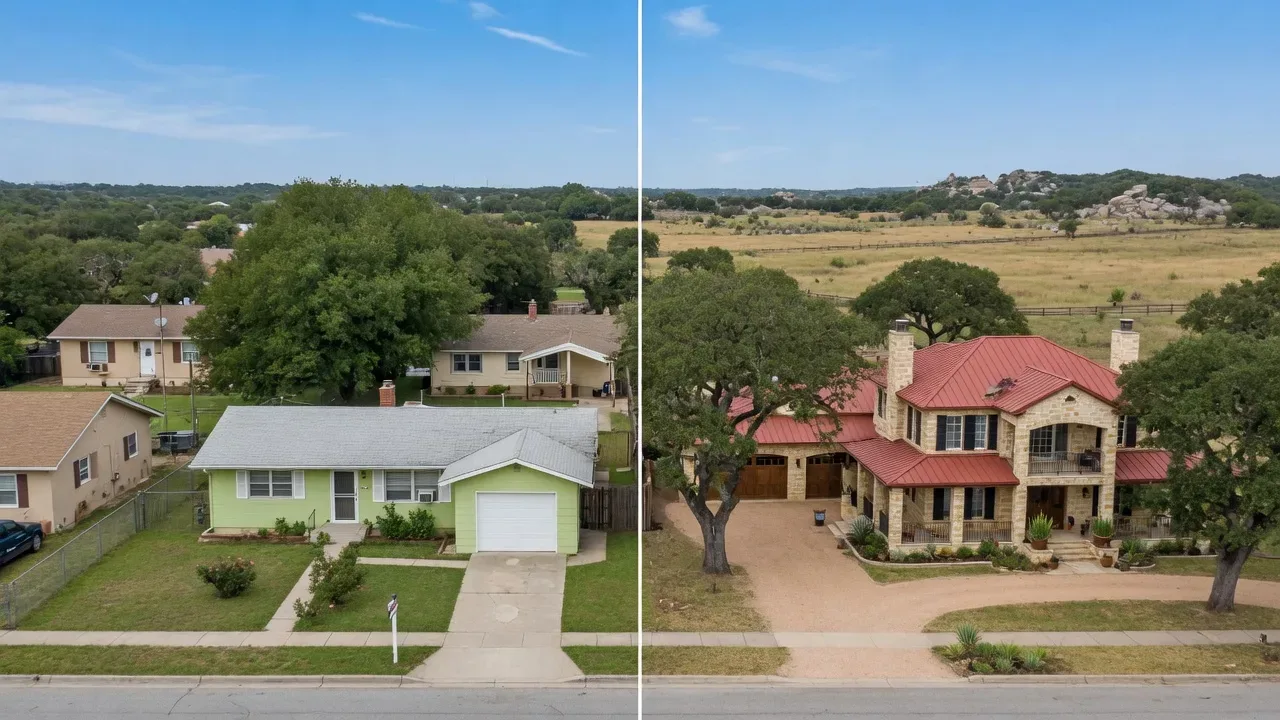
Texas Hill Country buyers face a question that is not as simple as it sounds: build new or buy resale? The answer depends on how you define "new construction," what you prioritize in timeline and cost certainty, and whether the property you want already exists. This guide provides a detailed, data-driven comparison of custom builds and resale homes in Boerne, Fair Oaks Ranch, and the surrounding Hill Country communities, written for California buyers and out-of-state relocators who need real numbers, not marketing language.
First, Define "New Construction"
"New construction" can mean three very different transactions:
- Completed inventory or spec home: The builder owns the land and has completed, or nearly completed, the house. The buyer can usually inspect the finished home and use ordinary permanent purchase financing. Depending on completion status, move-in may be possible within roughly 30-90 days.
- Production or semi-custom home: The buyer selects a floor plan, lot, options and finishes within a builder-controlled community. The lot is commonly included in the contract price, customization is limited, and completion may take several months or longer.
- True custom home: The buyer owns or acquires the lot, hires a builder and design team, and finances or pays for construction. This path carries the greatest site, design, financing, change-order and scheduling risk.
Most of the rock-excavation, utility-extension, construction-loan and 12-24-month timeline discussion in this article applies primarily to the third category. Buyers comparing a completed builder inventory home with a resale home will encounter a substantially different cost, financing and risk profile.
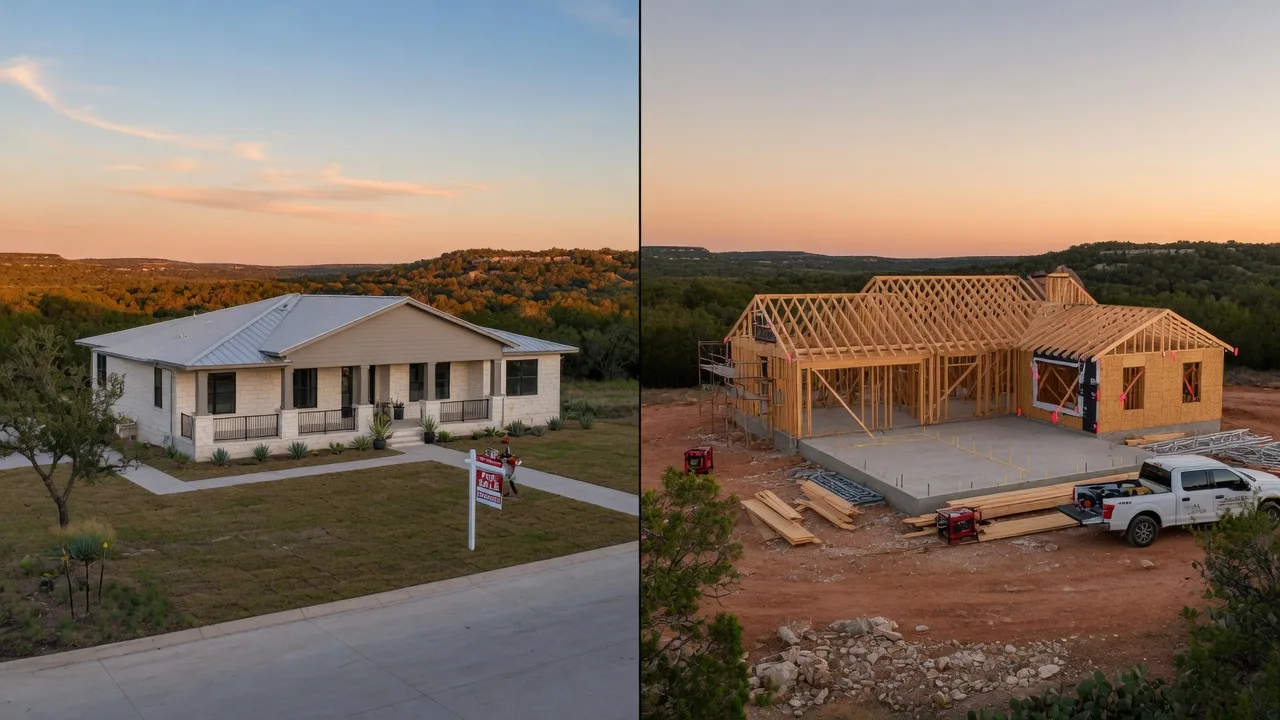
The Cost Comparison — What You Actually Pay
True Custom-Build Costs
The Hill Country is more expensive to build in than most of Texas. The reasons are geological, logistical, and regulatory — not just taste-level.
Custom Home Construction Costs
Published estimates for custom construction in the Texas Hill Country vary widely. A reasonable early-stage screening range is approximately $250-$450 or more per conditioned square foot, before land and financing, with luxury construction potentially exceeding that range. This is not a bid. The actual cost depends on the lot, plans, foundation design, exterior materials, finish selections, builder fee, site infrastructure and what the quoted price includes.
Before comparing builders, require each estimate to state whether its price-per-square-foot calculation includes:
- Conditioned living area only or total area under roof
- Builder overhead and profit
- Architectural and engineering fees
- Clearing, grading and excavation
- Foundation and retaining walls
- Driveway, drainage and erosion control
- Well, water meter or utility tap
- Septic system
- Electric, propane and communications extensions
- Permits, impact fees and architectural-review fees
- Landscaping, irrigation and fencing
- Appliances, window coverings and owner-supplied fixtures
- Construction-loan interest, inspections and closing costs
- Contingency
A price-per-square-foot figure is meaningless unless the inclusions and the square-footage definition are identical.
Sources: ohmees.com and NAHB Cost of Constructing a Home. NAHB data are national survey data included only as a benchmark.
Already own the land?
Owning the lot eliminates a new land-purchase payment, but the land is not economically free. It has equity value, carrying costs and an opportunity cost, and a construction lender may use it as collateral or count its equity toward the required borrower contribution. Existing land debt, taxes, HOA assessments and site-development costs still belong in the comparison. Ask the lender to show precisely how the lot value and any outstanding loan will be treated.
Resale Costs
The Hill Country resale market offers a wide range, but here is what you can generally expect:
- Boerne city median sale price: Redfin reported a three-month median of $494,731 for the period ending June 2026, up 7.7% from the same period one year earlier [1].
- Boerne city median sale price per square foot: $198, down 13.3% year over year for the same reporting period [1].
- Boerne city Redfin data period: The figures above are for the geography Redfin labels as Boerne and should not be used for Fair Oaks Ranch, Spring Branch, Canyon Lake or the Hill Country as a whole.
These figures cover Redfin's Boerne city geography. They should not be treated as representative of ZIP code 78006, all properties with a Boerne mailing address, or the broader Hill Country. Geography, property type and the reporting period must remain consistent when comparing market statistics. Nearby submarkets vary materially; buyers should request a current, property-type-specific comparative market analysis.
Source: redfin.com/city/2134/TX/Boerne/housing-market [1]
Buying a resale home generally provides an existing improvement that can be inspected before closing. Our home inspection checklist covers what to evaluate in a Hill Country property. Landscaping, neighborhood maturity and property condition vary by home, and inspections cannot eliminate the risk of concealed defects. Buyers should budget separately for inspections, immediate repairs, furnishings and planned upgrades.
True Custom Build vs. Resale: Cost Comparison Summary
| Factor | True Custom Build | Resale |
|---|---|---|
| Custom-build hard and soft costs | Lot- and plan-specific; require a line-item estimate | N/A |
| Completed builder inventory | Contract price generally includes the house and lot; verify options, incentives and excluded owner costs | N/A |
| Resale | N/A | Contract price includes the existing land and improvements; budget separately for inspections, immediate repairs and renovations |
| Contingency | Custom build: establish a project-specific reserve with the builder and lender | Resale: establish a repair and improvement reserve after inspections |
| What you get | A home designed for the buyer, subject to site, budget, engineering, product-availability and change-order constraints | An existing property that can be inspected before closing but may contain concealed or undocumented conditions |
Do not compare the median resale home with a luxury custom home. A useful comparison must hold location, lot size, conditioned square footage, construction quality, garage and outdoor areas, utility systems, landscaping and expected post-closing improvements as constant as possible.
Utility Hookup Costs: Obtain Property-Specific Estimates
Rural Hill Country lots often require specialized utility infrastructure that simply does not exist on a standard suburban lot. Costs vary substantially by property location, provider, lot configuration and applicable fees. Obtain written, property-specific estimates rather than relying on published ranges.
These items may be included in the contract price, carried as allowances or excluded entirely. Require the builder's proposal to state explicitly which utility and site-development items are included, which are allowances and which remain the owner's responsibility.
- Well drilling or water meter/tap fees: Not every lot requires a private well. Some are served by water-supply corporations, municipal water districts or city water. Confirm water availability, well-permitting requirements, water-service capacity and any tap or capacity fees.
- Septic system (OSSF): Confirm whether the site requires a conventional or aerobic system. Public wastewater may be available in some subdivisions.
- Propane tank installation: Many Hill Country homes are not connected to natural gas lines. Confirm with the local provider whether tank installation costs are included or carried as an allowance.
- Electric line extension: Obtain a written estimate from the utility provider for the specific lot location and required service capacity.
- Communications: Internet availability varies by location. Verify fiber, cable or fixed wireless availability and any extension or installation fees.
Propane: Verify the Actual Installation
Propane is common where natural gas service is unavailable, but installation requirements depend on container type, capacity, location, openings, ignition sources, property lines, traffic exposure and the adopted LP-gas rules. Do not reduce those requirements to a universal ten-foot rule.
For example, the Railroad Commission's current study guide states that an underground container in an area without vehicular traffic must generally have at least six inches of cover. Certain installations within ten feet of a public vehicular thoroughfare or designated parking location require 18 inches of cover or vehicle-barrier protection. Underground steel containers installed after the applicable date also require corrosion protection and periodic cathodic-protection testing.
For either a new installation or resale purchase:
- Use a Railroad Commission-licensed propane provider
- Confirm whether the tank is owned or leased
- Obtain the tank's size, age, serial information and service records
- Obtain cathodic-protection records for an underground steel tank
- Confirm required separation and delivery-truck access
- Coordinate the tank, piping, well, septic, driveway and utility layout
- Ask the provider when a leak or gas-system check is required
- Follow the detector manufacturer's placement instructions and applicable code
Source: rrc.texas.gov/media/mibhexcz/lpg-service-install-sg.pdf
The Timeline — How Long Each Path Takes
Custom-Build Timeline
Building a custom home in the Hill Country is a 12-24 month process from concept to keys:
- Land acquisition and due diligence: 1-3 months (surveying, project-specific geotechnical investigation when appropriate, OSSF site evaluation, floodplain review, deed-restriction review and confirmation of the applicable municipal, county and subdivision requirements)
- Architectural design: 3-6 months
- Permitting: 1-3 months (varies significantly by jurisdiction)
- Site preparation and foundation: 1-2 months (longer with rock excavation)
- Framing and rough-in: 2-3 months
- Interior finishes: 2-4 months
- Final inspections and punch list: 1-2 months
- Certificate of occupancy: Varies
Total realistic timeline: 12-24 months from land purchase to move-in
Resale Timeline
Buying a resale home is dramatically faster:
- Home search: 2-8 weeks
- Offer and negotiation: 1-2 weeks
- Under contract / negotiated option period: The number of days and option fee are negotiated in the contract; Texas does not prescribe a universal 10-14-day "standard." Source: trec.texas.gov
- Inspections, appraisal, and title work: 2-4 weeks
- Closing: Typically 30-45 days from contract execution
Typical contract-to-closing period: Approximately 30-45 days when financing, appraisal, title and property condition present no unusual delay. The home-search period occurs before this and may last weeks or months. Possession may begin at closing or later if the contract includes a seller leaseback or other temporary occupancy arrangement.
Timeline Comparison: True Custom Build vs. Resale
| Stage | True Custom Build | Resale |
|---|---|---|
| Land/search phase | 1-3 months (land + due diligence) | 2-8 weeks |
| Design phase | 3-6 months | Not applicable |
| Permitting | 1-3 months | No new permit is ordinarily required for the home's original construction, but buyers should investigate available permits, approvals and records for additions, conversions, accessory structures, septic work and other later improvements. |
| Construction | 6-12 months | Not applicable |
| Contract to close | Variable (construction loan) | 30-45 days |
| Total to move-in | 12-24 months | Approximately 30-45 days after contract execution in a straightforward financed purchase, plus the home-search period and any negotiated delayed possession. |
Hill Country Site Risks — Rock, Slope, Drainage, Utilities and Access
These site conditions are especially important in many Hill Country projects, although their severity and cost implications vary substantially by property.
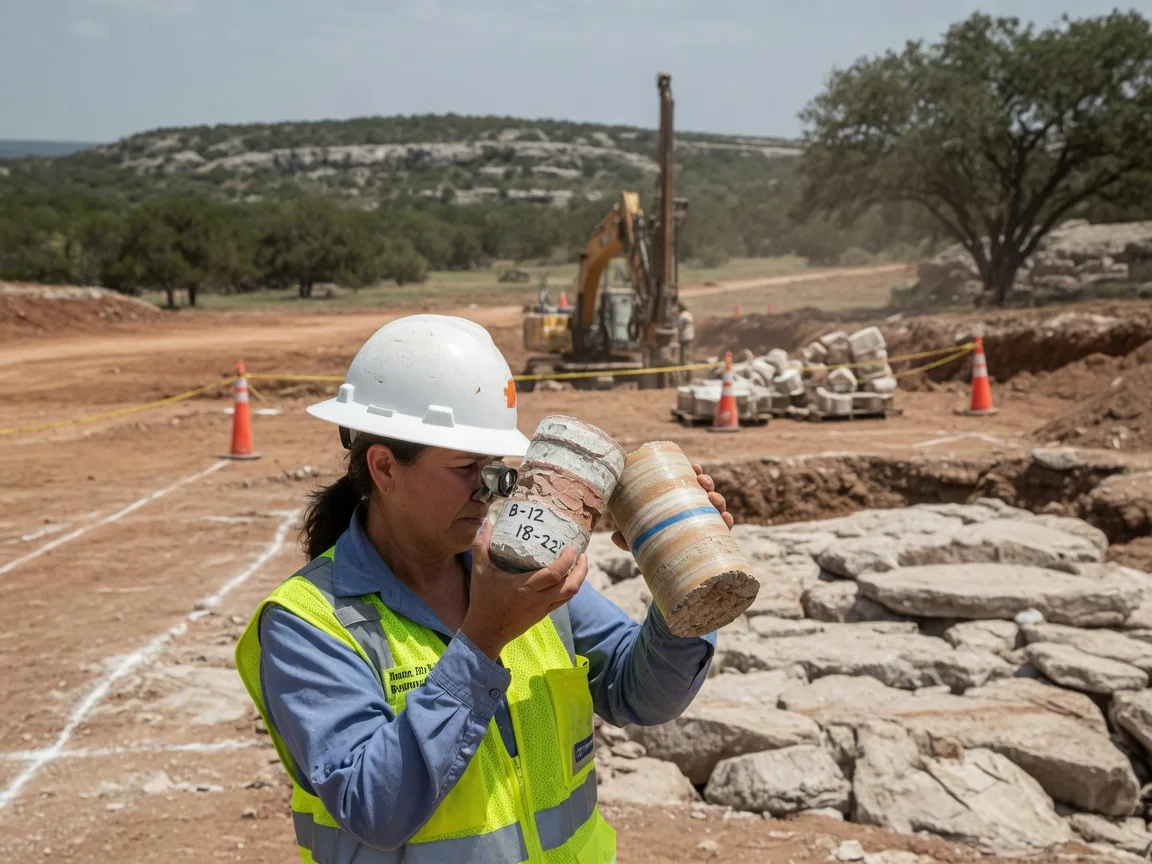
Limestone and Caliche
The Hill Country sits on limestone bedrock and caliche — a calcium carbonate hardpan layer that lies just inches to a few feet below the surface in many areas. This creates real, measurable financial risk:
- Foundation implications: Foundation design depends on subsurface conditions, slope, structural loads and the recommendations of the geotechnical and structural engineers. Shallow competent rock does not automatically require drilled piers, and surface appearance alone cannot establish the correct foundation system. Obtain a lot- and plan-specific foundation recommendation before treating any foundation premium as known.
- Septic and well considerations: Rocky terrain complicates both — a septic system may require a specialized aerobic system, and well drilling through limestone is more expensive and unpredictable.
Excavation cost depends on the depth, hardness and continuity of rock; the foundation and utility plans; equipment access; disposal or reuse requirements; and the pricing method in the construction contract. Obtain project-specific proposals after the relevant plans and site information are available.
Septic and well feasibility and cost are property-specific. Before relying on a preliminary budget, confirm the applicable OSSF process, obtain a site evaluation, investigate water-source options and request written estimates that identify assumptions, exclusions and allowances.
Geotechnical Investigation: Define the Appropriate Scope
The scope, price and turnaround time for geotechnical work depend on the proposed structure, drilling access, number and depth of borings, laboratory testing and required engineering analysis. Obtain a written proposal that identifies the tested locations, deliverables and limitations.
A project-specific geotechnical investigation may help characterize:
- Soil and rock conditions at the tested locations
- Engineering properties relevant to foundation design
- Potential excavation or drainage considerations
- Recommendations and limitations for the structural engineer and design team
The investigation does not guarantee uniform conditions across the entire property or establish the final excavation, foundation or utility cost. Scope, boring locations and testing methods should be selected with the project's design professionals.
Pre-Purchase Site-Due-Diligence Sequence
Before the land option or feasibility period expires:
- Obtain a current boundary and topographic survey or confirm the scope and timing for one.
- Overlay the proposed building footprint, driveway, utilities, septic area, drainage features, easements, setbacks and protected trees.
- Have the builder and civil or site professional walk the property.
- Obtain an OSSF site and soil evaluation when public wastewater is unavailable.
- Confirm water availability, well-permitting requirements and any water-service capacity or tap fees.
- Obtain written electric, communications and other utility-extension information from the actual providers.
- Determine floodplain, drainage, driveway and right-of-way requirements.
- Review recorded restrictions, plat notes and ACC/ARB requirements.
- Have a qualified geotechnical professional define the investigation needed for the proposed structure and footprint.
- Obtain a written site-work allowance or estimate that states what happens if actual conditions differ.
- Preserve sufficient contractual time and termination rights to evaluate the results with the builder, engineer, lender and attorney.
A geotechnical investigation provides information at the tested locations; it does not certify that an entire lot is "buildable" or eliminate every concealed-condition risk.
Subsurface conditions can be a major source of cost uncertainty, but the dominant risk varies by property and project. Other material risks may include access, drainage, floodplain constraints, utility availability, OSSF feasibility, deed restrictions, design changes, allowances, financing costs and builder performance.
A resale buyer usually avoids the initial excavation cost, but not every consequence of the site. Existing homes can have foundation movement, drainage problems, retaining-wall issues, difficult septic repairs or expensive excavation for additions and utility replacements. Inspection and record review remain necessary.
Builder's-risk, or course-of-construction, insurance generally protects covered property during construction against specified causes of loss such as fire, theft, vandalism and certain weather events. See our property insurance guide for Hill Country coverage requirements. Coverage, exclusions and deductibles vary substantially. Do not assume that defective design, faulty workmanship, flood, wind, tools, stored materials, temporary structures or resulting damage are covered. The construction contract should identify who purchases the policy, who is named as an insured, the coverage limit, deductible, policy period and responsibility for excluded losses. Obtain a project-specific quote instead of relying on a generic percentage of construction value.
Permitting and Regulatory Differences
Custom-Build Permitting
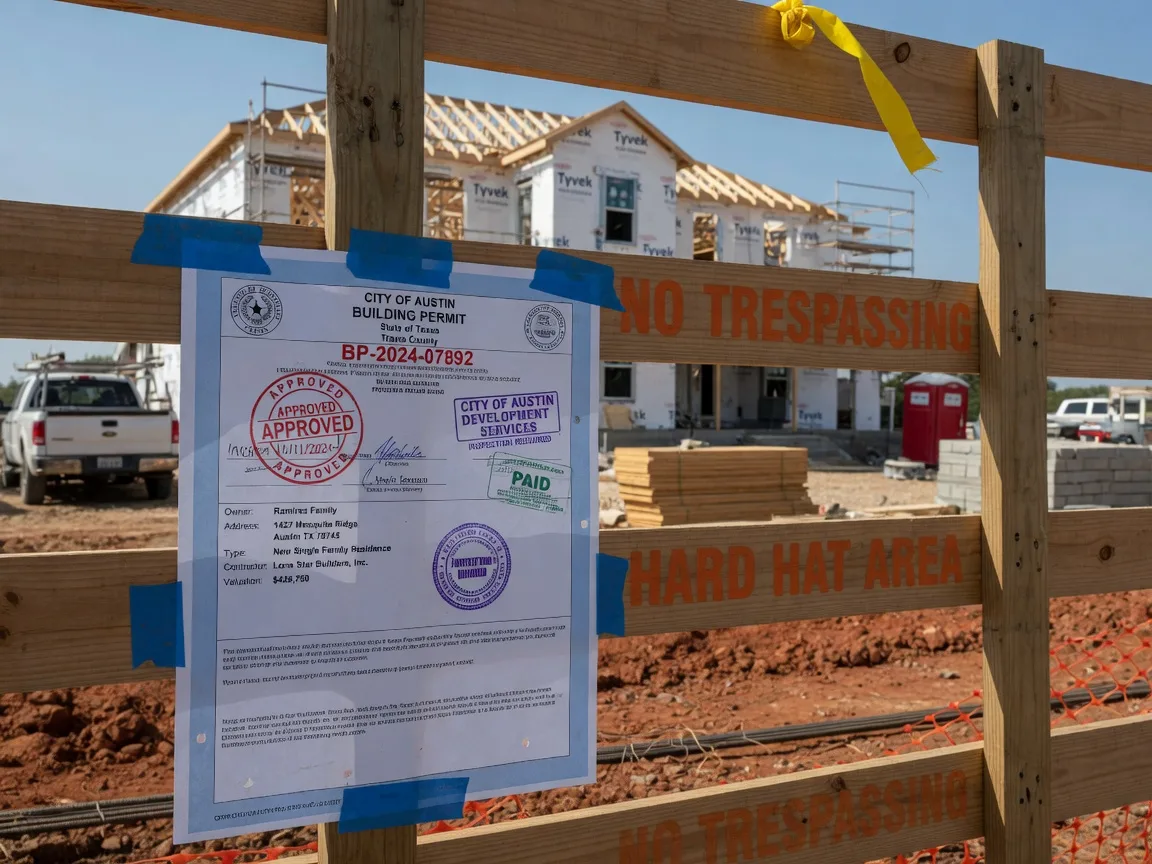
In the Hill Country, permitting is not a single process — it varies by jurisdiction and can involve multiple agencies:
- City of Boerne: New permit applications are processed through My Government Online. The City's published review schedule assigns 21 days to the first review of residential new construction and 14 days to a secondary review. Those are review targets, not a guarantee that a complete permit will be issued within 21 days. Revisions, separate planning or engineering approvals, floodplain issues, variances and incomplete submissions can extend the process. Verify the current requirements and schedule directly with Development Services before establishing a construction calendar. [2]
- Unincorporated Kendall County: The County Engineer's Office administers residential development, address, access/driveway, dark-sky lighting, OSSF, well-related, floodplain, right-of-way and platting requirements. A development permit is required before proceeding with property development and before septic or well permits are issued. Confirm the exact sequence for the property rather than treating county review as a single building-permit process.
- Unincorporated Comal County: Comal County's permit system is component-specific. Environmental Health reviews and issues OSSF permits; the Engineer's Office handles floodplain determinations, certain driveway/right-of-way and utility permits, subdivision compliance and related development matters. Do not imply that Comal County performs the same comprehensive single-family plan review as an incorporated city.
- Subdivision requirements: Master-planned communities and deed-restricted subdivisions may impose architectural-review, plan-approval, materials, landscaping, setback and construction-process requirements in addition to governmental requirements. The sequence varies by community. Review the current declaration, design guidelines, fee schedule and approval procedure, and confirm whether association approval must precede a governmental permit application or merely precedes construction.
Resale Permit and Improvement Records
Resale eliminates the need to obtain approval for the home's original construction, but it does not prove that every later improvement was permitted or approved. Depending on the location and age of the property, a rural single-family home may not have the same municipal permit and certificate-of-occupancy history as a home inside city limits.
During due diligence:
- Search available permit, septic, floodplain and appraisal-district records
- Compare the current improvements with the survey, tax record and seller's disclosure
- Ask for permits, final approvals, engineering records and transferable warranties for additions, conversions, pools, roofs, septic work and major mechanical replacements
- Investigate discrepancies with the appropriate jurisdiction
- Do not describe the property's condition or legal status as "known" merely because it is a resale
What You Get — The Comparison Matrix
Full Decision Factor Comparison: True Custom Build vs. Resale
| Decision Factor | True Custom Build | Resale |
|---|---|---|
| Customization | High for a true custom build, but constrained by budget, site conditions, code, deed restrictions and ACC/ARB requirements | Limited to renovations after purchase |
| Timeline to move-in | 12-24 months | 30-45 days (contract to close) plus search period |
| Cost certainty | Low — change orders and rock risk | Higher than a custom build after inspection and negotiation, but latent defects and future repairs remain possible. |
| Known condition | None until built | Existing improvements can be inspected during due diligence; inspections are visual and do not eliminate concealed-condition risk. |
| Warranty | Coverage depends on the written contract and warranty documents. A qualifying warranty connected to Texas HB 2024 may use minimum periods of one year for workmanship and materials, two years for plumbing, electrical, heating and air-conditioning delivery systems, and six years for major structural components. | No new-builder warranty should be assumed. Any remaining transferable warranty, residential service contract or seller-provided coverage must be verified in writing, including exclusions, transfer requirements and claim procedures. |
| Landscaping | Landscaping may be installed late in the project or carried as an allowance. Verify the scope, irrigation, drainage, tree preservation and establishment responsibilities. | Landscaping may already be established, but buyers should inspect drainage, irrigation, retaining features, tree health and maintenance obligations. |
| Neighborhood character | New, developing, may lack amenities | Generally established; verify surrounding land use, planned development, traffic and noise. |
| Energy efficiency | Generally newer systems and applicable current code requirements; verify actual equipment, testing, insulation, orientation and performance. | May need upgrades if older systems |
| Property tax | Custom/new home: The completed improvements will be appraised under Texas law, and new improvements are not protected by an existing homestead appraisal limitation. | Resale: Do not rely on the seller's current tax bill. The seller's exemptions, appraisal limitation or tax ceiling may not apply to the buyer. Estimate taxes using a realistic market value, current taxing-unit rates and the exemptions for which the buyer will qualify. |
| Homestead appraisal limitation | A residence-homestead appraisal limitation generally takes effect on January 1 of the tax year following the year in which the new owner qualifies. It does not simply transfer from the seller to the buyer. | (same) |
| Financing complexity | May involve cash, builder financing, a construction loan or construction-to-permanent financing. Draws, inspections, interest reserves, conversion terms and borrower equity vary by lender and transaction. | Usually financed with a standard purchase mortgage, subject to underwriting, appraisal and property-condition requirements. |
| Risk profile | Higher — rock, permitting, builder, timeline | Lower construction and completion risk, but greater potential for age-related repairs, deferred maintenance and concealed defects. |
Construction-Loan Draws and Cash-Flow Questions
Construction-loan proceeds are commonly released in stages after the lender or its inspector verifies completed work. The number of draws, inspection procedure, retainage, title updates, borrower contribution and payment timing are lender- and contract-specific.
Before signing the construction contract, obtain written answers to these questions:
- What work must be complete for each draw?
- Who requests and coordinates the inspection?
- How long does approval and funding usually take?
- Does the lender fund advances or reimburse payments already made?
- Must the borrower's cash or lot equity be contributed first?
- Is retainage withheld?
- Who pays inspection, title-update and draw fees?
- How are change orders and cost overruns funded?
- What lien waivers or affidavits are required?
- What happens if the appraisal or completed work does not support the requested draw?
- Who covers contractor invoices while a draw is pending?
Do not assume that the buyer must personally meet the inspector or advance $20,000-$50,000. Confirm the actual procedure with the lender, builder, title company and construction attorney.
Sources: consumerfinance.gov and Fannie Mae
The Builder Warranty — Read the Contract, Not the Label
Texas does not impose one identical express written builder warranty on every new-home transaction. Warranty coverage, exclusions, claim procedures, transferability and required notice vary by contract. Other legal rights, including possible implied warranties, can be fact-specific and should be discussed with a Texas construction attorney.
HB 2024 did not create a mandatory 1-2-6 warranty. It amended the statute of repose for certain residential construction claims. When a contractor provides a qualifying written warranty with minimum periods of one year for workmanship and materials, two years for specified plumbing, electrical, heating and air-conditioning delivery systems, and six years for major structural components, the statute provides a six-year repose period for covered residential construction claims against that contractor rather than the otherwise applicable ten-year period.
A statute of repose is an outside deadline for certain lawsuits; it is not a promise that every defect will be repaired for six years. Other limitation periods, contractual notice requirements and the Residential Construction Liability Act may affect a claim. Buyers should obtain and review the complete warranty and construction contract before signing.
Before signing, confirm:
- The specific coverage periods, exclusions and dollar limits for each warranty category
- Which items are expressly excluded from coverage (site work, driveways, landscaping, etc.)
- The claim submission deadline and required notification procedures
- Who decides whether a condition qualifies as a defect and whether that decision is final
- Whether mediation or arbitration is required before litigation
- Whether the warranty is transferable to a subsequent buyer and any transfer fee or notice requirement
- Who administers warranty claims and whether a third-party administrator is involved
- Your right to conduct independent inspections during and after construction
- Whether emergency repairs are permitted without prior warranty authorization and how reimbursement is handled
The Builder and Contract May Be a Bigger Risk Than the Lot
Texas does not have a statewide licensing program for general contractors or home builders, although regulated trades require licenses and local jurisdictions may require builder registration. Verify the builder rather than assuming that registration, an attractive model home or HOA approval establishes financial strength or construction quality.
Before signing:
- Confirm the builder's legal entity, insurance and local registration
- Check litigation, lien, bankruptcy and complaint history
- Contact recent clients whose homes are out of warranty as well as current clients
- Review allowances, escalation clauses and change-order markups
- Identify who bears material-price and delay risk
- Define the plans, specifications and finish schedule incorporated into the contract
- Confirm substantial-completion and outside-completion provisions
- Review financing, appraisal and termination contingencies
- Establish inspection access and correction procedures
- Address lien releases, final affidavits and retainage with the lender, title company and attorney
- Have a Texas construction attorney review a custom-building contract before execution
Compare Three Complete Scenarios
Build a separate total-cost estimate for:
- Completed builder inventory
- Production, semi-custom or true custom construction
- Resale plus immediate repairs and planned renovations
For each scenario, include:
- Purchase or land cost
- Design and engineering
- Site and utility work
- Construction or renovation
- Closing and financing costs
- Construction-period interest
- Temporary housing and storage
- Property taxes, HOA assessments and insurance during the waiting period
- Landscaping, fencing, appliances and window coverings
- Inspection and professional fees
- Contingency
- Expected move-in date
- Estimated value at completion
- Cash required if the appraisal is lower than project cost
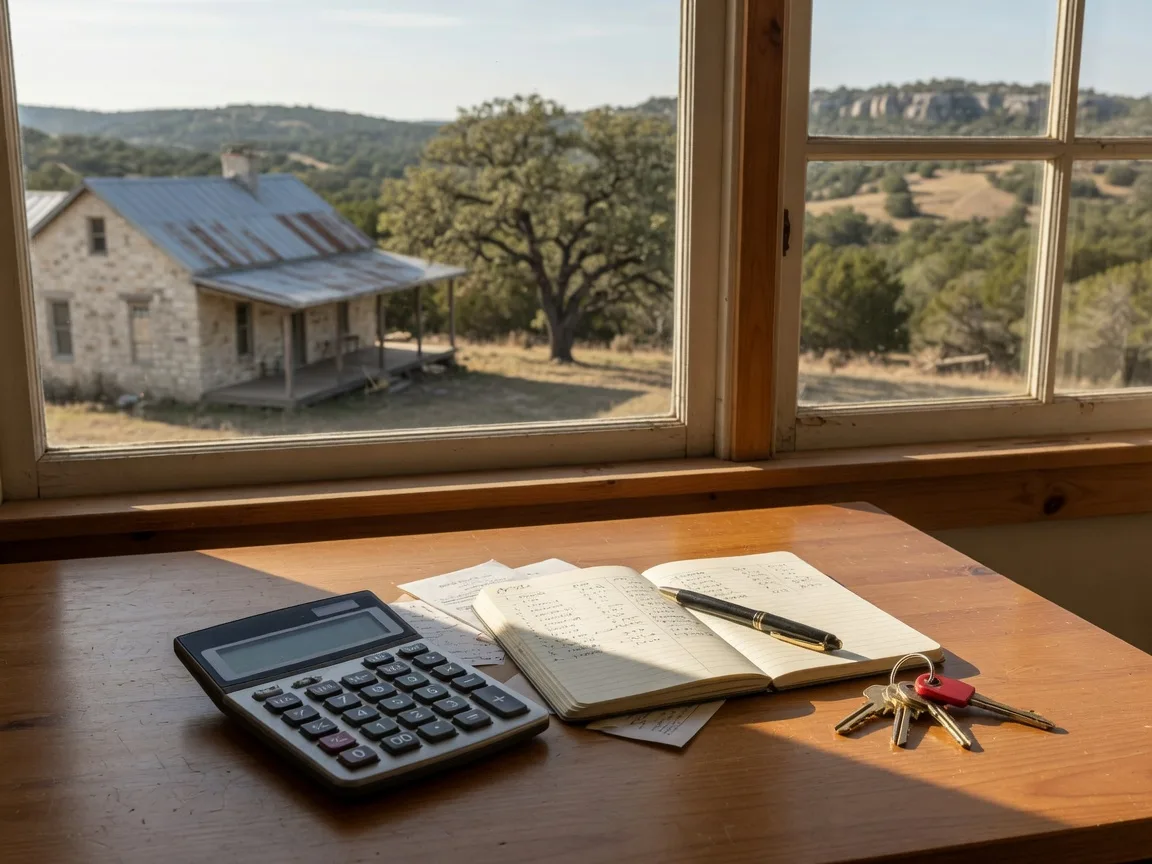
This is more useful than comparing one broad price-per-square-foot range with a regional resale median.
Builder Incentives and Their Tradeoffs
Completed inventory and production builders may offer closing-cost credits, interest-rate buydowns, upgrade allowances or price reductions. Resale sellers may also offer concessions. Compare the net price, lender fees, permanent interest rate, appraisal, taxes and included features rather than evaluating the incentive in isolation. A builder's incentive may require use of an affiliated lender or title company; compare that package with at least one independent financing quote.
When a True Custom Build Makes Sense
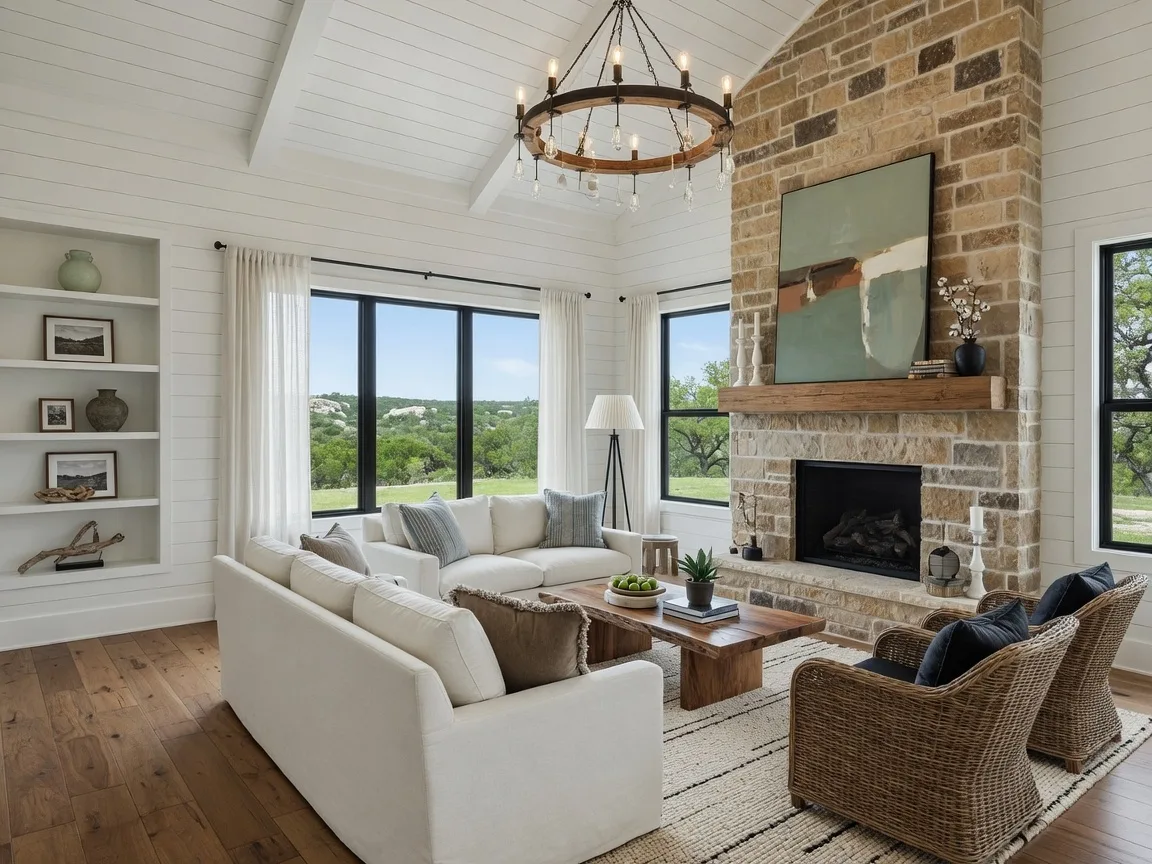
A custom build is generally the better choice when:
- You have specific design requirements that no resale home can meet
- You have a specific lot you want to build on
- You are not time-constrained (you can wait 12-24 months)
- You have the budget for land + construction + contingency
- You value newer building systems, the codes applicable to the project's jurisdiction and permit date, and the opportunity to negotiate clear express-warranty terms.
- You are building in a community with established infrastructure and ACC oversight
Note: Do not assume that every new Hill Country home is built to the newest national model code. Texas currently identifies the energy-efficiency provisions of the 2015 IRC Chapter 11 as its statewide single-family baseline.
When Resale Makes Sense
Resale is generally the better choice when:
- You need to move within 3-6 months
- You want greater cost and timeline predictability after completing inspections, appraisal, title review and other due diligence.
- You prefer an established neighborhood with mature landscaping
- You prefer the opportunity to inspect existing improvements before committing, while recognizing that inspections and records cannot reveal every concealed condition.
- You are working within a defined budget and do not want construction risk
- You do not want to manage a construction project from out of state
The Out-of-State Buyer Perspective
The builder's on-site sales team represents the builder's interests and should not be treated as the buyer's independent representative. Buyers should independently evaluate agency relationships and consider obtaining their own legal, inspection, lending and real-estate advice.
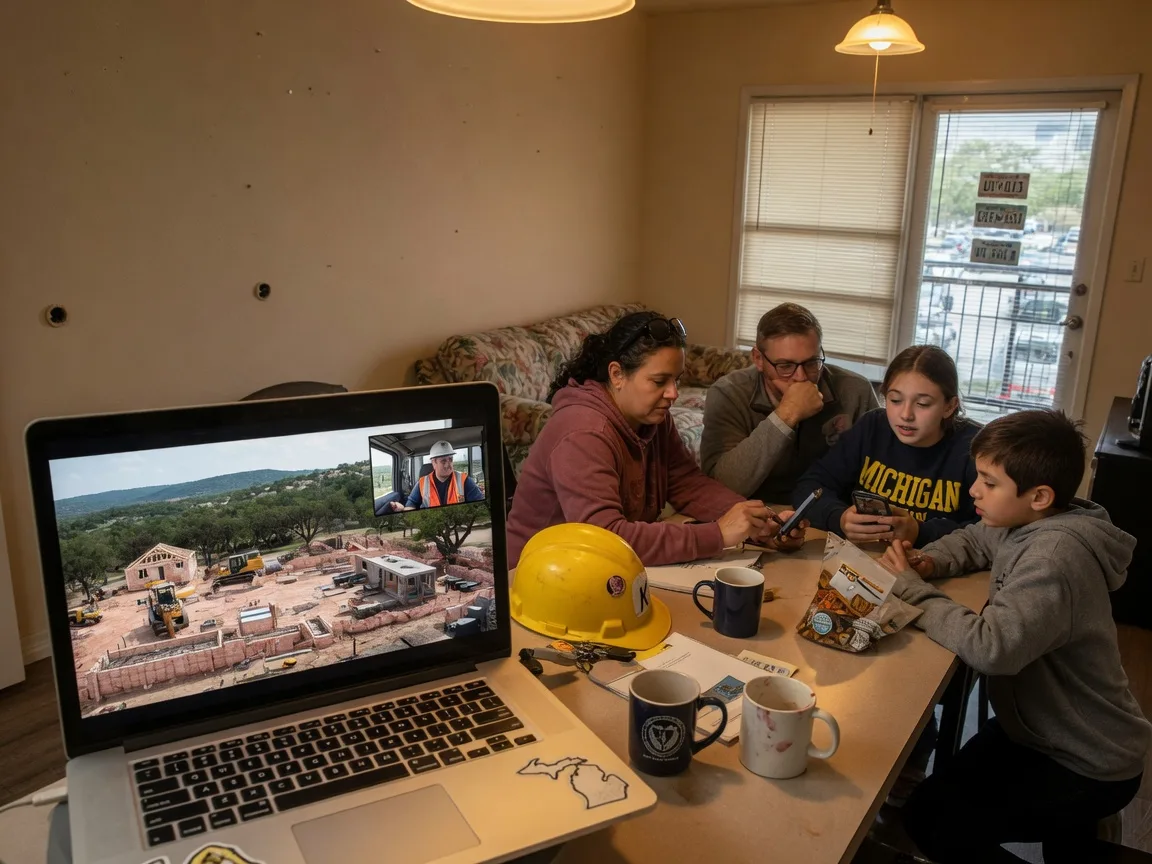
If you are relocating from California or another state, the resale path has a significant advantage: you can see the house, the neighborhood, and the community before you buy. An out-of-state buyer may be able to visit, but fewer site visits make documentation and local oversight more important. Before signing, establish who will attend milestone meetings, receive progress photographs, approve selections and change orders, coordinate independent inspections, verify draw requests and monitor the punch list. If an owner's representative is retained, include that fee in the project budget and define the representative's authority in writing.
Unless the buyer is paying cash or using builder-provided financing, a true custom build commonly requires a construction loan or construction-to-permanent loan. These structures differ from a standard purchase mortgage and may involve draws, inspections, interest-only payments during construction, conversion terms and additional borrower-equity requirements.
If you are selling a California home to fund the purchase, the timing coordination between a California sale and a Texas construction loan is significantly more complicated than coordinating a California sale with a Texas resale purchase.
For a detailed look at the relocation timeline, see our 12-Month California to Hill Country Relocation Timeline and Moving to Boerne from California.
Frequently Asked Questions
How much more does it cost to build new vs. buy resale in the Hill Country?
There is no reliable universal percentage. A completed production home can sometimes compete directly with resale, particularly after builder incentives, while a custom home on a separately acquired and difficult lot may cost substantially more. Compare the same location, lot size, square footage, quality, features and move-in condition using current written estimates and closed-sale data.
What is the biggest risk in Hill Country new construction?
Unexpected site conditions are among the largest risks, but the dominant risk depends on the property and contract. Rock excavation, slope, drainage, retaining walls, septic suitability, well production, utility extensions, appraisal gaps, change orders and builder performance should all be evaluated before the feasibility period expires.
How long does permitting take in Boerne?
The City of Boerne publishes a target of 21 business days for the first residential plan review and 14 business days for a secondary review. These are review targets, not a guarantee of permit issuance. The total period can be longer when an application is incomplete, corrections are required, external approvals are pending or resubmittals are necessary. Verify the current schedule directly with the City before relying on it.
Should I get an inspection on a custom build?
Use an independent Texas-licensed inspector whose access is authorized by the contract and builder. Depending on the project and inspector's scope, inspections may include pre-pour or foundation-stage review, framing and pre-drywall review, final inspection, specialty review by an engineer when warranted, and an inspection before the initial workmanship warranty expires. Confirm access, notice requirements and correction procedures before signing; do not assume the builder will permit every requested phase after the contract is executed. Prompt documentation is essential, but warranty coverage and other legal rights depend on the contract, applicable law, notice requirements and the nature of the defect.
What does a 1-2-10 or 1-2-6 builder warranty cover?
Those labels summarize time periods, but the written warranty controls the actual coverage, exclusions, claim procedure and transferability. A traditional 1-2-10 form commonly refers to one year for workmanship and materials, two years for specified delivery systems and ten years for defined structural coverage. Texas HB 2024 does not require every builder to provide a 1-2-6 warranty. Instead, it provides a six-year statute-of-repose framework when a builder supplies a qualifying written warranty with minimum periods of one year for workmanship and materials, two years for plumbing, electrical, heating and air-conditioning delivery systems, and six years for major structural components. Buyers should obtain and review the actual warranty before signing the construction contract.
Can I finance new construction with a regular mortgage?
It depends on the type of new construction. A buyer purchasing a completed builder inventory home can generally use permanent purchase financing, subject to lender and property requirements. A buyer funding construction on owned or acquired land commonly uses construction-to-permanent financing, which may be structured with one closing or two. Some builders finance construction themselves and sell the completed home to the buyer. Compare rates, required equity, draw procedures, appraisal treatment, contingency requirements and conversion terms with a lender experienced in construction financing.
A construction lender generally bases the maximum loan amount on its underwriting standards, the approved budget and the appraised value of the completed project. If the appraisal is below the project cost or expected value, the lender may offer a smaller loan, require more borrower equity, require a scope or budget change, or decline the transaction. Draws are ordinarily tied to the approved loan, budget and verified progress. Ask the lender in writing how it handles low appraisals, cost overruns, change orders, interest reserves and completion delays.
What if I am buying in a master-planned community?
Master-planned communities may impose private architectural and construction requirements in addition to city or county requirements. These can address design, exterior materials, setbacks, landscaping, contractor conduct, deposits, review fees and construction timing. Requirements and review periods vary by community and can change. Obtain the current governing documents and design guidelines, confirm the approval sequence and fees with the association, and include that process in the contract and schedule. For a resale property, also investigate unresolved violations, unapproved improvements and continuing maintenance obligations.
How do I choose between a custom build and resale?
If occupancy is required within six months, resale or completed builder inventory will usually be more realistic than a true custom build, although closing and completion risks still need to be evaluated. A true custom build may fit buyers who place a high value on site selection and design control, can tolerate a longer and less certain schedule, and have adequate reserves for site conditions, allowances and changes. Compare all relevant paths using written, property-specific budgets and timelines rather than deciding from the purchase price alone.
Related Reading
Home Inspection Checklist for Boerne TX
Detailed inspection checklist for Hill Country homes.
Texas Hill Country Home Maintenance Calendar
Seasonal maintenance guide for Hill Country homeowners.
Property Insurance in the Texas Hill Country
Understanding the insurance stack for Hill Country properties.
Boerne TX Property Tax Guide
Understanding property taxes in Kendall County.
Cost of Living in Boerne TX
Detailed cost breakdown for Boerne residents.
Cordillera Ranch Community Guide
Guide to one of the premier Hill Country communities.
Esperanza Community Guide
Guide to the Esperanza Hill Country community.
George's Ranch Community Guide
Guide to George's Ranch in the Hill Country.
Moving to Boerne from California
Complete relocation guide for California families moving to Boerne.
12-Month California to Hill Country Relocation Timeline
Month-by-month checklist from California exploration to Texas keys.
Sources
[1] Redfin, Boerne Housing Market data. Median sale prices, price per square foot, and market trends for Boerne. Source: redfin.com/city/2134/TX/Boerne/housing-market
[2] City of Boerne, Permits and Permit Review Timeline. Source: ci.boerne.tx.us/295/Permits and Permit Review Timeline
[3] Texas Legislature, HB 2024. Source: capitol.texas.gov
[4] Ohmees, Cost to Build a Custom Home in the Texas Hill Country (2026). Source: ohmees.com
[5] NAHB, Cost of Constructing a Home (2024). Source: nahb.org
[6] Texas Property Code, Chapter 27. Source: statutes.capitol.texas.gov
[7] Texas Administrative Code, Title 30, Chapter 285. Source: texreg.sos.state.tx.us
[8] Railroad Commission of Texas, LP-Gas Service Installation Study Guide. Source: rrc.texas.gov
[9] Texas State Energy Conservation Office. Source: comptroller.texas.gov
[10] Texas Association of Builders. Source: texasbuilders.org
[11] Texas Real Estate Commission. Source: trec.texas.gov
[12] Kendall County, Development Information. Source: co.kendall.tx.us
[13] Comal County, Permits and OSSF Permits. Source: comalcounty.gov
[14] CFPB, What Is a Construction Loan? Source: consumerfinance.gov
[15] Fannie Mae, Construction-Permanent Financing. Source: singlefamily.fanniemae.com
[16] Texas Comptroller, Property Valuation and Tax Administration. Source: comptroller.texas.gov
Last verified: August 12, 2026

Planning Your Build or Purchase in the Hill Country?
Whether you are considering a custom build or evaluating resale options in Boerne, Fair Oaks Ranch, or across the Texas Hill Country, a direct conversation saves time and prevents costly assumptions. Bill Ross and the Hill Country Homesteads Group team can help you evaluate land, builder contracts, resale properties, and the practical realities of coordinating a cross-state move. No pressure, just practical guidance from someone who has guided dozens of California families through this exact decision.
Bill@HillCountryHomesteads.com
Hill Country Homesteads Group, brokered by KW Boerne
116 Herff Rd, Suite 203, Boerne, TX 78006
Written by
Bill Ross
Hill Country Homesteads Group, brokered by KW Boerne
Bill Ross is a Texas real estate agent and founder of Hill Country Homesteads Group, serving Boerne, Fair Oaks Ranch, San Antonio, and the surrounding Hill Country. He holds a direct network of over 1,100 California real estate agents for coordinated cross-state transactions and has been featured in national coverage discussing his family's relocation from Silicon Valley to the Texas Hill Country. He holds the Certified Probate Expert and Texas Affordable Housing Specialist designations and has guided dozens of out-of-state buyers through new construction and resale decisions in the Hill Country.