
If you are relocating from California to Texas and considering new construction in a master-planned community, the experience is different from buying a resale home. The builder usually controls the contract form, construction schedule, selection process and closing timetable. The builder may also promote affiliated or preferred lenders and title providers and may condition certain incentives on using them. That structure can be convenient, but it creates risks that many out-of-state buyers do not anticipate.
This article explains what happens after you choose new construction. It covers builder contracts versus resale contracts, earnest money and nonrefundable deposits, construction timelines, material substitutions, change orders, builder incentives, affiliated lenders, inspections, warranty procedures, and the property-tax surprise that catches many relocators off guard.
Whether you are buying your first Texas home or your fifth, this guide will help you understand the process before you sign.
What This Article Covers
In this article, we will walk you through:
- Why the builder's sales representative does not represent you
- How builder contracts differ from standard resale contracts
- Earnest money, selection deposits and cancellation risk
- Construction and completion-date provisions
- Material substitutions and change orders
- How to measure the real value of builder incentives
- Builder-affiliated lenders and title providers
- Interest-rate locks and construction delays
- Pre-drywall, final, and warranty inspections
- Punch-list documentation and warranty procedures
- How January 1 appraisal timing can produce a misleading land-only tax estimate
- MUD and ESD taxes, PID assessments, and related local charges
- Future phases, roads, schools, and commercial development
- The resale consequences of buying in an unfinished community
- An anonymized case study comparing a land-only estimate with a later fully improved estimate
If you are a relocating family attracted to a master-planned community, this article is written for you. The builder wants your business. This article helps you understand exactly what you are signing up for.
Why the Builder's Sales Representative Does Not Represent You

When you enter a model home, the sales representative works for the builder. The representative may be a licensed real estate professional or an employee selling homes constructed by the employer. Either way, that person is not your representative and should not be treated as a confidential adviser.[1][2]
Information you provide about your budget, deadline, competing options, financing limits or willingness to pay for upgrades may be shared with the builder. The representative can explain the builder's homes and sales process, but should not be expected to identify provisions that disadvantage you, determine whether the contract is fair or negotiate against the builder's interests.
Effective January 1, 2026, a Texas license holder working with a prospective residential buyer generally must enter into a written representation or qualifying non-representation agreement before showing residential property or, if no showing occurs, before presenting an offer. The agreement must address services, duration, exclusivity and compensation and must disclose that broker compensation is not set by law and is negotiable.[1]
A builder may offer compensation to the buyer's broker, but that compensation is not guaranteed. The buyer's written representation agreement determines what the buyer may owe if the builder's offer does not cover the agreed compensation.
Many builders also require an agent to be identified or registered on the buyer's first visit before the builder will recognize the agent for compensation purposes. That is a builder compensation policy, not a law preventing the buyer from obtaining representation later. If you want representation, arrange it before the first model-home visit.
Builder Contracts vs. Standard Resale Contracts
The Texas Real Estate Commission (TREC) has separate contract forms for resale homes, completed new homes and new homes still under construction.[3] Nevertheless, many builders use a different contract prepared for the builder. Do not assume a builder contract contains the financing, appraisal, inspection, option-period or termination protections commonly negotiated in a resale transaction. Read the contract actually presented to you; its title matters less than its terms.
| Feature | Typical resale transaction | New-construction transaction |
|---|---|---|
| Contract form | Often a TREC resale form | May use a TREC new-home form or a builder-specific contract |
| Deposit | Amount and refundability are negotiated | May include earnest money, lot, selection, upgrade or other deposits with different refundability rules |
| Property condition | Existing home can be evaluated before contracting and during any negotiated inspection or option period | Some components are unfinished or concealed; inspection access and remedies depend heavily on the contract |
| Completion and closing | Closing date applies to an existing home | Contract may use an estimated completion date, broad extensions and a later builder-issued closing notice |
| Specifications | Buyer generally purchases the existing property in its observable condition | Plans, specifications, allowances, model-home displays and substitution rights determine what must be delivered |
| Financing and appraisal | Protections depend on the contract and addenda | Builder contract may provide limited or no termination right for financing failure, appraisal shortage or rate changes |
| Warranty | A Seller's Disclosure Notice may be required, but it is not a warranty; any residential service contract is separate | The builder's written warranty and applicable law control; the statutory Seller's Disclosure Notice is generally not required for a qualifying never-occupied new residence |
| Termination | Rights arise from the signed contract and applicable law | Deposit forfeiture or other remedies may apply if the buyer terminates without a contractual right |
| Dispute process | Mediation may be required; arbitration is not automatic in every transaction | Mandatory arbitration, notice requirements, venue provisions and limits on remedies are common but contract-specific |
Builder contracts are often presented as standard, non-negotiable documents, although particular terms or business points may sometimes be changed. Negotiability depends on the builder, inventory, construction stage and market conditions. Even when the builder will not revise the contract, understanding the deposit, delay, inspection, financing, appraisal, warranty and dispute provisions allows you to decide whether the risk is acceptable before signing.
Earnest Money, Selection Deposits and Cancellation Risk

New-construction contracts may require several different payments: earnest money, a lot deposit, a design or selection deposit, an upgrade deposit or a change-order payment. Do not assume every payment is legally or contractually treated the same way.
The contract should state:
- Where each payment is held
- Whether it is credited at closing
- When it becomes nonrefundable
- Whether financing denial, a low appraisal, failure to sell another home, a construction delay or a builder default permits a refund
- Whether the builder may retain the money as liquidated damages or pursue other remedies
- What happens if the builder terminates the contract
- Whether upgrade or selection payments are refunded if the home is later sold to someone else
Texas does not provide a general cooling-off period merely because a buyer changes their mind after signing a new-home contract at a sales office. Any termination right must come from the contract or applicable law. Do not rely on a verbal statement that a deposit "should be refundable." Require the applicable term in the signed contract or a signed amendment.
Construction and Completion-Date Provisions
A stated construction period may be an estimate rather than a guaranteed completion date. The contract may extend the schedule for weather, labor or material shortages, governmental delays, utility delays, change orders and other stated events. Some contracts contain an outside completion date or buyer termination right; others provide limited relief.
Before signing, identify:
- Whether the date is an estimate, target date or binding deadline
- Every event that permits an extension
- Whether there is an outside completion date
- When the builder may issue the final closing notice
- How much notice the buyer receives before closing
- Whether missing the closing date places the buyer in default
- Whether the buyer can recover deposits if the builder exceeds the outside date
- Who bears rate-lock extension charges, temporary housing, storage and moving costs caused by delay
Do not schedule movers, terminate a lease or make a nonrefundable travel commitment based only on an estimated construction date.
Material Substitutions and Change Orders
A substitution clause may permit the builder to replace a specified product because of availability, code requirements, design changes or other stated reasons. A broad substitution clause does not automatically eliminate every buyer remedy. The buyer's rights depend on the signed contract, incorporated plans and specifications, the nature of the substitution and applicable law.
Terms such as "comparable," "substantially similar" or "equal or greater value" may leave room for disagreement. Before signing, obtain the floor plan, elevations, finish schedule, allowances and product specifications incorporated into the contract. Identify which model-home features are upgrades and require every promised exception or selection to appear in a signed writing.
Change orders are written modifications to the plans, specifications, selections or other contract requirements. A change order may increase or decrease the price, provide a credit, affect the construction schedule or alter warranty and appraisal considerations. Common change-order situations include:
- Upgrading flooring, countertops or fixtures at the price stated in a written change order accepted by both parties
- Moving walls or electrical outlets
- Adding structural options not included in the base plan
- Changing appliance models
Every change order should identify the exact change, price, payment deadline, refundability, effect on the construction schedule and effect on warranties. It should be signed before the work is performed. Also ask whether the added cost must be paid in cash, can be financed and will be supported by the lender's appraisal.
Builder-Affiliated Lenders, Title Providers and Incentives
A builder may refer buyers to an affiliated or preferred lender, mortgage company, title agency or other settlement-service provider. An affiliated arrangement can be lawful when the relationship and estimated charges are properly disclosed and the arrangement complies with the Real Estate Settlement Procedures Act (RESPA) and its implementing Regulation X.[4]
In a transaction involving a federally related mortgage loan, federal law prohibits a seller from requiring the buyer, as a condition of sale, to purchase title insurance from a particular title company.[5] That rule should not be reduced to the broader statement that every title, escrow or settlement-service selection in every transaction belongs to the buyer.
Before accepting an affiliated-provider incentive:
- Obtain the required affiliated-business disclosure, if applicable
- Obtain the incentive terms and expiration date in writing
- Ask whether the incentive requires an application, loan approval or actual closing with the preferred lender
- Request Loan Estimates from the preferred lender and at least one independent lender using the same loan type, down payment, lock period and assumptions
- Compare interest rate, APR, points, lender credits, total loan costs, cash to close and projected payments — not merely the headline rate
- Ask who pays any rate-lock extension caused by a construction delay
- Remember that a title or escrow provider is not the buyer's attorney and does not review the builder contract for the buyer's benefit
RESPA prohibits kickbacks and unearned fees and regulates affiliated-business referrals. It does not mean every disclosed builder affiliation is improper.[4]
How to Measure the Real Value of a Builder Incentive
Builder incentives can have substantial value, but they should be evaluated as part of the entire transaction. Compare the final price, lot premium, structural options, design selections, lender charges, title charges, closing credits and financing terms against realistic alternatives.
Distinguish between:
- A permanent rate buydown or discount points, which may reduce the note rate for the loan term
- A temporary buydown, which reduces the borrower's payment for a limited period before the payment rises to the full scheduled amount
- A lender credit, which reduces upfront costs but may be paired with a higher rate
- A builder closing-cost credit, which is limited by actual allowable costs and applicable loan-program rules
- Upgrade or lot-premium incentives, whose value should be compared with the buyer's needs and the home's appraisal
Request a written worksheet showing the payment after every temporary subsidy expires.[6]
Texas appraisal districts do not mechanically set taxable value equal to the purchase price. They generally appraise property at market value as of January 1.[10] The sale price and concessions may be relevant market evidence, but neither a higher contract price nor a builder incentive automatically establishes the tax assessment.
Interest-Rate Locks and Construction Delays
A rate lock protects the stated rate only through its expiration date and subject to the lock agreement's conditions. If construction or closing extends beyond that date, the buyer may need to pay for an extension, accept the available market rate or pursue any other option allowed by the loan and purchase contracts.
Before locking, obtain the terms in writing and confirm:
- The lock expiration date
- The price and maximum length of an extension
- Whether a float-down option exists
- Which changes to the application can affect the lock
- Whether switching lenders affects a builder incentive
- Whether the builder or lender will absorb an extension charge caused by construction delay
- Whether the purchase contract permits termination if affordable financing is no longer available
The Loan Estimate identifies whether the rate is locked and, if so, the expiration date.[7] Lock periods, extension prices and extended-lock programs vary by lender and loan. Do not quote a statewide or industry-standard extension price.
Pre-Drywall, Final, and Warranty Inspections
A buyer's right to enter the construction site and conduct private inspections depends primarily on the contract and the builder's site-access rules. Municipal code inspections and a certificate of occupancy serve governmental purposes; they are not substitutes for an independent inspection performed for the buyer. Address inspection stages, notice requirements, access, reinspections and delivery of reports before signing the contract.
Pre-drywall inspection
A pre-drywall inspection is generally conducted after framing and the major plumbing, electrical and HVAC rough-ins are installed but before insulation and drywall conceal accessible components. The exact timing, access and scope depend on the construction schedule, builder requirements and inspection agreement. Because the home is not yet substantially completed, agree directly with an inspector who is competent to perform construction-phase inspections about the services that will be provided. Confirm in writing which framing, plumbing, electrical, mechanical, moisture-management and other visible components the inspector will examine and what type of report will be provided.
Final inspection
A final inspection is generally conducted when construction is substantially complete but before closing. It gives the buyer an opportunity to identify visible defects, incomplete work and items that appear inconsistent with the contract specifications.
When a Texas-licensed professional inspector or real estate inspector accepts employment to inspect a substantially completed one-to-four-family dwelling for a prospective buyer or seller, TREC's Standards of Practice establish the minimum required scope. An inspector may agree to provide services beyond that minimum but must possess the competency required to do so.[8]
11-month warranty inspection
An "11-month inspection" does not mean the warranty expires after eleven months. It is commonly scheduled during the eleventh month so the homeowner can document and submit covered items before a one-year warranty anniversary. The actual deadline and coverage are determined by the builder's written warranty. Calendar every warranty deadline from the applicable starting date — not from a generic assumption.
Inspection prices vary by location, home size, construction stage and scope. Obtain local quotes. Depending on the property, separate services such as a sewer camera inspection, foundation-elevation measurements, pool inspection, septic or well evaluation, irrigation inspection, thermal imaging or drainage evaluation may fall outside a basic inspection or require an additional fee.
Independently retain any inspector who will advise you. Do not treat municipal inspections, a certificate of occupancy or the builder's internal quality-control process as a substitute for an inspection performed for your benefit.
Punch-List Documentation
Before closing, the buyer and builder commonly conduct a final orientation or walkthrough and document incomplete or defective items on a punch list. Complete this early enough to inspect the work, prepare a written list and verify agreed corrections before funds are released.
Common punch-list items include:
- Paint touch-ups
- Door adjustments
- Appliance installation completion
- Trim and molding gaps
- Landscaping completion
- Grading and drainage corrections
Document each item in writing before closing and retain dated photographs or video. Obtain the builder's written acknowledgment of any item that will remain unresolved at closing.
The builder's obligation and deadline to complete unresolved punch-list items depend on the contract, written walkthrough documents and warranty. Do not assume every verbal promise survives closing. Any proposed holdback or repair escrow must be documented in a written agreement signed by the necessary parties and must be acceptable to the lender and closing or escrow agent before closing funds are disbursed.
Builder Warranties: Read the Actual Document
Do not assume that every Texas new home includes a universal "1-2-10" warranty. Texas law does not automatically give every buyer one year of workmanship coverage, two years of systems coverage and ten years of structural coverage. Some builders provide longer coverage, while others use different periods and definitions. Under Texas Civil Practice and Remedies Code §16.009, a contractor that provides a qualifying written warranty of at least one year for workmanship and materials, two years for plumbing, electrical, heating and air-conditioning delivery systems, and six years for major structural components may be subject to the six-year statute of repose described in §16.009(a-2) when the statutory requirements and the law's effective-date provisions apply. That statute establishes an outside deadline for certain lawsuits; it does not itself create or expand warranty coverage. The builder's actual written warranty controls its contractual promises, definitions, exclusions and claim procedures, subject to applicable law.[16]
Before signing, obtain the complete warranty — not merely a brochure — and identify:
- The start and expiration date of each coverage category
- The definition of a covered structural defect
- Workmanship and performance standards
- Exclusions for drainage, grading, soil movement, landscaping, cosmetic conditions, maintenance, owner modifications and third-party work
- Separate manufacturer warranties for appliances and equipment
- Required claim method and address
- Emergency procedures
- Builder inspection and repair rights
- Arbitration, mediation and venue provisions
- Whether the warranty transfers to a later purchaser
Do not assume that soil movement, landscaping or every cosmetic condition is excluded—or covered. Determine the treatment of each item from the builder's actual written warranty, definitions and exclusions.
Follow the claim method and deadlines stated in the written warranty. Submit claims in a form that creates a durable record and retain the warranty, reports, photographs, correspondence and proof of delivery. Whether the builder has the right to inspect or repair a warranty item depends on the warranty, contract and applicable law.
The Texas Residential Construction Liability Act, Chapter 27 of the Texas Property Code, does not itself function as the builder's warranty. It governs important procedures and remedies for many residential construction-defect claims.[9] Subject to statutory details and exceptions, a claimant generally must send the contractor written notice by certified mail, return receipt requested, at least 60 days before initiating an action, including arbitration, and describe the alleged defects in reasonable detail. The contractor may request access for up to three inspections during the applicable 35-day period and generally may make a written settlement or repair offer within 60 days after receiving the notice. A construction contract subject to Chapter 27 must contain the statutory disclosure prescribed by Section 27.007. Because mishandled notices or deadlines can affect a claim, consult a Texas construction attorney before beginning litigation or arbitration.
The Property-Tax Surprise: January 1 Generally Controls the Appraisal
Texas appraisal districts generally appraise taxable property at market value according to its condition as of January 1.[10] The increase is therefore not an automatic "Year 1 versus Year 2" rule, and the completed home is not automatically assessed at its purchase price.
If only vacant land existed on January 1, that year's appraisal may include only the land. If construction was partially complete, the appraisal may include the land and the value of the partially completed improvement. If the home was complete on January 1, the appraisal district may include the completed improvement for that tax year.
A buyer who closes after January 1 may encounter several different numbers:
- The property's current county appraisal district (CAD) market value, appraised value and taxable value
- A builder or lender estimate based on a completed home
- A current tax bill reflecting land or partially completed construction
- Closing prorations calculated under the builder contract
- A later escrow analysis based on the completed improvement
- A PID installment or other assessment separate from ad valorem tax rates
Another complication is builder inventory. Texas Tax Code §23.12 includes qualifying residential real property that has never been occupied, is held for sale in the ordinary course of a trade or business, remains unoccupied, is not rented or leased and produces no income. The statute applies a special inventory-appraisal standard while the property qualifies. A CAD value recorded while the builder owns the home therefore may not predict the property's taxable value after it is sold to and occupied by a homeowner.[17]
The correct planning method is to estimate the completed home's market value, apply the combined rates of the taxing units serving that exact address, account separately for PID assessments and other charges, and then apply only exemptions for which the buyer expects to qualify. Do not base affordability on a vacant-lot tax bill.
A qualifying owner who acquires and occupies a principal residence after January 1 may apply for a prorated general residence-homestead exemption for the applicable portion of that year if the statutory requirements are met.[11] The homestead appraisal limitation should not be described as immediately protecting a new home from its initial completed-value appraisal.
If the mortgage servicer initially collects too little for escrow, the later payment increase can include both the higher ongoing tax deposit and repayment of an escrow shortage. Ask the lender to show the completed-value tax assumption used in underwriting and escrow calculations.
EXAMPLE: A buyer closes on a completed home during a year in which the January 1 appraisal reflected only an $80,000 lot. At a hypothetical 2.00% combined tax rate, the land-only calculation is about $1,600 per year. If the appraisal district values the completed land and improvements at $500,000 as of the following January 1, the calculation before exemptions would be about $10,000 per year. The change results from the completed improvement being included in the later January 1 market-value appraisal — not from an automatic rule requiring the appraisal district to adopt the contract price.
Anonymized Case Study: Initial Land-Only Estimate vs. a Later Fully Improved Estimate
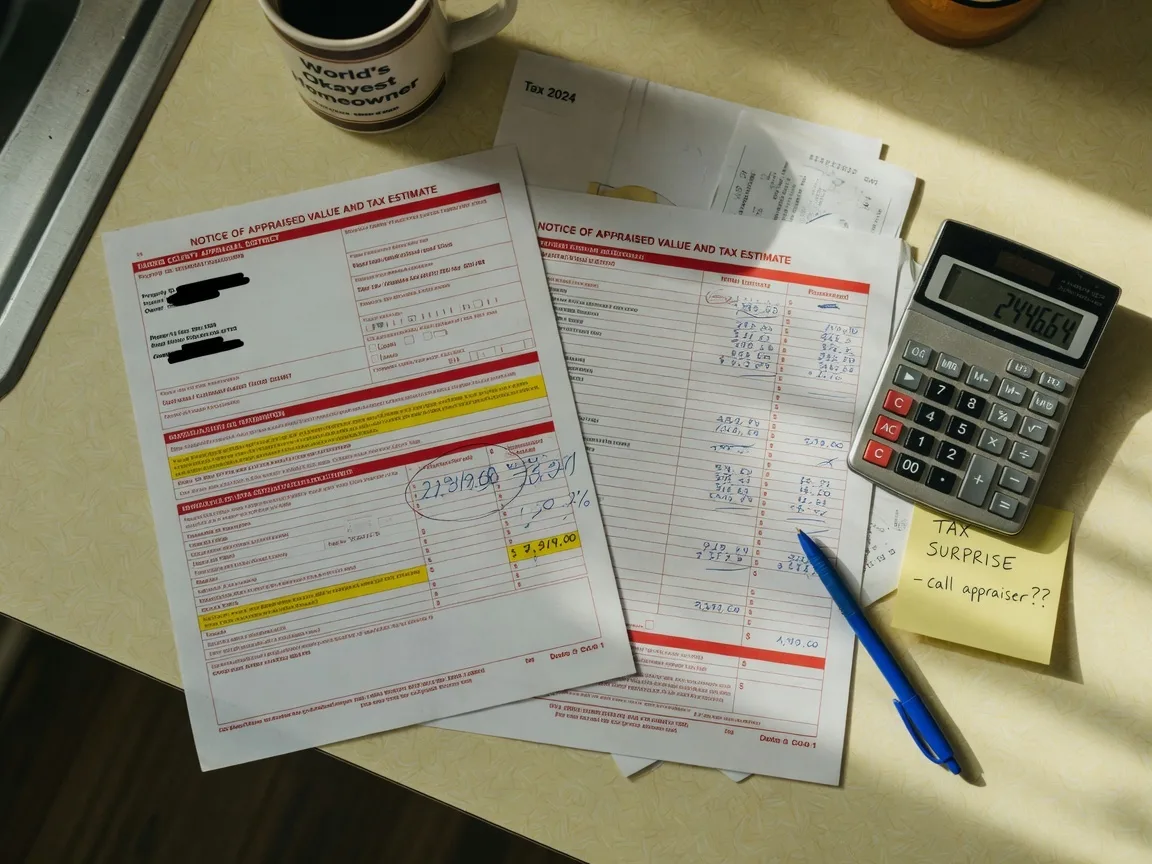
The rounded figures below are drawn from an anonymized transaction and illustrate the effect of using a land-only value instead of a fully improved value. They are not a prediction for every buyer. The tax calculations use an approximately 2.00% rate.
Initial estimate using land-only value
- Mortgage payment (principal and interest)$2,850/month
- Property taxes (based on $80,000 lot)$133/month
- Homeowner's insurance$185/month
- Total monthly payment$3,168
Later estimate using fully improved value
- Mortgage payment (principal and interest)$2,850/month
- Property taxes (based on $500,000 land + home)$833/month
- Homeowner's insurance$185/month
- Total monthly payment$3,868
The later estimated payment was approximately 22% higher than the initial land-only estimate.
The $700 monthly difference illustrates why a land-only estimate is not a reliable affordability number for a completed home. Texas generally uses a January 1 market-value appraisal system. California also reassesses property after a change in ownership or completion of new construction, but Proposition 13 then generally limits annual increases in the resulting base-year value to 2%, subject to its rules and exceptions.[12] The systems are different, but it is inaccurate to suggest that California buyers have no experience with reassessment after a purchase or new construction.
MUD and ESD Taxes, PID Assessments, and Related Local Charges
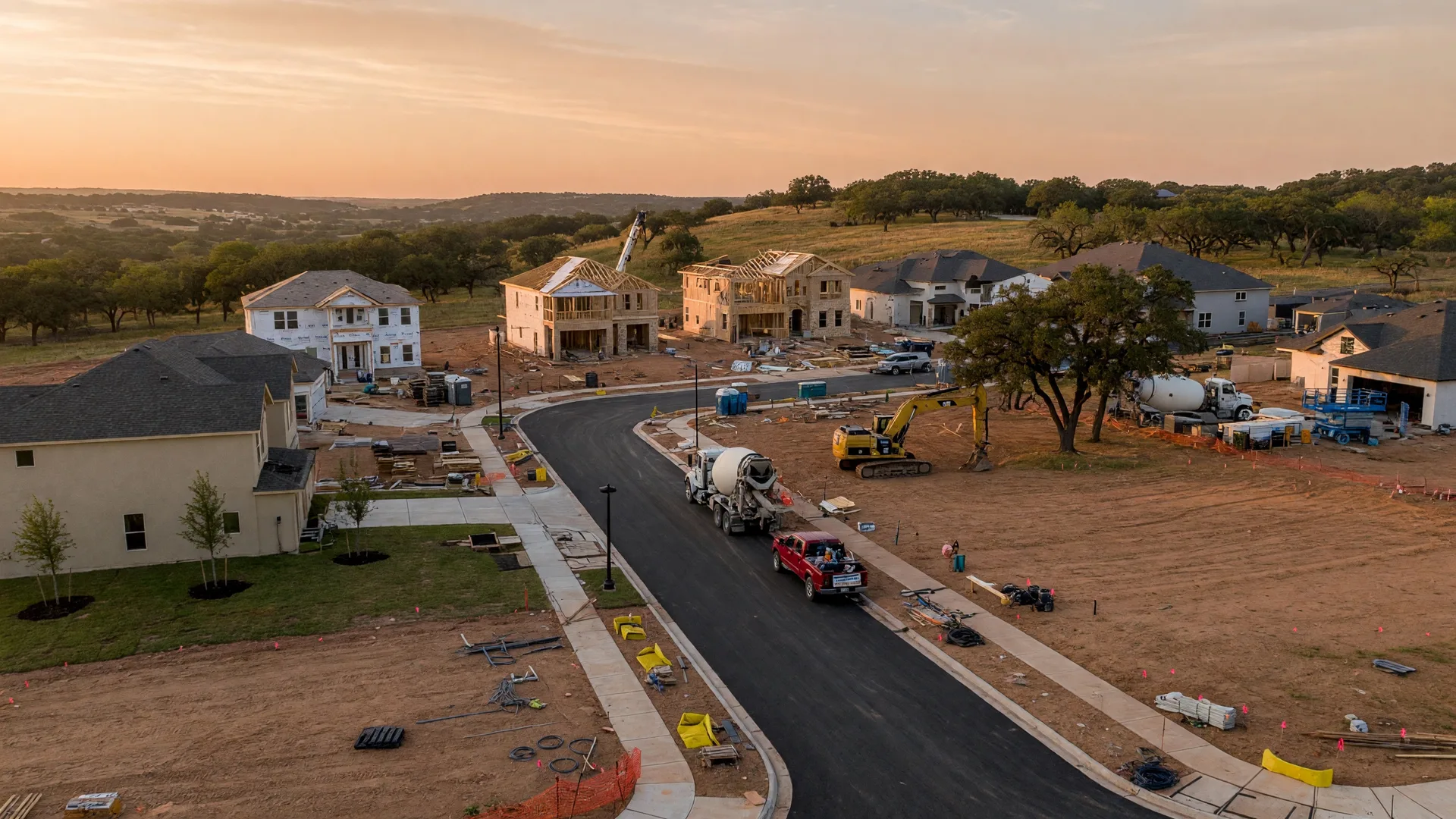
Many Texas developments use special-purpose districts that can increase total housing costs through ad valorem property taxes, special assessments, utility charges or a combination of these obligations:
- Municipal Utility District (MUD): A MUD is a governmental district that may provide water, sewer, drainage and other authorized facilities and services. A MUD may levy an ad valorem property-tax rate, impose utility charges and issue debt. Its tax rate, debt and utility charges vary by district. Verify the exact rate and charges applicable to the property.[14][15]
- Public Improvement District (PID): A municipality or county may levy a special assessment against benefited property in a PID, often payable in annual installments.
- Emergency Services District (ESD): An ESD may levy an ad valorem property tax to fund authorized fire-protection, emergency-medical and related services. Verify whether an ESD serves the property and whether its rate is included in the combined tax-rate estimate.[18]
Texas Property Code Section 5.014 requires prescribed notice for property in covered PIDs.[13] Texas Water Code Section 49.452 contains notice requirements for covered water districts, including many MUD transactions.[14] Failure to provide a required notice may create termination or other remedies, but those remedies have statutory conditions and timing requirements. Ask for the applicable notice before signing, and consult a Texas attorney promptly if a required notice was omitted.
These districts are common in new developments because they permit authorized infrastructure or services to be financed through taxes, assessments, debt or user charges assigned to property owners or users within the applicable area. Those obligations can materially increase the property's total housing cost.
Before buying, ask: Which special-purpose districts apply to this exact lot? What is the exact combined ad valorem tax rate? What is the current annual PID installment and its remaining term? What district debt, utility charges and other assessments apply?
Future Phases, Roads, Schools, and Commercial Development
When you buy in a new community, you are buying into a vision — not a finished product. Builder renderings, community maps and marketing descriptions may include conceptual or future improvements. A feature is not necessarily a binding builder obligation unless it is contained in the contract, recorded documents or another enforceable agreement. Review recorded plats, HOA documents, municipal or county development agreements and the responsible public agency's records. Distinguish what is completed, funded, approved or under construction from what is merely proposed.
Ask: What infrastructure is already built? What is funded and under construction? What is planned but not funded? What happens if the planned amenities are not delivered?
Also verify school-district boundaries directly with the district. A planned school, nearby school or marketing reference does not guarantee future attendance boundaries. Verify road projects with the city, county or TxDOT rather than relying solely on the sales office.
The Resale Consequences of Buying in an Unfinished Community
Buying in a new community before it is fully built carries resale risk:
- Your home may be surrounded by construction for years
- Future phases may add inventory that competes with your home
- The community's reputation may not be established until the build-out is complete
- Infrastructure delays can affect property values
A resale owner may also compete against the builder's unsold inventory, preferred-lender incentives, warranties and new phases. Before buying, ask how many lots remain, how many future phases are contemplated, whether multiple builders can offer competing products and whether the HOA restricts leasing or imposes other resale-related requirements. If you might sell before build-out, compare your likely resale position with the builder's projected inventory rather than assuming that additional construction will automatically increase your value.
The practical response is to stress-test the purchase against the possibility of selling before the community is built out. A longer holding period may reduce some risks, but no particular holding period guarantees appreciation or eliminates competition from the builder.
Before You Sign: Documents and Numbers to Collect
Ask for and review:
- The complete proposed contract and every addendum
- The lot description, survey or plat, easements and building setbacks
- The incorporated floor plan, elevations, specifications and finish schedule
- A written all-in price showing base price, lot premium, structural options, design selections and deposits
- The deposit and refundability schedule
- Financing, appraisal and sale-of-other-property provisions
- The estimated completion date, permitted extensions and any outside date
- Inspection-access provisions and required notice
- The complete builder warranty and claim instructions
- HOA declaration, rules, budget, assessments and transfer or resale charges
- Applicable MUD, PID and other special-district notices, together with current tax rates, assessments, debt information and utility charges
- A completed-value property-tax estimate for the exact address
- Homeowner's, wind/hail and flood-insurance quotes as applicable
- Utility providers and estimated connection or service charges
- Written documentation distinguishing funded improvements from conceptual future plans
- Any applicable certificate of occupancy or other governmental completion approval, utility-release requirements, final-walkthrough procedure and closing conditions
If a document, feature, credit or deadline matters to your decision, require it in the signed contract or an incorporated written amendment. A rendering, model-home conversation or marketing brochure is not an adequate substitute.
The Bottom Line
Buying new construction in Texas offers real advantages, including modern systems, energy efficiency and opportunities for customization. But builder-specific contracts, deposit rules, financing incentives, inspection access and warranties require careful review. Current tax records may omit some or all of a newly completed improvement, and an unfinished community may present future construction and resale competition. The purchase should be evaluated using the signed documents and completed-home costs — not the model-home presentation or initial monthly-payment estimate.
Here is what we covered:
- The builder's sales representative works for the builder, not for you
- Builder contracts differ from resale contracts in deposit rules, inspection rights, warranties, and dispute processes
- Earnest money and deposit forfeiture terms are set by the contract — read them before signing
- Construction dates may be estimates, not guarantees; identify every extension trigger
- Material substitutions and change orders require written documentation
- Builder incentives should be evaluated against the full transaction, not in isolation
- Rate locks have expiration dates; construction delays can trigger extension costs
- Pre-drywall and final inspections can identify visible issues at different construction stages; municipal inspectors and builder quality-control personnel do not inspect the home for the buyer's benefit
- An 11-month inspection is commonly scheduled before a one-year warranty anniversary, but the builder's actual written warranty determines every claim and coverage deadline
- Texas property is generally appraised according to its status and market value as of January 1, subject to special appraisal rules; a land-only or builder-inventory value is not a reliable affordability estimate for a completed owner-occupied home
- MUD taxes, PID assessments, district utility charges and other special-district obligations can significantly increase total housing costs
Before you buy, arrange buyer representation before the first builder visit and understand the written representation agreement and compensation terms. Arrange the inspections permitted by the contract, including pre-drywall, final and pre-warranty-deadline inspections when applicable. Budget using a completed-home market-value estimate, the exact combined tax rate, applicable exemptions and any separate PID assessment.
Frequently Asked Questions
Can I negotiate the builder's contract?
Possibly. Builder contracts are often presented as standard documents, but whether any provision or business term can be changed depends on the builder, project, inventory, construction stage and market conditions. Ask in writing about the purchase price, lot premium, upgrades, deposits, completion terms, financing and appraisal protections, inspection access, incentives, closing costs and dispute provisions. Even when the builder will not revise a term, understanding it before signing allows the buyer to decide whether the associated risk is acceptable.
Do I need a buyer's agent?
Texas does not require a buyer to retain a buyer's agent. If a Texas license holder will represent a residential buyer, however, Texas law generally requires a written representation agreement before a showing or, if no showing occurs, before an offer is presented. The agreement must state compensation and disclose that compensation is negotiable. A builder may offer compensation to the buyer's broker, but the offer is not guaranteed to cover everything the buyer agreed to pay. Arrange representation before the first model-home visit because builder registration policies may affect whether broker compensation is offered.
What happens if the builder misses the completion date?
It depends on the contract. Many builder contracts give the builder broad delay rights and may not require compensation for delays. Some contracts allow you to cancel and receive a refund of your deposit, but others limit cancellation rights after a certain date. Review the delay and cancellation provisions carefully before signing.
How much earnest money do I need?
There is no single Texas percentage for new-construction deposits. The builder may require earnest money plus separate lot, design, upgrade or change-order payments. Ask for a written schedule identifying every payment, when it becomes nonrefundable, whether it is credited at closing and what happens after financing denial, a low appraisal, delay, buyer default or builder termination.
What is a pre-drywall inspection?
A pre-drywall inspection is generally scheduled after framing and the major plumbing, electrical and mechanical rough-ins are installed but before insulation and drywall conceal accessible components. The buyer must coordinate the inspection with the builder's construction schedule and site-access rules. The price varies by location, home size, construction stage and scope; obtain a current quote instead of relying on a generic online price range.
Will my property taxes go up after the first year?
Possibly, and often substantially when the earlier January 1 appraisal included only land or partially completed construction. It is not automatic in every purchase. Texas appraisal districts generally value property according to its condition and market value as of January 1. If the completed improvement was already included, the first bill may already reflect the completed home. Check the CAD record and budget using a completed-value estimate, the exact combined tax rate, applicable exemptions and any separate PID assessment.
What are MUD taxes and PID assessments?
A MUD may levy an ad valorem property tax and impose utility charges to fund authorized facilities, services and debt. A municipality or county may levy a special assessment against benefited property in a PID, often payable in annual installments. The two are not interchangeable. Obtain the exact MUD rate, PID installment, remaining PID term, district debt and utility charges for the specific lot.
Can I use my own title company?
In a purchase involving a federally related mortgage loan, RESPA generally prohibits the seller from requiring the buyer, as a condition of sale, to purchase title insurance from a particular title company. That does not mean every title, escrow or settlement-service selection in every transaction is controlled by the buyer. A builder may also offer incentives associated with an affiliated or preferred provider, subject to applicable law. Ask a Texas real estate attorney or qualified title professional to review the specific requirement if the builder says a particular provider is mandatory.
Is there a three-day right to cancel a new-home contract?
Not generally. A buyer does not receive a universal cooling-off period simply because the contract was signed at a model home or sales office. Termination and refund rights must come from the signed contract or applicable law. Have the contract reviewed before signing rather than assuming it can be canceled later.
Sources
- [1] Texas Real Estate Commission, "What Changes in 2026 About Buyer/Tenant Representation in Texas." trec.texas.gov
- [2] Texas Occupations Code, Chapter 1101, including §1101.005. statutes.capitol.texas.gov
- [3] Texas Real Estate Commission, New Home Contract (Incomplete Construction), Form 23-20, effective July 1, 2026; and New Home Contract (Completed Construction), Form 24-20, effective July 1, 2026. trec.texas.gov trec.texas.gov
- [4] Consumer Financial Protection Bureau, Regulation X §1024.15, Affiliated Business Arrangements. consumerfinance.gov
- [5] Consumer Financial Protection Bureau, Regulation X §1024.16, Title Companies. consumerfinance.gov
- [6] Consumer Financial Protection Bureau, "Compare and Negotiate Your Loan Offers" and Temporary Buydown Guidance. consumerfinance.gov consumerfinance.gov
- [7] Consumer Financial Protection Bureau, "Review Your Loan Estimates." consumerfinance.gov
- [8] Texas Real Estate Commission, Real Estate Inspector Standards of Practice. trec.texas.gov
- [9] Texas Property Code, Chapter 27, Residential Construction Liability Act. statutes.capitol.texas.gov
- [10] Texas Comptroller of Public Accounts, "Valuing Property." comptroller.texas.gov
- [11] Texas Comptroller of Public Accounts, "Property Tax Exemptions." comptroller.texas.gov
- [12] California State Board of Equalization, "California Property Tax: An Overview." boe.ca.gov
- [13] Texas Property Code §5.014, Notice of Obligations Related to Public Improvement District. statutes.capitol.texas.gov
- [14] Texas Water Code §49.452, Notice to Purchasers. statutes.capitol.texas.gov
- [15] Texas Comptroller of Public Accounts, Special Purpose District Resources and Public Information Database. comptroller.texas.gov spdpid.comptroller.texas.gov
- [16] Texas Civil Practice and Remedies Code §16.009; 88th Texas Legislature, H.B. 2024, relating to statutes of limitation and repose for residential-construction claims. statutes.capitol.texas.gov capitol.texas.gov
- [17] Texas Tax Code §23.12, Inventory. statutes.capitol.texas.gov
- [18] Texas Health and Safety Code Chapter 775, including §775.074, Ad Valorem Tax. statutes.capitol.texas.gov
Related Articles
New Construction vs. Resale in the Texas Hill Country
Comparing the trade-offs between building new and buying existing in the Hill Country market.
The Tax Bill Beneath the Tax Bill: Special Districts, MUDs and PIDs
Special districts, MUDs and PIDs explained for relocating buyers.
Texas Homestead Exemption Guide
How to apply and how much you can save on property taxes.
First-Time Buyer Programs Available in Texas
Down payment assistance and financing programs for Texas homebuyers.
Considering new construction in the Texas Hill Country?
A direct conversation about your priorities, timeline, and budget can clarify which path fits your situation. No pressure, no sales pitch — just a straightforward analysis of your options.
Contact Bill
Written by
Bill Ross
Hill Country Homesteads Group, brokered by KW Boerne
Bill Ross is a Texas real estate agent with nearly four decades in high-tech sales and a network of 1,000+ California real estate agents for coordinated cross-state transactions. Featured in national coverage discussing his family's relocation from Silicon Valley to the Texas Hill Country.