

California retirees moving to Texas is a growing trend. Every year, a growing number of California retirees pack up and head east to Texas. The reasons are straightforward: no state income tax on retirement distributions, a significantly lower cost of living, warm weather, and communities that actively welcome newcomers [1]. For many, the math alone makes the decision compelling. But the decision to relocate in retirement is not purely financial. It is also about healthcare access, social connections, climate adaptation, and whether a new place can truly feel like home.
If you are retiring from California to Texas, this article covers the practical realities for fixed-income buyers evaluating the Texas Hill Country. The genuine advantages and the honest tradeoffs. My goal is to give you the information you need to decide whether this part of Texas is the right fit for your next chapter. I have worked with dozens of California retirees making this transition, and the ones who do it well are the ones who go in with open eyes.
The Financial Case: No State Income Tax on Retirement Income
Texas has no state personal income tax. For retirees on fixed or semi-fixed incomes, this is the single largest financial advantage of relocating. And it is not a small one. Here is what that means in concrete terms for different sources of retirement income [1]:
- Social Security: California does not tax Social Security benefits, so this is a wash between the two states. However, if you are still working part-time or drawing consulting income, Texas saves you the California tax on those earnings.
- 401(k) and IRA distributions: California taxes traditional 401(k) and IRA withdrawals as ordinary income, at rates ranging from 1% to 13.3%. Texas taxes none of it. On $80,000 in annual 401(k) distributions, a California retiree in the 9.3% bracket pays roughly $7,400 in state tax [1]. In Texas, that is $0.
- Pension income: California taxes most private and government pension income at ordinary rates. Texas does not. For a retiree receiving $50,000 annually from a pension, the California state tax would be roughly $3,500 to $4,500 depending on total income. Texas eliminates that entirely.
- Investment income: Capital gains, dividends, and interest income are all taxed by California at ordinary income rates (up to 13.3% for the highest earners). Texas imposes no state tax on any investment income [2].
For a California retiree with $120,000 in combined retirement income, moving to Texas can eliminate $8,000 to $12,000 or more in annual state income tax. Every year, for as long as you live there.
This is not a temporary incentive or a promotional rate. It is the structural reality of Texas's tax system [2]. The tradeoff, as discussed in our property tax comparison, is that Texas funds its government primarily through property taxes. They are higher than California's. But for retirees on fixed or semi-fixed incomes, the elimination of state income tax on retirement distributions typically outweighs the higher property tax burden, especially when the homestead exemption is applied.
The Property Tax Tradeoff: What Fixed-Income Buyers Pay
The property tax conversation is where I see California retirees get tripped up. California's Proposition 13 caps annual property tax increases at 2% and locks in a 1% base rate [3]. A California homeowner who bought 20 years ago might be paying 0.6% to 0.8% of their home's current market value in total property taxes.
In Texas, the effective property tax rate in Kendall County (Boerne), Bexar County (San Antonio), and Comal County ranges from approximately 1.8% to 2.5% of market value [3]. A $600,000 home in Boerne carries a property tax bill of roughly $10,800 to $15,000 per year before exemptions. That compares to maybe $4,000 to $6,000 on an equivalent California home under Prop 13.
The Texas Homestead Exemption mitigates this. If you are 65 or older, Texas offers an additional exemption beyond the standard $40,000 homestead exemption [3]. In Kendall County, for example, the over-65 exemption for school taxes was $10,000 in 2025, and some counties also offer a tax ceiling freeze for homeowners who qualify. Once you file for the over-65 homestead exemption, your school district property taxes cannot increase, even if your home value rises. This is a significant protection for retirees on fixed incomes.
The bottom line: your monthly housing costs will likely be lower in Texas than coastal California because the purchase price is so much less. But the composition of that cost shifts. More toward property taxes, less toward mortgage or income tax. Our income tax arbitrage article walks through this with real numbers across multiple income scenarios.
Healthcare Access: What Fixed-Income Retirees Need to Know
Healthcare is the concern I hear most often from California retirees considering the move. The short answer: San Antonio has a robust healthcare infrastructure, and Hill Country residents have access to it [4].
Major hospital systems within reasonable driving distance of Boerne and Fair Oaks Ranch:
- Methodist Healthcare : Multiple San Antonio campuses, including Methodist Hospital (the flagship) and Methodist Stone Oak. Strong cardiology, orthopedics, and general surgical programs.
- Baptist Health System : Five San Antonio-area hospitals, including Baptist Medical Center. Known for cardiac care and emergency services [4].
- University Health : The county safety-net hospital affiliated with UT Health San Antonio. A major teaching hospital with specialist access across most disciplines.
- CHRISTUS Santa Rosa Health System : Multiple campuses including a downtown San Antonio location and CHRISTUS Santa Rosa Hospital - New Braunfels, which is closer to Comal County residents.
For Boerne residents specifically, the drive to the South Texas Medical Center (San Antonio's concentrated hospital district) is approximately 30 to 35 minutes. Primary care physicians and many specialists are available in Boerne itself, reducing the need for city trips for routine care.
Medicare access: The San Antonio metro area has a large network of Medicare-accepting providers. Medicare Advantage plans from UnitedHealthcare, Humana, Aetna, and Blue Cross Blue Shield of Texas are widely accepted [5]. If you currently have a Medicare HMO or PPO in California, you will need to transition to a Texas plan. But the transition is straightforward during a qualifying life event like relocation.
The honest caveat: If you require highly specialized care (rare oncology protocols, advanced neurology, or specific academic medical center programs), San Antonio may not have the same depth as the Bay Area or Los Angeles. For those situations, the Texas Medical Center in Houston (approximately 3 hours from Boerne) or traveling back to California for specific consultations may be necessary. Most retirees do not face this issue, but it is worth understanding if you have a complex medical profile.
Lifestyle Fit: What Retirement Feels Like in the Hill Country
The Texas Hill Country offers a retirement lifestyle that is genuinely different from coastal California. Not better or worse, but distinct. Here is what tends to resonate with retirees who make the move, and what requires adjustment.
What people tend to appreciate:
- Pace of life: Boerne, Fair Oaks Ranch, and the surrounding communities operate at a slower tempo than the Bay Area, Los Angeles, or Sacramento. Fewer traffic jams, shorter commutes, more time spent on things you choose.
- Outdoor recreation: Hill Country hiking at Guadalupe River State Park, Government Canyon State Natural Area, and Cibolo Nature Center, plus golf courses, kayaking, and fishing. The landscape is different (limestone hills and live oaks instead of redwoods and coastline), but the outdoor access is real and varied.
- Texas wine country: The 290 corridor between Fredericksburg and Johnson City has developed into a legitimate wine region. The drive from Boerne to the winery district is about 45 minutes to an hour. See our full Hill Country wineries guide.
- San Antonio culture: The River Walk, the Pearl district, the San Antonio Museum of Art, and a thriving restaurant scene provide genuine urban amenities without the scale or cost of a major California metro.
- Community feel: Hill Country towns have a strong sense of local identity. Farmers' markets, community events, and active civic organizations make it easier to integrate than many California retirees expect.
What requires adjustment:
- Summer heat is not trivial: June through September, daytime highs in Boerne and San Antonio regularly reach the mid-90s to low 100s, with humidity pushing the heat index above 100 degrees F. Outdoor activities shift to early morning or evening. If you are coming from coastal California where summer highs are 70 to 80 degrees F, this is a meaningful change [6].
- Distance from California family: The flight from San Antonio to Los Angeles is about 3 hours, to San Francisco about 3.5 hours. That is manageable for visits, but it is not a quick drive. See our San Antonio airport guide for the practical details.
- Different social dynamics: Building a new social network in your 60s or 70s takes intentionality. The community structures in Hill Country towns help (churches, clubs, volunteer organizations, pickleball groups), but the process requires effort, especially in the first year.
Estate Planning: How Texas Compares to California for Retirees
For retirees with accumulated assets, estate planning is a significant consideration. And Texas offers several structural advantages [2].
No state estate tax. Texas has no state-level estate or inheritance tax. California also does not have one. At the federal level, estates exceeding $13.61 million (2025/2026 threshold) are subject to federal estate tax. The relevant point is that relocating to Texas does not add a state estate tax layer.
Community property benefits. Both Texas and California are community property states. This means that for married couples, a full step-up in basis applies to community property when one spouse passes away. This can significantly reduce capital gains taxes for heirs [7]. The step-up applies in both states, so there is no disadvantage in moving.
No state income tax on inherited retirement accounts. If your heirs inherit a traditional IRA or 401(k), they will need to take distributions. In California, those distributions are subject to state income tax. In Texas, they are not. This can be a meaningful benefit for estate planning, particularly if your beneficiaries are in California but the inherited accounts are in Texas.
The practical advice: before you move, consult with an estate planning attorney licensed in both California and Texas. Trusts, powers of attorney, and healthcare directives should be reviewed and updated to reflect Texas law. We covered this in depth in our article on what happens to your California estate plan after moving to Texas.
Choosing the Right Community for Your Retirement
Not all Hill Country communities serve retirees equally. Here is a practical framework for matching your needs to the right location.
55+ and Active Adult Communities
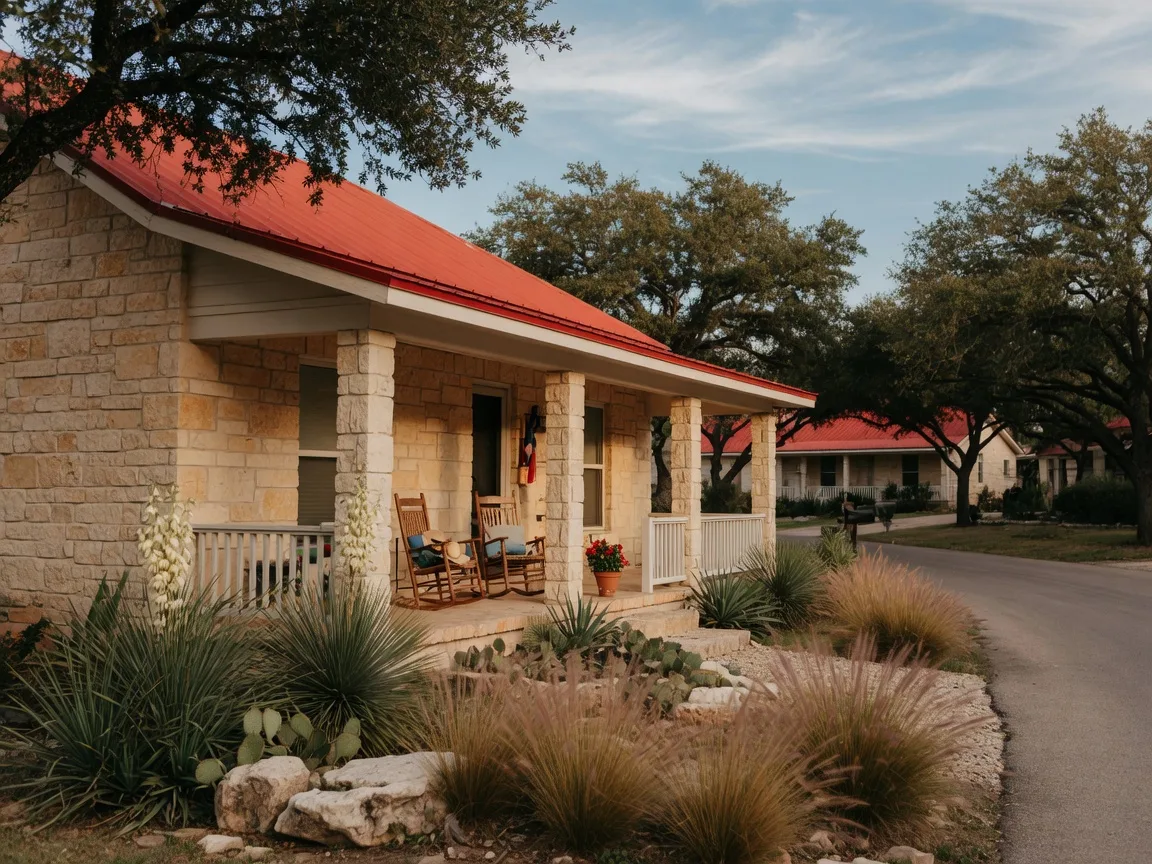
Regency at Esperanza in Boerne is the most established age-restricted active adult community in the area. It features an exclusive clubhouse, fitness center, pickleball courts, and a social calendar designed for active retirees. Homes range from the low $400s to the $700s. If the structure of a 55+ community (neighbors in a similar life stage, built-in amenities, managed maintenance) appeals to you, this is the primary option in the immediate Hill Country [8].
Morningside at Menger Springs in Boerne is a Life Plan Community (continuing care retirement community) offering independent living, assisted living, and skilled nursing on a single campus. If you want the security of knowing higher levels of care are available without relocating again, this is worth exploring [8].
HOA vs Non-HOA
Many Hill Country communities operate under mandatory HOAs. Master-planned communities like Elkhorn Ridge and Front Gate in Fair Oaks Ranch have mandatory HOAs that govern architectural standards, landscaping, and community maintenance. If you value consistent neighborhood aesthetics and shared amenities (pools, trails, maintained common areas), an HOA community provides structure. If you prefer maximum freedom over your property, look at non-HOA properties in unincorporated Kendall or Comal County.
Proximity to Healthcare
If healthcare access is a top priority, consider your distance from primary care providers and the highway access to San Antonio's medical district. Boerne's main corridors (Interstate 10 and Highway 46) provide direct access to San Antonio. Properties deep in the Hill Country (while beautiful) can add 20 to 30 minutes to a drive that is already 30 to 40 minutes from the medical center. For retirees with frequent specialist appointments, that added distance matters.
Common Regrets and How to Avoid Them
After working with California retirees relocating to the Hill Country, a few patterns emerge in what people wish they had done differently:
- Not visiting enough before buying. A weekend visit in October or March (when Hill Country weather is at its best) does not prepare you for August. The retirees who are happiest made multiple visits across different seasons before committing. At minimum, visit during the summer so you experience the heat firsthand [6].
- Underestimating the summer heat. The first summer is almost always an adjustment period. Retirees who thrive plan their outdoor activities for before 10 AM and after 7 PM from June through September. They invest in a good home HVAC system, shade structures, and screened outdoor spaces.
- Choosing too remote a location. A five-acre property with a long driveway is appealing. Until you need a specialist appointment three times a month or want to have dinner with friends across town. Proximity to basic services, healthcare, and social infrastructure matters more in retirement than many buyers anticipate.
- Not updating estate documents. Moving to a new state means your California-drafted wills, trusts, powers of attorney, and healthcare directives need review. Skipping this step can create exactly the kind of problems your estate plan was designed to prevent.
The Trial Run: Renting Before You Commit
One of the most practical strategies I recommend for California retirees is what I call the trial run. Before purchasing a home, rent in the area for three to six months. Ideally during summer. This gives you a realistic experience of the climate, the daily pace, the distance to healthcare and amenities, and whether the community feels like home.
Short-term rentals are available in the Boerne and Fair Oaks Ranch area, including furnished homes and condos. The cost is meaningful (typically $2,000 to $3,500 per month for a furnished one- or two-bedroom), but it is substantially less than the cost of buying a home in a location that does not fit.
We covered this strategy in detail in our article on renting first after moving to Texas. The core point holds: a few months of renting eliminates more risk than any amount of online research.
Frequently Asked Questions
Can I keep my California Medicare coverage after moving to Texas?
Original Medicare (Parts A and B) is portable nationwide, so your basic coverage follows you. However, if you have a Medicare Advantage plan (Part C), a Medicare Supplement (Medigap) plan, or a Part D prescription drug plan, those are typically region-specific and must be replaced with a Texas plan. You are eligible to enroll in a new plan during a special enrollment period triggered by your move [5].
How much do property taxes actually cost on a typical Hill Country home for retirees?
On a $500,000 home in Boerne, expect annual property taxes of roughly $9,000 to $12,500 before exemptions. After claiming the standard homestead exemption and the over-65 exemption, that figure drops to roughly $7,500 to $10,500. The over-65 exemption also caps your school district taxes, preventing them from rising even if your home value increases [3]. Compared to the $8,000 to $12,000 in California income tax you will no longer pay, the net effect is often a savings of several thousand dollars per year.
What is the one thing California retirees underestimate most about Texas?
The heat. Coastal Californians in particular do not have a reference point for sustained 95 to 105 degree days with high humidity lasting four months straight [6]. It is manageable with preparation, but retirees who skip a summer visit before buying often regret it. I always recommend renting for at least one full summer before committing to a purchase.
Do I need to update my California will and trust after moving to Texas?
Yes. While both states are community property states, Texas has different statutory requirements for wills, powers of attorney, and healthcare directives [7]. A California trust may still function, but your documents should be reviewed by a Texas-licensed estate planning attorney to ensure they comply with the Texas Trust Code and will be honored by Texas courts.
Are there age-restricted 55+ communities in the Texas Hill Country?
Yes. The most established 55+ active adult community in the immediate Hill Country is Regency at Esperanza in Boerne, which offers a clubhouse, fitness center, pickleball courts, and a full social calendar [8]. Morningside at Menger Springs is a Life Plan Community that covers independent living through skilled nursing on one campus. Both are excellent options for retirees who want built-in community and amenities.
Making an Informed Decision
The Texas Hill Country offers retirees genuine financial advantages, a warm and welcoming community structure, and a lifestyle that rewards intentional living. It also requires honest preparation. For the heat, for the distance, and for the adjustments that come with any major relocation.
If you are evaluating whether the move makes sense for your specific situation, I am happy to walk through the practical details. A conversation about your finances, your healthcare needs, and your community preferences can help you make a decision grounded in facts rather than assumptions.
For a complete cost comparison, see our California vs Texas cost of living breakdown. For a look at specific communities, review the city comparison guide.

Written by
Bill Ross
Hill Country Homesteads Group, brokered by KW Boerne
Bill Ross is a Texas real estate agent with nearly four decades in high-tech sales and a network of 1,100+ California real estate agents for coordinated cross-state transactions. He has been featured in national coverage discussing his family's relocation from Silicon Valley to the Texas Hill Country and specializes in guiding California retirees through every step of the transition.
Sources
- California state income tax rates on retirement income -- California Franchise Tax Board. ftb.ca.gov
- Texas property tax rates and state income tax structure -- Texas Comptroller of Public Accounts. comptroller.texas.gov
- Texas homestead exemption and over-65 property tax protections -- Texas Property Code Section 11.13; Kendall Central Appraisal District. kendallcad.org
- San Antonio hospital systems and healthcare infrastructure -- Texas Real Estate Source. texasrealestatesource.com
- Medicare options in Boerne and San Antonio -- Our Health Network; Medicare.gov. ourhealthnetwork.com
- Texas Hill Country climate data and seasonal temperature averages -- National Weather Service; NOAA. weather.gov/ewx
- Community property and step-up in basis rules for Texas and California -- ACTEC Foundation; Fidelity. actecfoundation.org
- 55+ and continuing care communities in Boerne -- 55places.com; Morningside Ministries. 55places.com
Last reviewed: August 2026. Tax rates, healthcare provider networks, and community details reflect published data as of August 2026. Verify specific provider acceptance and community availability with current sources before making decisions.